Data Transfer Nodes for Genomics: How to Optimize Network Performance
By Dr. Zubair Khalid, DVM, MS, PhD ·

A data transfer node (DTN) is a dedicated, network-tuned server whose only job is moving data between sites, while a general-purpose compute node splits its attention among schedulers, user jobs, and shared storage. The rule of thumb for choosing: if your lab or core facility regularly moves several hundred gigabytes per week, or your transfers crawl along at a small fraction of the bandwidth you pay for, build a dedicated transfer path around a DTN. If you move a few sequencer runs a month between trusted hosts, a well-configured rsync endpoint on an existing server is usually enough. Between those two points sit managed transfer services, UDP-based accelerated clients, science DMZ architectures, and object storage endpoints, each with different strengths. This article walks through every major option for data transfer node genomics optimization, compares them on the criteria that actually decide deployments, gives worked scenarios and commands, and catalogs the mistakes that waste the most time.
What Data Transfer Nodes for Genomics Actually Do
A DTN is a server positioned between your genomics data storage and the wide area network (WAN). It holds no authoritative copy of your data. It exists to terminate transfer protocols, buffer data at full line speed, apply checksums, authenticate remote users, and present a clean, monitored entry and exit point for large files. A typical pipeline looks like this in plain terms. A sequencer writes base calls to primary storage. Analysis nodes read from that storage. When raw reads, alignment files, or variant calls must leave the site, a scheduled job stages them on the DTN, which pushes them across the WAN to a peer node or a repository endpoint at the receiving institution.
Three features separate a DTN from an ordinary server:
- Protocol termination. The DTN runs the transfer software (rsync daemon, GridFTP server, Globus endpoint agent, or an S3-compatible gateway) so that heavy encryption, checksumming, and connection handling never compete with your alignment and calling jobs.
- TCP and disk tuning. Kernel buffers, congestion control, NIC offloads, and fast local staging disks are configured for one purpose, moving bytes.
- Isolation and monitoring. The DTN sits on a network path that is deliberately free of the firewalls, deep packet inspectors, and shared switches that choke bulk traffic, and it reports throughput continuously.
Genomics makes these features matter more than most fields do. Whole genome sequencing brought accuracy that earlier molecular methods could not match, and with it sharply higher technical requirements and, when analysis infrastructure lags behind sequencing, delays in producing results [1]. A single high-throughput sequencing run can produce several terabytes of raw base calls, and a project can accumulate hundreds of thousands of FASTQ, BAM, and CRAM files. Comparative genomics groups routinely sequence additional taxa and share both raw reads and assembled genomes to resolve relationships across clades, which means steady outbound and inbound traffic between collaborating sites [2]. Retrospective studies depend on pulling public datasets from repositories for training and validation, so inbound traffic competes with outbound for the same pipe [3]. When analyses themselves are distributed, such as multiple network alignment across species, the underlying methods emphasize scalability and effective parallelization, and the data movement layer must keep pace [4].
In short, data transfer nodes for genomics exist because the analysis is distributed, the data volumes are large, and the file counts are punishing, and because default server configurations handle none of that well.
Why Genomics Transfers Underperform by Default
Before comparing options, understand the specific failure modes. Almost every disappointing transfer traces back to one of these five causes.
The bandwidth-delay product caps a single stream
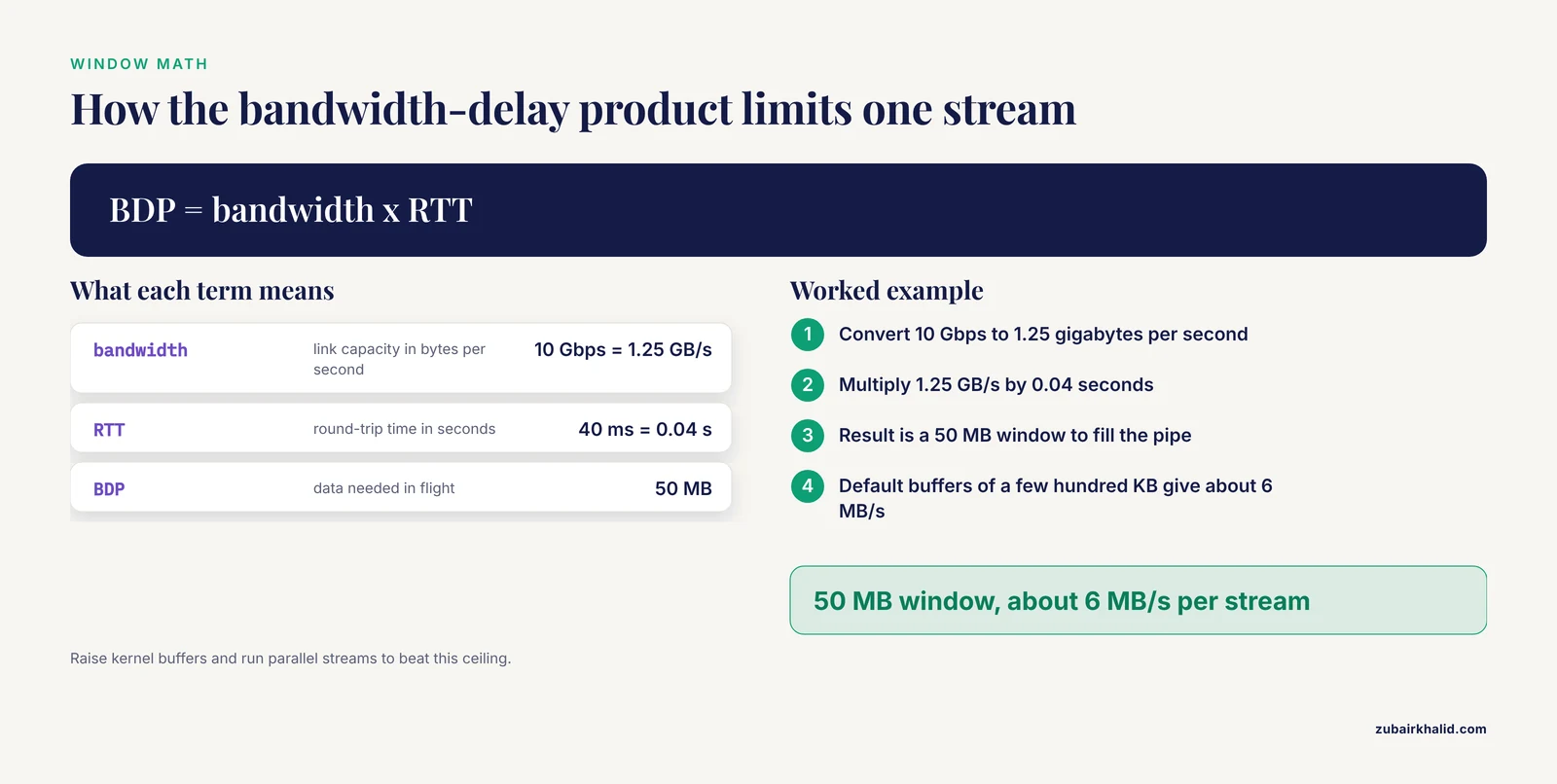
Transmission Control Protocol (TCP) can only have as much data in flight as its window allows. The ceiling for a single TCP stream is the bandwidth-delay product (BDP), which is bandwidth multiplied by round-trip time (RTT). The arithmetic is worth memorizing because it drives every design decision.
Consider a 10 Gbps path with a 40 ms RTT, a typical inter-institution distance within the United States. Ten gigabits per second is 1.25 gigabytes per second. Multiplying by 0.04 seconds gives a BDP of 50 megabytes. A single TCP stream needs a window of roughly 50 MB just to fill that pipe. Linux default socket buffers are a few hundred kilobytes, which means a single un-tuned stream on a 40 ms path tops out around 6 MB/s, roughly 5 percent of the link capacity. Cross-country paths with RTTs of 70 to 90 ms make the problem worse. This is the single most common reason a genomics transfer that should take an hour takes a day.
Two fixes exist, and mature deployments use both. Raise the kernel buffer limits so a single stream can use a large window, and run many streams in parallel so aggregate throughput does not depend on any one stream.
Small files destroy throughput
Protocols negotiate a connection or at least a request cycle per file. A directory of one million 1 KB index, annotation, or per-fragment files can spend most of its time on protocol overhead rather than payload. Genomics produces this shape of data constantly, per-lane reports, per-tile metrics, per-sample indexes, and per-chunk CRAM files. The standard mitigations are packing small files into archives or tar streams before transfer, transferring whole directory trees with tools that pipeline requests, and staging large consolidated batches on the DTN.
Storage, not the network, is often the real bottleneck
A single 7,200 rpm spinning disk sustains roughly 100 to 200 MB/s sequentially. A 10 GbE link moves about 1,250 MB/s at line rate. If the DTN reads directly from an aging NFS export or a busy shared filesystem, the disks, not the network, set the ceiling. The fix is local fast staging, usually NVMe scratch on the DTN itself, filled from bulk storage, drained to the WAN, then cleared.
Encryption and per-connection costs
SSH-based transfers spend real CPU on encryption and can be limited by a single ssh session's internal channel handling. On high-latency paths this compounds the window problem. Parallel-aware SSH variants and non-TCP transfer protocols both address this from different directions, which is why the option list below separates them.
Middleboxes and shared paths
Stateful firewalls, traffic shapers, and inspection appliances frequently cap long-lived bulk connections or drop them outright. A transfer architecture that routes bulk data around these devices, or negotiates explicit exceptions for the DTN's ports, outperforms one that fights them.
Data Transfer Node Genomics Optimization Options
The comparison below is the core decision framework. Each option is explained on its own terms afterward.
| Option | Best suited for | Core components | Pros | Cons |
|---|---|---|---|---|
| Tuned rsync over SSH on an existing server | Small labs, tens to low hundreds of GB per month | rsync daemon or SSH, tuned sysctl values, cron scheduling | Near-zero new hardware, universal availability, checksum verification built in | Single-stream ceiling on high-latency paths, weak audit tooling, competes with other server workloads |
| Dedicated DTN with parallel transfer tools | Core facilities, hundreds of GB to TBs per week | Dedicated server, NVMe staging, GridFTP, bbcp, or lftp, parallel streams, tuned kernel | Fills long-fat pipes, isolates transfer load from compute, supports automation | Requires hardware, dedicated administration, and port coordination with the network team |
| Managed transfer service endpoint | Multi-institution collaborations without shared infrastructure | Globus-style endpoint agent, institutional identity for authentication | No client installation for collaborators, reusable credentials, notifications, logging | Recurring service dependency, less control over tuning, features gated by subscription tiers |
| UDP-based accelerated transfer | Very long or lossy paths, satellite, intercontinental links | Commercial or open-source UDP transfer clients at both ends | Thrives where TCP collapses, high single-stream throughput | Both ends need matching software, licensing considerations, some UDP traffic is blocked by strict networks |
| Science DMZ architecture | Institutions moving TBs routinely, funded centers | Dedicated 10/40/100 GbE transfer VLAN, perfSONAR monitors, DTNs,豁 firewall exceptions for the transfer path | Removes middlebox penalties, measurable and reproducible performance, reusable for any science domain | Requires network engineering staff and campus buy-in, a project rather than a purchase |
| S3-compatible object storage endpoints | Cloud-native pipelines, many independent clients, archive pulls | MinIO or cloud object storage, multipart upload, HTTPS | Handles massive concurrency, works from anywhere, integrates with workflow engines | Per-request overhead hurts small-file workloads, egress costs on cloud providers, requires IAM discipline |
Option 1: Tuned rsync over SSH on an existing server
This is the default choice and often the right one. rsync synchronizes directory trees over SSH, resuming interrupted transfers and comparing checksums. On short paths (a campus LAN, or a low-RTT regional link), a single rsync stream with kernel buffers raised modestly can saturate a 10 GbE link.
The main optimization steps:
- Raise
net.core.rmem_maxandnet.core.wmem_maxso single streams can use large windows. - Schedule transfers with cron or a workflow engine rather than interactive runs.
- Use the
-cflag when you need rsync to verify file contents by checksum, accepting that full checksum comparison is slower. - Keep rsync off your head node. Moving it to an underused service node already delivers most of the benefit of a dedicated DTN at no hardware cost.
The limits show up on long, fat paths. One stream cannot exceed the window math above, and rsync's delta-transfer algorithm (computing differences between existing file versions) burns CPU on files that will never be sent again. For one-off transfers of whole files, the -whole-file behavior of -W avoids pointless delta computation, though that flag is only sensible when the destination copy does not exist or you intend to overwrite it entirely.
Option 2: A dedicated DTN with parallel transfer tools
This is the classic research-computing answer and the heart of serious data transfer node genomics optimization. The server is sized around its NIC, its staging disk, and its memory, not its CPU cores. NVMe scratch absorbs bursts from the sequencer and feeds the WAN at line rate. The transfer layer uses tools built for parallelism:
- GridFTP, from the Globus Toolkit lineage, negotiates parallel TCP streams and extended block sizes (EBS) in a single logical transfer, and supports checksum modes end to end.
- bbcp opens many parallel streams between two hosts and stripes across NICs, which makes it effective for point-to-point pushes between institutions that both control their endpoints.
- lftp can mirror directory trees with configurable parallelism and rate limits, which suits nightly scheduled syncs.
- HPN-SSH patches SSH to remove the internal window bottleneck so that even ssh-based workflows can fill long paths.
A representative kernel tuning baseline for such a node, consistent with guidance published by research and education network programs, looks like this:
net.core.rmem_max = 134217728
net.core.wmem_max = 134217728
net.ipv4.tcp_rmem = 4096 87380 134217728
net.ipv4.tcp_wmem = 4096 65536 134217728
net.ipv4.tcp_congestion_control = bbr
net.core.default_qdisc = fq
These are starting points, not gospel. The BBR congestion control algorithm estimates available bandwidth and RTT directly rather than inferring loss, which helps on long paths, though some network operators prefer CUBIC on well-provisioned research networks. Whatever you choose, validate with measurements, not folklore. The pros are clear: this configuration reliably fills inter-institution pipes, isolates transfer work from analysis work, and scales to terabyte-per-week operations. The cons are equally clear: hardware to buy, a node to patch and monitor, and coordination with your network group over open ports.
Option 3: Managed transfer endpoints
A managed service (the Globus model is the most widely used in genomics and bioinformatics data management) runs endpoint software on your storage or DTN, exposes it through a web interface, and handles authentication through institutional identity. Collaborators need only an account at any participating institution, no client software, no shared SSH keys.
Pros:
- Dramatically lower friction for multi-institution collaborations, which is most of them in genomics.
- Built-in transfer logs, notifications, checksum validation after transfer, and restartable transfers.
- The service handles parallelism and tuning on the wire, so your endpoint needs less hand-tuning.
Cons:
- You depend on an external service for a critical path.
- Advanced capabilities have historically been tied to subscription tiers.
- You still need storage behind the endpoint that can actually read and write at speed. A managed endpoint on slow storage is a polite front for a bottleneck.
This option wins when the human coordination cost of a collaboration exceeds the engineering cost of the transfer itself, which is the normal case for multi-site genomics projects.
Option 4: UDP-based accelerated transfer
TCP backs off aggressively when it detects packet loss, interpreting loss as congestion. On long, lossy, or heavily shared paths this punishes bulk throughput. UDP-based transfer protocols (the commercial Aspera FASP family and several open-source equivalents) implement their own reliability layer on top of UDP with explicit rate control, so they can hold a target send rate regardless of loss.
Pros: very high throughput on paths where TCP underperforms, strong performance for intercontinental genomics collaborations, and resumable transfers at scale. Cons: software must run at both ends, some campus networks filter unknown UDP traffic, and commercial products involve licensing. Deploy this when measurements show that tuned TCP genuinely cannot fill the pipe, not as a first move.
Option 5: The science DMZ
A science DMZ is a network architecture pattern, developed and documented by the research and education networking community, that carves out a demilitarized zone for bulk science traffic. Its components are a dedicated transfer network segment with high-speed links, DTNs within that segment, performance measurement nodes running perfSONAR that continuously test paths to collaborator sites, and a security policy that replaces inline inspection of the transfer path with disciplined border controls around it.
The pros: it removes the middlebox problem at the architecture level, produces continuous evidence of path health (invaluable when a collaborator claims your site is slow), and serves every scientific domain on campus, not just genomics. The cons: it is a project requiring network engineering staff, campus security agreement, and budget. If your institution has one, use it. If it does not and you move terabytes routinely, making the case for one is the highest-leverage infrastructure conversation you can have.
Option 6: S3-compatible object storage endpoints
Object storage changes the transfer model. Instead of a filesystem directory tree moved file by file, clients issue authenticated HTTP requests, upload objects in parallel multipart pieces, and list or retrieve by key. Genomics archives, repository submissions, and cloud pipelines increasingly speak this protocol.
Pros: enormous concurrency (hundreds of parallel part uploads), reachability from any network that allows HTTPS, natural fit for workflow engines that stage inputs and publish outputs, and versioned retention that supports genomics data storage policy. Cons: per-request cost and latency hurt workloads made of many tiny objects, egress pricing on public clouds can dominate a budget (no source in this article supports specific figures, so treat pricing as a procurement question), and identity and access management mistakes are a real security exposure for human genomic data.
A sound pattern is to keep the authoritative copy on your filesystem, publish derived or shareable artifacts to object storage, and let the object tier handle distribution, rather than migrating everything wholesale.
Choosing: The Criteria That Decide Real Deployments
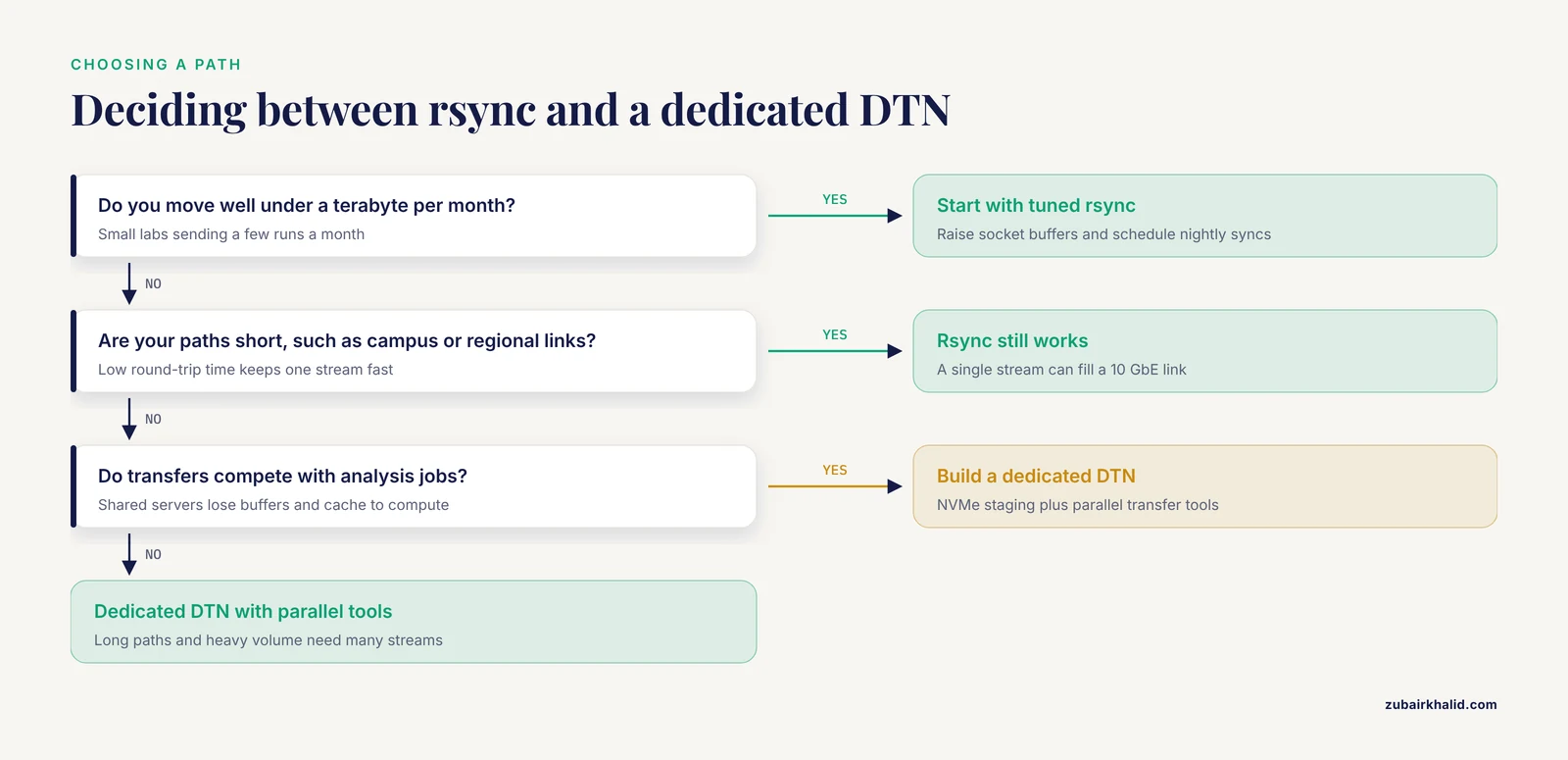
Asking which option is the best data transfer node genomics optimization is like asking which pipette is best. The answer depends on the job. Six criteria separate the options in practice.
Volume and cadence. Under roughly a hundred gigabytes a month favors Option 1. Steady terabytes per week favor Options 2 through 5. Spiky, burst-driven traffic (a new run every Monday) changes staging design more than protocol choice.
File size distribution. Mostly large CRAM and BAM files reward any parallel tool. Many small files reward bundling and object storage multipart design. Sequencing-adjacent outputs (per-tile metrics, index files, thumbnails from image-based assays) are the usual small-file culprits.
Path distance and quality. Same-campus transfers need almost no tuning. Cross-country and intercontinental transfers make the BDP math and loss behavior decisive, pushing toward parallel streams, BBR or equivalent congestion control, and, on lossy paths, UDP-based tools.
Security posture. Human genomic data is controlled-access data. Whatever option you choose must authenticate users against institutional identity or managed keys, encrypt in transit, log transfers, and avoid anonymous FTP entirely. Managed endpoints and science DMZ deployments both make the audit trail stronger than ad hoc scp.
Staff time. Option 1 costs an afternoon. Option 2 costs a week of an administrator's time plus recurring care. Option 5 is a campus project. Be honest about who maintains the thing after the person who built it leaves.
End-to-end integrity. Genomics files feed downstream analyses that can silently misbehave on corrupted input. Every option above supports checksums, but your bioinformatics data management policy must require them. Generate a manifest at the source, verify it at the destination, and record the result:
sha256sum sample_01.cram sample_02.cram > manifest.sha256
sha256sum -c manifest.sha256
Run the same verification on the receiving side. For pipelines that need file-level integrity continuously, CRAM and BAM formats carry built-in checksums of the reference and sequence blocks, which catches corruption introduced after transfer as well.
Worked Scenarios
Scenario 1: A single-investigator laboratory
A lab runs a benchtop sequencer producing 50 to 150 GB per run and shares data with one collaborator university two time zones away. Monthly volume stays under a terabyte. The right answer is Option 1: a service node with raised socket buffers, nightly rsync of the runs/ directory over SSH with key-based authentication, and a sha256 manifest checked on arrival. Total setup cost is one afternoon, and the collaborator's only obligation is an account. Upgrading further would be spending money on a problem this lab does not have.
Scenario 2: A sequencing core feeding a national compute provider
A core facility operates multiple instruments and ships every run to a distant analysis provider, roughly 2 to 5 TB per week. Single-stream rsync measured 300 Mbps on a 10 Gbps circuit, the classic BDP symptom. The right answer combines Options 2 and 3: a dedicated DTN with NVMe staging, a managed endpoint in front of it so the provider's staff can pull with their own credentials, and parallel GridFTP or bbcp transfers underneath. Staging flows from bulk storage to NVMe, then drains across the WAN, so the spinning disks behind the filesystem never become the bottleneck. The provider's ingestion pipeline validates sha256 manifests on receipt.
Scenario 3: A hub-and-spoke clinical genomics network
A central reference laboratory generates whole genome sequences and derives strain-specific assays, then local laboratories need rapid access to targeted results without moving every raw read to every site. A published pilot in tuberculosis surveillance demonstrates exactly this pattern in genomics practice: a central reference center tailored PCR assays from whole genome sequencing data and transferred them to the local laboratory where transmission was being tracked, enabling a fast, low-cost, decentralized multinodal network of laboratories [1]. The data movement lesson generalizes directly. Spoke sites do not need terabyte-class DTNs. They need small, reliable, authenticated endpoints that pull a few targeted derived files quickly, while the hub maintains a full-capability DTN. Hub-and-spoke designs trade symmetry for operational simplicity, and for federated surveillance and public health genomics that trade is usually correct.
Scenario 4: A genome center inside a research university
A center with several high-throughput instruments, multiple simultaneous collaborations, and terabyte-scale daily movement should be on its institution's science DMZ, with DTNs on the dedicated transfer VLAN and perfSONAR nodes measuring paths to the top five collaborator sites continuously. Derived datasets and submissions publish through object storage, raw read archives move through parallel GridFTP, and ad hoc collaborator requests go through a managed endpoint so no one emails one-off passwords.
Tuning Checklist with Commands
Work through this list in order on any DTN deployment. Each step is measurable, so each step's effect is verifiable.
- Baseline the path. Start an iperf3 server on the remote peer (
iperf3 -s) and test from the DTN (iperf3 -c dtn.partner.edu -P 8). Compare single-stream and eight-stream results. If eight streams dramatically outperform one, you have confirmed the window problem and parallelism is your friend.
- Raise kernel buffers. Apply the sysctl baseline shown in the dedicated DTN section, then retest. The single-stream number should rise substantially on paths with RTT above 20 ms.
- Check the NIC. Confirm the negotiated link speed (
ethtoolon the interface, for exampleethtool eth0), enable the interface's hardware checksum and scatter-gather offloads if not already active, and verify the switch port matches. A NIC negotiating at 1 Gbps when you believe you own 10 Gbps is a real and frequent finding.
- Mind the MTU. Jumbo frames (MTU 9000) reduce per-packet overhead on paths where every device in the route supports them. A mismatch anywhere in the path causes fragmentation or blackholing, so change MTU only in coordination with the network team and verify with ping's don't-fragment and size options.
- Add parallelism at the application layer. Configure GridFTP parallelism, bbcp stream counts, or lftp's parallel option to match the path. Eight to sixteen parallel streams is a common starting range for 10 Gbps long-haul paths, then tune by measurement.
- Stage on local NVMe. Copy the batch from bulk storage to DTN-local scratch, transfer from scratch, verify, then delete. Never read directly from an NFS mount over the WAN during a bulk push.
- Bundle small files. Tar per-run auxiliary directories into single archives before transfer, or restructure workflows so small-file outputs are consolidated per sample.
- Schedule and shape. Move bulk transfers off business-hours peaks with cron, and set rate limits where a transfer must coexist with interactive use.
- Monitor continuously. perfSONAR or simple scheduled iperf3 tests between fixed endpoints turn "the network feels slow this month" into a time series with evidence.
- Verify integrity everywhere. Manifests at both ends, plus format-native checksums where the file format provides them.
Common Mistakes and Limitations
- Blaming the network for a storage bottleneck. Measure both ends. If the DTN cannot read the data faster than 200 MB/s, no network tuning will help. Diagnose with disk benchmarks on the DTN before touching the network.
- Leaving default socket buffers. The single most common cause of chronic underperformance on long paths, and a five-minute fix.
- Sharing the DTN with compute. A transfer node that also runs BLAST jobs loses its buffers, its cache, and its schedule to the jobs. Dedication is the point.
- Routing bulk traffic through a stateful firewall. Mid-path inspection devices cap or drop long-lived connections. Negotiate a transfer-path exception as part of the architecture, not as an afterthought.
- Ignoring small files until they dominate. Millions of tiny files turn any protocol into a negotiation engine. Bundle by design, not by emergency.
- Skipping checksums because transfers "usually work." Silent corruption is rare but consequential in genomics, and manifest verification costs minutes. Make it policy.
- Assuming the purchased bandwidth is the delivered bandwidth. Measure from end to end, from host to host, including the storage tiers. The slowest component defines the transfer rate.
- Treating the DTN as storage. DTN scratch is scratch. Authoritative copies live in the genomics data storage system with backups, versioning, and retention policy. Filling the DTN's disks stalls every future transfer.
- One-size-fits-all procurement. The differences among these options are operational, not cosmetic. Matching the option to volume, distance, staffing, and security posture matters more than any individual product choice.
A final limitation deserves plain language. Individual deployments need site-specific evaluation by qualified network and systems engineers. Path characteristics, institutional security policy, and existing storage architecture vary enough that no article, including this one, substitutes for measuring your own path and validating your own configuration. The checklist above exists precisely so that the validation is systematic rather than anecdotal.
Frequently Asked Questions
What is a data transfer node in genomics?
A data transfer node is a dedicated, network-tuned server that moves genomics data between sites, handling protocol termination, buffering, checksums, and authentication so that compute nodes and primary storage are never on the critical transfer path. It stages data temporarily and does not hold authoritative copies.
How much throughput does a genomics lab actually need?
Size the link to your worst week, not your average day. If a sequencer produces 2 TB per run and results are due within 24 hours, you need sustained throughput above roughly 250 MB/s, which is a 2.5 Gbps circuit at minimum and comfortably a 10 Gbps circuit with headroom. Measure your actual cadence and work backward from the deadline.
Do I need a dedicated DTN or can I use rsync from a compute node?
Use tuned rsync on an existing server if you move well under a terabyte per month and paths are short. Build a dedicated DTN when transfers compete with analysis jobs, when paths are long enough that single streams cannot fill the link, or when collaborators need reliable, audited access. The dividing line is usually volume plus distance, not volume alone.
Which transfer protocol is best for genomics data?
There is no single best protocol. Tuned parallel TCP tools such as GridFTP and bbcp fill well-provisioned research networks, rsync over SSH remains excellent for routine scheduled syncs, UDP-based accelerated clients win on long lossy paths, and S3-compatible multipart upload suits cloud-native pipelines. Choose by measuring your specific path.
How do I verify that transferred genomics files arrived intact?
Generate a checksum manifest at the source with sha256sum, transfer the manifest with the data, and run sha256sum -c on the destination. BAM and CRAM formats additionally carry internal checksums that detect corruption introduced after transfer. Record verification results alongside the data in your bioinformatics data management records.
What is a science DMZ and why does it matter for genomics?
A science DMZ is a network architecture that places bulk-data transfer servers on a dedicated high-speed network segment with continuous performance monitoring and a security policy designed for large transfers rather than inline inspection of them. It matters for genomics because terabyte-scale, deadline-driven data movement is exactly the traffic pattern that generic campus security middleboxes degrade.
Sources
- Fast and low-cost decentralized surveillance of transmission of tuberculosis based on strain-specific PCRs tailored from whole genome sequencing data: a pilot study.
- Reconstructing intraordinal relationships in Lepidoptera using mitochondrial genome data with the description of two newly sequenced lycaenids, Spindasis takanonis and Protantigius superans (Lepidoptera: Lycaenidae).
- Prediction of early breast cancer metastasis from DNA microarray data using high-dimensional cox regression models.
- Multiple Network Alignment via MultiMAGNA+.