Data Residency and Sovereignty for Genomic Data in the Cloud
By Dr. Zubair Khalid, DVM, MS, PhD ·

Data residency is the physical location where a dataset is stored and processed, expressed in practice as the cloud region that holds the storage accounts, compute instances, and databases serving that dataset. Data sovereignty is the legal principle that data resident in a jurisdiction falls under that jurisdiction's laws, regardless of the nationality of the data holder, the data subject, or the cloud provider.
Human genomic data has migrated at scale into commercial cloud environments, driven by the volume of next-generation sequencing output and by the collaboration and security benefits that shared computing platforms offer [1][2][3]. That migration concentrates some of the most sensitive data people generate inside infrastructure whose physical location determines which privacy statute applies, which court can compel disclosure, and which safeguards an institution must fund. A wrong residency decision can invalidate a consent agreement, breach HIPAA or GDPR obligations, or stall an international collaboration, while a deliberate one is now a core competency of cloud bioinformatics rather than an administrative afterthought.
What Does Data Residency for Genomic Data in the Cloud Mean?
In plain terms, data residency for genomic data in the cloud answers two questions at once: where the bits physically exist right now, and which legal system reaches them because of that location. When you create an object storage bucket, launch a virtual machine, or provision a database, you choose a geographic region, and every byte you place there lives on hardware inside that region until you deliberately copy it elsewhere. Residency is therefore a property you configure. Sovereignty is a consequence you inherit, because the act of placing data on disk inside a country generally subjects that data to that country's legal regime.
Students and new practitioners frequently blur five related terms, and the confusion causes real project delays. Separating them cleanly is the first step toward a defensible design.
| Term | What it pins down | Who sets or enforces it | Genomic example |
|---|---|---|---|
| Data residency | The physical location of stored data and the compute that touches it | The cloud customer, through region and service choices | A CRAM file placed in a bucket in a US region stays on US soil until replicated |
| Data sovereignty | The jurisdiction whose laws govern data held in a territory | National and supranational regulators | Genomes stored in an EU region are subject to GDPR even if the sequencing lab sits in Boston |
| Data localization | Legal or contractual rules requiring data to remain inside a defined territory | Legislatures, funders, consent agreements | A national precision medicine program may require participant genomes to stay in-country |
| Data governance (stewardship) | Policies defining who may access data, for what purpose, across the data lifecycle | Data custodians, data access committees, institutions | A documented review of a collaborator's request before an analysis workspace is provisioned |
| Data security | Technical and organizational controls protecting confidentiality, integrity, and availability | Cloud provider and customer jointly | Encryption at rest, identity and access management policies, audit logging |
Two clarifications round out the definition. First, residency applies to data in motion as well as at rest, because transfers traverse networks and sometimes intermediate storage, so a residency plan covers movement, not just placement. Second, stewardship scholarship defines responsible data stewardship as the ethical and secure management, use, and protection of data to ensure accuracy, privacy, integrity, and appropriate access throughout the lifecycle [1]. Residency is one input to that lifecycle obligation, not a substitute for it.
Why Genomic Data Raises the Stakes
Genomes differ from most other data classes in four ways that regulators and ethicists treat as decisive. A genome is inherently identifiable, functioning in most contexts as a unique biological identifier. It is immutable, meaning a leaked genome cannot be reissued the way a compromised password can. It is familial, so one person's sequence reveals information about relatives who never consented to anything. And it is predictive, exposing disease risks that may not manifest for decades. These properties explain why stewardship research treats the alignment of authorized access with ethical use as a defining obligation for cloud-hosted genomic repositories [1].
The migration to the cloud happened for practical reasons that are easy to underestimate. Sequencing output grew faster than most laboratories could expand internal information technology infrastructure, pushing clinical and research labs toward cloud services for storage and computation [2]. At the same time, biomedical organizations adopted the cloud for scalable on-demand storage and compute, for collaboration during distributed work, and for security and compliance features that often exceed what a departmental server room can deliver [3]. Public repositories of human genetic variation, populated through crowdsourced submissions from laboratories, added a further distribution layer that is effectively impossible to retract once data are released [2].
The practical consequence is a one-way door. Once a genome leaves a controlled environment, control over copies is largely permanent, so the moment of upload is the moment to settle residency, consent compatibility, and governance. Decisions deferred until after ingestion tend to become permanent decisions made by default.
How Cloud Geography Works, Step by Step
Regions and the default placement decision
Commercial providers organize infrastructure into geographic regions, each containing physically separated availability zones. Every bucket, virtual machine, and managed database you create lives in exactly one region unless you configure replication or caching that extends it. This is not an abstraction. As early as 2015, the Trans-Proteomic Pipeline ran as a scientific workload fully hosted on Amazon Web Services, with all software and data residing on cloud resources and computationally intensive tasks dispatched to the Amazon Elastic Compute Cloud service [4]. The same placement logic that governed that proteomics pipeline governs today's AWS genomics workloads.
A residency-aware provisioning sequence looks like this:
- Choose the region. This single choice sets the default jurisdiction for the entire project and should be recorded in the data management plan with a written rationale.
- Create storage in that region. Buckets and volumes inherit regional placement, so confirm the region field before the first upload rather than after.
- Run compute adjacent to the data. Placing compute in the same region minimizes transfer latency, reduces egress charges, and keeps intermediate files, which can contain raw reads, under the same jurisdiction.
- Configure backups and replication deliberately. Every replica, snapshot, and archive tier is a new residency surface that needs its own justification.
- Decide where logs and telemetry go. Audit logs, application logs, and monitoring pipelines often ship to services in a provider-chosen location unless you constrain them.
- Grant access through scoped identities. Access control determines who can reach the data from anywhere on earth, which is why identity management belongs in the residency conversation even though it changes no bytes' location.
A worked example
Consider a cancer genomics consortium storing tumor and matched normal CRAM files amounting to tens of terabytes. The compliant pattern places the bucket in an eastern US region, runs variant calling on virtual machines in that same region, and exports only compact variant call files and summary tables to overseas collaborators. The raw genomes never change jurisdiction, and the exported derivatives are small enough to review for re-identification risk before release. The noncompliant contrast is subtle: if a well-meaning administrator enables cross-region replication "for backup" without checking the destination, complete copies of every genome now exist under a second jurisdiction, and the consent agreements covering the cohort probably never contemplated that copy.
Where residency quietly leaks
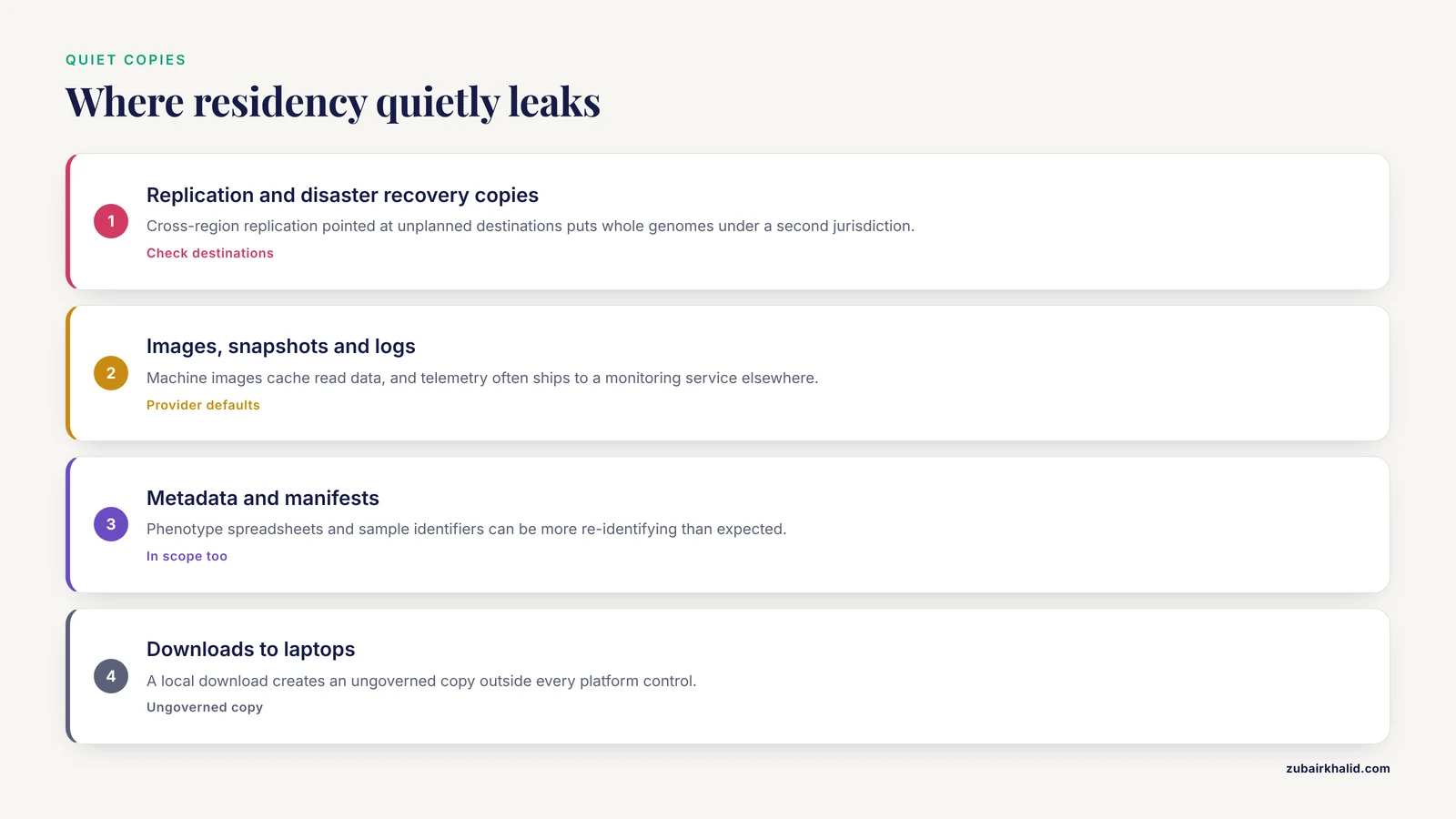
Residency failures rarely involve the primary bucket. They involve the copies nobody inventoried:
- Cross-region replication and disaster recovery copies pointed at unplanned destinations
- Machine images and snapshots that cached read data or patient identifiers
- Log files and telemetry shipped to a monitoring service in another region
- Metadata, including manifests, phenotype spreadsheets, and sample identifiers, which can be more re-identifying than expected
- Container images and pipeline artifacts baked with configuration data or embedded credentials
- Support and managed-service access channels that operate across regions
- Edge caches and transfer acceleration endpoints touched during large uploads
- Downloads to laptops, which create ungoverned copies outside every platform control
The unifying principle is that residency is a property of every copy, not only the original. Regulators have responded to exactly this pattern, with mandates increasingly specifying data access patterns and security protocols for genomic data storage and use [5].
The Rules That Attach to a Physical Location
HIPAA obligations for US laboratories
Clinical laboratories in the United States treat genomic results as protected health information, and the regulatory analysis differs between clinical care, research, and public database submission. A review of genomic data privacy in the cloud describes how laboratories turned to cloud services when internal infrastructure could not keep pace with sequencing data management, and lays out compliance strategies for genetic information across the US clinical and research environments [2]. Under HIPAA, a covered entity that engages a cloud provider for protected health information generally operates through a business associate agreement, which binds the provider to defined safeguards, breach notification duties, and flow-down obligations to its own subcontractors. Geography alone satisfies nothing. A bucket in an American region held under no agreement, with no access controls, is a worse compliance position than a well-governed bucket anywhere else.
GDPR and cross-border conditions
The GDPR extends beyond the borders of its drafting in the sense that it can reach organizations outside Europe that process personal data of people in the European Union. European researchers designing a Health Research and Innovation Cloud explicitly anchored that vision in GDPR compliance while preserving participant trust, proposing an open and decentralized infrastructure built on established standards and certified to high levels of interoperability and data security [6]. The instructive point for any reader is architectural rather than geographic: European policy thinking treats lawful, trustworthy cross-border health data sharing as achievable, but conditional on governance, certification, and ethics requirements being designed in from the start rather than bolted on.
Recurring risk themes
A systematic review of cybersecurity and privacy risks in healthcare cloud computing, combined with expert consultation and analysis of real intrusion incidents, identified ten recurring challenges for laboratory organizations: data breaches and unauthorized access, compliance with regulations such as HIPAA and GDPR, data sovereignty and jurisdictional issues, shared infrastructure vulnerabilities, insider threats, data loss and availability concerns, inadequate security measures by cloud providers, application vulnerabilities, limited visibility and control, and the complexity of cloud security management [7]. Four of the ten are residency problems in different clothing, namely regulatory compliance, jurisdiction, visibility, and management complexity. The review's central recommendation is procedural: organizations benefit from a risk-focused framework with proactive, continuous monitoring, because one-time certification decays quickly in a cloud environment where configurations change weekly [7].
Governance Frameworks in Real Cloud Genomics Platforms
The Five Safes model in a production repository
The Five Safes framework evaluates a data access request along five dimensions: safe people, safe projects, safe settings, safe data, and safe outputs. The Genome Institute of Singapore implemented this framework in RAPTOR, a cloud-native genomics repository and analytics platform that provides governance controls to data contributors and users so that sharing and analysis proceed without security breaches or regulatory violations [5]. Translated into genomic practice, the five checks ask whether the requester is authenticated and approved, whether the proposed analysis matches the consent under which the genomes were collected, whether the execution environment confines data appropriately, whether the data are de-identified or tiered by sensitivity, and whether exported results leak re-identifiable information. The framework's value is that it converts an abstract residency debate into five answerable questions attached to a concrete access request.
Stewardship outcomes as measurable commitments
A scoping review of 46 articles from the cloud governance and data sharing literature generated outcome domains and core outcomes for responsible stewardship of cloud-based genomic data, positioning stewardship practice as one axis by which repositories demonstrate trustworthiness in their access and management practices [1]. The practical translation matters more than the taxonomy. Contracts, audit trails, consent tracking, and periodic access reviews are measurable artifacts that an institution can produce, inspect, and improve, which moves the residency conversation from aspiration to evidence.
Analyze where the data lives
The strongest structural answer to residency risk is to stop moving genomes. The National Cancer Institute's Cloud Resources, the analytical components of the Cancer Research Data Commons, comprise three platforms, FireCloud at the Broad Institute, the Institute for Systems Biology Cancer Gateway in the Cloud, and the Seven Bridges Cancer Genomics Cloud, that host large multimodal cancer datasets and provide workspaces for analysis where the data resides, without download or storage, while allowing researchers to upload their own data and tools [8]. This architecture converts a residency problem into a credentialing problem. The genome never crosses a border, the analyst's authorization does, and authorization is far easier to audit, revoke, and log than a file transfer.
Federated alternatives
When data cannot move at all, computation still can. FEAST, a modular cloud-based platform developed under the ARPA-H Biomedical Data Fabric initiative, enables secure federated analysis of real-world biomedical data across institutions, with a cross-institutional survey of research use cases shaping its interface and backend requirements around security and interoperability standards [9]. In Europe, the proposed Health Research and Innovation Cloud follows the same logic through an open, decentralized infrastructure intended for GDPR-compliant health data sharing [6]. Federated designs keep each dataset under its home jurisdiction and exchange only aggregates, statistics, or model parameters, which shrinks the sovereignty exposure from whole genomes to derived numbers.
Knowledge resources that travel freely
Interpretation work illustrates a useful asymmetry. Cloud-hosted knowledge bases such as Literome extract directed gene interactions and genotype-phenotype associations from the biomedical literature and serve them from the cloud to support genomic interpretation, freely and without individual-level genomes [10]. Because such resources carry no participant data, they sit outside most residency restrictions. Moving knowledge across borders is cheap and largely unrestricted, moving genomes across borders is neither, and well-designed pipelines exploit that asymmetry by pairing local genomes with globally accessible interpretation resources.
Cloud Bioinformatics Workflows That Respect Borders
Containers as the unit of compliant execution
Containers package a pipeline with its dependencies into a consistent computational environment that behaves identically on-premises and in the cloud, supporting reproducibility, scalability, and security for NGS pipelines while simplifying the validation, version control, and documentation that clinical laboratory regulatory compliance requires [11]. The same review warns that usage varies widely and that inconsistent container practice can degrade performance or compromise the security and privacy of protected health information [11]. Three rules capture most of the benefit. Pin versions so that an analysis can be reconstructed years later. Scan images for vulnerabilities before deployment. Keep patient data out of images entirely, and pull container images from registries inside the same region as the data they will process.
Portable workflow managers, used with restraint
Workflow engines let the same pipeline run from a local server to the cloud. MetaPhage, a metagenomics analysis pipeline implemented in Nextflow, parallelizes tasks across locations from local servers to the cloud and relies on containerized packages for reproducibility [12]. Portability cuts both ways for residency. The same property that lets a pipeline burst to a distant region for capacity can drag raw reads across a border unless the configuration pins execution and storage to approved locations. The discipline is to treat the workflow configuration as a policy document, encoding region constraints alongside resource requests.
AWS genomics in practice
The AWS genomics toolchain illustrates both the promise and the discipline required. The Trans-Proteomic Pipeline work compared the relative performance and cost of different Elastic Compute Cloud instance types and published tutorials that let laboratories without information technology staff deploy large-scale analysis rapidly [4]. Two lessons from that era persist in current cloud bioinformatics practice. Instance selection drives cost, so matching instance types to workload is an economic control as much as a technical one. And elastic compute removes the capacity excuse for weak analysis, which raises rather than lowers the stakes on governance, because the same elasticity that accelerates a variant caller can multiply copies of its inputs if left unmanaged.
Verifying residency claims in practice
Residency is tested by inspection, not by assertion. A workable verification routine includes:
- Inventory every store holding project data, including buckets, databases, queues, snapshots, and archives.
- Map replication and backup destinations and confirm each against the residency plan.
- Review service defaults, because some managed services replicate or cache globally unless explicitly constrained.
- Trace where logs, metrics, and telemetry land and who can read them.
- Read the provider's subprocessor disclosures and government access transparency reporting.
- Execute the contractual instruments, business associate agreements and data processing agreements, and confirm they cover every service in the architecture.
- Monitor egress volumes and access logs continuously, since limited visibility and control is a documented failure mode in healthcare cloud adoption [7].
- Rehearse the hard cases before they occur: a foreign legal demand, a collaborator exfiltrating data to a laptop, a departing employee with standing credentials.
Clinical and Comparative Relevance
For clinical molecular laboratories, cloud adoption solved a capacity problem and created a compliance program. The same forces that pushed NGS laboratories toward the cloud, explosive data volume and inadequate internal infrastructure [2], now require those laboratories to govern cloud access as rigorously as they validate an assay, and containers are an accepted mechanism for making clinical pipelines reproducible and auditable across on-premises and cloud deployments [11]. For research consortia, the analyze-in-place platforms of the Cancer Research Data Commons [8] and the five-safes governance of RAPTOR [5] demonstrate that large-scale sharing and jurisdictional discipline can coexist in production. For laboratory medicine more broadly, the risk portfolio of cloud and AI adoption has been enumerated thoroughly enough to support systematic mitigation rather than improvised response [7]. Across international initiatives, the architectural trend is consistent: federated analysis [9] and decentralized European infrastructure [6] assume data stays put and computation travels, inverting the older assumption that data should be pooled wherever capacity was cheapest.
Misconceptions About Data Residency and Sovereignty
Misconception 1: The cloud has no location. Every object resides in a named region on physical hardware in a specific country. The abstraction is real but bounded, and every residency decision lives inside that boundary.
Misconception 2: Encryption neutralizes sovereignty questions. Encryption protects confidentiality against observers who lack keys. The ciphertext still sits under a jurisdiction, someone must control the keys, and authorized decryption happens somewhere. Encryption is a necessary control, not an exemption from territorial law.
Misconception 3: Residency equals compliance. A bucket in the correct country with permissive access settings is still a breach waiting to occur. Governance frameworks carry much of the compliance weight, which is why five-safes controls [5] and measurable stewardship outcomes [1] accompany location decisions rather than being replaced by them.
Misconception 4: Downloading to my own laptop keeps the data local. A download creates an ungoverned copy outside every control the platform enforces, on hardware nobody audited. Analyze-in-place architectures exist precisely to prevent this pattern.
Misconception 5: Privacy law prohibits all cross-border transfers. Major regimes regulate the conditions under which transfer occurs rather than banning movement outright, and serious infrastructure proposals are built around lawful, trustworthy sharing across borders [6]. The error runs in both directions, toward both casual transfer and reflexive refusal.
Misconception 6: De-identified genomes stop being sensitive. Removing identifiers does not erase inherent identifiability, familial implications, or predictive content, which is why genomic data retains heightened sensitivity after de-identification and why public repository submission deserves separate scrutiny from clinical storage [2].
Common Mistakes and Limitations
Recurring, avoidable errors show up across institutions:
- Accepting the default region at resource creation without a written residency decision, then discovering the choice is load-bearing.
- Enabling replication, backups, or lifecycle archival rules without auditing their destinations.
- Forgetting that logs, manifests, and phenotype metadata are in scope for residency and re-identification review.
- Assuming one signed agreement covers every service that touches the data, when managed services, monitoring, and support channels each need coverage.
- Treating compliance as a launch event rather than the continuous monitoring practice the risk literature recommends [7].
- Ignoring egress economics until they distort analysis design, when analyze-in-place patterns resolve both the cost and the residency exposure [8].
- Letting pipeline portability [12] become an uncontrolled export channel because nobody encoded region constraints in the workflow configuration.
- Uploading data before mapping consent terms and data access committee approvals onto the cloud setting [1].
Three limitations bound this guidance. Laws and provider terms change quickly, so current requirements must be verified with your institution's privacy office and counsel before committing a dataset to a region, and individual compliance decisions need qualified legal review rather than a general reference article. The evidence base itself is young, with stewardship frameworks for cloud genomics still being distilled from the literature [1], so expect specific recommendations to mature. Finally, platform behaviors vary by provider and service, and each should be confirmed against the provider's current documentation rather than assumed from prior experience.
Quick Review
- Data residency is where data physically lives, data sovereignty is which law governs it there, and data localization is a rule that it must stay put.
- The region chosen at resource creation is the single most consequential residency decision in a cloud bioinformatics project.
- Copies, backups, snapshots, logs, and metadata create additional residency surfaces that primary storage reviews routinely miss.
- Genomic data is identifiable, immutable, familial, and predictive, so stewardship obligations span the entire data lifecycle [1].
- Analyze-in-place and federated architectures move computation to the data, keeping genomes under their home jurisdiction [9].
- Five Safes governance supplies a practical structure covering people, projects, settings, data, and outputs.
- Verification is continuous and procedural: inventory, mapping, monitoring, contractual coverage, and rehearsed incident response [7].
Frequently Asked Questions
What does data residency for genomic data in the cloud mean?
It means the physical cloud region where sequencing data is stored and processed. When you create a bucket or launch compute, you pick a region, and that choice determines which country's laws reach the data while it sits there, independent of who owns the data or where the analysis team works.
Is data residency the same thing as data sovereignty?
No. Residency is a physical fact you configure, while sovereignty is a legal consequence you inherit. Data stored in a given jurisdiction falls under that jurisdiction's laws regardless of the owner's nationality or the provider's headquarters, which is why the two terms travel together but answer different questions.
Does putting genomic data in a US cloud region automatically satisfy HIPAA?
No. Location is one ingredient among several. A covered entity also needs a business associate agreement with the provider, technical safeguards, access controls, and audit trails, and the provider's obligations attach through that agreement rather than through geography alone.
Can genomic data be copied between cloud regions or countries?
Technically yes, since replication is a routine cloud feature. Legally it depends, because each copy lands under a new jurisdiction, so cross-region and cross-border copying requires a documented basis, appropriate agreements, and review of consent limitations before the feature is enabled rather than after.
How do federated platforms reduce residency and sovereignty problems?
They reverse the direction of data movement. Instead of pooling genomes in one location, federated platforms send analysis to each dataset where it already lives and share only results or model parameters, so every genome remains under its original jurisdiction throughout the collaboration.
What should I check before uploading human sequences to a cloud account?
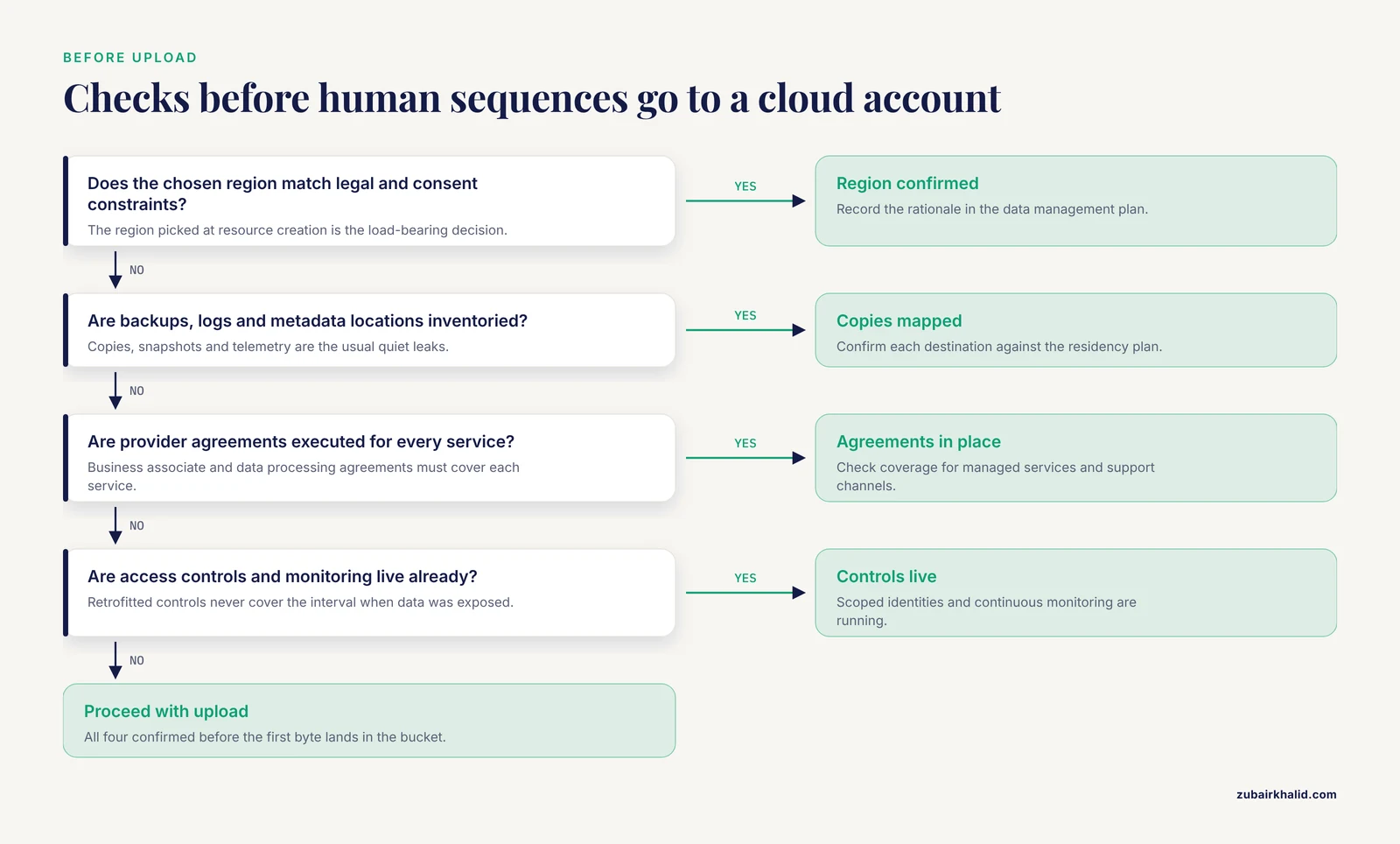
Confirm the region matches your legal and consent constraints, inventory where backups, logs, and metadata will reside, execute the necessary agreements with the provider, and configure access controls and monitoring before the first upload rather than after, because retrofitted controls never cover the interval when data was already exposed.
Sources
- Characterizing core outcomes of responsible stewardship for human genomic data in the cloud.
- Considerations for Genomic Data Privacy and Security when Working in the Cloud.
- Biomedical research in the Cloud: considerations for researchers and organizations moving to (or adding) cloud computing resources.
- Processing shotgun proteomics data on the Amazon cloud with the trans-proteomic pipeline.
- A five-safes approach to a secure and scalable genomics data repository.
- Towards a European health research and innovation cloud (HRIC).
- The Challenges of Data Privacy and Cybersecurity in Cloud Computing and Artificial Intelligence (AI) Applications for EQA Organizations.
- NCI Cancer Research Data Commons: Cloud-Based Analytic Resources.
- From use cases to infrastructure: a cross-institutional survey of priorities in data-driven biomedical research.
- Literome: PubMed-scale genomic knowledge base in the cloud.
- Containers in Bioinformatics: Applications, Practical Considerations, and Best Practices in Molecular Pathology.
- MetaPhage: an Automated Pipeline for Analyzing, Annotating, and Classifying Bacteriophages in Metagenomics Sequencing Data.