Cost-Effective Scaling of RNA-Seq Workflows in the Cloud
By Dr. Zubair Khalid, DVM, MS, PhD ·

Cost-effective scaling of RNA-seq workflows in the cloud means paying for compute only while it is actively processing reads, instead of buying hardware that sits idle between runs. The rule of thumb for choosing an approach is simple. If you run a few dozen samples occasionally, rent a single machine or use a turnkey web platform. If you run hundreds of samples in recurring batches, adopt a workflow manager on elastic cloud compute. If you process thousands of samples continuously, invest in managed pipelines or automated serverless architectures.
This article walks through each cost-effective RNA-seq cloud scaling option, compares them on the criteria that actually decide budgets, works through realistic scenarios, and lists the mistakes that quietly inflate cloud bills.
Why RNA-Seq Outgrew the Local Server
RNA-seq, the sequencing of a sample's transcriptome to quantify gene expression, became a standard replacement for microarrays as sequencing prices fell. That price drop produced a problem that has nothing to do with biology. The number and size of RNA-seq datasets grew so quickly that local servers and small university clusters became the bottleneck for analysis, not the sequencer [1].
This is the core problem cloud bioinformatics solves. The Stormbow project, an early cloud-based tool for read mapping and expression quantification, demonstrated the pattern back when it processed 178 RNA-seq samples on Amazon Web Services. Each sample of roughly 100 million reads took 6 to 8 hours to process, and the average cost was $3.50 per sample. The authors' argument still holds: on-demand compute resources let a lab scale up for large datasets and scale back down when the work is done, rather than provisioning for peak demand year-round [1].
Not every lab needs that elasticity. The rest of this article is about matching your workload to the delivery model that minimizes total cost, including the often-ignored cost of your team's time.
What You Actually Pay For
Before comparing options, be clear about the four real cost drivers in any cloud genomics project. Published per-sample figures like the Stormbow benchmark are useful anchors, but your bill follows these drivers.
Compute. You pay per virtual machine hour, per vCPU and GB of memory. RNA-seq workloads are bursty. Alignment and quantification of a 100-million-read sample took 6 to 8 hours in the Stormbow deployment, so a 200-sample study is roughly one machine-year of single-threaded work compressed into a few days if you parallelize across many machines [1].
Storage. You pay per gigabyte per month for object storage, with cheaper archive tiers for cold data. FASTQ files, BAM files, and intermediate counts accumulate fast, and keeping three copies of everything in hot storage is one of the most common silent budget leaks.
Data movement. Moving data out of a cloud region, or between regions, is billed separately from storage. This is why "data gravity" matters. Analyzing public datasets works best when your compute sits in the same cloud and region as the data.
Engineering time. A graduate student spending two weeks configuring a cluster can cost more than the entire compute bill. Platforms that remove infrastructure management charge a premium for convenience, and for many teams that premium is the cheaper option [2].
The Main Cost-Effective RNA-Seq Cloud Scaling Options at a Glance
There are five practical options for scaling RNA-seq analysis in the cloud. The table below is the core comparison of this article. Each option is then explained on its own terms.
| Option | Best for | Cost model | Ops burden | Scaling ceiling | Main trade-off |
|---|---|---|---|---|---|
| Raw compute plus a workflow manager (Nextflow, WDL/Cromwell, Snakemake) | Labs with scripting skills and recurring batches | Pay per instance-hour, heavily reduced with spot pricing | Moderate to high | Very high (hundreds to thousands of parallel jobs) | You own monitoring, cost tuning, and updates |
| Managed scientific workflow platforms (Terra, Seqera, Cavatica, AnVIL) | Teams that want pipelines without cluster administration | Pay for underlying compute plus platform services | Low to moderate | High | Less control, some vendor lock-in |
| Serverless orchestration | Population-scale, continuously fluctuating production workloads | Pay per function invocation and per job | High to build, low to run | Extremely high | Up-front engineering investment |
| Turnkey web platforms (ICARUS, NMDC EDGE, EAP-style services) | Experimental biologists, one-off analyses, standardized processing | Often free or pay-per-analysis | None | Bounded by what the platform offers | Fixed pipelines, limited customization |
| Portable community workflows from registries (Dockstore) | Any of the above, with reproducibility as the priority | Same as chosen execution platform | Low to moderate | Same as chosen execution platform | Workflow must match your data model |
Option Deep Dives
Raw Cloud Compute With a Workflow Manager
This is the workhorse of cost-effective scaling for teams with some scripting ability. You rent virtual machines from a provider such as AWS, install containerized pipeline software, and let a workflow manager fan the work out. A workflow manager is software that takes a description of your analysis steps and schedules each step on available machines, retrying failures and caching completed work.
The most common pattern today is running a community-maintained pipeline such as nf-core/rnaseq under Nextflow, a workflow manager widely adopted as a de facto standard in genomics [3]. A minimal launch looks like this:
nextflow run nf-core/rnaseq \
  -profile docker \
  --input samplesheet.csv \
  --outdir results/
On AWS, you point Nextflow at a batch compute environment, wrap each process in a container, and request spot capacity. A spot instance is a spare cloud machine offered at a large discount that the provider can reclaim with short notice. Because a workflow manager checkpoints completed steps and retries failed ones, spot interruptions cost you minutes, not days. This single configuration change is usually the largest compute saving available in cloud bioinformatics.
Pros: maximum control, lowest unit compute cost, excellent scaling from one machine to thousands of parallel tasks, full reproducibility through container images.
Cons: someone must own the configuration, the cost dashboards, and version upgrades. Teams without that person end up paying in delays what they saved in instance pricing.
Managed Scientific Workflow Platforms
Managed platforms wrap the raw compute model in a service layer. Terra, Seqera, and Cavatica handle the execution engine, the containers, the monitoring, and the billing interface, so you submit a workflow and watch progress instead of administering machines. These platforms grew out of the genomics community's need to run the same pipelines at small and very large scale without each lab rebuilding infrastructure.
The AnVIL ecosystem, a cloud-based platform for democratizing access to large-scale genomics data and analysis tools, illustrates both the power and the friction of this model. The full platform can be challenging for researchers without extensive bioinformatics expertise, which is exactly why the AnVILWorkflow R package was built. It lets researchers launch hosted workflows, including bulk RNA-seq analysis with Salmon, directly from an R session, simplifying environment setup, input formatting, submission, and result retrieval [2]. For exploratory analysis and bulk processing, that convenience means scalable computing without direct management overhead [2].
The rMATS-cloud project provides a rare direct comparison of this option. The authors packaged the rMATS alternative splicing workflow in three portable formats (CWL, WDL, and Nextflow) and ran it on three platforms, Cavatica, Terra, and Seqera, benchmarking both time and cost on two RNA-seq datasets. Their finding that the workflow handles datasets with thousands of samples shows that managed platforms are not just convenient, they scale to repository-sized studies [4].
Pros: low operations burden, built-in reproducibility, co-location with major public datasets, multi-platform portability when workflows are published in open formats [4].
Cons: platform fees and less fine-grained cost control than running raw spot fleets. Deep customization of execution details is harder.
Serverless Orchestration
Serverless architecture means the cloud provider runs small units of your code on demand, and you pay per invocation, with no servers to provision at all. For genomics, this is the pattern used when workloads are enormous and continuously fluctuating.
Celeste, the cloud infrastructure behind the All of Us Research Program's sequencing analysis, is the clearest published example. Built on serverless technology and container orchestration within a single AWS region, it routinely processed fluctuating workloads of up to 9,000 whole-genome sequencing samples per month. In twelve months of production, roughly 200 million serverless functions and over 20 million messages coordinated 1.8 million bioinformatics, quality control, and clinical reporting jobs [5]. The same architectural principles, fan-out per sample, event-driven coordination, containers for the actual tools, apply directly to RNA-seq at cohort scale, and the approach is openly documented so other large-scale sequencing efforts can reuse it [5].
Pros: near-perfect elasticity, you never pay for idle servers, and it is proven at petabyte scale on AWS genomics workloads [5].
Cons: this is an engineering project, not a purchase. Building and maintaining a serverless pipeline needs a dedicated infrastructure person. Most RNA-seq labs should consume this pattern through a platform rather than build it.
Turnkey Web Platforms
A third category removes the workflow layer entirely. You upload data to a web server, pick an analysis, and get results. The ICARUS v3 web server for single-cell RNA-seq demonstrates what modern platforms achieve. It uses geometric cell sketching to subsample cells for dimensionality reduction and clustering, then projects those results back onto the full dataset, and it completed analysis of a dataset of 1.3 million cells within the hour [6]. For labs without cloud infrastructure experience, a web server that absorbs all of the scaling complexity is the cheapest option in total cost of ownership, even if per-analysis flexibility is limited.
The NMDC EDGE resource from the National Microbiome Data Collaborative follows the same design philosophy for multi-omics, including metatranscriptome data. Its architecture separates the web application, orchestration, and execution layers, and the orchestration and execution layers use software containers and accommodate both high-performance computing and cloud services [7]. That layered design is a template worth copying even for labs building their own systems, because it lets you swap execution backends without rewriting the interface [7].
Pros: zero configuration, standardized production-quality workflows, strong for data standardization and interoperability [7].
Cons: you get the parameters the platform exposes. If your question needs a custom aligner, a nonstandard library prep, or an unusual statistical model, this option cannot carry the whole project.
Portable Community Workflows From Registries
Dockstore and similar registries sit across all the options above. They host versioned, containerized workflows in CWL, WDL, and Nextflow formats that any compatible platform can execute. rMATS-cloud is the model case, one scientific tool published in three workflow languages, runnable on virtually any cloud environment suited for biomedical research [4]. Publishing your lab's pipeline this way turns a one-time engineering investment into reusable infrastructure, and it is the mechanism that makes the managed-platform comparison in [4] possible at all.
The Criteria That Decide the Real Choice
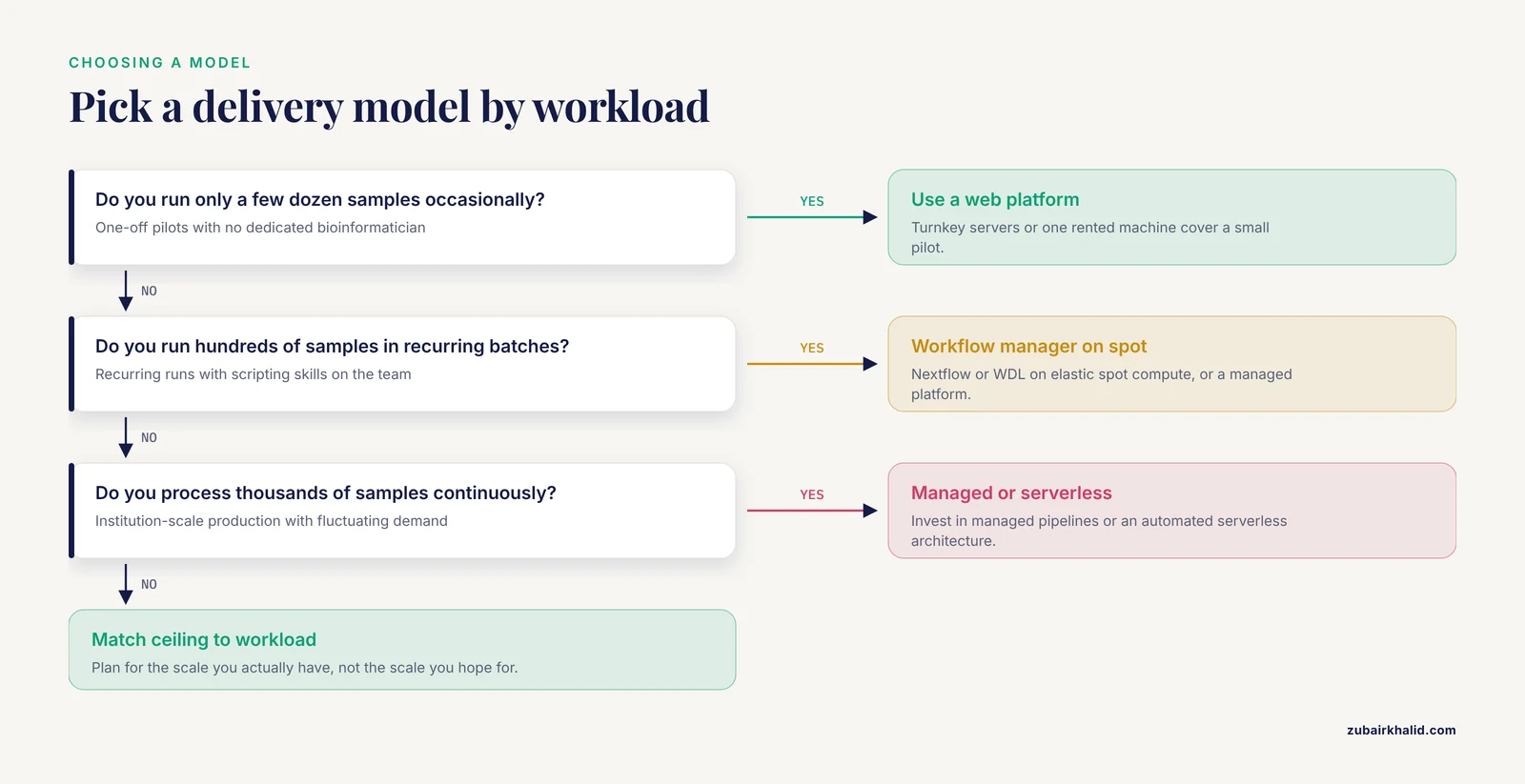
Cost-effective RNA-seq cloud scaling options differ less in sticker price than in where they place your costs. Evaluate every option against these six criteria.
Sample count and run frequency. A one-time 20-sample pilot and a monthly 1,000-sample production run have different optima. Occasional small runs favor managed platforms or web servers, where setup time dominates. Large recurring runs favor raw compute with spot pricing or serverless designs, where unit cost dominates [1][5].
Data gravity. Where your inputs live should decide where your compute lives. If your dataset is already hosted in a cloud platform, as many public genomics datasets are within AnVIL, analyzing it there avoids transfer charges and download time, a hidden saving that managed platforms monetize well [2].
Team skills. A workflow manager on spot instances is the cheapest per sample but requires someone fluent in Nextflow or WDL, containers, and cloud consoles. The managed platform premium is essentially the salary of the person you do not have to hire [2].
Reproducibility requirements. Publications, collaborations, and regulatory contexts all reward versioned pipelines and containers. Every option in this article can be reproducible, but only the workflow-manager, managed-platform, and registry-based options make reproducibility nearly automatic.
Scaling ceiling you actually need. Match the ceiling to the workload, not to ambition. A web server that analyzed 1.3 million single cells within the hour is far beyond what most bulk RNA-seq studies require [6]. Conversely, a lab anticipating thousands of samples should plan from the start for a workflow proven at that scale [4].
Run shape. Perfectly parallel per-sample work (alignment, quantification) scales beautifully everywhere. Stages that gather all samples (merging counts, batch correction, differential expression across the full matrix) need a large single machine at the end, and that step is often the one that determines your peak instance size and cost.
Worked Scenarios
These scenarios translate the comparison into concrete decisions. Treat the numbers as planning anchors, not quotes, since instance prices and pipeline efficiency change over time.
Scenario A, the 20-sample pilot
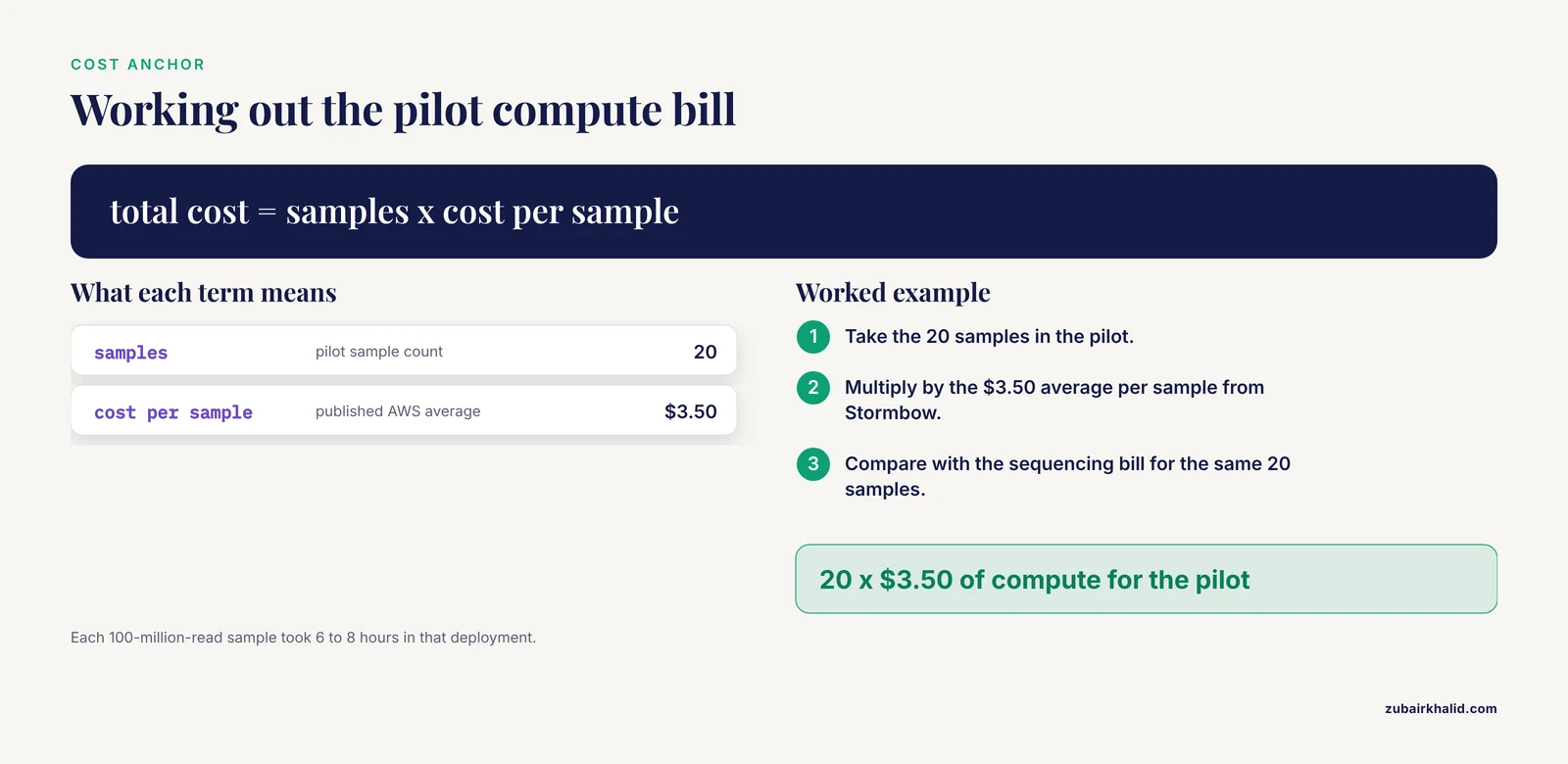
A lab has 20 samples of standard-depth bulk RNA-seq and no dedicated bioinformatician. Running the analysis on a single well-chosen cloud instance, or using a turnkey platform, is the best choice. The total compute is modest. As a reference point from a published AWS deployment, a 100-million-read sample took 6 to 8 hours at an average of $3.50 per sample, so even with pipeline changes and inflation since then, a 20-sample pilot is a small line item compared with sequencing itself [1]. The Stormbow experience is also a reminder that open-source, out-of-the-box tools for standard Illumina data existed in the cloud era from early on, so there is rarely a reason to hand-roll a pilot pipeline [1].
Scenario B, the 400-sample cohort study
Aim for a workflow manager on spot instances, or a managed platform that passes spot savings through. Scatter the per-sample steps (quality control, alignment or pseudoalignment, quantification) across as many parallel tasks as your budget allows, then gather on one larger instance. At a pace even resembling the Stormbow benchmark of several hours per 100-million-read sample, parallelizing across 50 machines turns a multi-month serial job into a few days [1]. Publish the workflow to Dockstore so the next study reuses it, as the rMATS team did when they made their splicing workflow portable across Cavatica, Terra, and Seqera [4].
Scenario C, single-cell RNA-seq at the million-cell scale
Single-cell datasets break the per-sample mental model because the unit of scale is the cell. Rather than provisioning a monster machine, use methods designed for the problem. ICARUS v3 subsamples cells through geometric cell sketching for the expensive dimensionality reduction and clustering steps, projects results back to the full data, and extends the subset approach to downstream analyses including differential expression, trajectory analysis, and cell-cell communication inference. It processed 1.3 million cells within the hour [6]. The cost lesson generalizes beyond this one tool: algorithmic subsampling can replace raw compute scale, and algorithmic savings are usually cheaper than instance savings.
Scenario D, continuous population-scale processing
If RNA-seq (or sequencing generally) is your institution's ongoing production workload with fluctuating demand, the Celeste architecture is the published blueprint. Serverless functions per unit of work, container orchestration for the tools, message-based coordination, all inside one cloud region to keep data transfer costs down, sustained 1.8 million jobs in a year at All of Us scale [5]. Few labs should build this from scratch, but platform teams serving many labs should study it.
Scenario E, standardized multi-omics processing
If your goal is comparable, standardized processing rather than bespoke analysis, use or imitate a resource like NMDC EDGE. Its three-layer separation (web application, orchestration, execution) with containerized, production-quality workflows supports both cloud and high-performance computing backends [7]. Standardization has a direct cost benefit, results from different batches become comparable without reprocessing, which avoids paying twice for the same compute.
The Cost-Control Playbook
Whichever option you choose, the same tactics cut bills across the board. These are the highest-yield practices in cloud bioinformatics cost management.
- Buy spot, not on-demand, for compute-heavy steps. Spot instances can be reclaimed at any time, so only apply them to steps your workflow manager can retry. Alignment and quantification, which are per-sample and stateless, are ideal. This is the single biggest compute saving available [5].
- Scatter aggressively, gather deliberately. Split per-sample work into the maximum sensible parallelism, but keep the memory-heavy gather steps on appropriately sized single machines. Over-sizing every task "just in case" is a classic bill multiplier.
- Manage storage tiers from day one. Move FASTQ and BAM files to archive storage after the active analysis window, keep only counts and summaries hot, and set lifecycle rules so this happens automatically. Delete intermediate files the workflow can regenerate from cached checkpoints.
- Keep compute next to data. Choose the region where your reference data and public datasets already live. Cross-region data transfer is billed and slow, and re-downloading public data repeatedly is a pure loss. Managed platforms with hosted datasets, such as AnVIL, turn data co-location into a genuine cost advantage [2].
- Use caching and resume. Workflow managers cache completed tasks. When a run fails at 90 percent, resuming costs 10 percent of the price of rerunning. Never disable caching to "simplify" debugging.
- Right-size memory with evidence, not fear. Run one representative sample, read the peak memory from the logs, and set task resources just above that. Defaulting every task to a large memory size because one step once failed is common and expensive.
- Set billing alarms and per-project budgets. A runaway loop that launches thousands of small jobs, exactly the failure mode visible at even larger scale in production genomics [5], should page you within hours, not appear on a monthly invoice.
- Standardize once, reuse everywhere. Containerized, versioned workflows from community collections such as nf-core reduce both engineering time and silent errors, and workflow registries make your investment portable across platforms [4][3].
Reproducibility Is Part of Cost
Reproducibility and cost are the same problem viewed from two angles. Rerunning an analysis because the original was irreproducible is the most expensive compute you will ever buy. The literature on cloud bioinformatics converged on a consistent stack: software containers so tools run identically everywhere, workflow languages so pipelines are portable, and registries so pipelines are citable and reusable [7][4].
The containerization and layered-architecture pattern described for NMDC EDGE, where the same production workflows run on high-performance computing or cloud services, means a lab can follow grant cycles and move between subsidized clusters and cloud bursts without rewriting the science [7]. Portable packaging pays a second dividend, the ability to benchmark. The rMATS-cloud team could compare time and cost across three platforms only because the workflow itself was portable, and publishing those comparisons helps the whole community choose cost-effective options with evidence instead of anecdote [4].
Accessibility tools extend the same economics to people rather than machines. AnVILWorkflow exists because the barrier to scalable cloud analysis was administrative, not computational, and removing it makes scalable computing accessible to researchers without direct infrastructure management [2]. In practice, every researcher who can launch a pipeline without a week of setup is a cost saving.
Common Mistakes and Limitations
These are the errors that most often turn a planned cost-effective RNA-seq cloud scaling project into an overrun.
Treating cloud costs like sequencer costs. Sequencer pricing is per sample and predictable. Cloud pricing is per hour, per gigabyte, and per transfer, and it changes with your configuration. The published benchmark of $3.50 per sample on AWS is from a specific pipeline and era, so use published figures as order-of-magnitude anchors and measure your own pipeline's actual per-sample cost from billing data [1].
Provisioning for peak and paying for idle. The entire economic argument for cloud scaling is elasticity. If you rent a fixed fleet sized for your largest run and leave it running between studies, you have rebuilt the local server problem at higher prices. Scale down to zero when idle, or use platforms and serverless patterns that do it for you [5].
Ignoring the gather stage. Teams size their parallel fleet for the scatter stage, then discover that merging hundreds of count matrices needs one very large machine. Plan for the peak single-task resource, and consider per-chromosome or block-wise gathering to keep the peak modest.
Running spot on the wrong steps. Spot interruptions are cheap only for retryable steps. Applying spot pricing to monolithic steps that restart from zero burns the discount on repeated wasted work.
Choosing a web platform for a custom question. Turnkey platforms deliver standardized pipelines, which is their strength and their limit. If your design needs nonstandard processing, budget for the workflow-manager route instead of bending a platform beyond what it exposes [7].
Letting storage grow unmanaged. The 9,000-samples-per-month cadence seen in production-scale genomics is survivable only because storage strategy is deliberate [5]. Without lifecycle rules, archive tiers, and deletion policies, storage costs creep past compute costs within a year of a large project.
Conflating portability with lock-in. Workflows published in open formats on registries can move between platforms, which is genuine leverage in pricing negotiations. Workflows built inside one platform's proprietary conveniences cannot. Prefer open formats from the first commit.
Overlooking the persistent disparities. Even as tools mature, the field continues to face economic disparities in access to sequencing and analysis capacity, a challenge highlighted in recent reviews of genomics infrastructure [3]. Grant budgets, institutional agreements, and cloud credits vary widely, so benchmark options for your own situation rather than copying another lab's stack. For study designs that are unusual, high-stakes, or at unusual scale, a consult with an experienced computational biologist or genomics core is the cheapest purchase in the whole project.
Frequently Asked Questions
What does cost-effective RNA-seq cloud scaling actually mean?
It means matching compute, storage, and platform choices to your workload so you pay for capacity only while analysis is running. In practice this usually combines a containerized workflow, elastic or spot compute, tiered storage, and a delivery model (raw compute, managed platform, or web service) chosen by sample count and team skills.
Which is the best cost-effective RNA-seq cloud scaling option overall?
There is no single best option. Most labs with recurring work do best with a workflow manager on spot instances or a managed platform such as Terra, Seqera, Cavatica, or AnVIL, while occasional small analyses belong on turnkey web servers. Published comparisons, such as one splicing workflow benchmarked across Cavatica, Terra, and Seqera, show that portable workflows let you pick and switch platforms as prices and needs change.
Can I run RNA-seq pipelines on spot instances without losing work?
Yes, if a workflow manager supervises the run. The manager checkpoints completed steps and retries interrupted tasks on replacement capacity, so spot reclamation costs minutes rather than the run. Reserve on-demand capacity for the few steps that cannot tolerate restarts.
Is a web platform cheaper than running my own cloud instances?
For small or one-off analyses, usually yes, because web platforms eliminate setup, maintenance, and idle-capacity costs, and some are free to use. For large recurring workloads, raw or managed elastic compute typically wins on unit cost, provided someone on the team can operate it.
How much does it cost to process one RNA-seq sample in the cloud?
Published figures vary widely by pipeline and era. An early AWS-based deployment reported an average of $3.50 per sample, with 6 to 8 hours of processing per 100-million-read sample, and that figure remains a useful order-of-magnitude anchor. Measure your own pipeline's per-sample cost from actual billing data before committing to a large project.
Do I need containers and a workflow manager to keep costs down?
You need them for anything beyond a handful of samples. Containers make runs portable and repeatable, and a workflow manager enables spot pricing, caching, and parallel scatter, which are the main levers of cloud cost control. Modern standardized pipeline collections bundle both, so adoption is mostly configuration rather than programming.
Sources
- Stormbow: A Cloud-Based Tool for Reads Mapping and Expression Quantification in Large-Scale RNA-Seq Studies.
- AnVILWorkflow: A runnable workflow package for Cloud-implemented bioinformatics analysis pipelines.
- Advancements and challenges in bioinformatics tools for microbial genomics in the last decade: Toward the smart integration of bioinformatics tools, digital resources, and emerging technologies for the analysis of complex biological data.
- rMATS-cloud: Large-scale Alternative Splicing Analysis in the Cloud.
- Celeste: A cloud-based genomics infrastructure with variant-calling pipeline suited for population-scale sequencing projects.
- ICARUS v3, a massively scalable web server for single-cell RNA-seq analysis of millions of cells.
- Standardized and accessible multi-omics bioinformatics workflows through the NMDC EDGE resource.