Data Versioning for Collaborative Bioinformatics Projects
By Dr. Zubair Khalid, DVM, MS, PhD ·

Data versioning records every change to a dataset over time so any collaborator can retrieve, compare, and reproduce any earlier state, while ordinary file sharing simply overwrites the old copy and loses the history. The rule of thumb is simple: if more than two people touch a dataset, or if the dataset supports a publication, a clinical report, or a downstream database, it belongs under version control. Everything else can usually live in a shared folder with a dated backup.
This article explains what data versioning for collaborative bioinformatics projects actually involves, compares the main options side by side, works through realistic scenarios, and lists the mistakes teams make most often. The focus is practical infrastructure and policy, not tool tutorials, although concrete commands and worked examples appear where they clarify a choice.
Why Versioning Matters in Bioinformatics
Software engineering solved change tracking decades ago. Genomics largely did not. For over 25 years, genomic data have been distributed in two flat file formats, FASTA for sequence and GFF for feature coordinates, and these formats carry no built-in mechanism to record what changed between releases [1]. When an assembly consortium updates a genome or re-annotates gene models, the update typically ships as a new set of files with a new name, and whatever changed between the old and new release exists only in human-readable release notes, if it exists at all. Different annotation versions cannot be computationally compared, improvements in assembly algorithms stay invisible to downstream users, and accumulated biological knowledge sits disconnected from the data it describes [1].
Scale makes this worse. The Cancer Genome Atlas (TCGA) holds more than 1.2 petabytes of whole genome, whole exome, methylation, RNA expression, proteomic, and clinical data, and managing that volume required a dedicated acquisition and management system that downloads, harmonizes, versions, and archives data and metadata as a coordinated operation [2]. A project of that size cannot rely on filenames like final_final_v3.
The problem also affects collaborative curation. Systems biology curation requires stable identifiers and versioning so that manually curated molecular interactions remain traceable as knowledge grows, and community curation needs role management and review features on top of that [3]. Model organism communities face the same issue at the resource level, where the Arabidopsis community identified the need for a centralized annotation authority that distributes a consistent, regularly updated annotation format and encourages its adoption across databases [4].
In short, collaborative bioinformatics data versioning is the practice of giving datasets the same history, identity, and review machinery that version control gives source code, adapted to files that are large, binary, and frequently regenerated.
What Needs Versioning in a Bioinformatics Project
A common error is to version only the raw reads and leave everything else untracked. In practice, a reproducible analysis depends on at least five versioned layers:
- Raw data. FASTQ, BAM, imaging, mass spectrometry, and assay outputs. These files are large and usually immutable after upload, so they need content-addressable storage or a versioned archive rather than line-by-line tracking.
- Reference data. Reference genomes, annotation releases, and alignment indexes. Galaxy's developers found that building the cache of reference data used by analysis tools was an error-prone manual process lacking reproducibility and provenance, which motivated a framework that automates reference data installation with full versioning and dependency support [5].
- Derived data and annotations. Gene models, variant calls, corrected segmentations, curated molecular interactions. These change constantly and are the layer where versioning pays off most [1].
- Metadata and sample provenance. Sample sheets, voucher and tissue records, extraction details, consent status. TOLKIN, a collaborative web application for systematics research, tracks individual observations, sequences, and specimens along with the documentation of their source, and versions the assembled datasets used for phylogenetic inference [7].
- Code, parameters, and execution environment. Pipelines, container images, and parameter sets. Guidelines for reproducible adaptive immune receptor repertoire sequencing (AIRR-seq) analysis emphasize versioned containers alongside documentation and archiving, because those analyses are highly sensitive to parameter choices [8].
A versioning policy should name an owner and a mechanism for each layer. A single mechanism rarely covers all five, which is why the choice of options matters.
Collaborative Bioinformatics Data Versioning Options
The main options fall into six families. Each solves a different slice of the problem, and most mature projects combine two or three.
Option 1: Git over Plain-Text Formats
Git records a content-addressed history of files in a repository. It works directly on small text files, which in bioinformatics means metadata CSVs, small FASTA and GFF3 files, Snakemake and Nextflow pipeline definitions, and documentation. Every commit records who changed what, branches let collaborators propose changes in parallel, and pull requests give a review point before data land on the main branch.
The strengths are maturity, zero licensing cost, offline operation, and an enormous pool of existing practice. The weakness is scale. Git stores every version of every file in each clone, so a 5 GB FASTQ file becomes unmanageable almost immediately, and binary files cannot be diffed line by line anyway.
A practical pattern for genomics is to keep the small, human-written files in Git and treat large regenerated files as build outputs with recorded checksums. For example, a repository might contain:
references/
  GRCh38_Gencode_v43.gff3.gz      # tracked directly, ~40 MB
metadata/
  samples_2026-04.tsv             # tracked directly
results/
  variants.vcf.gz                 # not tracked, checksum recorded
A manifest file listing SHA-256 checksums for every untracked output lets a collaborator verify that their locally regenerated files match yours bit for bit. This keeps Git fast while still pinning derived data to an exact state.
Option 2: Git Large File Storage (LFS)
Git LFS replaces large files in a repository with small pointer files and stores the actual bytes on a remote server. Cloning pulls pointers first and downloads file contents on demand. This suits repositories that mix code and a moderate number of large binaries, such as a project with reference genomes, prebuilt indexes, and a handful of archived result tables.
The pros are that the workflow stays almost identical to plain Git, history is preserved for the large files, and access control is inherited from the Git host. The cons are real: the LFS server typically enforces storage and bandwidth quotas, cloning a repository with many large versions becomes slow, and LFS is awkward for datasets that regenerate frequently, because every regenerated file is a new blob that lives forever in the store. LFS is a reasonable choice up to the low terabyte range with a small number of revisions per file, and a poor choice beyond that.
Option 3: DVC and Data Registries
Data Version Control (DVC) extends Git with a mechanism for tracking large data and machine learning artifacts. Data files live in cheap storage such as S3-compatible object storage, Google Cloud Storage, or an SSH server, while Git tracks lightweight placeholder files (DVC files) that record the data's checksum and storage location. A dvc.yaml file describes pipelines so that dvc repro regenerates outputs when inputs or parameters change.
DVC is the mechanism behind BioBricks.ai, an open registry that packages public biological and chemical datasets as modular "bricks." Each brick is a DVC Git repository containing an extract-transform-load pipeline, a package-manager-style interface handles installation, dependency resolution, and updates, and the current release provides more than 90 curated datasets spanning genomics, proteomics, cheminformatics, and epidemiology. Treating data as version-controlled software lets bricks be combined programmatically and reduces multi-dataset cohort assembly from days to minutes compared with bespoke scripts [9].
The pros of the DVC family are exact versioning of terabyte-scale data, pipeline awareness, and a clean separation between code history and data bytes. The cons are that collaborators must install DVC and have credentials for the storage remote, that DVC does not itself provide a browseable web interface for the data (you depend on the storage provider for that), and that someone must operate the remote. For a small lab, a managed Git host plus a cloud bucket is usually the least operational burden.
Option 4: Object Storage with Snapshots and Manifests
At the petabyte end, the dominant pattern is versioned object storage plus an explicit metadata layer. TCGA Expedition illustrates the architecture: a set of Bash, Python, and Java scripts downloads, extracts, harmonizes, versions, and stores all TCGA data and metadata, supporting command line access at high-performance computing facilities and conformance with federal security and regulatory best practices [2]. The versioning lives in the repository's data model and archive policy rather than in Git, because the data volume exceeds what any code-oriented system handles comfortably.
The practical version of this option for most teams is a cloud object store with versioning enabled, plus a manifest database that maps each dataset release to object keys, checksums, timestamps, and the pipeline version that produced them. The pros are essentially unlimited scale, low per-byte cost, lifecycle policies for archival tiers, and server-side access control. The cons are that raw object storage provides version identity but not change semantics (nothing tells you which annotation fields changed between two object versions), so the manifest layer does the analytical work, and that query and comparison tooling must be built or adopted.
Option 5: Database-Backed Collaborative Platforms
Some data are inherently collaborative and mutable, edited by many people over long periods, and for those a versioned database behind a web application often beats file-based versioning entirely. Three published systems show the pattern.
TOLKIN supports manage, integration, and public access to molecular, morphological, and biocollections data through a collaborative web application, combining LIMS features with workflow support, versioning datasets used in phylogenetic inference, and multi-user access that replaces sharing files and spreadsheets by email [7]. BioKC provides a web-based platform for collaborative curation of molecular interactions following the SBML data model, with stable identifiers, annotations, role management, and review support so that community curation remains consistent as contributors come and go [3]. CAVE, the Connectome Annotation Versioning Engine, addresses an extreme case: in petascale electron microscopy datasets, every proofreading edit relabels cell identities of millions of voxels and thousands of annotations such as synapses. CAVE provides scalable proofreading and annotation support so distributed communities can run reproducible analysis queries at arbitrary time points while editing is still ongoing [6].
The pros are real-time multi-user editing, fine-grained access control and roles, server-side query performance, and versioning semantics designed for the data type (annotation edits, curation changes, proofreading operations). The cons are operational: someone hosts the service, backups and migrations become the team's responsibility, and data are less portable than flat files unless the platform supports export.
Option 6: Workflow Platforms and Reference Data Managers
A final option embeds versioning inside the analysis platform. The Galaxy Data Manager framework converted the management of Galaxy's built-in reference data cache from a manual procedure into an automated, GUI-driven process with the same provenance and reproducibility afforded to analysis tools, and individual Data Manager tools can be installed from the ToolShed with full versioning and dependency support [5]. At the pipeline level, the AIRR-seq reproducibility guidelines pair ten common pipelines with versioned containers, documentation, and archiving capabilities, demonstrating that previously published results could be reproduced under those controls [8].
The pros are that reference data and execution environments become first-class, versioned citizens alongside the analysis, and collaborators inherit correct versions automatically. The cons are platform lock-in and the fact that this layer versions the analysis context, not the primary datasets, so it complements rather than replaces the other options.
Side-by-Side Comparison
The table below is the core of the decision process. Match your dominant constraint (file size, change frequency, team type) against each option.
| Option | What it versions well | Comfortable scale | Collaboration model | Main strengths | Main weaknesses |
|---|---|---|---|---|---|
| Git over plain text | Code, metadata, small FASTA/GFF3, pipeline files | Kilobytes to tens of MB per file | Branches, pull requests, full offline history | Mature, free, reviewable diffs | Fails on large or binary files |
| Git LFS | Reference genomes, indexes, archived results | Up to low TB, few revisions per file | Same as Git, plus on-demand download | Familiar workflow, real history for binaries | Storage and bandwidth quotas, slow with many revisions |
| DVC and registries | Large datasets plus the pipelines that build them | GB to multi-TB | Git-style commits over data pointers in cloud storage | Exact data versioning, pipeline reproducibility, proven public deployments [9] | Requires tooling and storage credentials, no built-in web browse |
| Object storage plus manifests | Raw reads, archives, consortium-scale releases | TB to PB | Shared bucket with access policies and release manifests | Unlimited scale, cheap, strong access control [2] | No change semantics without a metadata layer, self-built tooling |
| Versioned database platforms | Annotations, curation, proofreading, specimen records | Millions of records | Web application with roles and review [7][3][6] | Real-time multi-user editing, purpose-built version semantics | Hosting and maintenance burden, export portability |
| Platform data and container managers | Reference data caches, pipeline environments | Platform-scoped | Automatic inheritance by all platform users | Provenance by default, no manual index wrangling [5][8] | Lock-in, does not cover primary data |
Collaborative Bioinformatics Data Versioning Pros and Cons in Practice
The pros and cons that actually decide projects are rarely the ones on feature lists. Four criteria dominate.
Scale versus mutability. Raw sequencing data are huge and nearly immutable, so they suit object storage with checksum-addressed versions [2]. Annotations and curation are small or medium but highly mutable, so they suit Git, DVC, or a versioned database [1][3][6]. Teams get into trouble when they apply one mechanism to both layers, for example trying to LFS-track an entire raw read archive that changes monthly, or trying to manage a community annotation project through a shared network drive.
Who the collaborators are. A collaboration among four computational biologists works fine with Git plus DVC. A collaboration that includes curators, clinicians, or field biologists needs a web application with role management and review, which is precisely the gap TOLKIN and BioKC were built to fill for non-technical users and community curation teams [7][3]. Forcing nontechnical collaborators through a command line is the most common failure mode in collaborative bioinformatics data management.
Governance and compliance. Datasets from AI-driven genomics and high-throughput screening demand data governance, quality management, privacy measures, ownership clarity, access control, accountability, and traceability [10]. Versioning is the traceability mechanism: it answers who changed what, when, and under which approval. Any option you choose must support access control at the dataset level and an audit trail, and for human data this is a hard requirement, not a preference.
Reproducibility at a point in time. The strongest versioning systems let a collaborator request the exact data state as of a past date and get a consistent answer, even while editing continues. CAVE delivers exactly this for connectomics, allowing reproducible analysis queries at arbitrary time points during ongoing proofreading [6]. Ask this question of any candidate system, because it separates true versioning from simple backup.
Choosing Among the Options: Worked Scenarios
Scenario A: A lab maintaining its own genome annotations
A lab curates annotations for a non-model eukaryote. Assemblies and gene models get updated as long-read data and annotation methods improve, and collaborators download whichever release is newest, sometimes mixing coordinate systems across releases. The FASTA and GFF flat-file formats themselves cannot record the evolution of the assembly, so the lab cannot computationally compare annotation versions and downstream users cannot see what improved [1].
A workable setup: commit the current GFF3, protein FASTA, and a changes file to Git, tag each release (for example, annotation-v2.3), and record the underlying assembly version in the tag's metadata so assembly and annotation versions never drift apart silently. Publish checksums for every release. When a collaborator reports a result, the tag plus checksums identify the exact input state. If several groups annotate in parallel, consider moving curation into a versioned web platform with roles and review, following the BioKC pattern of stable identifiers plus collaborative review [3], and follow the Arabidopsis community's model of a single annotation authority that distributes a consistent format on a regular schedule [4].
Scenario B: A multi-site consortium accumulating clinical genomics data
A consortium aggregates clinical genomic and phenotype data across institutions, with federal security expectations. At this scale, versioning is an architecture problem. The TCGA Expedition design is the reference pattern: scripts that download, extract, harmonize, version, and store data and metadata as one operation, with repository architecture, loading methods for multiple platforms, and security and regulatory controls conforming to federal best practices [2].
Practical translation: enable versioning on the object store, define dataset releases as immutable manifests, and record for every release the source access date, harmonization pipeline version, and de-identification method. Access control and traceability requirements from data stewardship practice in AI-based genomics apply directly [10]. Individual pipeline steps should run in versioned containers so the processing context of each release is fixed [8].
Scenario C: A distributed community editing a shared resource continuously
Hundreds of contributors proofread segmentations and add annotations while other users analyze the data daily. File-based versioning is impossible here. CAVE shows the target behavior: concurrent editing and proofreading by many users, immediate reproducible access to the changing data landscape at arbitrary time points, and web-service deployment that scales to petascale datasets [6]. The general lesson for any continuously edited resource is to choose versioning semantics native to the edit operation, not generic file snapshots.
Scenario D: A team repeatedly assembling public datasets
A group keeps rebuilding analysis cohorts from a dozen public sources, spending days on location, cleansing, and integration each time, with inconsistent results between team members. The BioBricks.ai model addresses this by packaging each public dataset as a versioned DVC repository with an ETL pipeline and a package-manager interface for installation and dependency resolution, cutting multi-dataset cohort assembly from days to minutes [9]. Teams with similar internal needs can apply the same pattern to their own curated internal datasets, making a "lab data registry" where every dataset is a versioned, documented unit with a defined update path.
Governance, Stewardship, and Policy Layer
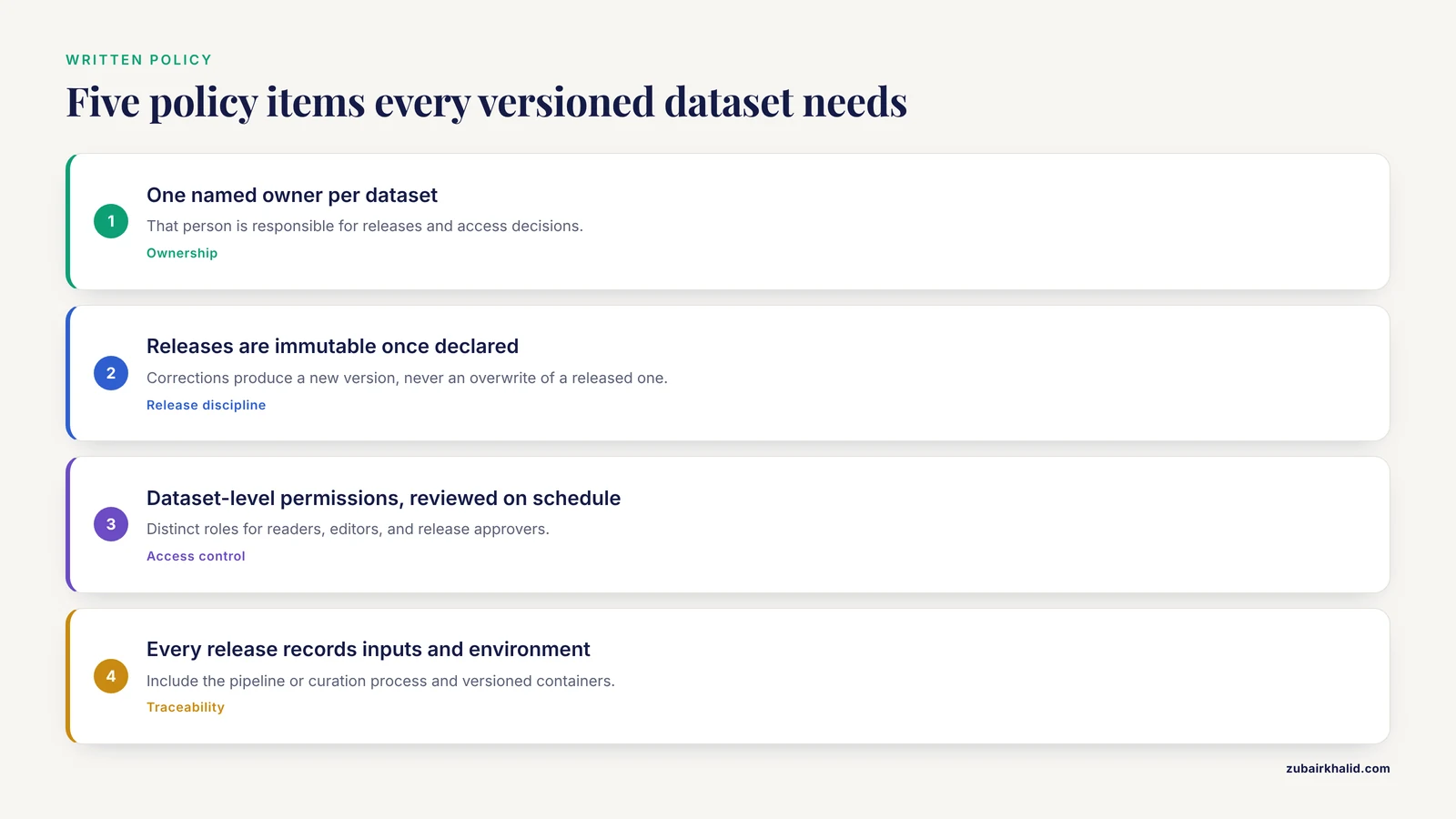
Versioning technology only works when paired with written policy. A stewardship review of AI-based genomics and high-throughput screening studies consolidated the recurring requirements: data governance, quality management, privacy measures, ownership, access control, accountability, traceability, curation frameworks, and storage systems [10]. Translate those into concrete policy items:
- Ownership. Every dataset has one named owner responsible for releases and access decisions.
- Release discipline. Versions are immutable once declared. Corrections produce a new version, never an overwrite of a released one.
- Access control. Dataset-level permissions, reviewed on a schedule, with distinct roles for readers, editors, and release approvers [10].
- Traceability. Every released version records its inputs, pipeline or curation process, and environment, including versioned containers where pipelines run [8].
- Identifier stability. Records, samples, and curated entities carry stable identifiers that survive version changes, so cross-references do not break when data update [3].
Communities that depend on shared resources also need shared standards. The Arabidopsis community's workshop priorities, including reliable and current annotation, community-defined common standards for data and metadata, and accessible repositories for integration, generalize to most collaborative bioinformatics settings [4].
Common Mistakes and Limitations
- Versioning filenames instead of data. Renaming
results_v2_final_FINAL.vcfrecords nothing about what changed. A version is a recorded state with an identity and a diff, not a filename convention [1]. - Versioning only code. A pinned pipeline run against an unversioned reference annotation is not reproducible. Galaxy's reference data problems arose exactly because the analysis side had provenance while the reference cache did not [5].
- Letting assembly and annotation versions drift independently. Downstream users need to know which assembly an annotation release sits on. Conventional flat-file formats do not enforce this, so your release process must [1].
- Using email and spreadsheets for shared datasets. This is the exact practice TOLKIN was built to replace, because files emailed between collaborators lose provenance, conflict, and cannot be merged [7].
- Ignoring access control until a human-data project arrives. Retrofitting governance onto an unversioned shared drive is far harder than starting with access control and traceability built in [10].
- Treating snapshots as backups. A version history is not a disaster recovery plan. You still need independent backups, restoration testing, and storage-tier policy.
- Assuming one tool covers everything. Every option in the comparison table has a scope. Mature projects stack two or three options across the five versionable layers described earlier.
- Over-tracking regenerated intermediates. Committing every BAM and index to LFS bloats storage and slows everyone. Track releases and checksums, regenerate intermediates on demand where the pipeline allows.
An honest limitation of the current ecosystem: file formats themselves lag behind. The lack of systematic versioning in FASTA and GFF means much of the versioning burden falls on the surrounding infrastructure, and incremental improvements to the formats alone have not solved the comparison and provenance problem at scale [1]. Plan your policy assuming the formats will not save you.
Frequently Asked Questions
What is collaborative bioinformatics data versioning?
It is the practice of recording every change to shared research datasets so any collaborator can retrieve, compare, and reproduce any past state. It extends version control ideas from software to files and records that are large, binary, and frequently updated, such as genome assemblies, annotations, and analysis outputs [1].
Should raw sequencing reads go in Git, Git LFS, or DVC?
None of them belongs in plain Git. For a handful of large files with few revisions, Git LFS works. For terabyte-scale raw data, versioned object storage with checksum manifests is the standard approach, as demonstrated at petabyte scale by the TCGA Expedition architecture [2]. DVC fits when you want Git-style history over data stored in cloud buckets.
How do I version genome annotations that get updated regularly?
Tag each annotation release in a repository, record the underlying assembly version with it, and publish checksums so downstream users can pin exact states. Because FASTA and GFF formats do not encode version history themselves, your release process must supply what the formats lack [1]. Community-scale efforts benefit from a centralized annotation authority distributing a consistent format on a schedule [4].
How is data versioning different from code versioning?
Code files are small, text-based, and mergeable, so Git handles them directly. Data files are often large, binary, and regenerated by pipelines rather than hand-edited, so they need pointer-based systems (DVC), storage-level snapshots with manifests, or purpose-built versioned databases [2][9]. The principles of history, identity, and reproducibility are the same, but the mechanisms differ.
What access controls matter for human genomic data under versioning?
Dataset-level access control, defined ownership, accountability, and full traceability of who changed what and when. Data stewardship practice for AI-based genomics treats governance, privacy measures, quality management, and traceability as core requirements, and a version history is the technical backbone of that traceability [10].
Do I need to version reference genomes and alignment indexes separately from my pipeline?
Yes. Galaxy's developers found that manual, unversioned management of the reference data cache was error-prone and lacked provenance, which is why they automated reference data installation with versioning and dependency support [5]. Pin reference data versions in your pipeline configuration and run analyses in versioned containers so the complete context of a result is fixed [8].
Sources
- Genome assemblies and annotations are not static and need support for tracking their evolution.
- TCGA Expedition: A Data Acquisition and Management System for TCGA Data.
- BioKC: a collaborative platform for curation and annotation of molecular interactions.
- Arabidopsis bioinformatics resources: The current state, challenges, and priorities for the future.
- Wrangling Galaxy's reference data.
- CAVE: Connectome Annotation Versioning Engine.
- TOLKIN--Tree of Life Knowledge and Information Network: filling a gap for collaborative research in biological systematics.
- Guidelines for reproducible analysis of adaptive immune receptor repertoire sequencing data.
- BioBricks.ai: a versioned data registry for life sciences data assets.
- Data stewardship and curation practices in AI-based genomics and automated microscopy image analysis for high-throughput screening studies: promoting robust and ethical AI applications.