Data Governance and Compliance in Cloud Migration for Bioinformatics
By Dr. Zubair Khalid, DVM, MS, PhD ·

By the end of this article you will be able to classify a genomic dataset for cloud migration, write a one-page governance plan for it, build an AWS storage environment that blocks public access by default, transfer data with verifiable checksums, and prove with commands that your controls are active. You will also understand what "responsible data stewardship" means in current cloud bioinformatics research and how to map it to concrete technical controls.
Here is what you need on hand before you start:
- An AWS account where you have administrative permissions, ideally inside AWS Organizations so you can separate production from testing accounts.
- AWS CLI version 2 installed and configured (
aws, versionshould report 2.x). - Python 3.10 or later if you plan to script transfers or audits.
- A small test dataset, for example a few compressed VCF files, so you can rehearse the migration before touching real human genomic data.
- If the data is human genomic data from funded research, a signed data use agreement or access approval from the data custodian. Cloud migration does not replace controlled-access approval, it changes where the enforcement happens.
One note on scope before the technical work begins. This article uses human genomic data as the running example because it carries the strictest obligations. The same controls apply with fewer constraints to mouse transcriptomes, metagenomes, or imaging data.
Why cloud migration changed governance in bioinformatics
For most of the history of molecular biology, data governance meant a server in a locked room, a shared folder with permissions, and an institutional IT policy nobody read closely. Genomic and related health data from government funded research have now undergone mass migration to the cloud, where they can be stored, accessed, and analyzed within shared computing environments that are often more secure than anything a single laboratory could build [1]. That migration is a genuine security upgrade. It also creates a new set of stewardship responsibilities, because aligning authorized data access with ethical data use is no longer a side effect of physical isolation. It has to be engineered deliberately.
This is the central idea a bioinformatician needs to internalize before moving any regulated dataset. The cloud provider supplies infrastructure. Your institution remains responsible for the governance decisions written into that infrastructure: who can read the data, for what purpose, under which agreement, with what audit trail, and for how long. A migration that only moves bytes and skips these decisions is a compliance failure with excellent uptime.
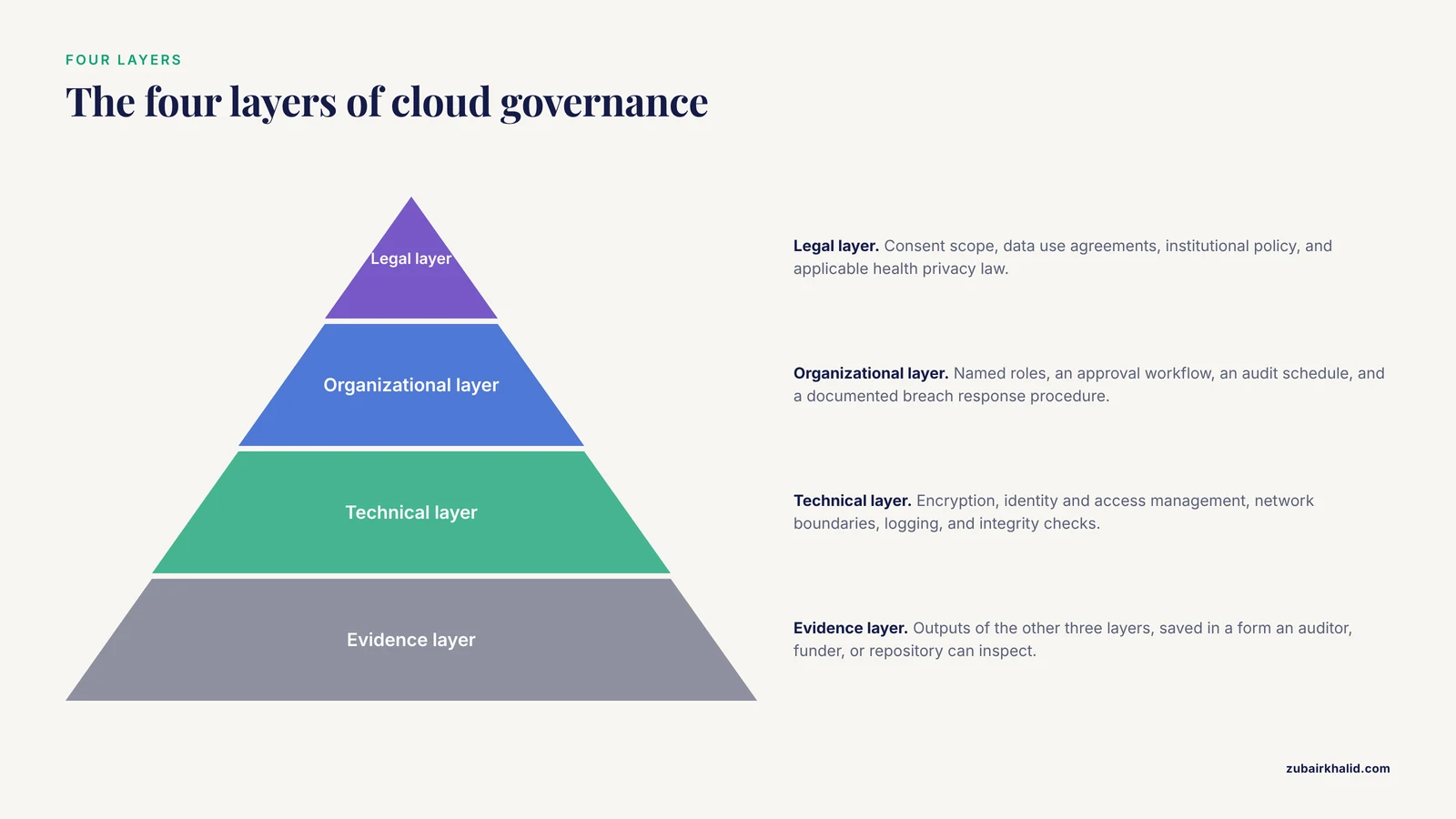
Practically, governance work in cloud bioinformatics divides into four layers:
- Legal and contractual layer. Consent scope, data use agreements, institutional policy, and applicable health privacy law.
- Organizational layer. Named roles, an approval workflow, an audit schedule, and a documented breach response procedure.
- Technical layer. Encryption, identity and access management, network boundaries, logging, and integrity checks.
- Evidence layer. The outputs of all three layers, saved in a form an auditor, funder, or repository can inspect.
Most migration projects fail at layer two. The engineering is learnable in a week. Getting a laboratory, a compliance office, and a data provider to agree in writing on who may do what with a dataset is the slow part, and it should start before you create a single bucket.
Core concepts and definitions
Data governance is the system of decision rights and accountability for data. It answers who decides, who is accountable, and on what documented basis.
Compliance is conformity to external requirements: statutes such as HIPAA for protected health information in the United States, funder policies for data sharing, institutional review conditions, and contractual terms in data use agreements.
Data stewardship is the day-to-day practice of managing data according to the governance decisions. In the genomic cloud literature, responsible data stewardship refers to the ethical and secure management, use, and protection of data to ensure its accuracy, privacy, integrity, and appropriate access throughout its lifecycle [1]. That definition is useful because every word maps to a technical control you can build:
| Stewardship goal from the definition | Concrete cloud control |
|---|---|
| Accuracy | Checksums at transfer and after every copy |
| Privacy | Encryption at rest and in transit, least-privilege access, de-identification where appropriate |
| Integrity | Versioning, object retention, change logging |
| Appropriate access | Identity policies, bucket policies, access review cadence |
| Throughout its lifecycle | Retention and deletion rules, disposition logs |
Controlled-access data is data released only to applicants who agree to stated use conditions. Most human genomic data from large consortia is controlled access. Open data carries no access restriction beyond attribution.
PHI means protected health information under HIPAA. Individual-level genomic sequence tied to an identifiable person is generally PHI when it arises in a covered healthcare context. De-identification, the removal or transformation of identifiers so data can no longer reasonably identify an individual, is a defined legal concept with specified methods, and your compliance office, not your pipeline, decides whether a dataset qualifies.
The research baseline: core outcomes of responsible stewardship
A recent scoping review in BMC Medical Genomics set out to define what responsible stewardship of human genomic data in the cloud actually requires. The authors searched the cloud governance and data sharing literature indexed in Web of Science and in the AI-assisted search tool Elicit, applied the scoping review approach of Arksey and O'Malley, and included 46 articles [1]. They then applied deductive thematic content analysis to generate outcome domains and individual core outcomes for cloud-based genomic data stewardship [1].
Three findings from that work matter directly for migration planning:
- The shift to cloud repositories represents a shift in privacy and security infrastructure as oversight becomes more globalized, which means a laboratory can no longer treat compliance as purely local [1].
- Stewardship is framed as an axis of trustworthiness. Repositories demonstrate trustworthiness through their data access and management practices, not through assertions about them [1].
- The outcome structure (domains plus individual core outcomes) gives you a defensible checklist skeleton. When you build your governance plan, organizing your controls around stewardship outcomes rather than around vendor features makes the plan portable across providers and audit frameworks.
The practical translation is simple. An auditor does not want to hear that your data is "secure in the cloud." An auditor wants to see the mechanism, the configuration evidence, and the review record. The rest of this article builds exactly that.
A reusable governance plan template
Before any transfer, write a short governance plan. This is the format that satisfies most internal reviews, funder data management expectations, and repository onboarding questionnaires, and you can complete it in about an hour per dataset. Save it as GOVERNANCE-plan.md in the project repository next to the code.
# Data Governance Plan: <DATASET NAME>

## 1. Dataset description
- What the data is: e.g., whole-genome sequence VCFs, 500 individuals
- Source and accession: e.g., dbGaP phsXXXXXX or internal study
- Data class: [Open | Controlled | PHI-containing]
- Consent scope: what participants agreed to, in one sentence

## 2. Approved uses
- Permitted analyses: e.g., germline variant calling, population statistics
- Explicitly forbidden uses: e.g., re-identification attempts, commercial use

## 3. Roles
- Data steward (accountable person): name, email
- Technical custodian (implements controls): name, email
- Authorized analyst roles and their access level: read-only, compute-only, admin

## 4. Environment
- Cloud account and region: e.g., prod account, us-east-1
- Storage location and encryption: e.g., S3 bucket, KMS CMK
- Network boundaries: e.g., VPC endpoints only, no public IPs

## 5. Access control
- Who approves access: process and expected turnaround
- How access is granted: IAM role, session duration, MFA requirement
- Access review cadence: e.g., quarterly review of IAM and bucket logs

## 6. Lifecycle
- Retention period and trigger for deletion
- Deletion method and evidence retained after deletion
- Exit plan: how data leaves the provider if the grant or contract ends

## 7. Incident response
- Definition of a reportable incident for this dataset
- Notification chain with names and phone numbers
- Where logs that support an investigation are kept

## 8. Change log
- Date, author, change
Treat this as a living document. Every time the plan changes, the change goes in section 8, and if the change affects access control, the corresponding IAM and bucket policies change in the same review.
Worked example: migrating a controlled-access genomics dataset to AWS
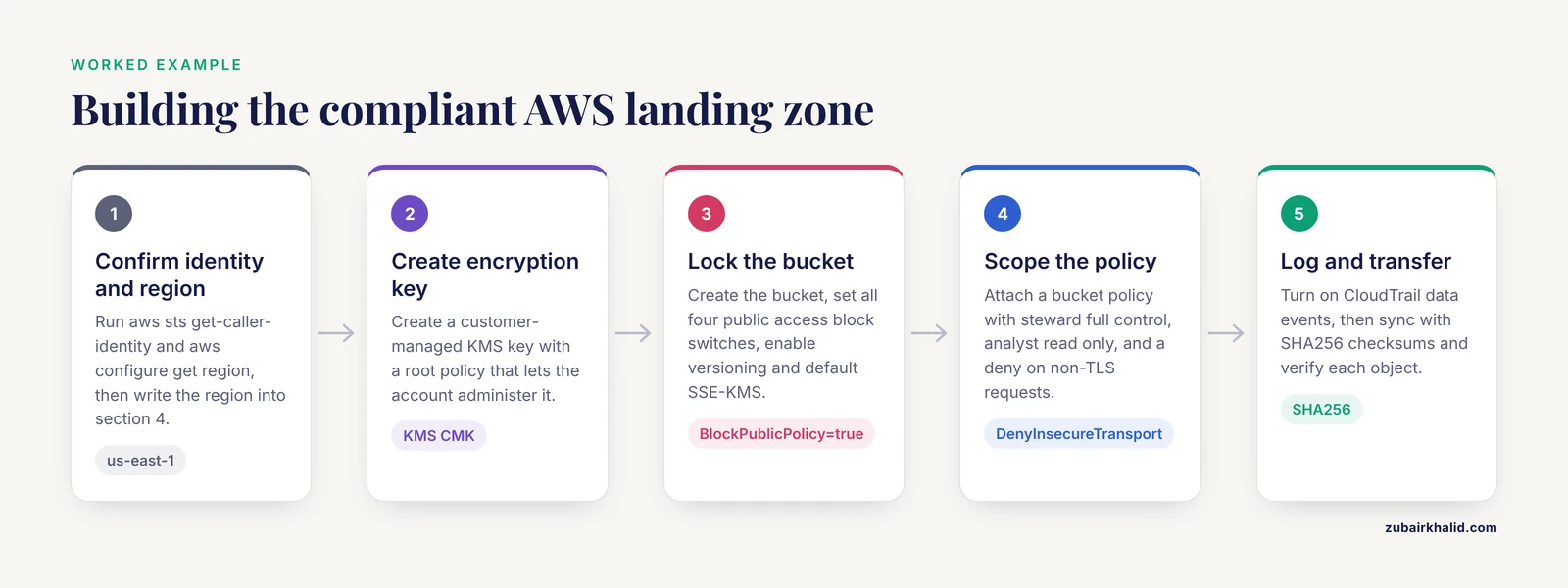
This walkthrough is the cloud migration compliance bioinformatics example for the rest of the article. It builds a compliant landing zone in AWS for controlled-access genomic data, using standard AWS CLI commands. All commands are reproducible. Replace bracketed placeholders with your own values.
Step 1. Confirm identity, account, and region
Never run governance commands without knowing exactly which account and region you are operating in.
aws sts get-caller-identityExpected output:
{
    "UserId": "AIDAEXAMPLE123456789",
    "Account": "123456789012",
    "Arn": "arn:aws:iam::123456789012/user/data-steward"
}
aws configure get regionIf this prints nothing, set a region explicitly:
aws configure set region us-east-1Choose the region based on where your data agreement and institutional policy permit the data to reside. Write that region into section 4 of your governance plan and never deviate from it silently.
Step 2. Create a dedicated encryption key
Customer-managed encryption keys give you control that provider-managed defaults do not. You can inspect the key policy, rotate on a schedule, and deny decryption to principals outside your account.
aws kms create-key \
  --description "Key for controlled-access genomics data" \
  --key-policy file://kms-root-policy.json
The initial key policy file must at minimum let the creating account administer the key. A minimal root policy looks like this:
{
  "Version": "2012-10-17",
  "Statement": [
    {
      "Sid": "EnableIAMUserPermissions",
      "Effect": "Allow",
      "Principal": {"AWS": "arn:aws:iam::123456789012:root"},
      "Action": "kms:*",
      "Resource": "*"
    }
  ]
}
Note the KeyId in the output. You will use it in the next steps.
{
    "KeyMetadata": {
        "KeyId": "1234abcd-12ab-34cd-56ef-1234567890ab",
        "KeyState": "Enabled",
        "Description": "Key for controlled-access genomics data"
    }
}
Step 3. Create the bucket and close every public door
aws s3api create-bucket \
  --bucket my-lab-genomics-prod \
  --region us-east-1
Then apply the public access block. This single call sets four independent switches that prevent common accident classes.
aws s3api put-public-access-block \
  --bucket my-lab-genomics-prod \
  --public-access-block-configuration \
  BlockPublicAcls=true,IgnorePublicAcls=true,BlockPublicPolicy=true,RestrictPublicBuckets=true
Each parameter matters:
BlockPublicAcls=truerejects any access control list that would grant public access.IgnorePublicAcls=truemakes existing public ACLs inert even if someone sneaks one in.BlockPublicPolicy=truerejects bucket policies that grant public access, evaluated at policy upload time.RestrictPublicBuckets=truelimits access for buckets that were ever public so that only authorized AWS principals get through.
Enable versioning next. Without it, an overwrite or a DeleteObject call silently destroys data, which violates the integrity commitment in the stewardship definition.
aws s3api put-bucket-versioning \
  --bucket my-lab-genomics-prod \
  --versioning-configuration Status=Enabled
Then set default encryption with your KMS key:
aws s3api put-bucket-encryption \
  --bucket my-lab-genomics-prod \
  --server-side-encryption-configuration \
  '{"Rules":[{"ApplyServerSideEncryptionByDefault":{"SSEAlgorithm":"aws:kms","KMSMasterKeyID":"1234abcd-12ab-34cd-56ef-1234567890ab"},"BucketKeyEnabled":true}]}'
BucketKeyEnabled=true reduces KMS request charges for the high-volume small-object writes typical of alignment and variant pipelines. That is a performance and cost optimization with no security downside, so turn it on.
Step 4. Attach a least-privilege bucket policy
The bucket policy is where governance becomes executable. The following template allows full control to the steward role, allows read and decrypt only to the analyst role, and denies any request that does not arrive over TLS. Denying non-TLS traffic matters because encryption at rest protects stored objects, while encryption in transit protects every read your analysts make.
{
  "Version": "2012-10-17",
  "Statement": [
    {
      "Sid": "StewardFullControl",
      "Effect": "Allow",
      "Principal": {"AWS": "arn:aws:iam::123456789012:role/data-steward"},
      "Action": "s3:*",
      "Resource": [
        "arn:aws:s3:::my-lab-genomics-prod",
        "arn:aws:s3:::my-lab-genomics-prod/*"
      ]
    },
    {
      "Sid": "AnalystReadOnly",
      "Effect": "Allow",
      "Principal": {"AWS": "arn:aws:iam::123456789012:role/genomics-analyst"},
      "Action": ["s3:GetObject", "s3:ListBucket"],
      "Resource": [
        "arn:aws:s3:::my-lab-genomics-prod",
        "arn:aws:s3:::my-lab-genomics-prod/*"
      ]
    },
    {
      "Sid": "DenyInsecureTransport",
      "Effect": "Deny",
      "Principal": "*",
      "Action": "s3:*",
      "Resource": [
        "arn:aws:s3:::my-lab-genomics-prod",
        "arn:aws:s3:::my-lab-genomics-prod/*"
      ],
      "Condition": {
        "Bool": {"aws:SecureTransport": "false"}
      }
    }
  ]
}
aws s3api put-bucket-policy \
--bucket my-lab-genomics-prod \
--policy file://bucket-policy.jsonThe DenyInsecureTransport statement is the one line in this file that auditors ask about most often, because a bucket that only allows HTTPS reads closes the most common accidental exposure vector left after permissions are reviewed.
Step 5. Create the analyst role with no more permissions than the policy promises
The analyst IAM role should mirror the bucket policy exactly. Anything broader than the bucket policy is dead weight, and anything the bucket policy forbids the role cannot grant anyway. Key elements:
s3:GetObjectands3:ListBucketon this bucket only, not onarn:aws:s3:::*.kms:Decryptandkms:GenerateDataKeyscoped to the specificKeyIdfrom step 2. Without these, every read and write fails even though the S3 permissions are correct. This is the single most common misconfiguration in encrypted genomics buckets.- No
s3:DeleteObject. Analysts transform data, stewards delete it.
Step 6. Turn on complete audit logging
Management events record API activity. Data events record reads and writes of the objects themselves. For controlled-access genomic data you need data events, because "who read patient-derived file X on date Y" is the question every review eventually asks.
aws cloudtrail create-trail \
  --name genomics-data-trail \
  --s3-bucket-name my-lab-genomics-logs \
  --is-multi-region-trail false

aws cloudtrail put-event-selectors \
  --trail-name genomics-data-trail \
  --event-selectors '[{"ReadWriteType":"All","IncludeManagementEvents":true,"DataResources":[{"Type":"AWS::S3::Object","Values":["arn:aws:s3:::my-lab-genomics-prod/"]}]}]'

aws cloudtrail start-logging --name genomics-data-trail
The logs bucket should itself have public access blocked, versioning enabled, and its own retention rule, since audit logs are the evidence layer and destroying them undermines everything else.
Step 7. Transfer the data with checksums
For a first migration, use the CLI with checksum verification so every object carries a provider-verifiable integrity value.
aws s3 sync ./raw-vcf/ s3://my-lab-genomics-prod/raw/vcf/ \
  --sse aws:kms --checksum-algorithm SHA256
Expected output during transfer:
upload: raw-vcf/sample_001.vcf.gz to s3://my-lab-genomics-prod/raw/vcf/sample_001.vcf.gz
upload: raw-vcf/sample_002.vcf.gz to s3://my-lab-genomics-prod/raw/vcf/sample_002.vcf.gz
Completed 12 objects, 4.2 GiB/4.2 GiB
Parameters that matter here:
-sse aws:kmsforces server-side encryption with your customer-managed key for these objects, overriding bucket defaults and making the intent explicit in the command history.-checksum-algorithm SHA256stores a full cryptographic hash with each object. SHA-256 is preferred over the legacy MD5-style ETag because multipart uploads make raw ETags useless as integrity checks.syncversuscp:synccompares source and destination and copies only differences, which makes reruns after a failure cheap and idempotent. Usesyncfor migrations,cpfor one-off single files.
For very large cohorts, sync is still fine, but consider aws s3 cp with -recursive from a staging account and keep the manifest of transferred keys in your governance record.
Step 8. Verify the migration
Verification has three parts, and all three should run in a script committed to the project repository so the check is repeatable.
First, confirm the security posture is what you intended:
aws s3api get-public-access-block \
  --bucket my-lab-genomics-prod \
  --query 'PublicAccessBlockConfiguration'
Expected output:
{
    "BlockPublicAcls": true,
    "IgnorePublicAcls": true,
    "BlockPublicPolicy": true,
    "RestrictPublicBuckets": true
}
aws s3api get-bucket-policy-status \
--bucket my-lab-genomics-prod \
--query 'PolicyStatus.IsPublic'Expected output: false. If this ever returns true, treat it as an incident under section 7 of your governance plan.
Second, confirm object-level integrity:
aws s3api get-object-attributes \
  --bucket my-lab-genomics-prod \
  --key raw/vcf/sample_001.vcf.gz \
  --object-attributes Checksum ObjectSize
Compare the returned SHA-256 against the value computed locally before upload:
sha256sum raw-vcf/sample_001.vcf.gzA mismatch means a corrupted or truncated transfer. Do not proceed to analysis until it resolves.
Third, confirm the audit trail is capturing data events. From another terminal, read one object, then search the trail:
aws cloudtrail lookup-events \
  --lookup-attributes AttributeKey=EventName,AttributeValue=GetObject \
  --max-results 5
You should see the GetObject event with the analyst role ARN and a timestamp. If the trail shows nothing, your event selectors from step 6 are wrong, and you are flying blind on the most important control in the stack.
Common errors with exact messages and fixes
An error occurred (AccessDenied) when calling the PutObject operation: Access Denied during upload despite correct S3 permissions. The role is missing kms:GenerateDataKey on the customer-managed key. Add that action scoped to the KeyId from step 2 to the role policy.
An error occurred (AccessDeniedException) when calling the Decrypt operation when analysts try to read. Same root cause on the read path: add kms:Decrypt scoped to the key. Do not grant kms:* on all keys. Scope it to the single key.
An error occurred (BucketAlreadyExists) when calling the CreateBucket operation. Bucket names are globally unique across all AWS customers. Add your institution or laboratory prefix, for example ucsf-my-lab-genomics-prod, and retry.
An error occurred (AccessDenied) when calling the PutBucketPolicy operation mentioning public policies after you enabled BlockPublicPolicy. This is the guardrail working. Your draft policy contains a statement that grants public access, most often a Principal: "*" with an Allow effect. Fix the policy, not the guardrail.
InvalidRequest when calling put-object-lock-configuration. Object Lock requires versioning to be enabled first. Run the put-bucket-versioning command, then retry.
Access Denied on aws s3 sync against an endpoint in a VPC with no internet route. Your VPC endpoint policy or route table is blocking the S3 gateway endpoint. Check that the endpoint policy allows the bucket ARN and that the subnet route table includes the endpoint.
Compliance mapping: from obligation to evidence
The table below is the artifact you bring to an audit or a data provider's onboarding questionnaire. Each row links a stewardship obligation to a control and to the command that proves the control is on.
| Control objective | Mechanism in this architecture | Evidence command |
|---|---|---|
| No public exposure | Four-part public access block plus restrictive bucket policy | aws s3api get-public-access-block, bucket BUCKET |
| Encryption at rest | Default SSE-KMS with customer-managed key | aws s3api get-bucket-encryption, bucket BUCKET |
| Encryption in transit | Bucket policy deny on aws:SecureTransport = false | aws s3api get-bucket-policy, bucket BUCKET |
| Least privilege | Role-scoped IAM policies matching bucket policy | aws iam get-role-policy, role-name genomics-analyst, policy-name read-only |
| Audit trail | CloudTrail trail with S3 object-level data event selectors | aws cloudtrail get-event-selectors, trail-name genomics-data-trail |
| Integrity | SHA-256 checksums stored per object at upload | aws s3api get-object-attributes, bucket BUCKET, key KEY, object-attributes Checksum |
| Recovery and immutability | Versioning, optionally Object Lock in compliance mode | aws s3api get-bucket-versioning, bucket BUCKET |
| Accountability over time | Quarterly access review with findings logged in the governance plan | Signed review record in the repository |
Run the evidence commands on a schedule, for example as a monthly GitHub Actions job or cron job, and store the output. Automated evidence collection converts an audit that would take a week of screenshots into an afternoon of reading logs.
Where AWS genomics services fit
The architecture above is provider-neutral in principle and concrete in AWS terms, which is why AWS genomics tooling is a natural fit for this pattern. Raw reads and variant calls live in S3 under the controls described here. Analysis runs where the data lives: AWS Batch for embarrassingly parallel jobs across samples, or a workflow engine such as Nextflow or WDL-based Cromwell pointed at spot-backed compute, or a managed service such as Amazon HealthOmics for ready-made genomics workflows. Query layers such as Amazon Athena can sit over metadata manifests so analysts explore cohort structure without ever copying the underlying VCFs across a network boundary.
Two governance rules keep this layer clean. First, compute resources get access through the same least-privilege analyst role, never through long-lived access keys embedded in containers. Second, any derived data, for example normalized BAM files or joint-called VCFs, inherits the dataset's data class. Write the derived-data destination into the governance plan so outputs do not quietly accumulate in a general-purpose bucket that lacks the same controls.
Common Mistakes and Limitations
Migrating first, governing later. The most expensive mistake in cloud bioinformatics is transferring data into a permissive environment and tightening it afterward. Public exposure during the gap is permanent from a trust perspective even if it lasts an hour. Build the bucket, policies, and logging before the first byte moves.
Treating a business associate agreement as a technical control. A signed agreement with a cloud provider establishes legal accountability. It does not stop a misconfigured bucket. Both layers are required and neither substitutes for the other.
Granting broad access for convenience. s3: on arn:aws:s3:: with a wildcard principal is how laboratories end up explaining themselves to compliance officers. Scope every policy to a named bucket and a named role. The time cost is minutes, and the policies stay readable.
Forgetting that derived data is regulated data. A pile of normalized expression matrices derived from identifiable genotypes inherits the source data's obligations. If your governance plan only names the raw files, your compliance perimeter is wrong.
Assuming encryption equals access control. Encryption protects against storage-layer exposure. It does nothing to stop an authorized analyst from downloading data they are authorized to read but not permitted to use. The use restrictions live in data use agreements and in your monitoring of access logs, and the cloud governance literature treats aligning authorized access with ethical use as a distinct stewardship responsibility for exactly this reason [1].
No deletion story. Every data use agreement has an end. If you cannot demonstrate that you can delete the data and prove deletion, you cannot sign the agreement honestly. Test the deletion path with synthetic data, including versioned objects and delete markers.
Over-engineering before a single analysis exists. The inverse mistake is real too. A two-person laboratory planning a pilot does not need a multi-account enterprise topology on day one. It needs public access blocked, encryption on, logging on, and a named steward. Add federation, custom key policies, and automated evidence collection as the project grows.
A note on limits. This article describes standard patterns and commands, but your institution's compliance office owns the final interpretation of what your dataset requires, and individual datasets, agreements, and IRB conditions vary enough that no template can substitute for that local review.
Frequently Asked Questions
What does cloud migration compliance mean in bioinformatics?
It means that the legal, organizational, and technical controls governing a dataset keep working after the dataset moves from local infrastructure to a shared cloud environment, and that you can demonstrate each control with evidence rather than assurances.
Is moving genomic data to the cloud more or less secure than a local server?
Done with the controls in this article, it is generally more secure, because shared cloud environments provide managed encryption, logging, and access controls that individual laboratories rarely implement well on their own, and current research frames the migration as a shift in privacy and security infrastructure [1].
What is responsible data stewardship?
It is the ethical and secure management, use, and protection of data to ensure accuracy, privacy, integrity, and appropriate access throughout the data lifecycle, a definition drawn from the genomic data stewardship literature [1].
How do I make sure a genomics bucket is never public?
Set all four components of the S3 public access block, attach a bucket policy with no public principals, and verify with get-public-access-block and get-bucket-policy-status on a schedule.
What should a cloud migration compliance template include?
At minimum: data class and consent scope, approved and forbidden uses, named roles, environment and encryption details, the access approval process, retention and deletion rules, an incident response chain, and a change log, in the format shown earlier.
How do I verify data integrity after a large transfer?
Compute a SHA-256 checksum locally, request the stored checksum with aws s3api get-object-attributes, and compare the two values for every object or for a sampled set on a recurring basis.
Who is responsible when several institutions share one cloud workspace?
Every party is accountable for its own users and roles, while a single named data steward from the data-providing institution should own the access approval process, which is why the governance plan assigns roles by name rather than by group.
How often should cloud access to genomic data be reviewed?
Quarterly is a defensible default for controlled-access data, with an immediate review triggered by personnel changes, new analysis aims, or any security event.