Cloud Genomics Platforms Comparison
By Dr. Zubair Khalid, DVM, MS, PhD ·

The real difference between cloud genomics platforms is not the science they run, since BWA-MEM, GATK, and BCFtools behave the same everywhere, but who owns the orchestration layer, how you pay for compute, and where the compliance boundary around your data sits. The rule of thumb for choosing is simple. If your team can write and maintain workflows in a language like WDL, Nextflow, or Snakemake, a raw cloud provider plus a workflow engine gives you the lowest marginal cost and the most control. If your team is small or clinical turnaround matters more than cost optimization, a managed science platform trades some flexibility for speed to the first result.
This guide compares the main cloud genomics platforms and deployment patterns using published evidence rather than vendor marketing. Every platform below has been used for real, published genomic analyses, so the pros and cons come from documented production experience, not from feature lists.
What a Cloud Genomics Platform Actually Provides
Before comparing options, define the moving parts. Cloud bioinformatics stacks the same components regardless of vendor.
Storage. Object storage such as Amazon S3, Google Cloud Storage, or Azure Blob Storage holds FASTQ files, BAM or CRAM alignments, reference genomes, and VCF (variant call format) outputs. VCF is the standard text format for recording genetic variants, and one analysis of a single human genome can produce tens of millions of variant records [1].
Compute. Virtual machines or containers execute the pipeline steps. A container is a packaged unit of software and dependencies that runs identically on any host, which is what makes results reproducible across machines and across cloud providers [2].
Workflow orchestration. A workflow management system (WfMS) chains hundreds of individual tasks into a directed acyclic graph, a structure where tasks flow one direction with no circular dependencies. Cromwell, Snakemake, and StreamFlow are WfMS examples that appear in the published cloud genomics literature [2][3].
Serverless functions. These are short-lived, event-triggered code executions where the provider manages all servers. You pay per invocation and per millisecond rather than per machine-hour. Serverless technology combined with container orchestration underpins at least one population-scale production system processing thousands of whole genomes per month [5].
Secondary and tertiary analysis. Secondary analysis converts raw sequencing reads into aligned genomes and variant calls. Tertiary analysis interprets those variants, for example against electronic health records. Cloud platforms increasingly support both, including tertiary analysis inside cloud-hosted notebooks [3].
The Main Cloud Genomics Platforms Comparison Options
The comparison below covers six deployment options that map to how genomics groups actually work. Each is described on its own terms first, then compared side by side.
AWS With Serverless and Container Orchestration
Amazon Web Services is the most heavily documented environment for population-scale genomics in the peer-reviewed literature. The clearest example is Celeste, the open-source cloud infrastructure built for the All of Us Research Program, one of the world's largest sequencing efforts targeting genetic data for more than one million individuals from diverse backgrounds [5].
Celeste runs within a single AWS Region and pairs serverless technology with container orchestration. Its production numbers give a sense of what this pattern sustains. In 12 months of operation, roughly 200 million serverless function invocations and more than 20 million messages coordinated 1.8 million bioinformatics, quality control, and clinical reporting jobs. The system routinely processed fluctuating workloads of up to 9,000 whole-genome sequencing (WGS) samples per month, where WGS means sequencing that covers the entire human genome rather than only selected regions [5].
The AWS genomics pattern suits teams with engineering capacity. You assemble the orchestration yourself from primitives like event-driven functions, queues, and managed Kubernetes or container services. The reward is nearly unlimited elasticity and fine-grained cost control. The cost is that you own availability, retries, monitoring, and every operational failure mode. Celeste demonstrates that this ownership model works at extraordinary scale, but it required a dedicated engineering organization to build and run [5].
Azure With Managed Workflow Execution
Microsoft Azure takes a different shape in the genomics literature. A documented pipeline pairs Cromwell, an open-source workflow engine originally built around the WDL language, with Azure execution for long-read PacBio HiFi sequencing data. The same pipeline ingests clinical data in FHIR format, the leading interoperability standard for electronic health record exchange, and merges both data types in a single scalable pipeline [3].
The distinctive Azure capability in this example is the tight coupling of genomic and clinical data. Tertiary analyses run securely in cloud-based Jupyter notebooks, with worked examples including exporting patient information to a database, clustering patients, and performing a pharmacogenomic study [3]. If your project sits at the intersection of sequencing data and health records, Azure's health data tooling deserves a close look.
Google Cloud Platform With Open-Source Modular Pipelines
The Google Cloud Platform (GCP) evidence base centers on reproducible, multi-site clinical research. The Cancer Immune Monitoring and Analysis Centers and Cancer Immunologic Data Center (CIMAC-CIDC) network, which harmonizes molecular assays for cancer immunotherapy trials, rebuilt its whole exome sequencing (WES) and RNA-Seq pipelines on GCP using Snakemake workflows packaged in Docker containers [2]. WES sequences only the protein-coding exome, roughly 1 to 2 percent of the genome, at high depth.
Two design choices stand out. First, the team used exclusively open-source tools, so no component is locked to one vendor. Second, the pipelines are modular, meaning individual steps can be swapped as bioinformatics standards evolve without rewriting the whole system. Benchmarking against validated truth sets showed improved reproducibility, precision, and recall for variant calling, transcript quantification, and fusion detection after the migration [2]. This matters because the network migrated between organizations, and the containerized design let the workflows survive that move intact.
Managed Science Platforms on Top of Raw Cloud
A managed science platform provides a web interface, prebuilt pipeline catalogs, provenance tracking, and billing dashboards on top of an underlying cloud. The classic documented example is the 2015 variant calling study that deployed the Real Time Genomics population caller on the Amazon cloud through the DNAnexus platform [1].
That study remains one of the best cost data points in the public literature for cloud variant calling. The team called variants jointly across 2,535 samples from Phase 3 of the 1000 Genomes Project, identifying 68.3 million variants. By running the work in parallel, the data was processed within 5 days at a compute cost of $7.33 per sample. The total came to $18,590 for completed jobs and $21,805 for all jobs launched, including failures. The authors concluded that given near-linear scalability, cloud computing is a cheap and efficient platform for analyzing even larger sequencing studies [1].
The managed platform trade is straightforward. You pay a platform fee or premium on top of raw compute in exchange for not hiring infrastructure engineers. For a group running occasional analyses, that premium is usually cheaper than the salary of the person who would otherwise maintain the cluster.
Hybrid Cloud-HPC Configurations
Not every group can or should abandon on-premises high-performance computing (HPC). The hybrid pattern splits a pipeline so that each stage runs in the environment that suits it best. A documented implementation used the StreamFlow workflow management system to coordinate a variant calling workflow across cloud and HPC environments, comparing it against Snakemake, an established WfMS targeting HPC facilities [4].
The measured outcome was that StreamFlow matched Snakemake performance when both ran on a single environment and delivered satisfactory improvements in a hybrid cloud-HPC configuration [4]. The motivation traces back to lessons from the COVID-19 pandemic, where result speed mattered enormously and no single environment was optimal for every heterogeneous tool in an NGS pipeline. If your institution already owns an HPC cluster with idle capacity, a hybrid setup can reduce cloud spend while keeping burst capacity available.
Free Public Infrastructure for Continuous Benchmarking
A final option that many teams overlook is running genomics workloads entirely on free public services. NCBench, a continuous benchmarking platform for DNA sequencing variant calling, runs completely on GitHub, GitHub Actions, and Zenodo, all free tiers of public infrastructure combined with open-source tools [6].
NCBench evaluates small variant callsets for recall, precision, and error patterns, and its authors used it to assess more than 40 callsets from various pipelines across three exome datasets at different coverages. It is deliberately agnostic about the dataset and can evaluate an arbitrary number of submitted callsets with interactive visual reporting [6]. This pattern will not run your production WGS pipeline, but it is a legitimate home for benchmarking, validation, and reproducible method comparison, which is a large share of the ongoing compute in many labs.
Side-by-Side Platform Comparison
The table below condenses the comparison into the dimensions that decide real projects. Every row is grounded in a published deployment.
| Option | Deployment model | Documented tooling | Documented evidence | Pros | Cons |
|---|---|---|---|---|---|
| AWS serverless and containers (Celeste pattern) | You build orchestration from cloud primitives | Serverless functions, container orchestration, open-source architecture [5] | 9,000 WGS samples per month, 200M function calls and 1.8M jobs in 12 months within one AWS Region [5] | Near-unlimited elasticity, proven at population scale, open-source design | Requires serious engineering staff, you own all operations |
| Azure managed workflows | Provider-managed execution engine | Cromwell, PacBio HiFi long reads, FHIR clinical data, Jupyter notebooks [3] | Full raw-data-to-tertiary-analysis pipeline demonstrated on real clinical formats [3] | Strong fit for genomic plus EHR projects, notebook-based tertiary analysis | Fewer published population-scale genomics case studies |
| GCP with open-source workflows | Your Snakemake or Nextflow code, containers, managed storage | Snakemake, Docker, open-source tools only [2] | CIMAC-CIDC cancer immunotherapy trial pipelines with improved reproducibility, precision, and recall [2] | Excellent reproducibility, modular design survives organizational migration, no vendor-locked tools | You maintain the workflow code and container images |
| Managed science platform (DNAnexus pattern) | Web platform on top of raw cloud | Real Time Genomics population caller on Amazon cloud via DNAnexus [1] | 2,535 genomes, 68.3M variants, 5 days, $7.33 per sample [1] | Fastest path to results, no infrastructure hiring, proven joint-calling economics | Platform premium over raw compute, less infrastructure control |
| Hybrid cloud-HPC | Split execution across environments | StreamFlow WfMS compared against Snakemake [4] | Comparable single-environment performance, improvements in hybrid configuration [4] | Uses existing HPC investment, cheaper for long-running stages, burst capacity on demand | Two environments to manage, workflow must support cross-site data movement |
| Free public infrastructure | CI-style continuous jobs | GitHub, GitHub Actions, Zenodo, open-source benchmarking tools [6] | Over 40 callsets evaluated across three exome datasets [6] | Zero direct cost, fully open and reproducible, continuous re-evaluation | Not suitable for production WGS at scale, execution limits of free tiers |
How to Compare Platforms on the Criteria That Decide Real Choices
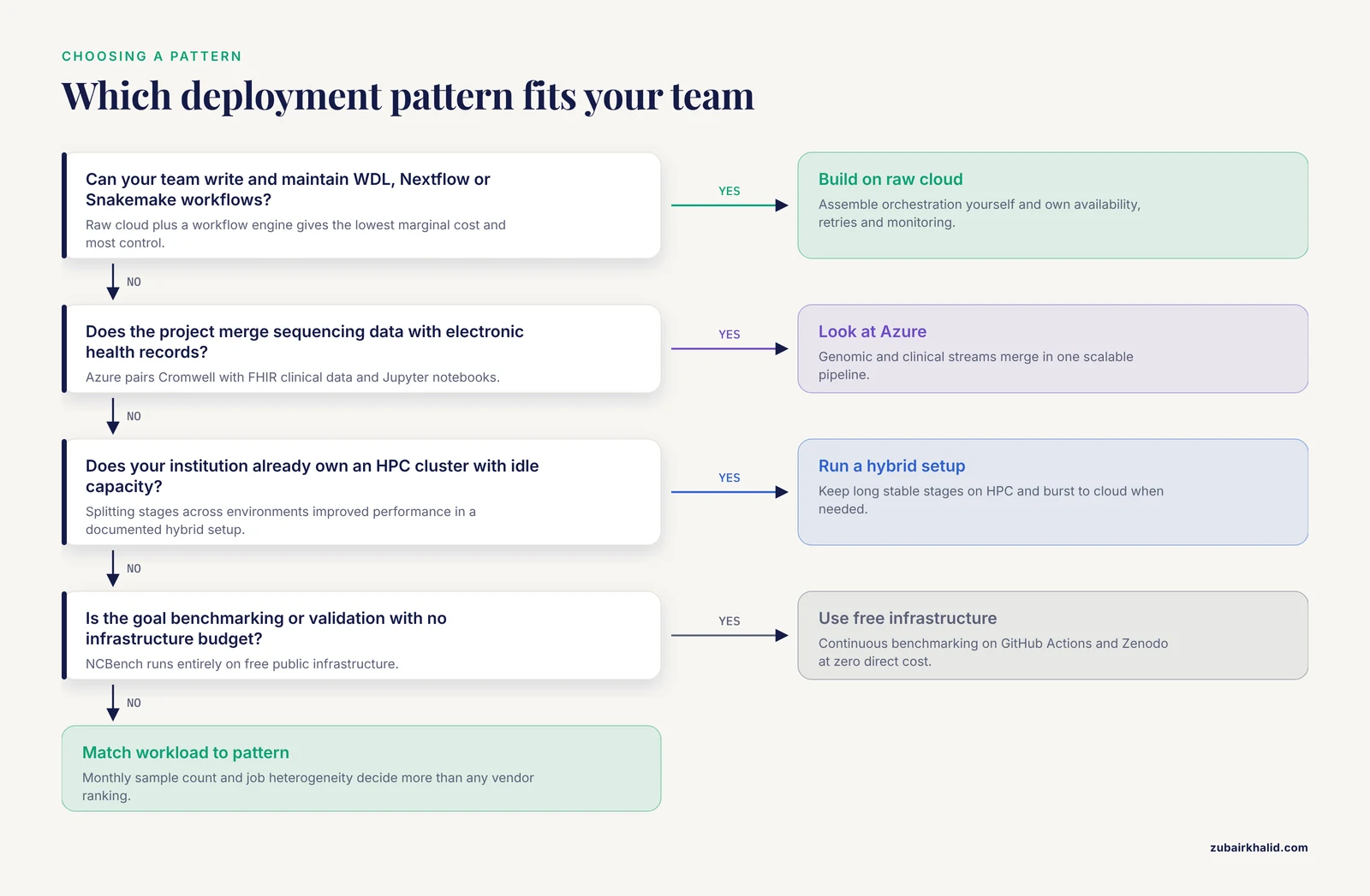
Vendor feature lists hide the differences that actually matter. Evaluate any candidate platform on these six criteria.
Cost Model and Scaling Behavior
Three cost structures dominate cloud bioinformatics. Raw cloud bills you per machine-hour, which rewards engineers who can pack work efficiently. Serverless bills per invocation and execution time, which rewards event-driven and bursty workloads, and the Celeste architecture shows the model scales to hundreds of millions of monthly invocations [5]. Managed platforms bill compute plus a platform layer, which the 1000 Genomes analysis showed can still deliver whole-genome variant calling at $7.33 per sample when the pipeline parallelizes well [1].
The scaling behavior of your pipeline matters more than the platform price list. The 1000 Genomes analysis found near-linear scalability between data size and cost, which is why the authors projected the same economics for larger studies [1]. Before committing to any platform, measure the cost of running your actual pipeline on 10 samples and extrapolate, because the per-sample figure, not the sticker price, determines your budget.
Portability and Lock-In
Pipelines written against open tools port freely. The CIMAC-CIDC work shows the practical value, since Snakemake and Docker pipelines moved between organizations without losing benchmark performance [2]. The theoretical grounding is older. Work on representing variant call format data as directed acyclic graphs demonstrated how genome analysis can be structured for efficient and cost-effective cloud execution [7], and the functional equivalence framework shows that independent groups can run different pipelines yet produce harmonized, interchangeable results when they follow shared processing standards [8].
Lock-in concentrates in two places. Proprietary accelerated pipelines tie you to specific hardware availability in specific regions. Platform-specific catalogs and interfaces create retraining and migration costs. Neither is disqualifying, but both should be priced into the decision.
Functional Equivalence and Reprocessing Costs
The most expensive mistake in cloud genomics is inconsistency between pipelines. Different WGS processing pipelines cause substantial differences in variant calling when datasets are combined, which historically forced computationally expensive reprocessing of everything. The functional equivalence (FE) framework, developed across five genome centers and NIH programs, defines processing standards that let different groups produce equivalent results with significantly less variability than sequencing replicates [8]. When you compare platforms, ask how each one helps you prove that a run yesterday matches a run today and that your results match a collaborator's results. A platform with strong provenance and versioned containers makes functional equivalence achievable. A loosely governed cluster makes it a permanent struggle.
Data Governance and Clinical Use
Clinical genomics changes the evaluation entirely. A laboratory developed test (LDT) must demonstrate consistent analytical performance, and benchmarking depends on hardware, operating system, and software libraries, which makes assessments unreliable when any underlying dependency changes. A cloud-based benchmarking workflow designed for this problem is independent of the technician executing it and the underlying compute hardware, so performance can be continually re-assessed across regions of interest and benchmarking samples [9]. For clinical groups, that property, reproducibility of the assessment itself, is a primary selection criterion, ahead of raw cost.
Interaction With the Variant Calling Stack
The platform choice interacts with the pipeline you run on it. Benchmarking studies consistently show that no single variant caller wins everywhere. In a benchmark of seven widely used tools on the well-characterized NA12878 genome from the Genome in a Bottle consortium, DeepVariant's deep learning approach achieved the highest precision (0.7869) and F1-score (0.8754) on a chromosome 20 subset, while on full whole-genome data Strelka2 led on precision (0.8326) and Octopus on recall (0.9838), with the authors concluding there is no universally superior variant caller [10].
That finding has platform consequences. GATK HaplotypeCaller showed the highest accuracy and sensitivity among pipelines tested on monozygotic twin genomes at 30x and 60x coverage, but demanded exceptionally high computational resources, while the DRAGEN read aligner combined with BCFtools achieved the best balance of accuracy and computational efficiency with minor specificity tradeoffs [11]. DRAGEN is a hardware-accelerated platform, and its highly efficient execution speed makes it a strong performer for large-scale WGS analysis, with DRAGEN and DeepVariant showing comparable high F1-scores for SNP and indel calling [12]. On cloud platforms, hardware-accelerated options change which instance types you rent and how many concurrent jobs fit your budget, so caller benchmarks belong in the platform decision, not after it.
The same logic applies upstream at the read mapping step. Across germline panel analyses, BWA-MEM was recommended for alignment, and interval padding, meaning extending target regions by 50 or 100 base pairs, proved necessary for detecting intronic spliceogenic pathogenic variants, which a commercial pipeline at default settings missed, including a missense pathogenic variant in TP53 [13]. In whole exome work, BWA and Novoalign aligners paired best with DeepVariant and SAMtools for SNVs and with DeepVariant and GATK for indels [14]. A platform that makes it easy to pin tool versions and swap pipeline components directly affects your variant accuracy, not just your convenience.
Scale Ceiling and Workload Shape
Match the platform to your workload shape. Fluctuating workloads of up to 9,000 WGS samples per month with mixed job types ran successfully on the serverless-plus-orchestration pattern [5]. A fixed batch of 2,535 genomes ran efficiently on a managed platform with embarrassingly parallel task structure [1]. A small benchmarking operation runs free on continuous integration infrastructure [6]. Your monthly sample count, job heterogeneity, and tolerance for operational work determine which pattern fits, more than any intrinsic ranking of cloud vendors.
Worked Scenarios
Abstract criteria become decisions through concrete situations. These five scenarios cover the most common real situations.
Scenario 1: A Research Group Joint-Calling Thousands of Genomes
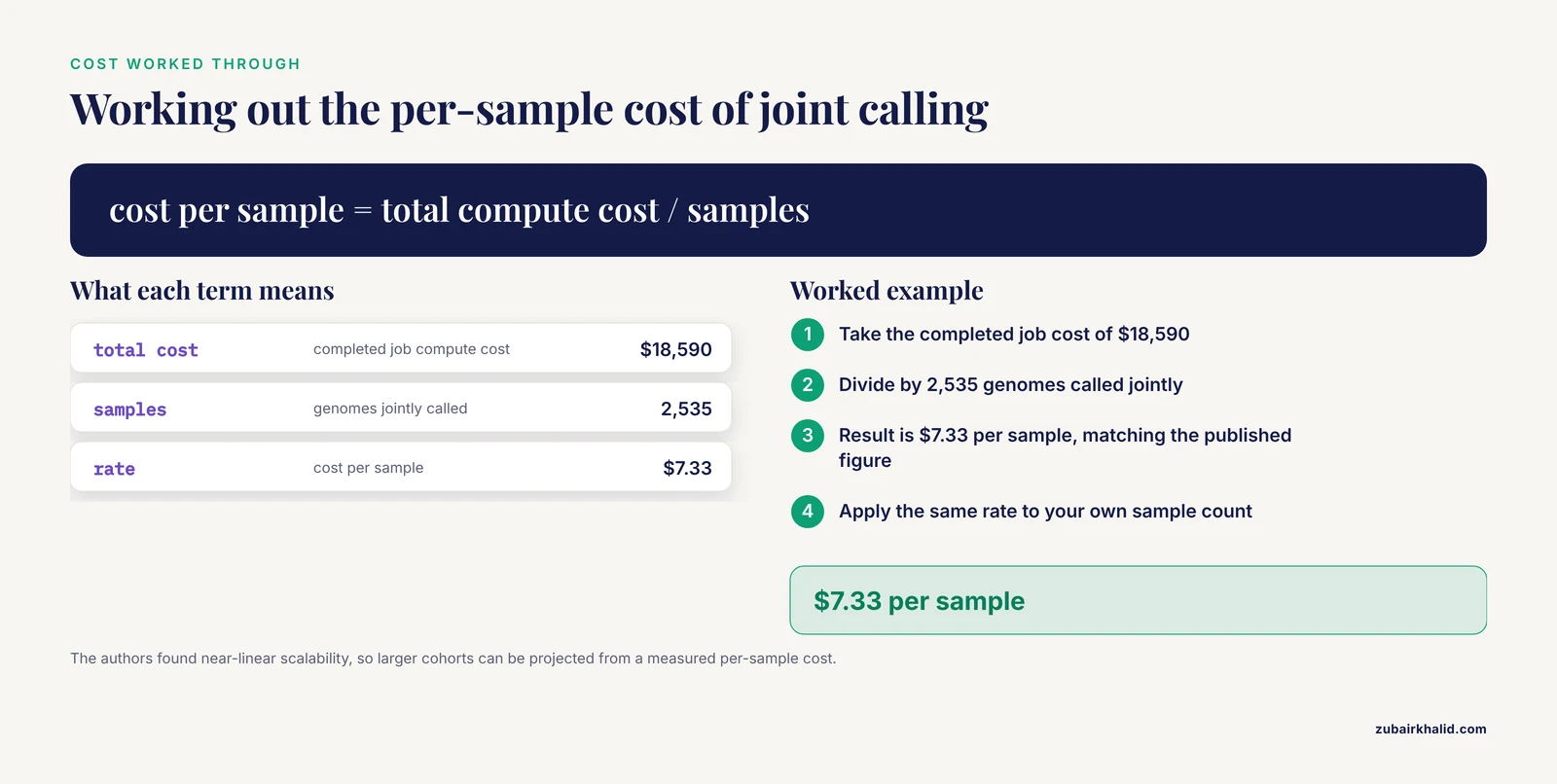
You have 3,000 short-read WGS samples and want a joint variant callset. The documented precedent is direct. The Real Time Genomics population caller processed 2,535 genomes from the 1000 Genomes Project in 5 days for $7.33 per sample, identifying 68.3 million variants, with total job costs of $18,590 for completed work [1]. At that rate, 3,000 samples lands in the low five figures for compute. A managed platform on raw cloud or GCP with your own Snakemake pipeline both reach the same result, and the choice reduces to whether your team wants to maintain infrastructure. Given the demonstrated near-linear scalability, budget projections for larger cohorts can extrapolate from your measured per-sample cost [1].
Scenario 2: A National Program With Continuously Arriving Samples
You operate a program where thousands of new genomes arrive monthly alongside QC and clinical reporting jobs. This is the Celeste situation. The serverless and container orchestration pattern absorbed workloads of up to 9,000 WGS samples per month, coordinated around 200 million serverless functions and over 20 million messages annually, all within a single AWS Region [5]. The lesson for platform selection is that serverless architecture suits fluctuating, event-driven genomics workloads, and that a single-region design was sufficient at this scale. Building this yourself requires sustained engineering investment, which is exactly why the All of Us program published the architecture as open source for other large-scale efforts to reuse [5].
Scenario 3: A Multi-Site Clinical Trial Network
You coordinate biomarker analysis across several hospitals and trial sites, and the network itself may change hands. The CIMAC-CIDC network faced exactly this, including migration to the National Cancer Institute, and solved it with modular Snakemake and Docker workflows on GCP built from open-source tools. Benchmarking showed improved reproducibility, precision, and recall across validated truth sets for variant calling, transcript quantification, and fusion detection [2]. For multi-site work, the ability of containerized workflows to survive organizational migration is the decisive platform feature, and it costs nothing extra to design for it from day one.
Scenario 4: Long-Read Sequencing Combined With Health Records
You sequence with PacBio HiFi long reads and want to connect variants to electronic health data. The documented Azure pattern runs Cromwell on Azure for the long-read variant calling, stores clinical data in FHIR format, merges both streams in one scalable pipeline, and performs tertiary analysis in cloud-hosted Jupyter notebooks, with worked examples spanning database export, patient clustering, and a pharmacogenomic study [3]. If your project is primarily genomic, this integration is a nice-to-have. If your project is clinical decision support, it is the core requirement and should drive the platform choice.
Scenario 5: A Small Lab Validating Its Pipeline
You are a two-person lab that needs to know how your variant calling pipeline performs, with no budget for infrastructure. The NCBench approach demonstrates that recall, precision, and error-pattern evaluation can run entirely on free public infrastructure, with more than 40 callsets evaluated across three exome datasets and results reported interactively [6]. Combine this with the lesson from the de novo mutation benchmarking work, where different pipelines showed distinct tendencies to detect variants in genomic regions with different GC content, and where read coverage at mutation positions served as an effective index for filtering high-confidence calls [15]. Free continuous benchmarking catches those systematic biases before they surprise you in a real dataset.
Common Mistakes and Limitations
These are the errors that show up repeatedly in published benchmarking and migration studies.
Assuming one variant caller is best. The largest benchmark of seven popular callers on NA12878 concluded there is no universally superior variant caller, with DeepVariant leading precision on a chromosome subset, Strelka2 leading whole-genome precision, and Octopus leading recall [10]. Choose callers per project, and record why.
Benchmarking only on aggregate metrics. Performance is not uniform across genomic regions and variant types [9]. A pipeline with excellent overall F1 can still miss the specific spliceogenic variants that matter in your panel, as happened with intronic pathogenic variants and a TP53 missense variant under a commercial pipeline at default settings [13]. Always benchmark against your regions of interest.
Ignoring GC content bias when comparing pipelines. Different pipelines show specific tendencies to detect de novo single-nucleotide variants in genomic regions with different GC content, so a pipeline that looks weak overall may simply behave differently across compositionally distinct regions [15]. Compare pipelines region by region, not just in aggregate.
Underestimating the cost of pipeline divergence. When different groups process genomes with different pipelines, combined analysis suffers substantial variant calling differences that force expensive reprocessing [8]. Agree on functional equivalence standards with collaborators before sequencing, not after.
Assuming results transfer unchanged across instruments and callers. A systematic comparison of 27 combinations of sequencing platforms and variant calling pipelines across five Illumina-ecosystem instruments found good SNP calling everywhere, with F-scores above 0.96 for exomes and above 0.975 for WGS, but indel performance varied widely, from 0.71 to 0.93 in WGS, and divergence was larger in WGS than in exomes [16]. Validate your exact combination.
Treating HPC and cloud as substitutes rather than complements. HPC is not always the most suitable environment for every stage of a pipeline involving many heterogeneous tools, and splitting execution across environments improved performance in a documented hybrid setup [4]. Dismissing either environment wholesale leaves savings on the table.
Letting benchmarking environments drift. Analytical benchmarking methods depend on hardware, operating system, and software libraries, so results cannot be reliably repeated when dependencies change [9]. Containerize your benchmarking the same way you containerize your production pipeline, following the practice demonstrated in multi-site clinical work [2].
Forgetting that storage and data movement are part of the bill. Every platform in this comparison moves multi-gigabyte files between storage and compute thousands of times per analysis. The published per-sample cost figures [1] reflect efficient parallel designs, and a poorly structured pipeline can spend far more on data movement than on the compute itself. Model the full data flow, not just the compute tasks.
Overlooking platform-specific caller performance. The DRAGEN platform's combination of accuracy, flexibility, and highly efficient execution speed made it the superior performer for large-scale WGS analysis in a head-to-head evaluation against GATK and DeepVariant [12]. If an accelerated option exists on your chosen platform, benchmark it, because it can change your cost per genome substantially.
Frequently Asked Questions
What is a cloud genomics platform?
A cloud genomics platform is a combination of storage, compute, workflow orchestration, and often a managed interface that lets you run sequencing analysis pipelines, such as variant calling on whole-genome or whole-exome data, without owning hardware. Published deployments range from self-assembled serverless architectures on AWS to managed platforms and free public benchmarking infrastructure [5][1][6].
Which cloud genomics platform is the best?
There is no single best platform, and the honest answer depends on your team and workload. Engineering-heavy groups processing thousands of genomes per month have proven the AWS serverless pattern at population scale [5], clinical trial networks have succeeded with modular open-source pipelines on GCP [2], and small groups reach results fastest on managed platforms or free infrastructure [1][6]. Evaluate candidates against cost model, portability, governance needs, and workload shape rather than vendor rankings.
How much does cloud-based variant calling cost?
The most cited public figure comes from joint variant calling of 2,535 genomes from the 1000 Genomes Project, which cost $7.33 per sample in compute, processed within 5 days, for a total of $18,590 for completed jobs [1]. Costs scale roughly linearly with data size in well-designed pipelines [1], so measure your own pipeline on a small batch and extrapolate from the measured per-sample cost.
Can I move my pipeline between cloud platforms later?
Yes, if you build for portability. Pipelines written in open workflow languages and packaged in containers have been migrated between organizations while maintaining benchmarked reproducibility, precision, and recall [2]. Shared processing standards also allow different groups to produce functionally equivalent results even when they use different pipelines [8]. Lock-in risk concentrates in proprietary accelerated tools and platform-specific interfaces, so document where those appear in your architecture.
Do I need to benchmark my variant calling pipeline even if it is well known?
Yes. Published benchmarks show that no caller is universally superior, with different tools leading on precision and recall across datasets [10], and that pipelines differ in behavior across genomic regions with different GC content [15]. Cloud-based benchmarking workflows let you assess performance continuously and independently of the hardware and technician, which is especially valuable for clinical applications [9], and open platforms make this possible even on free infrastructure [6].
Should I use cloud computing or my institution's HPC cluster?
Use both if you can. A documented hybrid workflow that split variant calling across cloud and HPC environments matched established HPC-only workflow performance on single environments and improved results in the hybrid configuration, because individual pipeline stages differ in which environment suits them [4]. If your institution has idle HPC capacity, run long, stable stages there and burst to cloud for elastic or event-driven work.
Sources
- Inexpensive and Highly Reproducible Cloud-Based Variant Calling of 2,535 Human Genomes
- Modular and cloud-based bioinformatics pipelines for high-confidence biomarker detection in cancer immunotherapy clinical trials
- A cloud-based pipeline for analysis of FHIR and long-read data
- Porting the Variant Calling Pipeline for NGS data in cloud-HPC environment
- Celeste: A cloud-based genomics infrastructure with variant-calling pipeline suited for population-scale sequencing projects
- NCBench: providing an open, reproducible, transparent, adaptable, and continuous benchmark approach for DNA-sequencing-based variant calling
- Representing Variant Calling Format as Directed Acyclic Graphs to Enable the Use of Cloud Computing for Efficient and Cost Effective Genome Analysis
- Functional equivalence of genome sequencing analysis pipelines enables harmonized variant calling across human genetics projects
- Benchmarking workflows to assess performance and suitability of germline variant calling pipelines in clinical diagnostic assays
- Variant calling in genomics: A comparative performance analysis and decision guide
- Comprehensive assessment of whole-genome sequencing-based variant calling pipelines in monozygotic twins
- Accuracy and efficiency of germline variant calling pipelines for human genome data
- Performance evaluation of pipelines for mapping, variant calling and interval padding, for the analysis of NGS germline panels
- Performance assessment of variant calling pipelines using human whole exome sequencing and simulated data
- Comparative Analysis for the Performance of Variant Calling Pipelines on Detecting the de novo Mutations in Humans
- Systematic comparison of germline variant calling pipelines cross multiple next-generation sequencers