Security and Compliance for Cloud-Based Genomics Data
By Dr. Zubair Khalid, DVM, MS, PhD ·

Cloud genomics data security compliance differs from ordinary cloud security in one decisive way, genomic sequences are permanently reidentifiable, so your controls must govern who uses the data and for what purpose, not merely who can open a file. The rule of thumb for choosing an option is simple, pick the deployment model whose governance boundary matches your strongest regulatory obligation, then optimize cost and convenience inside that boundary rather than the other way around. A clinical laboratory bound by patient care rules has a different compliance floor than a research consortium sharing crowdsourced variants, and the wrong starting point is expensive to reverse [1].
This article walks through the five practical options for cloud bioinformatics infrastructure, compares them side by side on the criteria that decide real deployments, and details the security and compliance considerations for cloud-based genomics data that reviewers, regulators, and institutional security offices will actually ask about.
Why Genomic Data Demands More Than Ordinary Cloud Security
Next-generation sequencing produces data volumes that routinely exceed what a university department or hospital laboratory can store and compute on its own hardware. That mismatch is the reason laboratories turned to cloud services in the first place, especially where internal IT infrastructure was inadequate for sequencing output, and it is also why public repositories of variants populated through crowdsourced submissions have grown so quickly [1]. The broader shift of cloud bioinformatics from command-line-only tooling to cloud platforms, containerized workflows, and AI-assisted analysis has lowered the barrier to entry for every lab, and with it raised new questions about transparency, trust, and rigor [2].
Genomic data is unusually sensitive for three reasons:
- It is inherently identifying. A genome is a biometric. Even after name and date of birth are stripped, sequence data itself can be reidentified through linkage to other datasets, so de-identification is weaker protection than it is for, say, billing records.
- It is permanent. A leaked credit card number can be reissued. A leaked genome cannot be reissued, which raises the stakes of every access decision across the entire data lifecycle.
- It is familial. One person's sequence reveals information about relatives who never consented, which is why regulators and ethics boards treat access governance, not just encryption, as the core control [3].
These properties explain why regulators increasingly mandate specific access patterns and security protocols for the storage and use of genomic data, and why simply moving data to a major cloud provider does not discharge your obligations. Cloud providers supply the tools for security and regulatory compliance, but building the required controls on top of those tools is genuinely nontrivial engineering and governance work [4].
The Regulatory Environment You Are Actually Complying With
Compliance means different things depending on the origin and intended use of your data, and the reviews of cloud genomic data governance consistently split the US landscape into three buckets [1].
Clinical patient care data. If your sequencing supports diagnosis or treatment, the data falls under the Health Insurance Portability and Accountability Act (HIPAA). The Security Rule requires administrative, physical, and technical safeguards for electronic protected health information, and in practice this means executed business associate agreements with your cloud provider, encryption at rest and in transit, unique user identification, audit controls, and access management. Clinical laboratories additionally operate under the Clinical Laboratory Improvement Amendments (CLIA) framework, which touches how analytical software and result reporting are validated and documented. Clinical genomic profiling assays that run their bioinformatics through cloud-based analysis pipelines demonstrate that this path is mature, but only after formal analytical validation with sensitivity, specificity, reproducibility, and limit-of-detection studies [5].
Research data. Government-funded human genomic data generally carries data sharing and access conditions set by the funder. Institutional review boards, data use agreements, and certificate-of-confidentiality style protections layer on top of the technical controls. A scoping review of the genomic data sharing literature found that government-funded genomic and related health data has undergone mass migration to the cloud, and that this migration makes responsible data stewardship, the ethical and secure management, use, and protection of data across its lifecycle, the axis by which repositories demonstrate trustworthiness [3].
Public and crowdsourced databases. Variant repositories accept submissions of human genetic variation identified within laboratories. Contributing to these databases has its own consent and privacy obligations, and the compliance questions center on whether individual-level data or only aggregated summaries are shared [1].
One more frame matters for anyone operating internationally or with international collaborators. The European Health Research and Innovation Cloud effort was explicitly designed around compliance with the EU General Data Protection Regulation, built on established standards, and certified to high interoperability and data security standards so that stakeholders can trust it [6]. That effort is a useful reminder that governance architecture, certification, and ethical-legal framework are the design inputs, not afterthoughts, for any large-scale cloud genomics effort.
Cloud Genomics Data Security Compliance Options at a Glance
The table below is the core decision aid for this article. Read the rows as deployment models, not vendor names.
| Criterion | On-premises servers and HPC | Self-managed public cloud (IaaS) | Managed genomics platform or trusted research environment | Federated analysis |
|---|---|---|---|---|
| Physical and network control | Full control stays with you | Provider controls facilities, you control logic | Provider controls infrastructure, platform controls policy | Data never leaves the source site |
| Compliance burden on your team | Highest, you own everything | High, you configure IAM, encryption, logging, networks | Lowest to moderate, governance is built in | Moderate, but coordination-heavy |
| Scalability on demand | None without capital purchases | Effectively unlimited | Effectively unlimited | Limited by the weakest participating site |
| Typical governance model | Institutional policy plus local IT | Shared responsibility model | Framework such as the five safes [4] | Data use agreements plus federation protocol |
| Best fit | Strictly local mandates, small stable workloads | Teams with cloud engineering skills | Clinical labs, consortia, population-scale projects | Multi-site collaborations under privacy law constraints |
| Main failure mode | Underprovisioned and unauditable | Misconfigured storage or identities | Vendor lock-in, cost at scale | Incomplete model training, operational complexity |
No single row is the best cloud genomics data security compliance choice in the abstract. The right row is the one whose failure mode you can actually detect and manage.
Option 1: On-Premises Servers and Private HPC
Running your own hardware is the default assumption many institutions still carry. Its compliance story is straightforward in one sense, the data never leaves a building you control, so there is no business associate agreement to negotiate and no shared responsibility model to reason about.
The problems are capacity and auditability. Sequencing output grows faster than departmental storage, and bursts of compute demand, for example a cohort-wide joint genotyping run, exceed what a fixed cluster absorbs. Institutions then end up with shadow storage on lab workstations, unencrypted external drives, and credential sharing, which are far worse compliance outcomes than a well-governed cloud deployment. On-premises remains the right choice when a funder, contract, or national rule explicitly requires local custody, or when workloads are small and steady enough that a managed environment is overkill.
If you stay on-premises, apply the same controls you would demand of a cloud provider, disk encryption, centralized authentication, per-user access logs, and documented backup and destruction procedures. Reviewers increasingly ask for evidence of those controls regardless of where the data lives.
Option 2: Self-Managed Workloads on Public Cloud Infrastructure
This is the aws genomics path most teams mean when they say they are moving to the cloud. You rent raw infrastructure, object storage, compute, identity management, and networking, and you assemble the security yourself. The shared responsibility model, standard in cloud provider documentation, splits the duties, the provider secures the facilities, hardware, and hypervisor, while you secure identities, configurations, data classification, and access decisions.
This option delivers the scalability that originally drove laboratories to the cloud for NGS data management [1], and it is the foundation beneath nearly every other option in this article. The National Cancer Institute-funded Cancer Genomics Cloud, for example, runs on infrastructure from providers such as Amazon Web Services and Google Cloud Platform, with containerized workflows ensuring identical execution in the cloud and on local hardware [7]. Cryo-EM structure-based drug design groups deploy secure virtual clusters inside a Virtual Private Cloud using AWS ParallelCluster, with shared elastic file systems and preinstalled analysis software, removing specialized IT maintenance from the researchers while keeping consistent environments across distributed groups [8].
The flexibility is real, and so is the responsibility. When you self-manage, the compliance-relevant controls are yours to configure and prove.
A Minimal Baseline on AWS
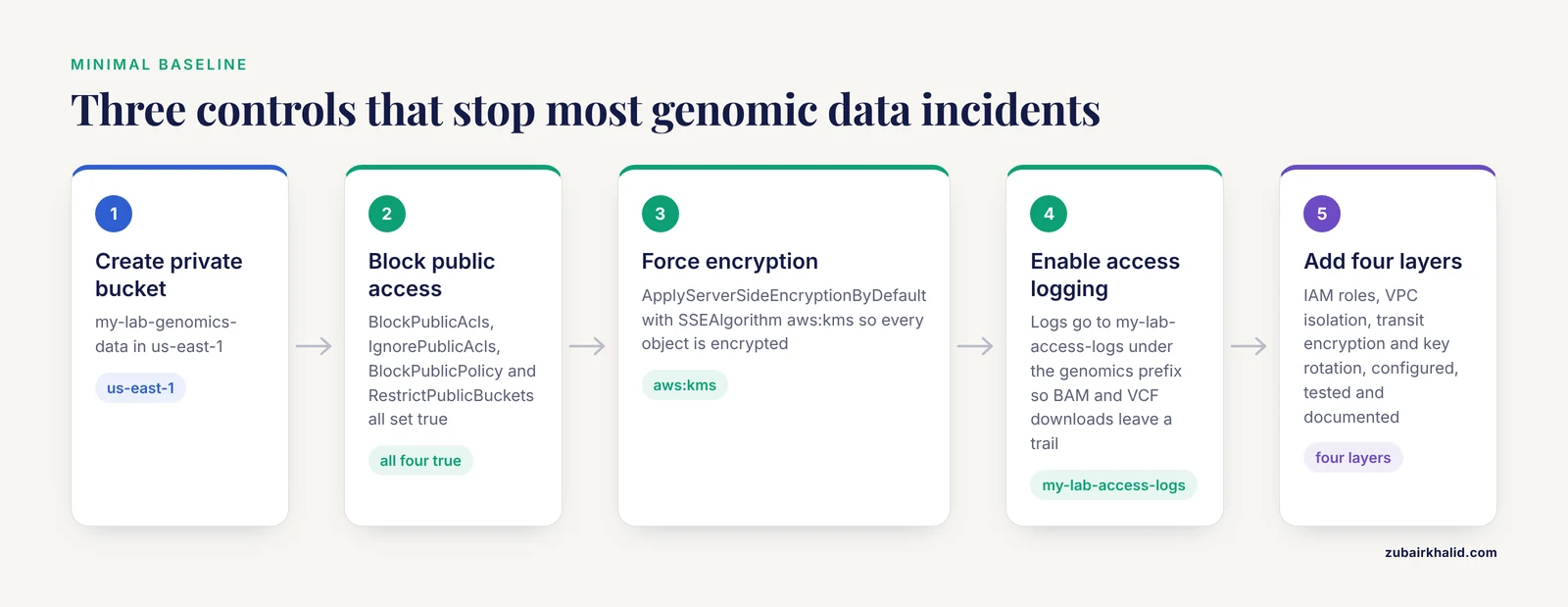
The following commands, drawn from standard AWS documentation patterns, establish the three controls that prevent the majority of genomic data incidents, public exposure, unencrypted storage, and untracked access. They are illustrative, and your institution's security office should own the final configuration.
Create a private bucket and block every public access path:
aws s3api create-bucket --bucket my-lab-genomics-data --region us-east-1

aws s3api put-public-access-block --bucket my-lab-genomics-data \
  --public-access-block-configuration \
  BlockPublicAcls=true,IgnorePublicAcls=true,BlockPublicPolicy=true,RestrictPublicBuckets=true
Force encryption at rest with a managed key so every object written by any pipeline is encrypted by default:
aws s3api put-bucket-encryption --bucket my-lab-genomics-data \
  --server-side-encryption-configuration \
  '{"Rules":[{"ApplyServerSideEncryptionByDefault":{"SSEAlgorithm":"aws:kms"}}]}'
Enable access logging to a separate bucket so downloads of BAM and VCF files leave an auditable trail:
aws s3api put-bucket-logging --bucket my-lab-genomics-data \
  --bucket-logging-status \
  '{"LoggingEnabled":{"TargetBucket":"my-lab-access-logs","TargetPrefix":"genomics/"}}'
Around that baseline, a compliant self-managed deployment needs four more layers. Identity and access management with per-user roles and no long-lived shared credentials, network isolation through a Virtual Private Cloud so compute nodes are not internet-reachable, transit encryption on every data transfer endpoint, and key management with documented rotation. None of these is exotic, but all of them must be configured, tested, and documented, which is exactly the work that managed platforms remove [4].
Option 3: Managed Genomics Platforms and Trusted Research Environments
A managed platform or trusted research environment (TRE) gives you a governed workspace where data, compute, and access policy are preassembled. Users analyze data inside the environment, and only vetted outputs leave it.
The Research Assets Provisioning and Tracking Online Repository (RAPTOR) developed by the Genome Institute of Singapore is the clearest published example of this model. RAPTOR is a cloud-native genomics repository and analytics platform built on a five-safes framework, providing security and governance controls to data contributors and users so that sharing and analysis happen without security breaches or regulatory missteps [4]. The model has proven itself at population scale, Genomics England runs automated, containerized gene-burden workflows through Nextflow inside its Research Environment on the Lifebit CloudOS platform, delivering scalable, secure, governance-compliant, and auditable computation across large rare-disease sequencing cohorts [9].
The Cancer Genomics Cloud represents a middle point in this category, a National Cancer Institute-funded collaborative resource that manages collaborators and compute hardware on commercial providers, so researchers get curated governance without surrendering the underlying AWS or Google Cloud substrate [7].
The compliance advantages are concrete. Governance controls such as dataset-level access requests, data use agreement enforcement, and egress review are built into the platform rather than hand-rolled. Audit trails covering who accessed what and when are generated automatically, which is precisely the evidence institutional review and funder audits demand [3]. The tradeoffs are real too. You accept the platform's data model, its workflow engine, and its export rules, and per-analysis or per-storage pricing at population scale requires budgeting discipline. For most clinical laboratories and multi-institution consortia without a dedicated cloud security engineering team, this category is the strongest default.
Option 4: Federated Analysis When Data Cannot Move
Sometimes the data legally or ethically cannot be pooled at all, multi-country collaborations, datasets governed by consent terms that prohibit transfer, or institutions whose data agreements forbid export. Federated learning addresses this by training models on geographically distributed genomic and clinical datasets while each site retains custody, complying with data privacy laws and regulatory constraints by design.
FeatureCloud is an established platform for this, providing a web interface and a repository of implemented federated methods. The fedflow tool extends it with a Python-based command line for headless orchestration, automating federated workflows on virtual machines or cloud instances, integrating with reproducible Snakemake pipelines, and demonstrating on a metagenomic dataset that federated algorithms can be compared directly against centralized pooled-data analysis [10]. In the United States, the FEAST platform developed under the ARPA-H Biomedical Data Fabric initiative applies the same philosophy to authorized-access real-world biomedical data, enabling secure federated analysis across institutions and using structured cross-institutional surveys to expose the infrastructure gaps and data integration challenges that federated designs must solve [11].
The compliance logic is appealing, the raw genomes never move, so the transfer risk disappears. The costs are operational, every participating site must maintain its own compliant environment, model convergence depends on network reliability and site availability, and the coordination overhead scales with the number of partners. Federated designs suit long-running multi-site collaborations far better than a one-off shared analysis between two labs.
Option 5: Standards-Aligned Open Frameworks
A final option is to build your own cloud environment on open, standards-aligned software so that compliance features are portable rather than proprietary. Bio-OS is an open-source, cloud-native framework for building interoperable biomedical cloud platforms, aligned with the Global Alliance for Genomics and Health (GA4GH) cloud workstream standards, the Workflow Execution Service (WES), Task Execution Service (TES), Data Repository Service (DRS), and Tool Registry Service (TRS), and designed to support FAIR principles for findable, accessible, interoperable, and reusable data [12].
The compliance value of standards alignment is often underestimated. When your data access layer speaks DRS and your workflow layer speaks WES, migrating between providers or adding a second environment is an engineering task rather than a renegotiation of your entire governance stack. Interoperability standards also give auditors a fixed reference point, a platform claiming conformance to published GA4GH interfaces is easier to evaluate than a bespoke system. The European Health Research and Innovation Cloud roadmap reaches the same conclusion from the policy side, recommending that such infrastructure be built on established standards and guidelines, through an open and decentralized foundation, and certified to the highest interoperability and data security standards [6].
The cost is engineering capacity. An open framework hands you components, not a finished governed product, so this option fits institutions with platform engineering teams or consortia that must avoid vendor lock-in for policy reasons.
Pros and Cons of Each Compliance Path
Teams evaluating cloud genomics data security compliance options usually weight five criteria, control, effort, speed, cost, and auditability. Here is how each path scores, stated plainly.
On-premises. Pros, maximal custody and full sovereignty over every control, no external agreement dependencies. Cons, no elastic capacity, the security tooling burden is entirely yours, and audit evidence is frequently weaker in practice than in cloud environments because logging and review processes are homemade.
Self-managed public cloud. Pros, effectively unlimited storage and compute, mature managed services for encryption, identity, and logging, full architectural freedom, and the widest hiring pool of engineers. Cons, the shared responsibility model means every misconfiguration is yours, the compliance surface is large, and costs require active management. This path rewards teams that already run production cloud infrastructure.
Managed platforms and TREs. Pros, governance, audit trails, and access workflows arrive prebuilt, time to a compliant analysis is shortest, and the model is validated at population scale in real programs [2][12]. Cons, less architectural freedom, potential vendor lock-in, and per-use economics that need forecasting at scale.
Federated analysis. Pros, data never leaves its custodian, sidestepping transfer approvals and cross-border friction, and the approach is explicitly designed for privacy-law compliance [10]. Cons, highest coordination overhead, results can differ from pooled analysis, and every site must still maintain its own compliant stack.
Standards-aligned open frameworks. Pros, portability, no lock-in, alignment with GA4GH cloud standards, and FAIR-aligned data management that improves review outcomes [12]. Cons, requires platform engineering investment and does not by itself provide governance, you still build the access and audit controls on top.
A useful heuristic when comparing vendors within a category, ask each one to demonstrate an end-to-end audit, from an access request through a data use agreement to a logged export of aggregate results. The quality of that demonstration predicts the quality of your next regulatory interaction far better than any feature list.
Security and Compliance Considerations for Cloud-Based Genomics Data
Whichever deployment model you choose, the same control areas determine whether your cloud genomics data security compliance posture survives scrutiny.
Identity and access management. Every human and every pipeline should authenticate as itself, with least-privilege permissions and no shared accounts. Federated single sign-on tied to your institution's identity provider lets you revoke access the moment a person leaves a project, which manual cloud accounts rarely support cleanly.
Encryption. Encrypt data at rest with customer-managed or provider-managed keys and encrypt every transfer channel. Encryption is necessary but never sufficient, it protects the bytes, not the decisions about who may use them.
Network isolation. Compute analyzing controlled-access data should live in a private network segment with no direct internet ingress. The Virtual Private Cloud pattern used by deployed scientific computing platforms, where secure clusters run in an isolated network with shared project file systems, is the established template [8].
Audit logging and monitoring. Log every access to data objects, every permission change, and every export, and retain logs per your institution's record requirements. Responsible data stewardship frameworks treat demonstrable integrity and appropriate access throughout the data lifecycle as core outcomes that repositories must be able to show, not merely assert [3].
De-identification and data minimization. Apply HIPAA de-identification methods, either Safe Harbor removal of the 18 identifier categories or documented expert determination, before data leaves a covered entity, and upload only the fields the analysis requires. Remember the familial nature of genomic data means even de-identified sequences retain reidentification risk, so access governance must back up de-identification rather than replace it.
Incident response. Document who declares an incident, how affected data owners and regulators are notified, and how forensic evidence is preserved from logs. Test the plan before you need it.
Container and workflow integrity. Reproducible, containerized workflows are now the norm in cloud bioinformatics [2], and they carry a compliance benefit, a pinned container image with recorded versions makes every analysis auditable after the fact. Platforms that integrate containerized Nextflow pipelines inside governed environments show how reproducibility and governance reinforce each other [9].
The Five Safes Framework
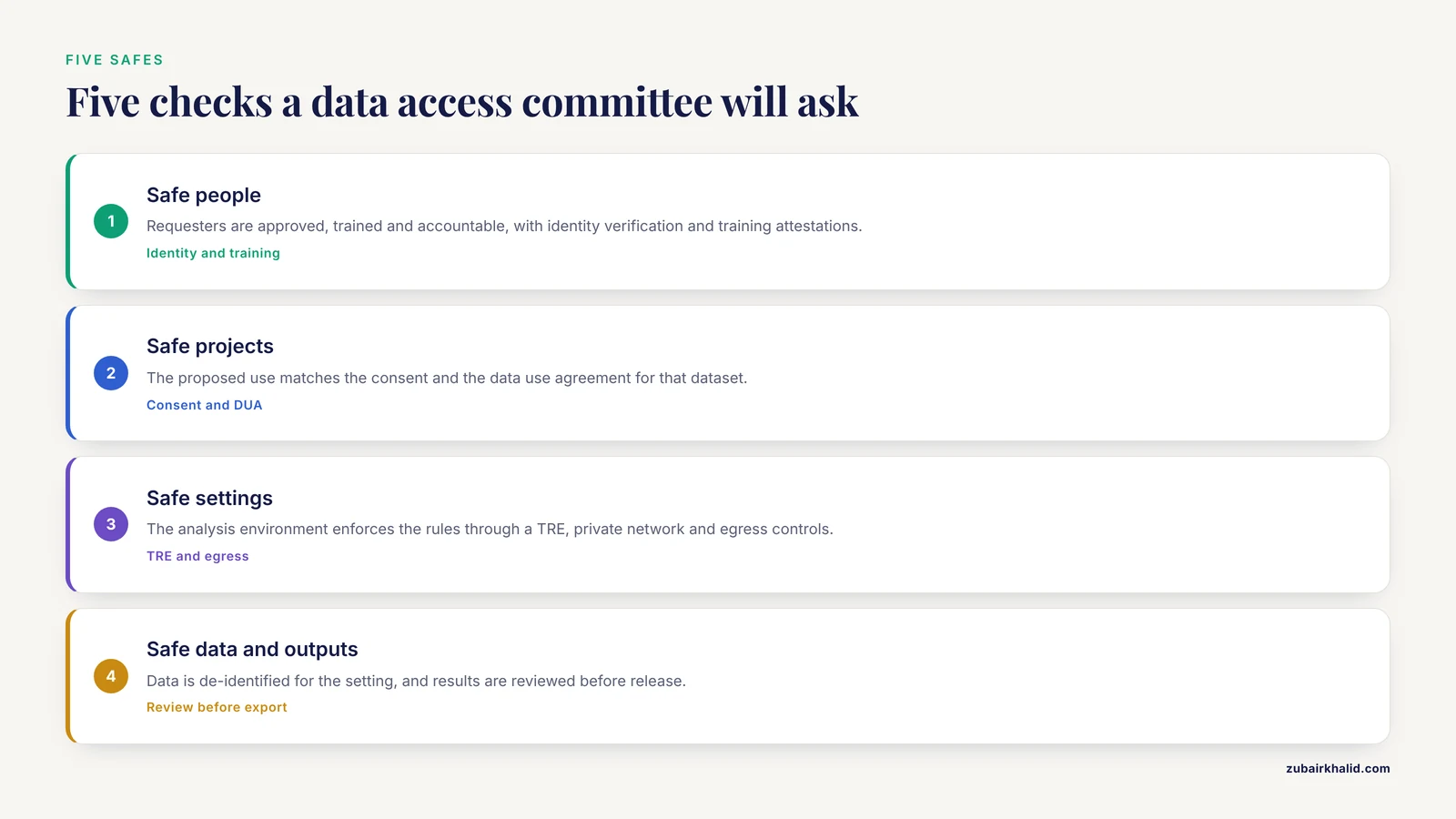
The five safes framework is the governance structure most often cited for cloud genomic repositories, and it is worth internalizing because it organizes nearly every question a data access committee will ask [4].
- Safe people. Are the requesters approved, trained, and accountable? This covers identity verification, institutional affiliation, and training attestations.
- Safe projects. Does the proposed use match the consent and the data use agreement? A dataset consented for oncology research cannot silently support ancestry consumer products.
- Safe settings. Does the analysis environment enforce the rules, through a TRE, private network, and egress controls, rather than relying on promises?
- Safe data. Is the dataset appropriately de-identified or aggregated for the risk level of the setting?
- Safe outputs. Are results reviewed before release so that no export reidentifies individuals through small cell sizes or unusual genotypes?
RAPTOR implements exactly this structure to give contributors and users security and governance controls for sharing and analyzing genomic datasets on commercial cloud providers [4]. If you build your own environment, mapping each of the five safes to a concrete technical control is the fastest way to a defensible design.
Responsible Stewardship as a Measurable Outcome
A recent synthesis of the genomic data sharing literature defined responsible data stewardship as the ethical and secure management, use, and protection of data to ensure accuracy, privacy, integrity, and appropriate access throughout its lifecycle, and derived core outcome domains that cloud-based repositories can use to demonstrate trustworthiness [3]. The practical takeaway for any team is to treat stewardship as measurable. Define, before launch, what evidence you will produce for each outcome domain, access decision records, integrity checks, privacy incident counts, and user-facing transparency about how data is used. Repositories that can produce this evidence on request are the ones that retain funder and participant trust as oversight globalizes [3].
The Data Lifecycle from Upload to Deletion
Compliance attaches at every lifecycle stage, and the failure modes differ by stage.
At ingestion, validate file integrity with checksums, confirm the consent scope of each batch, and quarantine unverified uploads. During storage, enforce encryption and replication policies, and keep controlled-access data separated from public data at the bucket or dataset level. During analysis, run workloads only in the governed environment, keep scratch files on encrypted volumes, and prevent results with reidentification potential from landing in unprotected locations. During sharing, use governed egress, signed URLs that expire, or federated queries rather than raw copies. At deletion, execute documented destruction, including derived files and backups within your retention windows, and retain the deletion record itself as audit evidence. Public variant repositories carry a parallel lifecycle obligation, ensuring submissions respect the consent under which the variants were generated [1].
Worked Scenarios
Scenario 1, a clinical molecular diagnostics laboratory. A hospital laboratory validating a comprehensive genomic profiling assay for solid tumors needs clinical-grade bioinformatics with documented analytical performance. The compliance floor is HIPAA plus CLIA, so the environment must support a business associate agreement, audit controls, and validated, versioned pipelines. A managed or vendor-supported cloud analysis environment integrated with the validated assay is the typical path, because clinical genomic profiling assays with cloud-based analysis have demonstrated high analytical performance across variant classes after formal validation [5]. The lab's job is to freeze pipeline versions, document validation, and restrict access to patient-identifiable data to clinical staff.
Scenario 2, a rare disease research consortium at population scale. A national genomics project holds hundreds of thousands of genomes and must let hundreds of researchers compute on them without any data leaving governance. The Genomics England pattern is the reference, a research environment on a managed platform where automated, containerized Nextflow workflows execute governance-compliant analyses and produce auditable gene-level outputs across the cohort [9]. Researchers bring their code to the data, exports are reviewed, and every computation is logged.
Scenario 3, a multi-institution academic collaboration with mixed international partners. Five universities want to train a model on genomic and clinical data held in three countries, with consent terms that prohibit pooling. Federated learning through an orchestrable platform lets each site keep its data local while contributing to shared model training, and command-line orchestration tools make the federation reproducible inside standard workflow managers [10]. The coordination costs are front-loaded, data use agreements at each site and a schedule for joint training runs, but the compliance question of transfer is dissolved by architecture rather than paperwork. This is also the pattern emerging in US federated ecosystem efforts built to let institutions analyze authorized-access biomedical data without centralizing it [11].
Common Mistakes and Limitations
These are the errors that show up repeatedly in real deployments and in the governance literature.
- Confusing provider compliance with your compliance. A cloud provider's certifications cover its infrastructure. Your bucket policies, identities, and access decisions remain yours under the shared responsibility model, and misconfigured storage remains the leading self-inflicted risk for data in the cloud [4].
- Treating de-identification as the whole answer. Genomic sequences are inherently reidentifiable, and familial information leaks through any single genome. De-identification is one layer, access governance and safe outputs are the layers that carry the real weight [3].
- Bolting governance on after upload. Retrofitting access controls onto an already-exposed dataset is far harder and riskier than provisioning the governed environment first. Decisions about the five safes should precede the first upload.
- Ignoring cost governance until the bill arrives. Elastic infrastructure is a compliance feature, it prevents hoarding, but uncontrolled egress charges and orphaned storage are budget and security problems at once. Economically optimized cloud deployments require deliberate instance selection and architecture review, as benchmarking studies of scientific cloud platforms have shown [8].
- Assuming audit logs are optional. Demonstrating integrity and appropriate access throughout the lifecycle is a core outcome expected of cloud-based genomic repositories [3]. If you cannot produce the logs, you cannot demonstrate the control.
- Choosing federation for the wrong reason. Federated analysis dissolves data transfer questions but adds operational complexity and can produce results that differ from pooled analysis [10]. If pooling is legal and consented, a TRE is usually simpler.
- Overlooking standards portability. Locking your workflows to a proprietary interface makes future migrations and audits harder. Aligning with GA4GH cloud standards such as WES, TES, DRS, and TRS preserves your exit options and gives reviewers a fixed reference [12].
One honest limitation for readers planning individual projects, the specifics of your institution's agreements, your funder's terms, and your data's consent scope always override general guidance, and a security review with your institutional compliance office is a necessary step for any controlled-access genomic dataset. The frameworks in this article tell you what to ask for in that meeting.
Frequently Asked Questions
Is storing genomic data on AWS or another public cloud HIPAA compliant?
The provider can be HIPAA compliant and sign a business associate agreement, but your deployment is only compliant if you configure identity management, encryption, private networking, and audit logging correctly. Compliance is a property of the whole system, not of the vendor logo.
What is the most practical compliant option for a small academic lab?
A managed genomics platform or trusted research environment is usually the best fit, because governance, audit trails, and access workflows arrive prebuilt and the lab avoids standing up its own cloud security engineering. Self-managed public cloud suits small labs only when someone on the team genuinely runs production infrastructure.
Do I need to de-identify genomic data before uploading it to the cloud?
Yes, apply HIPAA de-identification through Safe Harbor or expert determination before transfer, but treat it as one control layer rather than a complete solution. Genomic sequences remain inherently reidentifiable, so access governance and output review must back up de-identification.
What is the five safes framework?
It is a governance model with five checks, safe people, safe projects, safe settings, safe data, and safe outputs, applied before and during any analysis of sensitive data. Cloud-native genomic repositories implement it as concrete technical and procedural controls rather than policy paperwork.
Can collaborators in other countries access my genomic datasets?
Yes, through governed mechanisms such as trusted research environment accounts, federated queries, or federated learning where each site keeps its own data. The permitted path depends on your consent terms, data use agreements, and applicable privacy law, so confirm the mechanism with your compliance office before granting access.
How does federated learning reduce compliance risk?
Raw genomic data never leaves each participating site, so the transfer, pooling, and cross-border issues that drive most approval cycles simply do not arise. The tradeoff is operational complexity, since every site must maintain its own compliant environment and coordinated runs.
Sources
- Considerations for Genomic Data Privacy and Security when Working in the Cloud.
- Eras of bioinformatics technologies from command-line interfaces to artificial intelligence (AI) chatbots.
- Characterizing core outcomes of responsible stewardship for human genomic data in the cloud.
- A five-safes approach to a secure and scalable genomics data repository.
- Analytical Validation and Clinical Implementation of a 1080-Gene Comprehensive Genomic Profiling Assay with Integrated Cloud-Based Analysis for Solid Tumor Molecular Oncology.
- Towards a European health research and innovation cloud (HRIC).
- Artificial intelligence apps for medical image analysis using pyCERR and cancer genomics cloud.
- GoToCloud: Development and future of the cloud-based platform for cryo-EM structure-based drug DesignDevelopment and future of GoToCloud.
- Automated GenePy gene-burden computation via a reproducible Nextflow workflow integrated with the Genomics England (GEL) Lifebit platform.
- Fedflow: cloud orchestration for federated learning with the FeatureCloud platform.
- From use cases to infrastructure: a cross-institutional survey of priorities in data-driven biomedical research.
- Bio-OS: An Integrated Cloud-native Environment for Data-Intensive Biomedical Research.