RNA-Seq Analysis for Clinical Research: Tools and Compliance
By Dr. Zubair Khalid, DVM, MS, PhD ·

The difference between a research-grade and a clinically defensible RNA-seq analysis is not the algorithm, it is the audit trail. A rule of thumb for choosing tools: pick the simplest pipeline your question supports, wrap it in a workflow manager so every step is recorded and repeatable, and choose a platform your institution can actually validate under its quality system. This guide walks through the main tool options for RNA-seq analysis in clinical research, compares them on the criteria that decide real projects, and explains the compliance obligations that turn a good result into one a reviewer, collaborator, or regulator can trust.
What Makes Clinical RNA-Seq Different
RNA sequencing (RNA-seq) measures gene expression across the transcriptome with high sensitivity, and it has moved from a research technique toward clinical applications in precision oncology and rare disease diagnostics [1]. That transition changes the stakes of every computational decision. In a purely academic study, an irreproducible result wastes grant money. In a clinical research setting, the same analysis may inform a diagnostic claim, a trial endpoint, or a biomarker that guides patient care, so the analysis itself becomes part of the evidence.
Three properties separate clinical work from exploratory work:
- Reproducibility. The same input data, run through the same pipeline with the same software versions, must produce the same numbers. This is achievable with workflow managers and containerization, and modern RNA-seq pipelines built on Nextflow with containerized applications were designed explicitly to increase the accuracy and reproducibility of findings [2].
- Traceability. Every step, from raw read quality control to the final gene list, needs a documented record of what was run, with what parameters, on what reference, by whom, and when.
- Data governance. Patient-derived samples carry protected health information, so data handling, de-identification, and storage decisions are part of the analysis plan, not an afterthought.
The technical core of RNA-seq analysis is well established. A typical workflow runs quality control on raw reads, aligns or pseudoaligns reads to a reference, quantifies gene or transcript abundance, normalizes counts, applies statistical modeling to find differentially expressed genes, and interprets results through functional enrichment or pathway analysis [3]. What varies between projects is which tools fill those slots and how the whole thing is packaged for compliance.
The Core Toolchain, Stage by Stage
Quality control and preprocessing
Raw sequencing data start as FASTQ files. Quality control tools such as FastQC, aggregated across samples with MultiQC, reveal per-base quality scores, adapter contamination, and overrepresented sequences. Trimming low-quality reads and adapters before downstream steps is standard practice, and most automated pipelines include it as a first-class step [4] [2]. In clinical work, QC metrics also serve as batch documentation, so archive the reports, not just the cleaned reads.
Alignment and quantification
Two families of approaches dominate. Spliced aligners such as STAR and HISAT2 map reads to a reference genome, handling exon junctions. Quasi-mapping and pseudoalignment tools such as Salmon and Kallisto map reads directly to a transcriptome and are faster, which matters when hundreds of clinical samples arrive on a deadline [1]. Reviews of the field note that these algorithms improved the speed and accuracy of alignment substantially over earlier methods [1].
Head-to-head comparisons show that mapper choice is often less decisive than analysts assume. One evaluation of seven alignment and quantification tools on Illumina single-end reads found that between 92.4% and 99.5% of reads mapped to the reference, raw count distributions were highly correlated across mappers, and downstream differential expression results overlapped substantially [5]. The instructive exception: when a commercial suite's built-in differential expression module was used instead of DESeq2 on the same counts, results diverged strongly [5]. The lesson for clinical projects is that your statistical method, validated and documented, deserves as much attention as your mapper.
Differential expression
Differential expression analysis identifies genes whose expression differs between conditions. DESeq2 and edgeR are the reference-standard tools for count data from bulk RNA-seq, and pipelines commonly generate count matrices specifically formatted for them [2]. A step-by-step protocol covering both model and non-model organisms walks through the full path from raw reads to functional enrichment and discusses the advantages and disadvantages of alternative tools at each step, which is a useful model for writing your own standard operating procedure [6].
Visualization and interpretation
Visualization is where clinicians and computational teams meet, and it is an active area of development. A systematic review following PRISMA guidelines identified 33 studies published between 2017 and 2024 on RNA-seq visualization for clinical applications, and found that 56% concerned single-cell RNA-seq data, 23% bulk RNA-seq, 18% circular RNA-seq, and 3% long non-coding RNA-seq [7]. The review's conclusion is practical: visualization tooling is unevenly mature, strongest for single-cell data, and clinicians should expect to match the visualization approach to the data type rather than assume one dashboard fits everything [7].
Bioinformatics Tools Comparison: The Main Options Side by Side
The table below compares the dominant platform-level options for clinical RNA-seq analysis. Each is explained in its own subsection afterward.
| Option | What it is | Strengths for clinical work | Limitations | Typical fit |
|---|---|---|---|---|
| Galaxy (web platform) | Browser-based analysis with point-and-click tools and full history tracking | Accessible to non-programmers, built-in provenance of every step | Less scalable for very large cohorts, limited workflow customization | Method development, training, smaller studies, metatranscriptomic surveillance |
| nf-core / Nextflow pipelines | Community-maintained pipelines run with the Nextflow workflow manager | Reproducible, containerized, widely used, produces count matrices ready for DESeq2 or edgeR | Requires command-line infrastructure and someone who can maintain it | Multi-sample clinical studies, institutional cores |
| Snakemake pipelines (for example 3t-seq) | Python-based workflow manager pipelines | Flexible, explicit dependency management, MIT-licensed options exist | Each pipeline is custom, so validation is per-pipeline | Specialized analyses such as transposable elements and tRNAs |
| aTAP (web application) | Automated transcriptome analysis platform integrating QC, trimming, de novo assembly, quantification, and differential expression | Graphical interface aimed at biologists without command-line skills | Designed for academic use, so institutional validation and governance fall on you | Labs without dedicated bioinformaticians |
| Commercial suites (for example CLC) | Vendor-supported software with GUI and proprietary statistical modules | Vendor support, documentation, and sometimes regulatory-friendly packaging | Divergent statistical results versus open tools have been documented, lock-in risk | Hospital labs preferring vendor accountability |
| Command-line stack (STAR or HISAT2 plus Salmon, DESeq2 or edgeR) | Individual best-of-breed tools assembled by your team | Full control, maximum flexibility, extensive publication record | Every component must be versioned and validated by your own team | Research groups with bioinformatics staff feeding clinical projects |
| Single-cell toolkits | Pipelines converting raw reads to cell-by-gene matrices, then clustering and visualization | Captures cell-type heterogeneity that bulk data average away | Sensitive to technical noise from batch effects and incomplete RNA capture | Translational studies of tissue and blood cell populations |
Galaxy
Galaxy deserves specific mention because it makes provenance nearly automatic. Every click, parameter, and input is recorded in a history, and histories can be shared or exported as reproducible workflows. A published metavirome study illustrates the platform's range: researchers imported a public RNA-seq dataset into Galaxy, de novo assembled viral sequences with rnaviralSPAdes, classified contigs with VirHunter and Kraken tools, assembled a SARS-CoV-2 genome with coronaSPAdes, and then used the Coronavirus Typing Tool, Nextstrain, and Pangolin for genotyping and phylogenetic analysis [8]. That workflow, run end to end on public plant RNA-seq data that happened to contain viral reads, shows how open platforms let a small team assemble a competent pathogen-detection analysis without writing code. For clinical research, the same provenance features that make Galaxy a teaching tool make it an auditable one.
Workflow-managed pipelines
When sample numbers grow past a handful, manual analysis becomes a liability. Workflow managers solve this by encoding the entire pipeline in a script, so one command runs QC, alignment, quantification, and counting identically across hundreds of samples. The nf-rnaSeqCount pipeline is a documented example: built with Nextflow as the workflow management system and Singularity for application containerization, it maps raw RNA-seq reads to a reference genome and produces a read count matrix ready for differential expression tools such as DESeq2 and edgeR [2]. Containerization matters for compliance because it pins exact software versions, which is what a validation file needs to state.
Snakemake serves the same role with a Python-based syntax. The 3t-seq pipeline, built on Snakemake, handles an interesting clinical-adjacent gap: most RNA-seq methods analyze polyadenylated RNA from single-copy genes and ignore transposable elements and transfer RNAs, and 3t-seq performs integrated differential expression analysis of all three transcript classes, starting from raw data and running quality control, genome mapping, quantification, and statistical testing [9]. If your clinical question touches repetitive elements, for example in oncogenesis or autoimmunity, a general pipeline will silently discard those reads.
Automated web platforms
Not every lab has a bioinformatician, and web platforms fill that gap. aTAP integrates quality control of raw reads, trimming, de novo transcriptome assembly, expression quantification, differential expression analysis, and transcript annotation behind a graphical interface, letting researchers interact with and visualize results in a web browser [4]. For clinical research, the tradeoff is explicit: accessibility increases, but institutional validation and data governance for patient-derived data remain your responsibility regardless of how friendly the interface is.
Commercial suites
Commercial packages offer vendor support, which some institutional review processes prefer. The caution comes from data. In the seven-tool comparison described above, using the commercial CLC software's own differential expression module instead of DESeq2 on the same mapped reads produced strongly diverging results [5]. That does not make commercial tools wrong, but it means the statistical module inside a commercial suite must be validated on your own data, not assumed equivalent to the open-source standard.
Single-cell toolkits
Single-cell RNA-seq resolves cell populations that bulk RNA-seq averages, and the field has produced a mature core workflow: raw reads are processed into a gene expression matrix, normalized and scaled to remove technical noise, cells are grouped by expression similarity, and results are visualized in two or three dimensions [10]. Technical noise is a real constraint, since incomplete RNA capture, amplification bias, and patient-specific batch effects can bias analysis and interpretation if unaddressed [10].
Clinical sample handling is the practical bottleneck. Neutrophils, for example, are highly sensitive to processing, storage, and transportation steps. A comparative evaluation of single-cell technologies from 10x Genomics, PARSE Biosciences, and HIVE (Honeycomb Biotechnologies) on human blood-derived neutrophils found that all methods produced high-quality data capturing the neutrophil transcriptome, and the authors established workflow guidelines for sample collection to preserve RNA quality in clinical trials [11]. The same study noted that fixed-cell approaches showed close concordance with flow cytometry data. For a trial collecting samples across sites, that kind of method comparison, run before the trial, is the difference between interpretable and wasted specimens.
Regulatory Compliance for Clinical RNA-Seq Analysis
Compliance questions in this field cluster into four areas. The descriptions below reflect the general US framework for laboratory and clinical data, which is established professional knowledge, and institutions should confirm specifics with their own quality and compliance offices.
Clinical versus research use, and CLIA
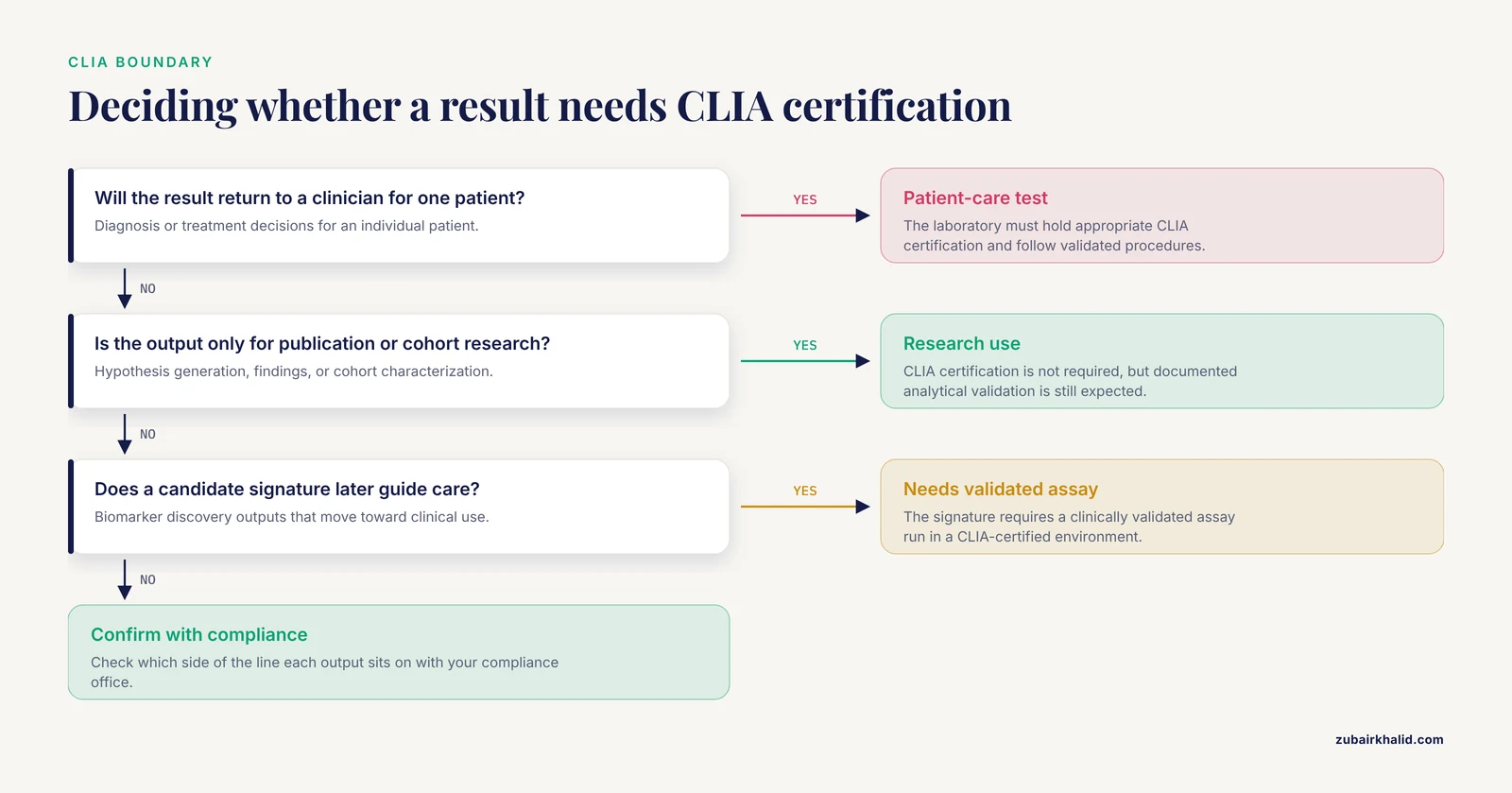
In the United States, the Clinical Laboratory Improvement Amendments (CLIA) regulate laboratories that perform testing on human specimens for patient care. The line that matters for RNA-seq is intent. An analysis used to generate hypotheses, publish findings, or characterize a cohort for research is research use. An analysis whose result returns to a clinician to inform an individual patient's diagnosis or treatment is a patient-care test, and the laboratory performing it must hold appropriate CLIA certification, follow validated procedures, and document staff competency. Many biomarker discovery projects produce candidate signatures that later require a clinically validated assay, run in a CLIA-certified environment, before results can guide care. Build your analysis plan around which side of that line each output sits on, because the documentation burden differs substantially.
Validation and documentation
Whether or not a given run is CLIA-regulated, clinical research funders, journals, and institutional review boards expect documented analytical validation. In practice this means a written record of software versions, reference genome build and annotation version, parameters, the computing environment, and results of any benchmarking you performed. Workflow managers make this nearly free once configured. A Nextflow pipeline with containerized software encapsulates versions and parameters so the run report doubles as a validation artifact [2]. A practical guide to RNA-seq analysis emphasizes reproducibility and practicality in exactly this spirit, with all scripts and a sample dataset released in a public repository so others can implement and verify the workflow [6].
A reasonable internal standard: could a qualified outsider, given your archived inputs and pipeline definition, regenerate your count matrix and differential expression table. If not, the analysis is not yet compliant with any serious quality expectation, regardless of the software used.
Protected health information and data handling
Patient transcriptomic data are human subjects data. RNA-seq itself can theoretically be used to identify individuals, so research datasets derived from clinical samples typically go to controlled-access repositories with data use agreements rather than open repositories. Within your institution, de-identification practices under the Health Insurance Portability and Accountability Act (HIPAA) govern how samples link to clinical metadata. Practical steps that are standard in the field include assigning study identifiers at the point of sample receipt, keeping the key that links identifiers to patient records in a separate secured system, restricting analysis environments to approved personnel, and documenting who accessed what and when. Consent language should cover data sharing and secondary use, since retrospective reuse of banked samples is a common source of compliance failures.
Reproducibility as a compliance control
Regulators and reviewers increasingly treat reproducibility as the primary evidence of analytical quality. Version control for code, containers for software, locked reference annotations, and immutable archived outputs together form the audit trail. The broader literature on pipeline development frames this directly: robust and flexible computational pipelines from quality control through alignment and comparative analysis reduce analysis time and increase accuracy and reproducibility of findings [2]. Treat your pipeline definition, not your results file, as the primary deliverable.
Pros and Cons in Practice: What Actually Decides Tool Choice
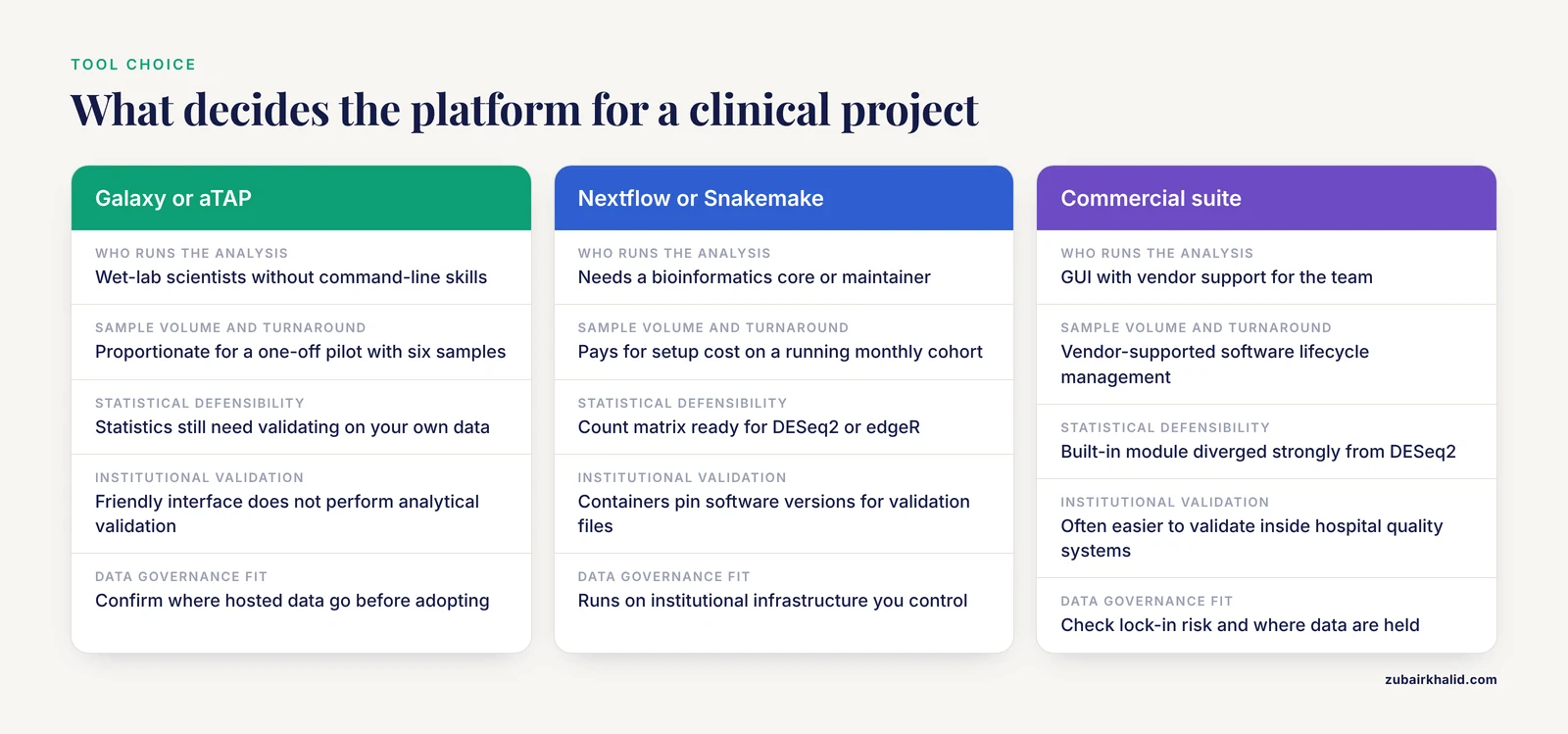
When teams weigh the options for clinical RNA-seq analysis, five criteria do most of the deciding.
1. Who runs the analysis. If wet-lab scientists will run analyses themselves, Galaxy or aTAP remove the command-line barrier, and aTAP specifically targets researchers without bioinformatics expertise through its graphical interface [4]. If you have a bioinformatics core, workflow-managed pipelines give more control and scale better.
2. Sample volume and turnaround. For recurring analyses, for example a running cohort where samples arrive monthly, a Nextflow or Snakemake pipeline pays for its setup cost quickly [2]. For a one-off pilot with six samples, a manual or Galaxy-based analysis is proportionate.
3. Statistical defensibility. The comparison evidence suggests the differential expression module deserves the most scrutiny, given the documented divergence between a commercial module and DESeq2 on identical counts [5]. Whatever statistics you use, validate them against a known truth, for example spike-in controls or a published benchmark dataset, before applying them to patient samples.
4. Institution-specific validation requirements. Hospital-affiliated labs often carry quality systems inherited from clinical laboratory practice. A vendor-supported package with documented software lifecycle management can be easier to validate internally than a stack of open-source tools, even when the open-source tools are scientifically equivalent. This is a legitimate reason to choose commercial software, and it should be weighed openly rather than dismissed.
5. Data governance fit. Web platforms that process data on external servers may conflict with institutional rules on patient data egress. Before adopting any hosted platform, including convenient ones, confirm where the data go, who can access them, and whether your data use agreements permit it.
Worked Scenarios
Scenario 1: Biomarker discovery from tumor samples
A research team collects bulk RNA-seq from tumor and adjacent tissue, aiming to identify expression signatures associated with outcome. A reasonable stack is FastQC and MultiQC for QC, STAR or Salmon for alignment or quantification, and DESeq2 for differential expression, all wrapped in a Nextflow pipeline [1] [2]. To strengthen clinical relevance without new sequencing, the team reanalyzes public cancer datasets, a pattern with precedent: analyses of TCGA (The Cancer Genome Atlas) RNA-seq and microarray data identified HLA class II gene expression, particularly HLA-DP and HLA-DR, as significantly associated with better overall survival in cutaneous melanoma, positioning that expression pattern as a candidate prognostic biomarker [12]. Public dataset reanalysis, done with documented tools, is a legitimate and inexpensive validation step before prospective collection.
Scenario 2: Single-cell profiling in a multi-site trial
A sponsor wants single-cell RNA-seq on blood samples collected at several hospitals. The dominant technical risk is sample handling, since sensitive cell populations degrade during transport. The neutrophil methods comparison offers the template: evaluate candidate platforms (10x Genomics, PARSE Biosciences, HIVE) on your actual sample type before the trial, establish collection and processing guidelines that preserve RNA quality, and check concordance with an orthogonal method such as flow cytometry [11]. Computational downstream, the standard single-cell workflow of normalization, noise removal, clustering, and dimensionality-reduced visualization applies [10]. Compliance adds sample-tracking requirements across sites and a data handling plan that satisfies the sponsor and each site's review board.
Scenario 3: Integrated multi-omics on a disease model
A lab studying a neuroinflammatory condition pairs RNA-seq with ATAC-seq, which profiles chromatin accessibility. One published integration did exactly this in a migraine model, combining differential expression and accessibility analyses, functional enrichment, multi-omics integration, protein-protein interaction network construction, and in silico drug prediction, and pinpointed Grid2 and Reln as central effectors enriched in synaptic pathways [13]. The compliance dimension here is modest but real: integrating multiple data types multiplies the documentation surface, because each modality has its own QC criteria and processing software, and the integration method itself needs a described and repeatable implementation.
Scenario 4: Pathogen detection within host transcriptomic data
Clinical RNA-seq libraries sometimes contain non-host reads, and metatranscriptomic analysis can surface them. The SARS-CoV-2 detection study described earlier demonstrates the full chain on public data: assembly of viral sequences from plant RNA-seq reads, classification of contigs, genome assembly with coronaSPAdes, and lineage assignment with Pangolin and related typing tools [8]. In a clinical research context, the same workflow pattern supports surveillance for viral co-infection or contamination, with the caveat that detecting non-intact environmental sequences is not evidence of active infection, and interpretation belongs with clinicians and microbiologists.
Scenario 5: Combining bulk and single-cell data with machine learning
Integrative designs are increasingly common in oncology research. A gastric cancer study combined bulk and single-cell RNA-seq with machine learning and standard bioinformatics methods, identified SLC7A7 and VIM as lysine metabolism-related genes involved in gastric carcinogenesis, built a prognostic risk nomogram, and verified expression findings in clinical samples and in vitro experiments [14]. The compliance consideration is that machine learning models used for prognostic prediction require documented training, testing, and, if intended for clinical decision support, a much heavier validation pathway than exploratory association analysis.
Common Mistakes and Limitations
- Treating the mapper as the validation target. Mapper choice matters less than teams assume, since mappers tested head to head produced highly correlated count distributions and overlapping differential expression results [5]. The differential expression statistics and the sample metadata model deserve equal or greater validation effort.
- Ignoring multi-mapped and repetitive-element reads by default. Standard pipelines discard reads that map to multiple loci, which silently removes transposable element signal. Specialized pipelines exist precisely because general workflows overlook transcripts from repeated sequences such as transposable elements and non-polyadenylated RNAs such as tRNAs [9]. In regulatory element biology, reads mapping to multiple loci can also be rescued statistically rather than discarded, as expectation-maximization approaches developed for CLIP-seq demonstrated [15].
- Letting batch effects reach the results. Technical noise from batch effects specific to the patient or sample can bias single-cell analysis and interpretation if not addressed [10]. Design the experiment so that batches are balanced across biological conditions, and record processing dates and sites in the metadata.
- Assuming a GUI means compliance. A friendly interface records provenance but does not perform analytical validation, access control, or data governance. Those remain institutional obligations regardless of platform.
- Confusing research outputs with clinical results. A differential expression table is not a diagnostic. Candidate biomarkers from research analyses, such as the HLA class II association in melanoma [12], require independent, clinically validated testing before influencing patient care.
- Undocumented ad hoc steps. The single most common compliance failure is a notebook of one-off commands that nobody can reproduce. Every manual step that touches data should eventually live in the scripted pipeline [6].
- Overinterpreting small discovery cohorts. Tools can find structure in noise, especially in single-cell data where clustering parameters shape the apparent cell populations [10]. Predefine your analysis plan where possible and treat unplanned findings as hypothesis-generating.
One limitation applies to individual cases in any of these scenarios: analysis design and interpretation for a specific patient or sample set should involve the responsible clinician and the institution's bioinformatics and compliance staff.
Frequently Asked Questions
What tools do I need for a basic clinical RNA-seq analysis?
At minimum, a quality control tool such as FastQC with MultiQC for aggregation, an aligner or pseudoaligner such as STAR, HISAT2, Salmon, or Kallisto, a quantification step producing a gene count matrix, and a differential expression package such as DESeq2 or edgeR [1] [2]. Most teams wrap these in a workflow manager so the run is reproducible and documented.
Do I need CLIA compliance for RNA-seq analysis?
It depends on use. Analyses supporting research publications do not require CLIA certification, but any RNA-seq result returned for individual patient care must be performed under appropriate CLIA certification with validated procedures. Confirm the boundary for your project with your institution's compliance office.
Which alignment tool is best for clinical RNA-seq?
STAR and HISAT2 for genome alignment, and Salmon or Kallisto for transcriptome-level quantification, are all well supported [1]. Comparative testing shows mappers produce highly correlated counts and similar downstream results, so differences between established tools are usually smaller than differences in statistical modeling and sample handling [5]. Pick based on your data type and infrastructure, then document and validate your choice.
How do I make my RNA-seq pipeline reproducible enough for regulators?
Encode the entire analysis in a workflow manager such as Nextflow or Snakemake, run software in containers so versions are pinned, archive the pipeline definition, parameters, reference versions, and outputs, and release scripts with a sample dataset where possible so external verification is feasible [9] [6] [2].
Can I use public datasets like TCGA in my clinical research?
Yes, and it is common practice for validation and hypothesis generation. Published work has reanalyzed TCGA RNA-seq and microarray data to associate HLA class II expression with survival in cutaneous melanoma [12]. Follow the repository's access and data use requirements, cite the original data producers, and document your reanalysis pipeline as you would for generated data.
Is single-cell RNA-seq ready for clinical samples?
For many sample types, yes, with attention to handling. Comparative evaluations on human blood neutrophils found that platforms from 10x Genomics, PARSE Biosciences, and HIVE all produced high-quality transcriptome data, and the studies provide sample collection guidelines for clinical trials [11]. Success depends more on sample processing and batch control than on platform choice, and technical noise must be addressed in the analysis [10].
Sources
- Advances in RNA-Seq Data Analysis: Towards More Reliable Clinical Translation
- nf-rnaSeqCount: A Nextflow pipeline for obtaining raw read counts from RNA-seq data.
- RNA-seq data science: From raw data to effective interpretation
- aTAP: automated transcriptome analysis platform for processing RNA-seq data by de novo assembly.
- Evaluation of Seven Different RNA-Seq Alignment Tools Based on Experimental Data from the Model Plant Arabidopsis thaliana.
- RNA-Seq Data Analysis: A Practical Guide for Model and Non-Model Organisms.
- Exploring RNA-Seq Data Analysis Through Visualization Techniques and Tools: A Systematic Review of Opportunities and Limitations for Clinical Applications
- Analysis of the RNA-Seq Data of Solanum tuberosum Revealed Viral Sequence Reads of a Severe Laboratory-Developed Strain of SARS-CoV-2 Containing Novel Substitutions
- 3t-seq: automatic gene expression analysis of single-copy genes, transposable elements, and tRNAs from RNA-seq data.
- Tools for the analysis of high-dimensional single-cell RNA sequencing data.
- Comparison of single-cell RNA-seq methods to enable transcriptome profiling of neutrophils in clinical samples
- Expressions of HLA Class II Genes in Cutaneous Melanoma Were Associated with Clinical Outcome: Bioinformatics Approaches and Systematic Analysis of Public Microarray and RNA-Seq Datasets
- Integrated ATAC-seq and RNA-seq analysis identifies Grid2 and Reln as potential regulatory genes in migraine pathophysiology
- Comprehensive analysis of scRNA-seq and bulk RNA-seq data via machine learning and bioinformatics reveals the role of lysine metabolism-related genes in gastric carcinogenesis
- CLIP-seq analysis of multi-mapped reads discovers novel functional RNA regulatory sites in the human transcriptome