FASTQ Data Management for Clinical Genomics
By Dr. Zubair Khalid, DVM, MS, PhD ·

The difference that drives every decision in this article is this: the FASTQ file is the raw, complete record of what the sequencer read, while the BAM, CRAM, and VCF files derived from it are lossy, interpretation-dependent views that cannot answer every future question. The rule of thumb for choosing a clinical genomics data management approach is simple: plan to keep the FASTQ for the full retention period, put it on the cheapest storage that still meets your access and compliance needs, and spend your engineering effort on metadata and provenance rather than on the byte volume itself.
This article is written for the bioinformatician, laboratory director, or informatics lead setting up genomics data storage for a clinical sequencing operation. It covers what FASTQ files actually contain, why clinical settings cannot treat them as disposable intermediates, the main clinical genomics data management options with their pros and cons, worked scenarios, and the mistakes that cause the most operational pain.
What a FASTQ File Is, and Why It Dominates Your Storage
A FASTQ file is a plain-text format that stores sequencing reads and their per-base quality scores. Each read occupies four lines: a read identifier beginning with the @ character, the nucleotide sequence itself, a separator line beginning with +, and a string of ASCII characters encoding the Phred quality score for each base. In current Illumina convention (the 1.8+ encoding), the quality character is the ASCII value of the score plus 33, so a Q30 base, which carries roughly a one-in-a-thousand chance of being a sequencing error, is stored as the character '?'. FASTQ files carry no alignment information, no reference coordinates, and no variant calls. They are the closest thing a sequencing run produces to a lab notebook.
Because each base costs one character of sequence plus one character of quality, FASTQ files are large and compress well. A 30-fold coverage whole-genome sequence of a human sample produces roughly 100 GB of uncompressed FASTQ, which compresses to roughly 40 to 60 GB with standard gzip depending on the platform and adapter trimming. A 30-fold whole-exome sequence produces on the order of 5 to 10 GB gzipped, and a targeted panel produces hundreds of megabytes. When you multiply these figures by thousands of samples per year, FASTQ files typically account for 70 to 90 percent of the raw bytes a genomics facility stores. Any serious plan for fastq data management for clinical genomics is, in practice, a plan for cheap, verifiable, long-lived bulk storage.
The downstream formats matter here because they define what you lose if you delete the FASTQ:
- BAM is an aligned, indexed, binary form of the reads. Alignment is lossless with respect to the reads themselves, but the choice of reference genome and aligner is baked in.
- CRAM is a newer container that stores reads by reference to the reference sequence, cutting file size substantially compared with BAM. CRAM still requires the exact reference used at encode time, which makes reference version control a hard dependency.
- VCF is a calls-only format. It records variants and genotypes at positions where the caller reported something. It cannot be used to re-call variants, re-run copy number or structural variant analysis, re-do quality trimming, or detect sample contamination. It is an interpretation of the data, not the data.
The clinical consequence is direct. Reanalysis of stored genomic data raises molecular diagnostic yield over time, and formal recommendations for reanalyzing existing genomic data from patients with epilepsy emphasize doing it in a sustainable, structured way rather than as ad hoc one-off requests [1]. Reanalysis requires reads, not just calls. A lab that discards FASTQ and keeps only VCF has permanently capped its diagnostic yield at whatever the calling pipeline of 2024 could find.
Why Clinical Genomics Must Plan Around the FASTQ
Research groups can delete raw data when a paper is published. Clinical laboratories generally cannot, for three converging reasons.
Variants of uncertain significance keep resolving
A variant of uncertain significance (VUS) is a genetic variant whose pathogenic or benign nature cannot yet be established. Despite mature classification frameworks, many variants identified in genetic testing, particularly missense variants, remain classified as VUS, which creates ongoing challenges for diagnosis and clinical management [2]. Resolution comes from population reference databases, data-sharing initiatives, computational prediction, deep phenotyping, and functional assays, and it is incremental. A VUS classified as benign in 2028 changes the interpretation of a report issued in 2024. When that happens, the laboratory needs the original reads to verify the call under current tools, not a five-year-old VCF generated by a five-year-old pipeline.
Reanalysis is now an expected service, not an exception
Recommendations for re-analysis of existing genomic data in epilepsy describe integrating reanalysis into clinical practice on a recurring schedule so that patients with initially uninformative results benefit as molecular knowledge grows [1]. The same logic applies across rare disease genetics. Each reanalysis cycle means re-aligning reads, re-calling variants, and re-annotating against the current gene-disease knowledge. None of this is possible without the FASTQ. The operational requirement this creates is not just storage. It is storage that can be read at practical cost and speed, with intact sample identity and pipeline provenance.
Clinical interpretation and monitoring evolve, especially in oncology
Next-generation sequencing is now central to molecular characterization in acute myeloid leukemia, supporting diagnosis, risk stratification under the 2022 WHO classification, selection of targeted therapies, minimal residual disease (MRD) monitoring, and tracking of clonal evolution [3]. Clonal evolution means the tumor sample sequenced at diagnosis will be re-queried as the disease is treated. MRD workflows, resistance-mutation hunting, and trial eligibility screening all pull against stored sequence data, often months or years after the original run. In germline genetics, classification under American College of Medical Genetics and Genomics (ACMG) criteria depends on evidence that accumulates over time, as illustrated by a reported de novo PAFAH1B1 frameshift variant classified as pathogenic using the PVS1, PS2_Moderate, and PM2_Supporting criteria [4]. Reclassification requests are a routine part of clinical genomics, and each one is a read-level data access event.
There is also a systems-level driver. The Electronic Medical Records and Genomics (eMERGE) Network has returned genome-informed risk assessments combining polygenic risk scores, integrated risk scores, and monogenic results to 23,840 participants and their providers, with prespecified clinical follow-up outcomes [5]. Programs of this scale only function when sequence data, clinical data, and phenotype data are linked under deliberate governance, which is exactly the discipline that fastq data management for clinical genomics enforces at the file level.
Clinical Genomics Data Management Options
There is no single best clinical genomics data management system. There are five practical options, each with a clear best-fit profile. The pros and cons below are qualitative but reflect real operating experience in the field.
Option 1: On-premise servers with attached disk storage
Small laboratories often start here. A compute server or small cluster holds sequencing output on attached spinning disk or NAS (network-attached storage) volumes, with backups to a second disk array or tape.
- Pros: Full physical control of patient data. No egress fees or vendor dependency. Lowest latency for local pipelines. Simple procurement through existing IT channels.
- Cons: Capacity growth requires capital purchases, which arrive in lurches rather than curves. Backup, drive replacement, and refresh cycles fall on laboratory staff. Single-site storage offers poor protection against site-level disaster. Access controls and audit trails are homegrown unless purchased separately.
- Best fit: Panel-based labs with modest volumes, slow growth, and strong institutional IT support.
Option 2: On-premise parallel and object storage
At larger scale, facilities move to a parallel filesystem such as Lustre or GPFS for active analysis, backed by an on-premise object store such as Ceph or MinIO for the raw data tier. Object storage stores files as flat objects addressed by identifiers, scales horizontally across many drives and servers, and exposes integrity features such as erasure coding and per-object checksums.
- Pros: Scales to petabytes without architectural change. Object checksums and erasure coding give built-in corruption detection, which matters enormously for clinical data. No recurring egress costs. Data stays inside the institution's security perimeter.
- Cons: Requires dedicated storage engineering staff. Hardware refresh, capacity planning, and power and cooling are your problems forever. Capital costs arrive up front.
- Best fit: High-volume clinical genomics centers with dedicated infrastructure teams and institutional policies that require local custody of patient data.
Option 3: Public cloud object storage with lifecycle tiering
This is the dominant pattern for new clinical genomics programs. Sequence output lands in cloud object storage (AWS S3, Azure Blob Storage, or Google Cloud Storage), typically encrypted, organized in buckets per study or per cohort. Lifecycle policies automatically move objects between storage classes: hot storage for data in active analysis, infrequent-access tiers for data accessed monthly or less, and archive tiers for data awaiting reanalysis years later.
- Pros: Capacity is effectively unlimited and billed as consumed. Lifecycle tiering maps directly onto the natural aging of FASTQ data, which is hot for weeks and cold for years. Encryption, identity and access management, and access logging are mature and auditable. Disaster recovery is inherent, because the provider manages replication across physical sites.
- Cons: Egress fees and retrieval fees on archive classes can be punishing if reanalysis demand spikes. Data governance becomes a shared responsibility that must be contractually and technically nailed down. Long-term costs depend on access patterns that are hard to predict. Some jurisdictions and some patient consent frameworks constrain where data physically resides.
- Best fit: Programs with variable volume, cloud-native pipelines, and the ability to forecast reanalysis demand well enough to tier deliberately.
Option 4: Managed commercial genomics platforms
Vendors in this category, including DNAnexus, Illumina's connected analytics offerings, and Seven Bridges, provide storage, workflow execution, compliance documentation, and audit tooling as a package. The laboratory uploads FASTQ or runs sequencing-to-analysis pipelines inside the platform boundary.
- Pros: Compliance burden (audit trails, access reviews, validation documentation support) is substantially offloaded. Time to a working system is short. Multi-site data sharing with collaborators or contract laboratories is built in.
- Cons: Ongoing platform fees scale with volume, and exit costs are real because petabytes must eventually be moved if the contract ends. Pipeline customization can be constrained by the vendor's supported toolset. The institution gives up some engineering control in exchange for operational simplicity.
- Best fit: Clinical programs that need validated, audit-ready infrastructure quickly and can accept vendor dependency as the price.
Option 5: Hybrid and colocation designs
Many mature programs land here. Active analysis runs on-premise or in colocation for latency and cost control. The canonical FASTQ archive lives in cloud archive storage or in a second physically separate site for disaster recovery. Metadata lives in an institutional system of record.
- Pros: Balances latency, cost, and resilience. Matches the natural data lifecycle, with reads moving from sequencer to hot storage to cold archive as a scheduled, monitored process.
- Cons: Highest architectural complexity. Data movement between sites must be monitored, checksummed, and reconciled. Two environments means two sets of access controls to audit.
- Best fit: Organizations with both a real bioinformatics team and a real storage engineering function.
Side-by-Side Comparison
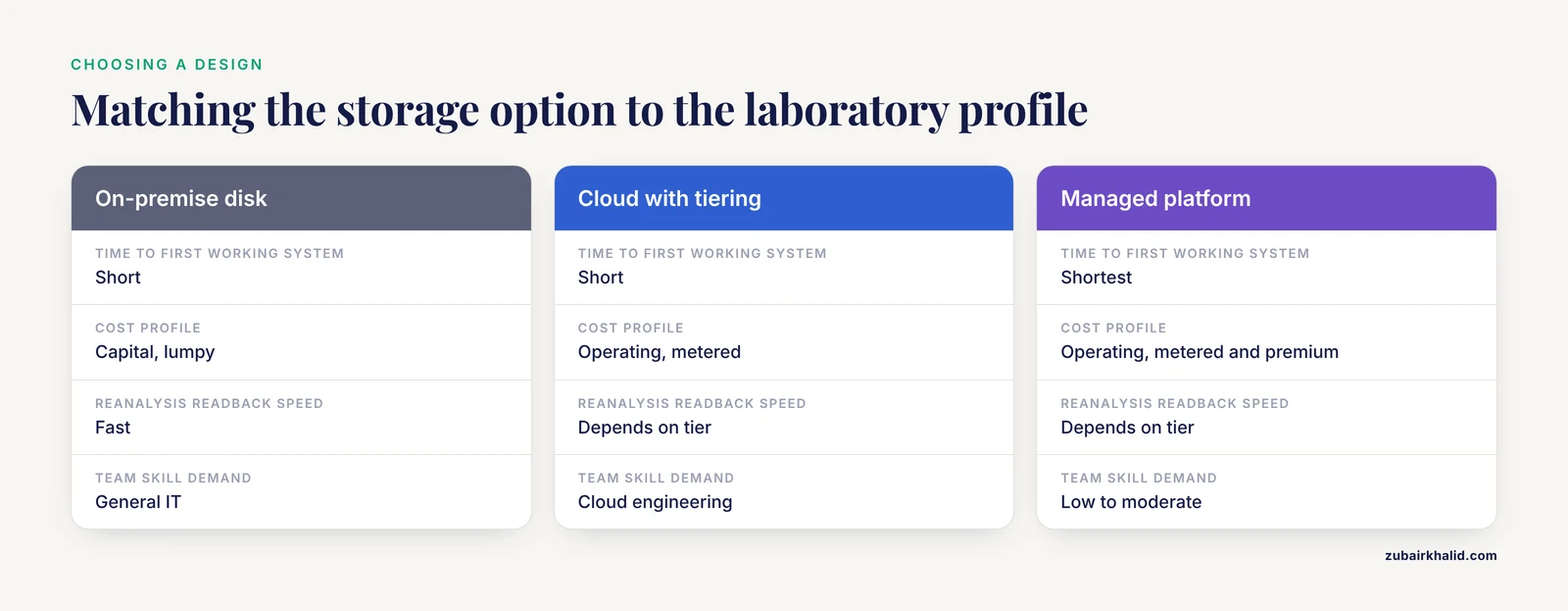
| Criterion | On-premise disk | On-premise object/parallel | Cloud with tiering | Managed platform | Hybrid |
|---|---|---|---|---|---|
| Time to first working system | Short | Moderate | Short | Shortest | Long |
| Cost profile | Capital, lumpy | Capital, large | Operating, metered | Operating, metered and premium | Mixed |
| Scalability headroom | Low | High | Very high | Very high | High |
| Reanalysis readback speed | Fast | Fast | Depends on tier | Depends on tier | Depends on tier |
| Built-in integrity checking | Manual | Strong | Strong | Strong | Strong if implemented |
| Disaster recovery posture | Weak | Weak to moderate | Strong | Strong | Strong |
| Audit and access tooling | Homegrown | Homegrown | Mature | Mature | Split across systems |
| Vendor dependency | None | None | Moderate | High | Moderate |
| Team skill demand | General IT | Storage engineering | Cloud engineering | Low to moderate | Both, plus integration |
| Typical fit | Small panel labs | Large centers with infra staff | Cloud-native programs | Compliance-first programs | Mature mixed programs |
Read this table as a decision aid, not a ranking. The best clinical genomics data management choice is the one whose weakness column you can actually live with, given your staffing and your reanalysis commitments.
How to Choose: The Criteria That Decide Real Implementations
Volume growth, reanalysis cadence, compliance posture, and team skills decide the choice far more than sticker price. Work through them in this order.
Data volume and growth rate
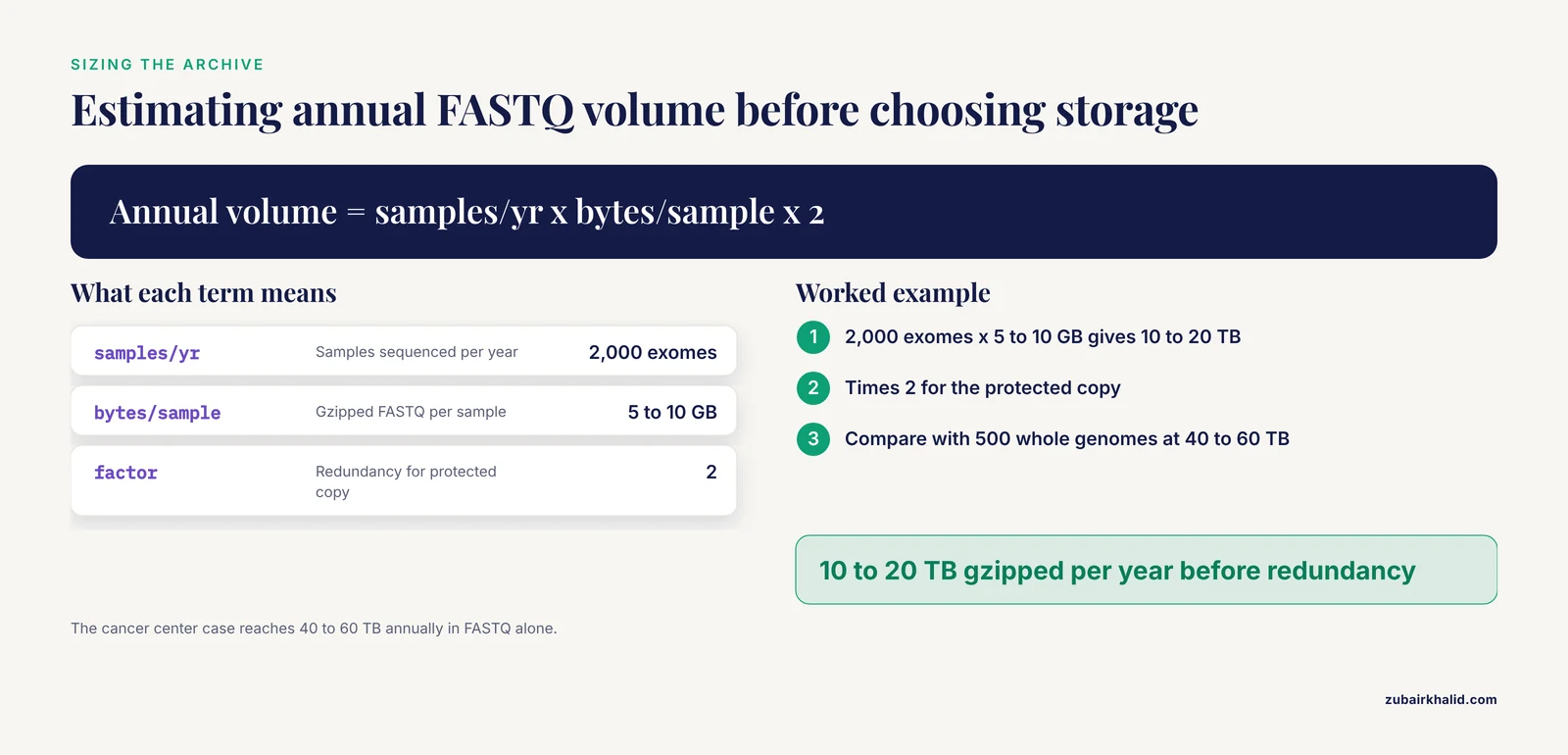
Estimate annual byte volume as (samples per year) times (bytes per sample) times a redundancy factor of at least 2 for the protected copy. A lab running 2,000 whole exomes per year generates roughly 10 to 20 TB of gzipped FASTQ annually, which is manageable almost anywhere. A cancer center running 500 tumor-normal whole genomes per year generates 40 to 60 TB annually in FASTQ alone before derivatives. The first lab can tolerate attached-disk storage with offsite backup. The second needs object storage or cloud tiering from day one, because growth is a curve, not a step.
Reanalysis cadence
Ask how often stored reads will be re-read. A germline rare-disease program may reanalyze a patient cohort on an annual schedule or on demand when a new gene-disease association lands, which the epilepsy reanalysis recommendations treat as a routine, sustainable clinical service [1]. An oncology program with MRD monitoring re-reads data continuously. Data that is re-read quarterly can sit in hot or infrequent-access tiers. Data re-read annually belongs in archive tiers, provided you have modeled retrieval cost and the hours of restore time before the reanalysis window closes. Cloud archive classes commonly charge per-gigabyte retrieval fees and take hours to restore, so a reanalysis wave across a thousand archived exomes is a planned budget event, not a surprise.
Compliance, identity, and audit
Genomic sequence is inherently identifying data. FASTQ files are de-identifiable only in the trivial sense that they contain no name fields, which is not de-identification at all. Clinical genomics data management therefore rests on the metadata chain: every FASTQ file must be traceable, through checksums and database records, to a patient, an accession, an assay, an instrument, and a reagent lot, and every access to it must be logged. This is where the option choices genuinely diverge. Managed platforms and cloud providers supply mature audit and identity tooling. On-premise designs require you to build or buy the equivalent, and the audit trail is not optional. Population-scale efforts that integrate the Human Phenotype Ontology (HPO) into health system infrastructure explicitly treat secure national data access, ISO standards alignment, and bias mitigation as design requirements rather than afterthoughts [6]. A single-laboratory implementation is a miniature of the same problem: structured phenotypes, structured genotypes, controlled access, and documented governance.
Team skills
Be honest about who will run the system. Object storage clusters need at least part of a storage engineer. Cloud architectures need someone fluent in IAM policies, lifecycle rules, and cost monitoring. Managed platforms need someone who can run the vendor's tools and negotiate the contract. If your bioinformatics staff is two people who also do primary analysis, a managed platform or simple cloud design will beat an ambitious on-premise build that quietly rots.
Worked Scenarios
Scenario A: Community hospital molecular diagnostics laboratory
A hospital lab runs 150 targeted panels and 40 exomes per month on a single sequencer. Reports go out in days. Reanalysis is rare but not zero. The right design is modest: on-premise hot disk for the current quarter, cloud archive storage for everything older, checksums computed at ingest, and a LIMS record linking every file to the patient accession. Annual FASTQ volume here is on the order of 15 to 25 TB, which fits comfortably in cloud archive classes. The compliance burden is carried by the hospital's existing information governance, with the laboratory adding file-integrity and access-logging controls on the genomics bucket. This is the profile where simplicity beats sophistication.
Scenario B: Academic cancer center with AML and MRD programs
A center running tumor-normal whole genomes, transcriptome sequencing, and serial MRD sampling for leukemia patients faces continuous re-queried data. The field context is explicit: NGS in AML underpins diagnosis, risk stratification, targeted therapy selection, MRD monitoring, and clonal evolution tracking [3]. Reads from diagnosis samples get pulled repeatedly as treatment evolves. The right design is on-premise parallel storage or a hybrid: hot tier on-premise for the last 12 to 18 months of samples, cloud archive for everything older, and a catalog that lets a bioinformatician request reads by patient, time point, and assay without hunting through directories. Retrieval-heavy archive economics matter here, so the reanalysis forecast belongs in the storage budget review, not in an afterthought.
Scenario C: Health-system research and population genomics program
A program returning genome-informed risk results to tens of thousands of participants, in the style of the eMERGE genome-informed risk assessment design with its 23,840 returned reports and prespecified outcome analysis [5], operates at a scale where phenotype integration is as important as sequence storage. Linking genomic data to structured phenotypes through ontologies such as HPO, with attention to digital infrastructure and data access governance, is the core design problem at this scale [6]. The storage architecture is likely cloud with tiering or a managed platform, but the distinguishing investment is the metadata layer: a catalog that can answer "which participants carry this variant and have this phenotype" without a human reading filenames. This is also where pharmacogenomics enters. In a large psychiatric cohort from the PREPARE program, polypharmacy patients in the pharmacogenomics-guided arm had about half the risk of hospitalization compared with controls (RR = 0.49, 95% CI 0.36 to 0.67) [7]. A pharmacogenomics service that must re-query stored sequence data whenever a new medication is prescribed needs reads within clinical turnaround time, which pushes that subset of samples out of archive tiers and into hot or infrequent-access storage regardless of age.
Scenario D: Reanalysis-as-a-service for unresolved rare disease cases
A genetics service inherits a decade of exomes stored as FASTQ with inconsistent metadata. The clinical rationale is strong: reanalysis raises diagnostic yield, and structured programs for it exist [1]. The informatics task is retroactive: inventory every file, compute checksums, extract sample and patient identifiers from file headers and legacy records, rebuild the accession map, and normalize reference genome versions before re-running pipelines. VUS burden makes this economically rational, since many variants in clinical testing remain unresolved and depend on accumulating evidence for classification [2]. The lesson for new programs is to build the metadata discipline now, because retrofitting it is the most expensive project in bioinformatics data management.
Operational Practices That Matter More Than the Storage Option
Whichever option you choose, these practices separate clinical-grade genomics data storage from a pile of files.
Checksum everything at ingest. Compute a SHA-256 checksum on every FASTQ and related file the moment it lands, store the checksum in the catalog, and verify it on every copy and every move. The command is one line:
sha256sum sample_A12345_R1.fastq.gz > sample_A12345_R1.fastq.gz.sha256Silent bit rot is the failure mode that no one notices until a reanalysis produces garbage, and checksum verification is the only reliable defense.
Make the catalog, not the directory tree, the source of truth. Every file should be findable by patient identifier, accession, assay, instrument run, tissue, library kit, and date through a database query. Directory trees encode exactly one taxonomy and break the moment the second question is asked.
Pin and version your references. Record the exact reference genome build and its checksum, the aligner version, the caller versions, and the pipeline version in the provenance record for every BAM and VCF. Reanalysis is only interpretable when the delta between old and new results is attributable to knowledge change rather than to unrecorded tool changes. This matters acutely in oncology, where clonal evolution tracking depends on comparing time points analyzed under known conditions [3].
Use declarative workflow definitions. Describe pipelines in a portable workflow language such as CWL, WDL, or Nextflow, and execute them with a versioned engine. A pipeline that exists only as an analyst's memory is not reproducible, and clinical reanalysis requires reproducibility.
Separate backup from archive. A backup is a second copy for recovery from loss. An archive is the primary long-homed copy under a retention policy. FASTQ data needs both, and they are not the same thing. The standard 3-2-1 pattern (three copies, two media types, one offsite) is a sound baseline for clinical raw data.
Control and log access explicitly. Encrypt data at rest and in transit. Grant access by role, not by individual, and log every read of clinical sequence data. When an external collaborator or a data-sharing initiative requests reads to help resolve a VUS, the request should flow through documented data governance rather than through someone's secure copy command [2].
Common Mistakes and Limitations
- Deleting FASTQ after producing VCF. This is the most expensive mistake in the field. The VCF cannot support re-calling, structural variant analysis, or contamination checks, and reanalysis programs depend on reads. If storage pressure forces a choice, protect the FASTQ and the catalog entry over intermediate files.
- Storing CRAM without the reference it was encoded against. CRAM files are unreadable, or silently wrong, without the exact reference. Record the reference checksum alongside the CRAM, or do not use CRAM for the clinical archive.
- Checksums computed but never verified. A checksum written once and never re-checked detects nothing. Schedule verification passes on the archive tier.
- Treating cloud archive tiers as instantly usable. Archive classes have retrieval fees and restore delays measured in hours. A reanalysis wave planned for Tuesday needs data requested the previous week.
- Confusing compression with de-identification. A gzipped FASTQ is a compressed human genome. It is among the most identifying data types that exist. Handle it under the same governance as the patient's medical record, which is how system-level genomic infrastructure treats it [6].
- Metadata capture deferred to "later." Retroactive metadata reconstruction across years of legacy files is slow, error-prone, and sometimes impossible. Capture linkage at the moment of sequencing, when the relationships are still unambiguous.
- Unversioned pipeline changes between original and reanalysis runs. If the original analysis and the reanalysis differ in reference or tool versions and neither is recorded, the comparison is uninterpretable.
- Assuming the same storage tier fits germline and oncology workflows. MRD and clonal evolution monitoring pull against stored data continuously [3], while germline programs may reanalyze annually. Tier accordingly.
One honest limitation of this article: no storage architecture substitutes for qualified human judgment. Individual clinical cases require interpretation by a qualified laboratory director and board-certified geneticists or oncologists, and the infrastructure described here exists to serve that judgment, not to replace it.
Frequently Asked Questions
How long should a clinical laboratory keep FASTQ files?
Long enough to cover the full retention window required by your regulatory and accreditation framework for test records, plus the realistic horizon of reanalysis benefit, which can be decades for germline data. Because reanalysis demonstrably raises diagnostic yield over time and formal clinical recommendations support structured reanalysis programs [1], the practical default for whole-exome and whole-genome data is to retain the FASTQ indefinitely under a tiered cost structure rather than to set a short expiry.
Is it acceptable to keep only BAM or CRAM files and delete the FASTQ?
For most purposes, yes, a verified BAM or CRAM preserves the reads, and CRAM cuts storage meaningfully compared with BAM. The conditions are non-negotiable though: you must retain the exact reference the CRAM was encoded against, checksums for every file, and the full pipeline provenance. If those conditions cannot be met, keeping the FASTQ is safer.
Cloud or on-premise, which is better for genomics data storage?
Neither is universally better. Cloud with lifecycle tiering wins on scalability, disaster recovery, and audit tooling, and loses on egress economics and shared governance responsibility. On-premise wins on local control and predictable readback costs, and loses on capital cycles and resilience. Mature programs frequently run a hybrid, with hot data local and archives in the cloud.
What makes stored FASTQ data ready for reanalysis?
Three things: intact file integrity verified by checksum, complete linkage from file to patient and assay through a catalog, and recorded provenance including reference version and pipeline versions. Programs that treat reanalysis as a scheduled clinical service, as the epilepsy reanalysis recommendations describe [1], build these three elements in from the start.
What metadata must travel with every FASTQ file?
At minimum: patient or specimen identifier, accession number, assay type, library kit, instrument and run identifier, lane, tissue source, sequencing date, read group information, and the checksum. In clinical operations this linkage is typically held in the LIMS and mirrored in the storage catalog, so that no file is ever unattributable.
Can stored FASTQ data be shared to help resolve uncertain variants?
Yes, and it often should be, because VUS resolution depends on population reference databases, data-sharing initiatives, and functional evidence that aggregate across laboratories [2]. Sharing must flow through your institution's data governance process, with documented consent scope, de-identification or controlled-access agreements as appropriate, and logged transfer. Thereads themselves are reidentifiable, so data-sharing agreements matter more for sequence data than for most other clinical data types.
Sources
- Recommendations for the re-analysis of existing genomic data from patients with epilepsy.
- Challenges and approaches to genetic variants of uncertain significance in clinical practice and research.
- Next-Generation Sequencing in Acute Myeloid Leukemia: Advancing Clinical Insights.
- [[A case of bilateral open-lip schizencephaly with West syndrome due to variant of PAFAH1B1 gene and literature review].](https://pubmed.ncbi.nlm.nih.gov/42982429/)
- The Electronic Medical Records and Genomics study: Design and analytic framework for assessing the impact of genome-informed risk assessments.
- Population health management of human phenotype ontology.
- Pharmacogenomics positively impacts polypharmacy-related toxicity and clinical outcomes in psychiatric patients.