BLAST vs. Bowtie vs. BWA: Choosing the Right Alignment Tool
By Dr. Zubair Khalid, DVM, MS, PhD ·

BLAST finds what a sequence is, while Bowtie and BWA find where it came from. BLAST is a similarity search tool built to compare one or a few sequences against large databases and identify them. Bowtie and BWA are short-read mappers built to place millions of sequencing reads onto a reference genome you already trust. The rule of thumb is simple. If you need to identify a sequence or find its relatives, run BLAST. If you need to map reads for RNA-seq, ChIP-seq, or variant calling, run Bowtie2 or BWA-MEM, with BWA-MEM as the usual default for whole-genome variant calling and Bowtie2 as a common choice for RNA-seq, ChIP-seq, and small-RNA work.
The blast vs bowtie vs bwa question trips up newcomers because all three tools produce alignments, all three are fast, and all three appear side by side in the same pipelines and web menus. Many servers even keep separate indexes of the same reference genome in BLAST, Bowtie, and BWA formats, because the tools cannot read each other's index files [1]. The difference between blast and bowtie and bwa is the question each one was built to answer, and that difference drives everything else: the algorithm, the input size, the statistics, and the output format.
This guide defines each tool on its own terms, compares them on the criteria that decide real projects, walks through worked scenarios with actual commands, and lists the mistakes that cost the most time.
What Alignment Means in Each Tool
An alignment arranges two sequences, letter by letter, with gaps inserted where needed so that matching characters line up. The sequence you bring to the analysis is the query. The sequence you compare against is the subject, or, in mapping work, the reference genome. A read is a single sequenced fragment, typically 50 to 300 base pairs for Illumina data.
Two alignment styles matter here. Local alignment finds the best matching stretch and is free to ignore the parts of either sequence that do not match. That suits sequences sharing only conserved islands. End-to-end (also called global) alignment tries to align the full length of both sequences. That suits a read that should come entirely from one place in the reference.
With those terms set, the field splits into two jobs.
Similarity search asks, "what is this sequence, and what does it resemble?" The database is enormous and the number of queries is small. BLAST owns this job.
Read mapping asks, "where in my reference did each of these ten million reads come from?" The reference is fixed and the number of queries is enormous. Bowtie and BWA own this job.
BLAST vs. Bowtie vs. BWA at a Glance
The table below is the core of any honest bioinformatics tools comparison between these three programs. Read the "question answered" row first, because it explains every other row.
| Feature | BLAST | Bowtie (1 and 2) | BWA (BWA-MEM) |
|---|---|---|---|
| Core job | Similarity search | Short-read mapping | Short-read mapping |
| Question answered | What is this sequence, and what is it related to? | Where does each read sit on my reference? | Where does each read sit on my reference? |
| Algorithm family | Seed word matching with dynamic programming extension | FM-index seed and extend | FM-index seed and extend with split-read support |
| Typical input | One to thousands of sequences (reads, contigs, genes, proteins) | Millions of short reads, roughly 50 bp and up | Millions of reads, roughly 70 bp up to the megabase range |
| Typical target | Large public or custom databases (nt, nr, swissprot) | One reference genome you index yourself | One reference genome you index yourself |
| Alignment style | Local, free to align only conserved islands | End-to-end by default, local mode available | End-to-end with soft clipping and split (supplementary) alignments |
| Gapped alignments | Yes | Bowtie2 yes, Bowtie 1 no | Yes |
| Sweet spot | Tens to thousands of queries against huge databases | Tens of millions of reads per sample | Tens of millions of reads per sample |
| Primary output | Pairwise text, tabular, or SAM-format hits | SAM, then sorted indexed BAM | SAM, then sorted indexed BAM |
| Index you build | makeblastdb | bowtie2-build | bwa index |
| Canonical uses | Sequence identification, homolog discovery, contamination checks, annotation transfer | ChIP-seq, small RNA-seq, amplicons, gene-level RNA-seq quantification | Whole-genome resequencing, SNP and indel calling, structural variant support |
| Poor fit | Mapping millions of reads, assigning one true origin per read | Distant homology discovery, long high-error reads | Reads under about 70 bp, distant homology discovery |
BLAST: The Similarity Search Engine
BLAST (Basic Local Alignment Search Tool) was developed at the National Center for Biotechnology Information (NCBI) and introduced in 1990. It remains the standard tool for sequence similarity search, available both as the NCBI web service and as the BLAST+ command-line suite you install on your own machine.
How BLAST works
BLAST is a heuristic, meaning it trades a small chance of missing a match for a large gain in speed. Instead of comparing your query to every position of every database sequence with full dynamic programming, which would be computationally infeasible against databases the size of NCBI nt, BLAST first looks for short exact or near-exact matches called words or seeds between the query and database sequences. Default word sizes are 28 for the megablast task, 11 for the classic blastn task, and 3 for protein searches. Promising seeds are then extended into full local alignments scored with dynamic programming.
You can trade speed for sensitivity. The megablast task is tuned for sequences that are highly similar to database entries, such as sequences from the same species or close relatives. Switching to the classic blastn task, for example with blastn -task blastn, uses shorter words and finds more distant nucleotide matches. Protein-level searches detect remote homology far better than nucleotide searches, because protein sequences tolerate the substitutions that accumulate over evolutionary time.
The five BLAST programs
BLAST is really a family of five programs:
- blastn compares a nucleotide query against a nucleotide database.
- blastp compares a protein query against a protein database.
- blastx translates a nucleotide query in six frames and compares it against a protein database.
- tblastn compares a protein query against a nucleotide database translated in six frames.
- tblastx compares a translated nucleotide query against a translated nucleotide database.
A practical consequence: if you have a coding sequence and want to find related genes in another organism, blastx or tblastn will usually outperform blastn, because the protein comparison absorbs synonymous changes.
Reading BLAST scores
Two numbers matter most in BLAST output.
The bit score is a normalized measure of alignment quality. Higher is better, and bit scores put results from different searches on a comparable scale.
The E-value is the expected number of alignments with a given score that you would find by chance in a database of the size searched. An E-value of 1e-20 means you would expect essentially zero alignments that good by chance at this database size. An E-value of 10 means roughly ten alignments that good are expected by chance, which is usually noise. The E-value depends on database size, so the same alignment gets a better E-value in a small database than in nt. Percent identity and alignment coverage must be read alongside it, because a short trivial match can carry a significant E-value.
Running BLAST from the command line
To search against your own reference or assembly, first build a BLAST database:
makeblastdb -in my_genome.fna -dbtype nucl -out my_genome_dbThen run a search. The -outfmt 6 option produces tabular output, one hit per line, which is easy to parse in scripts:
blastn -query mystery.fna -db my_genome_db -outfmt 6 -evalue 1e-5 -num_threads 8 -out mystery_hits.tsvFor a protein query against a curated database:
blastp -query proteins.faa -db swissprot -evalue 1e-3 -num_threads 8 -out proteins_vs_swissprot.tsvWhen to use BLAST
Use BLAST when the question is identification or homology. Typical jobs include naming an assembled contig, checking a PCR product, screening a sample for contamination, transferring annotation from a well-studied organism to a new one, and collecting homologous sequences for phylogenetic analysis. Gene family studies routinely work this way, for example the characterization of the expanded lysozyme repertoire across Caenorhabditis species, which combined sequence analysis tools with phylogenetic inference to trace gene duplications and adaptive evolution [2]. Database resources follow the same pattern at larger scale, exposing similarity search alongside multiple sequence alignment and phylogenetic tools so that thousands of isolates can be mined rapidly [3], and dataset assembly pipelines routinely extract candidate sequences from GenBank records on the basis of annotation and sequence similarity [4].
Do not use BLAST to map a sequencing run. A flow cell produces tens of millions of reads, and BLAST against a large database is orders of magnitude too slow for that workload. Its statistics are also tuned for discovery, not for the per-read placement decisions that downstream tools expect.
Bowtie: The Fast Short-Read Mapper
Bowtie introduced the index structure that made high-throughput read mapping practical on ordinary hardware.
How Bowtie works
Bowtie is built on the FM index, a search structure derived from the Burrows-Wheeler transform of the reference. The transform rearranges the reference into a form that supports fast exact-match searches in time proportional to the length of the search pattern rather than the size of the genome, with a memory footprint small enough to hold a human genome index in a few gigabytes of RAM. The mapper takes short seeds from each read, finds their exact matches in the index, allows mismatches through controlled backtracking, and extends the surviving candidates into full alignments.
Bowtie 1 versus Bowtie2
Bowtie 1, released in 2009, targeted the very short reads of that era, roughly 25 to 50 base pairs, and produced end-to-end ungapped alignments. It is largely legacy software now.
Bowtie2, released in 2012, is the current version. It handles gapped alignments, works well from about 50 base pairs upward, and offers both end-to-end mode and a local alignment mode that can trim (soft clip) the unreliable ends of a read. Bowtie2 also ships preset settings that trade speed for sensitivity, ranging from very-fast to very-sensitive, which is often the first knob to turn when mapping rates look low.
By default, Bowtie2 reports a single best alignment per read, choosing randomly among equally good hits. The -k option reports up to a set number of alignments per read, and -a reports all of them. How you treat these multi-mapping reads matters enormously in repetitive regions, a point that returns in the mistakes section below.
Running Bowtie2
Build the index once:
bowtie2-build reference.fa bt2_indexMap paired-end reads:
bowtie2 -x bt2_index -1 sample_R1.fq -2 sample_R2.fq -p 8 -S sample.samMap single-end reads:
bowtie2 -x bt2_index -U sample.fq -S sample.samWhen to use Bowtie
Bowtie2 is a strong choice for ChIP-seq peak calling, small RNA-seq, amplicon analysis, organelle and microbial genomes, and gene-level RNA-seq quantification in pipelines built around it. It is fast, well documented, and gentle on memory. It is not splice-aware, so transcript-level RNA-seq work generally calls for spliced aligners, and it is not the right tool for discovering what an unknown sequence is.
BWA: The Variant-Calling Workhorse
BWA (Burrows-Wheeler Aligner) shares the FM-index approach with Bowtie but has become the de facto standard aligner for whole-genome resequencing and variant discovery.
The three BWA algorithms
BWA ships three algorithms selected by subcommand:
- bwa aln (the backtrack algorithm) was the original implementation, designed for Illumina reads up to about 100 base pairs, invoked as bwa aln followed by bwa samse or bwa sampe.
- bwa sw handled longer reads and has been largely superseded.
- bwa mem, introduced in 2013, is the recommended default. It is designed for reads from about 70 base pairs up to the megabase range, is faster and more accurate than the older algorithms on longer reads, and produces split alignments with supplementary records for reads that span structural rearrangements or chimeric fusions.
Running BWA-MEM
Build the index once per reference:
bwa index reference.faMap paired-end reads, adding a read group tag that downstream variant callers require:
bwa mem -t 16 -R "@RG\tID:sample1\tSM:sample1\tPL:ILLUMINA" reference.fa sample1_R1.fq sample1_R2.fq > sample1.samThe read group string identifies the sample (SM) and platform (PL), and variant callers use it to separate samples during joint calling. The SAM output is then converted, sorted, and indexed into BAM with samtools:
samtools sort -@ 8 -o sample1.sorted.bam sample1.samBWA in variant-calling pipelines
BWA-MEM is the standard mapping step in GATK-style variant discovery workflows. A representative genome-wide SNP pipeline follows this sequence: quality control of the raw reads, mapping of short reads to the reference genome, recalibration of the alignment, variant calling, quality control of the calls, and filtering of candidate variants [5]. That pipeline was demonstrated end to end on the mosquito Aedes aegypti, a non-model arboviral vector, using publicly available scripts and datasets [5]. The same work notes that the choice of different parameters significantly affects the results, which is why disciplined recording of versions and settings matters as much as the aligner choice itself [5].
BWA-MEM earned this position through consistent behavior, mature split-read support, and deep compatibility with the SAM/BAM ecosystem that GATK, samtools, Picard, and genome browsers all share.
How to Choose: The Criteria That Decide Real Projects
Any bioinformatics tools comparison that stops at feature tables misses the point. These are the criteria that actually decide the choice in working labs.
The question you are asking
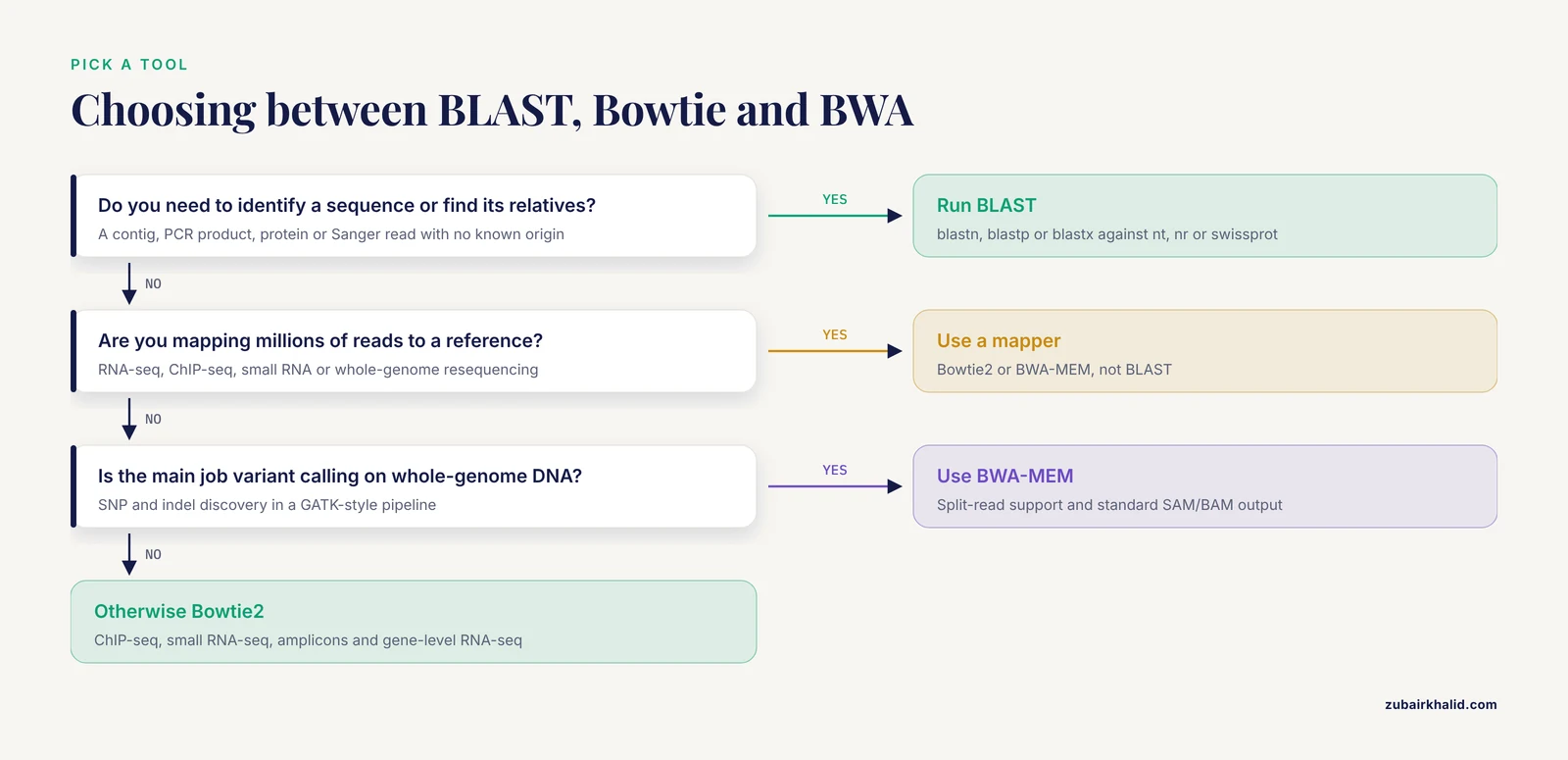
This criterion alone resolves most blast vs bowtie vs bwa debates. If your input is a contig you assembled, a gene you amplified, or a protein you predicted, and you want to know what it is or what it resembles, that is a BLAST job. If your input is a flow cell's worth of reads and you want each one placed on a reference you already trust, that is a mapper job. If you have a handful of reads that failed to map and you want to know what they are, extract them and run BLAST on the unmapped subset.
If you are torn between blast or bowtie for a mapping job, the answer is Bowtie, every time. BLAST is not a read mapper, and forcing it into that role wastes days of compute.
Speed and scale
BLAST cost grows with the product of query size and database size. It is comfortable with tens to thousands of queries against even the largest databases, and painful with millions of queries. FM-index mappers behave close to linearly in the number of reads, so tens of millions of reads per sample map in minutes to a few hours on a multicore workstation. This is an algorithmic difference, not a tuning difference. No BLAST setting makes it a read mapper.
Sensitivity and divergence
BLAST, especially at the protein level, is built to detect remote homology. Short-read mappers assume reads sit close to the reference. How close does mapping require? Less than many beginners expect. A RAD-seq comparison in Heliconius butterflies tested alignment to a reference genome against de novo assembly for species both closely related and about 15 percent divergent from the reference, and reference alignment gave the better results in both cases [6]. The practical reading is that reference-based mapping tolerates real divergence for marker discovery, though variant calling on distant material demands extra care with parameters and filtering.
Read length, error profile, and data type
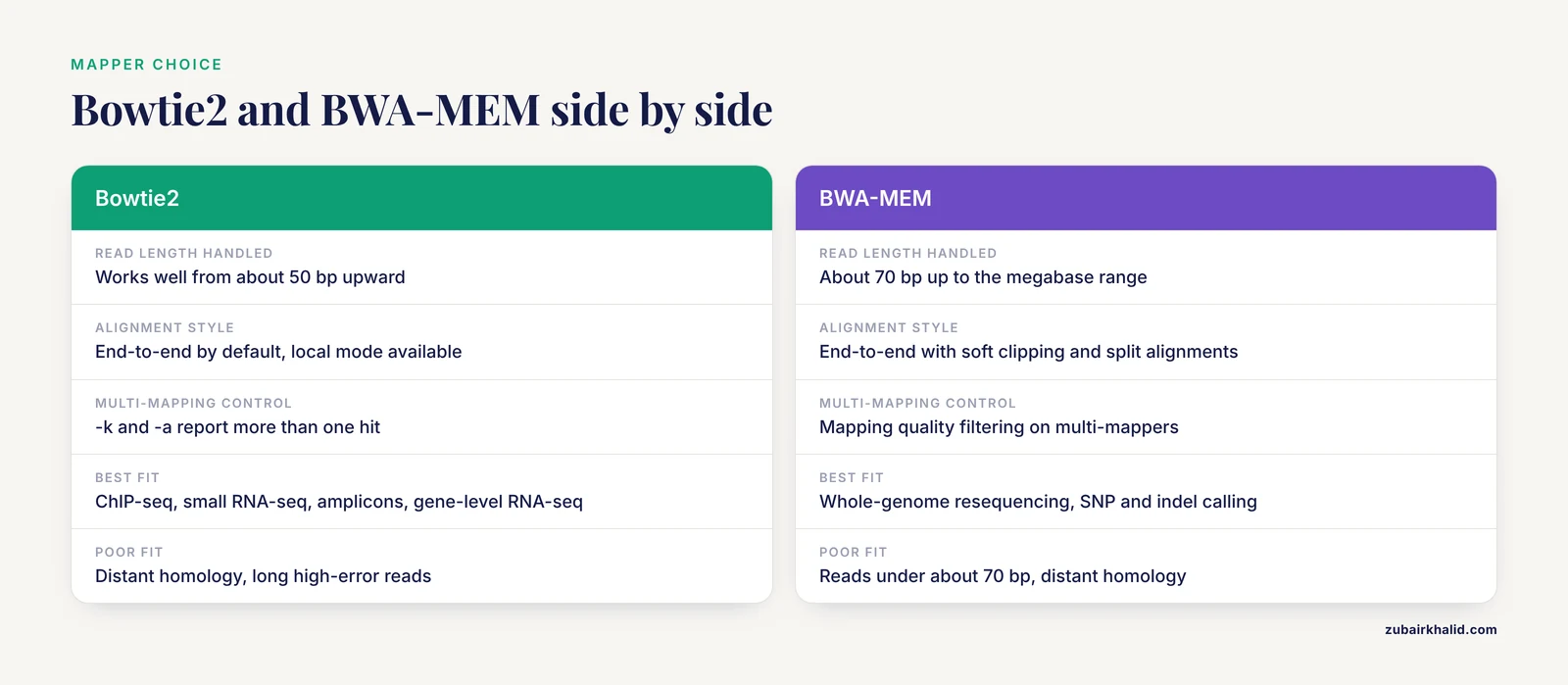
For standard Illumina short reads, Bowtie2 and BWA-MEM are both appropriate, and the rest of the pipeline usually decides between them. For longer reads, BWA-MEM covers a much wider range than Bowtie2. For modern PacBio or Oxford Nanopore data with their distinct error profiles, dedicated long-read aligners are the standard, and BWA-MEM is at best a fallback. Comparative evaluations of alignment methods on third-generation data show that the optimal choice shifts with sequencing depth, genome characteristics, and error patterns, and that popular methods are not consistently the most efficient ones [7]. Treat that as a general lesson for aligner selection everywhere.
Output and downstream compatibility
BLAST output, whether pairwise text or tabular, is built for human interpretation and simple scripting. Mapper output is SAM, converted to sorted, indexed BAM, which is the interchange format for GATK, samtools, Picard, featureCounts, and every mainstream genome browser. If the next step in your pipeline expects BAM, you need a mapper. If the next step is a phylogeny or an annotation table, BLAST output may be exactly right.
Indexing and reference management
Each tool needs its own index built from the same FASTA file: makeblastdb for BLAST, bowtie2-build for Bowtie2, bwa index for BWA. These indexes are large, version sensitive, and mutually incompatible. Sites that serve many tools solve this with automation that downloads reference data and builds indexes in BLAST, Bowtie, BWA, and 2bit formats in one pass, keeping every format synchronized while saving disk space [1]. On a single workstation, the equivalent discipline is manual: record the reference assembly version, rebuild every index whenever the FASTA changes, and never mix alignments made against different versions.
Worked Scenarios
Scenario 1: Identifying an unknown amplicon or contaminant
You amplified a 16S region from an environmental sample, or your sequencing facility flagged unexpected reads. Assemble or trim the sequence to a clean consensus, then run blastn against the NCBI nt database, either through the web interface or the command line. Read the top hits together with percent identity and coverage, not the E-value alone. If the query is a predicted protein, run blastp against swissprot for cleaner functional annotation. Total time is minutes, and the result is a name with evidence attached.
Scenario 2: RNA-seq differential expression
You have 50 million 100 bp paired-end reads per sample and want gene-level counts. Bowtie2 is a legitimate choice in gene-level quantification pipelines. The catch is splicing. A genomic aligner has no knowledge of introns, so a read spanning an exon junction either fails to map or maps awkwardly to one side. For transcript-level work, use a splice-aware aligner designed for RNA-seq. Whichever route you take, treat novel transcript discoveries with caution, because alignment artifacts are a documented source of false positives in non-co-linear transcript detection, and one evaluation found that a stepwise realignment strategy was needed to push precision above 98 percent for fusion, trans-splicing, and circular RNA calls [8]. Candidate fusions deserve validation regardless of the aligner that produced them.
Scenario 3: Whole-genome SNP discovery in a non-model insect
You sequenced 30 mosquitoes to find population markers. The published Aedes aegypti workflow is the template: quality control of raw reads, mapping of short reads to the reference genome, alignment recalibration, variant calling, quality control of the calls, and filtering of candidates, following GATK Best Practices [5]. BWA-MEM is the mapping step. Build the index once, map every sample with a proper read group, sort and index the BAMs, then proceed to the variant caller. Record every parameter, because parameter choices measurably change the final SNP set [5].
Scenario 4: Population genomics with a reference from a related species
You are working on butterflies with RAD-seq data and a reference genome from a related taxon. The Heliconius comparison gives the answer: align to the reference rather than assembling de novo, and expect this to hold even when the species is substantially diverged from the reference, as it did for H. erato at roughly 15 percent divergence [6]. BWA-MEM or Bowtie2 will both map the reduced-representation reads, and downstream stack-based calling produces the markers.
Scenario 5: Checking a Sanger trace or a cloned construct
You sequenced a plasmid insert or confirmed a variant by Sanger sequencing. Trim the low-quality ends of the trace, then BLAST the clean read against nt, or against your own construct database built with makeblastdb. This is the same logic clinical genetics studies use when they confirm candidate variants by aligning the Sanger sequences against the reference [9]. For a handful of sequences, BLAST is faster to run and easier to interpret than any mapper.
Scenario 6: Testing whether aligner choice changes your results
You suspect your mapping step is influencing your downstream calls. The cleanest test is read-level simulation with known ground truth. Frameworks exist precisely because the impact of different read-alignment methods is often unexplored when validation starts at the count-matrix level, and they model PCR amplification, cellular barcodes, UMI selection, fragmentation, and sequencing error to generate reads whose true origin is known [10]. Generate simulated reads matching your design, map them with both candidate aligners using identical downstream steps, and compare mapping rates and final calls. If the stakes are high, this half-day experiment beats any amount of forum reading.
Common Mistakes and Limitations
Using BLAST to map reads. BLAST on a full sequencing run is impractically slow, and its E-value statistics answer a different question than the per-read placement decisions that variant callers and quantifiers expect. Use mappers for reads and BLAST for the unmapped subset you want to identify.
Using a short-read mapper to discover homologs. Bowtie and BWA only report alignments to the reference you gave them. A read with no hit tells you nothing about what it actually is until you BLAST it. Absence of a mapping is not evidence of absence from the tree of life.
Reading the E-value as a probability. The E-value is an expected count of chance hits at a given database size, not the probability that the match is real. A short match in a low-complexity region can carry a significant E-value. Always read percent identity and coverage alongside it.
Ignoring multi-mapping reads. Reads from repeats and recent paralogs map equally well to several loci. Bowtie2's default silently picks one, which piles artificial coverage onto repeat consensus positions. Use -k or -a to expose the ambiguity, filter on mapping quality, or apply a method built for multi-mappers, depending on your question.
Assuming splice awareness. Bowtie2 and BWA-MEM align to the genome without intron knowledge. RNA-seq at the transcript level needs a spliced aligner, and fusion or circular RNA calls from any alignment-based pipeline are candidates for validation, since alignment artifacts are a known false-positive source in this space [8].
Copying parameters without recording them. Variant pipelines are parameter sensitive, and undocumented settings make results impossible to reproduce or debug [5]. Write tool versions, reference version, and complete command lines into a README or workflow file that ships with the analysis.
Believing one tool wins everywhere. Comparative evaluations of alignment methods show that popular tools are not consistently optimal, and that the best choice shifts with sequencing depth, genome characteristics, and error patterns [7]. The best bioinformatics software for your project is the one matched to your question and data, not the one with the most citations. When a decision matters, benchmark on a subsample of your own data.
Mixing reference versions and stale indexes. Rebuilding one index and forgetting the others is a classic silent failure. Any change to the FASTA requires rebuilding the BLAST, Bowtie, and BWA indexes together, and keeping them synchronized is exactly what automated reference management systems were built to do [1].
Underestimating compute and expertise costs. Integrated analysis platforms exist because the requirement for advanced bioinformatics expertise and computational hardware has limited many otherwise capable investigators [11]. Budget for RAM, disk, and learning time, or budget for a core facility.
Forcing these three tools onto every problem. Long high-error reads, metagenomic profiling, and remote protein homology each have purpose-built tools. BLAST, Bowtie, and BWA are the right answers to their own questions, not to every question.
Frequently Asked Questions
Can I use BLAST to align my RNA-seq reads instead of Bowtie or BWA?
You can, but you should not for a full dataset. BLAST would take orders of magnitude longer than a short-read mapper on millions of reads, and its E-value statistics are tuned for similarity search rather than mapping decisions. The practical compromise is to BLAST the small subset of reads that failed to map, which turns unmapped reads into a discovery opportunity.
Which is more accurate, Bowtie2 or BWA-MEM?
For whole-genome DNA resequencing, BWA-MEM is the safer default because of its split-read support and its standardization with GATK-style variant pipelines. For ChIP-seq, small RNA-seq, and gene-level RNA-seq, Bowtie2 performs comparably and is often the more convenient choice. Both are mature tools, and pipeline parameters usually influence results more than the choice between them.
When should I use BLAST instead of a short-read mapper?
Use BLAST when you need to identify sequences or find their relatives, not when you need to place reads of known origin. Concretely, BLAST is the tool for naming a contig, checking a PCR product, screening for contamination, finding homologs for a phylogeny, and confirming Sanger sequences.
Do BLAST, Bowtie, and BWA each need their own index?
Yes. Each tool reads a different index format, so the same reference FASTA must be indexed separately with makeblastdb, bowtie2-build, and bwa index. Infrastructure platforms automate building all of these formats from one download precisely to keep them synchronized.
What E-value cutoff should I use for BLAST?
There is no universal cutoff, and 1e-5 is a common starting point for nucleotide searches. Adjust for database size and purpose, and always interpret the E-value together with percent identity and alignment coverage, because a significant E-value on a short or low-complexity match can still be biologically meaningless.
Can Bowtie or BWA handle PacBio or Oxford Nanopore reads?
BWA-MEM can align long reads within its supported range, but modern PacBio and Oxford Nanopore projects, with their long reads and distinctive error profiles, are typically mapped with dedicated long-read aligners instead. Bowtie2 is not intended for those error profiles. Choose a long-read specialist for third-generation data.
Sources
- BioMAJ2Galaxy: automatic update of reference data in Galaxy using BioMAJ.
- Diversification and adaptive sequence evolution of Caenorhabditis lysozymes (Nematoda: Rhabditidae).
- OpenFluDB, a database for human and animal influenza virus.
- TaxMan: a taxonomic database manager.
- Identification of Single Nucleotide Polymorphism from Insect Genomic Data.
- Population genomics of parallel hybrid zones in the mimetic butterflies, H. melpomene and H. erato.
- Automated evaluation of multiple sequence alignment methods to handle third generation sequencing errors.
- NCLscan: accurate identification of non-co-linear transcripts (fusion, trans-splicing and circular RNA) with a good balance between sensitivity and precision.
- A Novel CRYBB2 Silent Variant in Autosomal Dominant Congenital Cataracts (ADCC) in Pakistani families.
- Minnow: a principled framework for rapid simulation of dscRNA-seq data at the read level.
- Visual Genomics Analysis Studio as a Tool to Analyze Multiomic Data.