How to Use User Reviews to Choose Bioinformatics Tools
By Dr. Zubair Khalid, DVM, MS, PhD ·

By the end of this article you will be able to collect real user reviews for a bioinformatics tool, judge which reviews actually apply to your data, run a small hands-on trial in about ten minutes, and write down a tool choice that a reviewer or collaborator can reproduce. You need four things on hand: a web browser with PubMed access, a terminal with conda or micromamba installed, a free GitHub account for reading issue trackers, and a spreadsheet for your comparison notes.
The problem this solves is volume. Recent field surveys count more than 80 dedicated phage analysis tools, most published since 2020 [1], 74 microsatellite mining tools reviewed in a single comparative study [2], and more than 100 tools for cell-cell communication inference built in six years [3]. Popular tool lists grow faster than anyone can test them. Reviews from people who actually ran the software, on data like yours, with hardware like yours, are the fastest filter available. This article shows you how to use them without being misled by them.
Why User Reviews Matter When Bioinformatics Tools Multiply
Tool choice in bioinformatics has become a review-reading problem because three forces collide at once.
First, the count of options keeps climbing. A single niche such as microsatellite (SSR) mining now has dozens of actively compared tools, and the authors of that comparative review explicitly state that selecting the most appropriate tool is daunting because of rapid technological change and the sheer number of options [2]. Cell-cell communication analysis went from almost no dedicated software to more than 100 tools and nearly 50 ligand-receptor databases in six years, creating what that review calls a challenge in identifying compatible and suitable tools for specific user needs [3].
Second, tools share fragile infrastructure. Reviews of the phage analysis ecosystem note that most downstream pipelines rest on a small set of upstream components, including gene callers, homology engines, and protein language models, so a change in one shared dependency can break many tools at once [1]. A review that says "worked great last year" may be stale by the time you read it, and a five-star review may not survive the next dependency update.
Third, marketing claims and real performance often diverge. In evaluations of AI-based medical image analysis tools for gynecological cancers, tool performance varied significantly even among tools that reported strong headline accuracy numbers [4]. Antimicrobial peptide predictors have been compared under evaluation protocols so inconsistent that data leakage and inflated performance estimates are documented risks [5]. In that environment, independent user experience is often more informative than a benchmark printed on a project homepage.
The good news is that bioinformatics has a rich, verifiable review culture. The rest of this article turns it into a procedure.
What Counts as a User Review in Bioinformatics
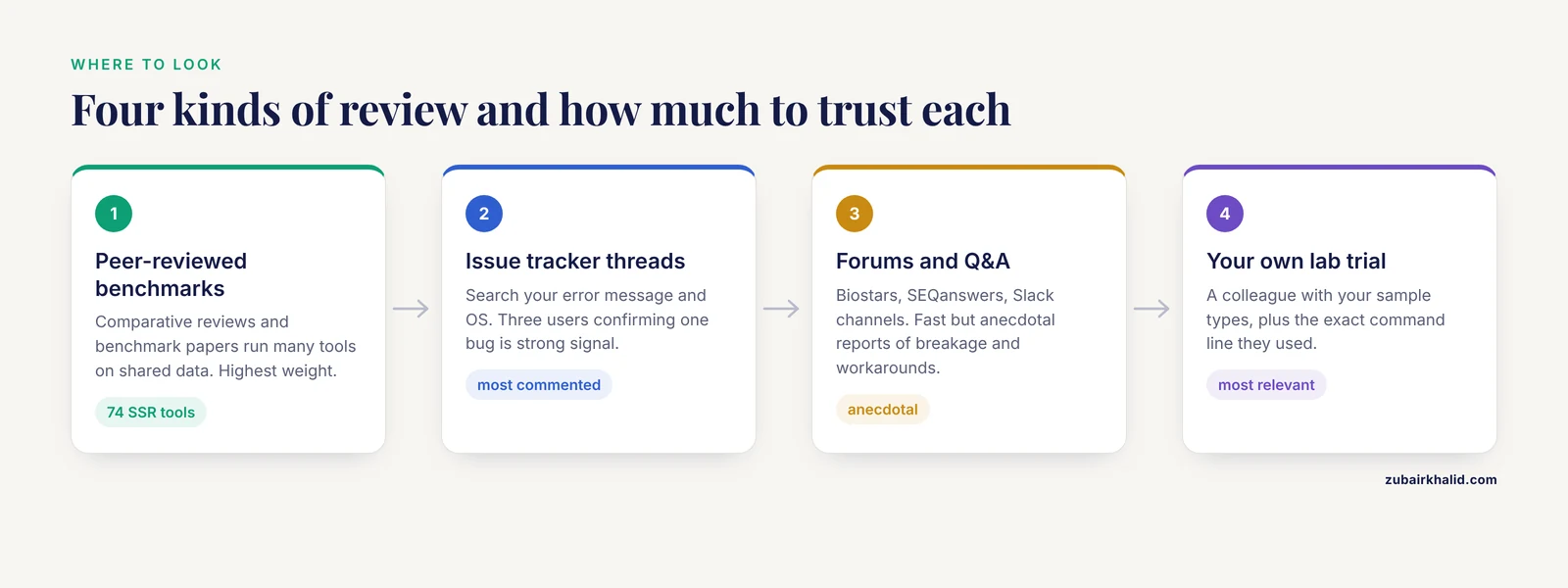
A useful habit is to sort every review you find into one of four types, because each type carries different weight.
Peer-reviewed comparative reviews and benchmarks
These are the highest-value documents. A comparative review surveys many tools side by side, usually with a table of features, requirements, and known limitations. The 74-tool SSR review is a model of the genre, combining literature review, tool comparison, and functionality analysis specifically to support tool selection decisions [2]. Benchmark papers go further and run the tools themselves on shared data. A benchmarking study of eight low-complexity region detection methods across the human proteome, run under multiple parameter settings, produced consensus analyses showing that regions detected by multiple tools were longer, more repetitive, and compositionally purer than single-tool calls [6]. That kind of cross-tool agreement is exactly the signal user reviews should look for.
Scoping reviews are a third variant, and one of the most useful for beginners. A scoping review of workflow management system evaluations collected 21 published evaluations covering 55 systems and distilled twelve evaluation themes, which we use as a framework later in this article [7].
Issue trackers and pull request threads
The GitHub or GitLab issue tracker is the rawest form of user review. Search it for your error messages, your operating system name, and your data type. An issue with three users confirming the same bug on three platforms tells you more about reliability than a polished homepage. The frequency of maintainer responses, and the tone of those responses, is itself review data.
Community forums and Q&A sites
Biostars, SEQanswers, tool-specific Slack and Discourse channels, and conference poster sessions capture the messy middle ground. People report what broke, what the workaround was, and whether support helped. Treat these as anecdotal but fast signals.
Reproduction reports from your own lab
The most relevant review of all is a colleague in the same field, with similar sample types, telling you what happened when they ran the tool. Ask for the command line they used, not just their opinion.
A Framework for Judging What Reviewers Say
Reviews are opinions until you attach them to criteria. The most defensible starting point comes from the scoping review of workflow management systems, which synthesized published evaluations and developer documentation into twelve themes: Basic Computing, Functions, Security, Scalability, Cost and Efficiency, Sustainability, Usability, Learnability, Reproducibility, FAIRness (Findability, Accessibility, Interoperability, Reusability), Flexibility, and Support [7]. These themes work for standalone tools as well as for workflow systems, because a standalone tool still has to be learnable, reproducible, and supported.
The same review found a split you should internalize before reading anything: evaluations focused on noncomputational users favored graphical user interfaces and platforms with plenty of guidance, while evaluations written from the developer perspective favored text-based interfaces [7]. When you read a review, check who wrote it and for whom. A complaint that a tool "has no GUI" from a developer is a preference. The same complaint from a wet-lab scientist is a usability finding.
Use this table to translate review comments into decisions:
| Criterion | What a positive review sounds like | Red flag in a review |
|---|---|---|
| Usability | "Ran my first analysis in an afternoon following the tutorial" | "Works once you reverse-engineer the config file" |
| Learnability | "Documentation covers common questions" | "Had to ask the authors directly to get it running" |
| Reproducibility | "Same input gave the same output on rerun, versioned container available" | "Results changed after I updated, no version numbers reported" |
| Support | "Maintainer answered my issue in two days with a fix" | "Issue open for a year, three duplicate reports" |
| Scalability | "Handled my 40-sample cohort overnight" | "Only tested on the demo dataset" |
| Cost and efficiency | "Runs on a laptop for small datasets" | "Needs 512 GB RAM, never stated up front" |
| Sustainability | "Active releases, dependencies pinned" | "Last commit three years ago, broken dependency" |
| FAIRness | "Standard input and output formats" | "Proprietary output format, no export" |
Bioinformatics Tools User Reviews Step by Step
This walkthrough shows how to move from "I need a tool" to "I chose this tool and here is why." Every step produces a written artifact you can put in a methods section or a lab notebook.
Step 1. Define the job before you read anything
Write one sentence describing the task, the input data, the output you need, and your compute budget. For example: "Align 500 paired-end amplicon reads per sample against a reference and produce a variant table, on a 16 GB laptop." Tools that fail this sentence do not need reviews. Most people skip this step and then drown in comparisons between tools that solve different problems, which the sequence and phylogeny review literature addresses directly by organizing tool guidance around scenario-driven decision-making rather than generic rankings [8].
Step 2. Find the reviews
Search PubMed with a structured query. For an alignment tool, try:
((toolname[Title/Abstract]) AND (benchmark OR comparison OR evaluation OR review))
  AND (bioinformatics[Title/Abstract] OR "high-throughput"[Title/Abstract])
Then broaden to sources the literature does not reach:
- The tool's own publication. Read the limitations paragraph, not the abstract.
- Papers that cite the tool publication but are not written by its authors. Filter citation lists on Google Scholar or Europe PMC for titles containing "benchmark," "comparison," or "evaluation."
- The issue tracker, sorted by "Most commented."
- Biostars and SEQanswers searches for the tool name plus your error-prone keywords such as "install," "crash," or "memory."
- Review papers in your subfield. Look for ones written explicitly from the user perspective, such as the cell-cell communication review that addressed tool selection "from the user's perspective" and documented pitfalls and unresolved issues [3], or the user-friendly review of RNA expression portals that evaluated cBioPortal, UALCAN, and ENCORI on data integration, simplicity of analysis, and results visualization for users without bioinformatic or statistical skills [9].
Collect at least three independent review sources before forming an opinion. One enthusiastic blog post is not a review base.
Step 3. Build a comparison matrix
Open a spreadsheet with one row per candidate tool and one column per criterion from the framework above. Fill cells with review citations, not adjectives. A cell should read "Support: maintainer answered 4 of 5 recent install issues (GitHub, accessed 2026-11-11)" rather than "good support." If a cell is empty, that is a finding too.
For molecular marker work, the 74-tool SSR comparison gives you a ready-made matrix of functionality analyses you can copy columns from [2]. For communication inference, the field review catalogs how tools differ in scoring approaches, requirements, and the ability to infer intercellular versus intracellular communication, which are exactly the rows your matrix needs [3].
Step 4. Check project health signals
Reviews age fast. Before trusting any of them, verify that the project is alive. Two curl commands against the GitHub API do this in under a minute.
curl -s https://api.github.com/repos/lh3/minimap2 \
  | jq '{stars: .stargazers_count, open_issues: .open_issues_count,
         last_push: .pushed_at, license: .license.spdx_id}'
Expected output, with your numbers differing:
{
  "stars": 571,
  "open_issues": 39,
  "last_push": "2026-10-02T09:14:55Z",
  "license": "MIT"
}
Then check development cadence:
curl -s "https://api.github.com/repos/lh3/minimap2/commits?per_page=1" \
  | jq -r '..commit.committer.date'
Expected output:
2026-10-02T09:12:31ZInterpret these the way a reviewer would. A tool with a push in the last three months, an open-source license, and a manageable open-issue count matches what the phage ecosystem review calls healthy shared infrastructure, where problems get patched rather than inherited [1]. A tool whose last commit predates the most recent glowing review has a review-freshness problem, not a quality problem, but you should still test it yourself before relying on it.
To check whether a tool's paper is still being cited, meaning people still get results with it, query Europe PMC:
curl -s "https://www.ebi.ac.uk/europepmc/webservices/rest/search?query=EXT_ID:39606018&resultType=core&format=json" \
  | jq '.resultList.result.citedByCount'
Expected output is a single integer, such as:
17A steady citation count with a dead repository tells you the tool works but is frozen. A falling citation count alongside a new competitor in the same reviews tells you the field has moved.
Step 5. Run a small trial
Never adopt a tool on reviews alone. Reviews tell you what happened to other people, on other data, on other hardware. Create a scratch environment and a three-sequence test file, then run the tool end to end.
conda create -y -n tooltest -c conda-forge -c bioconda mafft
conda activate tooltest

cat > test.fasta << 'EOF'
>seq1
MKTAYIAKQRQISFVKSHFSRQ
>seq2
MKTAYIAKQRQISFVKSHFSRQLEER
>seq3
MKTAYIAKQRQLEER
EOF

mafft test.fasta > aligned.fasta
head -n 8 aligned.fasta
Expected output on the terminal during the run:
stdout progress information goes to stderr
inputfile: test.fasta (single)
...
Strategy FFT-NS-2 (Fast but rough)
and in aligned.fasta:
>seq1
MKTAYIAKQRQISFVKSHFSRQ--
>seq2
MKTAYIAKQRQISFVKSHFSRQLEER
>seq3
MKTAYIAKQRQ-------LEER
You can verify the result without any biology knowledge. The longest sequence has 26 residues, so every output sequence must be 26 characters long. Sequence 3 contributes 15 residues, so it must show exactly 11 gap characters, which you can count with:
grep "seq3" -A 1 aligned.fasta | tail -n 1 | tr -cd '-' | wc -cExpected output:
11This toy pipeline teaches you the three things reviews describe in vague terms: how painful installation is, how loud and interpretable the output is, and how the tool behaves on trivially checkable data. If a tool cannot pass a three-sequence sanity check, or if its documentation cannot get you this far without support tickets, that failure is itself a user review you have now written.
Step 6. Verify benchmark claims yourself
When a tool's homepage claims state-of-the-art accuracy, do three things.
First, check whether the claim has an independent benchmark behind it. Look for third-party evaluations that report metrics with consistent protocols. For classification-style tools, the Matthews correlation coefficient is a standard balanced measure, and recent foundation-model approaches to phage identification report values above 0.95 on identification tasks, a number that means something only within the dataset and protocol it was measured on [1].
Second, check whether the evaluation design protects against data leakage. The antimicrobial peptide field found that existing studies often rely on heterogeneous datasets and inconsistent evaluation protocols that can produce data leakage and inflated performance estimates, and it asks directly what evaluation criteria are needed for fair, reproducible assessment [5]. If a tool paper trains and evaluates on sequences that share close homologs across the train and test split, treat the reported accuracy as an upper bound, not an expectation.
Third, look for consensus across tools rather than excellence in one. The low-complexity region benchmark found that regions detected by multiple independent tools were typically longer, more repetitive, and compositionally purer, suggesting stronger structural or functional relevance, while Jaccard similarity matrices clustered algorithms by shared detection principles [6]. Practically, this means running two or three tools from different method families and trusting the overlap. Agreement is a form of review, written by the tools themselves.
Step 7. Score, decide, and document
Turn your matrix into a number so that decisions are explicit. Weight each criterion, score it 1 to 5 based on your collected reviews and your trial, and compute a weighted total. Here is a worked example for a shortlisted candidate:
Criterion              Weight  Score  Weighted
Usability                 2      4       8
Learnability              2      3       6
Reproducibility           3      5      15
Support                   2      3       6
Scalability               2      4       8
Documentation             2      5      10
Maintenance activity      3      2       6
Community uptake          2      4       8
Total                                   67 out of 90
67 divided by 90 is 74.4 percent. Run the same rubric on the second candidate and compare. The weights encode your priorities, so change them deliberately and record why. Then write a one-paragraph decision memo: task, candidates considered, reviews consulted with dates, trial commands, final choice, and version number. Reviewers of your manuscript will ask for exactly this, and pangenome work has shown that diverse analytical procedures introduce reproducibility challenges that standard operating procedures and reporting criteria are meant to control [10].
Reading Benchmarks Critically
Benchmarks are user reviews written by specialists, and they have their own failure modes. Learn these four before you lean on one.
Publication bias toward new methods. Developers benchmark their own tool against competitors. The cell-cell communication review documented over 100 tools built in six years and explicitly listed assumptions and limitations that vary widely across methods, including scoring approaches and data requirements [3]. When a benchmark shows a new tool beating incumbents, check whether the incumbent was run with default parameters tuned years ago.
Inconsistent protocols across studies. The antimicrobial peptide evaluation framework found that comparing tools reliably is difficult because existing studies use heterogeneous datasets and inconsistent evaluation protocols, which can lead to data leakage and inflated performance estimates [5]. Two benchmarks of the same tool can disagree because they measured different things.
Single-tool agreement is not correctness. The low-complexity region framework showed that algorithm clusters follow shared detection principles, so tools from the same cluster will agree with each other for structural reasons [6]. A "99% agreement" claim between two tools that use the same algorithm family is weaker evidence than moderate agreement between two tools from different families.
AI black-box behavior needs its own scrutiny. The survey of explainable AI in bioinformatics found significant demand for transparency, driven by the need for user confidence in decision-making, and documented limitations in current explainability approaches for omics and imaging data [11]. If a review praises an AI tool's accuracy but cannot describe why it produces its outputs, and your results will guide experiments or clinical decisions, add interpretability as a scoring criterion. Practical guidelines for developers increasingly treat explainability as a requirement rather than a bonus [11].
Bioinformatics Tools Comparison in Practice
A comparison is only as good as its axis of comparison. Three patterns from recent reviews are worth copying.
Compare by scenario, not by leaderboard. The sequence and phylogenetics review explicitly organizes alignment and tree-building methods around trade-offs in accuracy, memory, scalability, and uncertainty support, and contrasts ultra-large-alignment heuristic engines with full maximum-likelihood frameworks and Bayesian platforms for time-scaled phylogenies [8]. Copy that structure. For your matrix, add a column for "smallest dataset this tool handles gracefully" and "largest dataset reported in reviews."
Compare upstream dependencies too. Because most downstream phage tools rest on shared gene callers and protein language models, a change in a dependency propagates across the ecosystem [1]. In your matrix, record the language, the dependency manager, and whether the tool ships a container. Two tools with identical review scores are not equivalent if one pins its dependencies and the other does not.
Compare with standard operating procedures in mind. Pangenome reviews propose standard procedures and reporting criteria precisely because diverse procedures undermine reproducibility [10]. Your comparison memo, with versions and dates, is your personal standard operating procedure.
Matching Tool Interfaces to Your Skill Level
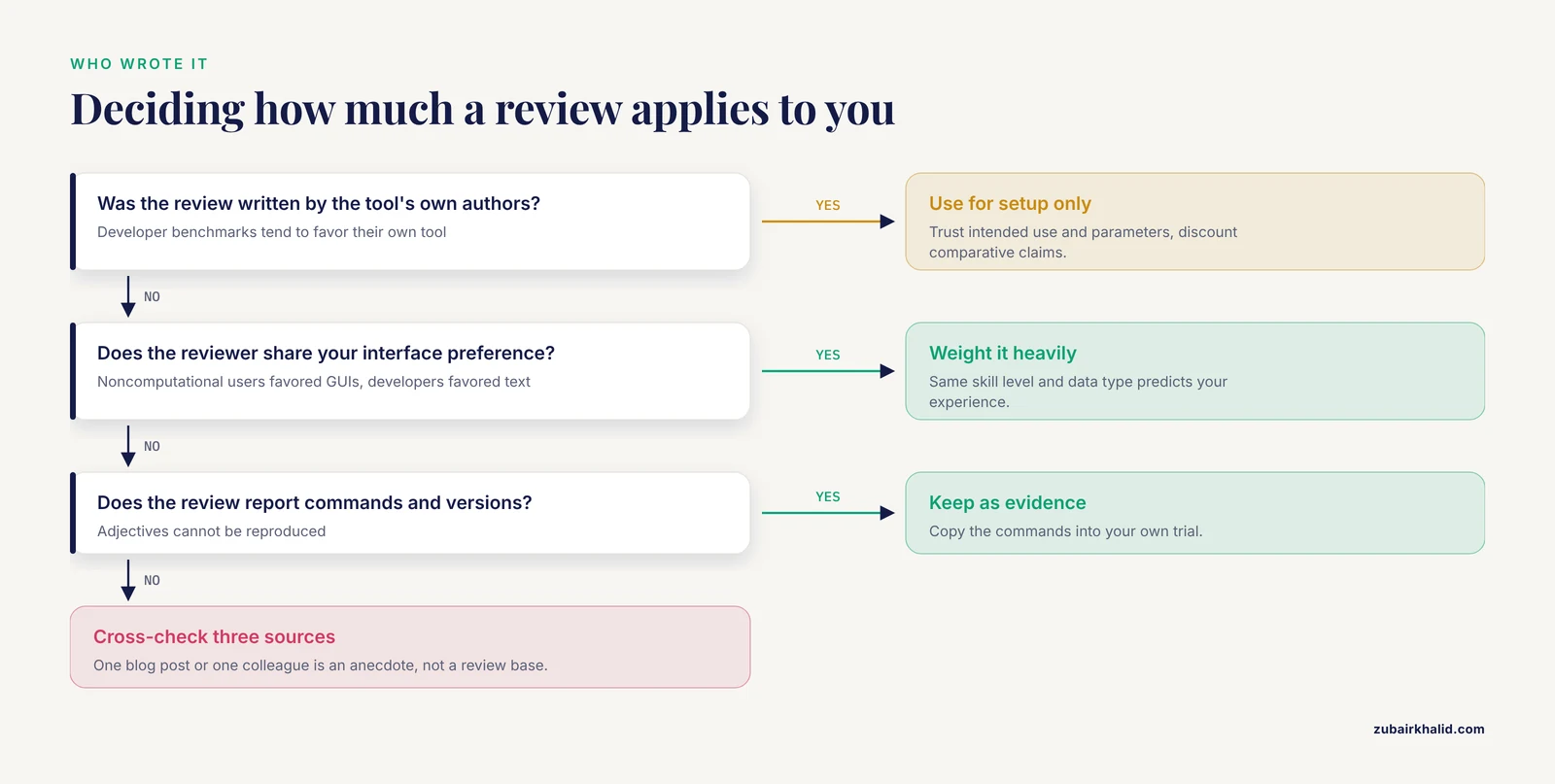
Reviews written by people unlike you will mislead you, and interface type is where this bites hardest. The workflow management system review found that evaluations focused on noncomputational users preferred graphical user interfaces and guided platforms, while developer-focused evaluations preferred text-based interfaces [7]. Know which reviewer you resemble before you weight their opinion.
If you have little or no programming background, prioritize web portals with demonstrated attention to simplicity and visualization. The RNA portal review evaluated cBioPortal, UALCAN, and ENCORI specifically on data integration, simplicity of analysis, and results visualization for users without bioinformatic or statistical skills [9]. Similar user-friendly, web-based collections exist for bacterial protein function prediction, where reviews emphasize tools experimentalists can adopt to generate testable hypotheses without a local compute setup [12]. Guided graphical interfaces also exist for harder tasks than people expect, including deep-learning image segmentation, where a published protocol walks users through training customizable models without extensive coding expertise [13]. Reviews of AI resources for drug target discovery likewise include practical guidance for researchers without computational expertise [14], and user-friendly platforms are being developed to close the gap between bioinformatics experts and other researchers [15].
If you are comfortable on the command line, invert the advice. Command-line tools with plain-text outputs, pinned dependencies, and active issue trackers give you more control and more reproducibility, which is why developer-oriented evaluations favored them [7]. Your reviews should then come from issue trackers and benchmark papers rather than from portal tutorials.
Even in the AI-heavy areas, user judgment remains central. The post-AlphaFold structural biology outlook stresses that practical success hinges on integrating new predictions into established protocols and that user-driven intervention is still as pivotal as the algorithms themselves [16]. Reviews that describe how experts combined a tool with manual inspection are more valuable than reviews that describe accuracy alone.
Common Mistakes and Limitations
These are the errors seen most often when people act on user reviews of bioinformatics tools.
- Trusting a single review source. One blog post, one paper, or one colleague is an anecdote. Cross-check at least three independent sources before shortlisting, and prefer reviews that report commands and versions over those that report adjectives.
- Ignoring reviewer identity. A review written by a tool's author is a demonstration. A review written by a developer is a developer's review. A review written by someone with your data type and skill level is the one that predicts your experience. The documented split between GUI-preferring and CLI-preferring evaluations shows how much reviewer perspective changes conclusions [7].
- Treating homepage accuracy as evidence. Self-reported metrics can be inflated by dataset construction and protocol choices, as documented for antimicrobial peptide predictors [5]. Look for independent benchmarks with explicit protocols before you accept a headline number.
- Confusing popularity with fit. High citation counts mean a tool solved many people's problems, possibly on data unlike yours. The SSR review evaluated 74 tools precisely because no single tool fits every use case [2]. Match the tool to the job sentence from Step 1.
- Skipping the trial run. Reviews cannot tell you how the tool behaves on your input formats, your file sizes, or your operating system. The ten-minute toy trial in Step 5 catches most installation and output-format surprises before they reach real data.
- Not recording versions. Reproducibility requires version numbers, parameters, and dates. Reviews that omit them cannot be reproduced, and neither can your analysis if you omit them. Pangenome practice responded to the same problem with reporting criteria and standard operating procedures [10].
- Reading old reviews after a major update. Software changes. If the tool released a new major version after the review was written, repeat Step 4 and Step 5 rather than assuming the review still holds, because shared upstream dependencies can change behavior across many tools at once [1].
- Overweighting explainability complaints you do not need, and underweighting those you do. If your results feed a decision with biological or clinical consequences, transparency is a requirement, and the demand for explainable AI in bioinformatics is documented and growing [11]. If you are running a one-off exploratory analysis, interpretability can be weighted lower than support and stability.
One broader limitation belongs here rather than anywhere else. Reviews aggregate other people's experience, benchmarks aggregate other people's data, and neither substitutes for validating a tool on a small, well-understood subset of your own data before scaling up. For individual research decisions with downstream consequences, consult a senior colleague or a core facility bioinformatician the same way you would consult a specialist for a difficult case.
Frequently Asked Questions
Are user reviews of bioinformatics tools reliable?
They are reliable as experience reports and unreliable as universal verdicts. Peer-reviewed comparative reviews with explicit evaluation criteria are the most trustworthy form, issue trackers are the most current, and anonymous forum posts are the most anecdotal. Weight them in that order.
Where can I find user reviews for bioinformatics software?
Start with PubMed searches for benchmark and comparison papers, then move to the tool's issue tracker, Biostars, SEQanswers, and community forums. Comparative review papers in your subfield, written from the user perspective, often contain ready-made comparison tables you can adapt.
How many reviews or citations does a tool need before I trust it?
There is no universal threshold, because a niche tool can be excellent with few citations. What matters is independent corroboration, meaning at least one benchmark or comparison paper you did not request from the authors, plus evidence of recent maintenance, plus your own successful trial run.
Should I pick the newest tool or an established one?
Pick by scenario, not by age. Reviews that organize methods around task scenarios and trade-offs in accuracy, memory, and scalability exist because the right choice depends on your data size and goals, not on release date. New tools with strong benchmarks are worth trialing, established tools with active maintenance are safer defaults.
How do I compare tools that all claim high accuracy?
Look for independent benchmarks with consistent evaluation protocols, check for data leakage in the reported results, and prefer tools whose findings agree across different method families. Cross-tool consensus is stronger evidence than a single tool's self-reported best score.
What if a tool is popular but has no recent updates?
Test it before assuming it is broken. Popularity with a frozen codebase often means the tool is stable and complete, but check the issue tracker for recent, unresolved installation failures, because shared dependency changes can break unmaintained software even when the code itself has not changed.
Can I trust a review written by the tool's own authors?
Trust it for setup instructions, intended use cases, and parameter explanations. Discount it for comparative claims, since developer benchmarks tend to favor their own tool and may run competitors with untuned default parameters. Seek out at least one third-party evaluation before deciding.
How do I record my tool choice for reproducibility?
Keep a decision memo with the task definition, candidate tools, review sources with access dates, trial commands and outputs, the final tool with exact version numbers, and all parameter settings. This is the same documentation practice that reporting standards and standard operating procedures in comparative genomics are designed to encourage.
Sources
- Phage bioinformatics tools: a review of computational approaches for bacteriophage research.
- What are microsatellites and how to choose the best tool: a user-friendly review of SSR and 74 SSR mining tools.
- Advances and challenges in cell-cell communication inference: a comprehensive review of tools, resources, and future directions.
- Artificial Intelligence Tools for Supporting Histopathologic and Molecular Characterization of Gynecological Cancers: A Review.
- Antimicrobial Peptide Databases and Prediction Tools: Toward a Standard Evaluation Framework.
- A benchmarking framework for comparative evaluation of low-complexity region detection tools in the human proteome.
- A scoping review of approaches to evaluating workflow management systems for bioinformatics users.
- Revisiting Algorithms, Tools, and Applications for Sequence and Phylogenetic Analyses in the NGS-Based Omics Era.
- The RNA world: from experimental laboratory to "in silico" approach. Part 1: User friendly RNA expression databases portals.
- The grammar of the pangenome: terms, concepts, methods, and emerging patterns-a general framework for comparative genomics and genome biology.
- Demystifying the black box: A survey on explainable artificial intelligence (XAI) in bioinformatics.
- Deciphering bacterial protein functions with innovative computational methods.
- CODAvision: best practices and a user-friendly interface for rapid, customizable segmentation of medical images.
- Artificial Intelligence Tools for Drug Target Discovery Research: Database, Tools, Applications, and Challenges.
- Value of Bioinformatics Models for Predicting Translational Control of Angiogenesis.
- An outlook on structural biology after AlphaFold: tools, limits and perspectives.