Long-Term Sustainability of Bioinformatics Tools
By Dr. Zubair Khalid, DVM, MS, PhD ·

Bioinformatics software sustainability is the capacity of a computational tool to remain installable, correct, and actively maintained for years after publication, even as its dependencies, hardware, funding, and development team change. In practical terms, a sustainable tool is one that a new user can still run five or ten years later and still reproduce the results claimed in the original paper.
This matters because bioinformatics research runs on software that is mostly written by graduate students, postdocs, and small academic teams with grant-funded, finite timelines. A typical analysis pipeline combines dozens of tools, each with its own dependencies, license, and maintenance history. When any one link breaks, the whole analysis can break with it. Surveys of the software engineering literature show that quality in bioinformatics code lags general-purpose software by a wide margin, with one systematic review of 167 bioinformatics projects estimating an average defect density roughly 11.8 times higher than that of general-purpose software [1]. Understanding what sustainability means, how to recognize it, and how to build it is therefore a working skill for anyone who writes, chooses, or depends on bioinformatics software.
What Does Bioinformatics Software Sustainability Mean?
A useful bioinformatics software sustainability interpretation starts with the broader software engineering definition. Sustainability in software has four commonly recognized dimensions: environmental, human, social, and economic. Sustainability means that a software artifact keeps delivering value over time without exhausting the people, money, and technical conditions it depends on [2]. In the bioinformatics setting, this general definition takes on a specific shape, because academic tools are usually built by one or two people, released with a paper, and then left to survive on volunteer effort.
Breaking the definition into its working parts helps:
- Technical sustainability. The code still runs on current operating systems, its dependencies still resolve, and its bugs get fixed. A tool that depends on a Python 2 interpreter, a defunct web service, or an unmaintained library is technically unsustainable even if the source code is still downloadable.
- Human sustainability. The project does not burn out its maintainers, and knowledge of the codebase is shared rather than locked in one person's head. Team-based development practices directly affect code quality through knowledge sharing and shared coding standards [3].
- Economic sustainability. Funding exists to keep developing the tool, whether through grants, institutional support, commercial licensing, or community contributions.
- Social and community sustainability. Users can get help, contribute fixes, and train successors. A tool with a documentation site, an active issue tracker, and a contributor pipeline is more socially sustainable than an abandoned repository.
When people ask what bioinformatics software sustainability means in everyday terms, the honest answer is: it is the set of conditions that lets the next user, who may be a stranger on another continent with a different operating system, get the same answer you did. The Bioconductor project articulated this goal early. Its founding aims included fostering collaborative development, lowering barriers to entry into interdisciplinary research, and promoting remote reproducibility of research results [4]. Those goals, written in 2004, map almost exactly onto what we now call sustainability.
One common misunderstanding deserves correction here. Sustainability is not the same thing as being open source. Open licensing makes sharing and reuse legally possible, and governance frameworks and intellectual property arrangements strongly shape how open-source bioinformatics projects develop [5]. But an open-source tool with no tests, one maintainer, and unmaintained dependencies can be less sustainable than a well-supported commercial product. Sustainability is a property of the whole system around the code, not of the license alone.
Why Bioinformatics Tools Stop Working
Software does not rot on its own. It stops working because the world around it changes. The decay follows a recognizable sequence, and recognizing each step helps you diagnose whether a tool is worth adopting.
Step 1: The paper is published and development slows
Most academic bioinformatics tools receive their burst of development in the months before a paper submission. After publication, the lead developer often graduates, changes labs, or moves to a new project. The repository freezes at the state that produced the paper. This is the single most common starting point of unsustainability, and it is structural, because academic reward systems recognize papers rather than maintenance work. Analysts of research software argue that software requires ongoing human effort to stay useful, to adapt to changing dependencies, to fix bugs, and to add features, and that this effort needs to be organized and rewarded rather than assumed.
Step 2: Dependencies drift
A tool that ran perfectly in 2018 can fail in 2025 for reasons that have nothing to do with its own logic. Operating systems deprecate libraries. Web APIs change their endpoints. Compiler versions reject code that used to compile. Because a typical bioinformatics tool sits at the top of a dependency stack dozens of layers deep, drift anywhere below it can break the tool. The gap is especially visible where software must track fast-moving hardware. Work on next-generation sequencing software for emerging computing platforms argues that sustainable accelerated bioinformatics requires a sustained collaboration between domain developers and technology experts, because neither group alone can keep accelerated kernels, libraries, and frameworks current as both the biology and the hardware change.
Step 3: Defects surface faster than they get fixed
Bioinformatics code carries a heavy defect load. The systematic review of 167 bioinformatics software projects found that average defect density requires significant improvement, running about 11.8 times higher than general-purpose software, and that a considerable share of defects involve annotations, which is unusual compared with traditional software domains [1]. Defects related to annotations are particularly dangerous in bioinformatics, because an annotation error can silently distort a biological result rather than crash loudly. When the maintainer has moved on, these defects accumulate uncorrected.
Step 4: Installability fails before correctness does
Users usually lose access to a tool long before they discover a scientific error in it. The install fails, a conda environment conflicts, a Docker base image is pulled from a registry, or a required database version is no longer mirrored. At that point most users abandon the tool and move to an alternative, which reduces the community, which reduces the number of people who would have noticed and fixed the problem. This feedback loop is what turns a merely stale project into a dead one.
Step 5: The niche is filled by a newer tool
Finally, a newer tool with better marketing, a friendlier interface, or a paper in a higher-profile journal absorbs the user base. Whether the newcomer is actually better is a separate question. Studies comparing the popularity and performance of methods have found real discrepancies between the most popular and the best-performing options, which raises concerns about how researchers select tools in the first place [7]. Popularity, not quality, often decides survival.
How Sustainability Is Observed and Measured in Practice
Because sustainability is about the future, measuring it directly is impossible. What researchers do instead is read signals from the present. Two complementary approaches dominate.
Repository-based measurement
Online software repositories record commits, issues, pull requests, releases, and contributor histories. Work in the software engineering literature has proposed data-driven methodologies that harness this repository data to quantify how sustainable a software artifact is, analyzing open-source projects to infer the conditions that support long-term survival [8]. In bioinformatics, the same signals are readable by any user: recent commits, responsive issue triage, tagged releases, continuous integration runs that pass, and a contributor list longer than one person.
Empirical quality studies
A second approach evaluates the code itself. The 167-project empirical study cited above used the PRISMA protocol to systematically extract and evaluate quality-related data across bioinformatics software, producing one of the first quantitative portraits of the field's engineering health [1]. The headline findings, the high defect density and the prevalence of annotation-related defects, give buyers and adopters a concrete reason to demand evidence of testing rather than trusting a publication record alone.
Popularity as a misleading proxy
The most tempting signal, citation counts and download numbers, is also the least reliable. The 20-year survey of gene set analysis methods built an open database of 503 method papers and ran automated benchmarking workflows, and found that the most popular methods were not consistently the best performing [7]. For sustainability specifically, popularity is a double-edged signal. A large user base increases the odds that someone will report and fix bugs, but popularity says nothing about whether the code is correct today. When you evaluate long-term sustainability of bioinformatics tools, weight repository activity and testing evidence more heavily than citation counts.
Bioinformatics Tools Comparison: Open Source Versus Commercial
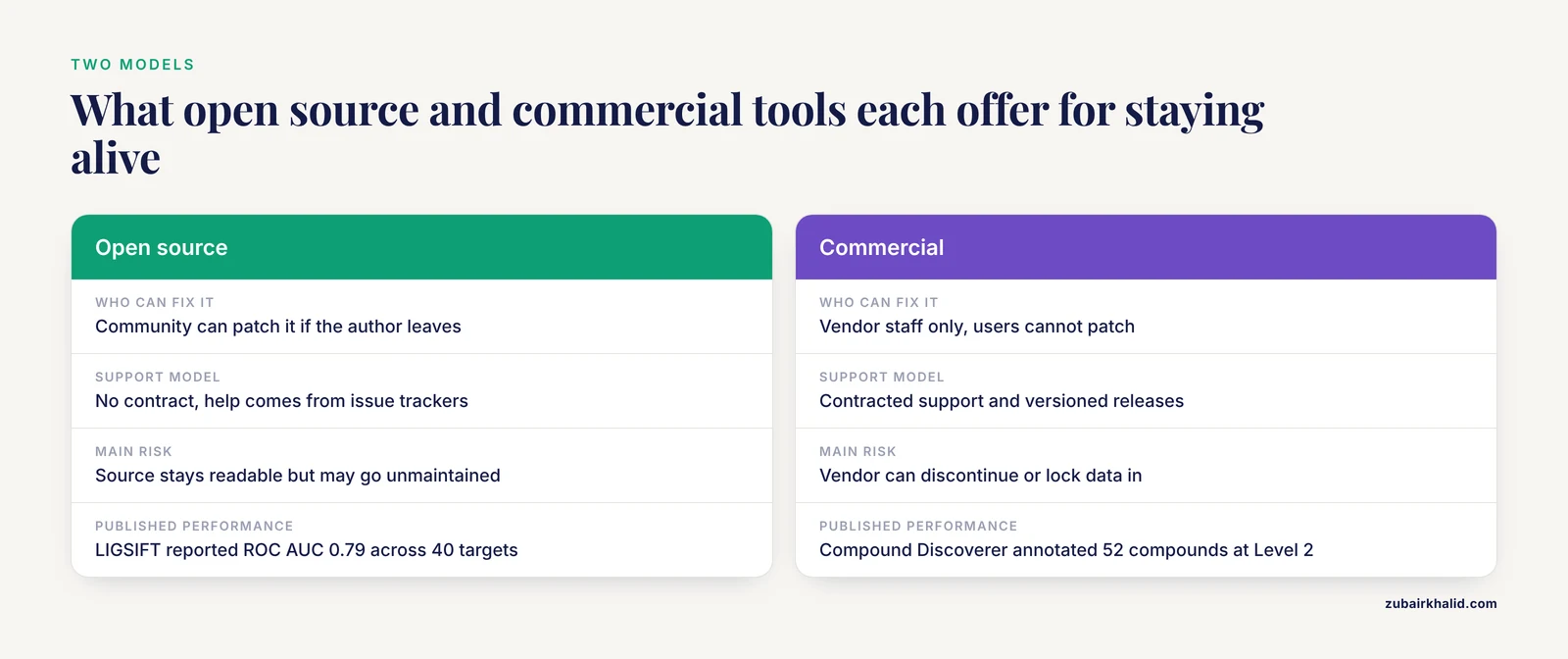
A practical bioinformatics tools comparison has to weigh sustainability alongside analytical performance, because the sustainable choice and the best-performing choice are not always the same product.
A controlled head-to-head example
One of the cleanest direct comparisons comes from untargeted metabolomics. A 2024 study evaluated data processing for gas chromatography coupled to high-resolution Orbitrap mass spectrometry, comparing the open-source tool MS-DIAL against the commercial Compound Discoverer platform, using thyme geographical differentiation, Spanish versus Polish samples, as a test case [9]. Both tools faced the same underlying challenges. Feature detection was heavily affected by unknown metabolites at the lowest identification confidence levels, by background signals, and by duplicate features, all of which had to be handled carefully before any multivariate analysis could be trusted. In the marker annotation step, the commercial platform putatively annotated 52 compounds at Level 2 confidence while MS-DIAL annotated 115 [9]. The takeaway is not that one product is universally superior. The takeaway is that open-source and commercial tools make different trade-offs, that both require expert judgment to produce reliable results, and that the commercial tool's support contract does not exempt the analyst from understanding feature filtering.
What open source offers sustainability
Open source offers three sustainability advantages that commercial software generally cannot match. First, the community can fix the tool even if the original author disappears, which is the mechanism that has kept projects like Biopython alive for decades. Second, the source code itself is an archive. Even an unmaintained open-source tool can be inspected, patched, or wrapped by a determined user, whereas a discontinued commercial product leaves users with nothing to work from. Third, open licensing enables the governance structures that make long-term collaboration possible, and the relationship between governance frameworks and intellectual property rights is a recognized determinant of how open-source bioinformatics software develops over time [5].
Specific open-source tools also show that sustainability and strong published performance can coexist. LIGSIFT, an open-source ligand structural alignment and virtual screening tool, reported an average area under the ROC curve of 0.79, an average enrichment factor of 20.8, and a hit rate of 59 percent in the top 1 percent of the screened library across 40 protein targets, while releasing its full source code to academic users [10]. Publishing performance metrics alongside source code is exactly the pattern that lets a community evaluate and eventually extend a tool.
What commercial software offers sustainability
Commercial vendors provide contracted support, versioned releases, regression testing, and staff whose job is compatibility across operating system updates. For laboratories without in-house engineering capacity, that support can be the difference between a working analysis and a stalled one. The metabolomics comparison above illustrates that commercial tools are actively engineered for the instrument ecosystems they serve [9]. The sustainability risk on the commercial side is different: the vendor can discontinue the product, change the license, or lock data into a proprietary format, and users have no recourse except migration.
The selection principle
The practical principle from the gene set analysis survey applies across bioinformatics. Tool selection procedures matter, and researchers should prefer tools validated by benchmarking evidence over tools chosen by citation count alone, with better validation strategies and education identified as priorities for the field [7]. This is the honest answer to "what is the best bioinformatics software": the best tool is the one whose performance is benchmarked for your data type, whose license fits your use, and whose maintenance model can outlive the paper that introduced it.
Strategies That Extend Tool Lifetimes
Long-term sustainability of bioinformatics tools is not achieved by one intervention. It is achieved by layering several practices, each of which removes one failure mode.
Containers and standardized packaging
Containers package an application together with its entire runtime environment, which decouples the tool from the host system and freezes the dependency stack. The BioContainers community published a set of recommendations for producing standardized bioinformatics packages and containers, aimed at making software more discoverable, reusable, and transparent, and explicitly framed as guidance for developers, organizations, journals, and funders to increase the quality and sustainability of research software [11]. Containers solve the installability failure mode directly, and they allow laboratories of any size to maintain multiple versions of the same tool and to combine tools into pipelines.
Containers do not solve everything, however. A containerized web application framework for structural bioinformatics was proposed precisely because researchers distributing software as part of a research project often lack the resources to maintain a robust application server, and because short software lifespans in structural bioinformatics stem from problems with scalability, portability, and maintainability [12]. The framework packages the full application, including the front end and back end, into a container that limits porting and maintenance effort, and shifts computation to a pay-as-you-use model for intensive work [12]. The lesson is that containerization is one layer of a sustainability strategy, not the whole strategy. A container full of untested, incorrect code is a reproducible way to get the wrong answer.
Systematic software testing
Testing is the practice with the strongest evidence gap in bioinformatics. A collaborative effort in microbial bioinformatics reported that sustainability and reproducibility remain major issues because continued validation through software testing is still not widely adopted, and the authors distilled their experience into seven recommendations to help researchers implement software testing, supported by a public repository of testing examples and guidelines [13]. Testing addresses the defect problem identified at the field level by catching regressions the moment they are introduced, which is exactly when the person who introduced them is still available to fix them.
Engineering discipline in pipelines
Modern analyses are increasingly assembled as workflows in systems such as Nextflow and Snakemake, and the engineering of those pipelines is its own sustainability problem. A software engineering perspective on reproducible pipeline development reinterprets the SOLID design principles for bioinformatics at two levels, the workflow management system itself and the pipeline code, and promotes designs built on well-defined task interfaces, explicit input and output specifications, and a clear separation between compute tasks and glue code [14]. The same work recommends systematic validation of environments, inputs, and runtime behavior, standardized project organization, and comprehensive testing with both real and synthetic data inside continuous integration, and connects these practices to FAIR-oriented research software guidelines [14]. Community-driven modular ecosystems, such as shared collections of workflow modules, spread maintenance across many laboratories instead of concentrating it in one, which is a structural sustainability advantage.
Team-based development culture
The deepest sustainability problem in academic bioinformatics is cultural. A group of computational biology researchers argues that the root cause of poor software development practice is the individualistic approach traditionally used to recognize scientific achievement, and they describe how involving every group member in learning, sharing, and discussing software development, while keeping personal ownership of projects, improved coding skills, efficiency, and cross-project collaboration [3]. Knowledge that lives in one person's head leaves with that person. Knowledge that lives in team review, shared standards, and paired development stays with the laboratory.
Mentorship pipelines
Sustaining a tool across a decade requires a conveyor belt of new maintainers. A case study of the Biopython project examined Google Summer of Code, a program that pays students to work on open-source projects, and found three positive outcomes: new features added to the codebase, training, and personal development of contributors. The study also documented genuine challenges mentors face in selecting and ranking projects, but its central conclusion is that programs which extend the software while training successive generations of contributors can play a vital role in the sustainability of open-source scientific software [15]. Biopython itself, decades old and still active, is the existence proof.
Institutional infrastructure
Individual projects cannot each solve funding, governance, and training alone. Software sustainability institutes develop, maintain, and disseminate best practices, build community around them, and create an environment where maintenance effort is appreciated and rewarded. The United Kingdom's Software Sustainability Institute operates on this model, and parallel efforts in the United States and Australia have been planned along similar lines, with an honest discussion of the strengths and weaknesses of the institute approach [6]. Institutional models complement project-level practices by changing the incentive environment that makes those practices possible.
Designing for the long term from the start
The benchmarking and commentary literature in bioinformatics has begun treating long-term sustainable software as a first-class design goal rather than an afterthought [16]. The practical translation is that decisions made in the first week of a project, the language chosen, the dependency footprint, the license, the data formats written, determine most of the maintenance burden for the next five years. Retrofitting sustainability onto a finished, single-author codebase rarely works. Building it in from the first commit usually does.
Choosing Sustainable Tools: A Practical Checklist
When you evaluate any candidate tool, run through this checklist before you commit an analysis to it.
- Check repository activity. Look at the date of the last meaningful commit and whether recent issues receive responses. Silence for two years on an issue tracker is a strong negative signal.
- Look for tests and continuous integration. Evidence of automated testing, as advocated in the microbial bioinformatics recommendations, indicates that regressions get caught rather than discovered by users [13].
- Check for containers or package manager support. Availability through established bioinformatics packaging channels, following community packaging recommendations, predicts painless installation and version management [11].
- Read the license. Confirm that the license permits your intended use, including redistribution inside pipelines if you need it.
- Count the maintainers. One-person projects are fragile by definition. A project with multiple maintainers and an onboarding path for contributors has a survivable governance structure [5],.
- Demand benchmarking evidence, not citation counts. Prefer tools whose performance has been evaluated independently, because popularity and performance diverge in bioinformatics more often than researchers assume [7].
- Verify reproducibility against the paper. If the tool claims specific results, check whether the exact versions and parameters are documented well enough to reproduce them, echoing the remote reproducibility goal set out by the Bioconductor project at its founding [4].
Summary Table: Sustainability Versus Commonly Confused Concepts
| Concept | What it means | What it does not mean |
|---|---|---|
| Sustainability | The tool remains installable, correct, and maintained over years as dependencies, hardware, funding, and people change | Not a guarantee that results are biologically correct without validation |
| Reproducibility | Another user can regenerate the published results from the documented code, versions, and data | Not the same as the tool still being maintained or improved |
| Availability | The code or binary can still be downloaded | Not the same as the tool still running on a current system |
| Popularity | Many papers cite the tool or many users download it | Not evidence of superior performance, since popularity and performance can diverge [7] |
| Open source | The license grants access to and rights over the source code | Not by itself a sustainability guarantee, since governance and maintenance still determine survival [5] |
| Containerization | The tool ships with a frozen runtime environment | Not a substitute for testing, correct logic, or ongoing dependency maintenance [11] |
Common Mistakes and Limitations
- Treating publication as proof of maintenance. A peer-reviewed paper certifies that the method worked at review time. It says nothing about whether the code compiles today. The empirical evidence shows field-level quality problems that peer review does not catch.
- Reading GitHub stars as a health metric. Stars measure attention, not maintenance. The repository signals that matter are commit recency, issue responsiveness, release cadence, and contributor count.
- Assuming containers make tools immortal. Containers freeze dependencies, but base images age, registries delete images, and vulnerabilities accumulate. Containerization is necessary hygiene, not immortality.
- Adopting tools by citation count. The gene set analysis survey found concrete discrepancies between the most popular and the best-performing methods over 20 years of the field [7]. Choosing the most-cited option is a shortcut that can embed the wrong method into your pipeline.
- Skipping the license check. Governance and intellectual property structure determines whether your laboratory can legally fix, redistribute, or build on a tool. Discovering a license conflict after the analysis is built is an avoidable failure [5].
- Leaving sustainability to one hero developer. The individualistic model is the documented root cause of poor software quality in academic settings, and shared team practice is the documented remedy [3].
- Ignoring the annotation layer. Because a substantial share of bioinformatics defects involve annotations rather than logic, updating a tool without rechecking reference annotations and database versions can silently change results.
A final limitation applies to everything above. Sustainability signals are probabilistic, not deterministic. A tool that passes every checklist item can still be abandoned when its funding ends, and a nominally fragile single-author tool can survive because its niche is stable and its dependencies are simple. Evaluate each candidate in the context of your own laboratory's skills, timeline, and risk tolerance, and plan for migration from the day you adopt any tool.
Quick Review
- Bioinformatics software sustainability means a tool stays installable, correct, and maintained for years as its dependencies, funding, hardware, and people change.
- The four dimensions of software sustainability are technical, human, economic, and social, and open licensing alone does not satisfy any of them.
- Tools die in a predictable sequence: development slows, dependencies drift, defects accumulate, installation breaks, and a newer tool absorbs the user base.
- Quality evidence in the field is sobering. A systematic review of 167 projects estimated average defect density around 11.8 times that of general-purpose software, with many defects involving annotations.
- Popularity is a weak proxy for quality. In a 20-year survey of gene set analysis, the most popular methods were not consistently the best performers [7].
- The layered sustainability toolkit includes standardized containers [11], systematic testing [13], engineering-disciplined pipelines [14], team-based development culture [3], mentorship pipelines such as Google Summer of Code [15], and institutional support [6].
- When comparing tools, benchmark evidence beats citation counts, and both open-source and commercial options carry distinct sustainability risks [9], [7].
Frequently Asked Questions
What does bioinformatics software sustainability mean?
It means a computational tool remains installable, correct, and actively maintained over years, even as its dependencies, operating systems, funding, and development team change. A sustainable tool is one a stranger can still run, years later, to reproduce the published results.
Why do bioinformatics tools stop working?
Tools stop working because the environment around them changes while the code stands still. Operating systems drop libraries, web services change interfaces, maintainers move on, and defects accumulate faster than they get fixed. Installability usually fails before correctness does, which drives users away and accelerates abandonment.
How can I tell whether a tool will still work in five years?
Read the repository, not the paper. Strong signals include recent commits, responsive issue handling, passing continuous integration, automated tests, container or package manager availability, and multiple maintainers. Weak signals to discount are star counts and raw citation numbers, which measure attention rather than maintenance.
Are open-source or commercial bioinformatics tools more sustainable?
Neither category wins automatically. Open source allows community repair and inspection, while commercial software provides contracted support and compatibility engineering. A controlled head-to-head comparison in untargeted metabolomics found both open-source MS-DIAL and commercial Compound Discoverer produced usable marker annotations, with different counts at the same confidence level, showing that both require expert judgment regardless of the business model behind them.
Do containers solve the sustainability problem?
Containers solve one specific failure mode, dependency and installation rot, by packaging the tool with its full runtime environment. They do not fix incorrect logic, absent tests, or a departed maintainer. A container is one layer in a sustainability strategy that must also include testing, documentation, and governance.
What can a single laboratory do to keep its tools alive?
Adopt team practices that spread knowledge beyond one person, write tests that run automatically on every change, package releases in standardized containers, document versions and parameters for reproducibility, and route new members through maintenance tasks as part of their training. These are the practices with documented evidence of improving code quality and contributor longevity in bioinformatics settings.
Sources
- Reaching Software Quality for Bioinformatics Applications: How Far Are We?
- Advancing Sustainability Through an IoT-Driven Smart Waste Management System with Software Engineering Integration
- Improving bioinformatics software quality through teamwork
- Bioconductor: open software development for computational biology and bioinformatics
- Knowledge Commons : The Relationship between Governance Frameworks and Intellectual Property Rights in the Development of Open Source Bioinformatics Software
- Addressing Research Software Sustainability via Institutes
- Popularity and performance of bioinformatics software: the case of gene set analysis
- Data-Driven Analytics towards Software Sustainability: The Case of Open-Source Multimedia Tools on Cultural Storytelling
- Comparison of data processing strategies using commercial vs. open-source software in GC-Orbitrap-HRMS untargeted metabolomics analysis for food authentication: thyme geographical differentiation and marker identification as a case study.
- LIGSIFT: an open-source tool for ligand structural alignment and virtual screening.
- Recommendations for the packaging and containerizing of bioinformatics software
- A Containerization Framework for Bioinformatics Software to Advance Scalability, Portability, and Maintainability
- Software testing in microbial bioinformatics: a call to action
- Software engineering for reproducible pipeline development in bioinformatics
- The Big Effects of Short-term Efforts: Mentorship and Code Integration in Open Source Scientific Software
- For long-term sustainable software in bioinformatics