Bioinformatics Software Support Options Compared
By Dr. Zubair Khalid, DVM, MS, PhD ·

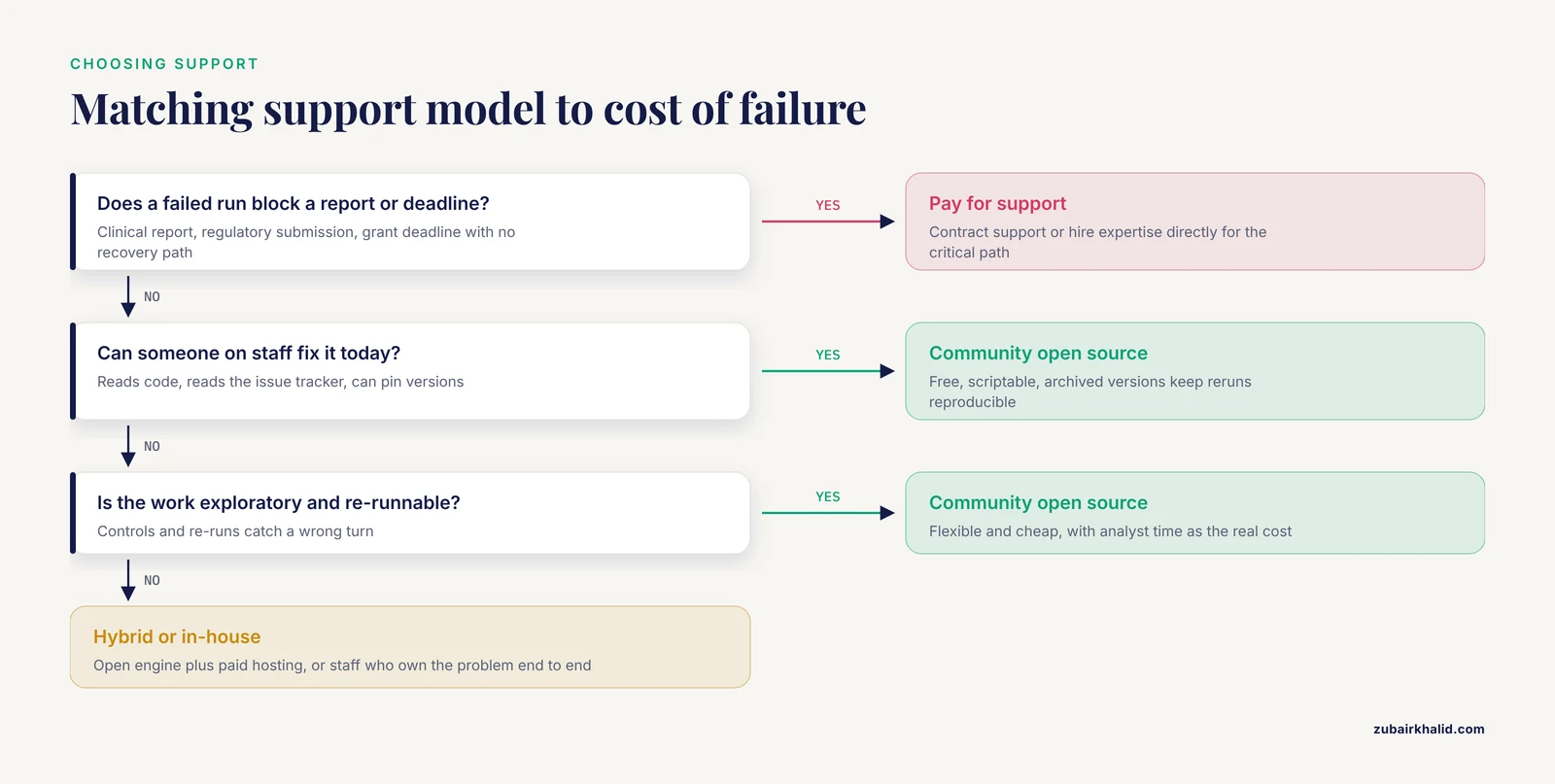
The core difference between support options is simple: commercial software gives you a contracted person or team to call, while community-supported open source gives you documentation, public issue trackers, and your own skills. The rule of thumb for choosing is to match the support model to the cost of failure. If a broken pipeline delays a clinical report, a regulatory submission, or a grant deadline with no recovery path, pay for support or hire the expertise directly. If the analysis is exploratory and a wrong turn is detectable through controls and re-runs, community-supported open source is usually the better and more flexible choice.
This article is a practical bioinformatics software support comparison. It covers the five support models you will actually encounter, compares them side by side on the criteria that decide real purchases and adoptions, walks through worked scenarios, and lists the mistakes that cost labs the most time. Throughout, the comparison leans on published head-to-head evaluations rather than marketing claims, because the evidence on accuracy does not always favor the option with the helpdesk.
What "Support" Means in Bioinformatics
Support in bioinformatics is not one service. It is four distinct layers, and different options cover different layers well.
- Installation and environment management. Getting the software running with the right dependencies, versions, and hardware. This is where most new users burn their first week.
- Operational troubleshooting. Fixing failed runs, cryptic errors, memory problems, and file format mismatches while a project is live.
- Scientific interpretation. Understanding what a result means, which parameters matter, and whether a finding is trustworthy.
- Sustainability. Bug fixes, security patches, updates for new data formats and sequencer chemistry, and long-term availability of the code.
A vendor contract usually covers layers 1 through 3 with contractual response times. Community support covers layer 1 through good documentation and package managers, layer 2 on a best-effort basis through public channels, layer 3 through papers and tutorials, and layer 4 only as long as the maintainers stay active. In-house staff cover all four layers but at salary cost. A fair bioinformatics tools comparison has to ask which of these layers you actually need, because paying for all four when you need one is the most common overspend, and assuming the community will cover layer 2 for a production pipeline is the most common underprovision.
The Five Support Options
Option 1: Commercial vendor support
Commercial software ships with a license fee, a helpdesk, scheduled training, and a defined escalation path. In the bioinformatics world this includes instrument-linked analysis suites such as Compound Discoverer for Thermo Scientific Orbitrap metabolomics data [1] and Ion Reporter for Ion Torrent sequencing data [2], as well as commercial molecular design platforms in the covalent docking space [3].
The strengths are real. You get a named party accountable for uptime and answers, validated workflows that reduce configuration burden, training materials aimed at bench scientists rather than programmers, and often regulatory documentation that helps in clinical and manufacturing settings. For a lab without dedicated computational staff, this can be the difference between using a sequencer and owning an expensive box.
The weaknesses show up in the data. In a direct head-to-head on GC-Orbitrap-HRMS untargeted metabolomics for food authentication, the commercial Compound Discoverer putatively annotated 52 compounds at Level 2 confidence while the open-source MS-DIAL annotated 115 compounds at the same confidence level [1]. The paid, vendor-supported tool did not win on scientific output in that comparison. Separately, in a 16S gut microbiome benchmark on the Ion Torrent S5 platform, the proprietary Ion Reporter workflows produced stable phylum-level consensus predictions, but at the species level, single-hypervariable-region open-source pipelines based on QIIME 2 and the SILVA database significantly outperformed the proprietary option [2]. Vendor support buys process reliability and accountability, not a guarantee of superior results.
The other costs are less visible at purchase time. Closed formats can make it hard to move data out. Feature roadmaps follow the vendor's market, not your question. And if the license lapses, historical analyses can become difficult to reproduce because you can no longer run the tool.
Option 2: Community-supported open source
Open-source software is free to obtain, inspect, and modify. Support arrives through documentation, tutorials, public issue trackers, user forums, and the goodwill of maintainers whose careers benefit from citations and adopters. Recent bioinformatics releases illustrate the modern distribution and support pattern. LIGSIFT, a ligand structural alignment and virtual screening tool, is freely available to academic users with source code included [4]. Pesci, a tool for comparing single-cell gene expression across species, distributes through pip, conda, and GitHub, and permanently archives its source on Zenodo with a digital object identifier [5]. Coolsecture, a cross-species Hi-C comparison toolkit, is released under the GPL-3 license with source code, Snakemake workflows, and documentation on GitHub, plus a Figshare archive [6]. mmContext, a framework for multimodal learning on omics and text data, publishes pretrained checkpoints on Hugging Face alongside full source code and tutorials [7].
The pros are substantial. There is no license fee. You can read the code, which means an expert on your team can verify behavior or fix a bug today rather than waiting for the next vendor release. Scriptable command-line tools integrate into reproducible pipelines. Archival DOIs on services like Zenodo let you cite an exact version forever, which is what a methods section needs [5],.
The cons are equally real. Nobody is contractually obligated to answer your question. Response time on an issue tracker can be hours from an engaged maintainer or never for an abandoned project. Documentation quality varies from excellent tutorials to a bare README. Dependency rot is chronic, where a tool that worked two years ago fails against a newer Python or library version. And layer 3, scientific interpretation, often rests on one paper and whatever the supplement explains.
The practical skill in this model is judging project health before you depend on it. Signals that matter include recent releases, active issue triage, archived versions with DOIs, and workflow definitions that let you reproduce results. A project that archives source on Zenodo and ships workflow files, as Coolsecture does with Snakemake [6], is signaling that reproducibility is part of the support offer.
Option 3: Commercial support layered on open source
A growing middle option keeps the open-source code but sells services around it: managed hosting, priority support contracts, training, and enterprise features. The workflow engine Nextflow shows this pattern clearly. TaxTriage, an open-source metagenomic pathogen detection pipeline, is built on Nextflow and offers cloud deployment through NF Tower, the Seqera Platform, alongside plain local installation, including standalone installs on systems with no external internet access [8]. The engine and the pipeline are open. The commercial layer is convenience, hosting, and someone to call.
This option also includes standards bodies and multi-tool ecosystems that behave like support networks. PEtab Select provides a standardized file format for model selection problems and plugs into established calibration tools including COPASI, Data2Dynamics, PEtab.jl, and pyPESTO, with support for Akaike and Bayesian information criteria [9]. When your software choice is anchored to a standard rather than a single product, you gain portability between tools, which is a form of insurance against any one project going quiet.
The pros: open code, exit options, and a paid escalation path when you need one. The cons: subscription fees for what the community gives away, and a dependency on the commercial layer's continued interest in the open project.
Option 4: Cloud and hosted analysis platforms
Hosted platforms run the analysis for you in someone else's compute environment. Vendor clouds such as the Ion Reporter ecosystem sit here [2], as do commercial hosting layers on open workflows such as NF Tower deployments of pipelines like TaxTriage [8]. Support typically includes infrastructure management, preconfigured pipelines, and a web interface.
The pros: no local hardware or environment management, updates handled for you, and access from a browser, which matters for collaborations spanning institutions. The cons: data transfer overhead for large files, less control over software versions, per-sample or subscription costs, and questions about where your data physically resides that matter for patient or proprietary data governance.
Option 5: In-house and core facility support
The final option is hiring. A bioinformatician on staff, or an institutional core facility with staff bioinformaticians, provides support that is accountable to you specifically, knows your data, and can cover all four support layers. This is the only option that can fully bridge a gap between tools, for example by writing a wrapper that chains a vendor export into an open-source downstream analysis.
Published work illustrates what in-house effort produces. The MEmilio epidemic simulation framework couples a high-performance C++ core with a user-friendly Python interface and applies strict software engineering practices so that diverse epidemiological models can be compared and deployed from laptops to high-performance computing systems [10]. A Python-based phylogenetic pipeline integrates sequence collection, alignment with MAFFT, MUSCLE, and ClustalW, tree construction by neighbor-joining, UPGMA, maximum likelihood, and maximum parsimony, plus visualization and statistical comparison into one unified workflow, replacing what previously required separate heterogeneous tools [11]. TransPro, a framework for benchmarking gene selection methods, exists in two coordinated packages, TransProPy in Python and TransProR in R, precisely because fragmented workflows and inconsistent metrics compromise reproducibility across transcriptomics analyses [12]. These are examples of the integration and standardization work that only happens when someone owns the problem end to end.
The pros: full control, institutional knowledge, and support shaped to your exact questions. The cons: salary cost, recruitment difficulty, key-person risk when one person holds all the knowledge, and the management burden of keeping in-house code maintained after the builder moves on.
Side-by-Side Comparison Table
| Criterion | Commercial vendor | Community open source | Commercial layer on open source | Cloud or hosted platform | In-house staff or core |
|---|---|---|---|---|---|
| Who answers | Contracted support team | Maintainers and user forums, best effort | Paid support staff plus community | Platform support team | Your own employees or core staff |
| License cost | License fee, often annual | Free | Subscription for services | Subscription or usage fees | Salaries, no license fee |
| Response time guarantee | Contractual, often defined tiers | None guaranteed | Contractual on the service layer | Usually defined | Internal expectations |
| Code inspectable | No | Yes | Yes | Rarely | Yes |
| Reproducibility of old analyses | Depends on license staying active | Strong when versions are archived with DOIs | Strong, engine stays open | Weak to moderate, versions change | Strong if version pinning is enforced |
| Flexibility to modify | Very limited | Full | Full on the open layer | Limited | Full |
| Best fit | Regulated or clinical settings, labs without computational staff | Research questions, method development, tight budgets | Production pipelines built on open engines | Multi-site collaboration, no local infrastructure | Core institutional workflows, bridging tools |
| Main risk | Lock-in, output may not lead benchmarks | Abandonment, no guaranteed help | Service layer dependency | Data governance, version drift | Key-person risk, maintenance debt |
Criteria That Decide Real Choices
Documentation and onboarding
The first practical test of any support option is how fast a competent newcomer reaches a correct result. Good open-source projects now compete with vendors here. mmContext ships tutorials and full training, evaluation, and data preparation pipelines so a new user can reproduce published models rather than reverse-engineering them [7]. Coolsecture bundles documentation and Snakemake workflows so the analysis runs as a unit rather than as loose scripts [6]. When comparing options, run the tutorial before you commit. A tutorial that fails on page two is the cheapest support signal you will ever get.
Response time and escalation
Ask a direct question of each option before you need it urgently. For commercial tools, submit a test ticket and time the response. For open source, search the issue tracker for your likely problems and note how maintainers responded to comparable questions. For the hybrid option, distinguish between what the contract covers and what still routes through the community. TaxTriage supports installation on systems with no external internet access, which is worth noting because air-gapped environments cannot rely on cloud support channels at all and need local competence regardless of the license [8].
Versioning, archival, and reproducibility
Reproducibility is where support models differ most sharply over a five-year horizon. The strongest current practice is permanent version archival with a citable identifier. TaxTriage v2.1.1 is archived on Zenodo specifically so the published analysis can be reproduced exactly [8]. Pesci archives source on Zenodo with a DOI [5], and Coolsecture archives on Figshare [6]. If you rerun an analysis three years from now, an archived version plus a pinned workflow beats a license server and a vendor's memory. Whatever option you choose, record exact versions, parameters, and container or environment definitions in your methods.
Validation transparency and benchmark access
The best bioinformatics software support includes honest evidence about performance, and the literature shows why this criterion cannot be skipped. In structural model assessment, CAD-score-LT reproduced scores from earlier CAD-score implementations almost exactly while cutting runtime by more than an order of magnitude, with speedups up to 100-fold for whole structures and 200-fold for inter-chain interfaces [13]. A vendor or project that publishes benchmarks like this, with versions and conditions stated, is supporting you before you ever contact them. Conversely, benchmarking frameworks for structural variant calling, including Truvari, EvalSVcallers, and SVbenchmark, implement different assumptions about breakpoint resolution, size concordance, and sequence similarity, and those parameter choices change evaluation outcomes for callers such as Manta, Delly, Lumpy, GRIDSS, and Wham [14]. When you compare tools, you are also implicitly comparing the assumptions of any benchmark used to rank them.
Licensing and data governance
Licensing shapes what support you can buy and what you can do. LIGSIFT is free specifically to academic users, which means a commercial entity needs a different arrangement [4]. Coolsecture's GPL-3 license carries obligations if you redistribute modified code [6]. For hosted options, clarify who controls the data and what happens to it. None of this is glamorous, but a licensing surprise late in a project is more expensive than any subscription.
Exit cost
Every option should be scored on how expensive it is to leave. Open source with archived versions and standard formats has low exit cost. Commercial tools with proprietary formats and instrument-tied workflows have high exit cost. Hybrid models sit in between, which is exactly why anchoring to standards, as PEtab Select does by building on the PEtab specification and interoperating with COPASI, Data2Dynamics, PEtab.jl, and pyPESTO [9], lowers long-term risk.
What Head-to-Head Evidence Actually Shows
Published comparisons give the grounding that a bioinformatics software support comparison needs, and the pattern across them is consistent: support quality and scientific output are related but distinct axes.
The metabolomics comparison found that both Compound Discoverer and MS-DIAL produced feature sets heavily affected by unknown metabolites at the lowest identification confidence levels, background signals, and duplicate features, all of which had to be carefully assessed before downstream multivariate analysis [1]. The lesson is that neither a helpdesk nor a GitHub repository removes the scientific judgment burden. Support gets the software running. You still own the curation.
The 16S comparison adds nuance about where proprietary pipelines hold up. Ion Reporter workflows using multiple hypervariable regions produced stable phylum-level consensus predictions, while single-region open-source pipelines significantly outperformed at species-level resolution [2]. The same study found that the choice of denoising algorithm, DADA2 versus Deblur, significantly affected alpha diversity calculations, and that using two primer sets instead of one yielded roughly 30 percent lower expected read counts in their Poisson regression model [2]. Pipeline configuration choices, not just the support model, drive results.
Evaluation context matters too. A framework study on microRNA sequencing data harmonization showed that the benefit of any harmonization method depends on the specific method, the paired clustering technique, and the cluster composition, with partial mitigation of artifacts at moderate signal-to-artifact ratios [15]. A tool that helps one dataset can do little for another, which is why a single published benchmark should inform, not decide, your choice.
Finally, tool diversity itself creates comparison problems. Reviews of the covalent docking landscape note that many docking tools cannot accurately model the energetics of covalent bond formation and often require quantum mechanical or semi-empirical calculations for reliable predictions, even as open-source, commercial, and web-based options multiply alongside artificial intelligence and machine learning assistants [3]. More options does not mean easier choices. It means the evaluation burden grows, and support that includes methodological guidance, whether from a vendor scientist or an in-house expert, becomes more valuable as the tool space grows.
Worked Scenarios
Scenario 1: A clinical or diagnostic laboratory
A laboratory sequencing human gut samples on an Ion Torrent platform needs defensible, consistent results and documentation. The published evidence shows the proprietary Ion Reporter pathway delivering stable phylum-level consensus, while open-source QIIME 2 pipelines outperformed at species level in single-region configurations [2]. A reasonable structure is to use the vendor-supported platform as the operational backbone, validate it against an open-source reference pipeline in-house, and document where the two agree and diverge. The support model is commercial first, with community open source as the validation check.
Scenario 2: An academic metabolomics core exploring biomarkers
A core facility processing plant metabolomics data for food authentication questions has statistical expertise but no vendor contract. MS-DIAL, the open-source option, annotated more compounds at Level 2 confidence than the commercial alternative in the published head-to-head, and both required careful filtering of unknowns, background signals, and duplicates before multivariate analysis [1]. The support model here is community first: package-manager installation, version archiving, and one person on staff who reads the issue tracker. The budget saved on licenses goes toward the analyst's time, which is the layer that actually determines marker reliability.
Scenario 3: A public health or veterinary diagnostics group detecting pathogens
A group needs putative pathogen detection from short- and long-read DNA and RNA sequencing data, including for host species beyond human, and some sites lack reliable internet. TaxTriage is built for exactly this: it combines read classification, mapping, and de novo assembly, flags putative pathogens against curated expectations from healthy cohorts, outputs an Organism Discovery Report with a confidence score, installs locally including without internet access, and deploys to the cloud through NF Tower when connectivity allows [8]. The support model is hybrid, open-source code with a commercial hosting layer available when a site wants it, plus customization options for host species of interest [8]. Evaluation against published in silico, clinical, and outbreak datasets showed performance comparable to alternative cloud-based pipelines with similar sensitivity and increased specificity [8].
Scenario 4: A drug discovery team screening covalent inhibitors
A medicinal chemistry group evaluating covalent docking faces a landscape spread across open-source, commercial, and web-based platforms, with artificial intelligence tools increasingly involved in prioritization, and with the caveat that many docking tools need supplementary quantum mechanical calculations for reliable energetics [3]. No single support model covers this. A sensible portfolio is a commercial platform for team-facing visualization and reporting, open-source tools for methods the team can validate and customize, and written internal criteria, informed by the published landscape, for when a quantum mechanical refinement step is required. Shape-based virtual screening tools such as LIGSIFT, which reports an average area under the ROC curve of 0.79, an average enrichment factor of 20.8, and a hit rate of 59 percent in the top 1 percent of screened libraries across 40 protein targets from the Directory of Useful Decoys, are free to academic users with source available [4], which matters for the academic collaborators on the team but not automatically for the company's own servers given the academic-only licensing.
Scenario 5: A modeling group comparing competing hypotheses
A systems biology team choosing between models of a biological process benefits from anchoring to a standard. PEtab Select standardizes the specification of model selection and calibration problems, supports Akaike and Bayesian information criteria, implements brute-force, forward, backward, and flexible selection strategies, and interoperates with COPASI, Data2Dynamics, PEtab.jl, and pyPESTO, with the compact format able to represent problems as large as billions of model alternatives [9]. Here the support model is the standards community, and the insurance is portability: if any one calibration tool stagnates, the problem specification survives.
Common Mistakes and Limitations
Treating a polished interface as evidence of a validated method. The clearest lesson from published head-to-heads is that user-facing polish and scientific output are separate properties. The commercial tool annotated fewer compounds than the open-source one in one metabolomics comparison [1], and the proprietary pipeline lost at species-level resolution in a 16S comparison [2]. Evaluate output quality on your own data with controls, not on screenshots.
Judging open-source health by popularity metrics alone. Star counts say little. Check release cadence, how maintainers respond to issues, whether versions are archived with persistent identifiers, and whether workflows ship with the code. Projects that archive on Zenodo or Figshare and bundle workflow definitions have made reproducibility part of their support contract [5], [6].
Not pinning versions. If your analysis runs on whatever version is installed today, a silent update can change results between the pilot and the final run, and you will have no clean way to show which version produced which figure. Record exact versions and archive what you can.
Assuming benchmark numbers transfer to your data. Published performance figures describe the tested datasets and settings. Harmonization benefits in miRNA studies depend on the method, the downstream clustering technique, and cluster composition [15]. Structural variant evaluation outcomes depend on the benchmarking framework's matching assumptions [14]. Run a small pilot on your own data before standardizing on any tool.
Ignoring license scope until it blocks a project. Academic-only terms [4] and copyleft obligations such as GPL-3 [6] are fine for many users and blockers for others. Read the license when you adopt, not when you publish or commercialize.
Underestimating the person cost in every model. Commercial support is people under contract. Community support is people acting voluntarily. In-house support is people on payroll. The model changes who pays and how fast they respond, never whether humans are involved somewhere. Budget analyst time in all five options.
Skipping the installation test. Run the tutorial and a small dataset end to end before committing. Installation friction today predicts operational friction in month six.
A final limitation applies to this article as a whole: published comparisons reflect specific datasets, platforms, and versions, and individual project needs vary. Treat the evidence here as directionally strong and confirm the decisive comparison on your own data before you standardize.
Frequently Asked Questions
What is the single best criterion for a bioinformatics software support comparison?
Start with the cost of failure. Define what happens if the software produces a wrong result or stops running during a critical project, then match the support model to that consequence. Everything else, including price and interface quality, is secondary to whether you can get help at the speed your deadlines require.
Is commercial software always better supported than open source?
No. Commercial tools provide contractual response times and accountability, but published head-to-head evaluations show that support quality does not guarantee scientific superiority. In one metabolomics comparison the commercial tool annotated fewer compounds at Level 2 confidence than the open-source alternative, and in a 16S benchmark the proprietary pipeline was outperformed at species level by open-source pipelines.
How can I judge whether an open-source project is healthy before relying on it?
Check four signals: recent release activity, how maintainers respond to issues, whether versions are archived with persistent identifiers such as Zenodo or Figshare DOIs, and whether documentation and workflows ship with the code. Projects meeting these criteria effectively build reproducibility into their support model.
Do I need a workflow manager if the vendor provides a graphical interface?
If reproducibility and scalability matter, yes eventually. Vendor interfaces are convenient but often resist automation and version control. Open workflow engines such as Nextflow let pipelines run locally, offline, or in the cloud, and many research pipelines publish ready-made workflow definitions you can adopt and audit.
Can I switch from a commercial tool to an open-source pipeline later?
Yes, but plan the exit early. Export your data in open formats from the start, keep copies of raw data outside the vendor platform, and validate the open-source replacement on a subset of samples against the commercial results before switching. Standards-based approaches reduce switching cost because problem specifications port between tools.
What does "support" include when I cite an open-source tool in a publication?
Cite the paper and the exact archived version, for example a Zenodo or Figshare DOI, so reviewers and readers can reproduce the analysis. Support in the publication sense means the archived code, the documentation, and the issue tracker, not a hotline. Archiving by authors exists precisely to make that citation durable.
Sources
- Comparison of data processing strategies using commercial vs. open-source software in GC-Orbitrap-HRMS untargeted metabolomics analysis for food authentication: thyme geographical differentiation and marker identification as a case study.
- Evaluating 16S metagenomics data analysis pipelines using an Ion Torrent sequencer for human gut microbiome research.
- The covalent docking software landscape: features and applications in drug design.
- LIGSIFT: an open-source tool for ligand structural alignment and virtual screening.
- Pesci: fast and user-friendly software to compare single-cell gene expression across species.
- Coolsecture: an easy-to-use and improved framework for cross-species Hi-C contact map comparison.
- mmContext: an open framework for multimodal contrastive learning of omics and text data.
- TaxTriage: an open-source metagenomic sequencing data analysis pipeline enabling putative pathogen detection.
- PEtab Select: Specification standard and supporting software for automated model selection.
- MEmilio: a high performance Modular EpideMIcs simuLatIOn software for multi-scale and comparative simulations of infectious disease dynamics.
- A python-based automated pipeline for phylogenetic tree construction, visualization, and comparative statistical evaluation.
- Comparative evaluation of gene selection approaches in transcriptomics: bias correction and visualization with TransPro.
- CAD-score-LT: versatile contact area-based comparison of macromolecular structures, interfaces, and binding sites.
- Structural Variant benchmarking frameworks: Parameterization, matching logic, and evaluation assumptions presented through HG002 and NA12878.
- Contextual evaluation of microRNA sequencing data harmonization for sample clustering.