How to Design a Bioinformatics Project in Python
By Dr. Zubair Khalid, DVM, MS, PhD ·

Bioinformatics project design in Python is the practice of planning a computational biology analysis as structured software, with an explicit question, folder layout, pinned environment, modular code, tests, and documentation, before writing the analysis itself. The deliverable is a reproducible pipeline that another scientist can install, run on new data, and verify without your help.
Most failed bioinformatics projects fail as projects, not as science. The analysis worked once, on one laptop, against one copy of the data, inside an environment nobody can rebuild. When a reviewer asks for code, a collaborator asks for a rerun, or your future self asks what the variable named df2 meant, an undesigned project has no answers. Designing up front makes those questions cheap to answer while the decisions are still easy to change. The published Python ecosystem shows the payoff. Kssdtree ships sketch-based phylogenetic analysis as an installable package with documentation and a video tutorial [1]. NetMedPy packages network medicine screening so it runs on anything from a standard desktop to a computing cluster [2]. esloco releases its sequencing coverage simulator on PyPI, GitHub, and Zenodo with a citable archived version [3]. Each of these began as someone's analysis. They became durable tools because the projects were designed, not just written.
What Is Bioinformatics Project Design in Python?
To design a bioinformatics project in Python is to make six decisions deliberately: what biological question the project answers, what data it consumes, what environment it runs in, how the code is organized, how correctness is checked, and how the result is shared. Students often treat these as afterthoughts. In practice, they are the project.
The phrase also covers distinct activities that are easy to lump together. Question design turns "look at this metagenome" into "produce a table of species abundances per sample with uncertainty estimates". Data design inventories every input file, its format, and its size. Software design decides which functions live in which module and which stages run in which order. Quality design decides how you will know the answer is right before anyone else does. Release design decides how a stranger will run your work a year from now.
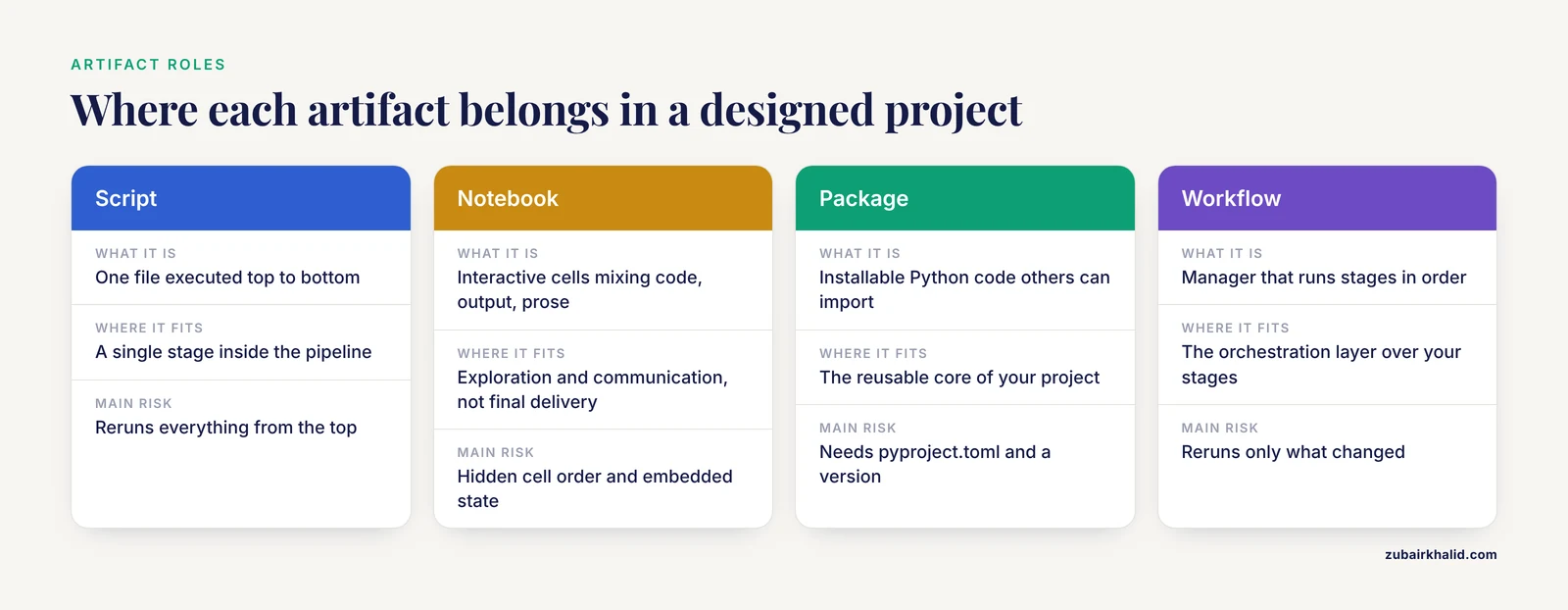
A designed project is also different from the artifacts it contains, and this is where students get confused most often.
| Term | What it is | Where it fits in a designed project |
|---|---|---|
| , - | , - | , - |
| Script | One file executed top to bottom | A single stage inside the pipeline |
| Notebook | Interactive cells mixing code, output, and prose | Exploration and communication, not final delivery |
| Package | Installable Python code others can import | The reusable core of your project |
| Workflow | A manager that runs stages in order and reruns only what changed | The orchestration layer over your stages |
| Pipeline | The ordered chain of analysis stages | What the workflow executes |
| Project | Question, data, environment, code, tests, docs, release | The whole thing, designed before coding starts |
The unit of design is the project, not the file. A single project can contain scripts, notebooks, an installable package, and a workflow at the same time. What makes it designed is that each artifact has one declared role and one home.
Why Python for Bioinformatics?
Python earned its place in computational biology through its ecosystem and its readability. Biopython handles the classic sequence work, including parsing FASTA, FASTQ, and GenBank files, manipulating alignments, and submitting BLAST searches. pandas and NumPy handle the tables and arrays that dominate omics data. scikit-learn supplies classical machine learning. PyTorch and JAX supply automatic differentiation for deep learning, and differentiable frameworks now let separately written biological models be combined and jointly optimized, as the DiffBreed breeding simulator showed by refining progeny allocation strategies with gradient-based optimization [4]. Snakemake, a workflow manager written in Python, orchestrates multi-stage pipelines. Matplotlib and Plotly handle visualization.
The breadth shows up in the published record. Python packages now cover sketch-based phylogenetics [1], RNA device design built on a foundation model [5], structural model comparison [6], sequence encoding and prediction [7], diverse subset selection [8], sequencing coverage simulation [3], gene regulatory network inference [9], molecular dynamics analysis [10], microbial community modeling [11], computational psychiatry modeling [12], nerve fiber simulation [13], gene regulatory network simulation [14], and network medicine screening [2]. Whatever your subfield, a well-designed Python project probably has company.
Python, R, or Compiled Tools?
Python does not win every fight, and a good design assigns each task to the right tool. R dominates interactive statistics in genomics through the Bioconductor ecosystem. Compiled languages such as C, C++, and Rust power the fastest sequence algorithms. Python's strength is orchestration and integration. A common production pattern wraps fast compiled tools for the heavy lifting, uses Python for parsing, statistics, machine learning, and plotting, and holds everything together under one reproducible workflow. Learning this division of labor is a skill in itself, and structured hands-on practice is how bioinformatics is taught effectively, as in a medical curriculum pilot that scaffolded clinically anchored sessions around tools such as BLAST and CLUSTAL W [15].
The Anatomy of a Well-Designed Project
Before the step-by-step walkthrough, here is the target. A designed Python bioinformatics project separates code, configuration, data, and outputs so that raw data is never edited, results are regenerable, and the environment can be rebuilt from a file.
| Path | Purpose |
|---|---|
| , - | , - |
| README.md | Question, quickstart commands, output descriptions |
| environment.yml | Pinned conda environment, committed to version control |
| pyproject.toml | Package metadata and dependencies for installable projects |
| config/ | Parameters, sample lists, thresholds, kept out of code |
| data/raw/ | Immutable input files, never modified |
| data/processed/ | Intermediate files, regenerable |
| src/projectname/ | Importable Python modules, the reusable logic |
| workflow/ | Pipeline definition, such as a Snakefile |
| tests/ | Unit and integration tests with tiny fixture data |
| notebooks/ | Exploration that is either promoted into the package or deleted |
| results/ | Generated tables and figures, regenerable |
Three principles sit under this layout. First, raw data is read-only. Scripts read from data/raw and write to data/processed or results, never the reverse. Second, configuration lives outside code, so the same code runs on a new dataset without edits. Third, everything between raw data and final figures is regenerable. If you can delete results/ and rebuild it from data/, code, and config, the project is reproducible in the sense that matters.
How to Design a Bioinformatics Project in Python: The Eight Steps
These steps run from question to release. Small projects compress them, large projects expand them, and skipping them is what turns a pipeline into a liability.
Step 1: Define the Biological Question and the Deliverable
Write the question as a sentence with a noun you can compute. "Which transcription factors regulate the top differentially expressed genes" is a project. "Study gene regulation" is a mood. Then define the deliverable: a figure, a table, a trained model, or a package. Strong projects frame their evaluation around explicit research questions and named metrics, the way a preference-guided network inference method was evaluated on 43 gene regulatory networks from the DREAM3 and DREAM4 benchmarks using AUROC and AUPR [9]. For classification tasks, AUROC is the area under the receiver operating characteristic curve and AUPR is the area under the precision-recall curve. Pick your metric at this step. If you cannot name the metric, you cannot tell whether the project succeeded.
Step 2: Inventory the Data and Formats
List every input with its file name, format, size, source, and access method. Common formats include FASTA for sequences, FASTQ for reads with quality scores, VCF for variant calls, PDB for structures, expression matrices as TSV or HDF5, and GROMACS trajectory files for molecular dynamics work [10]. Record checksums for raw files so corruption is detectable, for example with sha256sum. Note the sizes, because a 20 GB input pushes the design toward streaming and chunking rather than loading everything into memory. Keep a data dictionary, even a plain text table, so nobody has to guess what a column means six months later.
Step 3: Pin the Environment
Decide the Python version and every dependency version before analysis begins. The standard approach is a conda or mamba environment captured in an environment.yml file, plus a pyproject.toml declaring package dependencies.
mamba create -n seqqc python=3.11
conda activate seqqc
pip install biopython pandas pytest
conda env export > environment.yml
Commit environment.yml to version control. Anyone, including you on a new machine, rebuilds the exact environment with one command. For code you will reuse, make the project installable in editable mode with pip install -e . during development. Unpinned environments are the most common reason a pipeline that worked in March fails in September.
Step 4: Architect the Pipeline as Stages
Sketch the analysis as an ordered set of stages, where each stage reads defined files and writes defined files:
- Fetch or verify inputs.
- Parse and validate formats.
- Quality control and filtering.
- Core analysis.
- Summarize into tables.
- Plot figures.
- Assemble the report.
Each stage should run alone and resume after failure. For anything beyond a few stages, use a workflow manager. Snakemake, written in Python, tracks file dependencies and reruns only the stages affected by a change. Architect for the scale you are growing into. GRiNS added GPU acceleration so gene regulatory network simulations scale to large networks where ordinary differential equation formalisms become costly [14]. NetMedPy was built to run efficiently on anything from a standard desktop to a computing cluster [2]. You do not need their engineering, but you should know which direction your project grows.
Step 5: Write Modular, Reusable Code
Split code by responsibility into modules such as io.py, qc.py, analysis.py, and plotting.py. Each function does one thing, takes plain inputs, and returns plain outputs, which makes functions testable and composable. Keep the interfaces boring, because dictionaries, pandas DataFrames, and NumPy arrays interoperate with the rest of the ecosystem, the way the Selector library's subset selection algorithms integrate directly with scikit-learn [8].
Push repeated logic into shared functions early. The PyFibers project exists because peripheral nerve fiber simulations required large amounts of boilerplate rewritten for every study, so its authors standardized model creation, stimulation, and analysis into one framework covering 11 published fiber models [13]. Your version of that insight is smaller: the second time you copy a function between notebooks, promote it into the package.
Add a command-line entry point once the logic is stable, so the pipeline runs without opening an editor.
Step 6: Test at Three Levels
Testing in bioinformatics has three layers, and each catches different failures.
Unit tests check single functions against tiny fixtures stored in the repository. With pytest, a test for a GC content function is four lines and runs in milliseconds.
Integration tests run the whole pipeline end to end on a miniature dataset, perhaps 50 sequences, and assert that outputs exist and have the right shape.
Validation checks scientific correctness against known results. This is the layer students skip and reviewers notice. PyFibers validated each of its 11 fiber model implementations against the original published results [13]. DynamiSpectra ran comparative tests against widely used molecular dynamics analysis packages and confirmed consistent outputs [10]. esloco benchmarked its simulated coverage estimates against empirical data across a 45-gene panel and found close agreement [3]. Your equivalent is simpler: compute a statistic by hand for a tiny input, then assert the pipeline reproduces it.
Wire the first two layers into continuous integration so tests run on every push, the practice Selector lists among its development standards alongside version control and unit testing [8].
Step 7: Benchmark and Optimize Where It Counts
Profile before optimizing. Python's cProfile module and line-level profilers will usually point to one hot loop. Optimize that loop with vectorized NumPy, a compiled backend, or chunking, and leave everything else readable. Performance work pays when it targets the real bottleneck, and the gains can be dramatic. The CAD-score-LT reimplementation of the Contact Area Difference score kept near-identical scores while cutting running times by more than an order of magnitude, reaching up to 100-fold speedups for whole-structure scoring and 200-fold for inter-chain interface scoring on CASP16 oligomer model pairs [6]. Kssdtree likewise reports superior accuracy and time efficiency against other sketching-based phylogenetic tools on comprehensive benchmarking datasets [1]. Both teams benchmarked against real alternatives, which is the standard your own speed claims should meet.
Step 8: Document, Package, and Release
Documentation has three audiences, and each needs something different. Your future self needs a README with the question, quickstart commands, and output descriptions. Users need docstrings and a documentation site. Kssdtree publishes its documentation on Read the Docs, distributes the package on PyPI, hosts source on GitHub, and links a video tutorial [1]. Reusers need a license and an archived, citable version. NetMedPy and MIMIC release under the MIT license [2][11], and esloco archives releases on Zenodo with a DOI alongside PyPI and GitHub [3].
Packaging itself is a pyproject.toml, a version number, and a tagged release. If non-programmers need your tool, plan a gentler front end. SeqHIVE wraps 19 sequence encoding algorithms, 5 feature selection methods, and 26 classifiers in a graphical interface so biologists can build predictive models without programming [7]. DynamiSpectra analyzes molecular dynamics trajectories through a web platform without requiring programming expertise [10]. Ernie-Switcher deploys its RNA device design framework as a freely accessible web platform with code and pre-trained models on GitHub [5]. A web interface is a release channel, not a luxury.
A Worked Example: A Sequence QC Module with Biopython
Here is a concrete example you can adapt, small enough to finish in an afternoon. Suppose you receive contigs.fasta from an assembly and need per-sequence length and GC content, delivered as a table, rerunnable on the next assembly. The project has five files:
- environment.yml, pinning Python 3.11 with biopython, pandas, and pytest.
- src/seqqc/qc.py, the logic.
- src/seqqc/cli.py, the command-line entry point.
- tests/test_qc.py, the tests.
- README.md, the quickstart.
The core module:
from Bio import SeqIO
from Bio.SeqUtils import gc_fraction

def summarize_record(record):
    return {
        "id": record.id,
        "length": len(record.seq),
        "gc_percent": round(gc_fraction(record.seq) * 100, 1),
    }

def summarize_fasta(path):
    return [summarize_record(r) for r in SeqIO.parse(path, "fasta")]
Biopython's gc_fraction returns a fraction between 0 and 1, so the module multiplies by 100 for percent.
The test:
from Bio.Seq import Seq
from Bio.SeqRecord import SeqRecord
from seqqc.qc import summarize_record

def test_gc_and_length():
    rec = SeqRecord(Seq("ATGGCC"), id="t1")
    s = summarize_record(rec)
    assert s["length"] == 6
    assert s["gc_percent"] == 66.7
The command-line entry point:
import argparse
from seqqc.qc import summarize_fasta

def main():
    parser = argparse.ArgumentParser(description="Summarize FASTA sequences")
    parser.add_argument("fasta", help="input FASTA file")
    parser.add_argument("-o", default="qc.tsv", help="output TSV path")
    args = parser.parse_args()
    rows = summarize_fasta(args.fasta)
    with open(args.o, "w") as handle:
        handle.write("id\tlength\tgc_percent\n")
        for row in rows:
            handle.write(f"{row['id']}\t{row['length']}\t{row['gc_percent']}\n")

if __name__ == "__main__":
    main()
Running it:
python -m seqqc.cli contigs.fasta -o qc.tsv
pytest -q
This is a small project, but it contains every design element: a pinned environment, separated logic and interface, a test, a documented entry point, and regenerable output. Scale it up and you have a pipeline. Publish it and you have a package.
A Minimal Biopython Tutorial for the Parsing You Will Actually Do
Three Biopython patterns cover most day-one needs. Parse a GenBank record and inspect its features:
from Bio import SeqIO

record = SeqIO.read("sequence.gb", "genbank")
print(record.id, len(record.features))
Compute a reverse complement:
from Bio.Seq import Seq

print(Seq("ATGGCC").reverse_complement())
Submit an online BLAST search against the nt database:
from Bio.Blast import NCBIWWW
from Bio import SeqIO

record = SeqIO.read("query.fasta", "fasta")
result_handle = NCBIWWW.qblast("blastn", "nt", record.seq)
with open("blast_out.xml", "w") as out:
    out.write(result_handle.read())
The BLAST call sends your sequence to the NCBI servers over the network, so keep queries small and space out requests, as the official Biopython documentation advises. For large-scale searching, run BLAST locally instead.
Design Lessons from Published Python Packages
Reading how established packages are built teaches design faster than abstract advice. Four patterns repeat across the recent literature.
Modularity. MIMIC integrates generalized Lotka-Volterra models, Gaussian processes, and vector autoregression under one framework for microbial community dynamics, so new models slot in without rewriting the rest [11]. GRiNS combines the RACIPE and Boolean Ising formalisms in a modular library where users choose parameters, initial conditions, and time-series outputs [14]. cpm organizes computational psychiatry models behind a flexible, modular architecture designed to serve both expert and non-expert modellers [12].
Accessibility. SeqHIVE serves experts with customizable options and biologists with a guided interface [7]. Selector adds interactive quick-start notebooks and a web interface that requires no programming [8].
Validation. DynamiSpectra, PyFibers, and esloco all validated their outputs against established references before release [10][13].
Release discipline. Kssdtree, esloco, and NetMedPy ship with PyPI releases, public source code, documentation, and licenses [1][3][2].
| Package | Field | Design lesson worth copying |
|---|---|---|
| , - | , - | , - |
| Kssdtree [1] | Phylogenetics | Ship a docs site, PyPI release, and tutorial video together |
| Ernie-Switcher [5] | RNA design | Constrain model-guided optimization with domain rules, offer a web front end |
| CAD-score-LT [6] | Structural biology | Profile hot paths, then benchmark speedups against the real predecessor |
| SeqHIVE [7] | Sequence prediction | Design separate paths for expert and non-programmer users |
| Selector [8] | Subset selection | Version control, unit tests, CI, and notebooks from the first release |
| esloco [3] | Sequencing planning | Archive releases on Zenodo with a DOI for citability |
| DynamiSpectra [10] | Molecular dynamics | Validate against established tools, then wrap in a web platform |
| MIMIC [11] | Microbiome modeling | Keep multiple model backends behind one interface |
| cpm [12] | Computational psychiatry | A modular architecture lowers the barrier for beginners |
| PyFibers [13] | Neuromodulation modeling | Standardize boilerplate into a shared, validated framework |
| GRiNS [14] | Gene regulatory networks | Plan for scale with GPU acceleration before networks get large |
| NetMedPy [2] | Network medicine | Target both desktop and cluster execution, license permissively |
Misconceptions About Python Bioinformatics Projects
- "I will design it once the analysis works." Structure debt compounds. Every week of hardcoded paths and copied cells adds refactoring time that exceeds what design would have cost on day one.
- "Notebooks are enough." Notebooks excel at exploration and communication. They fail at delivery because hidden cell order, embedded state, and no test surface make them impossible to rerun confidently on new data.
- "Reproducibility means sending my script." A script without the pinned environment, the config, the data checksums, and the run order is a hint, not a reproduction.
- "Tests are for software engineers." In biology, silent wrong results are worse than crashes. A pipeline that returns plausible-looking numbers from a parsing bug can mislead a whole study.
- "More dependencies mean a better project." Every dependency is a future breakage. Import the standard library, NumPy, pandas, and Biopython first, and justify anything beyond that.
- "Python is too slow for real genomics." Python orchestrates fast compiled tools and vectorized libraries. The hot loops leave Python, and the control logic stays readable.
Common Mistakes and Limitations
- Hardcoded absolute paths such as /Users/you/Desktop/final_data_v3. Use relative paths from the project root and a config file.
- Editing raw data in place. One overwritten FASTQ can end a study. Make data/raw read-only at the filesystem level if you can.
- Unpinned environments. "It worked with whatever pip installed last week" is not an environment.
- Configuration buried in code. Thresholds and sample lists belong in config files, not on line 340.
- Notebook state chaos. Restart and run all before sharing a notebook. If it breaks, the notebook was lying to you.
- Silent failures. Missing values propagate quietly through pandas. Assert on expected shapes, sequence alphabets, and non-empty outputs at stage boundaries.
- No license or archive. Code without a license is legally unusable by others, and code without a tagged release or archived DOI cannot be cited.
- Over-engineering tiny analyses. A one-off check for a single sample does not need continuous integration. Match process to project size, and scale the process as the project grows.
- The limits of design itself. A well-designed pipeline does not replace scientific judgment. Individual biological conclusions still need review by a domain expert, and a passing test suite means the code does what you specified, not that the specification is biologically correct.
Quick Review
- Design means deciding the question, data, environment, structure, tests, and release before writing analysis code.
- Raw data is read-only, and everything downstream is regenerable from data, code, and config.
- Pin the environment in environment.yml and commit it.
- One function, one job, plain inputs and plain outputs.
- Test three ways: unit tests, end-to-end integration tests, and validation against known results.
- Benchmark against a real alternative before claiming speed.
- Release means a license, a version tag, an archive, and documentation.
Frequently Asked Questions
What is bioinformatics project design in Python?
It is the practice of planning a computational biology analysis as structured software, with a defined question, folder layout, pinned environment, modular code, tests, and documentation, before writing the analysis itself.
Do I need Biopython to do bioinformatics in Python?
No. Biopython is the standard library for sequence work, but many projects run on pandas, NumPy, scikit-learn, and workflow tools, adding Biopython when they parse FASTA, FASTQ, GenBank, or PDB files or submit BLAST searches.
How much Python do I need before starting a bioinformatics project?
Comfort with functions, modules, dictionaries, file handling, and the standard library is enough to start, and the rest you will learn by building the project itself.
Should I use Jupyter notebooks or scripts for a bioinformatics project?
Use notebooks to explore and communicate, then move stable logic into scripts and modules so the pipeline can run headlessly, be tested, and be rerun on new data.
How do I make a bioinformatics pipeline reproducible?
Pin the environment, keep raw data read-only with checksums, separate configuration from code, drive the pipeline with a workflow tool, and test it end to end on a small fixture dataset.
When should a bioinformatics project become an installable package?
Package it as soon as code is reused across analyses or by other people, which is when a pyproject.toml, versioned releases, and a public archive start paying for themselves.
Sources
- Kssdtree: an interactive Python package for phylogenetic analysis based on sketching technique.
- NetMedPy: a Python package for large-scale network medicine screening.
- esloco: simulation-based estimation of local coverage in long-read DNA sequencing.
- DiffBreed: automatic differentiation enables efficient gradient-based optimization of breeding strategies.
- Ernie-Switcher: RNA foundation model-guided design of programmable RNA devices in a navigable landscape.
- CAD-score-LT: versatile contact area-based comparison of macromolecular structures, interfaces, and binding sites.
- SeqHIVE: a Python package to convert the biological sequences to informative vectors for sequence property predictions.
- Selector: A General Python Library for Diverse Subset Selection.
- Multi-objective consensus optimization for gene regulatory networks inference: A preference-based approach.
- DynamiSpectra: A Python Software Package and Web Platform for Molecular Dynamics Data Analysis in Computational Biology.
- MIMIC: a Python package for simulating, inferring, and predicting microbial community interactions and dynamics.
- cpm: A python library for theory-driven modelling in computational psychiatry.
- PyFibers: An open-source NEURON-Python package to simulate responses of model nerve fibers to electrical stimulation.
- GRiNS: a python library for simulating gene regulatory network dynamics.
- A novel 'Blended Pedagogy' for integrating bioinformatics into the undergraduate medical curriculum: a pilot study on feasibility and student engagement.