How to Stay Motivated Learning Bioinformatics: A Practical Guide
By Dr. Zubair Khalid, DVM, MS, PhD ·

Most people who try to learn bioinformatics quit in the first three months. Not because the field is closed to them, and not because they lack ability, but because the feedback loop is brutal. You spend a day fighting an installation, another day parsing a file format, and at the end of the week you have a folder of files you cannot interpret. Motivation dies quietly in that folder.
This guide gives you a system that keeps the loop short and the wins visible. By the end of it you will be able to:
- Set up an isolated, reproducible analysis environment with a handful of commands
- Run a real quality control check on real sequence data and interpret the output
- Save every step of your work in version control so nothing is ever lost
- Choose between web servers, the command line, and full workflows depending on what you need that day
- Follow a 90-day plan with concrete weekly milestones instead of vague goals
To follow along you need a laptop with at least 8 GB of RAM, a terminal (Terminal on macOS, Windows Terminal or WSL on Windows), the Miniforge distribution of conda, git installed, and about two hours for the first session. Nothing else. Every command in this guide runs on a standard laptop.
Why Motivation Fails in Bioinformatics, and What Actually Works
Motivation research consistently points to three ingredients: visible progress, a sense of competence, and connection to other people. Bioinformatics education breaks all three by default. Progress is invisible because intermediate files are incomprehensible blobs. Competence feels absent because every error message assumes you already know the answer. Connection is rare because most learners study alone at night after their real job.
The fix is not willpower. The fix is engineering your learning so that progress, competence, and contact are built in. That means short tasks with checkable outputs, small datasets where you can verify the right answer by hand, and public artifacts you can show to other people.
The literature on how bioinformatics is actually practiced supports this approach. When researchers at Germany's public health institute described their CoVpipe2 workflow for reconstructing SARS-CoV-2 genomes from amplicon sequencing data, they listed the challenges that swallow beginners whole: primer clipping, heterozygous variant detection, low-coverage regions, and deletions near primer sites [1]. These are exactly the problems that defeat a learner who jumps into raw data on day one. CoVpipe2 exists because even experienced teams needed a structured, automated workflow rather than an ad hoc pile of scripts [1]. The lesson for your motivation is direct: structure beats improvisation, and you should borrow structure from day one.
Structure also comes in friendlier forms. A prospective study of BioDecryptors, an educational escape game for teaching bioinformatics to medical students and physicians, evaluated short-term knowledge and self-reported motivation in 55 participants working in teams of three to four, and found that gamified team-based formats can introduce bioinformatics concepts while supporting learner motivation [2]. You do not need to build an escape room. You do need to steal the design principle: a bounded challenge, a clear goal, a teammate, and a timer.
A Step-by-Step System for Staying Motivated
This is the bioinformatics motivation step by step method. Follow the steps in order on your first day, then repeat the cycle weekly with progressively harder data.
Step 1: Pick One Small, Real Question
Vague goals like "learn bioinformatics" produce vague effort. Write down one question a working scientist would ask. Good first questions look like this:
- Which of my two FASTQ files has better quality scores?
- Does this protein sequence contain a predicted transmembrane helix?
- Which of these ten candidate peptides looks antimicrobial?
Each question is answerable in one session with free tools, and each has a checkable answer. The third question, for example, can be answered in minutes using the Antimicrobial Peptide Scanner web server, which its developers released as a free resource alongside their deep learning model for antimicrobial peptide recognition [3]. Fast, checkable answers are the raw material of motivation.
Step 2: Build an Isolated Environment Once, Then Forget It
Environment problems are the single largest motivation killer for beginners. The solution is conda environments: self-contained folders that hold a specific set of tools and their exact versions, so a broken tool in one project cannot touch another.
Install Miniforge, then run:
conda create -n learn-bio -c conda-forge -c bioconda python=3.11 fastqc multiqc cutadapt seqtkThe parameters matter. -n learn-bio names the environment. -c conda-forge -c bioconda tell conda which repositories to search, and bioconda is the community repository for bioinformatics software. python=3.11 pins the interpreter version so tutorials written today keep working next year.
Activation takes one command:
conda activate learn-bioExpected output: after installation finishes, conda prints a summary of the packages it installed, and your prompt gains the prefix (learn-bio). If you see (learn-bio) at the start of your prompt line, everything you install or run is safely inside this project.
If the create command fails with a CondaHTTPError, you have a network or channel problem. Rerun the command, and if it persists, check your internet connection or a proxy setting at your institution. If it fails with a package conflict error, the usual cause is mixing channels in one command. Create the environment with conda-forge packages only, then add bioconda packages in a second command.
Step 3: Run Real Data Through a Real Tool in Under Ten Minutes
FASTQ is the standard file format for raw sequencing reads. Each read has four lines: an identifier, the sequence itself, a separator, and a line of per-base quality scores. You do not need a download to practice. Create a tiny FASTQ by hand so you can verify every result yourself:
mkdir -p ~/learn-bio/raw ~/learn-bio/qc
cat > ~/learn-bio/raw/toy.fq << 'EOF'
@read1
ACGTTTACGA
+
IIIIIIIIII
@read2
GGCATTACGT
+
IIIIIIIIII
@read3
TTACCGGTAA
+
IIIIIIIIII
@read4
AACGTTACGA
+
IIIIIIIIII
EOF
Four reads, ten bases each, perfect quality scores. Now run quality control:
fastqc ~/learn-bio/raw/toy.fq -o ~/learn-bio/qc
multiqc ~/learn-bio/qc -o ~/learn-bio/qc_report
fastqc computes per-read quality statistics and writes an HTML report. multiqc aggregates reports from many tools into a single page. Expected output: fastqc prints progress lines and creates toy_fastqc.html inside qc/. multiqc prints a line saying the analysis is complete for toy_fastqc and writes qc_report/multiqc_report.html. Open the HTML file in your browser. You have just produced your first bioinformatics deliverable.
The multiqc report page shows module summaries and status checkmarks for each sample, which is exactly what you will look at when you run it on real data later.
Step 4: Do One Transformation and Verify It by Hand
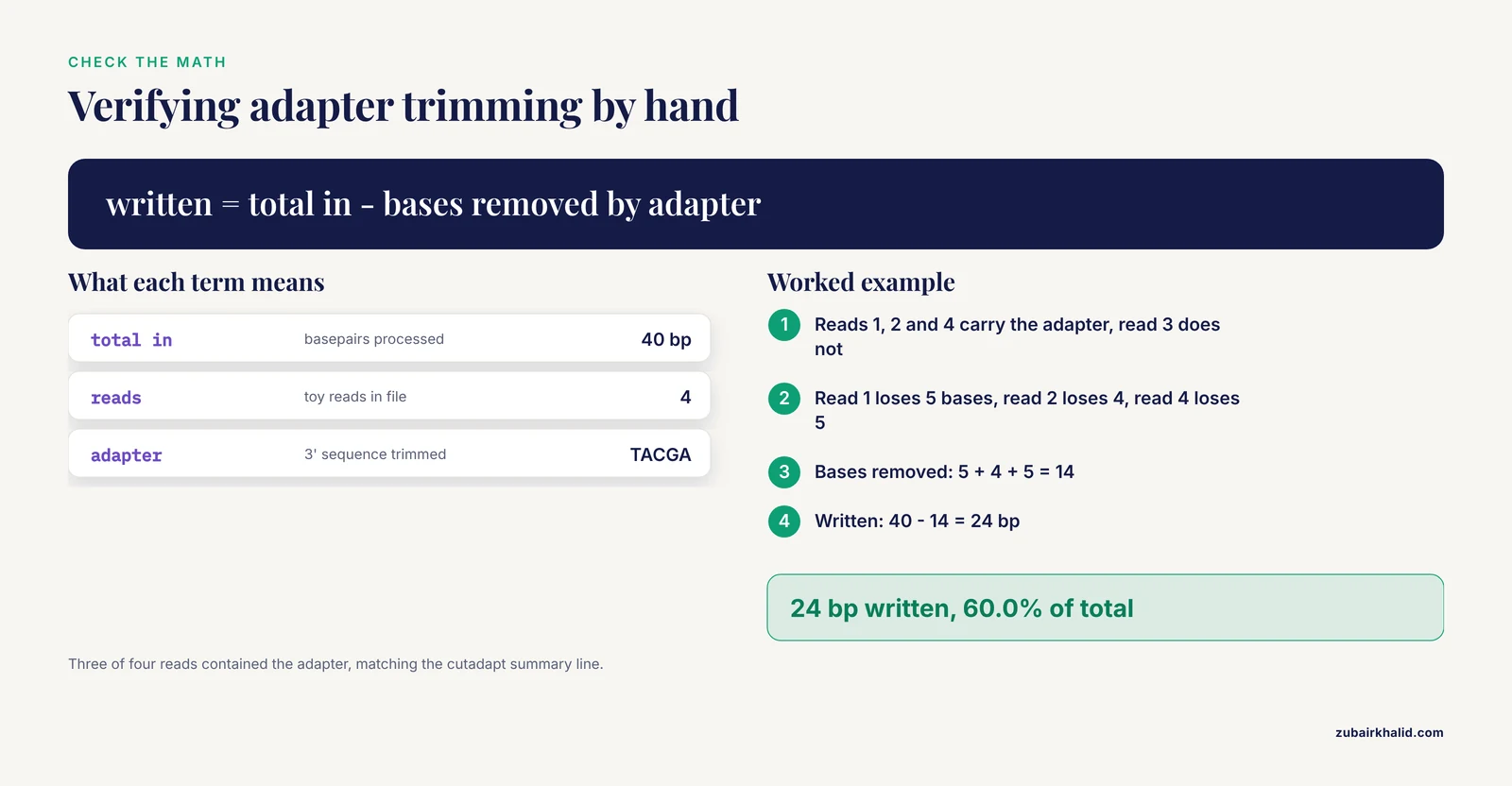
Adapter trimming removes short technical sequences that the sequencer adds during library preparation. Run cutadapt on your toy file:
cutadapt -a TACGA -o ~/learn-bio/raw/trimmed.fq ~/learn-bio/raw/toy.fqThe -a TACGA option tells cutadapt to treat TACGA as a 3' adapter and remove it plus everything after it. Expected output looks similar to this:
Total basepairs processed:       40 bp
  Read 1 with adapter:            3 (75.0%)
Reads written:                   4 (100.0%)
Total basepairs written:         24 bp (60.0% of total)
Check the math yourself. read1 (ACGTTTACGA) loses the last five bases, read2 (GGCATTACGT) loses four, read3 has no adapter and keeps all ten, read4 loses five. Three of four reads contained the adapter, forty basepairs in, twenty-four out. When a tool's summary matches arithmetic you did on paper, you have crossed a line that separates learners who trust tools from learners who understand them. That feeling is fuel, and it is reproducible on demand.
Step 5: Commit Every Win to Version Control
Git records a snapshot of your project at a moment in time, with a message you write yourself. This matters for motivation more than for safety. A commit history is a visible, dated record of competence growing.
cd ~/learn-bio
git init
git add toy.fq raw/ qc/ qc_report/
git commit -m "First QC and adapter trimming run"
Expected output: git prints a line confirming the initial files committed, including the message. From now on, every session ends with a commit. Six weeks in, git log becomes a receipt of everything you have learned, which is the most convincing argument against the voice that says you have made no progress.
Step 6: Graduate From Tools to Workflows
A workflow is a script that chains tools together so the whole analysis reruns with one command. Manually rerunning six commands after every change is where motivation goes to die. Workflow systems automate execution, make analyses reproducible, and make large-scale analysis accessible, which is the explicit design goal of platforms like SciApps, a web-based platform for reproducible bioinformatics workflows on local clusters or in the cloud [4]. Real production pipelines follow the same pattern. CoVpipe2 wraps quality control, mapping, variant calling, and consensus generation into a single automated workflow with additional features for detecting mixed samples and recombinants [1].
You do not need to learn Nextflow or Snakemake in week one. Start with a plain shell script that records your exact commands:
cat > run_analysis.sh << 'EOF'
#!/bin/bash
set -e
fastqc raw/toy.fq -o qc/
cutadapt -a TACGA -o raw/trimmed.fq raw/toy.fq
multiqc qc/ -o qc_report/
echo "Pipeline finished without errors"
EOF
chmod +x run_analysis.sh
./run_analysis.sh
The set -e line stops the script at the first failure instead of plowing ahead with broken intermediate files. When this script runs end to end and prints its final message, commit it. Later, when your analysis grows, the script's structure maps directly onto a real workflow language, and the transition will feel like a promotion rather than a restart.
Step 7: Practice on Data Where the Truth Is Known
Beginners assume they need real experimental data, and real experimental data is where beginners get lost, because nobody tells you the correct answer. Simulated data flips this. A position paper in Bioinformatics argues that simulated and experimental data deserve equal standing in bioinformatics methods assessment, because simulations calibrated by real data come with perfect ground truth, letting researchers assess and improve methods early, before large-scale experimental capacity exists [5].
The same logic applies to learning. When you simulate a dataset, you know the answer in advance, so every wrong result is a lesson instead of a mystery. The DREAM challenges, used to benchmark gene regulatory network inference methods like the ensemble-based AGRN, which combines random forest, extra tree, and support vector regressors with Shapley importance values, provide public datasets with community-defined truth for exactly this kind of practice [6]. Working a DREAM-style dataset means your score is computed for you, which turns practice into a game with a scoreboard. Games with scoreboards are the cheapest motivation ever invented.
A Table of Your Three Working Modes
| Mode | What it is | Best for | Time to first result |
|---|---|---|---|
| , - | , - | , - | , - |
| Web server | Paste data into a website, get results | Day-one learners, one-off questions, checking intuition | Minutes |
| Command line | Run installed tools in a conda environment | Custom analyses, automation, reproducible work | Under an hour once set up |
| Workflow | Scripted chains of command-line tools | Multi-step projects, reruns after changes, sharing | Hours to set up, then seconds to rerun |
Start every new technique in web server mode to build intuition, then reproduce it on the command line, then wrap it in a script. Each layer teaches something the others cannot, and moving up a layer is a natural milestone to celebrate.
The web server recommendation is not a compromise. An empirical analysis of recently released protein function and disorder prediction methods found that methods with working web servers generated roughly three times as many citations on average as tools available only as source code or not available at all, and that differences in raw predictive performance were unlikely to drive citation rates [7]. Accessibility wins. The same researchers who built S4PRED, a deep learning method for protein secondary structure prediction that reached an unprecedented accuracy on the standard CB513 benchmark, released it both as open-source code on GitHub and as part of the PSIPRED web service [8]. Serving your work through a browser is how the field itself maximizes impact, and it is a legitimate way for you to work.
Your First 90 Days: A Milestone Plan
Milestones convert motivation from a mood into a schedule. Here is a plan that assumes five to seven hours per week. Adjust the pace, keep the sequence.
Weeks 1 to 2: Environment and file formats. Complete Steps 2 through 5 above. Learn FASTQ, FASTA, and GFF3 by reading the first twenty lines of each file type and writing down what every column means. Milestone: your first git commit containing a QC report you can explain to another person.
Weeks 3 to 4: One analysis, end to end. Pick a single question, such as trimming adapters and recomputing quality statistics on a downloaded public dataset from a repository like SRA or ENA. Milestone: a shell script that reruns the whole analysis with one command.
Weeks 5 to 6: A benchmarked challenge. Work one DREAM-style or simulated dataset where the ground truth is published [5], [6]. Milestone: a number (accuracy, correlation, or error rate) attached to your own analysis, with a paragraph explaining it.
Weeks 7 to 8: First exposure to a real domain. Choose one application area and read one review in it. The field's breadth is easier to face once you have fundamentals. In personalized medicine, for example, reviews identify four distinct challenge areas: processing large-scale genomic data, interpreting the functional effect of variation, integrating systems-level data with phenotypes, and translating discoveries into practice [9]. Structural bioinformatics offers another window, with a decade of progress in accessible data, computational resources, and cross-validation between computational and experimental results [10]. Milestone: you can describe, in three sentences, what a working scientist in your chosen area does all day.
Weeks 9 to 10: Choose a bioinformatics course strategically. By now you know what confuses you, so pick a course that addresses your specific gaps rather than a generic survey. Look for three features: hands-on exercises with real data, an active discussion forum, and assessments that produce artifacts you keep. A structured bioinformatics course with graded milestones externalizes motivation on the days when internal motivation dips. Evidence from the BioDecryptors study supports structured, gamified, team-based formats for introducing bioinformatics concepts while supporting motivation [2], and conventional courses with deadlines and cohorts supply the same scaffolding in a slower form.
Weeks 11 to 12: Ship something small and public. Write a short README explaining your best analysis, push it to GitHub, and post it somewhere people will see it. Public artifacts change your relationship to the field. You are no longer a student begging for admission. You are a colleague with a URL.
Week 13: Retrospective. Reread your first commit. Redo your first QC exercise from memory. The gap between your day-one self and your week-thirteen self is the single most persuasive motivational document you will ever own, and you wrote it yourself without noticing.
How Real Projects Are Structured, and Why That Should Shape Your Practice
Two structural facts about professional bioinformatics have direct motivational consequences.
First, reproducibility is a first-class requirement, not a nicety. When researchers systematically compared matrix factorization methods, which reduce high-dimensional transcriptomic data to a few interpretable hidden factors, across fourteen colorectal, eight breast, and four ovarian cancer datasets, they found that a particular protocol of independent component analysis with a stabilization procedure produced markedly more reproducible components between datasets, and they built a user-friendly tool around that finding [11]. Methods that generalize are worth more than methods that work once on one dataset. For your motivation, this reframes unglamorous habits: writing a README, pinning versions, and scripting reruns are the habits that make your work count, and mastering them early puts you ahead of many graduate students.
Second, the field's hardest problems are integration problems, and integration problems are where careful structure pays off most. A recent review of data integration in computational biology describes how multiplying data types and batch effects hinder the joint use of available data, surveys the machine learning paradigms used to build joint representations across modalities, and catalogs the pitfalls of modern integration tools [12]. Methods like PANDA, a joint multi-omics discriminant analysis framework, explicitly learn consistent latent representations across omics types to avoid compromising between correlation and discrimination [13]. You will not touch multi-omics integration in your first quarter. Knowing that this is the horizon changes how you see the basics: file format discipline and reproducible scripting are the entry fee to exactly the work that excites you.
Choosing a Bioinformatics Course You Will Actually Finish
Course selection is a motivation decision before it is an educational one. Use these criteria:
- Artifact-producing assessments. Every assignment should leave you with a script, a report, or a figure you keep. Certificates motivate nobody after week two. Artifacts compound.
- Real data with known answers. The best courses give you practice data where the expected result is documented, so you can verify your pipeline the way you verified the cutadapt arithmetic above.
- A cohort or community. The escape game study recruited participants into teams of three to four and measured motivation with a structured questionnaire before and after the activity [2]. Team context is not decoration. It is the mechanism.
- Tool-agnostic fundamentals. Courses that teach concepts through whatever tool is currently fashionable age badly. Courses that teach you to read error messages, write reproducible scripts, and validate results against ground truth age well, because those skills transfer across every tool you will ever use.
- A defined scope. A course on transcriptomics analysis or on genome assembly beats a course on "bioinformatics." Narrow scope creates finishable units, and finished units are what sustain motivation.
If you cannot find a paid course that fits, assemble your own from documentation, public datasets, and the milestone plan above. Many working bioinformaticians are self-assembled in exactly this way.
Motivation Tips That Hold Up Under Scrutiny
These bioinformatics motivation tips are ordered by how often they rescue a stalled learner.
Keep a solved-problems log. Every time you fix an error, write one line: the error, the cause, the fix. This log becomes your personal documentation, and rereading it on bad days is direct evidence of growth. It also encodes the field's most transferable skill, which is reading an error message calmly and extracting its meaning.
Bias toward tools you can verify. Prefer tools and datasets where you can check the output against a known truth, whether that truth is hand-arithmetic on four toy reads, a simulated dataset with planted answers [5], or a challenge benchmark with published scores [6]. Verification converts anxiety into curiosity.
Copy the professionals' architecture, not their tools. Professionals automate with workflows, document assumptions, and test against ground truth, [5], [4]. A learner running four commands by hand with no notes is practicing the opposite of what the field rewards. Adopt the architecture now, at toy scale.
Build or extend something other people can use. The citation advantage of accessible tools is large and consistent across research areas and publication years [7]. Even a small contribution, such as improving documentation for an open-source tool like S4PRED [8], connects your learning to real users, and real users are the strongest motivation signal available outside a job.
Study the pitfalls before the victories. Reading about what goes wrong, such as the amplicon-specific pitfalls in primer clipping and low-coverage regions that shaped CoVpipe2's design [1], inoculates you against the despair of hitting the same problems without warning. Anticipated problems are puzzles. Unanticipated problems are crises.
Protect the streak, not the intensity. Twenty focused minutes daily outperforms a six-hour Sunday binge, because skill in this field is largely pattern exposure. Your eyes learn what good output looks like only through repetition.
Common Mistakes and Limitations
These are the bioinformatics motivation common mistakes, in rough order of how much time they waste.
Mistake 1: Tutorial hopping. Watching the fifth identical RNA-seq tutorial feels productive and teaches nothing new. The cure is a project with a checkable answer. If you cannot state the expected result before you run the analysis, you are watching, not learning.
Mistake 2: One giant conda environment. Beginners install everything into a single environment until a package conflict wrecks it. One environment per project, always. The two-command fix in Step 2 above prevents a failure mode that ends more beginner journeys than any concept in the curriculum.
Mistake 3: Treating errors as verdicts. An error message is a hypothesis about what went wrong, usually correct, usually stated in its first line. Learners who paste the whole traceback into a search without reading it skip the step that builds competence. Read the first line. Form a guess. Then search.
Mistake 4: Practicing only on clean toy data. Toy data teaches tool mechanics. Real data teaches judgment, and real data is messier in documented ways, from primer-site artifacts in amplicon sequencing to mixed samples and coverage dropouts [1]. Schedule regular contact with messy public data once the mechanics feel comfortable, roughly from week five onward.
Mistake 5: Ignoring reproducibility until "later." Later never comes, and unreproducible work is demoralizing twice, once when you cannot rerun it and once when you cannot show it. The habits take minutes: pin versions, write the script, commit.
Mistake 6: Measuring progress in tools memorized. Tool churn is constant. In machine learning applied to biology, methods arrive continuously, from graph neural networks for compound-protein interaction prediction [14] to language-model-based frameworks for protein-RNA interaction prediction [15] to deep learning classifiers for antimicrobial peptides [3]. Memorizing tools is a treadmill. Learning to read a method's data assumptions and validate it on ground truth [5] is a transferable skill that survives every tool change.
Mistake 7: Working in isolation. Most motivation failures in this field look like silence. Join a forum, a lab's journal club, a local meetup, or an open-source project's issue tracker. The escape game result [2] is one data point, but the direction is clear: learning alongside others works.
Mistake 8: Skipping domain knowledge. A learner who can run a pipeline but cannot say what a gene regulatory network is or why dysregulation of these networks matters in complex diseases such as cancer, Alzheimer's, and diabetes [6] will stall at interpretation, which is where all the interesting questions live. Read biology alongside code, in roughly equal proportion.
A word on limitations. This plan is a template drawn from how practicing bioinformaticians and educators actually structure their work, not a guarantee for any individual. Your available hours, background, and goals will force adjustments, and the honest measure of the plan is whether your artifacts accumulate, not whether you match the weekly schedule exactly.
Frequently Asked Questions
How long does it take to learn bioinformatics?
You can produce genuinely useful analyses within about three months of consistent weekly practice, following a plan like the 90-day schedule above. Deep competence in a specialty such as variant calling or multi-omics integration takes years, but the first useful milestone arrives much sooner than most beginners expect.
Do I need to be good at programming before I learn bioinformatics?
No. You need enough shell and Python or R to run tools, parse files, and script reruns, which is a few weeks of part-time practice. The milestone plan defers heavy programming until after you have built intuition with tools, web servers, and verified toy analyses.
Which bioinformatics course should I start with?
Start with a narrow, hands-on course in a single domain, such as RNA-seq analysis or genome assembly, that uses real data with documented expected results and leaves you with artifacts you keep. Generic survey courses lose momentum, and team-based or gamified formats have documented motivational benefits [2].
How do I stay motivated when my code keeps failing?
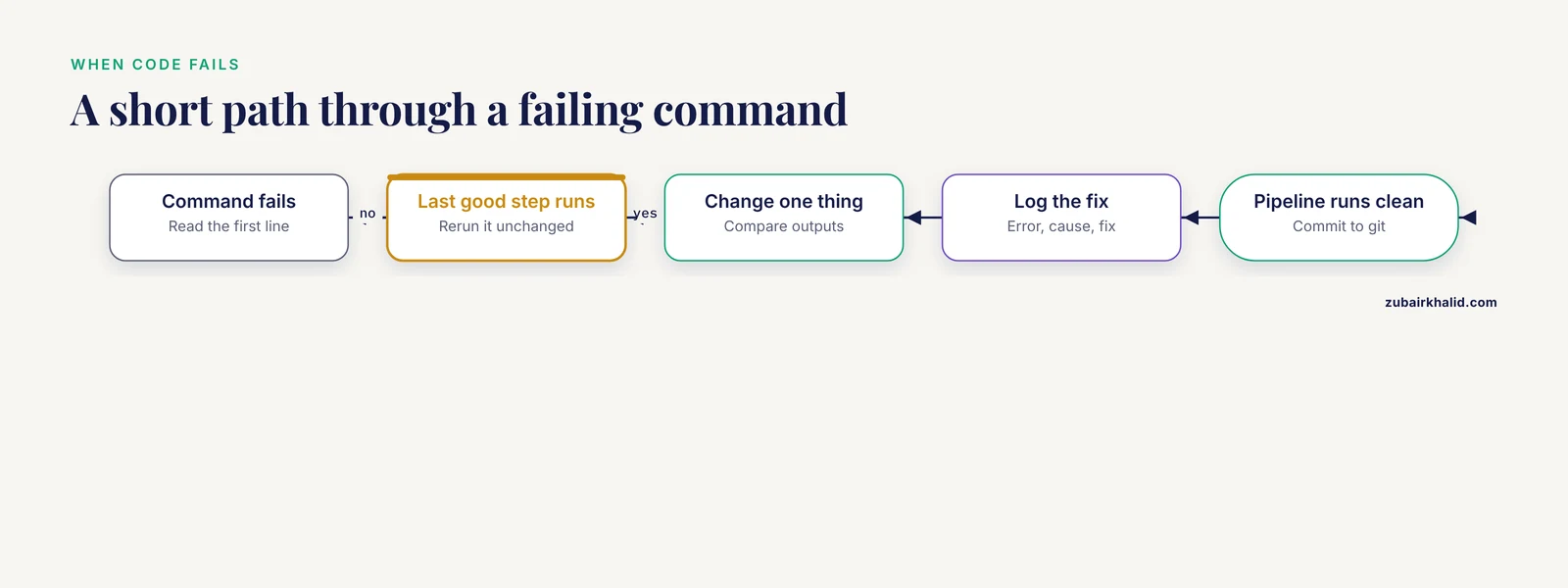
Shrink the failure loop. Rerun the last command that worked, change one thing, and compare outputs. Keep a solved-problems log so every fixed error becomes visible progress, and commit to git once the pipeline runs clean so the win is recorded permanently.
Can I learn bioinformatics without a background in biology?
Yes, if you read biology in parallel. Running pipelines without domain knowledge leads to a predictable stall at interpretation, so pair every technical week with reading on the underlying biology, such as why gene regulatory networks matter in complex disease [6].
How much statistics and math do I need to start?
You need basic descriptive statistics, an understanding of what a p-value claims, and comfort with matrices to start. Methods papers increasingly state their data assumptions explicitly, and learning to read those assumptions [5] matters more at the beginning than deriving algorithms from scratch.
Should I practice with web servers or the command line?
Use both, in that order. Web servers give minute-scale results and build intuition, and their importance is measurable, since tools offering working web servers earn roughly three times the citations of code-only tools [7]. Then reproduce the same analysis on the command line, where reproducibility and automation become possible [4].
How do I know I am actually making progress?
Three signs: your git log grows, your solved-problems log grows, and you can redo an early exercise from memory faster than you did it the first time. If all three are true over any two-week window, you are progressing, regardless of how overwhelmed you feel in the moment.
Sources
- Lessons learned: overcoming common challenges in reconstructing the SARS-CoV-2 genome from short-read sequencing data via CoVpipe2.
- BioDecryptors, a Bioinformatics Escape Game for Undergraduate and Postgraduate Learners in Clinical Microbiology: Prospective Before-and-After Study.
- Deep learning improves antimicrobial peptide recognition
- SciApps: a cloud-based platform for reproducible bioinformatics workflows
- Access to ground truth at unconstrained size makes simulated data as indispensable as experimental data for bioinformatics methods development and benchmarking
- AGRN: accurate gene regulatory network inference using ensemble machine learning methods
- Availability of web servers significantly boosts citations rates of bioinformatics methods for protein function and disorder prediction
- Increasing the accuracy of single sequence prediction methods using a deep semi-supervised learning framework
- Bioinformatics challenges for personalized medicine
- Achievements and challenges in structural bioinformatics and computational biophysics
- Assessing reproducibility of matrix factorization methods in independent transcriptomes
- Omics data integration in computational biology viewed through the prism of machine learning paradigms.
- Joint multi-omics discriminant analysis with consistent representation learning using PANDA.
- Compound-protein interaction prediction with end-to-end learning of neural networks for graphs and sequences
- PRIDA: Cross-domain protein-RNA interaction prediction based on biological language models and conditional domain-adversarial learning.