Data Retention Policies for Bioinformatics
By Dr. Zubair Khalid, DVM, MS, PhD ·

A bioinformatics data retention policy is the written rule that decides which datasets an organization keeps, in what format, for how long, and when each dataset is destroyed, while a backup policy only decides how data survives hardware failure. A backup protects you from losing data. A retention policy protects you from keeping data you cannot legally, ethically, or economically justify.
The rule of thumb for choosing between retention options is this. Classify every dataset into a tier the moment it is created. Keep raw, irreplaceable measurement data the longest. Set explicit, dated deletion schedules for derived files, working files, and logs, and verify that scheduled deletions actually happen. If you cannot state in one sentence why you are keeping a file and until when, that file is a liability, not an asset.
This guide walks through what a bioinformatics data retention policy covers, why genomic and multiomics data break the assumptions of generic IT retention rules, the main retention policy options with their pros and cons, the storage infrastructure realities that shape any genomics data storage plan, and worked scenarios for clinical, academic, and industry settings.
What a Bioinformatics Data Retention Policy Covers
A retention policy sits inside a broader bioinformatics data management program. It touches six decisions that every lab, core facility, and company eventually has to make in writing.
Data classes. A retention policy does not treat "data" as one lump. It names classes such as raw instrument output, aligned and processed intermediates, final analysis products, metadata and sample identifiers, audit logs, and the source code and container images that produced the results. Each class gets its own retention period.
Retention periods. The policy assigns each class a concrete duration, expressed in years or tied to an external event such as publication, grant closeout, or a regulatory record requirement.
Disposition. Disposition is the action taken at the end of a retention period, usually deletion or, less commonly, transfer to an external archive. A serious policy specifies how deletion is verified and documented, because a deletion nobody can prove is functionally indistinguishable from a deletion that never happened.
Legal hold. A legal hold suspends normal deletion for specific data involved in litigation, audit, or investigation. The policy needs a named person who can place and release holds.
Ownership and custody. The policy names who is responsible for each data class, who can approve exceptions, and who signs off when a retention period changes.
Disclosure. Where data subjects exist, the policy feeds the public-facing statement of how long personal data is kept. Privacy policies are the primary channel through which people are informed about the handling of their personal data under regulations such as the GDPR, and research on that disclosure channel found persistent failure. In a systematic evaluation of 2,235 Android application privacy policies, more than half were potentially non-compliant on retention disclosure, a meaningful subset indicated indefinite retention, and overlapping retention periods appeared frequently within single policies. The evaluation used a large language model based approach that reached an F1 score of 0.904 against expert annotations, which shows that unclear retention language is now both common and detectable at scale.
Retention has always been a governance question, not merely a storage question. The public debate over data retention requirements for communications surveillance in the United Kingdom showed how retention mandates create friction between the stated utility of keeping data and concerns about the scope and persistence of surveillance. That tension carries directly into genomics, where a retained genome is simultaneously a scientific resource and one of the most identifying records that exists.
Why Bioinformatics Breaks Generic IT Retention Rules
Most corporate data retention guidance assumes that data loses value over time. A five-year-old log file usually has no analytic value. Bioinformatics inverts that assumption in several ways, and those inversions drive the retention policy options described later in this article.
Results depend on tool choices and versions
Bioinformatics results are outputs of pipelines, not direct readings of nature. Two defensible tools applied to the same data can produce materially different answers, which means the raw data plus the complete tool context is what makes a result reproducible.
The clearest demonstration comes from clinical variant interpretation. When three bioinformatics tools were compared on rare candidate variants from whole-exome sequencing of 220 autism spectrum disorder family trios registered in the National Autism Database of Israel, the pairwise overlap between tools was 64.1 percent, 22.9 percent, and 23.1 percent for the three tool pairs, across a total of 372 variants in 311 genes distributed among 168 probands. Different defensible tools agreed only partially on which variants mattered [1]. A parallel benchmark of copy number variation detection across six commonly used software tools, on a challenging hyper-diploid cancer genome, found that results were consistent for copy gain, loss, and loss of heterozygosity across sequencing centers and technologies, but that the biggest driver of divergent calls was the determination of genome ploidy. The study established a high-confidence call set for the reference cancer cell line HCC1395 by combining consensus across callers with confirmation from orthogonal methods [2].
The retention consequence is direct. If raw sequencing data is deleted and only the final variant list is kept, nobody can ever rerun the analysis with a corrected tool, an updated reference, or a new ploidy model. Any retention policy for genomics data storage that treats raw reads as disposable is quietly destroying reproducibility.
Reference databases drift
Downstream interpretation depends on external databases that change on their own schedules. A comparison of enrichment analysis tools for metabolomics data examined how metabolite identifiers resolved across resources including HMDB, KEGG, PubChem, ChEBI, BioCyc/HumanCyc, LipidMAPS, ChemSpider, METLIN, and Recon2, and found that the databases carrying the most identifiers, such as PubChem, METLIN, and ChEBI, also contained duplicated entries and possible false positives [3]. Identifier mappings that were correct when an analysis ran can be ambiguous years later. That is an argument for retaining a frozen snapshot of the database versions and identifier mappings used, alongside the data itself.
Derived data products are meaningless without their inputs
A typical microbial genomics workflow produces layered outputs. In one published example, five related strains of a marine bacterium were compared by genome-to-genome distance, characterized by GC content and Chaos Game Representation, encoded into unique QR codes, placed on a phylogenetic tree built with 1,000 bootstrap replicates, and summarized by principal component analysis as part of a polyphasic taxonomic classification [4]. Each of those products is a derivative of the underlying sequence reads. The QR codes and trees have archival and communication value, but if the underlying sequences vanish, the derived products cannot be reinterpreted, revalidated, or extended. Retention policy has to protect the chain from raw data to final product, not just the polished endpoint.
Algorithmic labels persist in ways records do not
Machine learning adds a distinct retention problem. When models assign scores, risk labels, or classifications to people or samples, those labels can persist and be re-encountered long after the data that produced them would have been scheduled for deletion. Work on algorithmic evaluation tools in sport, which draws on evidence from education, employment, and healthcare, identifies precisely this risk of model-based labels persisting over time, along with privacy concerns and the effects of non-representative training data, and translates these threats into governance principles for accountable use [5]. In a bioinformatics setting, the analogous problem is a phenotype call, a disease risk score, or a model-predicted label attached to a sample record. The label is personal data even if the training data is deleted, so retention policy must cover model outputs and the models themselves, not just measured data.
Multiomics integration raises the stakes
Modern bioinformatics data management increasingly requires integrating genomic, transcriptomic, and metabolomic layers from the same cohorts. Network-based multiomics integration methods, such as a recently proposed molecular-pair framework applied to lipid metabolism in hepatocellular carcinoma studies, depend on consistent, linkable datasets across molecular types to produce predictive signals [6]. Integration multiplies the cost of inconsistent retention. If the genomics layer is retained under one schedule and the metabolomics layer under another, the integrated dataset silently degrades even though each half is individually well managed.
Bioinformatics Data Retention Policy Options
There is no single best bioinformatics data retention policy. There are a small number of coherent options, each with a distinct logic. The table below is the core comparison for the rest of this article.
| Option | Core rule | Best fit | Main advantage | Main drawback |
|---|---|---|---|---|
| Retain everything indefinitely | Nothing is ever deleted | Very small labs with cheap cold storage and no personal data | Zero risk of losing something needed later | Unbounded storage cost, unbounded liability, indefensible in audit |
| Fixed-term retention | Every dataset is deleted N years after creation or project close | Organizations that need one simple, explainable rule | Predictable, easy to audit, easy to automate | A single window never fits all data classes |
| Tiered retention by data class | Raw data kept longest, intermediates shorter, reports and metadata by class | Most organizations, the recommended default | Matches storage spend to scientific and legal value | Requires disciplined classification at creation time |
| Project-based retention | Data retained through publication or product release plus a fixed window | Academic labs and grant-funded cores | Aligns with funder and publisher expectations | Orphaned datasets from abandoned projects |
| Regulated-record retention | Retention follows the schedule for the governing record type | Clinical and diagnostic genomics | Directly compliance-aligned | Schedules do not generalize to research data |
| Metadata-only retention | Keep manifests, checksums, parameters, and identifiers, delete bulk data | Legacy or decommissioned datasets | Extremely cheap, preserves findability | Data cannot be reanalyzed or revalidated |
Pros and Cons of Each Retention Option
Retain everything indefinitely
How it works. All data is copied to durable storage and never deleted. Deletion is not part of the policy.
Pros. Nothing is ever lost. Reproducibility questions are always answerable in principle. The policy itself is one sentence long.
Cons. The liability grows without limit, because every retained record containing personal or genomic data is a record that can be breached, subpoenaed, or requested for deletion by a data subject. Storage cost grows with data volume, and modern sequencers make that growth fast. The policy is also vague in exactly the way regulators dislike. Indefinite retention statements in privacy policies are treated as a red flag, and retention periods that are unspecified or unclear are a recognized compliance failure mode. Keeping everything forever is not a policy. It is the absence of one.
Fixed-term retention
How it works. A single retention window, for example a fixed number of years after project closeout, applies to all datasets. Automated jobs delete data older than the window.
Pros. The rule is simple, explainable to auditors, and trivial to implement with scheduled scripts. Storage costs become predictable. Deleting on schedule demonstrates good faith data governance.
Cons. One window cannot fit raw sequencing reads, clinical reports, audit logs, and consent-bound data at the same time. A window that is long enough for the most demanding class wastes money on the least demanding class. A window short enough to be economical may destroy irreplaceable raw data. Fixed-term retention works best as a skeleton that data-class rules hang on, not as the entire policy.
Tiered retention by data class
How it works. Data is classified at creation into tiers, and each tier carries its own retention period and storage tier. A typical tiering for genomics data storage looks like this.
- Raw instrument data, such as BCL or FASTQ files. Longest retention, coldest storage. This is the only truly irreplaceable class.
- Alignment and processing intermediates, such as BAM and CRAM files. Medium retention. Regenerable from raw data at compute cost.
- Analysis products, such as VCF files, expression matrices, and reports. Retention matched to the reporting and publication cycle.
- Metadata, sample identifiers, manifests, checksums, and provenance records. Retention as long as, or longer than, the data they describe.
- Pipeline provenance, including tool versions, containers, parameters, and reference database snapshots. Retention matched to the analysis products they explain.
Pros. This option matches cost to value, satisfies reproducibility needs, and produces a policy that can actually be followed. It is the closest thing to a best bioinformatics data retention policy for most organizations because it acknowledges that raw data, derived data, and provenance have different lifespans.
Cons. It requires classification discipline at the moment of data creation, when nobody wants to fill in a form. Misclassification at creation is the main failure mode. It also demands storage infrastructure that supports multiple tiers, which smaller groups may lack.
Project-based retention
How it works. Retention is anchored to project milestones. Data lives until the paper is published, the dataset is deposited, or the grant ends, plus a fixed tail period, then is deleted or archived.
Pros. It maps naturally onto how academic work is funded and evaluated. It creates a clean handoff to public repositories, which function as indefinite external retention for publishable data. It gives principal investigators a defensible answer to the question of what to delete.
Cons. Projects overlap, merge, and die. Data shared across projects can end up with conflicting schedules. Abandoned projects leave orphaned data that no milestone will ever trigger. The policy needs a fallback rule for data whose project never reaches its milestone.
Regulated-record retention
How it works. Retention periods are set by the record category the data belongs to, following the requirements that govern clinical records, laboratory records, or research records in the organization's jurisdiction.
Pros. Compliance alignment is built in. Auditors recognize the schedule. It removes discretion from individual decisions.
Cons. Regulatory schedules are written for records, not for multi-terabyte raw read sets. A schedule designed around a report may say nothing about the gigabytes of sequence data behind it. Organizations in regulated settings typically run this option for the report layer and a tiered option for the data layers underneath.
Metadata-only retention
How it works. For data that is being disposed of, the organization retains a compact permanent record of what existed. This includes file manifests, checksums, sample identifiers where permitted, analysis parameters, and tool versions, while deleting the bulk files.
Pros. It preserves findability and auditability at negligible cost. It answers "did we ever process this sample and how" without storing terabytes. It is the correct end state for most decommissioned projects.
Cons. The data itself is gone. Reanalysis, revalidation, and new-cohort comparisons are impossible. This option is a disposition outcome, not a starting policy, and it should never be applied to raw data whose regeneration is impossible.
Storage Infrastructure Realities for Genomics Data Storage
Retention periods are only as good as the storage media that hold the data. Bioinformatics data management plans that assume a disk or archive medium will faithfully hold bits for decades are making an assumption that storage engineering does not support.
Three facts from storage research matter for policy design.
First, retention behavior is a property of the medium, and it differs across technologies and generations. Comparative work on 2D and 3D TLC NAND flash memory examined data-retention characteristics between the two generations of flash, reflecting the reality that the flash generations sitting in your storage tiers today do not age identically [7]. A procurement decision made for one generation of drives cannot be silently assumed to hold for the next.
Second, emerging nonvolatile media have their own retention profiles that must be measured, not assumed. Phase-change memory, or PCRAM, has been studied specifically for data retention measured under test conditions, which reflects the broader engineering principle that every nonvolatile technology needs its own retention characterization [8].
Third, volatile memory introduces the simplest and starkest version of the problem. Research on power-gated SRAM circuits compares designs specifically for their ability to hold data in low-leakage sleep states with high immunity to noise [9]. SRAM holds data only while powered. That distinction between volatile and nonvolatile storage is the bedrock of every tiered storage design. Anything that matters past a power cycle belongs on nonvolatile media, and anything retained for years belongs on media whose long-term behavior has been characterized and planned for.
The policy consequence is that retention is not only about time. It is about migration. A credible genomics data storage plan specifies refresh and migration cycles, verifies data integrity with checksums at each migration, and treats "the array still spins" as insufficient evidence that the data is intact.
Choosing the Best Bioinformatics Data Retention Policy for Your Organization
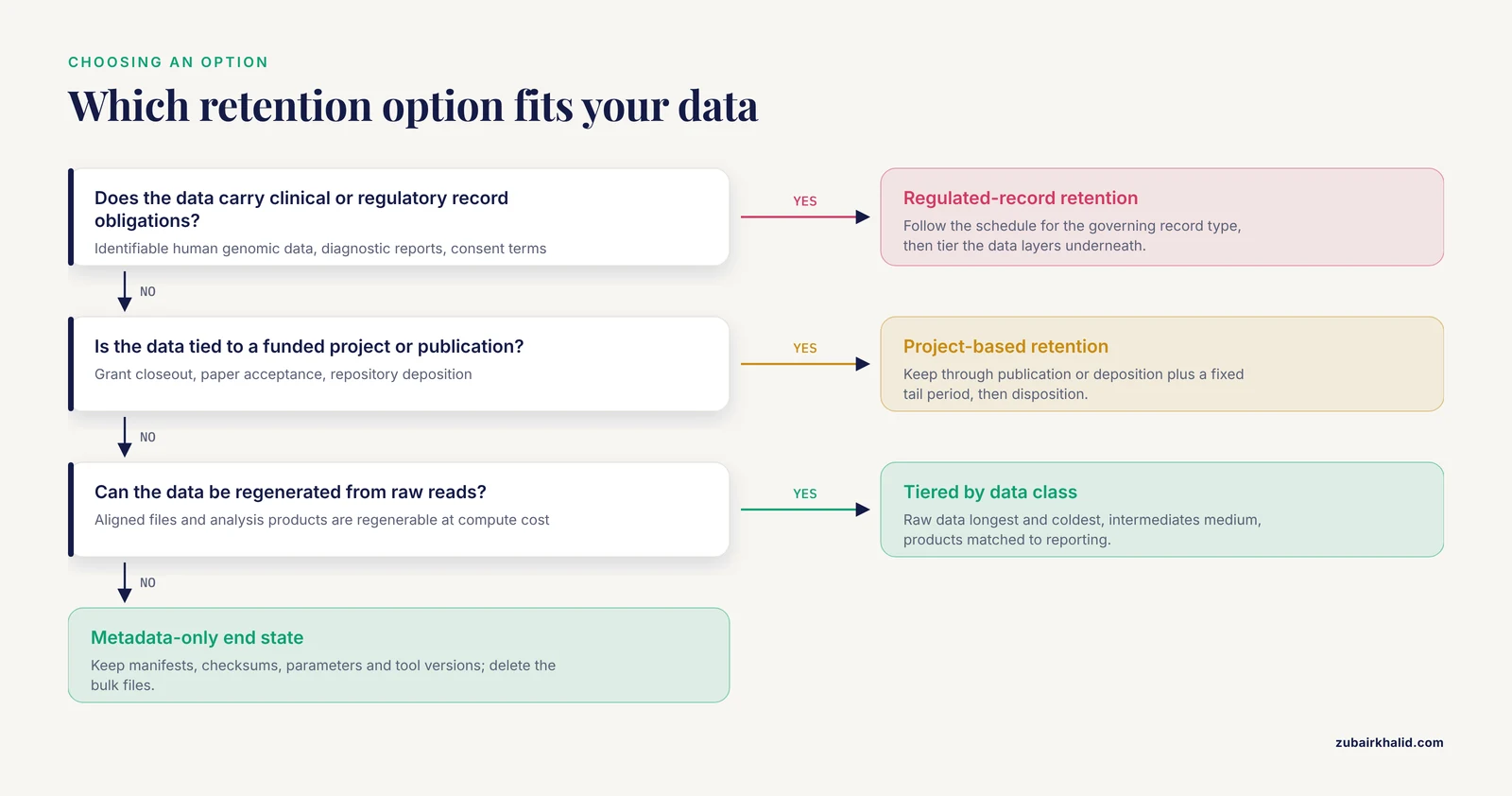
The right option falls out of five questions. Answer them in order.
1. What legal and consent obligations attach to the data? Data containing identifiable human genomic information carries consent terms, privacy obligations, and data subject rights. Data from a de-identified public reference strain carries almost none. The obligations set the floor for retention and, importantly, set a ceiling as well, because a data subject's right to erasure can require deletion that a science-first policy would never choose.
2. Is the data reproducible from something else? Raw instrument data is irreplaceable. Aligned files are regenerable from raw data. Enrichment results are regenerable from intermediates plus the right database snapshot. The further a file sits from raw measurement, the shorter its retention period can be.
3. How tool-sensitive are the results? The variant calling examples above, where defensible tools overlapped on as little as 22.9 percent of called variants [1] and where ploidy determination drove divergent copy number calls [2], argue for long retention of raw data in any domain where a result could face clinical or scientific challenge. If a result could ever be contested, keep the inputs.
4. What does storage actually cost per year, per tier? Retention policy is a budget document in disguise. Tiered retention exists precisely because hot, fast storage and cold, dense storage have very different economics, and because derived data can be regenerated from raw data at compute cost instead of being stored forever at storage cost.
5. Who signs off on exceptions and holds? Every policy needs a named data steward. Without one, exceptions accumulate silently and the policy drifts toward "retain everything," which is the failure mode most organizations fall into by default.
As a practical recommendation for most bioinformatics groups, the tiered retention by data class option, with project-based triggers for academic work and regulated-record schedules for clinical work layered on top, gives the best balance of reproducibility, compliance, and cost.
Building the Policy, Step by Step
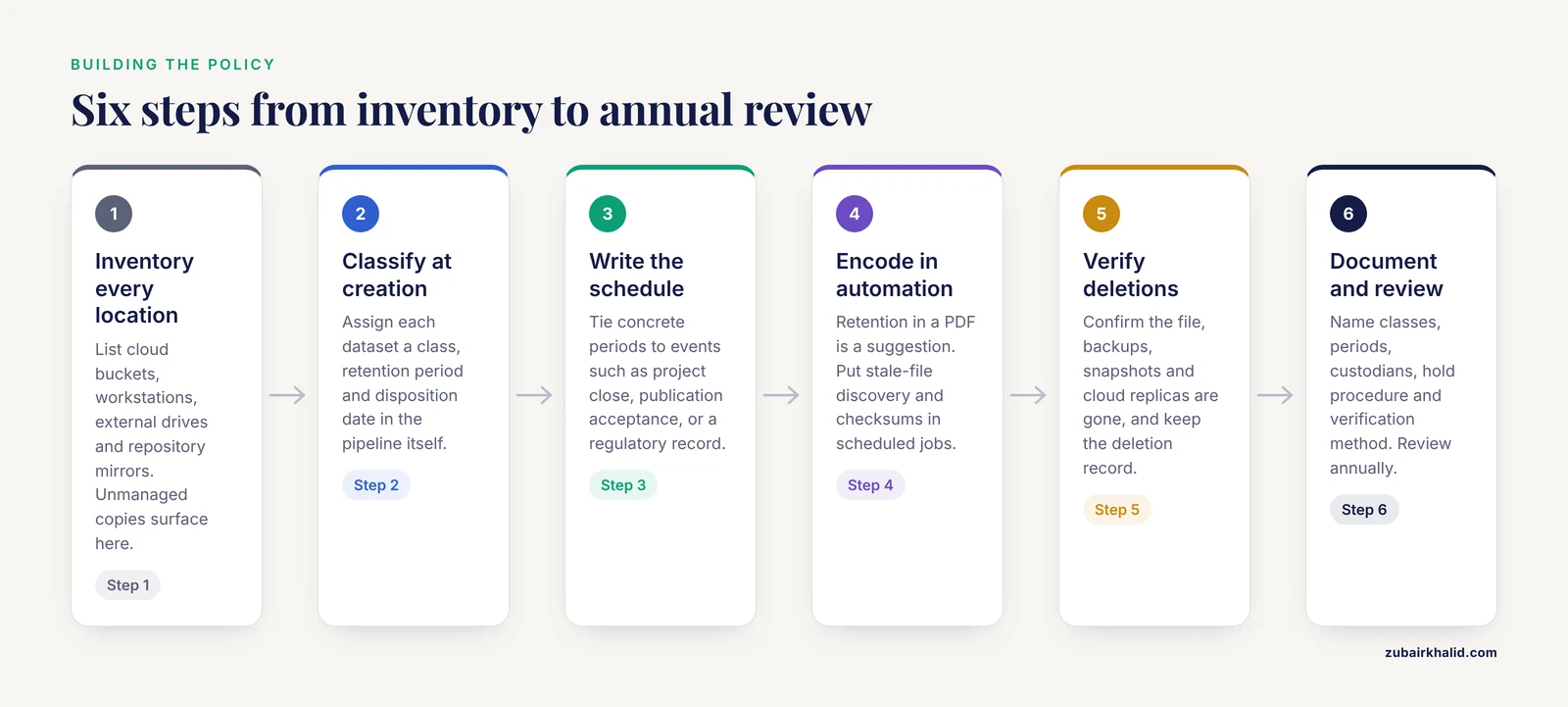
Step 1, inventory. Enumerate every location where data lives, including cloud buckets, workstations, external drives, and repository mirrors. Most organizations discover unmanaged copies during this step. That discovery is the point.
Step 2, classify. Assign every dataset to a class from the tiered list above. Do this at creation time, in the pipeline itself, not retrospectively. A sample sheet or metadata record should carry the class label, the retention period, and the disposition date.
Step 3, write the schedule. Express retention as concrete periods tied to events. For example, raw data retained for a fixed multi-year period after project close, intermediates retained until the associated publication is accepted, metadata and provenance retained permanently. Where precision is required, name the periods in years and name the event that starts the clock.
Step 4, encode it in automation. Retention that lives in a PDF is a suggestion. Retention that lives in a scheduled job is a policy. Stale-file discovery and integrity verification are both standard filesystem operations.
Find files older than a candidate retention window before enabling any deletion:
find /data/projects/archive -type f -mtime +1825 -printRecord checksums at creation so future verification is possible:
sha256sum sample_R1.fastq.gz >> manifest.sha256Verify integrity of archived data on a fixed schedule by re-running the checksum against the stored manifest and comparing results. Any mismatch triggers restoration from a second copy before the data is considered retained.
Step 5, verify deletions. A deletion is complete when the file, its backups, its snapshots, and its cloud replicas are gone, and when a record of the deletion, including the manifest entry and the date, is retained. Partial deletion across replicas is one of the most common real-world failures, because the bulk copy is deleted while a snapshot or bucket version quietly persists.
Step 6, document and review. The policy document names the classes, periods, custodians, hold procedure, and verification method. Review it annually and whenever the storage infrastructure, funding model, or regulatory context changes.
Worked Scenarios
Scenario 1, a clinical molecular diagnostics laboratory. The lab sequences patient samples and issues variant reports. The regulated-record option governs the report layer, with retention following the schedule for laboratory and clinical records. Underneath it, a tiered option governs the data layers. Raw reads are retained long enough to support any challenge to a reported result, which matters because the tool-comparison evidence shows that a different defensible caller can produce a materially different answer for the same patient data. Alignment files are retained until the report cycle closes. Pipeline provenance, including caller versions and the ACMG-aligned interpretation tooling context, is retained with the report. Deletion is verified across primary storage and backup replicas.
Scenario 2, an academic sequencing core. The core runs dozens of projects a year for many investigators. The project-based option is the anchor. Data lives through publication and repository deposition, plus a fixed tail period. Metadata, manifests, and checksums are retained permanently under the metadata-only end state once bulk data is dispositioned. The core's biggest operational risk is orphaned projects, so the policy includes a fallback rule. Any project with no activity for a fixed period is escalated to the data steward before bulk deletion. Because published bacterial and viral genome analyses often consist of layered derived products built on short read sets, as in polyphasic taxonomic workflows that generate distance analyses, sequence representations, and bootstrap phylogenies from underlying sequences [4], the core retains the read data behind any published figure until deposition is confirmed.
Scenario 3, a startup building predictive models on multiomics data. The company trains models on patient-derived data and deploys scores into products. Two retention problems dominate. First, training data privacy, which requires retention periods that honor the consent under which data was collected and deletion schedules that are actually executed. Second, the persistence of model-based labels. As governance analyses of algorithmic evaluation tools emphasize, labels produced by models can outlive the data that produced them and attach lasting characterizations to individuals, which is why the retention policy must cover model outputs, model versions, and training datasets as separate classes with separate schedules [5]. The engineering team also keeps frozen snapshots of every reference database and feature pipeline version used for each training run, because identifier mappings and tool behavior drift over time in ways that only become visible when results are questioned [3]. When the company adopts large language model assistance in analysis workflows, benchmarking evidence that such models recall stored knowledge well but perform inconsistently on applied inference tasks [10] reinforces the existing rule. Automated tools are recorded in the provenance chain like any other pipeline component, and their outputs are treated as derived data subject to the same schedule.
Common Mistakes and Limitations
Writing "as long as necessary" as a retention period. This formulation is the single most common policy failure. It gives auditors nothing to check and data subjects nothing to rely on. If a period cannot be stated, the reason for retention probably cannot be stated either.
Confusing backup with retention. Backups answer a disaster question. Retention answers a governance question. A backup policy that never expires copies is an indefinite retention policy wearing a disguise, with all of that option's liability and none of its documentation.
Keeping derived data and deleting raw data. This inverts the correct structure. Raw data is irreplaceable and small relative to its scientific value. Derived data is regenerable and often larger than the raw data. Any policy that does this should be reversed immediately.
Assuming storage media outlast the retention period. Flash generations differ in retention behavior [7], nonvolatile memory technologies require their own retention characterization [8], and volatile memory holds nothing past a power loss [9]. Migration with checksum verification is part of retention, not an optional extra.
Ignoring provenance. A retained VCF file without the tool versions, reference build, parameters, and database snapshots that produced it is a dead artifact. Provenance is the cheapest data class to retain and the most valuable per byte.
No hold mechanism. When litigation or investigation suspends deletion, an automated pipeline that keeps deleting on schedule creates spoliation risk. The legal hold procedure is not bureaucracy. It is the switch that stops the machine.
No deletion verification. Declaring deletion without confirming it across primary storage, backups, and cloud replicas means the policy's most consequential action is also its least observed.
Limitation. This article describes general practice for designing and operating retention policies. Individual deployments carry institutional obligations that vary with the data, the jurisdiction, and the funding context, and final retention decisions should be reviewed with the organization's data governance, privacy, and legal advisors.
Frequently Asked Questions
How long should raw sequencing data be kept?
Longer than any other data class, because raw reads are the only irreplaceable layer in the pipeline. The concrete number depends on your regulatory context, consent terms, and funder requirements, so set it as an explicit multi-year period tied to project closeout rather than leaving it indefinite.
What is the difference between a retention policy and a backup policy?
A backup policy determines how many copies of data exist and how quickly they can be restored after a failure. A retention policy determines how long data exists at all and when it is deleted. Backups are about survival, retention is about justification.
Do we have to delete data at the end of the retention period if the data is scientifically valuable?
Valuable data should be moved, not quietly kept. Transfer it to an appropriate public repository, a sanctioned long-term archive, or a newly documented retention class approved by the data steward. Silent indefinite retention is the outcome that audits and privacy reviews flag first.
What happens to derived files when raw data is deleted?
Derived files remain valid as historical records but lose their ability to be revalidated, reinterpreted, or regenerated into new products. This is why metadata, manifests, and provenance records should be retained at least as long as any derived product, even after the raw data and intermediates are gone.
How should retention work with cloud genomics storage?
Cloud storage changes cost and replication behavior, not governance logic. Classify data at upload, apply the same retention periods, configure lifecycle rules where the provider supports them, and remember that deletion must reach object versions, replicas, and snapshots, not just the visible object.
What should a written bioinformatics data retention policy contain?
Six elements. Named data classes with concrete retention periods, a disposition and deletion-verification procedure, a legal hold mechanism with a named owner, custody assignments, an exception process, and an annual review date. A policy missing any of these will fail in practice even if it looks complete on paper.
Sources
- Comparison of three bioinformatics tools in the detection of ASD candidate variants from whole exome sequencing data
- Evaluation of somatic copy number variation detection by NGS technologies and bioinformatics tools on a hyper-diploid cancer genome
- Evaluation and comparison of bioinformatic tools for the enrichment analysis of metabolomics data
- Genomic Analysis of a Marine Bacterium: Bioinformatics for Comparison, Evaluation, and Interpretation of DNA Sequences
- Talent Identification and AI-Driven Decision Tools in Sport: A Policy-Oriented Perspective on Algorithmic Bias, Data Privacy, and Digital Determinism in Player Evaluation
- Multiomics Data Integration of Lipid Metabolism in Hepatocellular Carcinoma Studies Using Bioinformatics Networks Based on Vertical and Horizontal Comparisons
- Data-Retention Characteristics Comparison of 2D and 3D TLC NAND Flash Memories
- Comparison of data retention measured by static laser testing and in PCRAM devices
- Power gated SRAM circuits with data retention capability and high immunity to noise: A comparison for reliability in low leakage sleep mode
- Bioinfo-Bench: A Simple Benchmark Framework for LLM Bioinformatics Skills Evaluation