Bioinformatics Course Reviews: How to Read Them and What to Ignore
By Dr. Zubair Khalid, DVM, MS, PhD ·

Bioinformatics course reviews are evaluations, formal or informal, of courses that teach the computational analysis of biological data such as genome sequences, transcript counts, and protein measurements. Reading them well means matching the reviewer's background and goals to your own, and weighing documented learning outcomes far more heavily than star ratings or one-line opinions.
This matters because choosing a bioinformatics course is a genuinely expensive decision in time. A semester-long course, a two-week workshop, or a self-paced online program can consume a hundred hours or more, and the field changes fast enough that a course praised three years ago may now teach tools that have been replaced. Reviews are also unusually noisy for this subject. The same course can be called transformative by a computer science student and impenetrable by a biology student, and both reviews can be honest. Published research on bioinformatics education shows exactly this pattern, where the value of a course depends heavily on who is taking it and what they came in knowing [1][2][3]. This article explains what bioinformatics course reviews actually contain, how to interpret them step by step, and which signals to disregard.
What Does "Bioinformatics Course Reviews" Mean?
The phrase covers four distinct things that readers often lump together, and confusing them is the first mistake most people make.
Peer-reviewed education case studies. These are formal publications in which instructors or education researchers describe a course, report evaluation data, and discuss outcomes. Examples include the case study of a peer-to-peer undergraduate multi-omic data analysis course at the University of Southern California [4], the report of a three-month advanced bioinformatics and genome analyses course built from scratch at the Institut Pasteur de Tunis [5], and the comparison of online and onsite instruction in a fully online Master of Science in Bioinformatics program [6]. These are the highest-quality reviews available because they describe curriculum, assessment, and measured results.
Institutional course evaluations. Universities collect end-of-term student surveys for every course. These influence instructors but rarely reach prospective students outside the institution, except through word of mouth or aggregated ratings sites.
Platform ratings. Coursera, edX, Udemy, and similar platforms display star ratings and short comments. These are the reviews most people read first and trust most, and they are the least informative per word, because the reviewer population is self-selected and their goals are invisible.
Community discussions. Threads on Reddit, Biostars, forum posts, and blog write-ups from people who completed a course. These are often the richest source of practical detail, such as how much time the homework actually took and whether the instructors answered questions, but they are unverifiable anecdotes.
When you search for bioinformatics course reviews interpretation, you are really asking how to convert these four uneven inputs into one decision. The rest of this article gives you a method for doing that.
Why Bioinformatics Course Reviews Mislead More Than Most Reviews
Course reviews suffer from a mismatch problem that product reviews do not. Bioinformatics is a highly interdisciplinary subject used by scientists from widely different academic backgrounds, which means any single course serves several audiences with different starting points [3]. The UK MSc module described by Johnston and colleagues explicitly grouped its content into "diversity-addressing" material, designed to build a common foundation, and "diversity-exploiting" material, designed to harness the different viewpoints students brought with them [3]. That design choice exists precisely because a mixed cohort experiences the same lecture very differently.
This has a direct consequence for review reading. A review that says "way too basic" may come from someone with a decade of programming experience taking a course pitched at life scientists who have never opened a terminal. A review that says "impossible, assumes you already know everything" may come from a biologist in a course pitched for informatics students. Neither review is wrong. Both are reporting their position on the course's difficulty gradient, not the course's quality.
The same effect shows up across course types described in the education literature. An information systems program built a bioinformatics course specifically for non-majors in an honors curriculum, partnering with the biology department because the standard curriculum did not serve that audience [1]. McGill University built a bioinformatics course for Master of Library and Information Studies students with a library and information science perspective, aimed at librarians who would support researchers rather than run analyses themselves [2]. A course designed for librarians would score poorly in reviews written by bench biologists who wanted to learn R, and a course for bench biologists would bore the librarians. The lesson is blunt. Before you weigh any opinion, identify who wrote it and whether that person resembles you.
Summary Table: Types of Bioinformatics Course Reviews
| Review type | What it reliably tells you | What it hides | How much weight to give |
|---|---|---|---|
| Peer-reviewed education case study | Curriculum, assessment design, measured outcomes, cohort composition | Negative results instructors chose not to publish | High, read the methods |
| Institutional evaluation | Systematic satisfaction and workload data | Not usually visible to outsiders | High if accessible |
| Platform star rating | Whether a large number of people finished and were satisfied | Who the raters are, what they wanted, what they learned | Low to moderate |
| Platform written comments | Specific pain points, recurring complaints | Same as above, plus selection bias | Moderate, look for patterns not single opinions |
| Community threads and blogs | Time cost, tooling currency, instructor responsiveness | Verifiability, survivorship bias | Moderate to high when detailed |
| Instructor-published course reports | Design intent, structure, project requirements | These are advertisements for the course design, not audits | Moderate |
A Step-by-Step Method for Bioinformatics Course Reviews Interpretation
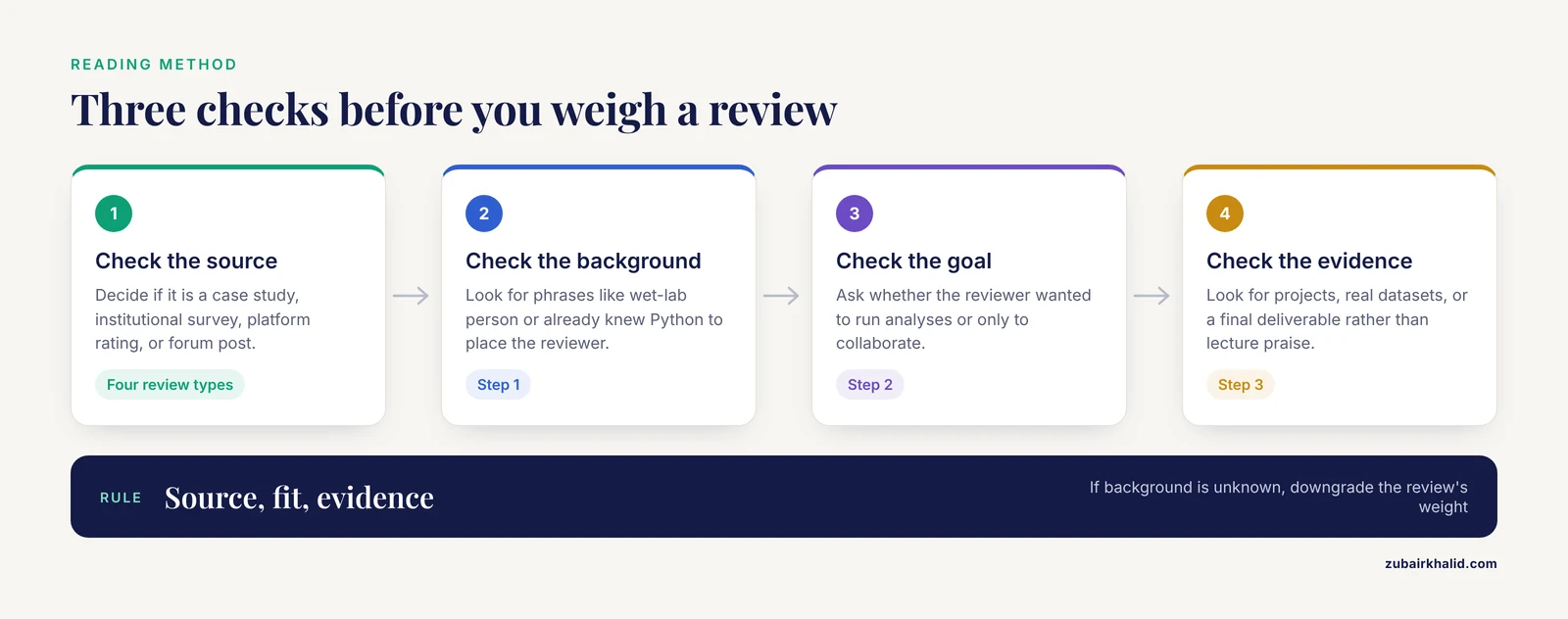
Treat every review as a claim that needs three checks: source, fit, and evidence. Here is the process in order.
Step 1. Identify the reviewer's starting point
Scan the review for signals of background. Phrases like "as a wet-lab person," "coming from software development," "first-year student," or "I already knew Python" tell you the reviewer's position on the interdisciplinary gradient. The education literature is full of courses built for specific audiences, including librarians [2], non-majors in an honors program, and undergraduates in a quantitative biology degree [4]. A review is only transferable to you when the reviewer's background matches yours. If you cannot determine the reviewer's background, downgrade the review's weight accordingly.
Step 2. Identify the reviewer's goal
Two people can take the same course with different goals and write opposite reviews. One wanted to learn bioinformatics well enough to run analyses independently. The other wanted awareness sufficient to collaborate with bioinformaticians, which is the explicit goal of some university courses [2] and a recognized outcome in interdisciplinary program design [3]. A review complaining that a course "didn't go deep enough on the statistics" may describe a perfectly good awareness-level course. Ask what the reviewer was trying to achieve and whether that matches your plan.
Step 3. Check what the course actually assessed
Course quality in this field tracks with what students were required to produce, not what they watched. The published descriptions make this concrete. Farh and Lee describe a project-based assessment for an introductory bioinformatics course aimed specifically at reinforcing students' ability to interpret and integrate data analyses [7]. Saarunya and Ely implemented a semester-long course built around project and problem-based learning [8]. Smith and colleagues ran a course in which undergraduates joined actual research projects and submitted manuscripts, an "on the job" learning model [9]. Chen's bioinformatics database course was built around ontologies with student projects as a central component across more than a decade of offerings [10][11].
When reading reviews, look for evidence that the course made students do something. Reviews that mention projects, real datasets, or a final deliverable describe a course structure that the education literature consistently supports. Reviews that only mention lecture quality describe a course whose learning value is much harder to establish.
Step 4. Check the delivery mode and whether it was honestly described
Online delivery is a frequent flashpoint in reviews. The controlled evidence is more reassuring than most online-skeptical reviews suggest. In a comparison of online and onsite instruction within a fully online Master of Science in Bioinformatics program, analysis of student exam performance using three assessments found no significant difference in grades between online and onsite students, and student satisfaction showed no statistically significant difference for most questions, although responses did differ on a few course evaluation items [6]. The authors concluded their model provided a rigorous course of study comparable to onsite instruction [6].
So when you read a review that dismisses an online course on principle, weight it lightly. When you read a review that says the online version had weak instructor access or broken compute environments, weight it heavily, because those are the specific failure modes that online delivery actually creates and the research shows they can be avoided but often are not.
Step 5. Check the tooling and its currency
Bioinformatics courses age through their software. A course built around a specific database curriculum can be re-examined over a long period and improved, as Chen did when revisiting a database course offered from 2005 through 2017 and arguing for incorporating newer technical content such as blockchain technology to strengthen ontology-centered education [10]. The original course development paper from 2012 already documented the challenge of keeping pace with the growing role of biological databases in the post-genome era [11].
This gives you a concrete review-reading tactic. Prefer recent reviews. A 2024 or 2025 review of a course's command-line content tells you whether the environment, package versions, and workflows still work. Reviews from 2018 describe a different course in practice, even if the syllabus looks identical. If the newest detailed review is old, treat the course as unverified on tooling.
Step 6. Look for cohort-level data rather than individual impressions
The strongest reviews report numbers from entire cohorts rather than single experiences. The peer-to-peer Multi-Omic Data Analysis course at USC reported eight semesters of operation teaching 107 undergraduate students, with two to three weekly lectures covering R and Python data analysis, scientific communication, and research readiness [4]. The Tunis course reported upgrading participants' skills to recognized international standards over a three-month intensive format [5]. The ChatGPT evaluation study used a concrete corpus of 184 programming exercises from an introductory bioinformatics course [12].
When a review or course description gives you a cohort-level figure, such as how many students completed the course or how many passed an assessment, it is worth several dozen anonymous comments. When you see only individual impressions, look for whether the same complaints or praises recur across independent reviewers, since recurrence across unconnected reviewers is the closest an amateur reader can get to cohort data.
Step 7. Separate satisfaction from learning
Satisfaction and learning are different measurements, and reviews almost always report only the first. The online versus onsite study is the clearest published illustration, because it measured both. Student satisfaction differed on a few evaluation questions between online and onsite groups, yet grades on three assessments showed no significant difference [6]. A course can be loved and teach little, or disliked and teach well. Reviews phrased as "enjoyed it" tell you about the experience. Reviews phrased as "I could independently do X afterward" tell you about learning. Train yourself to skip past enjoyment language and hunt for capability language.
What to Ignore in Bioinformatics Course Reviews
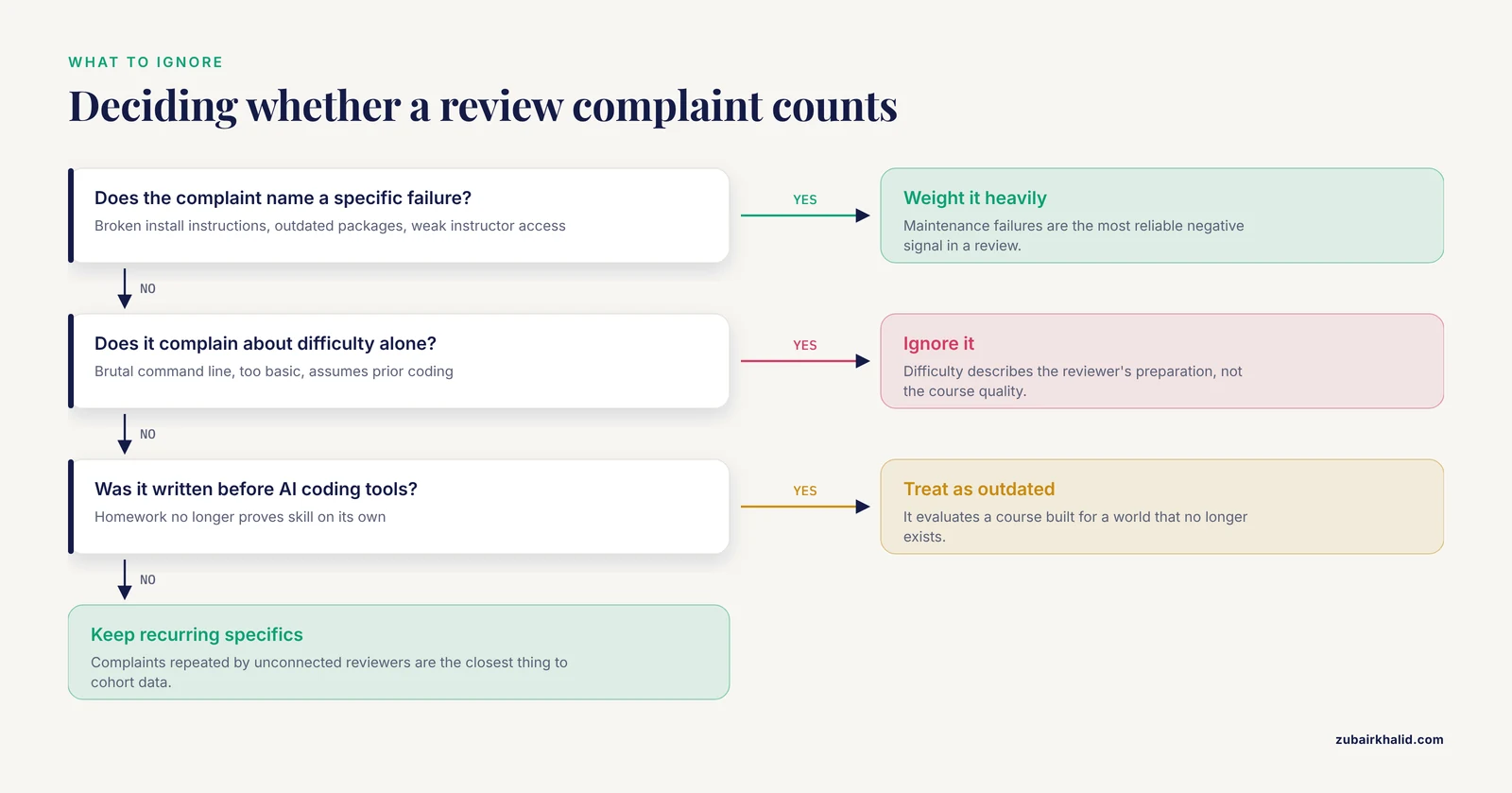
Now the second half of the title. These are the review signals you should actively disregard.
Ignore difficulty complaints without context
"I had to learn the command line, this course was brutal" is a review of the reviewer's preparation, not the course. Learning to write code is a documented challenge for life-science students, which is precisely why introductory courses exist and why the field keeps investing in them [12][13]. Difficulty per se is not a quality signal in either direction. A course that feels easy may not be teaching, and a course that feels brutal may be the one that finally makes you competent.
Ignore ratings that predate or ignore the AI tools
This is the newest and least understood distortion in course reviews. Piccolo and colleagues evaluated ChatGPT on 184 programming exercises from an introductory bioinformatics course and found the model solved 139 exercises, 75.5 percent, on its first attempt, and within seven or fewer attempts solved 179, or 97.3 percent [12]. Their stated implication is that instructors need to adapt pedagogical approaches and assessment techniques to account for these publicly available capabilities [12].
For a review reader, this has two consequences. First, any review written before these tools existed evaluates a course built for a world that no longer exists, where homework problems were reliable evidence of skill. Second, a course whose assessments can be trivially completed by a chatbot will look easier and better in reviews than it deserves. Reviews praising a course as "stress-free, the assignments went quickly" deserve suspicion, because the assignments may have gone quickly for reasons that have nothing to do with the reviewer.
Ignore reviews that judge a course against the wrong purpose
Courses are built for defined audiences, and the literature shows the range is wide. A web-based introductory course with practical exercises was designed explicitly for non-bioinformaticians [13]. A crash course existed to give readers tools to critically evaluate genome-wide association studies rather than to make them GWAS analysts [14]. An information systems department built a bridge course for non-majors [1]. A simulation course was developed within a computing curriculum. A review penalizing a course for not teaching advanced workflow engineering, when the course was designed as an introduction for non-bioinformaticians [13], is measuring the course against a goal it never claimed. Read the course's own stated audience first, then check whether the reviewer is inside or outside that audience.
Ignore single extreme reviews on both ends
Extreme praise and extreme complaints both attract attention and both carry the least information. The middle of the distribution, where reviewers describe specific assignments, specific instructors, and specific time costs, is where useful signal lives. If a hundred reviews exist, read the five most recent detailed ones and the three most critical detailed ones. Skip the single-paragraph extremes entirely.
Ignore instructor-published descriptions treated as reviews
Course design papers, such as the report on designing and running the Tunisian advanced course [5], the description of a semester-long project and problem-based course [8], or the report on a web-based introductory course for non-bioinformaticians [13], are valuable sources of fact about structure and intent. They are written by the people who built the course. Treat them as syllabus evidence, not as evaluation. The honest ones, such as Chen's re-examination that stated a lot of improvements could be made to his own decade-old course [10], explicitly report weaknesses, and that self-criticism is itself a positive signal about the instructors.
Ignore novelty claims
Reviews sometimes praise a course for teaching a fashionable technology. The database course literature shows why this is weak evidence. Chen's 2019 re-examination argued for engaging blockchain technology to enrich a bioinformatics database course [10]. A reviewer in 2019 might have scored the course up for that ambition, but novelty of topic says little about whether students can actually analyze data at the end. The durable quality signal in the literature remains the same across decades: students working on real problems and being assessed on their interpretation [7][8][9].
Signals of a Good Bioinformatics Course, According to the Education Literature
Flip the perspective. Instead of reading reviews to find what is wrong, learn the features that published course reports identify as load-bearing, then search reviews for evidence that those features exist.
Project-based assessment with interpretation at the center. Farh and Lee designed their introductory course assessment specifically to reinforce data analysis interpretation and integration [7]. When a review mentions a capstone project or a required analysis write-up, that matches the strongest pattern in the literature.
Real research work. The "on the job" course incorporated undergraduates in actual research projects with manuscript submissions [9]. Reviews from students who produced something used outside the classroom describe the highest-value experiences available.
Immediate hands-on practice. The UK MSc module combined lectures with immediate computational practicals facilitated by virtual machines, and student feedback specifically praised this structure for building confidence among cohorts with diverse backgrounds [3]. Reviews that mention working through problems during class, rather than watching demonstrations, indicate this structure.
Sustained practice rather than one-shot exposure. The USC peer-to-peer course ran for eight semesters with two to three lectures weekly [4]. The Tunis course ran three months of extensive instruction [5]. Short crash courses have legitimate uses [14], but reviews should tell you which you are buying, and the review phrase "worked through real datasets every week" is a better predictor of skill gain than "covered a lot of material."
Honest iteration. Chen's multi-year re-examination of his database course documented both its contribution and its shortcomings across 2005 to 2017 [10][11]. Courses whose instructors publicly revise, and reviews that mention improvements between cohorts, indicate a program that responds to feedback. The NLP study of a bioinformatics course found measurable differences between students' conceptualization at the beginning and the end of the academic period, demonstrating that learning processes in such courses can be objectively assessed rather than merely felt [15]. Courses that measure themselves this way, and reviews that cite such measurements, deserve the most trust.
Community structure. The USC peer-to-peer study reported benefits related to student cohesion and community alongside learning outcomes [4]. Reviews mentioning study groups, responsive peer instructors, or an active forum are describing conditions that the literature links to persistence, which matters because the biggest risk in learning bioinformatics is quitting.
How Bioinformatics Courses Are Actually Evaluated in Practice
Understanding how professionals evaluate courses upgrades your review reading, because you can then ask whether a review contains any of this evidence. Published practice uses several approaches.
Grade-based comparison is the most direct. The online versus onsite study compared exam performance across three assessments and found no significant difference in grades between delivery modes [6]. This is the standard you want behind any claim that one format is better than another.
Text analysis of student understanding is newer. Romero-Gómez and Orjuela-Cañón applied natural language processing tools to determine differences in how students conceptualized course material at the beginning versus the end of a bioinformatics course within a biomedical engineering program, and found that differences existed between the start and the end of the academic period [15]. This matters for review readers because it demonstrates that "students understood more" can be measured, not just asserted, so a course that publishes this kind of evaluation has done something most have not.
Longitudinal self-audit is the rarest. Re-examining a course across twelve years of offerings and identifying both its contributions and needed improvements, as Chen did [10], is the education equivalent of a follow-up study. Almost no course you are considering will have this. Its absence is normal. Its presence is a strong positive.
Exercise-level testing has now become relevant because of AI. The ChatGPT study treated every programming exercise in an introductory course as a test problem and reported exact solve rates, 75.5 percent on the first attempt and 97.3 percent within seven attempts [12]. This exercise-level granularity is far more informative than a star rating, and when course evaluations begin reporting which exercises AI tools can and cannot solve, reviews will be able to tell you which parts of a course still require genuine human learning.
Matching Reviews to Your Own Goal When You Want to Learn Bioinformatics
The keyword behind most searches for bioinformatics course reviews is a personal one: someone wants to learn bioinformatics. Reviews can serve that goal, but only after you decide which of three learner profiles fits you, because each profile should weight different review statements.
Profile A, the analysis doer. You want to analyze your own data, such as RNA-seq counts or variant calls. Weight reviews that describe hands-on exercises with real datasets, working computational environments, and projects [8][13]. Discount reviews from people who wanted pure conceptual understanding. For you, a review saying "the assignments took me six hours a week and I actually built a pipeline" is gold.
Profile B, the collaborator. You want to understand enough to work with bioinformaticians, read papers, and ask good questions. Weight reviews from people with similar goals, and pay attention to courses designed for adjacent audiences, such as the McGill course for librarians [2] or the crash course aimed at critical evaluation of GWAS [14]. A review complaining about limited coding depth may actually confirm this course suits you.
Profile C, the career changer. You want employable skills and possibly a credential. Weight reviews of structured programs with assessed outcomes, such as the fully online Master of Science program whose assessments showed parity with onsite instruction [6], and semester-long curricula. Community cohesion also matters for persistence in long programs, so reviews mentioning peer support [4] deserve weight.
One further practical note on tools. Whatever course you choose, plan to practice with the AI tools that now exist, because the evidence shows they can solve most introductory programming exercises [12]. The rational response is not to avoid coding practice but to use the tools as tutors and then test yourself with the tools closed. Reviews that mention how a course adapted its assignments in response to these tools, rather than ignoring them, signal an instructor paying attention to the current reality of the field.
Common Mistakes and Limitations
Mistake 1, trusting aggregate ratings across different courses. Aggregator sites mix introductory, advanced, credit-bearing, and hobbyist courses under one browse page. The Tunisian report described a three-month advanced course aiming at international standards [5], which is a different product from a web-based short introduction for non-bioinformaticians [13]. Never compare ratings across course types.
Mistake 2, reading the rating before the review text. The number anchors your judgment. Read the detailed text first, form your own assessment, then look at the score.
Mistake 3, assuming review count equals reliability. For niche bioinformatics courses, especially university special topics and regional workshops, the review count is small and the population skewed. The peer-to-peer USC course taught 107 students over eight semesters [4], and even a course of that size generates a limited review pool. Small samples of self-selected reviewers deserve proportionally skepticism.
Mistake 4, confusing production quality with teaching quality. Polished videos and slick platforms correlate with budget, not learning. The courses with published learning evidence, from project-based assessments [7] to real research integration [9], are often plain in presentation.
Mistake 5, ignoring the maintenance burden of computational courses. Bioinformatics teaching requires functioning software environments. The UK module used virtual machines specifically to create an efficient technical learning environment [3], and Chen's re-examination showed courses need substantial periodic updating to stay current [10]. Reviews complaining about broken install instructions or outdated package versions are describing a maintenance failure, which is one of the few review complaints that is almost always legitimate.
Limitation. Most bioinformatics course reviews you will encounter online contain no verified outcome data at all, and even the published literature relies heavily on single-institution case studies, satisfaction surveys, and self-reported skill changes rather than controlled comparisons. The online versus onsite grades comparison [6] is a notable exception, not the norm. Read everything in this article with that asymmetry in mind. Individual learning also depends on personal circumstances that no review can capture, and for formal academic or clinical credentialing decisions you should consult the program's own advisors and accreditation information directly.
Quick Review
- Match the reviewer's background and goal to yours before weighing their opinion, because bioinformatics courses serve genuinely different audiences [1][2][3].
- Trust documented learning outcomes over satisfaction, since the two can diverge even when both are measured.
- Favor courses where students produce interpreted analyses of real data, the pattern most consistently reported across project-based and research-integrated courses [7][8][9].
- Prefer recent reviews, because tooling ages quickly and courses need periodic reinvention to stay current.
- Weight cohort-level numbers over individual impressions, as in the eight-semester, 107-student peer-to-peer course report [4].
- Discount reviews written before AI coding assistants, which now solve most introductory bioinformatics programming exercises [12].
- Recurring specific complaints, especially about broken environments or outdated tools, are the most reliable negative signal in any review.
Frequently Asked Questions
What does bioinformatics course reviews mean?
It refers to evaluations of courses that teach computational analysis of biological data, ranging from peer-reviewed education studies and institutional surveys to platform star ratings and forum posts. The phrase usually implies learning to judge those evaluations critically rather than taking them at face value.
Can I trust star ratings on learning platforms for a bioinformatics course?
Only partially. Star ratings tell you many people finished and felt satisfied, but they hide the raters' backgrounds, goals, and whether they acquired any skill. Use them as a filter to find courses worth investigating, then rely on detailed written reviews and course documentation.
Do online bioinformatics courses teach as effectively as onsite ones?
The controlled comparison in a fully online Master of Science in Bioinformatics program found no significant difference in exam grades between online and onsite students, and no significant difference in satisfaction for most evaluation questions [6]. Specific complaints about weak online instructor access or broken compute environments are legitimate, since those are real failure modes of online delivery.
How do I know if a bioinformatics course will actually teach me skills?
Look for evidence of project-based assessment, real datasets, and interpretation-focused evaluation, which are the features the education literature most consistently links to student learning [7][8][9]. In reviews, search for capability language, such as "I could independently run the analysis afterward," rather than enjoyment language.
Why do reviews of the same bioinformatics course contradict each other?
Because bioinformatics is interdisciplinary, one course serves cohorts with very different starting points, and instructors design content around that diversity [3]. A programmer and a biologist can take the same course and honestly report opposite experiences. Both reviews describe their position relative to the course, not the course's absolute quality.
Should AI chatbots change how I read bioinformatics course reviews?
Yes. One study found ChatGPT solved 75.5 percent of 184 programming exercises from an introductory bioinformatics course on the first attempt and 97.3 percent within seven attempts [12]. Reviews written before these tools describe courses whose homework functioned as reliable skill evidence, and reviews praising effortless assignments may be describing assessments a chatbot can now complete.
Sources
- BUILDING A BIOINFORMATICS BRIDGE ONE COURSE AT A TIME
- Bioinformatics education in an MLIS program: the McGill experience
- Interdisciplinary and Transferable Concepts in Bioinformatics Education: Observations and Approaches From a UK MSc Course
- Evaluating peer-to-peer bioinformatics education: a case study of student learning outcomes and community impact in an undergraduate multi-omic data analysis course
- Designing and running an advanced Bioinformatics and genome analyses course in Tunisia
- Comparison of Online and Onsite Bioinformatics Instruction for a Fully Online Bioinformatics Master’s Program
- A Project-based Assessment for Introductory Bioinformatics Course - An Assessment Aimed to Reinforce Students' Ability in Data Analyses Interpretation and Integration
- [Design and implementation of semester long project and problem based bioinformatics course [version 1; peer review: 3 approved with reservations]](https://www.semanticscholar.org/paper/dc92a134d0147ed343e7c3c20b35d82d70a40a01)
- “On the job” learning: A bioinformatics course incorporating undergraduates in actual research projects and manuscript submissions
- Re-examination of a Bioinformatics Database Course: Engaging Blockchain Technology
- Development of a Database Course for Bioinformatics
- Evaluating a large language model’s ability to solve programming exercises from an introductory bioinformatics course
- Implementing a web-based introductory bioinformatics course for non-bioinformaticians that incorporates practical exercises
- A Bioinformatics Crash Course for Interpreting Genomics Data.
- Natural Language Processing Approach for Learning Process Analysis in a Bioinformatics Course