Atomic Commits for Reproducible Research
By Dr. Zubair Khalid, DVM, MS, PhD ·

By the end of this article you will be able to structure a research repository so that every analysis change, every figure regeneration, and every manuscript revision exists as its own identifiable, reversible, and citable unit of work. You will know how to stage partial changes, write commit messages that survive peer review and reviewer questions, verify that a specific figure came from a specific commit, and avoid the habits that make computational histories useless six months later.
You need a computer with git version 2.20 or later installed (check with git, version), a terminal, and ideally a GitHub account if you plan to share or archive your work. No prior git fluency is assumed, though basic command line familiarity helps.
What an Atomic Commit Is
An atomic commit is a single snapshot in version control that contains exactly one logical change. The word atomic is borrowed from database theory, where a transaction is indivisible: it either completes as a coherent whole or does not happen at all. Applied to git for scientists, atomicity means three things for every commit you make.
First, the commit contains one logical unit of work. Fixing a bug in a differential expression script is one unit. Renaming variables across the whole project is a different unit. Adding a new parameter sweep is a third. None of these belong in the same commit.
Second, the commit leaves the repository in a state that actually works. If you commit a script change without the corresponding change to the configuration file it reads, anyone (including you, on a new machine) who checks out that commit gets a broken analysis. An atomic commit pairs a change with everything required for that change to run.
Third, the commit message describes the change completely enough that a reader can understand it from the message alone, without reading the diff. This matters more in research than in most software work, because the reader six months from now is usually you, under pressure from a reviewer asking exactly how a result was produced.
The opposite of atomic commits is the end-of-day blob: one commit containing a bug fix, a new figure script, three renamed columns in a metadata table, and a half edited methods section, with the message "updates". That blob is a reproducibility failure even though the files are technically stored.
Why Atomicity Matters for Reproducible Research
Papers record outcomes. Repositories record processes. A recent effort to build the ResearchTrails dataset constructed human research trajectories directly from git repositories, using commit histories as proxies for research exploration and extracting successive changes to methods, experiments, and ablations [1]. The authors found that these trajectories contain meaningful signals about intermediate research decisions that final papers simply do not reveal. When your commits are atomic, that trajectory is legible. When they are blobs, the decision path is destroyed at the moment you make it.
Atomicity also creates decision points. In the Evolving Idea Graphs framework for multi-agent scientific ideation, a learned controller explicitly decides when a partially formed proposal is ready for commit as a final synthesis, rather than letting intermediate states blur together. Human research benefits from the same discipline. The question "is this unit of work finished and coherent enough to record as one commit?" is a real scientific judgment, and making it explicitly produces cleaner provenance than a continuous stream of half finished states.
There are practical payoffs beyond philosophy.
- Debugging. With atomic commits,
git bisectcan locate the exact commit that introduced a wrong result, reducing a hunt across weeks of work to a dozen checks. - Partial rollback. If a reviewer objects to a new normalization step, you revert one commit instead of untangling a blob.
- Attribution. Each logical change carries its own author, date, and rationale, which matters for multi author labs and for answering "who changed this threshold and why".
- Machine readability. Well structured commit histories can be mined and analyzed at scale, which is only possible when each change is one coherent unit with a descriptive message.
Atomic Commits for Reproducible Research: Step by Step
This walkthrough uses a small RNA-seq differential expression project as a running example. Substitute your own pipeline. Every command shown is real and every output block is what you should expect to see.
Step 1. Configure git once per machine
git config --global user.name "Zubair Khalid"
git config --global user.email "[email protected]"
git config --global init.defaultBranch main
The user.name and user.email values are stamped permanently into every commit you make. On a shared lab server, set them locally per repository instead of globally by omitting the -global flag. If you skip this step, your first commit fails with:
Author identity unknown

*** Please tell me who you are.

Run

  git config --global user.email "[email protected]"
  git config --global user.name "Your Name"

to set your account's default identity.
The fix is exactly what the message says. Omitting -global scopes the identity to the current repository only.
Step 2. Initialize the repository and exclude what does not belong
mkdir rnaseq-dge && cd rnaseq-dge
git init
Expected output:
Initialized empty Git repository in /home/zk/rnaseq-dge/.git/Before committing anything, create a .gitignore file so intermediates never enter history:
# .gitignore
*.log
results/intermediate/
*.pyc
.Rhistory
A useful rule for scientists: git tracks text that describes your work (scripts, configuration, small tables, manuscript source). It does not track large binary intermediates well. Raw sequencing files, multi gigabyte BAM files, and model checkpoints belong in dedicated storage or an institutional repository, with checksums recorded in the git repository instead. GitHub rejects files larger than 100 MiB, so committing them will fail at push time regardless.
Step 3. Stage one logical change at a time
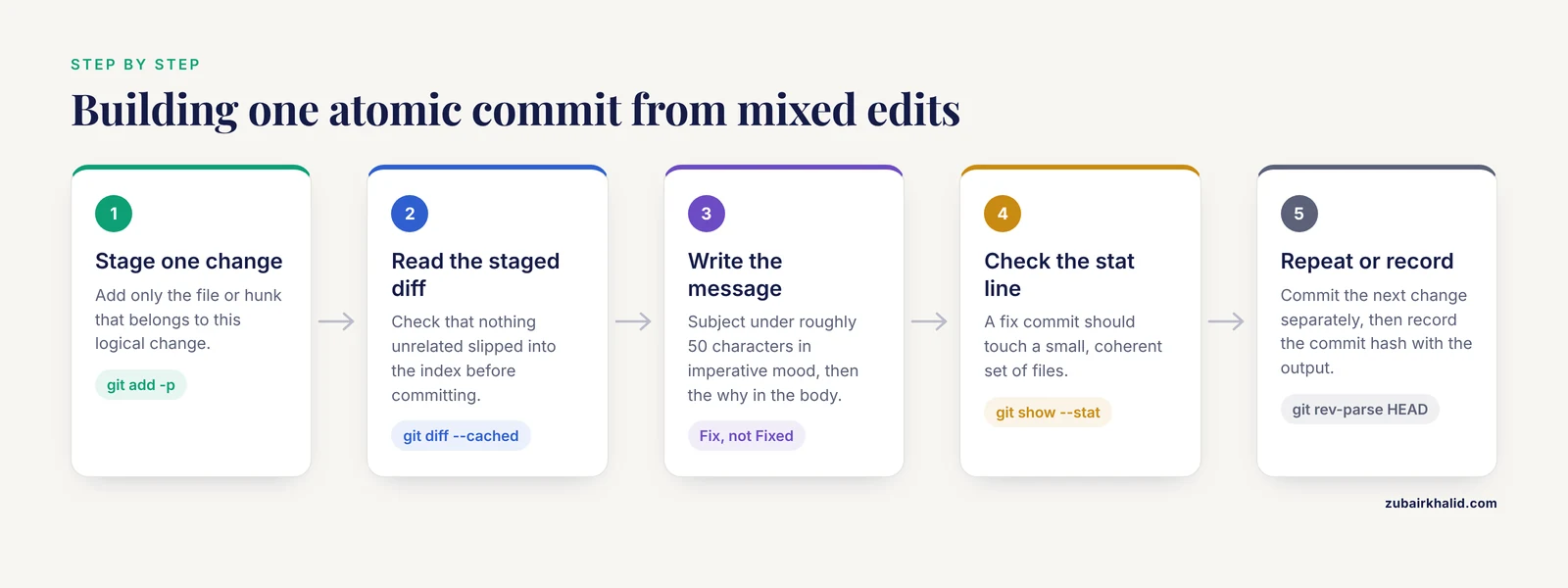
Suppose you have edited two files: analysis/de.R, which fixes an incorrect contrast specification, and figures/volcano.R, where you started exploring a new plot. These are two logical changes. Stage only the first:
git add analysis/de.RTo stage only part of a file, use the patch mode flag:
git add -p analysis/de.RInteractive output:
@@ -12,7 +12,7 @@ res <- results(dds, contrast=...)
-res <- results(dds, contrast = c("condition", "treated", "control"))
+res <- results(dds, contrast = c("condition", "knockout", "wildtype"))
Stage this hunk [y,n,q,a,d,s,e,?]?
The prompt letters matter. Press y to stage the hunk, n to skip it, s to split a hunk into smaller pieces, e to edit it manually, and q to quit and leave the rest unstaged. This is the single most important command for achieving atomicity when you have already mixed work in one file.
Step 4. Verify exactly what is staged
git diff --cachedThis shows the full diff of what will go into the commit. Read it. Staging surprises are the most common source of blob commits. git status shows the two-level summary:
On branch main
Changes to be committed:
  modified:   analysis/de.R

Changes not staged for commit:
  modified:   figures/volcano.R
To unstage everything (the files stay edited on disk):
git restore --staged analysis/de.RStep 5. Write the commit
git commit -m "Fix contrast specification in DESeq2 results call

The contrast vector passed to results() compared treated against
control, but the design compares knockout against wildtype. This
produced log2 fold changes with the wrong sign in Table 2 of the
manuscript draft. Correct contrast verified against the pcauchy
sanity check in tests/test_de.R."
The first line is the subject. Keep it under roughly 50 characters, in imperative mood ("Fix", not "Fixed" or "Fixes"). The body, separated by a blank line, explains why the change was made. Explaining why, not what, is the part humans consistently omit and the part that later readers need most. Studies of commit message quality find that most messages in practice lack important information because writing good ones is perceived as tedious [2]. In research, that omission is expensive, because the "why" is often the experimental rationale itself.
If you prefer a structured format, the Conventional Commits specification, which has been widely adopted in modern software development, prefixes the subject with a type and optional scope, for example fix(de): correct contrast vector in results() [3]. Labs can define their own type vocabulary. A research-friendly set looks like this:
| Type | Meaning | Example subject |
|---|---|---|
analysis | Change to a computational method or script | analysis(de): switch shrinkage to apeglm |
fix | Correction of an error in existing code or a result | fix(qc): correct sample order in PCA labels |
data | Addition or update of small reference data or metadata | data: update sample sheet with batch labels |
figure | Regeneration of a figure or table from committed code | figure(fig2): regenerate volcano plot at 300 dpi |
docs | Manuscript, README, or protocol text | docs(methods): document read trimming parameters |
env | Dependency or environment specification change | env: pin DESeq2 to 1.42.0 in environment.yml |
Structured types also make the history machine processable. A benchmark of 93,807 conventional commits across 119 repositories showed that automated systems can learn repository specific type and scope conventions from history, which only works when the convention is applied consistently in the first place [3].
Step 6. Verify the commit is what you intended
git log --onelineExpected output:
a1b2c3d Fix contrast specification in DESeq2 results call
9e8f7a6 Add differential expression script and sample sheet
Inspect the full change:
git show --stat HEADExpected output:
commit a1b2c3d4...
Author: Zubair Khalid <[email protected]>
Date:   Mon Nov 9 14:22:05 2026 -0500

    Fix contrast specification in DESeq2 results call

 analysis/de.R | 2 +-
 1 file changed, 1 insertion(+), 1 deletion(-)
The stat line is your atomicity check. A fix commit should touch a small, coherent set of files. If a commit labeled "fix" touches forty files, it is not atomic, and you can still split it (see the mistake section below).
Step 7. Repeat for the next logical change
Now stage and commit the figure work separately:
git add figures/volcano.R
git commit -m "figure(volcano): draft log10 FDR threshold exploration"
Then, when the corrected analysis is confirmed, regenerate the figure as its own commit so the figure provenance chain is explicit:
Rscript figures/volcano.R
git add figures/volcano.pdf
git commit -m "figure(fig2): regenerate volcano plot with corrected contrast"
Step 8. Connect results to commits
The cleanest pattern for reproducibility is a results manifest. After producing any output, record the commit it came from:
git rev-parse HEAD > results/COMMIT
sha256sum figures/volcano.pdf >> results/manifest.txt
git add results/COMMIT results/manifest.txt
git commit -m "figure(fig2): record commit and checksum for volcano output"
git rev-parse HEAD prints the full 40 character commit hash. Anyone holding the figure can now ask the repository exactly which code state produced it. For a systematic alternative, tag states that matter:
git tag -a submission-v1 -m "State used for initial submission"Annotated tags are permanent named pointers into history and are far easier to cite in a methods section than a bare hash.
How Granular Should Commits Be?
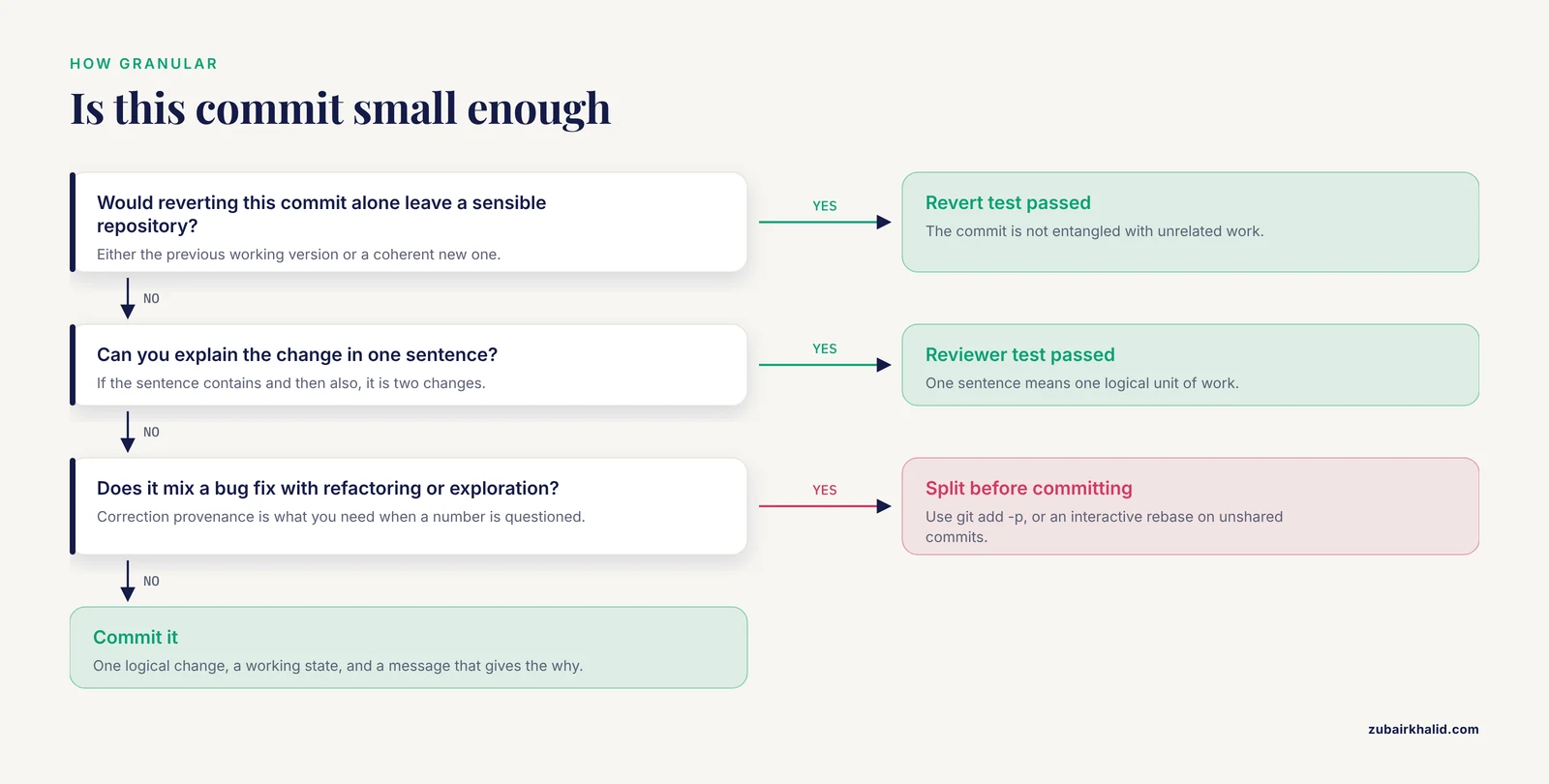
The unit of atomicity is a logical change, not a file and not a line. Useful heuristics for research repositories:
- Each commit should pass the "revert test". If you reverted this commit alone, would the repository be in a sensible state, either the previous working version or a coherent new one? If reverting breaks unrelated work, the commit is too entangled.
- Each commit should pass the "reviewer test". Could you explain this single change to a collaborator in one sentence? If the sentence contains "and then also", split it.
- Bug fixes get their own commits, always. Mixing a correction with refactoring hides the correction, and correction provenance is precisely what you need when a published number is questioned.
- Exploratory work goes on a branch. Commit freely and messily on a
explore/branch, then assemble the coherent units into atomic commits (or a merge) when the exploration pans out. Git history on main should read like a methods section, not a diary.
Research on commit messages supports the granularity intuition. Analysis of fix commits in the Linux kernel repository, where every logical code change carries a natural language message, shows that clustering the text of well separated fixing commits reliably surfaces the most common error categories per subsystem. That analysis is only possible because kernel commits are atomic by community convention. Work on identifying the core change within a commit similarly shows that changes within one commit contribute unequally to its purpose, which is an argument for keeping commits small enough to have one purpose at all [4].
Handling Data, Environments, and Derived Outputs
Code is the easy part. Research reproducibility fails most often at the boundaries between code, data, and computed results.
Small reference data and metadata (sample sheets, primer tables, gene sets) belong in git as first class citizens. Commit them in data commits with messages explaining their source and any manual edits. If a collaborator hand edits a CSV, the commit that records it should say who edited what and why, because that edit is otherwise invisible to everyone else.
Large raw data does not belong in git history. Record instead:
sha256sum raw/reads/*.fastq.gz > checksums/raw_reads.sha256
git add checksums/raw_reads.sha256
git commit -m "data: record checksums for sequencing batch 2026-11-04"
The checksum manifest plus a pointer to the institutional archive gives you verifiable data identity without bloating the repository. If you must version moderate sized files (tens of megabytes, such as a compressed reference index), use git LFS so the main history stays small.
Environment definitions must be committed alongside the code they support. For a Python project commit environment.yml or requirements.txt. For R, commit an renv.lock file. For conda based pipelines, commit the environment file in the same commit as any script change that introduces a new dependency. A change that uses a new package without committing the updated environment is not atomic, because the commit does not reproduce on its own.
Derived outputs (figures, result tables) can go either way, but decide as a lab policy and be consistent. Committing small final figures with a manifest linking them to the producing commit gives you bulletproof provenance at the cost of some history noise. Committing only code and regenerating outputs on demand is cleaner but requires the environment to be perfectly pinned. Whichever you choose, never commit a regenerated figure in the same commit as an unrelated code edit, because the file history then no longer answers "which code version made this exact image".
Mining Your Own History Later
The reason atomic commits compound in value is that a clean history becomes a queryable record. The tools that make this possible are standard git plumbing.
To find which commit introduced a specific line:
git log -L 40,45:analysis/de.RTo find when a result file last changed and why:
git log --oneline --follow results/fig2_volcano.pdfTo locate the commit where a numerical result changed:
git bisect start
git bisect bad HEAD
git bisect good a1b2c3d
git bisect performs a binary search over commits, checking out successive midpoints until it isolates the first commit where a test you run (for example, a script that recomputes a key statistic and compares it to the published value) flips from correct to incorrect. With a clean atomic history, this typically takes a handful of steps. With blob commits, bisect returns a blob you still have to untangle by hand.
These workflows scale beyond one repository. Retrieval methods that draw on commit history to improve the quality and relevance of commit related text show measurable gains over approaches that look at each change in isolation [5], and classifiers can detect categories of changes, such as refactoring types, directly from commit message text with strong performance [6]. Your own history is the same kind of data at smaller scale. A lab that writes structured atomic messages can, years later, grep its way to every analysis decision behind a published figure.
LLM Assistance for Commit Messages
Large language models now write competent commit messages from diffs, and the research literature has moved fast on this. Evaluations found that ChatGPT generated commit messages that outperformed prior dedicated automatic generation methods by large margins, with messages generally accurate and high quality, though failures cluster in identifiable cases. Reasoning based systems that retrieve broader software context beyond the diff itself improved over human written messages by an average of 30.2 percent in human evaluation [7]. Transformer models fine tuned with instruction tuning, including T5 family and CodeT5 variants, have been evaluated for message generation with BLEU and ROUGE metrics [8]. LLM based evaluators combining chain of thought reasoning with few shot examples approach human level proficiency at judging message quality [9].
For a scientist, the practical translation is this. If your editor or a hook drafts commit messages for you, treat the draft as a proposal, not a decision. The model sees the diff but not your intent, and the intent is the part that matters for reproducibility. A safe workflow is to let the tool generate a first line, then write the why yourself in the body. Review every generated message before committing, exactly as you would review a generated methods paragraph.
Common Mistakes and Limitations
These are the failure modes that most often destroy the value of a research history.
- End of day mega commits. One commit per day of mixed work is the default failure pattern in academic computing. Fix it with
git add -pbefore committing, or with an interactive rebase to split the most recent run of blobs:git rebase -i main~5opens an editor whereediton a commit lets yougit reset HEAD~and restage the changes as separate atomic commits. Only do this on commits you have not shared.
- Useless messages. "update", "fix", "changes", and the empty message produced by accidentally committing with no editor are the most common failures. If the message could describe a thousand possible changes, it describes none of them.
- Committing secrets. API keys for cloud computing and sequencing vendor portals end up in committed configuration files with surprising frequency. GitHub push protection blocks many known secret patterns at push time, but the durable fix is a
.gitignoreentry plus a config template file.
- Force pushing shared branches.
git push, forceon a branch others use rewrites shared history and breaks every collaborator's clone, along with any hashes you cited in a manuscript. Use-force-with-leaseat most, and never rewrite main.
- Amending pushed commits.
git commit, amendis safe only before the commit has been pushed. Amending a pushed commit changes its hash, which breaks provenance references.
- Treating git as backup instead of provenance. A repository with atomic commits is an experiment log. A repository with blob commits is a directory that happens to have timestamps. The difference is entirely in your staging discipline.
- Assuming git proves correctness. Atomic commits prove what you did and when. They do not prove the analysis was right. A beautifully atomic history can still contain a silent bug carried through many commits, which is why the manifest pattern, where key results are recomputed and compared at tagged versions, matters as a complement.
- Ignoring commit hygiene under deadline pressure. The weeks before a submission are exactly when provenance gets destroyed. Committing atomically under deadline takes barely more time than blobbing, and it is the history from those weeks that reviewers and collaborators will interrogate.
One honest limitation applies to the broader literature. Much of the published research on commit message generation and evaluation uses software engineering repositories as data. The conventions transfer well to computational research code, but a manuscript driven project, where the "artifacts" are figures and prose, needs the small extensions described above, particularly around data checksums and result manifests, which no git tooling enforces for you.
Working on GitHub as a Researcher
GitHub for researchers adds three capabilities that reinforce atomic commit discipline.
Pull requests as review units. Push your branch to GitHub, open a pull request, and have a labmate review the diff. Atomic commits make review readable. A pull request containing one logical change can actually be reviewed in an afternoon. Hosted review also creates a permanent discussion record attached to the exact code, which replaces the email thread that nobody can find later.
Issues linked to commits. Reference an issue number in your commit message, for example fix(qc): correct swap of batch labels (#14). GitHub links the commit to the issue automatically, giving you a traceable chain from observed anomaly to fix.
Releases and archiving. When a version of the repository supports a manuscript submission, create a GitHub release from the annotated tag. Releases produce a stable snapshot that collaborators, reviewers, and journal workflows can reference independently of future commits. Many researchers additionally deposit the release snapshot in an archival repository to obtain a persistent identifier for the code, which journals increasingly request for data and software availability statements.
A minimal weekly rhythm that keeps all of this sustainable:
git pull --rebase          # start the week current
# ... work in small staged units ...
git push origin main       # or push your feature branch
git tag -a w46-snapshot -m "End of week 46 state"
git push origin w46-snapshot
Frequently Asked Questions
What exactly counts as an atomic commit in scientific research?
An atomic commit contains one logical change, leaves the repository in a working state, and has a message that explains the change and the reason for it. Fixing a contrast specification in a statistics script is atomic. Fixing it while also renaming files and editing the methods section is not.
How small should each commit be?
Small enough that you could explain the change to a collaborator in one sentence and reverting it alone leaves a coherent repository. In practice this usually means one to five files for research code, and never a mix of a bug fix with unrelated reformatting or exploration.
Should I commit my large sequencing or imaging data files?
No. Files over 100 MiB are rejected by GitHub, and large binaries bloat git history permanently. Commit a checksum manifest such as a SHA-256 list for the raw data instead, keep the data in dedicated storage, and use git LFS only for moderately sized files you genuinely need versioned.
Can I fix a commit message after I already made the commit?
Yes, if it has not been pushed. Run git commit, amend to edit the most recent message, or git rebase -i to reword older ones. Once a commit has been pushed and shared, avoid rewriting it, because the hash change breaks anyone who referenced it.
How do atomic commits help if a reviewer questions one of my results?
You can point to the exact commit that produced the figure or table, using a tag or a results manifest, and show the diff that introduced the relevant analysis decision. If the reviewer objects to a methodological choice, you can often revert that single commit and regenerate the result without disturbing anything else.
Do I need GitHub, or is local git enough?
Local git gives you atomic commits and full history, which covers personal reproducibility. GitHub adds offsite backup, pull request review for lab collaboration, issue linking, and releases that others can cite. The commit discipline is identical either way.
Can I use an AI tool to write my commit messages?
You can, and current models produce drafts that are often accurate and well formed. Review every draft before committing and write the rationale yourself, because the model sees only the diff, not your experimental intent, and the rationale is the part a reproducibility reader needs.
How do I link a published figure to the exact code that generated it?
Tag the repository state used for the submission, commit a manifest recording the commit hash and SHA-256 checksum of each output file, and cite the tag in your methods section. Anyone can then check out that tag and verify the figure byte for byte.
Sources
- Learning Scientific Exploration from Human Research Decision Trajectories
- From Commit Message Generation to History-Aware Commit Message Completion
- HARE: History-aware Repository-Level Memory Retrieval for Conventional Commit Header Generation
- Commit Messages Generation Based on Core Changes
- Delving into History: Retrieve Less but Augment More on Commit Message Generation
- Detecting refactoring type of software commit messages based on ensemble machine learning algorithms
- Only diff Is Not Enough: Generating Commit Messages Leveraging Reasoning and Action of Large Language Model
- "APPLICATION OF TRANSFORMER MODELS FOR GENERATING COMMIT MESSAGES IN VERSION CONTROL SYSTEMS"
- Evaluating Generated Commit Messages with Large Language Models