AlphaFold Server vs. Local Installation for Non-Model Organisms
By Dr. Zubair Khalid, DVM, MS, PhD ·

The difference is simple: the AlphaFold Server is a free, browser-based service from Google DeepMind that runs AlphaFold 3 on their hardware with a daily job quota and no configuration, while a local installation runs the AlphaFold software on your own machine (or a rented cloud GPU) with full control over inputs, versions, seeds, and scale. The rule of thumb: use the AlphaFold Server when you have a handful of proteins, no budget for GPUs, and a non-commercial project. Install AlphaFold locally when you need batch predictions, reproducible parameters, custom search databases, long complexes, or unpublished sequences you cannot send to a third-party server.
For anyone working on non-model organisms (species without a large curated literature, genome resources, or structural coverage, such as parasites, orphan crops, wildlife pathogens, or newly sequenced microbes), the choice matters more than it does for human or mouse work. Distant homology, shallow sequence databases, and unusual protein chemistries are exactly where the strengths and limits of each option diverge.
This article explains what each option actually is, compares them on the criteria that decide real projects, walks through worked scenarios, and lists the mistakes that waste the most compute and time.
What the Two Options Actually Are
AlphaFold Server in Brief
The AlphaFold Server is a web application at alphafoldserver.com, launched by Google DeepMind in 2024 alongside the AlphaFold 3 model. AlphaFold 3 extended the original protein-only method to model complexes containing proteins, DNA, RNA, chemical ligands, ions, and common post-translational modifications in a single structure prediction [https://storage.googleapis.com/model-licenses/AF3%20Terms%20of%20Use%2020231102.pdf]. The server exposes that capability through a point-and-click interface: you specify entity types (protein chain, RNA chain, ligand, ion), paste sequences or draw SMILES strings for small molecules, and the backend generates the multiple sequence alignment (MSA, a table of homologous sequences that reveals which positions have been conserved over evolution), searches for structural templates in the Protein Data Bank (PDB), runs the model, and returns a ranked set of five predicted structures with confidence metrics.
The key characteristics of the server:
- Free of charge for non-commercial use, governed by terms of service you accept at sign-up.
- Runs on Google DeepMind's infrastructure, so no GPU hardware, database downloads, or environment setup are needed.
- A web interface only. There is no public API, so you cannot script submissions or integrate the server into a pipeline.
- A per-job token limit (tokens cover residues, nucleotides, and ligand atoms combined) and a daily job quota per user. The current numbers are documented in the server FAQ and change occasionally, so check them before planning a large batch.
- The model version on the server is updated by DeepMind, not pinned by you.
- Output is a downloadable archive containing ranked model files in mmCIF format, predicted aligned error (PAE) plots, and per-residue confidence (pLDDT) encoded in the B-factor column of the structure files.
Local Installation in Brief
A local installation means running AlphaFold software on hardware you control. Three practical flavors exist, and choosing among them is part of the decision:
- Official AlphaFold 3 locally. DeepMind released the AlphaFold 3 source code and inference weights in late 2024 under a Creative Commons non-commercial license, through a GitHub repository maintained by the AlphaFold team. You run it on Linux with NVIDIA GPUs, typically inside Docker. Before the first prediction you must download the genetic databases used for MSA generation and template search, which occupy several terabytes of disk. The pipeline produces the same style of output as the server: five ranked diffusion samples per seed with full confidence outputs.
- AlphaFold 2 via ColabFold. ColabFold is a widely used reimplementation and notebook wrapper around AlphaFold 2 and AlphaFold 2-Multimer, published as open-source software in 2022. It replaces the slower jackhmmer search with MMseqs2, which produces usable MSAs in minutes instead of hours, and offers a free Google Colab route that needs no local hardware at all. The companion localcolabfold package installs the same stack on a modest consumer GPU or even a strong laptop.
- Original AlphaFold 2 pipeline. The reference DeepMind implementation from 2021, still the correct choice when you want the well-characterized AF2 behavior, custom relax settings, or integration with legacy pipelines. It has the same database footprint requirements as AF3.
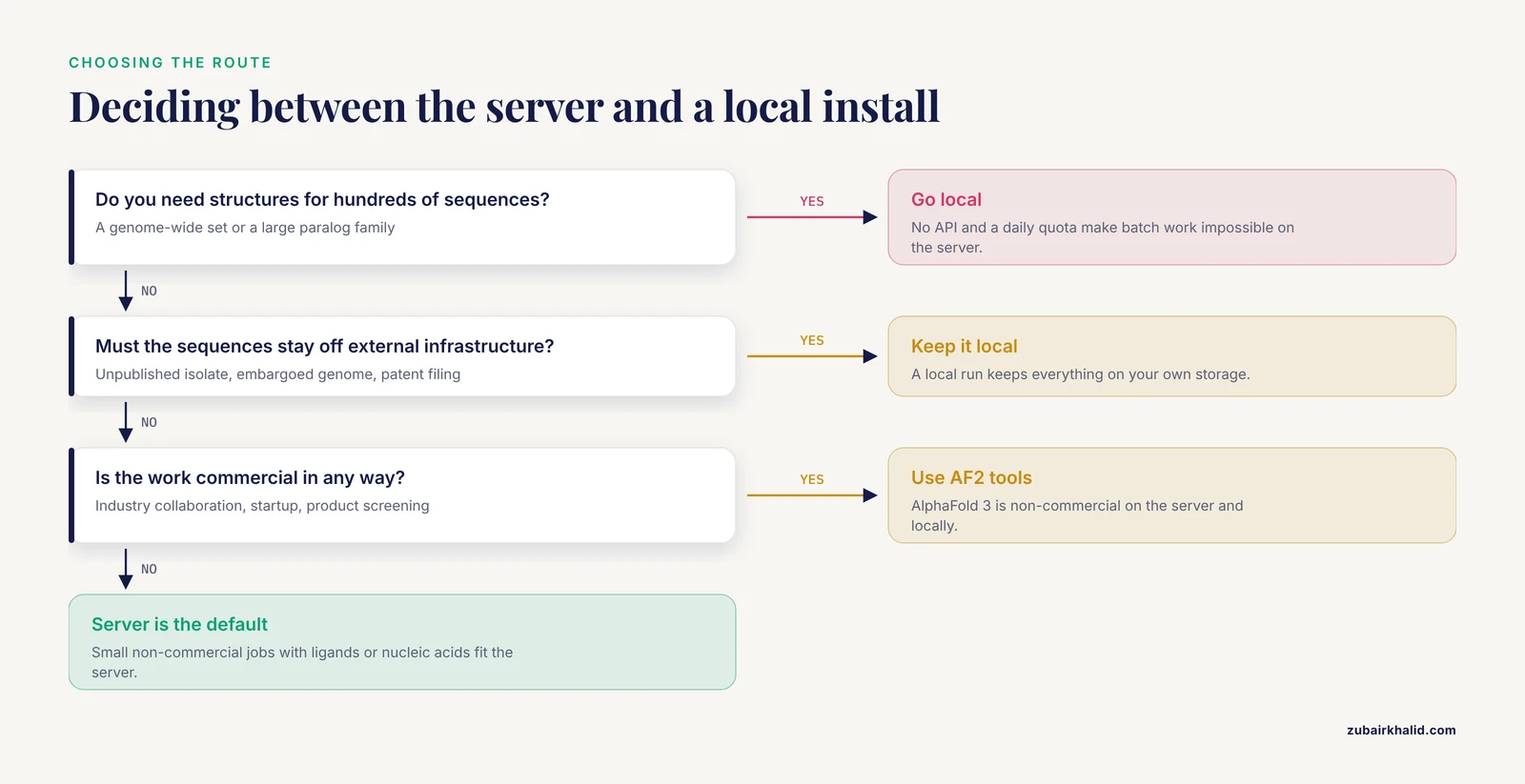
A critical licensing difference shapes everything: AlphaFold 2 is open source under permissive terms and its weights are freely usable, including commercially, while AlphaFold 3's code and weights carry a non-commercial license that requires acceptance and prohibits commercial applications. If your work has any commercial dimension (an industry collaboration, a startup, screening for a product), that difference alone decides the AF3 question for you.
Side-by-Side Comparison
| Criterion | AlphaFold Server | Local AlphaFold 3 | Local AlphaFold 2 / ColabFold |
|---|---|---|---|
| Access | Web browser, free account | GitHub repo, Docker, Linux + NVIDIA GPU | Notebook or conda install, modest GPU or free Colab |
| Cost | Free | Hardware and storage cost (or cloud rental) | Free on Colab, low hardware cost locally |
| Model version | Set by DeepMind, changes over time | You pin the exact version and weights | You pin AF2 versions and weights |
| License | Non-commercial only | Non-commercial (CC BY-NC-SA class) | Permissive, commercial use allowed |
| Entities modeled | Proteins, DNA, RNA, ligands, ions, modifications | Same as server | Proteins and protein complexes only |
| Job quota | Daily quota per user, no API | Unlimited by quota, limited by hardware | Unlimited by quota |
| Batch automation | None, manual entry | Fully scriptable | Fully scriptable |
| MSA databases | DeepMind's fixed pipeline and databases | Your choice, custom databases possible | Your choice, MMseqs2 or custom MSAs |
| Custom MSAs | Not supported | Supported (a3m input) | Supported (a3m input) |
| Templates | Auto-selected from PDB | Configurable, can disable | Configurable, can disable |
| Seeds and sampling | Not user-controlled | User-controlled, multiple seeds | User-controlled |
| Privacy | Sequences leave your machine | Data stays with you | Data stays with you (or Colab's terms) |
| Hardware floor | None | Data-center class GPU recommended | Consumer GPU (8 to 16 GB VRAM) workable |
| Setup effort | Minutes | Days (databases, drivers, containers) | Hours |
| Runtime per monomer | Minutes after queue wait | Minutes on strong GPU | Minutes on Colab or consumer GPU |
The table compresses the trade-offs, but the rows that actually decide non-model organism projects are batch scale, MSA control, reproducibility, licensing, and what you can submit. The rest of the article unpacks those.
When to Use AlphaFold Server
The server is the right default for a large fraction of non-model organism projects. Use it when every one of the following is true:
- You have a small number of targets. Tens of proteins, not hundreds. Manual form entry and the daily quota cap what is practical.
- The work is non-commercial. Student projects, method development for a thesis, exploratory structure inspection, teaching.
- You need the AF3 feature set. The protein has a bound cofactor, metal ion, drug-like ligand, nucleic acid partner, or a modification such as phosphorylation. AlphaFold 2 locally cannot model ligands at all, so if you need those entities and cannot run AF3 locally, the server is the only AF3 route.
- You have no infrastructure. No GPU cluster, no sysadmin help, no appetite for downloading terabytes of databases.
- Reproducibility requirements are loose. A figure in a talk, a hypothesis to test by mutagenesis, a sanity check before committing to crystallography or cryo-EM.
For a typical tutorial-style workflow, the server path looks like this:
- Create an account at alphafoldserver.com with a Google account.
- Start a new job. Add a protein entity, paste the amino acid sequence in single-letter code, and name the chain.
- Add additional entities as needed: another protein chain for a predicted dimer, an ion entity such as Zn for a zinc finger, or a ligand by SMILES string.
- Submit. The job enters a queue, runs the MSA and template pipeline on DeepMind's end, and typically returns results within minutes to hours depending on queue load.
- Download the results archive. Inspect the ranked models in a viewer such as ChimeraX or PyMOL, read the PAE plot for inter-domain and inter-chain confidence, and treat pLDDT below roughly 70 as low-confidence regions (often flexible loops or disordered segments).
That entire workflow, end to end, takes under an hour for a first-time user with no background in computational structural biology. No local setup matches that onboarding speed.
When a Local Installation Is the Right Choice
Go local when at least one of these applies:
- Batch scale. You have a newly assembled genome or a family of 200 paralogs and you want a structure prediction for every sequence. The server has no API and a daily quota, so this is impossible there. Locally, a loop over FASTA entries with ColabFold's command-line interface or the AF3 pipeline handles the whole set unattended.
- Reproducibility and version pinning. A methods section that says "predicted with AlphaFold 3, weights version X, databases dated Y, seed 1" is defensible. A methods section that says "predicted on the server at some point in 2025" is not, because DeepMind updates the served model and you cannot pin it. Peer reviewers increasingly ask for exact versions and seeds.
- Custom MSA strategy, which is the single biggest scientific argument for non-model organisms. The default pipelines search public sequence databases (UniRef-family databases, metagenomic databases, and for templates the PDB). A protein from a deep-branching eukaryote, a rare parasite, or a recently sequenced pathogen may have almost no detectable homologs in those databases, producing a shallow MSA and unreliable predictions. Locally you can build a custom database from your organism's genome annotation plus close relatives you sequenced yourself, or assemble an MSA with a more sensitive remote-homology searcher and feed it in as an a3m file. The server accepts neither custom MSAs nor custom databases.
- Seed control and conformational sampling. Both AF3 and AF2 are stochastic. Different seeds give different models, particularly for flexible regions, multi-domain orientations, and weakly constrained complexes. Locally you can run the same input under many seeds and look for consistent geometry across samples, which is the practical way to gauge reliability of inter-domain contacts. The server gives you its fixed five samples and no seed control.
- Data privacy. Sequences submitted to the server are processed on external infrastructure under the server's terms. If you are working on an unpublished pathogen isolate under a confidentiality agreement, a licensed vaccine candidate, or sequences tied to a patent filing, review those terms carefully with your technology transfer office. A local run keeps everything on your storage.
- Commercial use. AlphaFold 3's non-commercial license blocks it, on the server and locally. AlphaFold 2 via ColabFold or the reference implementation carries no such restriction.
How Non-Model Organisms Change the Decision
Everything above applies to any species. Three factors specific to non-model organisms shift the balance further toward local setups, and they deserve their own explanation.
Shallow MSAs Are the Core Problem
AlphaFold's accuracy depends on an evolutionarily informative MSA and, secondarily, on structural templates. For humans, yeast, and E. coli, virtually every protein has thousands of homologs in the default databases. For a hemoflagellate parasite protein or an orphan crop kinase, you may retrieve a handful of distant homologs, and the model then leans heavily on templates or, when no template exists, produces plausible-looking but poorly constrained geometry.
Concrete mitigation strategies, all local-only:
- Expand the search space by building a custom FASTA database that includes your organism's predicted proteome, proteomes of close relatives from available genome projects, and untranslated-region products if annotation is poor.
- Run a more sensitive homology search for the MSA. ColabFold's MMseqs2 pipeline tends to recover more remote homologs faster than the classic jackhmmer setup, and you can iterate with increased sensitivity settings.
- Feed a hand-curated MSA. If your protein family has literature-curated alignments, converting them to a3m format and supplying them directly often outperforms automatic search, because you can include divergent members the automatic pipeline missed.
Templates Can Help or Hurt
For a protein in a well-studied family, template search against the PDB usually helps. For a non-model organism protein with a remote homolog of different oligomeric state or domain architecture, a spurious template can drag the prediction toward the wrong quaternary arrangement. Locally you can disable templates or rerun with and without them and compare. On the server you cannot, so you see only the pipeline's automatic choice.
Complexes With Non-Protein Components Are Common
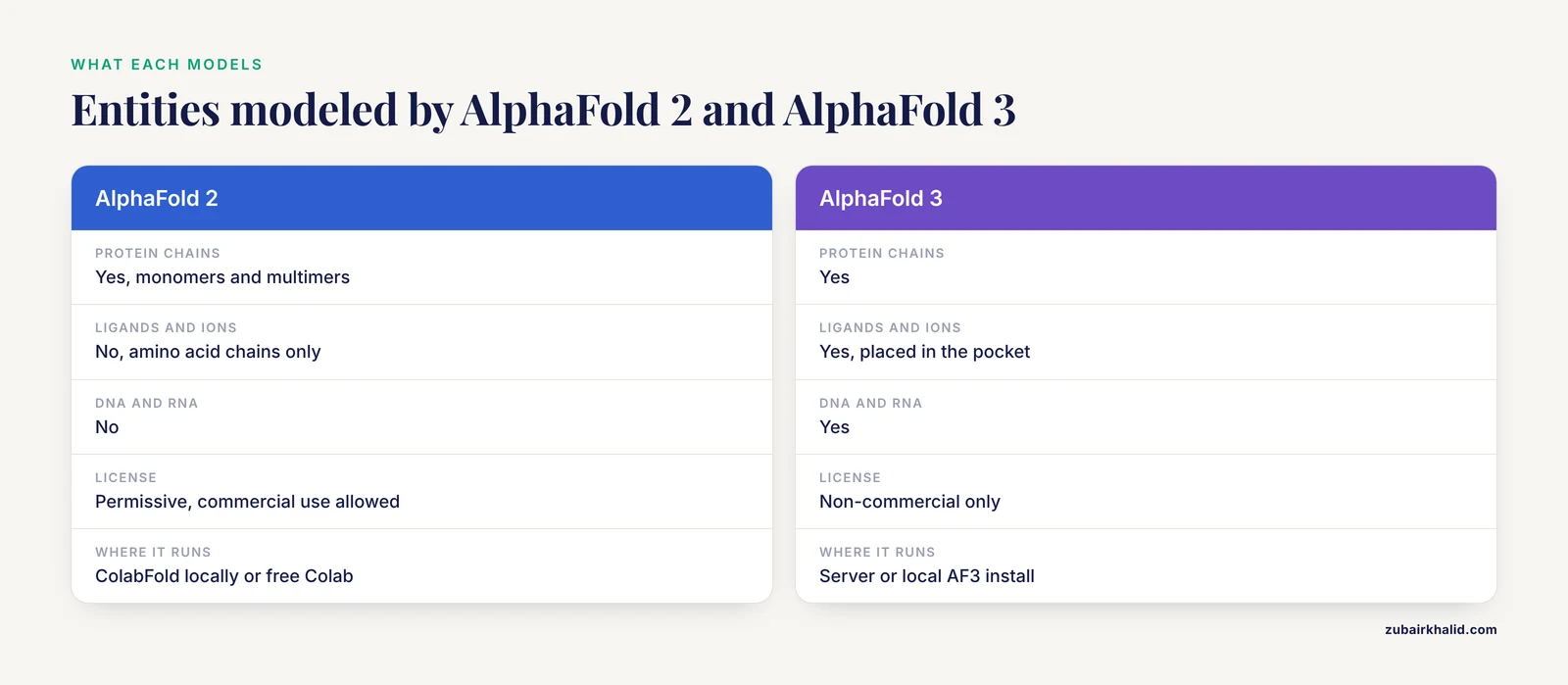
Non-model organism biology is full of metalloproteins, glycosylated enzymes, membrane receptors with bound ions, and RNA-binding complexes. AlphaFold 2 handles only chains of amino acids. AlphaFold 3 models the ligands, nucleic acids, and ions in place, which matters because the AF3 ligand predictions, while not quantitative binding-affinity measurements, frequently place a known cofactor in approximately the right pocket. If your target is an enzyme from a nematode with a heme group and a zinc site, the server (or local AF3) is the only option within the AlphaFold family that represents those components.
Choosing by the Criteria That Decide Real Projects
Throughput and Automation
Server throughput is bounded by manual entry and the daily quota. If a screen takes more than a week of daily manual submissions, automate locally instead. The realistic local options for batch work are ColabFold's command-line mode (a single call processes a FASTA file with hundreds of entries) and the AF3 pipeline driven by generated JSON inputs.
Reproducibility
A prediction you cannot reproduce is a prediction you cannot defend. Server runs are not reproducible in the strict sense: the model version changes, seeds are fixed by the service, and there is no way to rerun an identical job. Local runs are reproducible to the level of pinned weights, pinned databases, and recorded seeds. If structures will appear in a published paper as quantitative claims (not just as illustrative cartoons), pin everything and archive the exact input JSON, MSA files, and version numbers.
Cost and Hardware
The server is free. Local AF3 needs serious hardware: DeepMind's documentation targets data-center class NVIDIA accelerators (A100-class, with 80 GB of memory giving comfortable runtimes), plus several terabytes of storage for databases. Smaller GPUs can run the AF3 pipeline but slowly and with careful memory management. By contrast, localcolabfold runs useful AF2-Multimer predictions on a consumer GPU with 8 to 16 GB of VRAM, and the free Colab notebooks run on Google's hardware at no cost. The pragmatic middle path for many labs is ColabFold locally for scale and the server for the occasional AF3 ligand or nucleic acid job.
Privacy and Intellectual Property
Server submissions leave your institution. For most academic exploratory work this is irrelevant. For unpublished pathogen isolates, embargoed genomes, or anything with commercial context, it is not. Read the terms of service, and when in doubt keep the sequences local.
Scientific Fitness
Match the tool to the question:
- Static fold of a single protein, sanity check, figure for a talk: server or ColabFold, whichever is faster for you.
- Protein with a ligand, ion, or RNA partner: server or local AF3.
- Large ensemble analysis, ensemble across seeds, interface confidence comparisons across paralogs: local, any version.
- Absolute binding-affinity claims, protein dynamics, or conformational change trajectories: none of these tools. AlphaFold predicts static structures, and neither the server nor a local install substitutes for molecular dynamics, biophysics, or experiments.
Worked Scenarios
Scenario 1: A Parasite Enzyme With a Bound Cofactor
You study a metabolic enzyme from a trypanosomatid parasite. The sequence is published, the enzyme uses PLP as a cofactor, and you want a structural hypothesis for active-site residues before designing mutants.
Choice: AlphaFold Server. You need AF3's ligand handling, you have one protein, the work is academic, and the server's automatic pipeline will retrieve the parasite homologs available in public databases. Build the job with one protein entity and one PLP ligand entity, submit, and examine the ranked models for cofactor placement and the PAE plot for inter-domain confidence. If the MSA turns out shallow (visible as low pLDDT across the core and high PAE between domains), escalate to a local setup where you can deepen the alignment.
Scenario 2: A Family of 180 Kinases From a Newly Sequenced Flatworm Genome
Your collaborator assembled and annotated a platyhelminth genome. You want predicted structures for every kinase to classify them and spot divergent ATP-binding pockets.
Choice: Local ColabFold (AF2-Multimer) or local AF3. One hundred eighty manual server submissions is not viable. Write a loop that feeds each sequence into ColabFold's command-line interface on a lab workstation with a 24 GB GPU, generating an MSA per protein against a custom database containing the flatworm proteome plus related lophotrochozoan proteomes. A monomer prediction takes on the order of tens of minutes per protein on that hardware, so the full family finishes in days without supervision. Pin versions and record seeds in your methods section.
Scenario 3: An unpublished Pathogen Isolate Under Confidentiality
A veterinary diagnostic lab sequences a novel orthoreovirus from an outbreak. Genome release is planned for a later date and a confidentiality agreement is in force. You want polymerase domain structures now.
Choice: Local installation. Sequences cannot leave the institution. Localcolabfold gives rapid monomer predictions of the polymerase fragments on modest hardware with everything on local disk. If a full polymerase heterotrimer with RNA is needed and a data-center GPU is available through the institution's HPC core, local AF3 models the RNA-protein complex, with the same privacy posture. Document the license terms if any commercial vaccine work is contemplated, because AF3's non-commercial license will constrain downstream use.
Scenario 4: A Graduate Student Learning Structural Prediction
You need to learn the workflow, understand pLDDT and PAE, and produce two figures for a committee meeting, using a frog immune gene and its fish ortholog.
Choice: AlphaFold Server first, Colab notebook second. Start on the server for the fastest path from sequence to structure with zero setup. Then open the ColabFold notebook, rerun both sequences there, and compare the outputs. This paired exercise teaches the difference between a managed service and a configurable pipeline better than any written alphafold tutorial, and it costs nothing.
Common Mistakes and Limitations
- Treating a high pLDDT as proof of a correct complex. pLDDT measures local geometry confidence, not biological correctness of an interface. Two chains can pack beautifully and still represent a spurious dimer. Check the ipTM (inter-chain predicted TM score) and PAE cross-channels, and validate interfaces experimentally when the claim matters.
- Over-reading ligand placement. AF3 often positions a cofactor plausibly but its placement is a prediction with its own confidence, not a docking result with an affinity. Do not report binding energies or pose claims from it.
- Ignoring MSA depth. If the automatic pipeline returns almost no homologs for your non-model organism protein, the prediction deserves suspicion regardless of the confidence numbers. Inspect the number of sequences in the MSA from the output, and locally, try harder search strategies before concluding the protein is an orphan.
- Batching through the server by hand. Reentering hundreds of sequences into a web form wastes days and hits the quota. Any project measured in hundreds of targets belongs on a command-line pipeline.
- Forgetting the license boundary. Building a commercial application on AF3 outputs, whether from the server or a local install, violates the non-commercial terms. AF2-based tools remain the commercial-use option in the AlphaFold family.
- Assuming the server model equals the local model forever. DeepMind can update the served model. A result you generated on the server in one month may not be bit-identical (or even qualitatively identical) to a local run of the pinned AF3 release. Never mix the two in a single comparative figure without noting the version difference.
- Underestimating setup time for local AF3. The databases, container images, GPU drivers, and license acceptance take real calendar time, often days for a first-time installer. Budget accordingly rather than discovering the download size the night before a deadline.
- Using AlphaFold output as the only evidence for a mechanism. A predicted structure generates hypotheses. Confirm catalytic residues, interfaces, and ligand roles with mutagenesis, binding assays, or experimental structures where the claim carries weight.
- Skipping the disordered-region reality. Both the server and local runs will return confident-looking helices in regions that are actually intrinsically disordered in solution. Long low-complexity tails from parasite and plant proteins are frequent offenders. Interpret low pLDDT as a flag, and interpret high pLDDT in a biologically implausible compact conformation skeptically.
Frequently Asked Questions
Is the AlphaFold Server free, and can I use it for my non-model organism project?
Yes, it is free for non-commercial use, and any species works as input because predictions depend on sequence, not on species-specific settings. Accept the terms of service, keep each submission within the token and daily quota limits, and cite the AlphaFold 3 publication in any resulting paper.
Do I need to build my own multiple sequence alignment before submitting to the server?
No. The server runs its own MSA pipeline against DeepMind's databases automatically, and it does not accept uploaded alignments. If your protein has too few homologs in those databases, a local installation with a custom database or a supplied a3m file is the workaround.
Can my laptop run AlphaFold locally?
A laptop can run localcolabfold for AlphaFold 2 monomers if it has a recent NVIDIA GPU, and the free Colab notebooks remove even that requirement. Official AlphaFold 3 needs data-center class GPU hardware and terabytes of database storage, which is out of reach for ordinary laptops.
Which option should I use for a protein that binds a ligand or DNA?
AlphaFold 3 is required, so use the AlphaFold Server or a local AF3 installation, because AlphaFold 2 and ColabFold model only amino acid chains. Add the ligand entity on the server by SMILES string, or include it in the input JSON for a local AF3 run.
Can I predict hundreds of proteins from a new genome with the server?
Not practically. The server has no API and a daily quota, so large-scale screens require a local command-line pipeline such as ColabFold or the official AF3 scripts running over your FASTA file.
Is a local AlphaFold 3 installation legal for academic work?
Yes, for non-commercial academic use, provided you accept the license terms that DeepMind attached to the code and model weights when they were released in late 2024. Read the license on the official repository before downloading, and route any commercial questions to your technology transfer office.