AlphaFold Server vs. Local Installation: A Side-by-Side Comparison
By Dr. Zubair Khalid, DVM, MS, PhD ·

The AlphaFold Server is a free, browser-based service from Google DeepMind that runs AlphaFold 3 predictions on DeepMind's own hardware, while a local installation puts the AlphaFold code, model weights, and sequence databases on machines you control so you decide every input, output, and version. The rule of thumb is simple: use the server for occasional jobs and quick biological questions, and install AlphaFold locally once you need batch throughput, custom alignments, private sequences, or a pipeline you can reproduce months later.
AlphaFold is a neural network that predicts the three-dimensional structure of biological molecules from sequence. DeepMind released AlphaFold 2 in 2021, which handles proteins and protein complexes, and AlphaFold 3 in 2024, which adds DNA, RNA, small molecule ligands, ions, and chemical modifications. Both were trained on the Protein Data Bank (PDB), the public archive of experimentally determined structures, and both report calibrated confidence scores next to every predicted model.
This guide compares the AlphaFold server vs. a local installation on the criteria that decide real projects: cost, hardware, input control, throughput, privacy, reproducibility, and licensing. The difference between the AlphaFold server and a local installation is not model accuracy, because both routes run the same published network. The difference is control.
What AlphaFold Predicts, and How to Read Its Confidence Scores
AlphaFold 2 predicts the structures of single protein chains and protein complexes. AlphaFold 3 extends this to joint modeling of proteins with DNA, RNA, ligands, ions, and covalently modified residues, which is why a protein-DRA complex or an enzyme with a bound drug candidate can now be predicted in one job. At CASP14, the blind community benchmark where AlphaFold 2 debuted in 2020, its accuracy for many targets approached what experimental methods achieve, and that result reshaped structural biology.
Every prediction comes with confidence metrics, and reading them correctly matters more than which route you choose. The per-residue score is pLDDT, a confidence value on a 0 to 100 scale stored in the B-factor column of the output file. The pairwise score is PAE, the predicted aligned error, an estimate in angstroms of how much the position of one part of the model could err relative to another. PAE is the number that tells you whether an interface between two chains should be believed. AlphaFold 3 adds a predicted distance error metric alongside these. Outputs are delivered as mmCIF files, the standard text format for macromolecular structures.
One distinction prevents a lot of confusion. The AlphaFold Protein Structure Database, hosted by EMBL-EBI in partnership with DeepMind, holds precomputed AlphaFold 2 predictions for more than 200 million cataloged UniProt proteins. The database answers the question of what the prediction for a known protein looks like. The AlphaFold Server answers what the model predicts for your new construct, complex, or ligand. A local installation answers the same question as the server, on your terms.
The AlphaFold Server Explained
What It Is and What It Costs
DeepMind launched the AlphaFold Server in May 2024 alongside the AlphaFold 3 publication in Nature. It runs at alphafold.google.com in any modern browser, requires only a Google account, and costs nothing for non-commercial use. DeepMind supplies the accelerators, the GPUs and tensor processing units that execute the model, so a laptop or a library computer works fine. There is nothing to install and nothing to maintain.
What You Can Submit
You build a job from entities: protein chains pasted as sequences, DNA and RNA strands, ions, ligands specified by Chemical Component Dictionary (CCD) three-letter codes or by SMILES strings, and modified residues from a built-in list. SMILES is a text notation that describes a molecule's atoms and bonds, and the CCD is the PDB's dictionary of standard small molecules. Copy counts for each entity describe stoichiometry, so a homodimer is one entity with two copies and a heterodimer is two entities with one copy each.
The server handles the rest of the preparation automatically. It searches your sequences against public databases to build a multiple sequence alignment (MSA), the set of evolutionarily related sequences that tells the model which positions are conserved. It selects experimentally solved structures of related proteins as templates. Then it runs the model. As of this writing you cannot upload your own MSA, choose templates yourself, or set the random seed that initializes inference.
The Limits You Will Hit
Three limits shape daily use. First, size: DeepMind's server documentation sets a total budget of 10,000 tokens per job, where a token is the model's counting unit, roughly one residue for proteins and nucleic acids and one atom for small molecules. A large protein-RNA complex carrying several ligands can exhaust that budget quickly. Second, volume: the number of jobs each user can submit per day is capped, and the current figure is published in the server FAQ, where it has changed before, so check it before planning any screening project. Third, waiting: jobs queue, and turnaround ranges from minutes to hours depending on load and job size.
Data Handling and Terms of Use
Submitted sequences travel to Google's infrastructure. DeepMind's server documentation states that inputs are used to provide the service and are not used to train the models, but the practical point stands: the server is the wrong place for sequences covered by confidentiality agreements, unpublished collaborator data you promised to protect, or proprietary targets. The terms of use restrict the service to non-commercial purposes and ask that published work cite the AlphaFold 3 paper.
A Local Installation Explained
Running AlphaFold locally means installing official code and model weights on hardware you control. Three routes cover most needs, and both official models are implemented in JAX, a Python framework for accelerator computing.
AlphaFold 2: The Fully Open Workhorse
DeepMind released AlphaFold 2 in July 2021 under permissive terms. The code is Apache 2.0 licensed and the model parameters are Creative Commons BY 4.0, which permits commercial use. AlphaFold 2 handles proteins and protein complexes only.
A local run has two stages. The data pipeline builds the MSA by running profile hidden Markov model searches, using tools such as JackHMMER, against databases including UniRef90 and MGnify, and it finds templates among PDB structures. The model stage then runs the neural network on a GPU. The full database set occupies about 2.2 TB of disk, and the repository includes a script that downloads everything. A 16 GB consumer GPU handles many monomer predictions, larger multimers benefit from more memory, and an optional Amber relaxation step cleans up stereochemical clashes in the final models.
The bundled run_alphafold.py script takes a FASTA file plus a handful of options: fasta_paths for your sequence file, output_dir for results, data_dir for the databases, model_preset set to monomer or multimer, and max_template_date, the cutoff that controls which solved structures the model may use as templates. That last option matters more than most newcomers expect.
AlphaFold 3: The Academic Release
DeepMind published the AlphaFold 3 code in November 2024 and made the model weights available on request. The terms differ from AlphaFold 2 in ways that matter. The code ships under a Creative Commons BY-NC-SA (non-commercial, share-alike) license, and the weights are provided to academic institutions for non-commercial research after accepting the model parameter terms. Commercial use is not covered.
Technically, AlphaFold 3 runs as a Docker image, with Docker packaging the software and all of its dependencies, on a single NVIDIA A100 or H100 with 80 GB of memory. Input is a JSON file describing every chain, ligand, ion, and modification in the complex, which is more verbose than a FASTA file but far more expressive. The repository includes scripts that download the genetic databases, a multi-terabyte job, and the run script handles the data pipeline and inference together.
ColabFold and Other Lighter Routes
ColabFold wraps AlphaFold 2 with MMseqs2, a much faster MSA search method, and offers free notebooks on Google Colab plus a local batch tool called colabfold_batch. It is the fastest path from sequence to model when you want more control than the server but less setup than the official pipeline. OpenFold, an Apache 2.0 licensed reimplementation with independently trained weights, serves groups that need a fully open, commercial-friendly stack. Open reimplementation models of the AlphaFold 3 style, such as Boltz and Protenix, are also maturing for teams that want joint biomolecular modeling under open terms.
Hardware and Storage Reality
Plan for three resources. GPU memory decides what fits: 16 GB covers many AlphaFold 2 monomer jobs, big complexes want more, and AlphaFold 3 wants an 80 GB A100 or H100 as DeepMind's documentation recommends. Disk holds the databases: about 2.2 TB for AlphaFold 2's full set, a comparable footprint for AlphaFold 3, plus room for outputs. Time goes mostly into the data pipeline, which often takes longer than the neural network itself on a first run for a target. Expect a day or two of setup for a comfortable AlphaFold 2 or ColabFold environment, and longer for AlphaFold 3 with its Docker build and weight request.
AlphaFold Server vs. Local Installation: Side-by-Side Comparison
The table below is the core of the comparison, and the sections after it explain the rows that actually decide projects.
| Criterion | AlphaFold Server | Local installation |
|---|---|---|
| Underlying model | AlphaFold 3, whatever version DeepMind currently runs | AlphaFold 2 (any pinned release) or AlphaFold 3 (academic release) |
| Where it runs | DeepMind's hardware, in your browser | Your workstation, lab server, or cluster |
| Cost | Free for non-commercial use | Free code, your hardware, storage, and power |
| Hardware you supply | None | NVIDIA GPU plus multi-terabyte disk for databases |
| Setup effort | Minutes, with a Google account | Days, including environment and database downloads |
| Inputs | Protein, DNA, RNA, ions, ligands by CCD code or SMILES, modified residues, copy counts | All of those, plus custom MSAs, chosen templates, template cutoffs, and random seeds |
| Per-job size | Capped by a token budget counting every chain, ligand, and ion | Bounded by GPU memory |
| Throughput | Daily cap per user, shared queue | Scripted batches, limited only by your GPUs |
| Data privacy | Sequences go to Google's service | Nothing leaves your machines |
| Works offline | No | Yes, once databases are installed |
| Reproducibility | Server version can change without notice | Pin code, weights, and database versions |
| Outputs | Downloadable mmCIF files with confidence scores | Same formats, plus logs, MSAs, and raw features |
| Commercial use | Not permitted | AlphaFold 2 weights allow it, AlphaFold 3 weights do not |
| Code access | None | Full source, modifiable |
| Best fit | Quick questions, teaching, occasional complexes | Screening, pipelines, sensitive data, method development |
Accuracy is deliberately absent from the table. The server and a local AlphaFold 3 run use the same published network, so raw model quality is not the deciding factor. Control, scale, privacy, and terms are.
The Criteria That Decide Real Choices
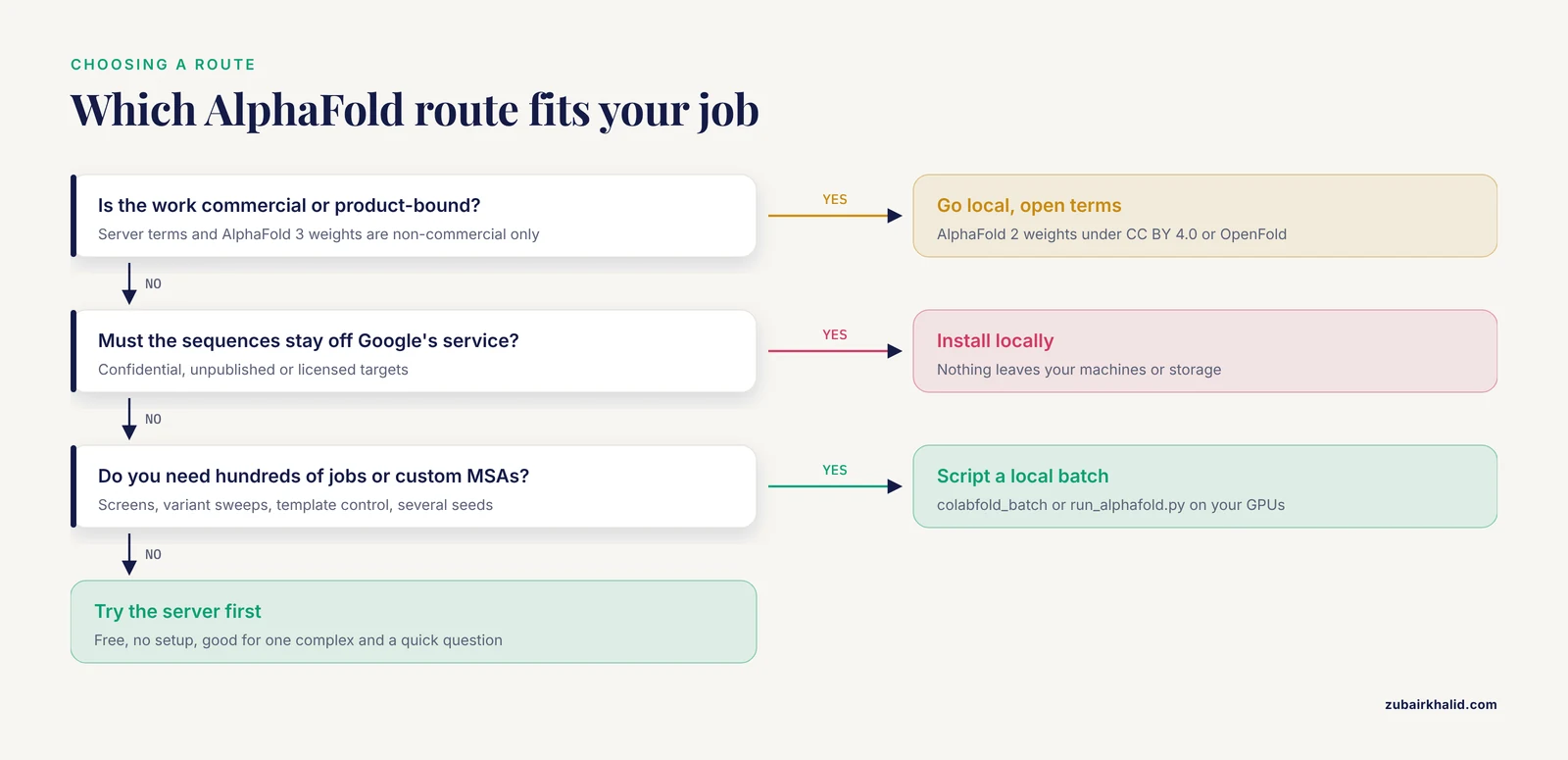
Choosing the AlphaFold server or a local installation becomes easy once you separate accuracy from control. These five criteria settle almost every real decision.
Input Control
Custom MSAs matter for hard targets. If a protein has few homologs, a deeper search, or an alignment built from your own family database, can be the difference between a usable model and noise. Local runs also let you pick templates explicitly, set template date cutoffs, define modified residues and ligand identities precisely, and control stereochemistry. The server makes sensible automatic choices for all of these, which is a feature for routine jobs and a ceiling for difficult ones. Seed control belongs here too: running one input with several random seeds locally can reveal alternative conformations, while the server picks the seed for you.
Throughput and Batch
The server's daily cap is fine for a handful of jobs and hopeless for a screen. Locally you script everything: a loop over a FASTA file with colabfold_batch, or run_alphafold.py calls submitted to SLURM, the job scheduler used on most university clusters. Throughput then scales with how many GPUs you can occupy, and overnight runs covering dozens to hundreds of targets are routine on a single node.
Privacy and Data Control
Anything submitted to the server goes to Google's infrastructure under the terms described above. A local installation keeps sequences, results, and failures on your own storage. For unpublished structures of collaborator proteins, licensed industrial targets, or data governed by grant agreements, that difference alone settles the question.
Reproducibility and Versioning
The server runs whatever version DeepMind has deployed, and that can change without announcement, so a paper reporting server results describes a moving target. Locally you pin a code release, archive the weights, record database versions and the template cutoff, and rerun the identical job a year later. One caveat applies to both routes: GPU inference is not perfectly deterministic, so reruns can differ in fine detail even with identical inputs.
Licensing and Commercial Use
The server and the AlphaFold 3 weights are non-commercial. AlphaFold 2 weights under CC BY 4.0 do permit commercial use, which is why groups building products on structure prediction usually run AlphaFold 2 locally or use OpenFold. Read the current terms yourself before building a paid service or product on any of these routes, because licenses have changed before and will change again.
When to Use the AlphaFold Server
The server is the right call in these situations:
- You have a single complex and a yes-or-no question, such as whether two proteins plausibly form the interface a colleague proposed.
- You have no GPU access and no administrator help, and you need an answer today.
- You are teaching. Students can submit a job and interpret pLDDT and PAE within one lab session, with zero setup.
- You specifically need AlphaFold 3 capabilities, such as a ligand or RNA in the model, and the academic release terms or hardware requirements put local AlphaFold 3 out of reach.
- You are triaging. Run the complex on the server first, and only invest in local infrastructure if the question survives contact with the prediction.
When a Local Installation Is the Better Choice
Install locally when any of these applies:
- You need hundreds or thousands of predictions, such as every variant in a domain, all pairs in a small interactome, or a design campaign.
- Sequences cannot leave your institution for contractual, ethical, or competitive reasons.
- You need custom MSAs, explicit template control, or multiple seeds per target.
- Results must flow into a downstream pipeline automatically, without a human downloading files from a browser.
- Your work is commercial, which points to AlphaFold 2 weights or OpenFold rather than the server or AlphaFold 3.
- You are benchmarking or developing methods and need to modify the code itself.
A Short AlphaFold Tutorial: Your First Prediction on Each Path
On the Server, Start to Finish
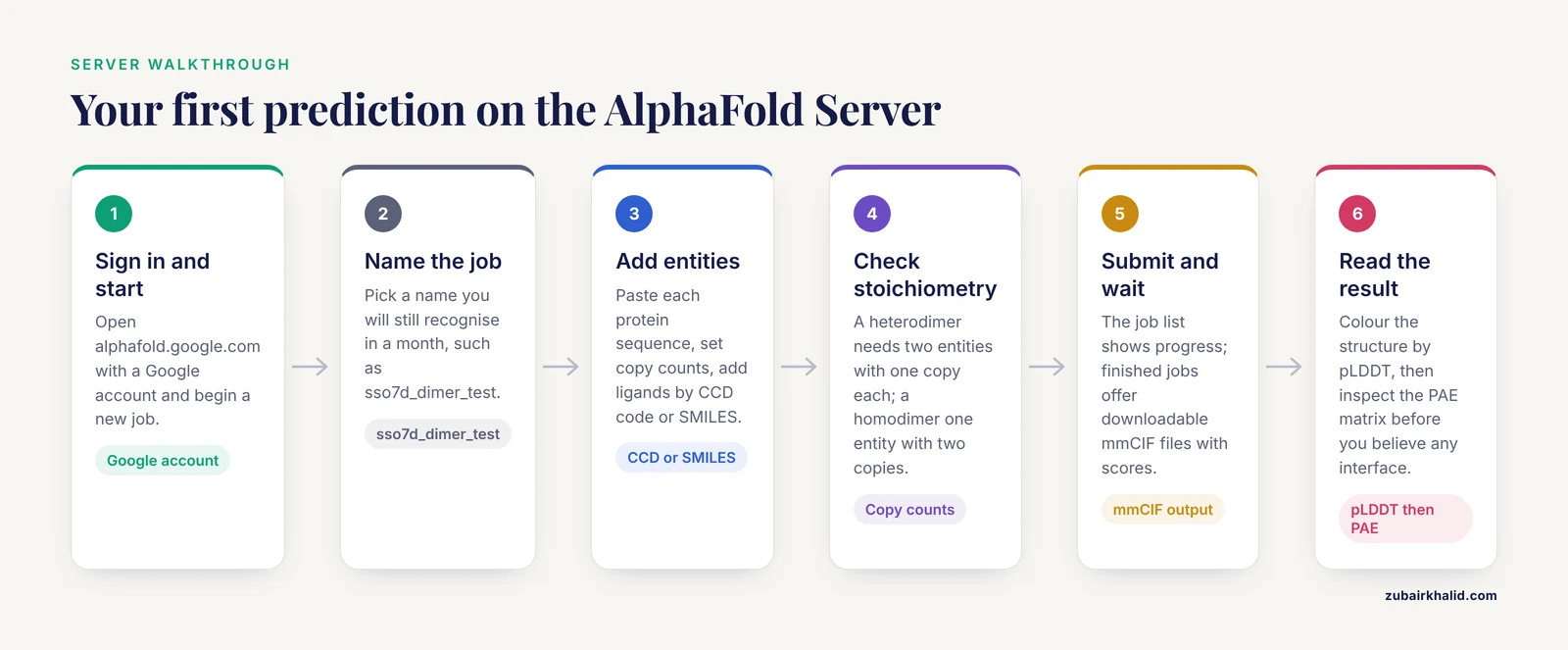
- Sign in at alphafold.google.com with a Google account and start a new job.
- Name the job something you will recognize in a month, for example sso7d_dimer_test.
- Add entities. Paste each protein sequence, set the copy count for each chain, and add any ligand by CCD code or SMILES.
- Check stoichiometry before submitting. A heterodimer needs two entities with one copy each, and a homodimer needs one entity with two copies.
- Submit and wait. The job list shows progress, and finished jobs expose downloadable mmCIF files with confidence scores.
- Read the result properly. Color the structure by pLDDT, then inspect the PAE matrix before you believe any interface.
With ColabFold, the Fast Local Route
Follow the repository's install instructions for a local conda or pip setup, or use the free notebook on Google Colab. The batch tool takes an input FASTA and an output directory:
colabfold_batch input.fasta results/The tool writes ranked models, per-residue confidence, and PAE files into the results directory, with options for the number of models, recycling rounds, and MSA mode when you need them. For most users this is the shortest path from FASTA to a model they control.
With the Official Pipeline
- Provision a machine with an NVIDIA GPU, current drivers, the NVIDIA Container Toolkit, and Docker, plus at least 3 TB of free disk for databases and outputs.
- Clone the repository for AlphaFold 2 or AlphaFold 3 and build the provided image, for example with
docker build -t alphafold3 .for AlphaFold 3. - Run the bundled database download script and let it finish. This is the long step, measured in hours and terabytes.
- For AlphaFold 2, download the model parameters with the bundled script. For AlphaFold 3, request the weights through DeepMind's form and place the file where the run script expects it.
- Prepare input: a FASTA file for AlphaFold 2, a JSON job specification for AlphaFold 3.
- Run the pipeline. For AlphaFold 2, call run_alphafold.py with fasta_paths, output_dir, data_dir, model_preset, and max_template_date set for your job. For AlphaFold 3, call run_alphafold.py with the JSON path, the model directory, and an output directory.
- Inspect ranked models, pLDDT, and PAE exactly as you would for server output. AlphaFold 2 writes its ranked predictions as files named ranked_0 through ranked_4, with ranked_0 usually the best.
Worked Scenarios
Scenario 1: An Interface Worth Testing
A graduate student reads a paper claiming two bacterial proteins interact. She pastes both sequences into the server as one job with one copy of each entity. The result returns a compact interface with low PAE between the chains and high pLDDT across the contact helices. That is a hypothesis, not proof. She designs two point mutations at predicted contact residues, submits those variants as separate server jobs, and watches the interface fall apart in the predictions. Total cost: nothing. Total time: an afternoon. The mutations now go into the wet lab with a structural rationale.
Scenario 2: Several Hundred Variants for a Figure
A lab wants models for every missense variant across a 90-residue active site to correlate predicted structural changes with activity data. The server's daily cap turns that into a month-long slog of manual submissions. Instead, the lab installs ColabFold on a single 24 GB GPU workstation, writes a script that generates one FASTA per variant, and runs colabfold_batch over the whole set, reusing the MSA computed once for the wild-type family. Models land in a results tree named by variant, and a parsing script tabulates pLDDT and PAE into a spreadsheet. The run finishes over a weekend, and every model traces back to the same pinned ColabFold version.
Scenario 3: A Core Facility Service
A university core facility wants to offer structure prediction to dozens of groups. Staff install AlphaFold 2 and ColabFold on a SLURM cluster with two A100 nodes, pin the code version, and document the database snapshot date. Users submit through the scheduler, the facility accounts usage per GPU hour, and every result records the exact release used. When AlphaFold 3 weights arrive under the academic terms, the facility adds an AlphaFold 3 queue for qualifying projects and writes the license conditions into the user agreement. None of this is possible on the server, which has no scheduler, no multi-user quotas, and no way to archive a pinned environment.
Common Mistakes and Limitations
- Reading pLDDT as a guarantee. pLDDT is a per-residue confidence score on a 0 to 100 scale. Above 90 usually means a well-determined backbone, 70 to 90 means the overall fold is probably right with uncertain side chains and loops, 50 to 70 deserves caution, and below 50 usually marks disorder rather than a real structure. A low score on a terminus is often the model correctly telling you the region is flexible.
- Judging interfaces by pLDDT alone. Interfaces are judged by PAE, the pairwise error estimate. Two chains can each look excellent while the model has no idea how they are oriented relative to each other, which shows up as high PAE across the interface.
- Trusting ligand poses blindly. AlphaFold 3 predicts ligand geometry, and its own evaluation reports ligand accuracy below dedicated docking tools in some settings. Check distances, angles, and chemistry before a pose enters a manuscript.
- Running one seed and calling it the answer. The model often has more than one plausible state. Local runs with several seeds expose alternatives, and a single server job does not.
- Ignoring MSA depth. A protein with shallow homologs gets a weak alignment and a weak model. Check how many sequences the MSA contains before blaming the network.
- Benchmarking with template leakage. If you evaluate against structures that were available before your template cutoff, the model may have seen the answer. Set max_template_date deliberately and report it.
- Mixing up the licenses. Building commercial work on the server or on AlphaFold 3 weights violates their terms. AlphaFold 2 weights and OpenFold are the commercial-friendly paths.
- Assuming server and local runs are interchangeable records. The server version can change under you, and GPU nondeterminism means even identical local reruns can differ in detail. Record versions, seeds, and database dates with every result you intend to publish.
- Underestimating the pipeline. The databases alone run to multiple terabytes, and the MSA stage often takes longer than the model stage. Budget disk and time for the pipeline, not just the GPU.
- Treating a prediction as a mechanism. AlphaFold returns one static model, or a few if you run seeds. Dynamics, membrane context, allostery, and regulation require experiments or simulation on top of the prediction.
Finally, individual predictions that will guide experiments, publications, or clinical decisions deserve review by someone with structural biology experience before anyone acts on them.
Frequently Asked Questions
Is the AlphaFold Server free?
Yes. The server is free for non-commercial use with a Google account, subject to a daily cap on jobs per user and a per-job size limit.
Can I run AlphaFold 3 on my own hardware?
Yes, for academic, non-commercial research. Request the model weights from DeepMind, accept the terms, and run the official code on a data-center-class NVIDIA GPU with terabytes of database storage. It is not a laptop workload.
Which produces better models, the server or a local installation?
Neither, in raw accuracy, because both routes run the same published model. Local runs pull ahead when custom MSAs, template control, or multiple seeds rescue a difficult target.
Can I use AlphaFold Server predictions in commercial research?
No. The server terms restrict outputs to non-commercial purposes. For commercial work, AlphaFold 2 weights and OpenFold are the standard open options.
Do I need to build my own MSA before predicting?
Not on the server, which builds alignments automatically. Locally it is optional, and a custom, deeper alignment can rescue targets with few homologs.
Is the AlphaFold Server the same as the AlphaFold Protein Structure Database?
No. The database, hosted with EMBL-EBI, holds precomputed AlphaFold 2 predictions for cataloged UniProt proteins. The server runs AlphaFold 3 on your own custom jobs.