AlphaFold Server Limitations: Common Problems and Fixes
By Dr. Zubair Khalid, DVM, MS, PhD ·

Most AlphaFold Server problems trace back to two causes, a malformed input or the platform's own job rules. The first thing to check is the error text on the job card in your dashboard. The server reports rejected inputs, exhausted daily allowances, and oversized queries with distinct messages, and that single line usually points straight to the relevant fix below.
The AlphaFold Server is Google DeepMind's free web interface to AlphaFold 3, opened to the public in 2024. You enter protein, DNA, and RNA sequences, add ligands or ions, and receive a ranked set of predicted structures with confidence scores. Because it runs on shared infrastructure under a daily job allowance, it behaves very differently from a local installation, and a large share of reported AlphaFold server limitations comes from that difference rather than from the model itself.
This article works through the causes in order of frequency, explains the mechanism behind each failure, and gives concrete fixes. It doubles as a practical AlphaFold tutorial for the server workflow, including the commands you need to check a returned model before you trust it. One distinction matters throughout. The AlphaFold Server predicts new structures on demand, while the AlphaFold Protein Structure Database hosts over 200 million precomputed models that you can often download instead of waiting for a prediction [1]. Routing each question to the right service resolves many apparent limitations before they happen.
The 60-Second Diagnostic Sequence
Run these checks in order before changing anything else.
- Read the exact error text on the failed job card. Rejected input, quota exhaustion, and oversized input each produce different wording.
- Resubmit a minimal job containing one protein chain and nothing else. If that succeeds, add entities back one at a time until something breaks.
- Count your residues. Sum every chain, nucleotide, and ligand against the input specification page linked from the submission form.
- Check your remaining job allowance for the day on the dashboard.
- Look up every ligand by its three-letter Chemical Component Dictionary (CCD) code. The CCD is the identifier list for small molecules found in Protein Data Bank (PDB) structures. If a code is not accepted, the server cannot model that molecule.
- Search the AlphaFold Protein Structure Database for your UniProt accession, the stable identifier for a protein in the UniProt database, before predicting anything. A model may already exist.
- Open the returned model's per-residue confidence (pLDDT) and predicted alignment error (PAE) files before interpreting any biology. Both are explained below.
- Record the date, the input, and the output files. Results do not stay on the server indefinitely.
Which AlphaFold Service Are You Actually Using?
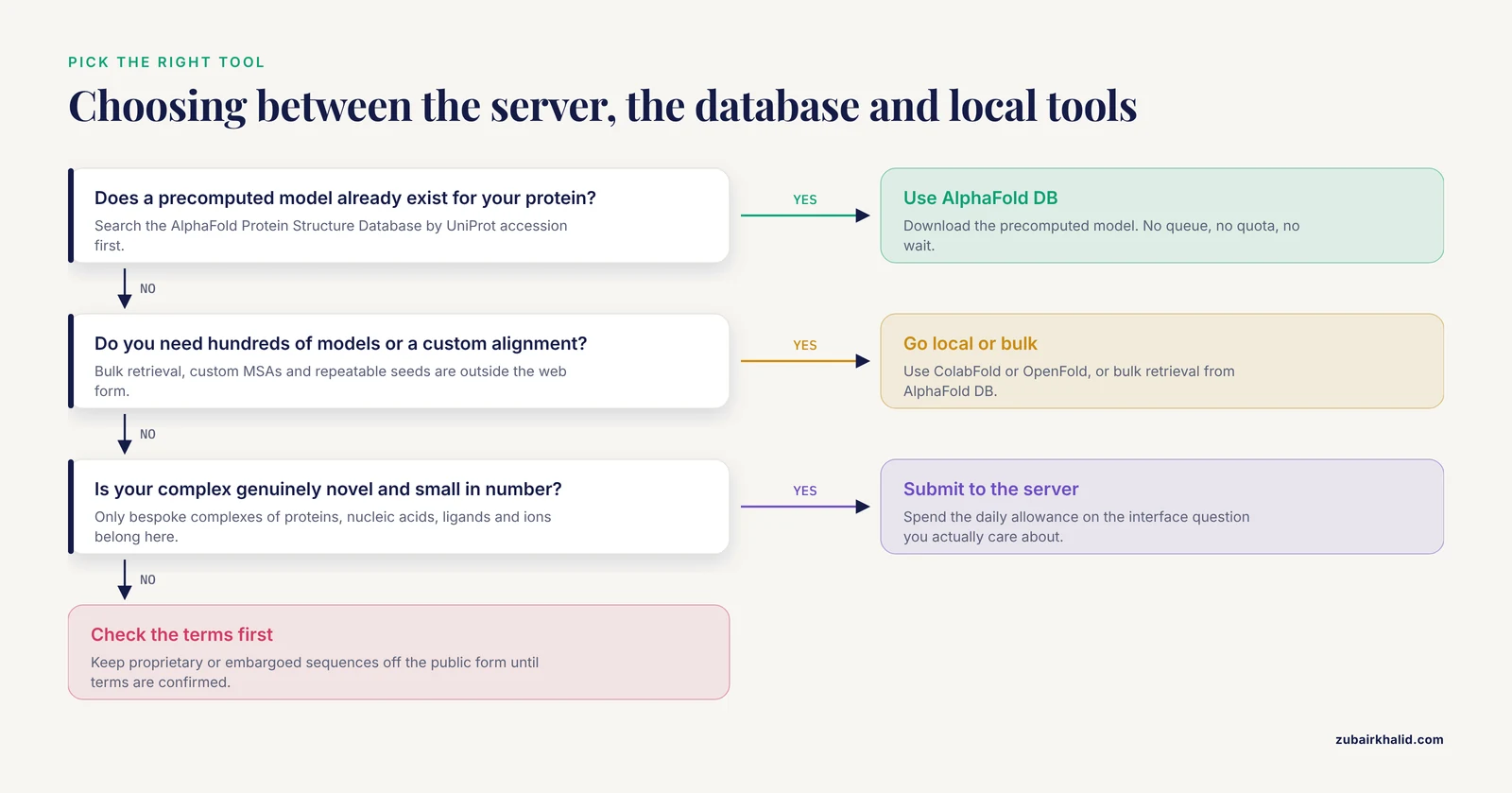
Misdirected jobs create a surprising fraction of reported failures. Three services share the AlphaFold name and they fail in different ways.
The AlphaFold Server is the interactive prediction form. It runs AlphaFold 3, accepts custom complexes of proteins, nucleic acids, ligands, and ions, and enforces job quotas and input size caps. Use it for a small number of bespoke complexes, meaning specific combinations of molecules that no database already contains.
The AlphaFold Protein Structure Database (AlphaFold DB), hosted by EMBL-EBI, holds precomputed monomer models searchable by UniProt accession and organized by proteome, the full set of proteins an organism encodes. Nothing is computed when you request a structure, so there is no queue and no quota. Its limitation is coverage rather than capacity. Predictions exist for complete proteomes of selected organisms, and gaps remain for unusual isoforms, some non-model organisms, and any complex of two or more chains.
Local and open reimplementations, including ColabFold and OpenFold, run AlphaFold 2-class models on your own hardware or a cloud notebook. They accept your own multiple sequence alignments (MSAs), the evolutionary profiles that drive prediction quality, they allow unlimited batch runs, and they behave reproducibly once you fix the random seed and database versions. They do not reproduce AlphaFold 3's chemistry handling.
A job that exceeds server quotas, needs a custom alignment, or must run thousands of times belongs in the third category. A monomer from a well-covered proteome belongs in the second. Only genuinely novel complexes belong in the first.
Caution: the AlphaFold Server is a shared public service governed by posted terms of use. Keep proprietary, embargoed, or otherwise sensitive sequences off a public web form until you have confirmed the terms cover your situation.
Quick Troubleshooting Table
The table below compresses the rest of the article. Confirm the symptom, apply the fix, and read the matching section for the mechanism behind it.
| Symptom | Likely cause | How to confirm | Fix |
|---|---|---|---|
| Job rejected the moment you submit | Malformed sequence or entity syntax | Submit each entity alone in a minimal job | Clean the sequence text, correct the entity type, resubmit (Section 1) |
| Unsupported ligand error | CCD code outside the allowed set or invalid SMILES | Look up the three-letter code in the Chemical Component Dictionary | Switch to a supported code or drop the ligand and model it separately (Section 7) |
| Job sits in the queue for hours | Peak demand or daily allowance spent | Check the job counter and compare waits at a different hour | Run off-peak, split large jobs, keep a local fallback (Section 2) |
| Input-too-large rejection | Token or entity caps exceeded | Count all residues and nucleotides across every chain | Split into domains, trim disordered tails, or pull the full-length model from AlphaFold DB (Section 3) |
| You need hundreds of models this week | Interactive service used for batch work | You are resubmitting forms by hand | Download precomputed models in bulk, move novel targets to local tools (Section 4) |
| Part of the chain looks like loose spaghetti | Genuine disorder or shallow evolutionary information | Check pLDDT along the chain, values under 50 mean very low confidence | Treat as intrinsically disordered, trim for rigid-body work, keep for disorder annotation (Section 5) |
| Chains float apart or the interface looks arbitrary | Weakly constrained interface | Inspect the inter-chain PAE block, high values mean uncertain relative placement | Declare stoichiometry explicitly, rerun, validate the interface independently (Section 6) |
| Wrong number of copies in the output | Copies never declared | Count chains in the output mmCIF file | Add each copy as its own entity with a copy count, rerun (Section 6) |
| Metal ion absent or oddly coordinated | Ion handling limits in the model | Compare against known metal-binding residues | Predict binding residues with a dedicated tool, place ions for display only (Section 7) |
| Protein-RNA complex contradicts your data | Hard problem class with documented failure cases | Check interface PAE against known binding sites | Cross-check with a docking server, treat the model as one hypothesis (Section 8) |
| Results vanished from the dashboard | Retention window elapsed | Check the job submission date | Download everything at completion, archive inputs and outputs (Section 10) |
| Local run disagrees with the server model | Different versions, databases, seeds, or alignment handling | Record versions and rerun both | Treat each as a sample, compare per-residue confidence rather than global scores (Section 11) |
If you arrived searching for how to fix AlphaFold server limitations, that table is the short answer and the sections below are the long one. Most solutions turn out to be procedural rather than computational.
AlphaFold Server Limitations: Causes and Fixes in Order of Frequency
Each section explains why the failure happens, because the mechanism usually dictates the fix.
1. Malformed Inputs Reject at Submission
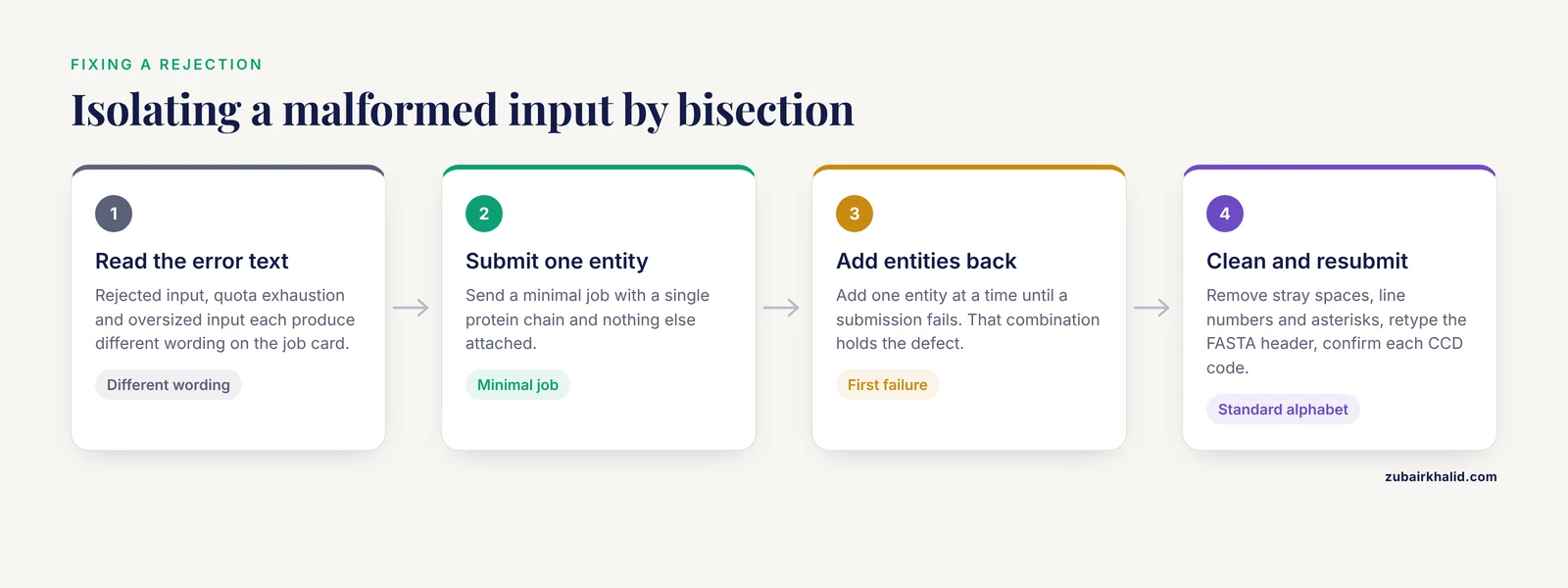
The submission parser is strict by design. AlphaFold 3 treats your form entries as a formal system of entities, each with a type, a sequence or identifier, and a copy count, and it refuses anything ambiguous rather than guessing.
The recurring errors are mundane. Copied sequences carry stray spaces, line numbers from PDFs, or asterisks left by alignment viewers. A protein sequence pasted into the DNA field fails immediately. A ligand named by a code that exists in the Chemical Component Dictionary but is not enabled on the server passes the dictionary check and still fails. A SMILES string, the line notation describing a small molecule's structure, can parse in a drawing tool yet fail sanitization on the server.
Fix it by bisection. Submit one entity alone. Add the second. The first combination that fails contains the defect. Then normalize the text, retype the FASTA header, remove every character outside the standard amino acid or nucleotide alphabet, and confirm each modification by its exact CCD code. For ligands entered as SMILES, run them through a sanitizer such as the one in RDKit before pasting, because a valence error a drawing tool forgives will reject the job.
One further trap. Entity definitions and copy counts are part of the specification. If the biological assembly is two copies of A plus two copies of B, declare two copies of each explicitly. Do not rely on the model to infer the assembly from a single copy.
2. Daily Quotas and Queue Delays
The server is free because it is rationed. Each account receives a fixed daily allowance of jobs, and submissions compete for a shared compute pool, so wait times stretch during the business hours of every heavily submitting timezone.
The mechanism matters for planning. A quota message is not an error in your input, and resubmitting the identical job wastes allowance. When the dashboard reports no remaining jobs, the fix is scheduling rather than debugging. Reserve the allowance for complexes that genuinely require on-demand prediction. Run exploratory work at off-peak hours. Keep a local ColabFold environment ready as the fallback so a stalled queue never blocks a deadline.
Queues also fail soft. A job can sit for hours and then complete normally, so resist duplicating a pending submission, because duplicates consume the allowance twice.
3. Input Size Caps and Token Limits
AlphaFold 3 does not read residues, it reads tokens. A token is the unit the model attends over, roughly one amino acid or nucleotide, with small molecules consuming additional tokens for their atoms. Attention computations grow with the square of the token count, which is why the server enforces a ceiling on total size instead of charging linearly.
When a job exceeds the cap, some fixes preserve science better than blind trimming. Split a large multidomain protein into domains, predict them separately, and reconcile them with a structural alignment. Remove long low-complexity or disordered terminal tails, which spend tokens without contributing a defined structure. For full-length context, download the existing AlphaFold DB model for the monomer and spend the server job on the interface you actually care about.
Remember that truncation changes biology. If a disordered tail binds a partner, cutting it removes the interaction you meant to study. Trim only what you can defend in a review.
4. Bulk Workloads the Server Cannot Serve
The web form is interactive by design. There is no official bulk interface, scripted submission falls outside the terms of service, and a project needing hundreds of structures cannot be clicked into existence.
Route the workload instead. Start with the AlphaFold DB, whose precomputed proteome-wide models often remove the need to predict anything. Bulk retrieval from that database has its own friction, because the standard interface centers on a curated list of organisms and accessions. The AlphaFoldDB Structure Extractor addresses this directly. It accepts NCBI Taxonomy IDs, RefSeq accessions, locus tags, and UniProt or AlphaFold accessions, returns structures in PDB, mmCIF, bCIF, or PAE JSON formats, generates an ID mapping file that traces inputs back to standard accessions, and offers an API for pipeline integration, with tests on inputs up to 5000 accessions [2]. Here mmCIF is the current PDB text format for structures, bCIF is its binary compressed variant, and PAE JSON is the pairwise error matrix shipped as a machine-readable file.
For sequences with no database model, move computation local. ColabFold and OpenFold run AlphaFold 2-class predictions without per-job quotas, accept custom MSAs, and scale across a GPU queue. Reserve the interactive server for the small set of complexes where AlphaFold 3's chemistry handling justifies spending quota.
5. Low-Confidence Regions and Misleading Global Scores
Low pLDDT is often correct behavior rather than a malfunction. pLDDT is a per-residue score from 0 to 100 estimating how well the predicted local structure agrees with experimental measurement. By the standard convention used across AlphaFold outputs, values above 90 indicate very high confidence, 70 to 90 confident backbone, 50 to 70 low, and below 50 very low, which usually marks intrinsic disorder, meaning a region with no single stable structure.
The mechanism is evolutionary. The model derives predictions from patterns across related sequences, so a domain with deep homology snaps into place while a region without conserved structure stays flexible in the output. That flexibility is information. A floppy tail in the model is a statement that the tail has no single structure to find.
The trap is aggregation. A mean pLDDT, a pTM score, or a global RMSD can look identical between two predictions while specific residues disagree sharply. An evaluation spanning 10 proteins and 222 single amino acid variants, covering multiple AlphaFold 2 implementations, OpenFold, ColabFold, and the AlphaFold 3 server, found that these global indicators frequently suggest comparable performance while substantial local differences remain, and proposed per-residue confidence profiles together with Bland-Altman agreement analysis, a statistical method for comparing two measurement approaches residue by residue, to expose them [3].
The fix is to read confidence at the resolution your question needs. For domain-level questions, global scores suffice. For a binding site, a catalytic residue, or a variant, inspect per-residue values and the PAE entries at that exact location.
6. Stoichiometry and Interface Failures
AlphaFold 3 generates structures through a diffusion process, meaning it samples from a learned distribution rather than deterministically computing one answer. The interface between two chains is a hypothesis conditioned on your inputs, and when the inputs underspecify the assembly, the sampler fills the gap with plausible alternatives.
Two failure modes dominate. The first is missing copies. If you submit one copy of each chain for a protein whose biological assembly is a homotrimer, the server has no instruction to build three. Declare copy counts explicitly for every entity. The second is weakly constrained placement. Each chain can fold beautifully while the relative arrangement stays uncertain, and you detect this in the PAE matrix. PAE, predicted alignment error, is a matrix of expected positional error in angstroms between every pair of residues. Read the block where rows of chain A meet columns of chain B. Values comparable to the diameter of the interface mean the model knows both shapes but not how they dock.
Work through the fixes in order. Specify stoichiometry first. Rerun and compare the ranked candidates, because independent samples that agree on an interface strengthen the case. Check whether interface residues carry high pLDDT individually yet high PAE collectively, the signature of a shape-known, arrangement-unknown interface. When an interface will drive a decision, validate it with an orthogonal method, because a confident-looking contact can still be wrong.
7. Ligands, Modified Residues, and Metals
Chemistry inputs fail more often than sequence inputs because chemistry has a long tail. The server accepts ligands by CCD code or SMILES, but its supported set does not span the entire PDB dictionary, and a perfectly valid code can still be unavailable.
Three habits prevent most rejections. Prefer an existing CCD code over hand-written SMILES whenever the molecule appears in the dictionary. Sanitize SMILES with RDKit before pasting. Treat covalent bonds between a ligand and the protein as a special case to verify visually, because bond geometry is where automated handling is least forgiving.
Metals deserve separate caution. An ion can appear, vanish, or coordinate implausibly across candidate models, because the diffusion process treats it as one more set of atoms rather than as a constrained coordination shell. When a metal site matters to your question, predict the binding residues with a dedicated method instead. MIB2 predicts metal ion-binding sites and models them, using predicted structures including those from the AlphaFold DB, with metal-type-specific scoring across 18 metal ion types [4]. Use the server model for the protein scaffold and overlay the predicted binding geometry afterward, not the reverse.
8. Protein-RNA and Protein-DNA Complexes
Nucleic acid complexes are a strength of AlphaFold 3 relative to older tools, but the margin is narrower than headline numbers suggest, and the failures concentrate in exactly the cases docking practitioners care about.
A benchmark of 235 protein-RNA complexes, curated from PDB structures deposited up to July 2024, compared five template-free docking web servers with the AlphaFold Server. Among the docking servers, HDOCK led with success rates of 31.1 percent for the top-ranked prediction and 44.7 percent within the top five, scored by CAPRI criteria, the community standard for grading docking accuracy. The AlphaFold Server, running AlphaFold 3, outperformed all of them with an 87.0 percent success rate within its top five predictions, yet it failed in nine cases where docking approaches succeeded [5].
The practical translation is a rule rather than a statistic. For protein-RNA questions, run the prediction, then check the modeled interface against whatever experimental constraints you hold, mutation data, crosslinking, conserved residues. Where the model contradicts solid evidence, a docking calculation remains a legitimate second opinion, and the benchmark set is publicly available for calibrating expectations. Treat the server as the strongest single hypothesis generator in that comparison, not as an oracle.
9. Variant Models That Disagree Between Runs and Tools
Modeling a single amino acid substitution sounds trivial, and it is the case where tool disagreement bites hardest. The evaluation discussed above compared predictions across 222 variants and found that implementations looking equivalent on global metrics can differ at the variant site itself [3].
The mechanism combines sampling with information content. A substitution changes the sequence slightly, the evolutionary signal barely moves, and the sampler can settle into slightly different local arrangements depending on seed and implementation. Two models that both score well can disagree about a side-chain orientation or a loop conformation precisely where you want an answer.
The fix is procedural. Never base a variant claim on one model from one tool. Generate several candidates, compare per-residue confidence at the mutated position and its neighbors, and look for agreement across independent runs. Where runs disagree, report the disagreement rather than averaging it away. For decisions with consequences, pair the structural picture with variant effect predictors and experimental evidence.
10. Expired Results and Lost Outputs
Server storage is temporary. Completed jobs and their output files are retained for roughly a month, after which they are deleted, and a deleted job takes its structures, confidence files, and job parameters with it.
This limitation produces a distinctive failure, the analysis that worked last month cannot be reproduced today because the model files are gone. The fix is mechanical. Download the full output archive the day a job completes, including coordinate files and every confidence JSON. Store the exact input specification beside the outputs, because reconstructing entity definitions from memory is where reproducibility dies. A one-line notebook entry per job, date, entities, copy counts, archive filename, prevents most of these losses.
11. Server Versus Local Discrepancies
A colleague runs the same sequence locally and gets a different model. Usually nobody is wrong. The server and a local stack differ in software version, sequence databases, alignment computation, and random seeds, and AlphaFold predictions respond to all four.
The server performs its own genetic search and does not accept user-supplied MSAs or templates, while ColabFold and similar tools do. A deeper or cleaner alignment on your workstation can legitimately shift confidence and even domain packing. Diffusion sampling adds run-to-run variation that seed control would otherwise freeze, and the web interface does not expose seed settings.
Handle discrepancies as data rather than noise. Record versions and dates for every run. Where two systems agree, trust that region more. Where they disagree, localize the disagreement with per-residue confidence comparisons instead of arguing from global scores.
12. Rare Causes Worth Knowing
A short list of uncommon failures completes the diagnosis. Model updates change behavior quietly, so a prompt that produced a certain result last month can score differently after an upgrade, and noting the date protects you from false alarms. Transient server errors occasionally fail jobs with no input defect, and a plain retry after a few minutes resolves them. Session problems, an expired login mid-submission or a stale browser tab, produce submissions that vanish, resolved by reloading and resubmitting once. Terms and availability also evolve, the service is currently offered for non-commercial use under posted terms that can change, so reread them whenever the legal context of a project matters.
A Worked Diagnostic Walkthrough
Here is the full workflow on a realistic case. You predicted a two-chain complex, one chain ends in a floppy tail, and a collaborator asks which parts to believe.
Step 1, archive the outputs. Download the result archive and unpack it. Keep the original input text beside it.
Step 2, quantify per-residue confidence. pLDDT values ride in the B-factor column of the output mmCIF, the same convention the AlphaFold DB uses. With Python and the gemmi library:
import gemmi
st = gemmi.read_structure("model_0.cif")
plddt = [atom.b_iso for model in st for chain in model
         for res in chain for atom in res]
print("residues:", len(plddt), "mean pLDDT:", round(sum(plddt) / len(plddt), 1))
Residues under 50 should map onto the floppy tail. If they coincide with the terminal 40 residues, you are looking at predicted disorder, not a broken prediction.
Step 3, read the interface. Each model ships a confidence file in JSON format containing the PAE matrix. Key names vary between releases, so inspect before slicing:
import json
d = json.load(open("confidences.json"))
print(list(d.keys()))
Locate the PAE array and the per-token chain labels, slice the block where chain A rows meet chain B columns, and average it. An average in the low single digits of angstroms signals a well-determined interface, while tens of angstroms signals a guess.
Step 4, compare with the database monomer. Pull the precomputed model for each chain, replacing the accession and version with your own:
curl -L -o AF-P00533-F1-model_v4.cif \
  https://alphafold.ebi.ac.uk/files/AF-P00533-F1-model_v4.cif
Superpose the server chain onto the database model and look for domain swaps or shifts larger than the pLDDT-weighted expectation.
Step 5, find structural neighbors. Upload the structured core to the Dali server, which compares your model against structural libraries and the foldomes, the complete fold repertoires, of key organisms in the AlphaFold DB, and annotates alignments with protein families [6]. Neighbors with known ligands or partners often explain an otherwise mysterious interface.
Step 6, decide and document. Keep the high-pLDDT core for downstream modeling, annotate the tail as disordered, record the PAE-based verdict on the interface, and archive everything. If the interface was the question and PAE ran high, rerun with explicit stoichiometry and compare candidates before believing any single arrangement.
Common Mistakes and Limitations
- Reading the mean pLDDT as a certificate of quality. Averages bury residue-level failures exactly where your question lives, at a binding site or a mutation.
- Judging interfaces by eye. A contact that looks tight can carry a large relative position error, and PAE exists precisely to catch this.
- Treating the top-ranked candidate as the only answer. The ranked candidates exist because the sampler produces alternatives, and agreement between them is evidence you should use.
- Over-reading side chains. Side-chain orientations, protonation states, and tautomers are not experimental measurements, and the server offers no pH control. Do not build hydrogen-bond arguments on rotamers alone.
- Using the server as a production pipeline. Quotas, queues, limited retention, and no bulk access make it the wrong tool for hundreds of jobs.
- Predicting what the database already has. Searching AlphaFold DB first preserves quota for genuinely novel complexes.
- Inferring function straight off a structure. Function annotation from predicted models is its own methodological field, with tools such as PANDA-3D trained specifically on AlphaFold models to predict Gene Ontology terms [1]. A shape suggests function, it does not prove it.
- Forgetting that models are static. There is no allostery, no dynamics, and no ensemble thermodynamics in a single prediction. One conformation is a sample, not a movie.
- Confusing syntax validation with scientific validation. The server checks that your input parses, not that your stoichiometry guess or ligand identity is biologically right.
- Letting outputs expire and rebuilding from memory. Every serious analysis should rest on archived files, not on recollection.
- Treating individual predictions as self-interpreting. Any prediction that will inform a decision deserves expert review and, where feasible, experimental validation, the same standard applied to every computational result in structural biology.
Prevention Practices
- Check AlphaFold DB before every prediction and spend quota only on what the database lacks.
- Keep an input template with validated FASTA formatting, a CCD lookup bookmark, and an RDKit sanitization step for SMILES.
- Declare stoichiometry explicitly, every entity and every copy count, on every job.
- Budget quota weekly. List the complexes that truly need on-demand prediction and defer the rest.
- Download and archive outputs the day they appear, with inputs and parameters attached.
- Log software versions, dates, and seeds wherever the interface exposes them.
- Maintain a tested local fallback so a queue never becomes a deadline crisis.
- Build validation into the pipeline by default, per-residue confidence review, interface PAE thresholds, structural neighbor searches, and functional cross-checks against prior annotations.
Frequently Asked Questions
Why is my AlphaFold Server job stuck in the queue?
Queue position reflects shared demand and your remaining daily allowance, not a defect in your input. Check the dashboard counter, avoid duplicate submissions, run at off-peak hours, and keep a local fallback for deadline-driven work.
What does a low pLDDT score mean in an AlphaFold Server model?
It means the model has low confidence in that region's local structure, and values under 50 usually mark intrinsic disorder rather than a broken prediction. Treat those residues as flexible and trim them for rigid-body work while keeping them for disorder annotation.
Can the AlphaFold Server handle long proteins or large complexes?
Only up to the token and entity caps documented on its input specification page. Split large proteins into domains, trim disordered tails, or take full-length monomers from the AlphaFold DB and reserve the server for the interface question.
How do I fix a rejected AlphaFold Server job?
Read the error text, then submit each entity alone to isolate the defect. Most rejections come from formatting artifacts, wrong entity types, or unsupported ligand codes, and cleaning the input before resubmitting resolves them.
Is the AlphaFold Server accurate for protein-RNA and protein-DNA complexes?
It performs strongly on protein-RNA complexes overall but has documented failure cases where docking methods succeed. Validate important interfaces against experimental constraints and consider a docking calculation as a second opinion.
Can I download AlphaFold models in bulk instead of running predictions?
Yes, for anything already in the AlphaFold DB. Bulk retrieval tools accept taxonomy IDs, RefSeq accessions, locus tags, and UniProt accessions, and they export PDB, mmCIF, bCIF, and PAE JSON formats.
Why do AlphaFold Server results differ from my local AlphaFold runs?
Different software versions, sequence databases, alignment handling, and random seeds all shift predictions. Record versions for every run and compare results per residue rather than through global scores.
How long does the AlphaFold Server keep my results?
About a month, after which jobs and files are deleted. Download the full archive, coordinates and confidence files together, the day each job completes.
Sources
- PANDA-3D: protein function prediction based on AlphaFold models.
- AlphaFold Database Structure Extractor: a web server and API to download AlphaFold structures using common protein accessions.
- Comprehensive evaluation of AlphaFold/OpenFold prediction of experimentally unresolved proteins through novel metrics.
- MIB2: metal ion-binding site prediction and modeling server.
- Evaluation of protein-RNA Docking Web Servers for Template-Free Docking and Comparison with the AlphaFold Server.
- Dali server: structural unification of protein families.