Access Control Models for Genomic Data in the Cloud
By Dr. Zubair Khalid, DVM, MS, PhD ·

Access control for genomic data in the cloud differs from ordinary file permissions in one decisive way: the data can never truly be anonymized, so the access control system must make authorization decisions based on who is asking, what they intend to do with the data, and under which legal agreement, not merely on which file they clicked. The rule of thumb for choosing a model is simple. If your team is small and your data is public or synthetic, discretionary access control with bucket policies is enough. If your users fall into clean groups such as analyst, clinician, and administrator, use role-based access control. If access depends on context such as dataset consent terms, project membership, or requester location, use attribute-based access control. If you share human data across institutions under GDPR or similar law, add a federated controlled-access layer with data access agreements on top of everything else.
This article walks through the access control models for genomic data in the cloud, compares the realistic options side by side, explains how major cloud bioinformatics platforms implement them, and gives worked scenarios and common mistakes drawn from published implementations.
Why Genomic Data Demands Stronger Access Control Than Other Data
Genome sequence data is simultaneously an identifier and a medical record. A single FASTQ file from a whole genome sequencing run contains hundreds of millions of reads that encode information about inherited disease risk, cancer driver mutations, ancestry, and kinship. Even when names and identifiers are stripped, genomic data resists de-identification because a genome cannot be changed after a breach. This is the core technical reason that access control for genomic data is harder than access control for most other cloud workloads.
Carter's review of genomic data privacy and security in the cloud frames the problem clearly. Next-generation sequencing produces data volumes that overwhelm on-premise infrastructure, which pushes clinical laboratories and research groups toward cloud services, and the same shift brings regulated genetic information into shared, multi-tenant computing environments where compliance strategies must be deliberate rather than incidental [1]. In the US regulatory environment, laboratories working with patient genomes must design their cloud architecture around compliance obligations for genetic information in clinical care as well as research and public databases [1].
The migration has accelerated. Rahimzadeh and colleagues document that genomic and related health data from government-funded research has undergone mass migration to the cloud, where it can be more securely stored, accessed, and analyzed within shared computing environments. Their scoping review of 46 articles concludes that this shift creates new stewardship responsibilities, specifically the need to align authorized data access with ethical data use across the data lifecycle [2]. In other words, the question is no longer only "can this user read this file?" but "is this use of this file authorized, auditable, and consistent with the consent under which it was collected?" That second question is what pushes cloud bioinformatics teams beyond simple permissions and toward structured access control models.
The Vocabulary You Need First
Every model below rests on a few terms that are worth defining precisely, because vendors often use them loosely.
Access control model means the formal rules a system uses to decide whether a request to read, write, copy, or compute on data should be allowed. The model determines what evidence the system considers: identity, group membership, attributes, clearance levels, or signed agreements.
Authentication establishes who the requester is, usually through a federated identity provider such as Google, institutional single sign-on, or an eLexIR-style research identity. Authorization decides what the authenticated requester may do. Access control models govern authorization. Conflating the two is the most common early design error.
Least privilege means each identity receives the minimum permissions needed for its current task and nothing more. This principle applies under every model and is the single highest-leverage control in cloud genomics.
Controlled access means access is granted only after a request is reviewed and an agreement, such as a data use agreement or data access agreement, is executed. Open access means anyone can retrieve the data. Many repositories mix both. The St. Jude Survivorship Portal, for example, provides open-access exploration of summary data alongside controlled-access features for participant-level clinical and genetic data from more than 7,700 childhood cancer survivors [3].
Data access agreement means the legal instrument that records what a user or institution may do with a dataset. In federated architectures, the distributed node holding the data is responsible for handling access requests, concluding agreements with data users, and providing secure access [4].
The Core Access Control Models Compared
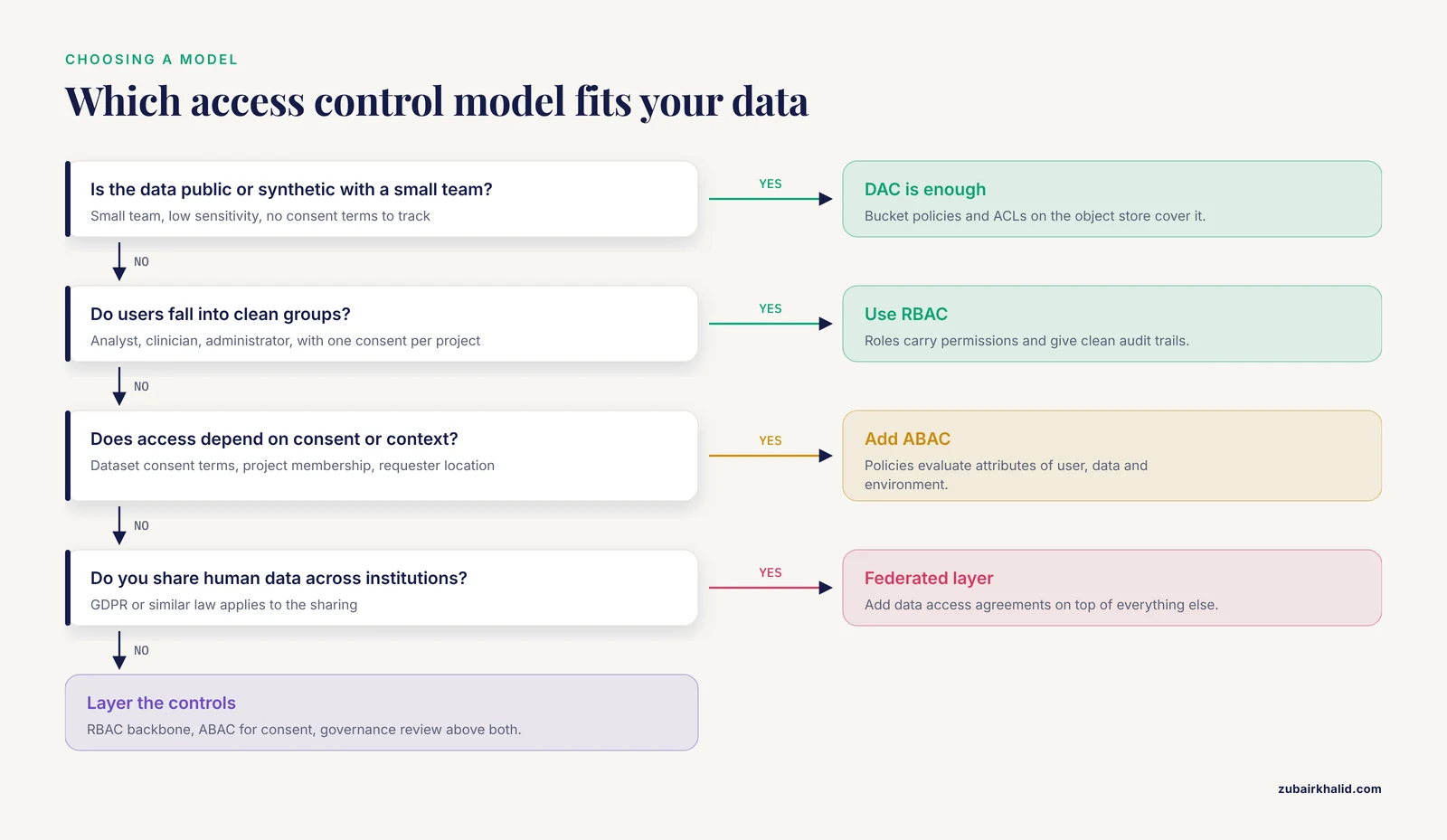
The table below is the decision core of this article. Each row is a model that is in production use for genomic data somewhere today.
| Model | How a request is decided | Strengths for genomic data | Weaknesses for genomic data | Typical cloud implementation |
|---|---|---|---|---|
| Discretionary access control (DAC) | Data owner grants permissions directly on each resource | Simple, low overhead, native in every object store | Permission sprawl, no context, error-prone at scale | S3 bucket policies and ACLs, GCS IAM on buckets |
| Role-based access control (RBAC) | Requester is assigned to a role, roles carry permissions | Auditable, scales with team structure, easy review | Role explosion as projects and consent terms multiply | IAM roles and groups, platform roles in Terra or CGC |
| Attribute-based access control (ABAC) | Policies evaluate attributes of user, data, and environment | Handles consent terms, dataset sensitivity, and location natively | Policy complexity, harder to audit without tooling | Policy tags, attribute-based policies in cloud IAM |
| Mandatory access control (MAC) | Central authority labels data and users with sensitivity levels | Strong isolation, fits multi-tier security classifications | Rigid, high administrative burden, poor fit for collaborative science | Security labels on storage plus compute isolation |
| Federated controlled access | Central index supports discovery, each holding node enforces local policy and agreements | Respects data sovereignty, matches GDPR-driven architecture | Slow to provision, requires legal and stewardship capacity per node | Beacon network-style or middleware-driven federations |
| Governance overlay (five safes) | Every access decision is checked against people, projects, settings, data, and outputs | Aligns technical controls with regulator expectations | Adds process overhead, needs institutional commitment | Purpose-built cloud-native repositories layered on a CSP |
A note on the last row. The five safes framework is not an access control model in the operating-system sense. It is a governance framework that decides what questions must be answered before access is granted: safe people, safe projects, safe settings, safe data, and safe outputs. The Genome Institute of Singapore implemented this framework in RAPTOR, a cloud-native genomics data repository and analytics platform built on a commercial cloud service provider, specifically to give data contributors and users security and governance controls without risking breaches or regulatory violations [5]. Treat it as a policy layer that sits above whichever technical model you pick.
The Models Explained on Their Own Terms
Discretionary Access Control
DAC is the default of every object storage service. A data owner writes a policy that grants a principal, such as a user, group, or service account, a permission like read or write on a bucket or object. In an AWS genomics workflow, this is the S3 bucket policy that lets a pipeline's execution role read raw FASTQ files from an ingest bucket and write BAM and VCF outputs to a results bucket.
The strength of DAC is immediacy. A principal investigator can grant a collaborator read access to one cohort in under a minute. The weakness is that DAC has no memory of purpose and no notion of sensitivity. A policy that says "user X can read bucket Y" cannot express "user X can read bucket Y only for COVID variant surveillance and only through the approved analysis environment." At the scale of thousands of samples across dozens of studies, DAC degrades into a pile of one-off grants that nobody can review coherently. Published implementations therefore use DAC as the primitive layer and put a structured model on top of it.
Role-Based Access Control
RBAC is the workhorse of cloud bioinformatics platforms. Users are assigned to roles, roles carry permission sets, and permissions attach to resources. The National Cancer Institute-funded Cancer Genomics Cloud (CGC) supports cloud-hosted collaborative projects with explicit tooling for managing collaborators and compute hardware from providers such as Amazon Web Services and Google Cloud Platform, which is RBAC in practice: project roles determine who can see a dataset, launch a workflow, or modify billing [6].
RBAC pros and cons for genomic data deserve plain language. The pros are auditability, because a compliance officer can list who holds the "analyst" role on a study, and operational simplicity, because onboarding a new postdoctoral researcher is one role assignment rather than forty bucket policies. The cons appear when consent terms differ across datasets inside one project. If cohort A is consented for cancer research only and cohort B is consented for any biomedical research, a single "analyst" role cannot represent that difference. Teams then either split cohorts into separate projects, which fragments analysis, or escalate to ABAC.
Attribute-Based Access Control
ABAC evaluates a policy against attributes of the requester (institution, training status, role), the resource (consent group, disease area, sensitivity tier), and the environment (network origin, encryption state, time). This is the model that maps most naturally onto genomic consent. A policy can state that a user with attribute trained=genomic_data_controlled_access may run compute on datasets whose consent attribute is disease=research_any, while datasets tagged consent=cancer_only are visible only to users whose project attribute includes cancer approval.
The cost of ABAC is policy complexity. Every attribute becomes a piece of metadata that must be correct, and a wrong consent tag on a dataset becomes a compliance incident rather than an inconvenience. Organizations adopting ABAC for genomic data need a data stewardship function that maintains attribute quality. Rahimzadeh and colleagues identify responsible data stewardship, the ethical and secure management, use, and protection of data to ensure accuracy, privacy, integrity, and appropriate access throughout the lifecycle, as a core outcome domain for cloud-based repositories, and attribute hygiene is where stewardship meets engineering directly [2].
Mandatory Access Control
MAC assigns sensitivity labels to data and clearance levels to users, and a central authority, not the data owner, controls both. You encounter MAC concepts in clinical genomics when a laboratory segments patient-identifiable clinical data from research copies, or when a platform enforces that encrypted, controlled datasets can only be processed in designated compute environments. MAC delivers strong isolation, which is why it underlies high-assurance designs such as the distributed secure genomic analysis system built on the Tokyo QKD Network, where a trusted server enforces different levels of data access control for the data owner and multiple users while running sequencing analysis hardware including GPUs and FPGAs [7]. That system demonstrated comparable throughput with and without encryption on the trusted server, showing that strict layered control does not necessarily destroy performance [7].
The practical drawback of pure MAC in research settings is rigidity. Scientific collaboration crosses sensitivity tiers constantly, and every crossing requires administrative action. Most cloud genomics deployments borrow MAC's labeling and isolation ideas, applying them to specific high-sensitivity datasets, rather than adopting MAC as the sole model.
Federated Controlled Access
Federation inverts the central archive. Instead of moving genomes into one repository, data stays at the institution that holds it, a central node supports data discovery, and each distributed node handles its own access requests, agreements, and secure provisioning. The DS-PACK tool assembly, in production at the ELIXIR Luxembourg data hosting platform, exists because GDPR requirements prompted a shift from centralized controlled-access genome-phenome archives to federated models, and because many research institutions lack the resources to build controlled-access processes from scratch. DS-PACK semi-automates the end-to-end process from data submission to access, centralizes access control management, distributes enforcement, and supports access via cloud-based applications, with data protection principles built into every component [4].
Federation is the access control model that matches data sovereignty law most closely. Its costs are latency and heterogeneity. Getting access to ten datasets across ten federated nodes means ten review processes, and each node may enforce policies with different tooling. Middleware such as DS-PACK reduces that burden by making the controlled-access process reusable and semi-automatic [4].
The Five Safes Overlay
Because regulators increasingly mandate specific data access patterns and security protocols for storage and use of genomic data, several production repositories implement five safes as the governance layer that a technical model must satisfy [5]. In RAPTOR, the framework provides controls to data contributors and users on a commercial CSP, meaning the repository can demonstrate to regulators and contributors exactly how each safe dimension is enforced: who is approved, for which project, in which environment, on which data, with which output restrictions [5].
How Major Platforms Implement Access Control
Reading real implementations is the fastest way to understand which model fits which problem. The platforms below span the range of cloud bioinformatics practice.
Terra. Terra, the cloud platform used for the National Institutes of Health All of Us program, attempts to temporally and ontologically harmonize data across large biomedical datasets [8]. Its access model is RBAC organized around workspaces and billing projects, with the All of Us researcher tier system adding credentialing steps before a user can access controlled genomic data. The All of Us Researcher Workbench, where scholars run genome-wide association studies in Jupyter Notebooks using the Hail framework for large-scale analysis, demonstrates how a credentialing gate and a controlled cloud workspace combine to let early-career researchers analyze a broad, diverse genomic dataset responsibly [9].
Cancer Genomics Cloud. The CGC pairs project-level collaborator management with containerized workflows that execute identically on the cloud and on local hardware, which ties authorization to reproducibility: a user authorized on a project runs the same versioned, containerized analysis as every other authorized user [6].
AWS genomics stacks. In AWS genomics architectures, authorization is decomposed across services. IAM policies define what identities may do, S3 bucket policies control data-plane access to buckets holding FASTQ, BAM, and VCF files, and services such as AWS HealthOmics or self-managed Nextflow on EC2 execute pipelines under roles that carry only the permissions a given workflow step needs. GWASHub illustrates the pattern in production. It is a secure cloud-based platform for GWAS meta-analysis where users interact through a web portal, data is managed through an AWS MySQL database and S3 block storage, and analysis jobs are distributed to AWS compute resources, with private and secure project spaces as the primary access boundary [10].
Open and controlled hybrids. The St. Jude Survivorship Portal shares more than 1,600 phenotypic variables and 400 million genetic variants from pediatric cancer survivors, providing both open-access and controlled-access features in one portal [3]. The design lesson is that access control should be tiered by data granularity. Aggregate summaries and cohort-level statistics can be open, while participant-level genomic data sits behind controlled access.
Federated middleware. DS-PACK shows what the federated alternative looks like in production, with centralized access control management, distributed enforcement, legal facilitation, and data stewardship combined into an operational model [4].
Special-purpose secure enclaves. The quantum-secure distributed genomic analysis system described by Fujiwara and colleagues represents the high-assurance end of the spectrum, combining a trusted server on an information-theoretically secure network with differentiated access levels for owners and multiple users [7].
Training environments. Access control also applies to teaching. Programs that train researchers on cloud platforms, such as the All of Us scholar programs, operate inside the platform's controlled environment, so trainees inherit the platform's authorization model while learning cloud bioinformatics skills [9].
Comparing the Options on the Criteria That Decide Real Choices
When teams search for the best access control genomic data cloud option, they are usually weighing six criteria. Here is how the models score on each.
Expressiveness versus auditability. ABAC is the most expressive and the hardest to audit by hand. RBAC trades expressiveness for clean audit trails. DAC is neither expressive nor auditable at scale. If your institution must answer the question "who accessed patient genome X and under what authority," RBAC with tight project scoping, or ABAC with automated policy logging, is the defensible answer.
Consent fidelity. Only ABAC and federated models represent consent terms structurally. RBAC approximates consent by fragmenting datasets into separate projects per consent group. DAC cannot represent consent at all. RAPTOR's five safes implementation exists precisely because regulators mandate data access patterns that coarse models cannot express, and the framework gives contributors and users governance controls on top of cloud infrastructure [5].
Time to first analysis. DAC delivers access in minutes. RBAC in hours to days. Controlled access with agreements in days to weeks. Federation can take longer when multiple nodes are involved, which is why DS-PACK semi-automates the process end to end, from submission to access [4]. If your bottleneck is onboarding computational trainees, a platform with a mature credentialing workflow, such as the Researcher Workbench, reduces friction because the training pipeline is built into the access model [9].
Data sovereignty and legal exposure. Federation wins. Keeping data at the holding institution and enforcing local policy is the architecture GDPR pressures favor, and DS-PACK was built explicitly as a response to that shift from centralized archives to federated sharing [4]. Centralized commercial-cloud archives must instead rely on contractual and technical controls to demonstrate equivalent protection.
Cost of operation. DAC is cheapest to start and most expensive to operate at scale, because unreviewed permission sprawl becomes a security liability. RBAC has moderate fixed cost. ABAC has the highest engineering cost in policy development and attribute maintenance. Federation distributes cost across institutions, which suits consortia but burdens small nodes, again the gap DS-PACK fills with reusable open-source middleware [4].
Compatibility with secure compute. All models can be paired with isolation. Containers provide a consistent computational environment that supports reproducibility, scalability, and security for NGS pipelines on-premise or in the cloud, and they facilitate the validation, version control, and documentation needed for clinical laboratory compliance [11]. The secure-secondary-use system built on the Tokyo QKD Network goes further, running encrypted analysis on the trusted server with throughput comparable to unencrypted operation [7]. The pairing principle is the same everywhere: authorization decides who may run analysis, and the execution environment decides what the analysis can exfiltrate.
Worked Scenarios
Scenario 1: A clinical laboratory moves its somatic variant pipeline to AWS
A molecular diagnostics laboratory runs tumor-normal sequencing and needs to move processing to the cloud. The data is protected health information. The right design combines RBAC for staff with MAC-style isolation for the patient data itself. Technicians receive a role that can submit jobs but not download files. Bioinformaticians receive a role that can inspect intermediate outputs inside the environment. No human role can copy raw FASTQ or patient-linked VCF files outside the account boundary. S3 bucket policies restrict data-plane access to specific pipeline execution roles, encryption is enforced at rest and in transit, and containers give the laboratory a consistent, validated environment for the clinical pipeline that supports regulatory documentation [11]. Carter's review is the reference point here, because it describes exactly these strategies for managing genomic data in the cloud in a compliant manner in the US regulatory environment [1].
The cybersecurity dimension is not theoretical. A systematic review of healthcare cloud computing risks identified ten key challenges, including data breaches and unauthorized access, compliance with regulations such as HIPAA and GDPR, data sovereignty and jurisdictional issues, shared infrastructure vulnerabilities, insider threats, and limited visibility and control [12]. A laboratory designing cloud access control should walk that list and name the control that mitigates each item.
Scenario 2: A research consortium harmonizes cancer cohorts across repositories
A consortium wants to compare its new RNA-Seq data against the NCI Genomic Data Commons. The GDC publishes its DNA-Seq and mRNA-Seq pipelines as text-based standard operating procedures, and discrepancies between documented steps and code revisions accumulate as documentation lags, so the consortium adopts containerized, executable versions of those workflows to harmonize user data with repository data [13]. Access control splits into two problems. The GDC-side data is accessed under dbGaP-style controlled access, so consortium members apply through the repository's access process, which is a federated agreement pattern even though the data lives centrally. The consortium-side harmonized outputs inherit RBAC within the consortium platform. The lesson is that harmonization projects must plan access control for both sides, and the agreement layer for the controlled source data usually takes longer than the compute work.
Scenario 3: A public GWAS meta-analysis platform
A multi-cohort consortium wants hundreds of investigators to submit summary statistics for meta-analysis without ever handling individual-level genotypes. GWASHub shows the template. Private and secure project spaces bound what each submitting group can see, automated harmonization and validation check incoming files, an AWS MySQL database and S3 storage hold the data, and analysis jobs run on AWS compute [10]. Because summary statistics are far less identifying than individual-level genotypes, the platform can offer a lighter access model than a controlled-access genome archive while still isolating projects from each other. Choosing the access model to match the true sensitivity of the data is the entire point of this scenario.
A Layered Reference Architecture
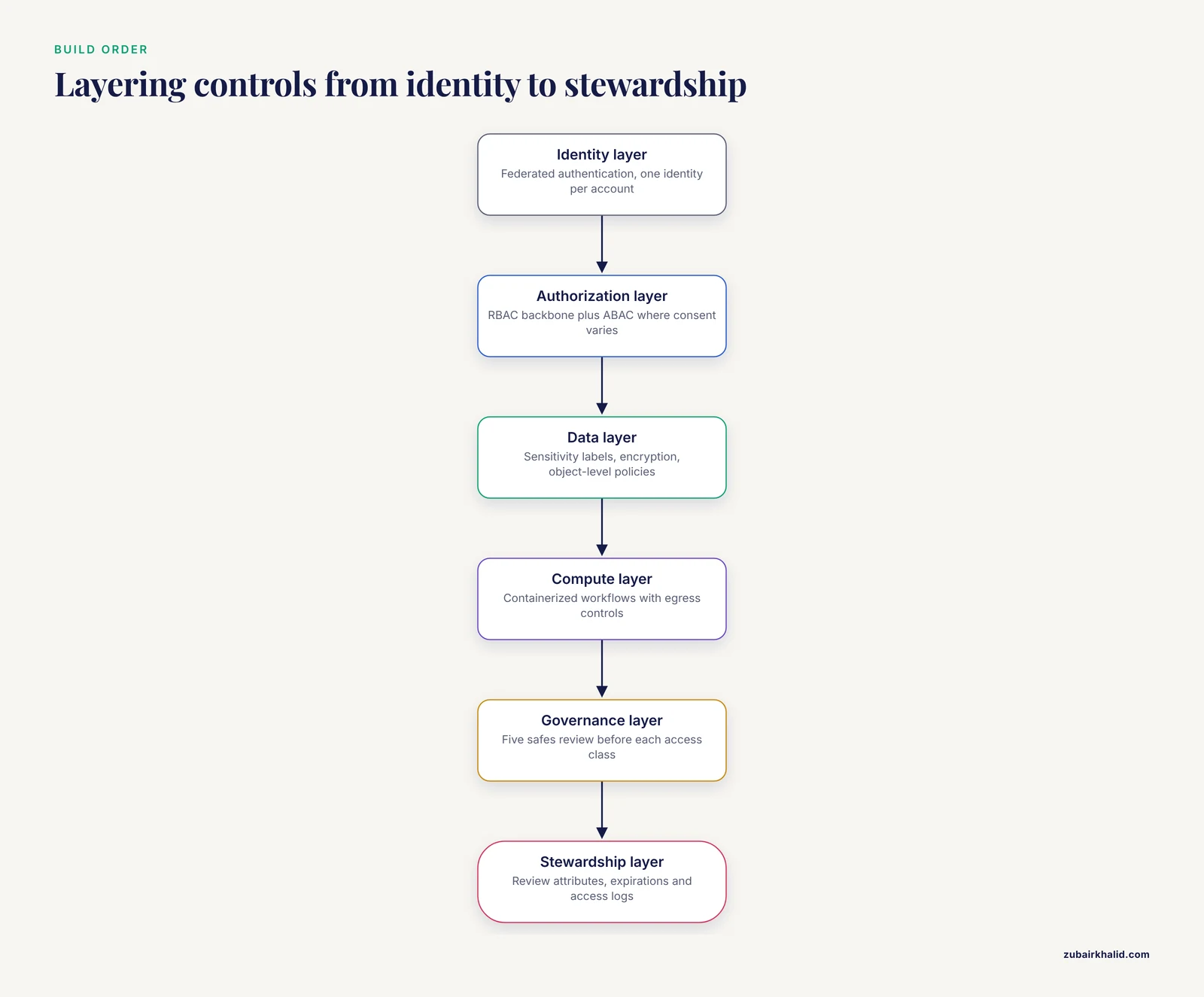
If you are building rather than choosing, layer the controls in this order.
- Identity layer. Federated authentication tied to institutional or research identities. Every human and service account has a single identity.
- Authorization layer. RBAC as the backbone, with ABAC policies where consent terms or dataset sensitivity vary. Every permission grant maps to a documented agreement or role definition.
- Data layer. Sensitivity labels on buckets and tables, encryption at rest and in transit, and object-level policies restricting access to named roles and pipeline service accounts.
- Compute layer. Containerized workflows so that authorized users can only execute versioned, reviewed analysis code, which simultaneously serves reproducibility and security [11]. Egress controls prevent approved compute from copying controlled data outward.
- Governance layer. A five safes review, formal or lightweight, that documents safe people, safe projects, safe settings, safe data, and safe outputs before each new access class is granted [5].
- Stewardship layer. Ongoing review of attribute correctness, agreement expirations, and access logs, consistent with the core stewardship outcomes identified for cloud-based genomic repositories [2].
Teams that skip layers 3 through 6 and rely on identity plus role assignment alone tend to discover the gap during their first security review or data provider audit.
Common Mistakes and Limitations
Treating authentication as authorization. Passing institutional single sign-on proves who a user is. It says nothing about which consent groups they are approved for. Conflating the two is how controlled datasets end up downloadable by anyone with a university account.
Granting bucket-level access where object-level intent exists. A single S3 bucket holding twelve studies with different consent terms cannot be governed by one bucket policy. Partition data by sensitivity and consent first, then attach policies.
Letting service accounts accumulate permissions. Pipeline roles grow one permission at a time until they can read everything. Re-review service account policies on a schedule, and scope each workflow's role to the paths it actually touches.
Ignoring egress. A user authorized to compute on controlled data but able to upload results anywhere can move derived re-identifiable data out of the environment. Output review or egress filtering is part of access control, not an optional extra. The safe outputs dimension of the five safes framework exists for exactly this reason.
Assuming de-identification solves access control. Genomic data is inherently identifying at the population level. Authorization must assume the data is sensitive regardless of identifier stripping, which is the premise behind controlled-access and agreement-based models across the platforms described above [1][4].
Underestimating the legal layer. Access control models enforce policy, they do not write it. If agreements, consent interpretation, and data stewardship processes are missing, no technical model compensates. DS-PACK bundles legal facilitation and data stewardship with its middleware precisely because the technical enforcement alone is insufficient [4].
Overbuilding for a small team. A five-person lab analyzing public reference data does not need ABAC, federation, or a five safes committee. The cost of the wrong model cuts both directions. Over-engineering access control on a small, low-sensitivity workload burns time that security review of the actual high-sensitivity assets would use better.
A limitation of the evidence base. Most published descriptions of access control implementations, including RAPTOR, DS-PACK, GWASHub, and the portals discussed here, report design and rationale rather than quantified security outcomes such as breach rates. Claims that a given model prevents incidents are therefore inferences from design, not measured results [12].
Frequently Asked Questions
What is the best access control model for genomic data in the cloud?
There is no single best model. The best access control genomic data cloud design for most teams is RBAC as the backbone with ABAC policies for consent-sensitive datasets, wrapped in a governance review process. RBAC provides auditable role assignments, ABAC expresses consent terms that roles cannot, and the governance layer aligns access with ethical use requirements documented for cloud-based genomic repositories [2][5].
What are the main access control genomic data cloud options?
The main options are discretionary access control through object store policies, role-based access control through IAM roles and platform roles, attribute-based access control through consent and sensitivity tags, mandatory access control through labeled isolation, federated controlled access where each holding institution enforces its own agreements, and governance overlays such as five safes that sit above any technical model [4][5].
How does AWS handle access control for genomics workloads?
AWS genomics architectures decompose access control across IAM policies for identities, S3 bucket policies for data-plane access, and scoped execution roles for pipeline compute. Production platforms built on AWS, such as GWASHub, pair an AWS MySQL database and S3 storage with private project spaces and distribute analysis jobs to AWS compute under those boundaries [10].
What are the pros and cons of role-based access control for genomic data?
The pros are auditability, simple onboarding, and clean compliance reporting. The cons are role explosion when datasets carry different consent terms, and the inability of a plain role to express purpose-limited use. Teams resolve the cons by splitting datasets into separate projects per consent group or by adding attribute-based policies on top of the roles.
What is a five safes framework and why do genomic repositories use it?
Five safes is a governance framework that checks every access decision across five dimensions: safe people, safe projects, safe settings, safe data, and safe outputs. The Genome Institute of Singapore implemented it in RAPTOR, a cloud-native genomics repository, to give data contributors and users security and governance controls while meeting regulator-mandated access patterns on a commercial cloud provider [5].
How does federated access differ from a central controlled-access archive?
In a central archive, data and access decisions live in one place. In a federation, a central node supports data discovery while distributed nodes handle access requests, conclude agreements with users, and provide secure access to the data they hold. This architecture spread under GDPR pressure, and middleware such as DS-PACK, in production at ELIXIR Luxembourg, makes the controlled-access process reusable for institutions that could not otherwise build it [4].
Sources
- Considerations for Genomic Data Privacy and Security when Working in the Cloud.
- Characterizing core outcomes of responsible stewardship for human genomic data in the cloud.
- St. Jude Survivorship Portal: Sharing and Analyzing Large Clinical and Genomic Datasets from Pediatric Cancer Survivors.
- DS-PACK: Tool assembly for the end-to-end support of controlled access human data sharing.
- A five-safes approach to a secure and scalable genomics data repository.
- Artificial intelligence apps for medical image analysis using pyCERR and cancer genomics cloud.
- Secure secondary utilization system of genomic data using quantum secure cloud.
- Data Interoperability and Harmonization in Cardiovascular Genomic and Precision Medicine.
- Implementing a training resource for large-scale genomic data analysis in the All of Us Researcher Workbench.
- GWASHub: An Automated Cloud-Based Platform for Genome-Wide Association Study Meta-Analysis.
- Containers in Bioinformatics: Applications, Practical Considerations, and Best Practices in Molecular Pathology.
- The Challenges of Data Privacy and Cybersecurity in Cloud Computing and Artificial Intelligence (AI) Applications for EQA Organizations.
- Harmonizing and integrating the NCI Genomic Data Commons through accessible, interactive, and cloud-enabled workflows.