How to Write a Project Summary That Aligns with Funding Priorities
By Dr. Zubair Khalid, DVM, MS, PhD ·

By the end of this article you will be able to write a project summary for grant submission that a program officer and a review panel can screen in under five minutes and score as clearly aligned with the call. You will know which sections to include, how to divide a fixed word limit among them, how to mirror the funder's own priority language without sounding like a brochure, and how to test your draft against the published assessment criteria before you submit.
Have these on hand before you start:
- The funding call document, including the assessment criteria and the exact word or character limit for the summary
- Your project plan, with your aims, methods, team, timeline, and expected outputs already drafted at outline level
- Any reviewer comments from a previous submission of the same or a related idea
- A plain text editor so you can count words precisely, plus the registration number of your trial or protocol if one exists
What a Project Summary Is and Why Reviewers Read It First
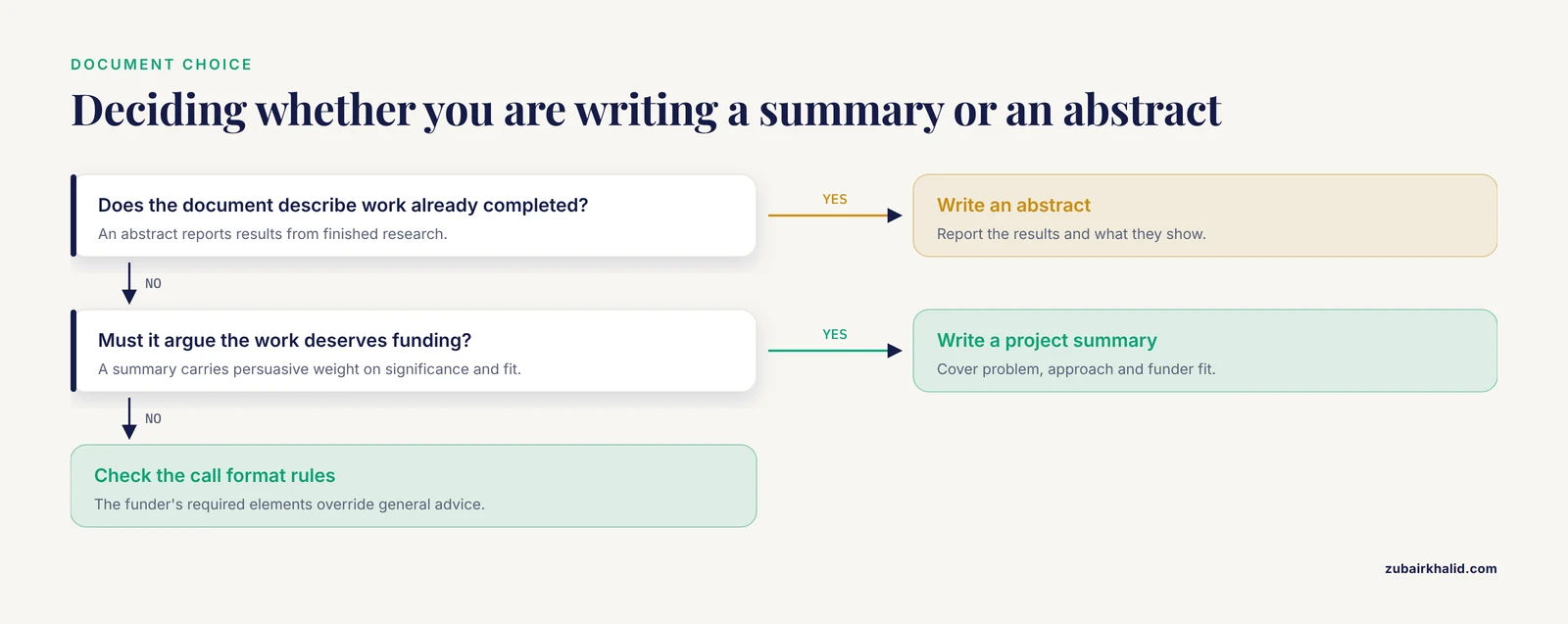
A project summary is the short standalone statement at the front of a grant application, typically one paragraph to one page, that tells a reviewer what you propose, why it matters, how you will do it, and what will change as a result. Many agencies and foundations use the summary as a screening document. Program staff read it to assign the application to a study section or review panel, and reviewers often read it before the full proposal to form a first impression of significance and feasibility.
A summary differs from a scientific abstract in one essential way. An abstract describes completed work and reports results. A project summary describes proposed work and makes a case that the work is worth funding. That means your summary must carry persuasive weight on three fronts at once: the importance of the problem, the soundness of the approach, and the fit between your project and the funder's stated priorities. Published project descriptions show how experienced teams compress all three into a few sentences. The Listen to Me project protocol opens with the scale of health inequity for people with intellectual disability, then names coproduction with people with lived experience as the method, then states the three-year multi-method design underpinned by an implementation science framework [1]. In one paragraph the reader learns the problem, the approach, and the design framework.
Reading the Funding Call Before You Write a Word
Grant proposal planning starts with dissection of the call, not with writing. Extract four things from the call document.
- The stated priority areas. These are usually one to five bullet points, for example disease areas, methodological approaches, career stages, or populations of interest. Copy them verbatim into a working file.
- The assessment criteria and their weights. Many funders publish scoring systems where significance, approach, investigator, and environment are each rated. If significance carries the largest weight, your summary must spend its opening sentences on the problem rather than the methods.
- The format rules. Word limits, character limits, required headings, and required elements such as a trial registration number differ across funders. A summary that exceeds the limit can be administratively rejected before scientific review.
- The funder's mission statement in one sentence. Foundations in particular score applications against mission fit.
Keep this extraction next to you as you write. Every later step in this guide refers back to it.
How to Write a Project Summary for Grant Submission, Step by Step
This walkthrough assumes a summary limit between 250 and 1,000 words, which covers most agency one-page summaries and most foundation letter-of-inquiry summaries. If your limit differs, the proportions still hold.
Step 1: Write the Need Statement From the Funder's Side
Open with the problem, framed in terms the funder has already said it cares about. Use the call's own vocabulary where it is accurate. If the call names a priority such as improving medication safety in older adults, and your project addresses potentially inappropriate medication use in hospitalized patients aged 65 and older, say so in your first two sentences using the call's phrasing.
Real summaries do this well. The POLAR_MI project summary states the aging population context, names drug-related problems and potentially inappropriate medications as the target, and then describes a retrospective analysis of electronic health records from 2018 to 2021 at ten German university hospitals covering 166,126 cases [2]. The reader moves from public health context to data source to sample size in three sentences.
Step 2: State the Gap in One or Two Sentences
After the need, state precisely what is unknown or unavailable. A gap statement has three usable shapes:
- Evidence gap: the phenomenon is described but the causal link is untested
- Tool gap: the measurement instrument or intervention does not exist or excludes a population
- Translation gap: evidence exists but is not applied in practice
The Listen to Me protocol illustrates the tool gap shape. Systematic review evidence confirms that people with intellectual disability are excluded from patient-reported experience measures because suitable instruments and supports are lacking, so the project will coproduce measures designed for and with that population [1]. The gap and the solution are the same sentence, which is the strongest form.
Step 3: State Your Objective as a Measurable Aim
One sentence. An objective that cannot fail is not an objective. Compare these two versions:
Weak:   "This project will advance understanding of nutritional risk
         in gastrointestinal cancer."

Strong: "This project will derive body composition profiles with
         unsupervised machine learning in 189 gastrointestinal cancer
         patients and test their association with malnutrition risk
         and quality of life."
The strong version names the method, the population, the sample, and the outcomes. The NUTRISCREEN summary does exactly this, describing a cross-sectional analysis of patients enrolled through a registered trial, with malnutrition assessed by the NRS-2002 tool and quality of life by the EORTC QLQ-C30 questionnaire [3]. Every element a reviewer needs to judge feasibility is present in the aim sentence itself.
Step 4: Describe the Design With Concrete Numbers
This is where most summaries fail. Reviewers screening for feasibility look for a design they can picture. Include, in proportion to their importance:
- Study design in standard terminology (cross-sectional, prospective cohort, mixed-methods pilot, retrospective analysis of electronic health records)
- Population and sample size, or data source and case count
- Time frame
- Primary exposure and outcome, named specifically
- Analysis approach at the level a non-specialist can verify as sensible
The Project Ice Storm summary shows how distinctive framing earns attention. Mothers exposed to a severe 1998 ice storm were followed prospectively, and offspring whose prenatal stress exposure could be quantified through objective hardship and subjective distress measures underwent MRI assessment of hypothalamic-pituitary-gonadal axis structures at age 18.5 years, alongside salivary hormone measurements [4]. A reviewer reading those sentences immediately understands why the study can answer a question no ordinary cohort can.
When your project uses a framework, name it. Framework names are shorthand that reviewers recognize and that signal methodological discipline. The migraine guideline summary names the GRADE approach for assessing evidence quality and the Cochrane review methods for the underlying systematic review [5]. In mixed-methods applications, state the integration plan explicitly. The shared electronic health record evaluation specifies an explanatory sequential and convergent approach across a 12-month pilot in 35 community pharmacies and 31 general practices, with activity logs, surveys, and semi-structured interviews [6]. That level of design detail in a short summary tells the panel the full proposal will be coherent.
Step 5: Connect the Expected Outcome to the Funder's Priority
Write one or two sentences on what changes if the work succeeds. Match each expected outcome to a stated call priority. A useful construction is:
"This directly addresses the call's priority of [priority phrase, quoted] by [specific mechanism]."
Be concrete without overstating. The NUTRISCREEN team positions body composition analysis as something that may integrate with nutritional risk assessment rather than replace it, and labels their gender-stratified finding as exploratory [3]. Honest hedging in the right places builds reviewer trust, and panels can detect overselling at a glance.
Step 6: Add the Credibility Markers Reviewers Scan For
These are short, factual, and often overlooked:
- Trial or protocol registration numbers, such as a ClinicalTrials.gov identifier. The NUTRISCREEN summary includes its registration ID, which signals that the protocol was fixed in advance [3].
- Cohort infrastructure, if your project builds on an established community-engaged resource. The PRIDE Study summary identifies itself as a community-engaged longitudinal cohort of sexual and gender minority adults, which itself addresses funder priorities for population health equity and engaged research [7].
- Named data sources and their scale, as the POLAR_MI team did by specifying ten university hospitals and a defined case count [2].
Step 7: Assemble and Enforce a Word Budget
Distribute your limit before you write, then write to the budget. A common allocation for a 500-word summary looks like this:
| Section | Share of words | Words in a 500-word summary | Question it answers |
|---|---|---|---|
| Need and gap | 20% | 100 | Why should the funder care? |
| Objective and aims | 15% | 75 | What exactly will you do? |
| Design and methods | 35% | 175 | How will you do it credibly? |
| Expected outcomes and priority alignment | 20% | 100 | What changes, and why this funder? |
| Team, timeline, and registration markers | 10% | 50 | Can this team deliver? |
To compute the budget for any limit, multiply the limit by each percentage:
# Example: 1,000-word limit
Need and gap:            1000 * 0.20 = 200 words
Objective and aims:      1000 * 0.15 = 150 words
Design and methods:      1000 * 0.35 = 350 words
Outcomes and alignment:  1000 * 0.20 = 200 words
Team and markers:        1000 * 0.10 = 100 words
Total:                                 1000 words
Step 8: Run the Alignment Check
Before you show the draft to anyone, verify mechanically that the call's priority language appears in your summary and that each assessment criterion is addressed at least once. A simple text check works:
# Save your summary as summary.txt and the call priorities as call.txt
# Count the words in your draft
wc -w summary.txt
# Expected output (example):
# 487 summary.txt

# List the priority terms from the call, one per line, in call.txt
# Check which terms appear in your draft
grep -i -f call.txt -o summary.txt | sort | uniq -c
# Expected output (example):
#   3 medication safety
#   2 older adults
#   1 implementation
If a priority term is absent, either your project genuinely addresses it under different words (in which case use the funder's word) or it does not address it (in which case reconsider the fit before investing more time in the application). Poor fit is the most common reason scientifically sound projects are never discussed at panel.
Step 9: Read It as a Reviewer Would
Print the summary alone, without the rest of the application. Answer four questions in the margins:
- Could I state the objective in one sentence after one reading?
- Do I believe the team can execute the design as described?
- Can I name which call priority this addresses?
- Is any claim unsupported or overstated?
If any answer is no, revise that section, not the whole document.
Step 10: Circulate for Two Types of Feedback
Ask one reader who knows the science and one reader who does not. The science reader checks technical accuracy. The non-specialist reader checks whether the need and the objective are clear to someone outside your subfield, which is exactly the position of many panel members and program staff. Then revise once, re-run the alignment check from Step 8, and stop. Summaries improve through subtraction.
A Worked Example: Rebuilding a Weak Summary
Suppose your draft opening reads:
"Obesity and multimorbidity are major challenges. Our project will use novel approaches and cutting-edge methods to generate important insights with broad impact."
Compare the structure of a strong published summary on a comparable topic. The migraine guideline summary opens by naming the deliverable (evidence-based guidelines), the developer and end user (created by professional societies to offer clear, actionable recommendations to healthcare professionals), the evidence method (randomized controlled trials incorporated through the GRADE approach), and the gap it addresses, such as the paucity of head-to-head drug comparisons [5]. Nothing is novel-sounding and empty. Every phrase points to something checkable.
Rebuild your draft the same way:
Before: "Our project will use novel approaches to generate important
         insights."

After:  "This project will evaluate whether granting community
         pharmacies read-and-write access to shared electronic health
         records improves care coordination, using a 12-month
         mixed-methods pilot across 35 pharmacies and 31 practices
         with activity logs, surveys, and interviews."
The second version is longer per sentence but shorter overall, because it replaces three vague claims with five checkable facts of the kind the published EHR evaluation contains [6].
Common Mistakes and Limitations
These are the errors that most often cost fundable projects their summary score.
Restating the full proposal. A summary is not a compressed version of every section. It is a screening document. If your summary attempts to cover your budget justification or your full analysis plan, it will exceed its limit and blur its argument.
Vague significance claims. Phrases such as novel, cutting-edge, and broad impact carry no scoring weight because they cannot be checked. Replace each one with a fact.
Ignoring the funder's exact language. If the call says implementation science and you write translational research, a program officer doing a first-pass sort may misroute your application. Use the call's term first, your preferred synonym second.
Methods detail without outcomes. A methods-only summary reads as a plan without a destination. Every design sentence should exist to support a stated outcome.
Missing feasibility anchors. Sample sizes, data sources, time frames, and registration numbers are what let a reviewer judge deliverability. The strongest summaries in real projects carry a number in nearly every sentence, from the 224 mothers in the ice storm cohort to the 166,126 hospital cases in the medication safety analysis [4] [2].
Writing the summary last, at midnight, the day the application is due. The summary is the highest-leverage page in the application. Write it early, in parallel with grant proposal planning, and revise it after every other section changes, because aims evolve and the summary must match the final aims exactly.
Reusing one summary across funders without realignment. Funders within a field differ in what they prioritize, even when the science is identical. A methods-focused agency needs a methods-forward summary. A mission-driven foundation needs an outcomes-forward summary. Budget fifteen minutes per funder for realignment, and re-run the alignment check each time.
One honest limitation applies to this guidance. Funder formats vary in structure and evaluation, and the criteria of a specific program always override general advice. Read the current call document for your target program, and treat the proportions and checklists here as defaults to adjust, not rules to obey. For individual applications with unusual constraints, a program officer or your institution's research development office can give guidance specific to that call.
Where Structured Training Fits
If you are building this skill systematically, a research grant writing course typically covers three areas that a single article cannot: live review of your own draft by former reviewers, funder-specific formats and scoring rubrics, and practice with the full application narrative beyond the summary. Courses offered through research development offices, professional societies, and university centers vary widely, so ask whether participants get written feedback on a real draft. Pair any course with reading strong published summaries in your field. Project protocols and summaries are public in journals, and reading a dozen of them, marking where each sentence moves from problem to method to outcome, teaches structure faster than any template.
Frequently Asked Questions
How long should a grant project summary be?
Follow the funder's stated limit exactly, which is usually between 250 and 1,000 words. If no limit is stated, one page is the safe default.
What is the difference between a project summary and an abstract?
An abstract describes completed research and reports results, while a project summary describes proposed work and argues that it deserves funding.
When in grant proposal planning should I write the summary?
Write a first draft after your aims and design are outlined but before the full narrative, then revise it after the full proposal is complete so it matches the final aims word for word.
How do I find the funding priorities in a call for proposals?
Look for the priority areas, assessment criteria, and mission statement sections of the call document, and copy the priority phrasing verbatim into your working notes before drafting.
Can I reuse the same project summary for different funders?
You can reuse the core content, but realign the need statement, expected outcomes, and vocabulary with each funder's stated priorities and re-run your alignment check for every submission.
How many citations should a project summary include?
Only the few that a screening reader needs, typically one to five for the key evidence behind the need statement, because most funders treat the summary as a non-cited or lightly cited argument rather than a review.
Should the summary mention expected results before any data exist?
Yes, state expected outcomes and their connection to the funder's priorities, but phrase them as expected or anticipated rather than proven, and keep the hedging honest.
Do research grant writing courses help with summaries?
Yes, especially those that provide written feedback on your actual draft from experienced reviewers, because summary quality depends on calibration to reviewer expectations that reading alone rarely supplies.
Sources
- Co-Producing Patient-Reported Experience Measures With People With Intellectual Disability to Improve Healthcare Quality and Outcomes: The 'Listen to Me' Project Protocol.
- Use of Potentially Inappropriate Medication and Association with Falls During Hospitalisation: An Analysis Based on Electronic Health Records (POLAR_MI project).
- Exploring Body Composition Profiles in Patients with Gastrointestinal Cancers: A Cross-Sectional Analysis of the NUTRISCREEN Project.
- Prenatal maternal stress is associated with alterations in the structural integrity of the hypothalamic-pituitary-gonadal axis 20 years later: Project Ice Storm.
- Evidence-based guidelines for the pharmacological treatment of migraine, summary version.
- A mixed methods evaluation of a shared electronic health record between general practice and community pharmacy.
- Methods of family building used by sexual and gender minority adults in the United States.