University Project Management Programs for Scientists
By Dr. Zubair Khalid, DVM, MS, PhD ·
The transition from brilliant scientific hypothesis to a successful, funded, and completed research project requires more than just technical expertise. It demands rigorous project management skills. The one-sentence difference between a skilled scientist and a project leader is the ability to define scope, manage complex stakeholders, and mitigate risk across timelines and budgets. The rule of thumb for choosing a program is this: if your primary challenge is technical execution, choose a highly applied, hands-on workshop; if your primary challenge is strategic direction or interdisciplinary coordination, choose a formal, structured certification program.
The Imperative for Structured Research Project Management
Scientific research, particularly in modern translational and clinical settings, is inherently complex. It is not merely a linear sequence of experiments. It is a dynamic system involving multiple moving parts: highly specialized personnel, fluctuating funding cycles, unpredictable experimental outcomes, and a vast array of regulatory requirements [1]. A lack of formal project management training can lead to scope creep, missed deadlines, resource mismanagement, and ultimately, research failure, even when the underlying science is sound.
Project management in science translates abstract scientific goals into actionable, measurable deliverables. It provides the framework to answer fundamental questions: Who is responsible for what? When must this milestone be met? What happens if the primary hypothesis fails?
Core Components of Scientific Project Management
Effective research project management relies on mastering several key domains. These concepts, drawn from successful large-scale studies and educational models, form the backbone of any robust project plan.
- Scope Definition: This involves clearly articulating what the project will and will not achieve. For a clinical trial, this means precisely defining the patient population, the intervention, and the primary endpoints [2]. In a basic science project, it means defining the specific mechanisms to be tested and the acceptable margin of error.
- Stakeholder Management: Science often involves diverse groups: principal investigators, lab technicians, funding agencies, clinical partners, and regulatory bodies. Successful management requires understanding the needs and expectations of every group, from the junior lab assistant to the funding body [3].
- Risk Management: All research carries inherent risks, from equipment failure to unexpected biological variability. Project management requires proactively identifying potential failure points and developing contingency plans. For example, if a primary assay fails, what is the backup methodology?
- Quality Assurance and Standardization: Maintaining high standards is non-negotiable. This includes standardizing procedures to ensure reproducibility and using automated systems to reduce human error. An automated imaging response evaluation system, for example, uses standardized criteria like RANO (Response Assessment in Neuro-Oncology) to ensure fast, reliable, and reproducible assessments in glioblastoma clinical trials, reducing manual error [4].
- Evaluation and Metrics: Success must be quantifiable. Whether measuring patient satisfaction, adherence to a protocol, or the sustained performance of a clinical intervention, clear metrics are essential. Framework-based evaluations, such as Moore's Level 5 framework, allow for examining sustained performance change in healthcare providers across multiple competencies [5].
University Project Management Programs for Scientists Options
When looking for university project management programs for scientists, the options generally fall into four distinct categories. The best university project management programs for scientists will tailor their content to the unique demands of the life sciences.
1. Formal Certificate and Master’s Programs (The Academic Path)
These programs offer the most comprehensive, academically rigorous training. They are ideal for scientists aiming to move into research management roles, such as Program Director, Principal Investigator (PI), or Research Operations Manager. They focus on theory, methodology, and organizational structure.
- Focus: Advanced project lifecycle management, statistical analysis of project data, governance, and compliance.
- Structure: Usually semester-based, involving lectures, case studies, and capstone projects.
- Pros: Provides deep theoretical grounding; highly valued for career advancement into management roles.
- Cons: Time-intensive; may be less immediately applicable to day-to-day lab tasks without significant self-directed application.
2. Applied Workshop Series (The Skill Booster Path)
These shorter, intensive programs are designed for scientists who need specific tools and techniques applied directly to their current research challenges. They focus on immediate, actionable skills.
- Focus: Specific deliverables like creating a detailed research project plan template, writing grant proposals, risk assessment matrices, and running effective meetings.
- Structure: Short, modular sessions (e.g., 1-3 days) often delivered virtually or on campus.
- Pros: High immediate applicability; cost-effective for individual skill acquisition.
- Cons: Lacks the deep theoretical context of a formal degree; effectiveness depends heavily on the quality of the specific modules offered.
3. Self-Paced Online Learning Platforms (The Flexible Path)
These programs leverage technology to deliver content asynchronously. They are perfect for working researchers who cannot commit to fixed schedules.
- Focus: Foundational concepts, tool usage (like Gantt charts or Kanban boards), and best practices in collaboration.
- Structure: On-demand modules, often delivered via learning management systems.
- Pros: Maximum flexibility; allows for continuous learning alongside demanding research schedules.
- Cons: Requires high self-discipline; lacks the immediate, personalized feedback of in-person mentorship.
4. Implementation Science and Process Improvement Cohorts (The Optimization Path)
This specialized path is designed for scientists focused on translating basic discoveries into real-world impact, such as improving clinical protocols or scaling public health interventions. These programs often use methodologies like Design Thinking or Quality Improvement (QI) cycles.
- Focus: Evaluating real-world effectiveness, change management, and optimizing existing systems. This includes methodologies like the Delphi approach, which uses a structured survey and consensus-building process to define priority metrics among global experts [6].
- Structure: Often collaborative, involving real-world data analysis and iterative feedback loops.
- Pros: Directly addresses the challenges of scaling research; highly relevant for translational science.
- Cons: Requires a willingness to engage with non-scientific stakeholders (policymakers, patients, industry).
Comparative Analysis of Project Management Options
The following table provides a side-by-side comparison to help determine the best university project management programs for scientists based on specific needs.
| Feature | Formal Certificate/Master's | Applied Workshop Series | Self-Paced Online Learning | Implementation Science Cohort |
|---|---|---|---|---|
| Primary Goal | Career transition to management | Solving immediate project hurdles | Foundational knowledge acquisition | System optimization and scale |
| Time Commitment | High (Months to Years) | Low to Medium (Days to Weeks) | Variable (Self-directed) | Medium to High (Iterative) |
| Depth of Knowledge | Deep and Comprehensive | Specific and Tactical | Broad and Foundational | Interdisciplinary and Contextual |
| Best Suited For | Aspiring Program Directors, Senior PIs | Researchers with immediate project bottlenecks | Busy researchers needing foundational skills | Translational scientists, Public Health researchers |
| Key Output | Formal degree/certification | Actionable project plan/toolkit | Mastery of specific tools/concepts | Scalable intervention protocols/QI reports |
| Typical Focus | Governance, Finance, Risk Modeling | Scheduling, Risk Mitigation, Reporting | Basic terminology, Workflow mapping | Stakeholder engagement, Change management |
Worked Scenarios for Choosing a Program
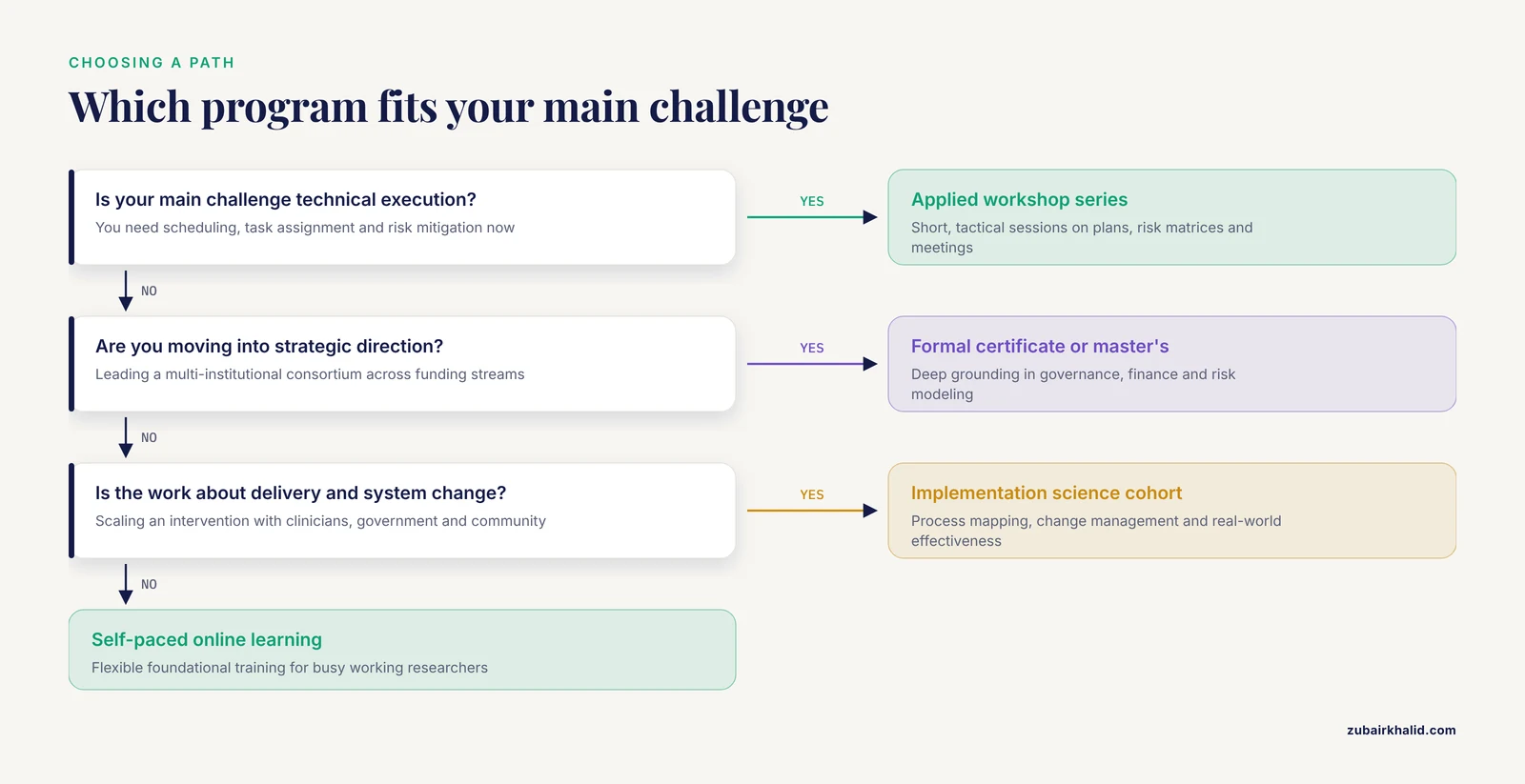
- Scenario A: Dr. Smith, a post-doctoral researcher, has just been awarded a multi-year grant for a complex, interdisciplinary study involving genomics and clinical data. He needs to structure the timeline, assign tasks to three different lab teams, and prepare a robust risk assessment.
- Recommendation: Applied Workshop Series. He needs immediate, tactical skills in scheduling, task assignment, and risk mitigation, not a full MBA.
- Scenario B: Dr. Jones, a senior faculty member, wants to transition from being a primary researcher to leading a multi-institutional consortium that manages dozens of projects across different funding streams.
- Recommendation: Formal Certificate/Master’s Program. The complexity of institutional governance and financial oversight requires deep, structured knowledge.
- Scenario C: Dr. Chen, a lab manager, needs to ensure all lab staff understand the standardized protocol for data entry and equipment usage to reduce errors and improve workflow efficiency.
- Recommendation: Self-Paced Online Learning Platform. She needs a scalable, repeatable training tool that staff can access on their own time.
- Scenario D: Dr. Miller, a public health researcher, is leading a project to improve the delivery of a new medical intervention in a community setting, requiring collaboration between clinicians, local government, and community leaders.
- Recommendation: Implementation Science Cohort. This focus is on the process of delivery and system change, which is the core of implementation science.
Deconstructing the Research Project Plan Template
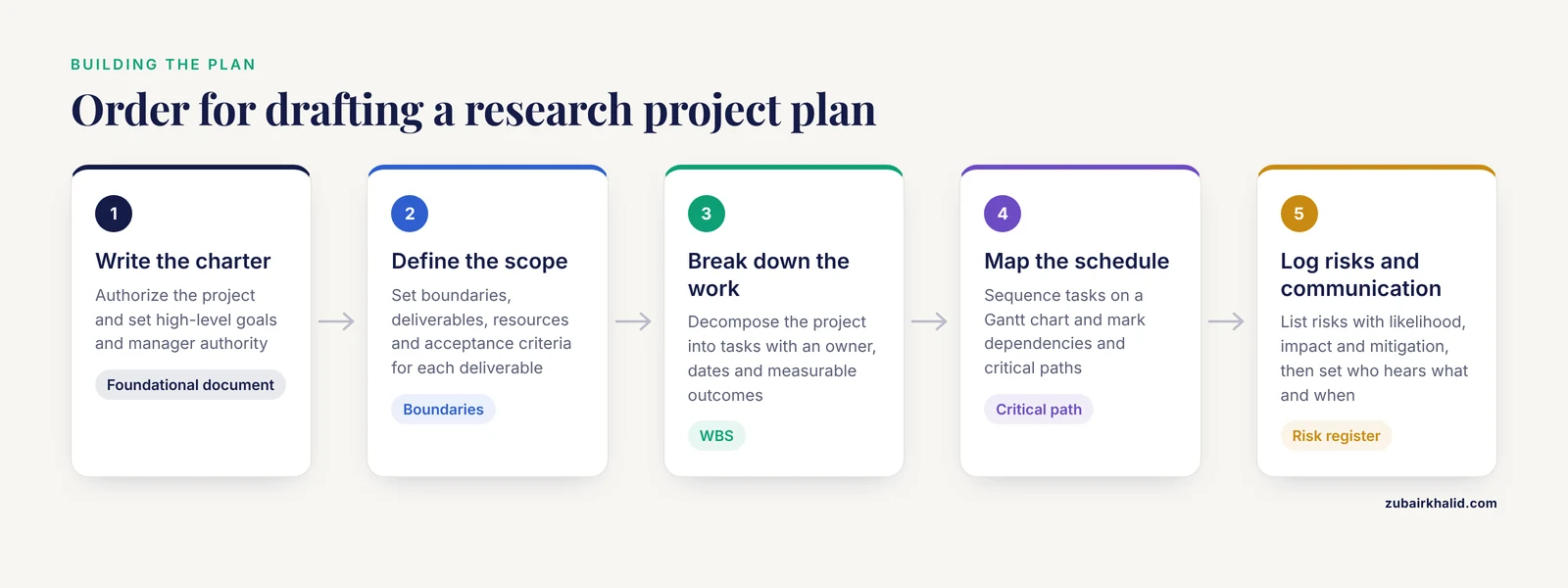
A strong research project plan template is not a static document. It is a living, dynamic tool that evolves as new data emerges. While specific templates vary, a comprehensive plan must integrate the following elements:
- Project Charter: This is the foundational document that formally authorizes the project. It defines the high-level goals, the business case for the research, and the project manager's authority.
- Scope Statement: This defines the boundaries. It details the specific deliverables, the required resources (personnel, equipment, budget), and the acceptance criteria for each deliverable.
- Work Breakdown Structure (WBS): This decomposes the entire project into smaller, manageable pieces (tasks). Each task should have a clear owner, a defined start and end date, and measurable outcomes.
- Schedule/Timeline (Gantt Chart): This visual tool maps the sequence of tasks and identifies dependencies. It allows the team to see critical paths, where delays in one area will impact the entire project.
- Resource Allocation Matrix: This lists all required resources (personnel, software, consumables) and assigns them to specific tasks.
- Risk Register: This is a critical component. It lists potential risks, assesses their likelihood and impact, and outlines mitigation strategies. For instance, a risk might be "failure of the automated imaging response evaluation system [4] due to software bug," and the mitigation strategy would be "pre-testing on a separate validation dataset."
- Communication Plan: This dictates who needs to know what, when, and how. It prevents information silos and ensures all stakeholders are aligned, from the lab technician to the funding agency.
Deep Dive into Advanced Scientific Project Management Methodologies
The best university project management programs for scientists do not just teach generic scheduling; they integrate methodologies specific to the scientific method.
1. Consensus-Driven Priority Setting (The Delphi Method)
When a research project involves highly complex, emerging technologies, defining the most important metrics can be subjective. The Delphi method is a structured communication technique used to achieve consensus among a panel of experts.
In one study comparing artificial intelligence-based computer-aided detection (CADe) programs in colonoscopy, researchers used a modified Delphi approach [6]. They gathered 121 scoring criteria from 25 global leaders. They then conducted multiple rounds of ranking and open comment to narrow these down to the final six highest priority criteria. This method ensures that the project's evaluation metrics are not dictated by a single bias but by the collective expertise of the field. This is a powerful technique for defining success in highly uncertain scientific environments.
2. Implementation Science and Process Mapping
Translational research often fails not because the science is flawed, but because the delivery of the intervention is poor. Implementation science programs teach scientists how to move from "proof of concept" to "real-world efficacy."
The IMP(2)ART programme, for example, was a UK-wide trial evaluating an implementation strategy to improve self-management support for asthma [7]. They used detailed observational methods, including video-recordings and specific observation forms, to quantify how healthcare professionals actually delivered patient-centered care. This moves project management beyond "did the intervention work?" to "how well did we implement the intervention?" By mapping the process, they could identify gaps in delivery.
3. Standardized Assessment and Automation
In high-stakes research, such as cancer trials, consistency is paramount. Manual assessments are time-consuming and prone to inter-observer variability.
The Automated Imaging Response Evaluation System (AIRES) is an example of how project management can leverage technology to enforce standardization. AIRES applies standardized criteria, such as mRANO (modified Response Assessment in Neuro-Oncology), to automatically categorize tumor changes on MR images [4]. This automation reduces the need for extensive manual training and minimizes human error, streamlining the workflow and increasing the reliability of the trial results.
4. Managing Interprofessional and Multi-Site Teams
Large-scale clinical research requires coordinating diverse teams, often across different hospitals or countries. This demands robust communication and validation processes.
When evaluating new diagnostic tools, such as the BD FACSPresto™ point of care CD4 analyzer, project managers must assess not just the technical validity against a reference standard, but also the feasibility of use among non-laboratory personnel [8]. Furthermore, in large international collaborations, project managers must account for external pressures, such as "force majeure." During a pandemic, a citizen science project had to re-think experiential learning by pivoting to online MOOCs and webinars to maintain engagement and mitigate the handicap of reduced face-to-face interaction [9].
Common Mistakes and Limitations
Even with the best training, research project management is challenging. Scientists often make predictable errors that can derail even the most promising projects.
Overlooking the Human Element
A common mistake is treating the project as a purely technical exercise. While schedules and budgets are important, the human element, the skill, motivation, and retention of the scientific workforce, is critical [1]. Program managers must recognize the unique challenges faced by clinician-investigators, who must balance demanding clinical duties with the rigors of research, and develop strategies to support their dual obligations [1].
Scope Creep
Scope creep occurs when new features or requirements are added to a project after the scope has been defined, often without corresponding adjustments to time or budget. This is particularly prevalent in exploratory research, where the initial hypotheses may lead to exciting, but unplanned, avenues of investigation. A disciplined project manager must have a formal change request process to evaluate any proposed scope change against the project's core objectives.
Underestimating Methodological Rigor in Evaluation
A project may successfully deliver a product, but if the evaluation framework is weak, its impact is unknown. For instance, when evaluating a new educational program for health care providers, one must use rigorous methods like Moore's Level 5 to assess not just immediate knowledge gain, but sustained performance change at a six-month follow-up [5]. Similarly, when reviewing systematic literature, using tools like the AGREE-II critical appraisal tool is necessary to ensure the quality of the evidence being used for training guidelines [10].
Limitations of Current Data
It is important to note that while project management principles are highly transferable, specific data regarding the cost or exact implementation success of every university project management program is highly variable. Furthermore, when analyzing health outcomes, researchers must be mindful of confounding variables and the limitations of study design. For example, when assessing the impact of a voucher scheme, researchers must account for lived experiences and complex data linkage challenges to capture a full picture of effectiveness [11]. Individual cases always require expert clinical judgment and cannot be generalized solely from project management data.
Frequently Asked Questions
How do I start writing a research project plan template?
You begin by drafting a formal project charter that defines the high-level goals and objectives of your research. Next, you conduct a detailed scope definition to establish the boundaries of the project, followed by a Work Breakdown Structure to decompose the entire project into manageable tasks.
Should I choose a formal certificate or a short workshop?
The choice depends on your career goal. Select a formal certificate or Master's program if you intend to move into high-level research management or leadership. Choose a short workshop if you need immediate, tactical skills to solve a specific bottleneck in your current project.
How do I handle unforeseen risks in my research project?
Effective risk management requires a dedicated risk register. In this register, you must list potential risks, estimate their likelihood and impact, and, most importantly, develop specific mitigation strategies to minimize the negative effects before the risk occurs.
Can project management skills be applied to basic science research?
Yes, they are applicable to all phases of research. Project management provides the necessary structure to manage the lifecycle of any scientific endeavor, from the initial hypothesis development and resource allocation to the final data analysis and publication strategy.
What is the difference between project management and scientific methodology?
Scientific methodology focuses on the process of discovering new knowledge, ensuring internal validity, and testing hypotheses. Project management focuses on the process of delivering a defined outcome, whether that outcome is a paper, a clinical trial, or a software tool, on time, within budget, and to the required standard.
How do I ensure my research project stays focused on its goals?
The most effective way to maintain focus is through rigorous scope definition and continuous progress tracking against your defined deliverables. Use a clear communication plan and hold regular check-ins against your project plan template to catch deviations early.
Sources
- Clinician-Investigator Training and the Need to Pilot New Approaches to Recruiting and Retaining This Workforce.
- Clinical and economic evaluation of laparoscopic surgery compared with medical management for gastro-oesophageal reflux disease: 5-year follow-up of multicentre randomised trial (the REFLUX trial).
- Improving equity in respiratory disease outcomes in Africa using data-driven tools: National Institute of Health Care and Research's (NIHR) EQUI-RESP-AFRICA project.
- Automated imaging response evaluation system: Prototype software tool for standardized radiographic response assessment in glioblastoma clinical trials.
- Performance Change in Treating Tobacco Addiction: An Online, Interprofessional, Facilitated Continuing Education Course (TEACH) Evaluation at Moore's Level 5.
- Creating a standardized tool for the evaluation and comparison of artificial intelligence-based computer-aided detection programs in colonoscopy: a modified Delphi approach.
- Delivery of Supported Self-Management in Primary Care Asthma Reviews: Insights From the IMP(2)ART Programme.
- Performance evaluation of BD FACSPresto™ point of care CD4 analyzer to enumerate CD4 counts for monitoring HIV infected individuals in Nigeria.
- Force majeure impact on citizen science: Perspective from an EU funded project.
- Methodologic Quality of Guidelines for Training or Competence Processes for Basic Point-of-Care Echocardiography in Critical Care: A Systematic Review of the Literature.
- Evaluation of the Healthy Start voucher scheme on maternal vitamin use and child breastfeeding: a natural experiment using data linkage.