How to Create a Lab Report Template for Undergraduate Students
By Dr. Zubair Khalid, DVM, MS, PhD ·
By the end of this article you will be able to build a complete undergraduate lab report template, adapt it to intro biology, chemistry, or an upper-level research course, attach a grading rubric, and distribute it to students as a document or as a lab notebook template PDF. You need a word processor (Microsoft Word, Google Docs, or LibreOffice), a plain-text editor if you want a version students can fill in digitally, and your course syllabus so the template matches your learning objectives.
A template is not a formality. Structured reporting is one of the skills that course-based undergraduate research experiences are designed to build, and students in these courses report large gains in knowledge, experience, and confidence when the reporting expectations are clear. The same principle applies at every level, from a first-year biology bench practical to a semester-long independent project.
Why a Template Improves Student Writing
Students write better lab reports when the structure is predictable. Without a shared scaffold, an instructor spends most of the grading time explaining where content belongs rather than evaluating scientific reasoning. A good undergraduate lab report template solves three problems at once.
First, it makes the intellectual moves explicit. A report is not a diary of what happened in lab. It is an argument with a fixed shape: here is the question, here is how I addressed it, here is what I observed, here is what it means. When the section headings carry those moves, students learn the genre instead of guessing at it.
Second, it supports skill development that instructors can actually measure. In a biochemistry course-based research experience spanning five semesters and more than 300 students, over 90% of students reported increased knowledge, experience, and confidence in the anticipated learning outcomes, including the ability to interpret wet-lab experiments and apply bioinformatic techniques. Those gains depend on assignments that repeatedly ask students to organize evidence, which is exactly what a reusable research template does.
Third, it reduces cognitive load during lab itself. When students know the report structure in advance, they collect data with the end product in mind. Project-based laboratory modules that run across multiple weeks, where students carry a real research question from cloning through fermentation and quantification, rely on this alignment between the experiment and the report that follows it.
The Standard Undergraduate Lab Report Template Format
Most science faculty expect the IMRAD structure: Introduction, Methods, Results, and Discussion, bookended by a title page and a reference list. This undergraduate lab report template format works across biology, chemistry, neuroscience, and biochemistry courses. Here is what belongs in each section.
Title and Author Block
The title should state the variables or the system, not "Lab 3." Compare "Lab 3: Enzymes" with "Effect of Temperature on Peroxidase Activity in Turnip Extract." The block should capture the course number, experiment dates, author names, lab partners, and the submission date. Group contracts and authorship expectations belong here too, which matters because collaboration skills in laboratory courses are increasingly assessed directly rather than assumed.
Abstract
A single paragraph of 150 to 250 words that answers four questions in order: what question did the study ask, what did you do, what did you find, and what does it mean. Students should draft the abstract last, even though it appears first.
Introduction
Three paragraphs cover background with citations, the specific gap or question, and an explicit hypothesis with a testable prediction. In courses built around primary literature modules, the introduction is where students practice the short literature review that real research papers require.
Materials and Methods
Written in past tense, in enough detail that a peer could repeat the work. This section includes reagents and concentrations, equipment models, the actual procedure as performed rather than as photocopied from the manual, and the analysis plan, meaning the software and statistical test used. Teaching students to document methods as performed is also where safety documentation habits begin, because a methods section that names specific chemicals forces a student to know what they handled.
Results
Text that describes figures and tables without interpreting them, in past tense. Every figure gets a numbered caption that stands on its own. Raw data belongs in an appendix, not in the body.
Discussion
Restate the main finding, compare it with published results, name the limitations and likely sources of error, and propose a concrete next experiment. A common instructor complaint is that students treat the discussion as a conclusion paragraph. Prompt lines inside the template prevent that.
Build Your Template Step by Step
The fastest way to create a template you can reuse every semester is to write it once in Markdown, then convert it to the format your students use. Markdown is plain text, so it opens in any editor, and free tools convert it to Word, PDF, and HTML.
Step 1: Write the Skeleton in Markdown
Open any plain-text editor and create a file called lab-report-template.md with this content:
# [Title: Name the Variables and the System]

**Course:** [Course number and name]
**Experiment dates:** [Start date] to [End date]
**Author:** [Your name, student ID]
**Lab partners:** [Names]
**Submitted to:** [Instructor name]
**Date submitted:** [Date]

## Abstract
[150 to 250 words. Question, approach, main result with numbers, conclusion.]

## Introduction
- Paragraph 1: Background and significance. Cite at least two sources.
- Paragraph 2: What is known and what remains unresolved.
- Paragraph 3: Hypothesis and specific prediction.

## Materials and Methods
### Reagents and Organisms
[Names, suppliers, concentrations.]
### Equipment
[Instrument names and models.]
### Procedure
 [Describe what was actually done, in order, past tense.]
 [Continue for each step.]
### Data Analysis
[Software used. Statistical test. Significance threshold.]

## Results
[Describe Figure 1, then Table 1. State findings. No interpretation here.]

**Table 1.** [Caption describing the table in one sentence.]

**Figure 1.** [Caption describing the figure in one sentence.]

## Discussion
- Paragraph 1: Main finding restated plainly.
- Paragraph 2: Comparison with published literature. Cite sources.
- Paragraph 3: Limitations and sources of error.
- Paragraph 4: Next experiment and why it follows from this one.

## Discussion
[5] State your main finding in one sentence, with the key number.
[1] How does your result compare with the published value or the
   expected direction? Cite the paper you are comparing against.
[6] Name two specific sources of error and state the direction
   each would shift your result.
[7] Propose one follow-up experiment and state what it would test.
This structure mirrors how laboratory modules built around open-ended research projects scaffold reporting, where students generate their own data sets and then present them as short research papers or traditional reports with a brief literature review [2].
Step 5: Attach a Collaboration Rubric
If students work in teams, embed the collaboration expectations in the template itself. A validated approach from a biochemistry curriculum uses a common rubric with five subcategories applied across multiple lab courses: quality of work, commitment, leadership, communication, and analysis [4]. Add a block like this to the end of the template:
## Collaboration Statement
| Name | Contribution | Quality of work (1-5) | Communication (1-5) |
|------|--------------|----------------------|---------------------|
|      |              |                      |                     |
Each team member completes it privately, which lets the instructor grade individual contribution within a shared report.
Step 6: Pair It With a Lab Notebook Template PDF
The report records the argument. The lab notebook records the raw work. Distribute a lab notebook template PDF alongside the report template so students log reagent lot numbers, actual masses and volumes, instrument settings, and timestamped observations during lab, then transfer the summarized version into the methods and results sections. Keeping the two documents distinct stops the most common student error, which is writing the report from memory days after the experiment instead of from contemporaneous notes.
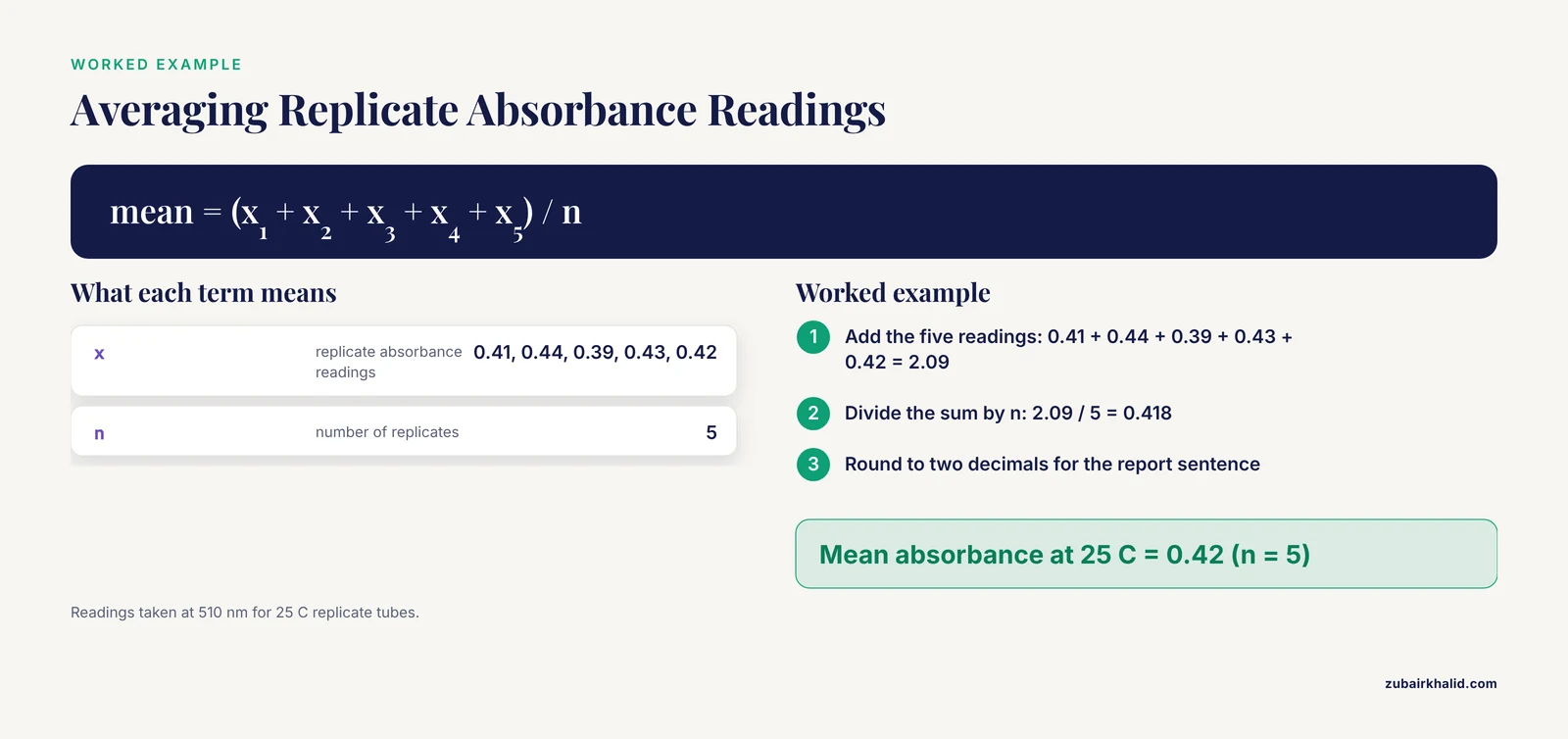
A worked example of the kind of analysis line the notebook should support, and the report should summarize:
Data: absorbance readings at 510 nm for 25 C replicate tubes
Replicates: 0.41, 0.44, 0.39, 0.43, 0.42
Mean = (0.41 + 0.44 + 0.39 + 0.43 + 0.42) / 5 = 0.418
Report sentence: "Mean absorbance at 25 C was 0.42 (n = 5)."
Choosing a Format for Your Template
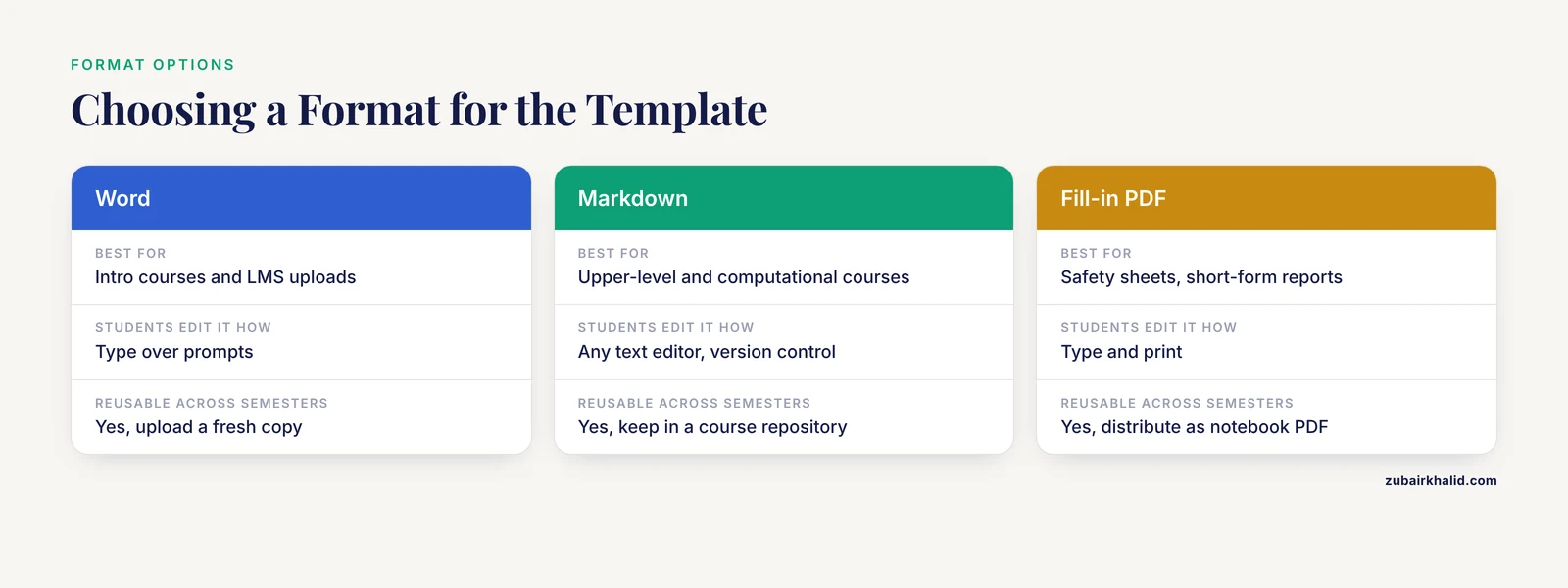
| Format | Best for | Students edit it how | Reusable across semesters |
|---|---|---|---|
| Word (.docx) | Intro courses, institutional LMS uploads | Type over prompts | Yes, upload a fresh copy per section |
| Google Docs | Group reports, live instructor comments | Shared editing | Yes, copy one per team |
| Markdown (.md) | Upper-level and computational courses | Any text editor, version control friendly | Yes, keep in a course repository |
| LaTeX | Physics, chemistry, math-heavy reports | Compile locally or online | Yes, one master .tex file |
| Fill-in PDF | Safety sheets, short-form reports | Type and print | Yes, distribute as a lab notebook template PDF |
Markdown is worth a note for anyone planning a research career. Because it is plain text, it works with version control, which is the same workflow students will eventually use for manuscripts, code, and analysis pipelines. A research template that students first meet as undergraduates shapes how they document work later [1].
Adapting the Template to the Course Type
Introductory Courses
Keep the full IMRAD skeleton but shorten every prompt. First-year students benefit most from the discipline of separate results and discussion sections, so enforce that boundary even when the experiment itself is simple. A guided structure is what turns a recipe-following exercise into practice in scientific reasoning.
Course-Based Undergraduate Research Experiences
In a CURE, the report template should mirror a real manuscript more closely, because students are producing genuine, sometimes novel, data. The evidence is strong that this pays off. In the biochemistry CURE study cited above, 96% of students reported increased skill with bioinformatic techniques and 85% reported increased ability to interpret wet-lab experiments, and the gains held across in-person and hybrid modalities [1]. Build the template around the actual analysis types in the course, and include a data-availability statement as practice for real publication norms.
Project-Based Multiweek Modules
When a module spans cloning, expression, fermentation, and quantification, as in an ergothioneine production module built for undergraduate biochemistry, use one living template that students expand week by week rather than a fresh report per session [3]. Each week adds a methods subsection and a results subsection, and the final discussion synthesizes all of it. Pair the report with pre-lab quizzes and a self-evaluation survey, both of which contributed to measured gains in technical skill and research confidence in that module.
Online and Hybrid Courses
Online laboratory courses can support the same reporting structure. A behavioral neuroscience course run asynchronously online had students complete a full experiment measuring heart rate variability with a smartphone app, from proposal to final presentation, and students reported that the project was very important for learning each course outcome [8]. For these courses, the template should specify how figures are exported and named, since students cannot walk a printed graph to the instructor's desk.
Oral Reports
Consider alternating written reports with oral ones. In an organic chemistry laboratory curriculum, students scored higher on oral lab reports than on written reports of comparable complexity when both were scored with rubrics based on the Science Writing Heuristic, an approach that structures lab reporting around the sequence of question, evidence, and claim [9]. The oral format also delivers feedback immediately instead of a week later. If you adopt this, give students the same section prompts verbally: state the question, state the evidence, state the claim, state the uncertainty.
Grading With the Template
The template and the rubric should be the same document seen from two sides. Build the rubric directly from the section headings and assign weights that reflect your learning goals. A workable default distribution for a 100-point report is abstract 5, introduction 15, methods 15, results 25, discussion 30, references and presentation 10. The discussion carries the most weight because interpreting evidence is the hardest skill and the one students report gaining most from research-based courses [1].
Two grading practices have direct literature support. First, rubrics with named subcategories improve consistency across graders and give students actionable feedback, which is why collaboration rubrics with fixed subcategories are applied across multiple courses in some curricula [4]. Second, immediate feedback changes what students learn from the assignment, which is a core argument for oral reports in lab curricula [9]. If you grade in a large course, annotate the template file itself with comments rather than writing a separate feedback letter, so the advice lands next to the sentence it concerns.
Safety and Professional Practice Elements
An undergraduate lab report template is also a safety document, and the two roles reinforce each other. A published case report describes a 19-year-old undergraduate who developed allergic contact dermatitis from hexamethylene diisocyanate while working in a university optical fabrication lab, and the subsequent worksite review found hazardous chemicals in use without hazard communication, training, standard operating procedures, or personal protective equipment [5]. Requiring students to list every chemical with its hazard class in the methods section, and to attach the relevant safety data sheet citations, builds the habit of hazard identification before an incident rather than after one.
Two structural additions do this work cheaply. Add a "Hazards and Controls" subsection under Materials and Methods where students name each chemical, its primary hazard, and the control used, such as working in a fume hood or wearing specific gloves. Add a safety reflection prompt to the discussion of any experiment involving sensitizers, corrosives, or biological agents. For clinical laboratory science programs, this mirrors professional competency frameworks, where occupational exposure and protection, specimen handling, quality control, and critical value notification are treated as entrustable professional activities that interns must demonstrate, not as paperwork [10].
The safety content also supports learning transfer. An integrative review of undergraduate nursing education found that the central challenge of professional preparation is connecting classroom and laboratory knowledge to practice in real settings [11]. A template that asks students to connect what they handled, why it was hazardous, and how it was controlled is practicing exactly that connection.
Common Mistakes and Limitations
Merging results and discussion for beginners. Instructors sometimes allow combined sections to save length. In introductory courses this teaches students to blur the line between observation and interpretation, which is the single most common failure mode in scientific writing. Keep them separate until students demonstrate they can hold the distinction.
Writing the methods section from the lab manual. A methods section copied from the manual describes what the manual said, not what the student did. The fix is structural, not exhortatory: require a notebook entry for every step and have students note deviations in the template itself.
Treating the abstract as an introduction. Students frequently write background in the abstract. The four-sentence pattern of question, approach, result, meaning, stated in the prompt lines, prevents this.
Omitting negative results. A template that only rewards confirmed hypotheses teaches students to hide data. The discussion prompt should explicitly ask what the result means whether or not it matched the prediction.
Overengineering the first version. A nine-page template with mandatory subsections for every conceivable analysis will be ignored. Start with the skeleton above, watch where students struggle for one assignment cycle, and add prompts only where the writing actually fails.
Safety as an afterthought. Hazard communication that exists only as a signature on a form at the start of the semester does not prevent exposures, as the occupational dermatitis case demonstrates [5]. The methods section is the natural home for hazards, because that is where the chemicals are named.
One limitation to state plainly. A template standardizes structure, not judgment. Students who follow every prompt can still produce a report with correct sections and weak reasoning, and no template substitutes for an instructor reading the argument and responding to it. Individual student cases need individual feedback, which is the part of teaching a template cannot automate.
Frequently Asked Questions
What sections should an undergraduate lab report template include?
Include a title and author block, abstract, introduction, materials and methods, results, discussion, references, and an appendix for raw data. Add a collaboration statement and a hazards and controls subsection for team-based or chemical experiments. This IMRAD-based structure matches what most science faculty expect and transfers directly to real manuscript formats.
How long should an undergraduate lab report be?
For a single-session introductory experiment, 4 to 6 double-spaced pages excluding figures and references is typical. Multiweek project-based reports run longer because they accumulate methods and results across sessions. Set the length by what each section must accomplish rather than by a page count, and put those requirements in the prompt lines.
Can I use a free undergraduate lab report template for any science course?
Yes, as a starting point, because the IMRAD skeleton is shared across biology, chemistry, neuroscience, and biochemistry. You will need to adjust the prompt lines for the analysis types in your course, such as statistical tests, bioinformatic outputs, or instrument traces, and match the citation style to your department.
What is the difference between a lab report and a lab notebook?
The lab notebook is a contemporaneous record of what happened at the bench, including failed attempts, raw values, and observations. The lab report is a selected and organized argument built from that record. Students should keep them as separate documents and distribute a lab notebook template PDF alongside the report template.
How do I grade with a lab report template?
Build the rubric directly from the template's section headings, assign point weights that reflect your learning goals, and give the rubric to students with the template on day one. Rubrics with named subcategories such as quality of work, communication, and analysis improve grading consistency and feedback quality [4].
Should first-year students use the same template as seniors?
No. First-year students need short prompt lines and strict section separation. Upper-level students in research-based courses should get a template that resembles a real manuscript, with data availability statements and full statistical reporting, because their reports feed genuine projects.
How do I make a lab notebook template PDF?
Write the notebook page structure, with fields for date, experiment title, reagent lot numbers, masses and volumes, observations, and a signature line, in any word processor or Markdown editor, then export to PDF. Pandoc converts a Markdown file to PDF with a single command. Distribute the PDF for printing or as a fill-in form.
Can lab reports be oral instead of written?
Yes, and there is evidence they work well. In an organic chemistry laboratory curriculum, students scored higher on oral reports than on written reports of similar complexity when both were assessed with Science Writing Heuristic rubrics, and oral assessment delivered feedback immediately [9]. A practical approach alternates written and oral reports across the semester.
Sources
- Analysis of Perceived Student Learning Gains in a Biochemistry Lab Course-Based Undergraduate Research Experience.
- Aversive and Appetitive Learning in Drosophila Larvae: A Simple and Powerful Suite of Laboratory Modules for Classroom or Open-ended Research Projects.
- Development and implementation of a project-based laboratory module: heterologous expression and fermentation of ergothioneine in E. coli for undergraduate biochemistry and molecular biology education.
- Teaching and assessing undergraduate collaboration skills scaffolded through the biochemistry curriculum using collaboration rubrics and student learning contracts.
- Isocyanate induced allergic contact dermatitis in a university undergraduate student: An occupational dermatitis case report, review of laboratory safety regulations, and implications for campus research.
- Instruments to evaluate undergraduate healthcare student learning styles globally: A scoping review.
- Promoting Undergraduate Surgical Education: Current Evidence and Students' Views on ESMSC International Wet Lab Course.
- Use of a Smartphone-Based App in an Online Behavioral Neuroscience Lab Course.
- Oral Reports in an Organic Chemistry Laboratory Curriculum.
- Towards a global framework of entrustable professional activities for undergraduate clinical laboratory interns: a competency-based approach.
- Nursing students learning transfer from classroom to clinical practice: An integrative review.