How to Write a Transparent Methods Section for Your Systematic Review
By Dr. Zubair Khalid, DVM, MS, PhD ·

By the end of this article you will be able to draft a complete, reproducible methods section for a systematic review: one that names your databases and search dates, reports your screening numbers, assigns the right risk of bias tool to each study design, and describes your synthesis in enough detail that a stranger could repeat it. You do not need special software to start. Have on hand your registered protocol number, the search histories from each database, your screening log, and the PRISMA 2020 checklist, which is freely available.
A transparent methods section is the difference between a review that readers can trust and a review they must take on faith. Recent published reviews demonstrate the standard well. One mixed-methods review of risk communication reported its PROSPERO registration number, named five databases, gave the exact search dates down to the day, listed the supplementary sources it checked, and stated which appraisal tool it used for each study type [1]. That level of specificity is the goal.
Why the Methods Section Carries the Whole Review
A narrative essay can survive vague methods. A systematic review cannot, because the entire value of the review depends on the reader believing you found the right evidence and handled it consistently. When a review states that it screened 29,216 records and included 105, as one environmental health review did, the reader needs to know exactly how that funnel was built to judge whether anything relevant was lost along the way [1].
This is also the clearest distinction between a systematic review and an ordinary literature review. If you are learning how to write a literature review for a course paper, you can select sources by judgment and describe that judgment loosely. A systematic review commits you to a systematic literature search with predefined eligibility criteria, duplicate screening, documented appraisal, and a reproducible record flow. The methods section is where you prove you did all of that.
Most journals now expect methods transparency to follow the PRISMA 2020 statement, and many require proof of registration before they will consider the manuscript. Reviews across fields, from brain imaging AI to glycemic prediction models, state their adherence to PRISMA 2020 in the methods section itself [2], [3].
Before You Write Anything: Registration and Protocol
Write the methods section before you run the review, not after. A protocol freezes your decisions in advance and prevents the most damaging form of bias, which is quietly changing the rules after seeing the results.
Register your protocol. PROSPERO is the international registry for health-related review protocols, and a registration number such as CRD42024568007 or CRD420251232269 appears in the methods sections of registered reviews as proof of prospective registration [1], [4]. Register before screening begins, because a registration date after data extraction undermines the point.
Write the protocol to a reporting guideline. PRISMA-P is the reporting standard for review protocols. A protocol for a review of mental health among women experiencing domestic violence explicitly states its adherence to PRISMA-P, and that protocol already specifies the databases, the screening procedure with a senior reviewer for tie-breaking, the extraction sheet design, and the two appraisal tools before any search is run [5]. Protocol papers published in methods journals serve the same function and often document tooling choices in detail, such as a photovoltaic biodiversity protocol that prebuilt and validated its search string and named the screening software it would use [6].
Keep an audit trail from day one. Save the raw search output from every database with the date run, keep the deduplication log, and never overwrite a screening file. Every number you report later comes from this trail.
The Transparent Methods Systematic Review Template Format
The format below follows the standard PRISMA 2020 methods structure. Each heading below is an H3 you can lift directly into your manuscript, followed by what belongs under it.
Eligibility Criteria
State inclusion and exclusion criteria as a definable list, tied to a framework so readers can see the logic. Common frameworks are PICO for intervention questions and PECO for exposure questions, and at least one published protocol explicitly applied the PECO framework to guide its eligibility decisions [6]. A qualitative review protocol used the SPIDER tool to structure its inclusion criteria around population, sample, phenomenon of interest, design, evaluation, and research type [7]. Name the framework you used and translate each letter into a concrete criterion.
Information Sources and Search Strategy
Name every database with its platform, for example MEDLINE via PubMed, Embase, CINAHL via EBSCOhost, Scopus, Web of Science, and the Cochrane Central Register of Controlled Trials [8], [5]. Give the exact date each search was run and the date limits applied. One review reported searches run on April 19, 2024, from database inception, then updated searches in 2026 with additional supplementary sources checked on specific days in July [1]. That granularity is what allows reproduction.
Include the full search string for at least one database, list grey literature sources, and describe supplementary methods such as backward and forward citation searching, which several reviews used to catch records the databases missed [9], [10], [1].
Selection Process
State who screened and how many reviewers were involved. The standard is at least two independent reviewers screening titles, abstracts, and full texts, with disagreements resolved by discussion or by a third reviewer [11], [8], [10], [5]. Also state whether screening software was used, since named tools increase reproducibility [6].
Data Collection Process
Describe the extraction form, who extracted, and whether extraction was duplicated. Some reviews use an established framework to structure extraction, such as the CHARMS framework for prediction model studies [12], while others describe a tailored extraction sheet built for the review [5]. Either approach is acceptable as long as the form or its items are available to readers.
Risk of Bias Assessment
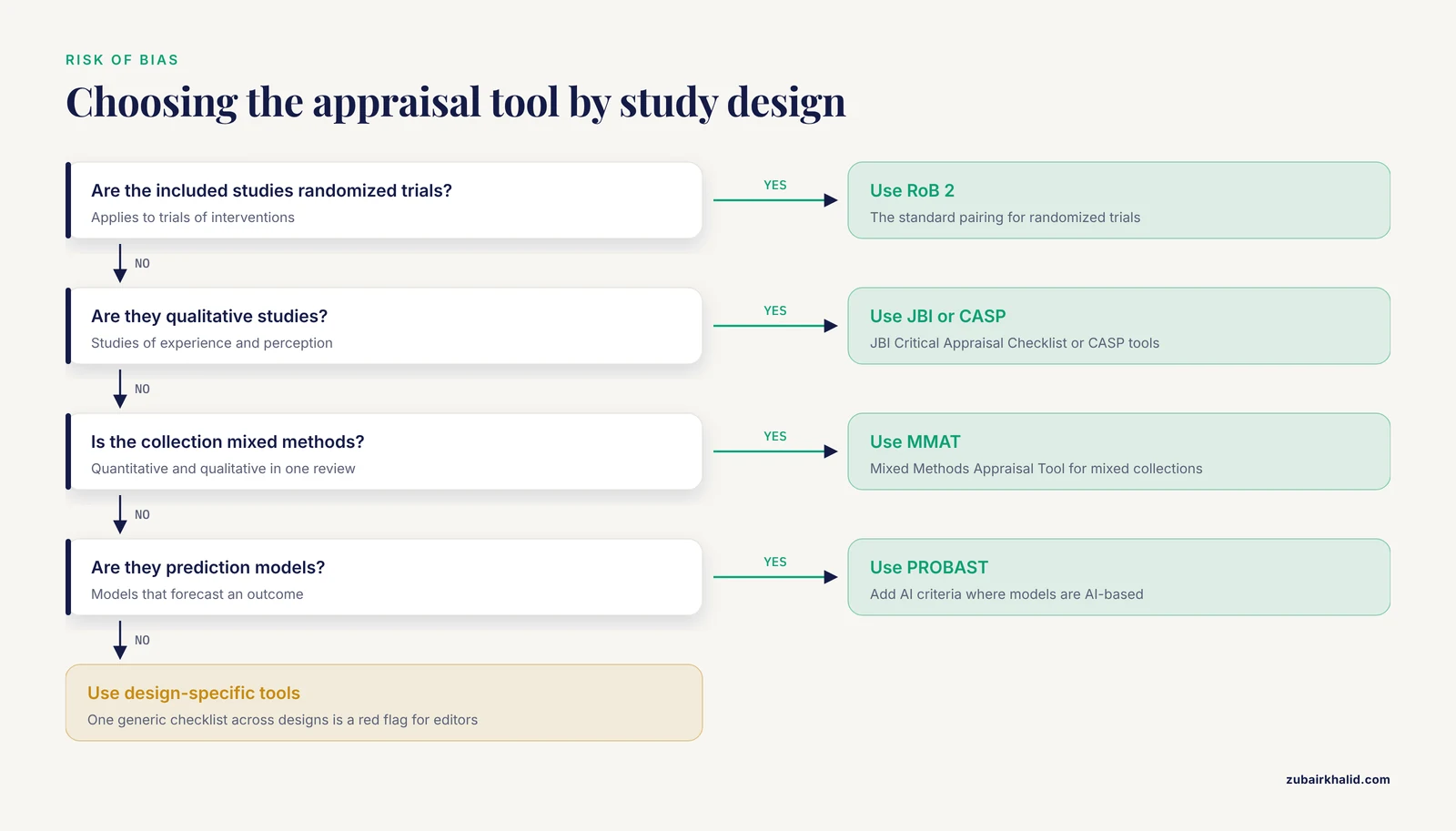
Match the tool to the design. Using one generic checklist across heterogeneous designs is a red flag for editors. See the table below for the standard pairings used in the published literature.
| Evidence type | Appraisal tool | Example from the literature |
|---|---|---|
| Randomized trials | RoB 2 | AI-enabled smoking cessation interventions [10] |
| Qualitative studies | JBI Critical Appraisal Checklist for Qualitative Research, or CASP tools | Internationally educated nurses review [13], domestic violence protocol [5] |
| Mixed methods collections | Mixed Methods Appraisal Tool (MMAT) | Risk communication review [1] |
| Prediction models | PROBAST, or PROBAST plus AI criteria | Glycemic prediction [3], wearable migraine forecasting [14], radiation dermatitis models [12] |
| Broad mixed evidence bases | Design-specific tools per study | Prescription length review [15] |
State whether appraisal was done in duplicate, whether disagreements were resolved by a third party, and how appraisal scores were used, for example whether low-quality studies were excluded or down-weighted in synthesis.
Synthesis Methods
Describe the synthesis approach in plain terms and justify it. Options include narrative synthesis when evidence is too heterogeneous to pool [15], thematic synthesis with GRADE-CERQual for qualitative confidence ratings [1], the JBI convergent integrated approach where quantitative findings are transformed into qualitative data and combined [13], and quantitative meta-analysis with a stated pooling model.
For meta-analyses, name the effect measure, the pooling model, and the software. One urology review specified random-effects models, sensitivity analyses that varied imputed correlations, leave-one-out omission of individual studies, and modified Hartung-Knapp intervals [16]. A smoking cessation meta-analysis specified random-effects restricted maximum likelihood models with Knapp-Hartung adjustment [3]. A glycemic prediction review used RMSE as the principal endpoint and a Bayesian random-effects model where raw data were sparse [3]. Specify comparably for your own review.
A Numbered Walkthrough, With Expected Output
Here is the workflow in eight steps, with example commands and what each step produces.
Step 1. Define and register the question
Write your question in PICO or PECO form, draft the protocol, and register it. The output is a registration number such as CRD420261449460, which appears in your methods section under a sentence like: the protocol was prospectively registered in PROSPERO [17].
Step 2. Build and validate the search string
Start with a naive set of terms, expand them, and test comprehensiveness. The R package litsearchr automates part of this, and a published protocol paired it with a pruning exercise plus a benchmark list of known-relevant papers to verify the search found what it should [6]. A simplified version of that workflow:
library(litsearchr)

# Candidate terms harvested from scoping searches
naive_terms <- c("photovoltaic", "solar farm", "grassland",
                 "fauna", "biodiversity", "ground-mounted")

# Trim generic words and near-duplicates
terms <- remove_stopwords(naive_terms, method = "GENIA")

# Assemble the Boolean string with exact-phrase wrappers
write_search(group_keywords(terms), exactmatch = TRUE)
The expected output is a single Boolean string, for example:
("photovoltaic" OR "solar farm" OR "ground-mounted solar")
AND ("grassland" OR "grassland fauna" OR "biodiversity")
Then validate it. Run the string against a benchmark list of papers you already know are relevant. If the string misses known papers, prune and rebuild until sensitivity is acceptable, then freeze the string.
Step 3. Run and log the searches
Run the finalized string in every database on the same day where practical, and export all records with abstracts. Your log entry should read: Embase searched May 22, 2026, date limits January 1, 2000 onward, 4,113 records exported. Real reviews report search dates with this precision, [17].
Step 4. Deduplicate and report the numbers
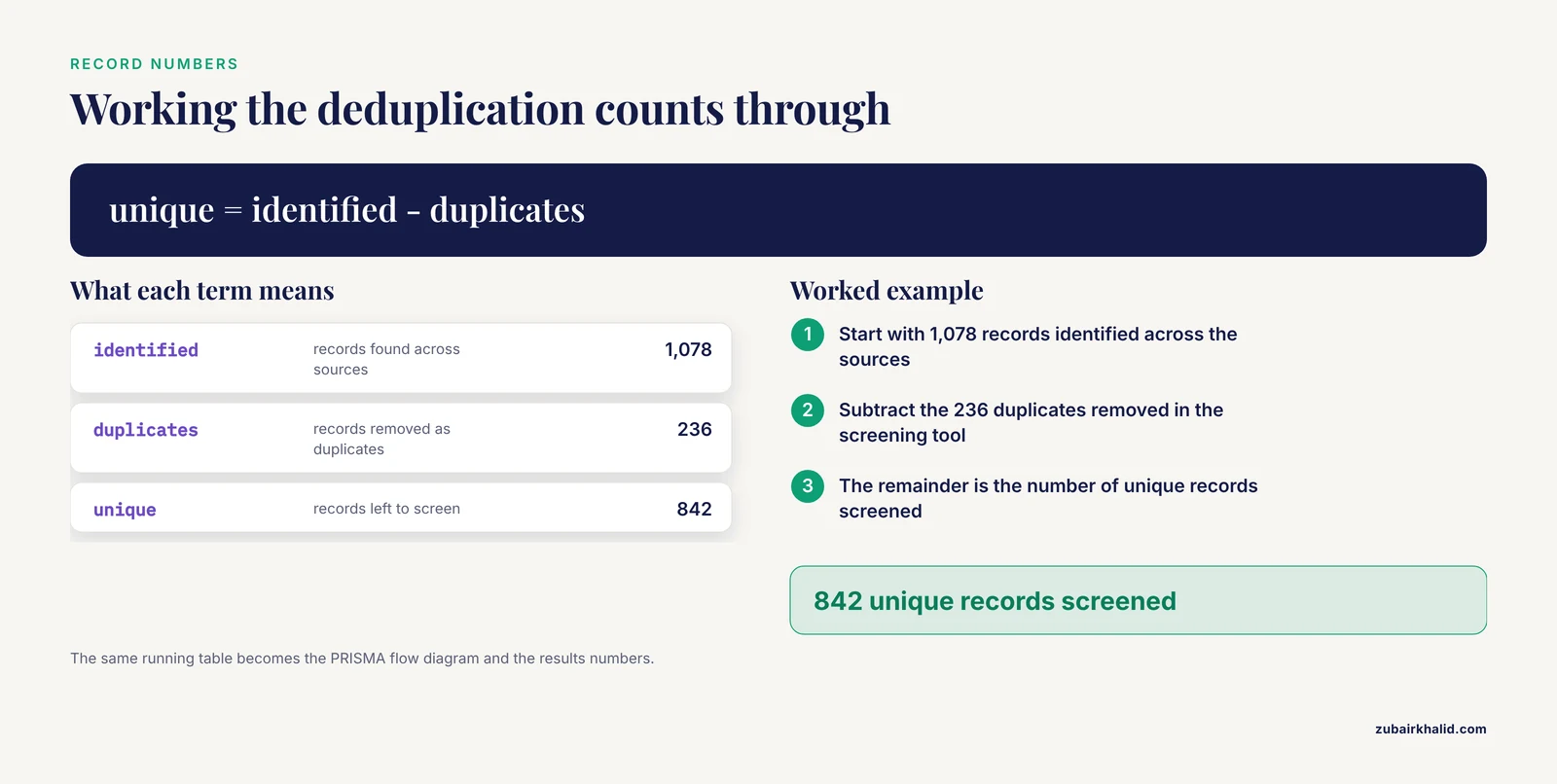
Import records into your screening tool, remove duplicates, and record every count. One review reported 1,078 records identified, 236 duplicates removed, 842 unique records screened, 258 full texts assessed, and 123 studies included after a record-level eligibility re-audit [2]. Another reported 1,740 records, 717 duplicates, 1,023 screened, 396 full texts, and 70 included reports from 58 operationally unique studies, with 9 of the included reports found through citation searching rather than the databases [9]. Keep a running table exactly like this. It becomes your PRISMA flow diagram, and the same numbers feed the results section.
Step 5. Screen in duplicate
Two reviewers screen titles and abstracts independently, then full texts independently [11], [8]. Record the reason for every full-text exclusion so you can report exclusions by reason. Set a disagreement resolution rule in advance, such as discussion followed by escalation to a senior reviewer [5].
Step 6. Extract data onto a defined form
Use an existing framework where one fits your question, such as CHARMS for prediction models [12], or build a tailored sheet and publish it as a supplement [5]. Extract in duplicate for the outcomes that drive your conclusions.
Step 7. Appraise risk of bias with the design-matched tool
Apply the tools from the table above. The glycemic prediction review applied PROBAST to 19 quantitative reports covering 28 assessment units, with two named reviewers working independently [3]. Note who appraised, how disagreements were handled, and whether appraisal influenced synthesis.
Step 8. Write the synthesis paragraph last
Once you know what the data allowed, write the synthesis subsection honestly. If heterogeneity prevented pooling, say so, as one review of prescription length policies did before choosing narrative synthesis [15]. If you transformed quantitative findings for integration with qualitative data, name the approach, as the JBI convergent integrated approach review did [13].
A Filled-In Template Example
The following condensed example shows the template format with realistic content, modeled on the reporting patterns in the published literature. Replace the bracketed details with your own.
Protocol and registration. This review followed the PRISMA 2020 statement. The protocol was prospectively registered in PROSPERO (CRD42026XXXXXX). Eligibility criteria. We included peer-reviewed original research articles applying [exposure or intervention] to [population], published from January 2000 onward. We excluded review articles, animal studies, and in vitro or in silico studies, following the exclusions used in a comparable mixed-methods review [1]. Information sources and search. We searched PubMed/MEDLINE, Scopus, and Web of Science Core Collection from database inception through June 30, 2026, with searches run on July 15, 2026 [17]. We supplemented this with backward and forward citation searching and with grey literature sources. The full PubMed search string appears in Supplement S1. Selection process. Two reviewers independently screened titles and abstracts, then full texts. Disagreements were resolved by a third reviewer [10]. Data collection. One reviewer extracted data onto a tailored sheet and a second verified entries against the source papers [5]. Risk of bias. We assessed randomized trials with RoB 2 [10] and qualitative studies with the JBI Critical Appraisal Checklist for Qualitative Research [13]. Synthesis. Because included studies differed in design and outcomes, we synthesized findings narratively [15] rather than pooling effect estimates.
Notice the pattern: every sentence answers one of three questions. What did you look for, where and when did you look, and who checked what.
Common Mistakes and Limitations
- Writing the methods after the results are known. Retrospective methods sections drift toward whatever flatters the findings. Register the protocol first and write methods from the protocol [5], [8].
- Reporting a search as a single undated event. Undated searches cannot be reproduced or updated. Report the platform, the string, the run date, and the date limits for every source.
- Leaving the search string in a supplement nobody can find. If the full string is not in the paper or an accessible supplement, the systematic literature search is not transparent.
- Mismatching appraisal tools to designs. Applying a trial checklist to qualitative studies tells readers nothing. Use design-specific tools, and name them,,.
- Reporting included studies without the funnel numbers. Readers cannot evaluate selection bias without identified, screened, full-text, and included counts, plus reasons for exclusion at full text [2], [9].
- Hiding sensitivity analysis choices. If your pooled estimates depend on imputed correlations or on keeping one influential study, report the sensitivity analyses that show it [16].
- Conflating shared cohorts. When the same patients appear in multiple reports, either merge them or state clearly that reports from shared cohorts were retained only when they contributed non-overlapping data and were linked during synthesis, as one review did [9].
- Overclaiming from heterogeneous evidence. When designs, populations, and outcome measures vary widely, narrative synthesis with an explicit statement of why pooling was inappropriate is more transparent than a forced meta-analysis [15].
One further limitation applies to any template: the right methods depend on your question. A review of qualitative experience needs a different appraisal and synthesis plan than a review of prediction models, and no template replaces methodological judgment.
Frequently Asked Questions
What is a transparent methods section?
It is a methods section written so that an independent reader could repeat every step, from the search string and its run dates to the screening, extraction, appraisal, and synthesis decisions, without contacting the authors.
Do I have to register my review before I start?
For health-related reviews, yes, registration in PROSPERO before screening is standard and journals increasingly require the registration number, which several published reviews report directly in their methods [1], [4], [17].
How many databases do I need to search?
There is no fixed number, but published reviews commonly search between three and nine databases chosen to match the question, and a mixed-methods review searching five databases plus grey literature and citation tracking is a reasonable benchmark [13], [1], [3].
Can I copy the methods from a published review?
You can copy the structure and adapt the reporting style, but every substantive detail must reflect what you actually did, and a copied search string built for someone else's question will not be valid for yours.
What do I do when two reviewers disagree during screening?
Resolve first by discussion, and escalate unresolved cases to a third or senior reviewer, a procedure stated explicitly in published protocols [5] and reviews [10].
How do I report studies excluded at full text?
Keep a table listing each excluded full text with a cited reason drawn from your predefined eligibility criteria, and summarize the counts by reason in your results.
Do I need a meta-analysis for a transparent methods section?
No. Narrative synthesis is fully acceptable when heterogeneity precludes pooling, provided you state the reason and describe your synthesis approach explicitly [15], [12].
What is the difference between a systematic review and a literature review?
A literature review selects and discusses sources by scholarly judgment, while a systematic review applies a predefined, registered, reproducible protocol with duplicate screening and documented appraisal, and its methods section exists to prove that the protocol was followed [13], [4].
Sources
- Best practices in communication of environmental health risks due to localised pollution events: a mixed-methods systematic review.
- Advances in artificial intelligence for brain imaging and computer-aided diagnosis of neurological diseases: a systematic literature review.
- Machine Learning Models for Glycemic Prediction in Type 1 and Type 2 Diabetes: Systematic Review and Meta-Analysis.
- Predictive modelling approaches for childhood diarrhoeal disease: a systematic review (2000-2025).
- Mental health issues among women experiencing domestic violence and their help-seeking behaviour in the WHO South-East Asian Region: a systematic review protocol.
- Systematic review protocol for evaluating the ecological effects of ground-mounted photovoltaic facilities on faunistic biodiversity in grasslands(✰).
- Teachers' perceptions of physical activity in children and young people with type 1 diabetes: a qualitative systematic review protocol.
- Clinical pharmacokinetic-pharmacodynamic relationships between drug exposure and the QT/QTc interval: Protocol for a systematic review and quantitative synthesis.
- Sports genomics research in Turkish athlete populations 2019 to 2026: a systematic review.
- Artificial intelligence-enabled interventions for smoking cessation: a systematic review and meta-analysis of randomised controlled trials.
- Advances in Machine Learning Paradigms for Reliable Swimming Pool Drowning Detection: Systematic Review of Methods and Implementations.
- Predicting acute radiation dermatitis in breast cancer patients using artificial intelligence: a systematic review.
- Barriers and facilitators to career progression and leadership among internationally educated nurses and midwives in the UK: a mixed methods systematic review.
- Clinical performance and applicability of prediction models using wearable-derived physiologic signals to anticipate migraine or headache attacks: A systematic review.
- Medication and health-related outcomes by prescription lengths: A systematic review.
- Vibegron add-on therapy for persistent overactive bladder symptoms in men with benign prostatic hyperplasia: a systematic review and meta-analysis of randomized comparisons and within-group changes.
- Explainable artificial intelligence in clinical decision support systems: a systematic review of techniques, clinical applications, evaluation, and future directions.