How to Track Author Contributions in Research
By Dr. Zubair Khalid, DVM, MS, PhD ·

By the end of this guide, you will be able to set authorship rules before a project starts, assign standardized contributor roles, keep a running record of who did what while the work is happening, and use both project-level and publication-level tools to document and verify contributions. You need nothing more than a spreadsheet and a text editor to start. Optional tools covered here include Git, Overleaf, ORCID, the OpenAlex API, and the R package bibliometrix for analyzing authorship patterns across a body of literature.
Why Tracking Author Contributions Matters
Authorship determines who gets credit, who carries responsibility, and whose career advances. Recent work in the Indian Journal of Community Medicine describes how authorship inflation, including gift authorship (listing people who made minimal or no contribution), inflates academic profiles without reflecting actual input, and the same analysis calls for transparent authorship roles as one of the fixes [1]. Tracking contributions carefully protects you in two directions. It ensures contributors receive the credit they earned, and it prevents names from being attached to work those people did not actually do.
Tracking also matters for larger-scale questions. When institutions evaluate research output, they usually rely on author lists and citation counts, which can distort recognition. Public, comparative measurement of research investment reliably changes institutional behavior, a mechanism documented across legal education, hospital quality reporting, and federal funding policy in a proposal for benchmarking neurological disparities research [2]. At the level of a single paper, the same principle applies. What gets measured and recorded shapes who gets recognized.
The Vocabulary You Need First
Authorship means taking public responsibility for a published paper. The International Committee of Medical Journal Editors (ICMJE) defines authorship through four criteria, widely adopted as standard: substantial contribution to the work's design, data acquisition, or analysis, drafting or revising the manuscript, final approval of the version to be published, and accountability for all aspects of the work.
Contributorship is the broader idea that specific roles, not just the binary author-or-not label, should be recorded. The standard framework is CRediT (Contributor Roles Taxonomy), which defines 14 roles: Conceptualization, Data curation, Formal Analysis, Funding acquisition, Investigation, Methodology, Project administration, Resources, Software, Supervision, Validation, Visualization, Writing - original draft, and Writing - review & editing. Most major publishers now ask for CRediT statements at submission.
Bibliometrics is the quantitative study of publications, citations, and collaboration patterns. Tools in this family, such as VOSviewer and the bibliometrix package in R, let you analyze authorship and collaboration networks across hundreds or thousands of papers. Two recent bibliometric studies on robotic-assisted total hip arthroplasty and on intelligent assistance for unicompartmental knee arthroplasty extracted authorship, country, institution, and citation records from the Web of Science Core Collection to map collaboration networks and identify leading authors and institutions [3] [4]. The same methods work at the scale of your own publication record.
Evidence traceability describes systems that record where each claim or result came from and who produced it. This concept, discussed in the context of autonomous AI research agents that must document their reasoning and data sources, applies equally to human teams. A contribution you can trace to a dated artifact (a commit, a notebook page, a version history entry) is a contribution you can defend.
How to Track Author Contributions Research: Step by Step
This walkthrough follows the life of a typical life science project, from planning to post-publication. Each step lists what you do, what tools you need, and what a correct result looks like.
Step 1. Set Authorship Rules Before the Project Starts
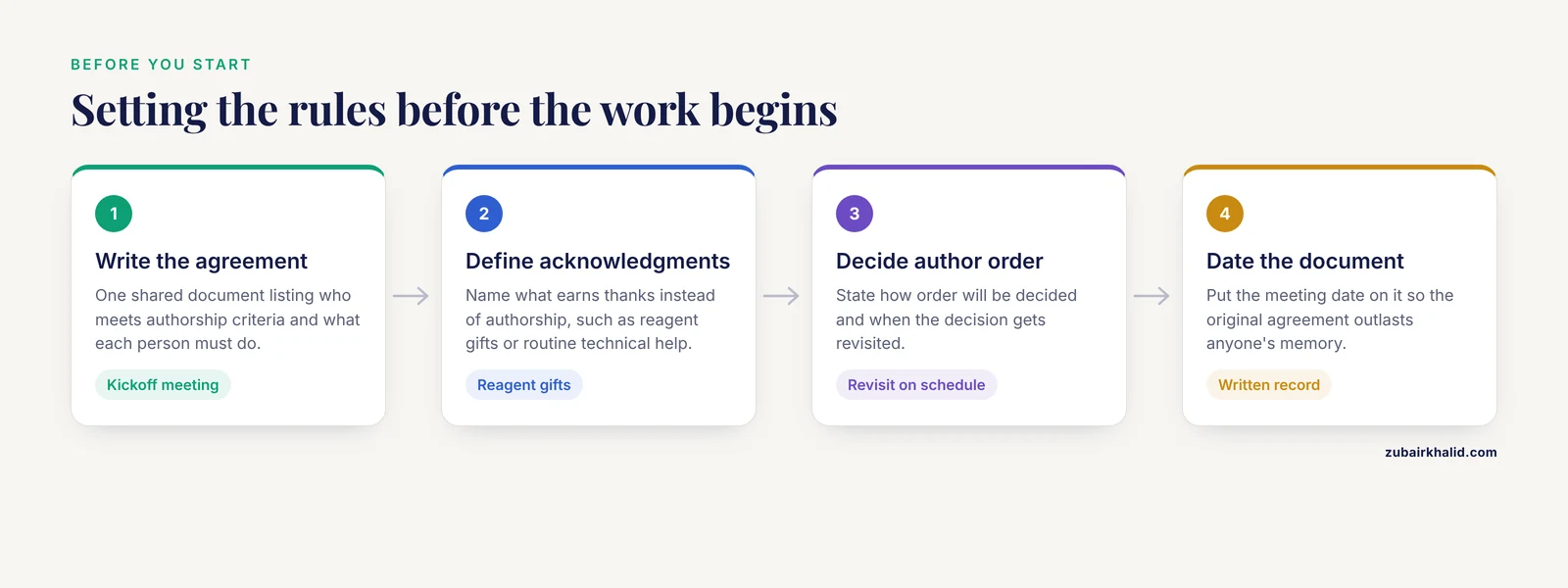
Write down, in one shared document, three things at the project kickoff meeting:
- Who is expected to meet authorship criteria, and what each person must actually do to meet them.
- What earns an acknowledgment instead of authorship (for example, reagent gifts, routine technical assistance, or feedback on a conference abstract).
- How author order will be decided and when that decision will be revisited.
Put the meeting date on the document. When disputes arise months later, the record of the original agreement matters more than anyone's memory.
Skipping this step is where problems begin. Research with vulnerable participants shows how power imbalances inside a collaboration shape whose voice dominates methodological and theoretical decisions, and how deliberate structures are needed to counteract them [5]. A written authorship agreement is one of those deliberate structures. The same lesson appears in work with undergraduate nursing students, where mentorship, peer support, and faculty guidance emerged as central to whether students could successfully navigate research projects and receive recognition for them [6].
Step 2. Assign CRediT Roles Early and Update Them
Create a role matrix in a spreadsheet. Put the 14 CRediT roles down the left column and each contributor across the top. Mark expected involvement now, then revise it as the project evolves.
A small three-person project might look like this after the first month:
| CRediT role | A. Rivera | J. Chen | M. Okafor |
|---|---|---|---|
| Conceptualization | Yes | Yes | |
| Investigation | Yes | ||
| Methodology | Yes | ||
| Writing - original draft | Yes | ||
| Writing - review & editing | Yes | Yes | Yes |
Review this matrix at every project meeting where tasks change. The matrix becomes the direct input for the publisher's contributor statement at submission, which means you never reconstruct roles from memory.
Step 3. Track Contributions While the Work Happens
For computational work, use Git. Every commit records who changed what and when. Two commands cover most needs:
git shortlog -sneThis prints a per-author commit count with names and emails, sorted by volume:
    48  J. Chen
    31  A. Rivera
     7  M. Okafor
For finer detail on one person's analytical contributions:
git log --author="Chen" --numstat --statThis lists every commit by that author with lines added and removed per file. Combine it with commit messages that describe the scientific task ("optimize wash buffer protocol", "rerun model with batch covariate") and you have an automatic, dated record suitable for a Data curation, Software, or Formal Analysis role claim.
For manuscript writing, use a platform with version history, such as Overleaf or Google Docs. Overleaf's history feature shows per-user edits with timestamps. Export or screenshot the history at major milestones (draft one, revision one, pre-submission) rather than assuming the history will persist after the project archive is closed.
For wet-lab work, the record is the laboratory notebook, electronic or paper, plus instrument logs. Encourage every team member to date-stamp entries and to note in each entry who performed the hands-on steps.
Step 4. Maintain a Contribution Ledger
A contribution ledger is a single spreadsheet, updated weekly or at milestones, that maps each contribution to a person, a CRediT role, and an evidence artifact. This is the single highest-leverage habit in tracking author contributions research teams can adopt.
Set up a file called contributions.csv with one row per contribution:
contributor,role,task,start_date,end_date,evidence
A. Rivera,Conceptualization,developed hypothesis and study design,2026-01-12,2026-01-30,proposal_v2
J. Chen,Methodology,optimized [Western blot protocol](/blog/guides/western-blot-protocol),2026-02-03,2026-03-15,lab_notebook_p44-61
J. Chen,Investigation,collected all 96 tissue samples,2026-03-01,2026-06-10,sample_log_v3
M. Okafor,Funding acquisition,secured seed grant,2026-01-05,2026-01-05,award_notice
A. Rivera,Writing - original draft,drafted introduction and results,2026-07-01,2026-08-15,manuscript_v1
M. Okafor,Supervision,revised analysis plan and manuscript,2026-02-01,2026-09-20,git_commits+comments
At submission time, this file converts directly into the CRediT statement. If a reviewer or editor later questions any role, each row points to dated evidence. When a contribution ledger cannot point to an artifact, treat that role assignment as provisional and confirm it with the contributor.
If you want a quantitative estimate of relative contribution for discussions about author order, use the standard equal-split approach for a quick calculation:
5 authors, equal weighting: each author = 1 / 5 = 0.20

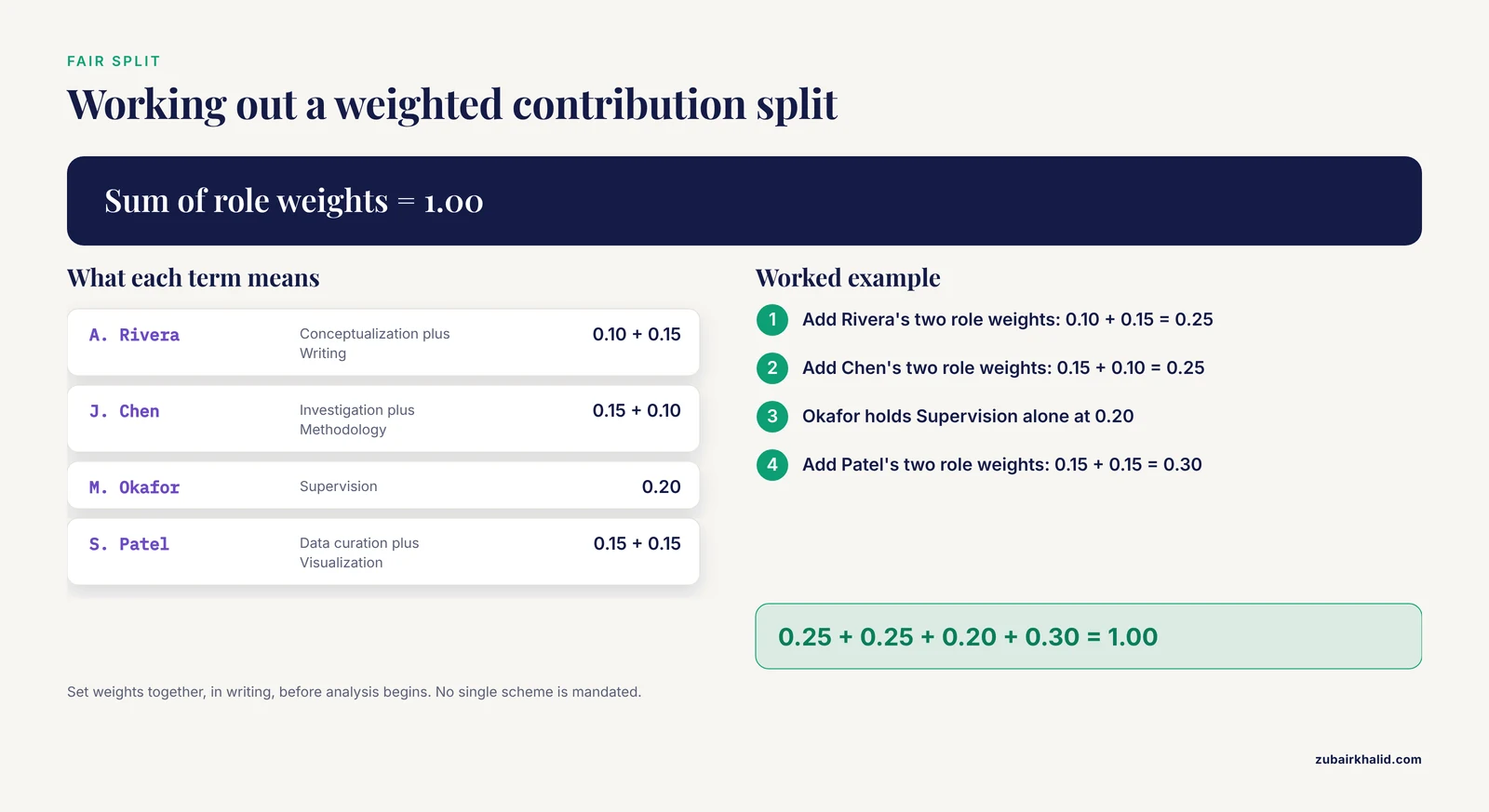
Weighted example for a 4-author paper:
A. Rivera:  Conceptualization (0.10) + Writing (0.15) = 0.25
J. Chen:    Investigation (0.15) + Methodology (0.10)  = 0.25
M. Okafor:  Supervision (0.20)                          = 0.20
S. Patel:   Data curation (0.15) + Visualization (0.15) = 0.30
Sum must equal 1.00. Adjust weights within your team, in writing, before analysis begins.
There is no single mandated weighting scheme. The value lies in forcing an explicit, shared conversation rather than in the specific numbers.
Step 5. Include Non-Traditional Contributors Correctly
Modern life science projects routinely include people who do not fit the traditional academic author model. Patient and public involvement (PPI) contributors can change study design in substantive ways. In one documented French cancer prevention program, five patients and five citizens joined a structured involvement group whose work over nine monthly meetings led to concrete revisions of a colorectal cancer prevention study to better address patient needs [7]. If a PPI contributor shapes the research question or interprets results, discuss authorship with them. If their role is advisory, plan an acknowledgment statement from the start and record it in the ledger.
Work with women in prison highlights the same principle: meaningful engagement of individuals with lived experience from project design through dissemination is a recognized equity requirement, and contributions made under such engagement deserve formal recognition pathways rather than informal thanks [8]. Decide, in Step 1, how these contributions map onto the authorship criteria.
Step 6. Verify Roles at Submission
Before you submit, do three checks:
- Read the journal's authorship policy and confirm every listed author meets its criteria. Most journals use an ICMJE-aligned disclosure form where each author separately confirms their contributions.
- Cross-check the CRediT statement against your contribution ledger. Every role claimed should have at least one evidence artifact.
- Confirm every author has an ORCID iD linked in the submission system. ORCID is a persistent digital identifier that ties a person's outputs to their identity across journals and years, which is what makes post-publication tracking reliable.
Step 7. Track Contributions After Publication
Once papers are published, bibliometric tools let you quantify collaboration patterns over a career or across a field. A convenient free option is the OpenAlex API, which indexes hundreds of millions of works with structured author metadata.
Query OpenAlex for all works linked to an ORCID:
import requests

orcid = "0000-0002-1825-0097"
url = "https://api.openalex.org/works"
params = {"filter": f"author.orcid:{orcid}", "per-page": 200}

response = requests.get(url, params=params)
data = response.json()

print(f"Total works: {data['meta']['count']}")

for work in data["results"][:5]:
    authors = [a["author"]["display_name"] for a in work["authorships"]]
    print(work["publication_year"], "|", ", ".join(authors[:4]), "|", work["title"])
Expected output looks like this:
Total works: 47
2025 | Chen, J., Rivera, A., Okafor, M., Patel, S. | Spatial profiling of...
2024 | Chen, J., Rivera, A. | Batch correction methods for...
2024 | Okafor, M., Chen, J. | ...
Each authorships entry also carries institutions and, for corresponding authors, a flag, so you can script counts of first authorships, last authorships, and corresponding authorships over time. Those three counts are the conventional signal of a researcher's role progression.
For a full collaboration-network analysis, use bibliometrix in R with an exported Web of Science or Scopus file:
library(bibliometrix)

# Export your search results from Web of Science as a
# plaintext "Full Record and Cited References" file named savedrecs.txt
D <- convert2df("savedrecs.txt", dbsource = "wos", format = "plaintext")

res <- biblioAnalysis(D)
summary(res)

# Author collaboration matrix
AU <- cocMatrix(D, Field = "AU", type = "collaboration")
dim(AU)
The summary(res) output prints annual scientific production, author counts per paper (a direct measure of team size trends), and the most productive authors and corresponding authors. The collaboration matrix feeds networkPlot() to visualize co-author clusters. Applied to a field rather than a person, these methods reveal who collaborates with whom and how those patterns change. A longitudinal framework built for biomedical informatics analyzed 78,073 articles from 29 PubMed-indexed journals and found that clinical and computational collaboration grew over the 2011 to 2025 window, a signal visible only through this kind of systematic metadata tracking [9].
Key Options at a Glance
| Method | What it captures | Best for | Effort |
|---|---|---|---|
| Written authorship agreement | Intent and criteria before work begins | Every project, at kickoff | Low |
| CRediT role matrix | Role-level credit claims | Publisher submissions | Low |
| Git commit history | Dated per-author code and analysis changes | Computational projects | Low once adopted |
| Overleaf or Docs version history | Per-author manuscript edits | Writing-stage credit | Low |
| Contribution ledger (CSV) | Roles tied to dated evidence artifacts | Dispute prevention, audits | Medium |
| ORCID | Persistent identity across outputs | Career-level tracking | Very low |
| OpenAlex API | Works, authorships, institutions at scale | Automated reporting | Medium |
| bibliometrix or VOSviewer | Co-authorship and citation networks | Field-level analysis | Medium to high |
Common Mistakes and Limitations
Treating authorship as a decision for the end of the project. Teams that defer the conversation until manuscript time default to hierarchy and habit instead of documented contribution. Decide early, in writing, and revisit on a schedule.
Relying on memory for the CRediT statement. Filling in contributor roles while sitting at the submission portal is how gift authorship creeps in and how genuine contributions get dropped. The ledger in Step 4 exists to prevent exactly this.
Confusing involvement with authorship. Advisory input, material provision, and general encouragement usually warrant acknowledgment rather than authorship. Conversely, substantive intellectual contribution from a junior team member, a statistician, or a community partner warrants authorship even if tradition in your department says otherwise. Structured involvement frameworks, such as the engagement charter and annual action plan used by the DIADEME patient involvement group, show how formalizing expectations clarifies everyone's contribution from the outset [7].
Letting seniority silence negotiation. Where power imbalances are strong, junior members may accept author arrangements they believe are unfair rather than raise the issue. A written agreement created in Step 1 gives juniors an objective reference point, and supervisors should invite questions about it explicitly.
Reading citation counts as contribution measures. Citation metrics carry documented biases, including the Matthew Effect, in which highly cited researchers keep accumulating citations regardless of their individual contributions, and geographic or institutional bias favoring high-income and prestigious settings [1]. Large collaborative consortia complicate per-author credit further. Use citation-based tools to describe collaboration patterns, not to assign individual merit.
Assuming automated tracking is neutral. Metadata-driven tracking inherits the quirks of its inputs. In the longitudinal digital medicine framework cited above, apparent declines in research attention often disappeared once keyword source changes were accounted for, meaning that shifts in how publications are indexed, not real changes in activity, explained most apparent drops [9]. When you script your own tracking, sample a few records by hand to confirm the metadata matches reality.
Ignoring trainee credit. Graduate and undergraduate projects generate real, specific contributions that trainees need on their records. Phenomenological work with nursing students identified skill development through graduation research projects as a central benefit, supported by mentorship and peer collaboration [6]. Supervisors should name those contributions precisely in CRediT statements rather than folding them into "students assisted with experiments".
Expecting any single tool to be sufficient. Git does not record who ran the gels. The notebook does not record who debugged the analysis. Version history does not record who designed the study. The system works when the written agreement, role matrix, ledger, and evidence artifacts reinforce each other.
One general limitation applies to every method described here: individual authorship disputes involve specific people, histories, and institutional policies, and serious conflicts may need mediation by a research integrity office or a trusted senior colleague outside the project team.
Frequently Asked Questions
What is the CRediT taxonomy and how do I use it?
CRediT is a standardized taxonomy of 14 contributor roles, from Conceptualization to Writing - review & editing, that most major publishers accept at submission. Assign each author the roles they genuinely performed, ideally by updating a role matrix throughout the project rather than reconstructing roles at the end.
What is the difference between authorship and acknowledgment?
Authorship means meeting the journal's criteria, typically the ICMJE four criteria of substantial contribution, manuscript drafting or revision, final approval, and accountability. Acknowledgment covers contributions that fall short of those criteria, such as technical assistance, materials, or general advice, and it should still be specific and named.
How do I track author contributions for a computational project?
Use Git from day one. The command git shortlog -sne gives per-author commit counts, and git log, author="Name", numstat shows each author's detailed changes with dates. Write commit messages that describe the scientific task so the history reads as a contribution record.
How do I handle a disagreement about author order?
Refer back to the written agreement from the project kickoff, review the contribution ledger and its evidence artifacts together, and negotiate from documented contributions rather than seniority or title. If you cannot reach agreement, escalate to a neutral senior colleague, department head, or your institution's research integrity office before submission.
Can patients, community members, or people with lived experience be authors?
Yes, when they meet the authorship criteria. Patients and citizens involved in research design have produced documented, substantive changes to studies, and contributors with lived experience engaged from design through dissemination may perform work that qualifies. Discuss authorship openly with them and record the decision in your ledger.
What tools can I use to track scientific collaboration across many papers?
For free large-scale tracking, query the OpenAlex API with an author's ORCID. For formal co-authorship network analysis, export records from Web of Science or Scopus and analyze them with the bibliometrix R package or VOSviewer. Recent field-level studies used exactly this pipeline to map collaboration networks, leading institutions, and influential author clusters [3] [4].
What is gift authorship and how do I prevent it?
Gift authorship means listing someone as an author despite minimal or no real contribution, often to satisfy a supervisor's expectation or a political norm. Prevent it by agreeing on authorship criteria before the project starts, tying every role claim to a dated evidence artifact in your contribution ledger, and requiring each author to independently confirm their contributions on the journal's form [1].
How much weight does each author get in a fair contribution split?
The simplest defensible scheme splits credit equally, giving 1/n to each of n authors (0.20 each for five authors). Weighted schemes exist but have no single standard, so if your team uses one, set the weights together, in writing, before the analysis is done, and treat the result as an internal planning tool rather than an official measure.
Sources
- Challenges in Academic Authorship and Citation Metrics: Navigating Inflation, Biases, and the Rise of Evidence Synthesis.
- Measuring what matters: case for a national benchmarking framework for neurological disparities research.
- Citation landscape and research themes of robotic-assisted total hip arthroplasty: a bibliometric analysis of the 100 most-cited English-language publications in the Web of Science Core Collection.
- Advances in intelligent assistance operative adjuncts for unicompartmental knee arthroplasty: A bibliometric analysis of research trends and developments.
- Navigating power imbalances in research with children and young people in shelters for domestic violence.
- Undergraduate Nursing Students' Experiences in Graduation Research Projects: A Descriptive Phenomenological Study.
- Patient and public involvement in a cancer prevention research department: lessons learned from the DIADEME group.
- When practical barriers create ethical challenges to research with women in prison: Recommendations for researchers to advance women's health.
- A Scalable Framework for Longitudinal Surveillance of Research Evolution in Digital Medicine.