How to Track Data Citations for Your Shared Datasets
By Dr. Zubair Khalid, DVM, MS, PhD ·
By the end of this guide you will be able to track data citations for shared datasets with a workflow you can repeat every quarter. You will register a citable record for your data, run baseline searches across free and subscription databases, automate a recurring sweep with public APIs, merge and classify the results, and maintain a citation ledger that slots straight into a grant report or promotion dossier.
You need surprisingly little on hand: the DOI or accession number of your dataset, the exact title as it appears in the repository, a Google account for alerts, and Python 3 with the requests library if you want the automated sweep. Library access to Web of Science or Scopus helps but is optional. Everything else runs in a browser or a terminal.
The effort pays off because research data sharing now produces measurable scholarly returns. Two recent analyses, one in neuroscience and one across a large portfolio of shared clinical trials, put concrete numbers on reuse and the citations it generates. The sections below turn those findings into a practical routine.
Why Tracking Matters: The Evidence for Research Data Sharing
A bibliometric analysis of neural morphology publications found that sharing digital reconstructions of brain cells through NeuroMorpho.Org, a curated repository for that data type, significantly increased the citations to the original paper [1]. Reuse did not fade with time. The rate of data reuse held constant for at least 16 years after sharing, the entire period analyzed, and reuse overall nearly doubled the peer-reviewed discoveries in that field [1]. Integrative applications that combined several datasets accrued on average twice the citations of re-analyses of a single dataset [1].
Clinical data tells the same story. Among 336 Johnson & Johnson sponsored trials that shared individual participant data (IPD, the row-level records behind each trial result) through the Yale University Open Data Access (YODA) Project platform, 265 trials, or 79 percent, produced at least one secondary publication [2]. Those trials generated 1,167 secondary publications in total, of which 209, about 18 percent, came from fully external teams [2]. Where the access route was documented, 161 of 190 external publications, 85 percent, obtained the data through sharing platforms [2].
The lesson is that reuse is real, sustained, and easy to miss. Citations to shared data scatter across citation indexes, supplement files, and methods paragraphs. A tracking routine gathers them into documented impact, which is precisely the use the neuroscience authors highlighted for merit evaluations [1].
First, Make the Dataset Citable
Tracking starts before the first search. A dataset can only be cited well if it can be identified without ambiguity, and ambiguity has been the historical blocker. A working group in neuroimaging observed that the lack of widely accepted standards for citing data made it difficult to track usage and measure impact, and proposed a fix built on Digital Object Identifiers (DOIs, permanent alphanumeric links managed by registration agencies such as DataCite and Crossref) combined with a standardized metadata schema [3].
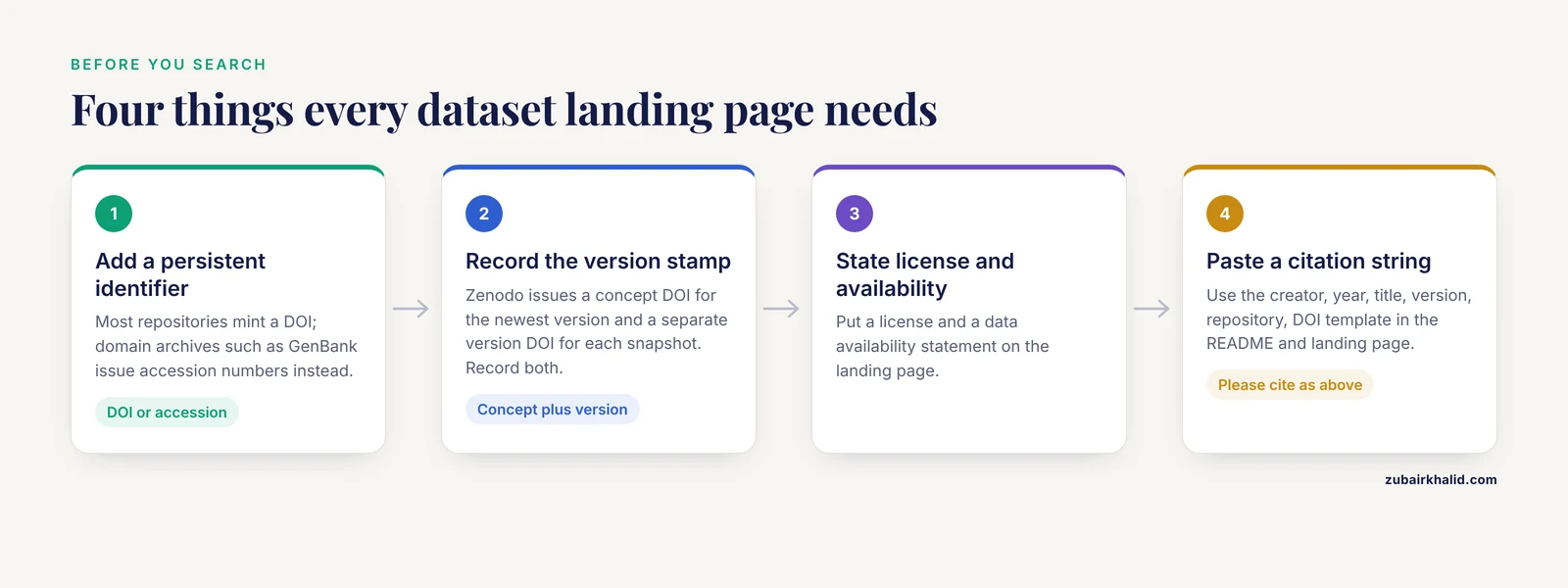
In practice you need four things on your dataset landing page:
- A persistent identifier. Most repositories mint a DOI. Domain archives such as GenBank at NCBI issue accession numbers, which serve the same purpose inside their field.
- A version stamp. Repositories built on Zenodo issue a concept DOI that always points to the newest version and a separate version DOI for each snapshot. Record both.
- A license and a data availability statement.
- A ready-made citation string. Paste this template into your README and your landing page:
Creator A, Creator B (Year). Title of the dataset, version 1.0. Repository name. https://doi.org/10.xxxx/xxxxxAdd one line underneath: Please cite this dataset as above, in addition to any paper describing it.
If you also publish a data paper, a conventional article whose content is the dataset itself, its Cited by page becomes one of your best tracking assets, because reusers who skip the dataset DOI often cite the paper instead.
The neuroimaging prototype went further, tagging individual images and derived combinations with their own group-level DOIs that automatically inherit the attributes and provenance of their source records [3]. That design lets a downstream user cite exactly the subset they used and lets you track reuse down to the item level. You do not need that machinery to start, but it matters when a collaborator wants to build a merged resource from several repositories.
Data Repository Comparison: Where You Deposit Shapes What You Can Track
The repository you choose determines the identifier you will search for and the usage signals you will see. This data repository comparison is organized around trackability rather than feature lists.
| Repository type | Examples | Identifier you will track | Usage signals available | Best fit |
|---|---|---|---|---|
| Generalist | Zenodo, Dryad, figshare, OSF | DOI per record and per version | Download and view counts, sometimes linked citing works | Mixed file types, software, fast public release |
| Domain-specific | GenBank and SRA at NCBI, NeuroMorpho.Org | Accession numbers, sometimes DOIs | Field-standard search tools, curated links to source papers | Reuse within your specialty |
| Institutional | University research data services | DOI minted through DataCite | Local usage statistics | Funder and institutional compliance |
| Controlled access | YODA Project, dbGaP | Approved data use requests tied to accessions | Publications from approved users | Sensitive human data |
Three selection rules follow from the table. First, prefer a domain repository when your field has one, because reusers in your specialty already search there. NeuroMorpho.Org shows how a domain archive can anchor reuse for an entire research community [1]. Second, fall back to a generalist repository for mixed file types or a quick release, and check that your funder accepts it. Third, use controlled access for sensitive human data and expect a different tracking pattern. In the YODA portfolio, external teams overwhelmingly reached the data through the platform itself rather than informal channels [2], so publications from approved users become your main reuse signal.
How to Track Data Citations for Shared Datasets Step by Step
Setting the routine up takes an afternoon. Keeping it running takes under an hour per quarter.
Step 1. Collect Every String That Identifies Your Dataset
Searches fail when they hunt a single string. Build a list of five:
- The concept DOI.
- Each version DOI.
- Any accession numbers.
- The exact dataset title, in quotes.
- The repository name plus your surname plus the release year.
Create a ledger file with these columns. You will fill it in as results arrive.
date_found,citing_work,doi_or_pmid,discovery_route,reuse_type,verifiedStep 2. Run a Baseline Sweep by Hand
Start with Google Scholar. Paste the quoted DOI into the search box, then repeat with the quoted title. If you published a data paper, open its Cited by page and skim it. Record the hit counts in your ledger as a baseline.
Next, query Europe PMC, a free full-text index of biomedical literature maintained at EMBL-EBI, through its REST API (an application programming interface, a URL that returns structured data instead of a web page). The quoted phrase forces exact matching so the DOI is not broken into tokens:
curl -s "https://www.ebi.ac.uk/europepmc/webservices/rest/search?query=%2210.5281%2Fzenodo.YOUR_RECORD_ID%22&format=json&pageSize=25"Abbreviated example response, values illustrative:
{
  "version": "8.0",
  "hitCount": 2,
  "resultList": {
    "result": [
      {
        "id": "12345678",
        "source": "MED",
        "title": "Example title of a citing article",
        "journalTitle": "Example Journal",
        "pubYear": "2025",
        "doi": "10.1234/example"
      }
    ]
  }
}
The parameters that matter are query, which holds your quoted identifier, and pageSize, which caps rows per response. The hitCount value at the top tells you how many records matched.
Finally, ask OpenAlex, a free open catalog of scholarly works, the same question and then invert it. First find the OpenAlex record for your dataset:
curl -s "https://api.openalex.org/works?search=%2210.5281%2Fzenodo.YOUR_RECORD_ID%22&per-page=10&[email protected]"From the results, copy the id field, which looks like https://openalex.org/W0000000000. Then list works citing that record:
curl -s "https://api.openalex.org/works?filter=cites:W0000000000&per-page=50&[email protected]"The mailto parameter identifies your client to the OpenAlex API and places you in a faster polite pool. per-page caps rows per response.
Step 3. Turn On Standing Alerts
Create a Google Scholar alert for the quoted dataset title so new indexed matches reach your inbox. Save the same query as a permanent search in Europe PMC, which supports email alerts for saved searches. If your library subscribes to Web of Science or Scopus, save the search there and enable its alerting option. Alerts catch the low-hanging fruit between your deeper quarterly passes.
Step 4. Run a Quarterly Forward Citation Search
Forward citation search means finding works that cite a known work. In Web of Science, open Cited Reference Search, enter the first author of your data paper, the dataset title or repository name in the cited work field, and the release year, then match against the candidate list. The YODA Project analysis located its secondary publications exactly this way, through Web of Science citation searches of the primary publications [2], which shows the method scales across hundreds of datasets. Scopus offers an equivalent cited-by view, and Lens.org provides a free alternative.
Complement forward searches with backward citation tracking, screening the reference lists of papers that already cite you, plus manual checks of original records. Scoping reviews use this pairing routinely [4].
Step 5. Automate the Full-Text Sweep
The script below reruns the Europe PMC and OpenAlex queries and writes a CSV you can diff against last quarter. Install the dependency with pip install requests, save the file as sweep.py, and replace the two variables at the top.
import csv
import time
import requests

DATASET_DOI = "10.5281/zenodo.YOUR_RECORD_ID"   # replace with your own DOI
MAILTO = "[email protected]"                      # identifies you to the OpenAlex API

def sweep_europepmc(doi):
    url = "https://www.ebi.ac.uk/europepmc/webservices/rest/search"
    params = {"query": f'"{doi}"', "format": "json", "pageSize": 100}
    response = requests.get(url, params=params, timeout=30)
    response.raise_for_status()
    hits = response.json().get("resultList", {}).get("result", [])
    return [
        {
            "source": "EuropePMC",
            "identifier": hit.get("doi") or hit.get("id"),
            "title": (hit.get("title") or "").strip(),
            "venue": hit.get("journalTitle") or "",
            "year": hit.get("pubYear") or "",
        }
        for hit in hits
    ]

def sweep_openalex(doi):
    url = "https://api.openalex.org/works"
    params = {"search": f'"{doi}"', "per-page": 50, "mailto": MAILTO}
    response = requests.get(url, params=params, timeout=30)
    response.raise_for_status()
    works = response.json().get("results", [])
    rows = []
    for work in works:
        location = work.get("primary_location") or {}
        source = location.get("source") or {}
        rows.append(
            {
                "source": "OpenAlex",
                "identifier": (work.get("doi") or "").replace("https://doi.org/", ""),
                "title": work.get("display_name") or "",
                "venue": source.get("display_name") or "",
                "year": work.get("publication_year") or "",
            }
        )
    return rows

rows = sweep_europepmc(DATASET_DOI)
time.sleep(2)
rows += sweep_openalex(DATASET_DOI)

with open("data_citation_sweep.csv", "w", newline="", encoding="utf-8") as handle:
    writer = csv.DictWriter(handle, fieldnames=["source", "identifier", "title", "venue", "year"])
    writer.writeheader()
    writer.writerows(rows)

print(f"Sweep complete. {len(rows)} candidate records saved to data_citation_sweep.csv")
Run it:
python3 sweep.pyExpected console output:
Sweep complete. 5 candidate records saved to data_citation_sweep.csvSample contents, values illustrative:
source,identifier,title,venue,year
EuropePMC,10.1234/example,Example study reusing the shared dataset,Example Journal,2025
OpenAlex,10.1234/example.two,Integrative analysis built on the shared dataset,Another Journal,2026
Common errors and fixes:
| Exact error or symptom | Likely cause | Fix |
|---|---|---|
| requests.exceptions.HTTPError: 429 Client Error: Too Many Requests for url | Calls too frequent without client identification | Add mailto to OpenAlex calls and keep the time.sleep pause in the script |
| jq: error (at stdin:0): Cannot index string with "resultList" | The endpoint returned an error page instead of JSON | Inspect the raw response with curl before piping to jq and read the message |
| hitCount is 0 for a paper you know used the data | Full-text indexing gaps or reformatted DOI strings | Repeat the search with the accession number and the quoted title |
| HTTPError: 404 Client Error: Not Found for url https://api.datacite.org/dois/... | Typo in the DOI prefix or suffix | Confirm the DOI resolves at doi.org, then retry |
Google Scholar has no official API and throttles scripted access, so drive it by hand or rely on alerts.
Step 6. Deduplicate and Classify What You Found
Merge records from different sources on DOI first, then PubMed identifier, then normalized title, because the same article often arrives from two databases. A meta-research protocol designed to measure the uptake of reporting guidelines builds structured de-duplication into exactly this step so each citing article is counted once [5].
Then label each record. Four categories cover most cases: re-analysis of your dataset alone, integrative analysis combining your dataset with others, methods or benchmark mention, and internal reuse where one of your own coauthors appears. Weight integrative reuses more heavily when you summarize impact, since they represent the highest-value form of reuse identified in the neuroscience analysis [1].
Step 7. Verify a Sample Before You Report Anything
Automated sweeps produce leads, not proof. Open at least five records, or ten percent of the total, and confirm the DOI or accession string actually appears in the methods or data availability section. Expect imperfection. When researchers applied machine reading to full texts to detect data deposition statements automatically, articles were classified with 81 percent F-measure, a single score that blends precision and recall, so both misses and false alarms occur [6]. Watch for two formatting traps: DOIs split across line breaks in PDFs, and accession numbers buried in supplement tables rather than the main text.
Step 8. Keep the Ledger Current and Close the Loop
Add each verified record to your ledger with the date and the discovery route. Link citing works from your dataset landing page where the repository allows it, thank the reusers, and deposit updated versions under a new version DOI when the data change.
Two existing tools show where this habit leads. The neuroscience group behind the bibliometric analysis released an open-source citation tracking web service that lets researchers monitor reuse of their datasets in independent peer-reviewed reports [1]. At program scale, SPARClink demonstrates the same architecture for the NIH SPARC program, whose datasets are curated under FAIR principles (Findable, Accessible, Interoperable, Reusable). SPARClink automatically and continuously finds new published outputs and the external resources referring to them by querying repository REST APIs and storing the results in a public database [7]. Your ledger is the single-dataset version of the same idea.
Tips That Save Time and Improve Coverage
- Search variants, not just the canonical string. Try the title with and without its colon, the repository abbreviation, and the accession number with its version suffix.
- Combine databases deliberately. A protocol for assessing the uptake of the GRIPP2 reporting guidelines plans forward citation searches across Web of Science, Scopus, and Google Scholar together, because no single index covers every citing venue [5].
- Capture alternative metrics alongside citations. The same protocol tracks mentions in policy documents and other altmetrics, measures of attention beyond the citation count [5].
- Put your requested citation in three places: the README, the landing page, and any data paper.
- Version cleanly. A changelog in the README tells reusers which snapshot they used, which keeps version DOIs meaningful.
- Join the OpenAlex polite pool by including mailto in every call.
- Schedule the sweep. A recurring calendar reminder beats good intentions.
- Report reuse in units reviewers understand: number of external studies, fields of reuse, and integrative versus single-dataset analyses.
Common Mistakes and Limitations
- Reading download counts as citations. Downloads measure curiosity. Only a citing work documents reuse.
- Relying on one database. Coverage differs enough that a single-source count can mislead.
- Trusting formal citation fields alone. When researchers text-mined PubMed Central for data deposition statements, they predicted 52,932 articles reporting a deposition, many of which were absent from the MEDLINE Secondary Source Identifier field meant to record them [6]. Mentions hide in methods paragraphs and supplements.
- Skipping de-duplication. Double counting inflates your numbers and undermines trust in the report.
- Counting internal reuse as external impact. In the YODA portfolio, most secondary publications included at least one original trial investigator, so raw counts overstate independent reuse [2]. Label internal and external reuse separately.
- Mixing up concept and version DOIs. Advertising only the concept DOI blurs version-specific credit. Advertising only one version DOI hides reusers of later snapshots.
- Expecting a fast payoff. Reuse accrues over years rather than spiking and fading in the first season after release [1].
- Treating automated output as ground truth. Text-mining tools miss some deposition statements and flag others incorrectly, so keep the manual verification step.
- Ignoring blind spots. Theses, preprints outside major indexes, and closed industry reports can reuse your data without leaving a trace in scholarly databases.
Frequently Asked Questions
How do I find papers that cite my shared dataset?
Search your dataset DOI and exact title in Google Scholar, Europe PMC, and OpenAlex, then run a cited reference search on your data paper in Web of Science or Scopus. Merge the results and verify each hit in the full text.
Do I need a DOI before I can track citations?
No, but it helps enormously. Accession numbers and exact quoted titles also work as search strings, though they produce noisier results.
Which tool is best, Google Scholar, Web of Science, or OpenAlex?
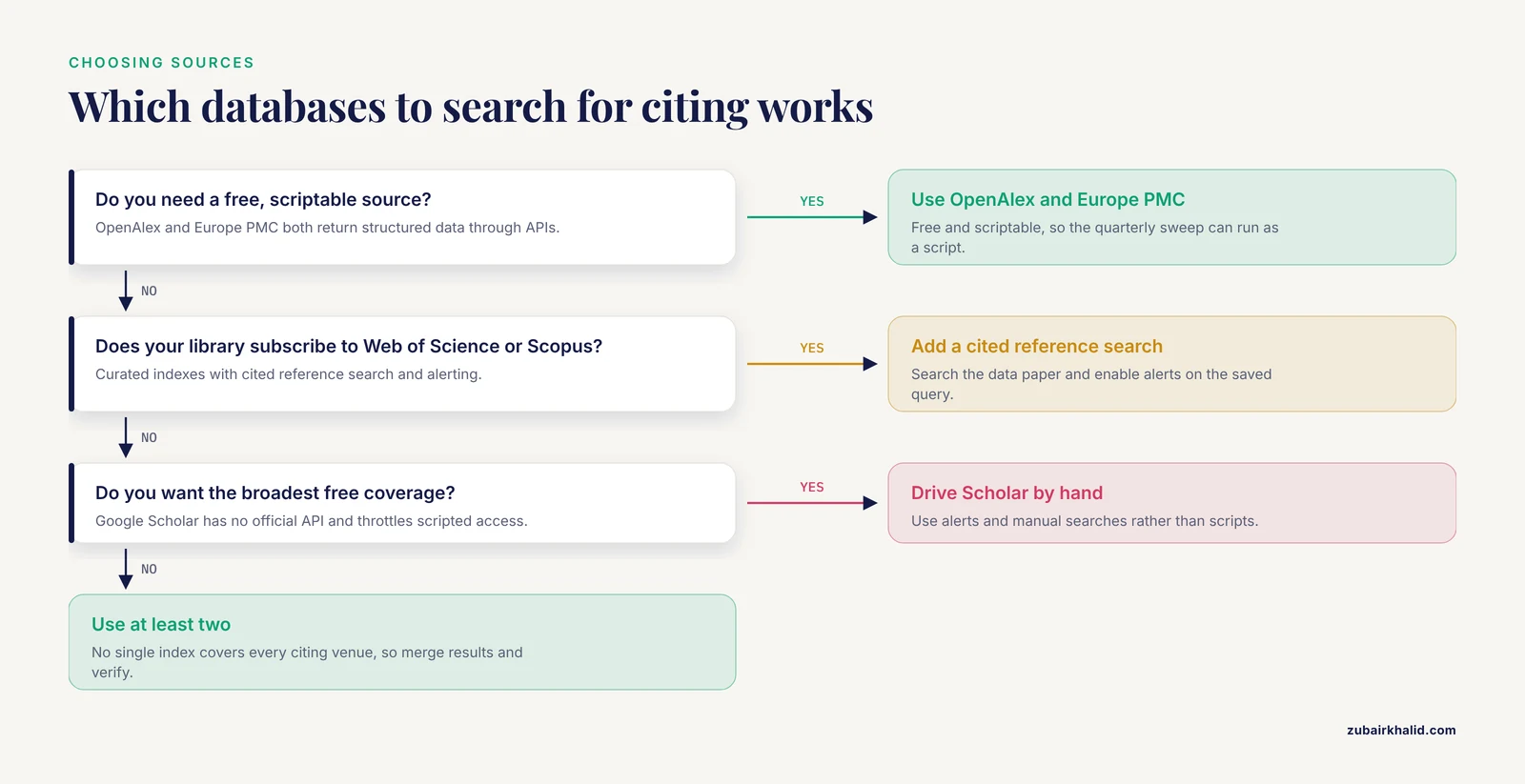
Use at least two. Google Scholar is broad and free, Web of Science and Scopus are curated but subscription based, and OpenAlex and Europe PMC are free and scriptable.
How often should I check for new data citations?
Quarterly suits most datasets. Standing alerts catch urgent mentions between passes, and one deeper annual pass can add backward citation tracking.
What should I do if someone reused my data without citing it?
Email the corresponding author with your recommended citation string and the dataset link. Most cases are oversight, and a polite note usually fixes them.
Can I track citations to a specific version of my dataset?
Yes. Search the version-specific DOI separately from the concept DOI and keep the results in separate ledger rows.
Are download counts the same as data citations?
No. Downloads measure interest, while citations document actual reuse in a published work. Track both but never conflate them.
How do I make my dataset easier for others to cite?
Deposit it in a repository that mints a DOI, paste a ready-made citation string into the README and the landing page, and label versions clearly.
Sources
- Bibliometric analysis of neuroscience publications quantifies the impact of data sharing.
- Secondary use and scholarly impact of a portfolio of clinical trials with shared individual participant level data: cross sectional study.
- Data Citation in Neuroimaging: Proposed Best Practices for Data Identification and Attribution.
- Nursing Minimum Datasets in Long-Term Care Settings: Scoping Review.
- Assessing the impact, uptake and use of reporting guidelines for patient and public involvement in research: GRIPP2 - study protocol for a meta-research project.
- Extraction of data deposition statements from the literature: a method for automatically tracking research results.
- SPARClink: an interactive tool to visualize the impact of the SPARC program.