Thesis Writing Sprint Method: Step-by-Step Guide
By Dr. Zubair Khalid, DVM, MS, PhD ·

By the end of this guide you will be able to convert your thesis into a list of sprint-sized writing tasks, calculate how many sprints you need, run timed writing blocks with a tracked word count, and build a review cycle that keeps quality under control. You will need a word processor or plain-text editor, a timer (a phone works), a spreadsheet or a plain text log file, and an honest estimate of your target word count. If your data analysis is finished, you can start sprinting this week. If it is not, Step 1 shows you how to sequence writing around the work that remains.
The sprint method treats thesis writing as a series of short, defined blocks instead of one long, undefined ordeal. The alternative, waiting for long uninterrupted stretches of motivation, fails often enough that researchers have documented the pattern in detail. Thesis-writing burnout follows the writing stages and peaks during the middle, three-chapter phase, where exhaustion and cynicism reach their highest measured levels [1]. Writing anxiety, including fear of the blank page and fear of statistics, is common and measurable among students at the start of the process [2]. Procrastination during thesis writing traces back to weak self-regulation, uneven writing ability, and emotional regulation problems, and it damages wellbeing in ways students report directly [3]. Sprints attack all three problems the same way: they shrink the unit of work until starting is easy.
What the Thesis Writing Sprint Method Is
A sprint is a fixed block of time, usually 25 to 50 minutes, with one defined output such as a drafted section, a revised paragraph, or a completed figure caption. You decide the task before the timer starts. You write without editing until the timer ends. You log the result. Then you rest.
The method borrows from time-boxed work practices and from self-regulated learning research. In a study of 303 postgraduate students, ChatGPT was used most successfully as a planning, monitoring, and evaluation aid across the forethought, performance, and self-reflection phases of thesis writing, with students acting as primary authors rather than delegating authorship [4]. That finding translates directly into sprint design: plan before the block, monitor during it, evaluate after it. The sprint structure makes each phase explicit.
The method also matches how writing skill actually improves. Graduate students who struggled to apply critical thinking in their theses reported that their working strategies were time management, technological support, careful reading and source evaluation, and a support system of peers and supervisors [5]. A sprint schedule builds time management into the calendar and creates natural checkpoints for feedback from others.
Step 1: Map Your Thesis Before You Sprint
You cannot sprint toward a target you have not defined. Start by writing down your structure. For most life science degrees, a biology thesis structure follows a variation of IMRaD (Introduction, Methods, Results, and Discussion):
- Title page and abstract
- Introduction and literature review
- Materials and methods
- Results, with tables and figures
- Discussion
- Conclusion
- References
- Appendices (raw data, permits, sequences, ethics approvals)
Chapter conventions vary by institution, and some programs split the content into four or five numbered chapters. Surveys of student understanding show that the sections students handle confidently differ from the ones that cause trouble. In one large survey, students generally understood how to justify a study and connect it to existing literature, could identify research methods and tools but needed more help with sampling and statistics, presented findings clearly with tables and graphs but sometimes lacked depth in interpretation, and could write conclusions that occasionally needed more clarity and completeness [6]. Use that pattern as a diagnostic. When you map your own thesis, mark the sections where your weakest skills sit, because those sections need the most sprints and the earliest supervisor feedback.
Assign a word count to every section based on your program's requirements. A typical MSc thesis in the life sciences runs 12,000 to 20,000 words, but your department's handbook is the authority. The worked examples below assume a 14,000-word thesis. Replace the numbers with your own.
Step 2: Audit Materials and Set Up a Workspace
Before the first sprint, gather everything you will write from: your data, analyzed and stored; your reference library (Zotero, Mendeley, or EndNote); your figures, at final resolution; your institutional template or style guide; and any supervisor comments from your proposal stage.
Anxiety research explains why this step matters. Students preparing thesis proposals reported both somatic anxiety (physical symptoms such as tension) and cognitive anxiety (worrying thoughts), driven by pressure to produce perfect work, time constraints, and inadequate writing methods [7]. A complete workspace removes several of those triggers at once. You cannot stall in a sprint because a figure is missing if every figure is already exported and named.
Create a project folder with one plain-text or markdown file per section:
thesis/
  00_abstract.md
  01_introduction.md
  02_literature_review.md
  03_methods.md
  04_results.md
  05_discussion.md
  06_conclusion.md
  sprint_log.csv
  outline.md
In outline.md, write the one-sentence claim of every section and the subheadings under it. This document is your sprint backlog. Every heading that needs prose becomes one or more sprint tasks.
Step 3: Calculate Your Sprint Budget
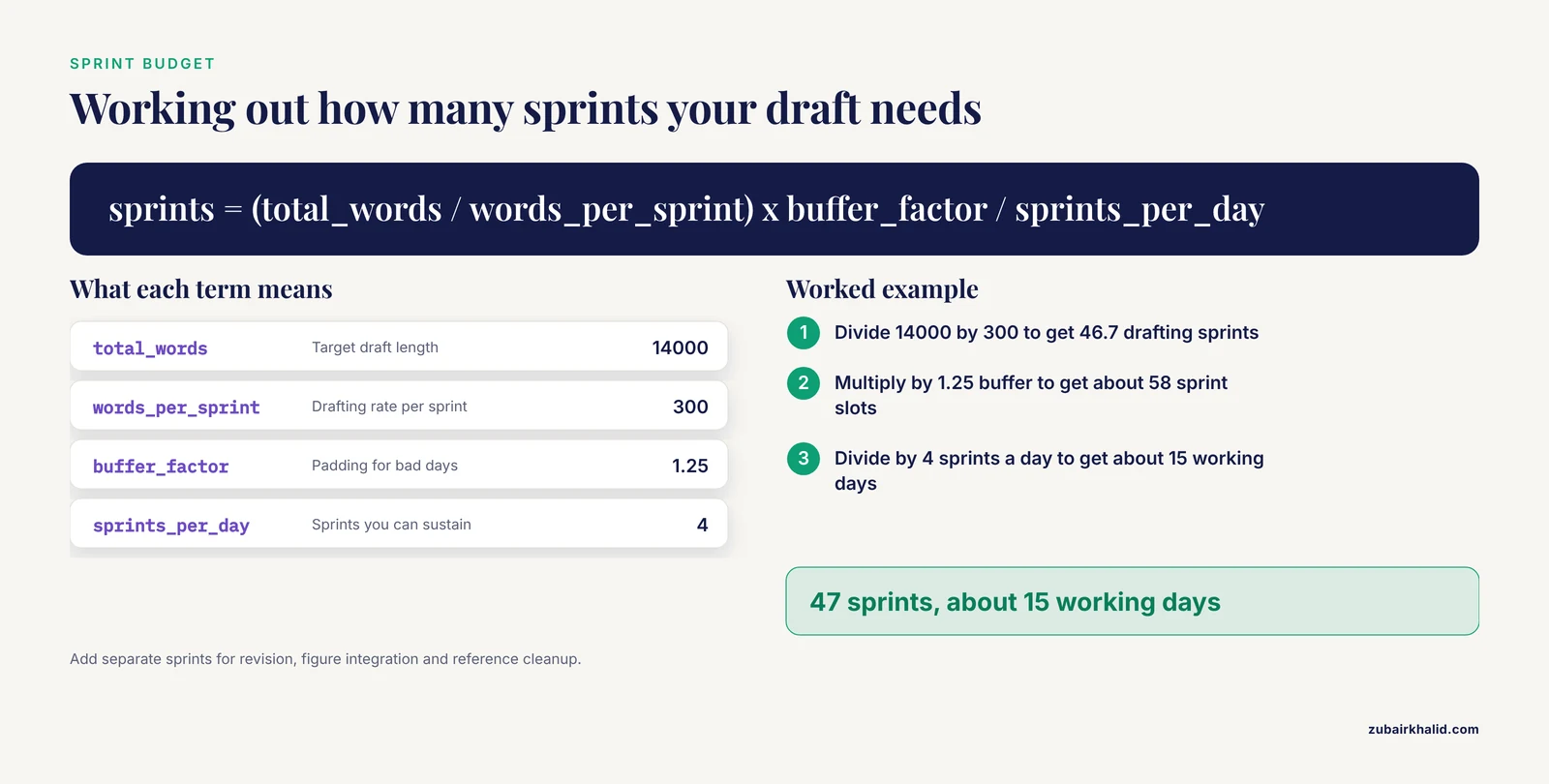
This is the core arithmetic of the thesis writing sprint method, and doing it once removes the vague dread of an unbounded task.
Inputs you need:
- Total target words: 14,000
- Words you can draft in a 45-minute sprint: 250 to 400 for most writers on familiar material
- Sprints you can sustain per day: 3 to 5 on a working day, 6 on a full writing day
- Days available before your draft deadline
Worked calculation for a 14,000-word thesis:
# sprint_budget.py
total_words = 14000
words_per_sprint = 300          # conservative drafting rate
sprints_per_day = 4
buffer_factor = 1.25            # 25% padding for bad days

draft_sprints = total_words / words_per_sprint
calendar_days = draft_sprints * buffer_factor / sprints_per_day

print(f"Sprints needed: {draft_sprints:.0f}")
print(f"Calendar days at {sprints_per_day} sprints/day: {calendar_days:.0f}")
Expected output:
Sprints needed: 47
Calendar days at 4 sprints/day: 15
So a 14,000-word draft needs roughly 47 drafting sprints, which fits into about 15 working days with padding. Add separate sprints for revision, figure integration, and reference cleanup, which Step 6 covers. If your deadline is shorter than your calculated calendar days, you have learned that early, on a calculator, rather than in week nine.
A summary of the sprint types and their parameters:
| Sprint type | Duration | Output | Typical daily count | Best stage |
|---|---|---|---|---|
| Draft sprint | 45 min | 250 to 400 new words | 3 to 5 | First pass |
| Outline sprint | 25 min | Completed section outline | 2 to 3 | Before drafting |
| Revision sprint | 30 min | One section edited, no new prose | 2 to 4 | After full draft |
| Data sprint | 45 min | One figure or table finalized | 2 to 3 | Results stage |
| Cleanup sprint | 25 min | References, formatting, captions | 3 to 5 | Final two weeks |
Step 4: Run a Sprint (The Protocol)
Follow this sequence exactly for each block. The rigidity is the point, because structure is what stops procrastination.
- Pick one task from the backlog. Write it as an output, not an activity. "Draft the paragraph justifying the choice of qPCR over Western blotting in Methods" is a task. "Work on Methods" is not.
- Reread your outline line for that section. Thirty seconds.
- Set the timer for 45 minutes and start it.
- Write without editing. No rereading sentences, no thesaurus hunts, no reformatting citations. Insert a placeholder like
[REF]or[CHECK n]and keep moving. Perfectionism during drafting is a documented anxiety driver, and separating drafting from editing is the direct countermeasure. - When the timer ends, stop mid-sentence if you are mid-sentence. Log your word count.
- Take a 10 to 15 minute break away from the screen.
- After every third sprint, spend five minutes fixing the placeholders you left.
A plain-text timer command if you work in a terminal:
# macOS/Linux: 45-minute draft sprint with an audible alert
sleep 2700 && say "Sprint complete, log your word count"
On Windows, use timeout 2700 in Command Prompt or simply a phone timer. The tool does not matter. The unbroken block does.
Step 5: Track Every Sprint in a Log
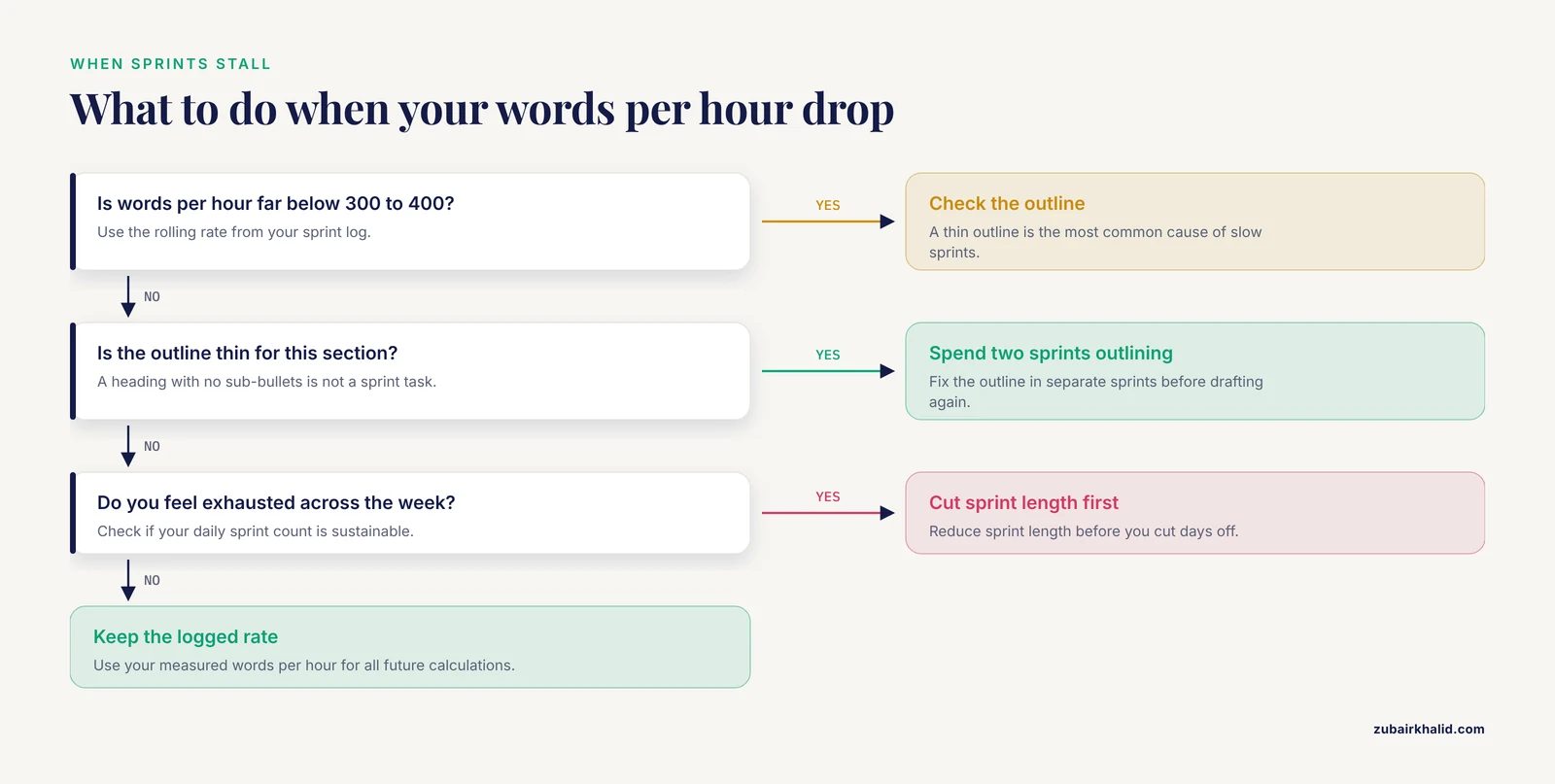
Monitoring is the middle phase of self-regulated writing, and students who used a structured planning-and-monitoring loop reported better writing experiences than those who wrote reactively [4]. Your log is the monitoring instrument. Keep it as a CSV so a spreadsheet or a short script can summarize it:
date,sprint_type,section,minutes,words_written,notes
2026-11-11,draft,methods,45,320,left [CHECK 3] for reagent vendor
2026-11-11,draft,methods,45,290,flow cytometry gating paragraph done
2026-11-11,data,results,45,0,figure 2 finalized, 0 words
2026-11-12,draft,literature_review,45,310,slow start, outline was thin
Then compute your rolling rate:
# sprint_summary.py
import csv

with open("sprint_log.csv") as f:
    rows = [r for r in csv.DictReader(f) if r["sprint_type"] == "draft"]

words = sum(int(r["words_written"]) for r in rows)
hours = sum(int(r["minutes"]) for r in rows) / 60
print(f"Draft words: {words}")
print(f"Draft hours: {hours:.1f}")
print(f"Words per hour: {words / hours:.0f}")
Expected output after the four example rows plus a few more:
Draft words: 2140
Draft hours: 6.5
Words per hour: 329
If your words-per-hour is far below the 300-to-400 assumption, your outline is too thin. Spend the next two sprints outlining instead of drafting. Thin outlines are the most common cause of slow sprints, and fixing the outline is cheaper than forcing prose.
Step 6: Build in Revision and Integrity Sprints
A first draft produced at 300 words per sprint will be rough. That is expected. Schedule revision sprints only after a complete section exists, because editing sentence by sentence during drafting destroys momentum and doubles the calendar time.
Revision sprints have three passes, run on different days:
- Structure pass. Does each section make the claim your outline promised? Move paragraphs, cut duplicates.
- Clarity pass. Fix diction, sentence structure, paragraph coherence, and idea organization. These are exactly the categories that documentation analysis of thesis manuscripts identifies as the main linguistic weaknesses in student writing [8]. Read each paragraph aloud. If you run out of breath, the sentence is too long.
- Mechanics pass. Grammar and spelling tools help here, with a documented catch. A mixed-methods study of students using Grammarly found that 75.55 percent of surveyed students showed dependence on the tool, and unhealthy use produced anxiety when writing without it, eroding independent writing skill [9]. The practical rule: run the checker at the end of a revision sprint, accept or reject each suggestion with a reason, and never let it write for you. The same principle applies to AI writing assistants generally. Students using AI paraphrasing tools reported time savings and vocabulary improvement but worried about over-reliance and reduced originality, and the study concluded such tools should complement rather than replace critical writing skill [10].
Run an integrity sprint before every supervisor submission. Plagiarism in thesis writing includes intentional and unintentional copying, is rising with easy access to online content, and threatens the credibility of the student, the supervisor, and the institution [11]. During the integrity sprint, check that every borrowed idea carries a citation, that quotations are marked, that paraphrases genuinely restate the source in your own sentence structure, and that your institution's similarity report is clean of surprises. An honest similarity check is part of the sprint output, logged like a word count.
If you write in a language other than your own, schedule translation sprints and verify terminology against the primary literature in your field. Students report both heavy use of translation tools and frustration with inaccuracies, so treat machine translation as a first pass that you verify line by line [12]. Linguistic difficulty is one of the three dominant categories of thesis-writing obstacles, alongside psychological barriers and insufficient academic support, and it responds to deliberate practice rather than to willpower [13].
Step 7: Schedule Feedback and Protect the Middle Phase
Two findings from the research literature should shape your calendar.
First, burnout peaks in the middle. In a survey of 117 postgraduates, exhaustion and cynicism peaked during the three-chapter writing stage and then declined as students moved into the final chapters, where professional efficacy rose and fatigue became manageable [1]. Plan your lightest sprint weeks for the middle of the draft. Front-load the sections you find easiest, schedule supervisor meetings at fixed dates rather than "when I have something to show," and tell someone your weekly sprint count so the commitment is external.
Second, pacing itself is a quality variable. In an assessment of a structured "Help thesis writing" training module, 80 percent of participants were satisfied with the teaching across evaluated aspects, yet more than half judged the teaching rhythm unsuitable [14]. A pace that suits one writer will not suit another. If four sprints a day leaves you exhausted, three sustained for six weeks beats five sustained for nine days. The log from Step 5 will show you your sustainable rate within two weeks.
Anxiety management also belongs on the calendar. Students coping with research and thesis anxiety reported that regular practice, working through online resources, and using available support were the strategies that worked [2]. Translated into the sprint system: a short daily writing practice even on rest days, a saved list of style and statistics resources you trust, and a standing weekly check-in with a peer or supervisor.
Worked Example: A Two-Week Sprint Plan for a Results-First Draft
Suppose your analysis is done, your outline is complete, and you have 20 working days. Here is how the first two weeks look for a 14,000-word biology thesis, drafting Methods and Results first because they depend only on your own data:
Week 1
  Day 1: 1 outline sprint (methods), 3 draft sprints (methods)      ~900 words
  Day 2: 4 draft sprints (methods)                                 ~1200 words
  Day 3: 2 draft sprints (methods), 2 data sprints (figures 1-2)
  Day 4: 1 revision sprint (methods), 3 draft sprints (results)    ~900 words
  Day 5: 4 draft sprints (results)                                 ~1200 words
  Day 6: rest or 1 light cleanup sprint
  Day 7: rest

Week 2
  Day 8:  2 data sprints, 2 draft sprints (results)
  Day 9:  4 draft sprints (results)
  Day 10: 1 revision sprint (results), 1 integrity sprint,
          send methods + results to supervisor
  Day 11: 4 draft sprints (introduction)                           ~1200 words
  Day 12: 4 draft sprints (introduction/literature review)
  Day 13: 4 draft sprints (literature review)
  Day 14: rest or 2 outline sprints (discussion)
By day 14 you have roughly 7,000 drafted words plus a revised Methods and Results section in front of your supervisor. The Discussion, the hardest section per the understanding survey [6], gets the back half of the schedule with the most revision sprints attached, and by then your supervisor has already seen your data chapters, which anchors the Discussion to results they have read.
Common Mistakes and Limitations
Outlining too thinly. A heading with no sub-bullets is not a sprint task. Sprints stall when the writer must decide what to say and say it in the same 45 minutes. Fix the outline in a separate sprint.
Editing during drafting. Rereading and polishing mid-sprint cuts output roughly in half and feeds the perfectionism that drives writing anxiety [7]. Enforce the no-editing rule with placeholders.
Sprinting an unfinished analysis. The method assumes your data exist. Writing Results before your statistics are final means rewriting them. Finish analysis first, or convert the gap into data sprints.
Tool dependence. Grammar and paraphrasing assistants are end-of-sprint checkers, not co-authors. Excessive reliance produces measurable anxiety when the tool is absent and erodes independent skill [9], and students themselves worry about declining originality [10]. The same caution applies to using ChatGPT to generate prose rather than to plan, question, and critique your own drafts [4].
Plagiarism by accretion. Notes copied from papers have a way of surviving into drafts. Keep quoted text in quotation marks with a source from the first note, and run a deliberate integrity sprint before every submission [11].
Ignoring the middle-phase slump. Burnout peaks during the middle chapters, not at the start [1]. If you schedule your hardest cognitive work, typically the Discussion, in the same weeks as your peak writing volume, expect the slump to hit there. Sequencing is the fix.
Skipping the log. Without a record you cannot tell a slow week from a normal one, and you cannot renegotiate your deadline with evidence. Two minutes per sprint is the entire cost.
One honest limitation. The sprint method organizes effort. It does not replace the judgment of your supervisor, your committee, or your institutional ethics and formatting requirements, and individual programs differ enough that their handbooks override any general structure described here.
Frequently Asked Questions
What is the thesis writing sprint method?
It is a way of writing a thesis in fixed, timed blocks of 25 to 50 minutes, each with one defined output such as 300 drafted words or one revised section, tracked in a log so you can measure your rate and adjust your schedule with evidence instead of feelings.
How long should a thesis writing sprint last?
Forty-five minutes works well for drafting, 25 minutes for outlining and cleanup, and 30 minutes for revision. Choose the length you can repeat three to five times a day without exhaustion, because burnout research shows middle-phase fatigue is the main schedule threat.
How do I plan a thesis using sprints?
List every section with a word count, break each section into outline bullets, convert each bullet into a sprint task, calculate sprints needed as total words divided by your words-per-sprint rate, add 25 percent buffer, and divide by your daily sprint capacity to get calendar days.
How many words should I aim for per sprint?
A realistic drafting target is 250 to 400 words in 45 minutes on familiar material. Log your own rate for two weeks and use your measured number, not an assumption, for all future calculations.
Can I use AI tools like ChatGPT or Grammarly during sprints?
Use them at the edges, for planning outlines, clarifying your own arguments, and checking grammar after drafting, and keep authorship decisions with yourself. Studies of both tools show benefits for planning and editing alongside measurable risks of dependence and reduced originality when they substitute for your own writing.
What is the most common mistake in the sprint method?
Editing while drafting. It halves output, lengthens the project, and feeds perfectionism-driven anxiety. Draft in one sprint, revise in a different sprint on a different day, and use placeholders like [REF] to keep moving.
Does the sprint method work for a biology thesis?
Yes. A biology thesis maps cleanly onto sections with countable words, figures, and tables, and drafting Methods and Results first from finished data is a natural sprint sequence. The Discussion and the statistical passages need the most sprints because students consistently report the weakest grasp there.
How do I avoid burnout during thesis sprints?
Cap daily sprints at a rate you can sustain for weeks, schedule your easiest weeks in the middle of the draft where burnout peaks, keep a peer or supervisor check-in on a fixed date, and take full rest days. If your log shows falling words per hour, cut sprint length before you cut days off.
Sources
- MIXED-METHOD ANALYSIS OF PREDISPOSING FACTORS ASSOCIATED WITH THESIS-WRITING BURNOUT AMONGST CHINESE POSTGRADUATES
- MEASURING ANXIETY TOWARDS RESEARCH AND THESIS WRITING AMONG ISLAMIC COLLEGE STUDENTS: A MIXED-METHODS STUDY
- Exploring EFL undergraduate students’ academic procrastination in thesis writing: A narrative study in Indonesia
- ChatGPT as a self-regulated learning support tool in thesis writing: a mixed-methods study
- Navigating TEFL Graduate Students Challenges and Strategies in Utilizing Critical Thinking Skills in Thesis Writing
- Managing the Level of understanding in thesis writing among Grade 12 Students
- The Struggle with Writing Anxiety: English Language Education Department Students and Thesis Proposal Completion
- LINGUISTIC BARRIERS ENCOUNTERED IN THESIS WRITING BY STUDENTS OF THE SHARIA ECONOMICS PROGRAM AT INSTITUT 'AISYIYAH SULAWESI SELATAN
- Perspective on the Dependency of Using Grammarly in Thesis Writing: A Mixed Method Study
- AI Paraphrasing Tools in EFL Undergraduate Thesis Writing: Students' Perceptions and Influential Factors
- Plagiarism in Thesis Writing: Role, Types, Detection, Ethical Implications, and Prevention
- Student’s Perception Towards the Use of DeepL Translator in Writing Thesis or Journal for English Education Students
- A Literature Review on Factors Affecting EFL Students’ Difficulties in Thesis Writing
- [[Students assessment of teaching method used in the module "Help thesis writing": intended for interns at the Armed Forces Hospitals and held at the Army Center for Epidemiology and Public Health, Marseilles].](https://pubmed.ncbi.nlm.nih.gov/27800091/)