How to Adjust Your Thesis Timeline When You Fall Behind
By Dr. Zubair Khalid, DVM, MS, PhD ·
Most thesis timelines fall behind for the same reason. The original schedule assumed that every experiment would work the first time, every reagent would arrive on schedule, and every draft would need one revision. None of those assumptions survive contact with a real research project. If your thesis timeline is falling behind, the first thing to check is not your motivation or your work ethic. It is the gap between what you planned to produce each week and what you actually produced, measured over the last four to six weeks. That single comparison tells you whether you are dealing with a planning error, a technical problem, or an external bottleneck, and each of those needs a different fix.
This guide walks through the common causes of a slipping thesis timeline, a diagnostic sequence you can finish in one afternoon, a troubleshooting table you can reuse, and a method for rebuilding a schedule that holds up. It also covers how to plan a thesis from the start so that a two-week delay never becomes a two-semester crisis.
The First Thing to Check When Your Thesis Timeline Is Falling Behind
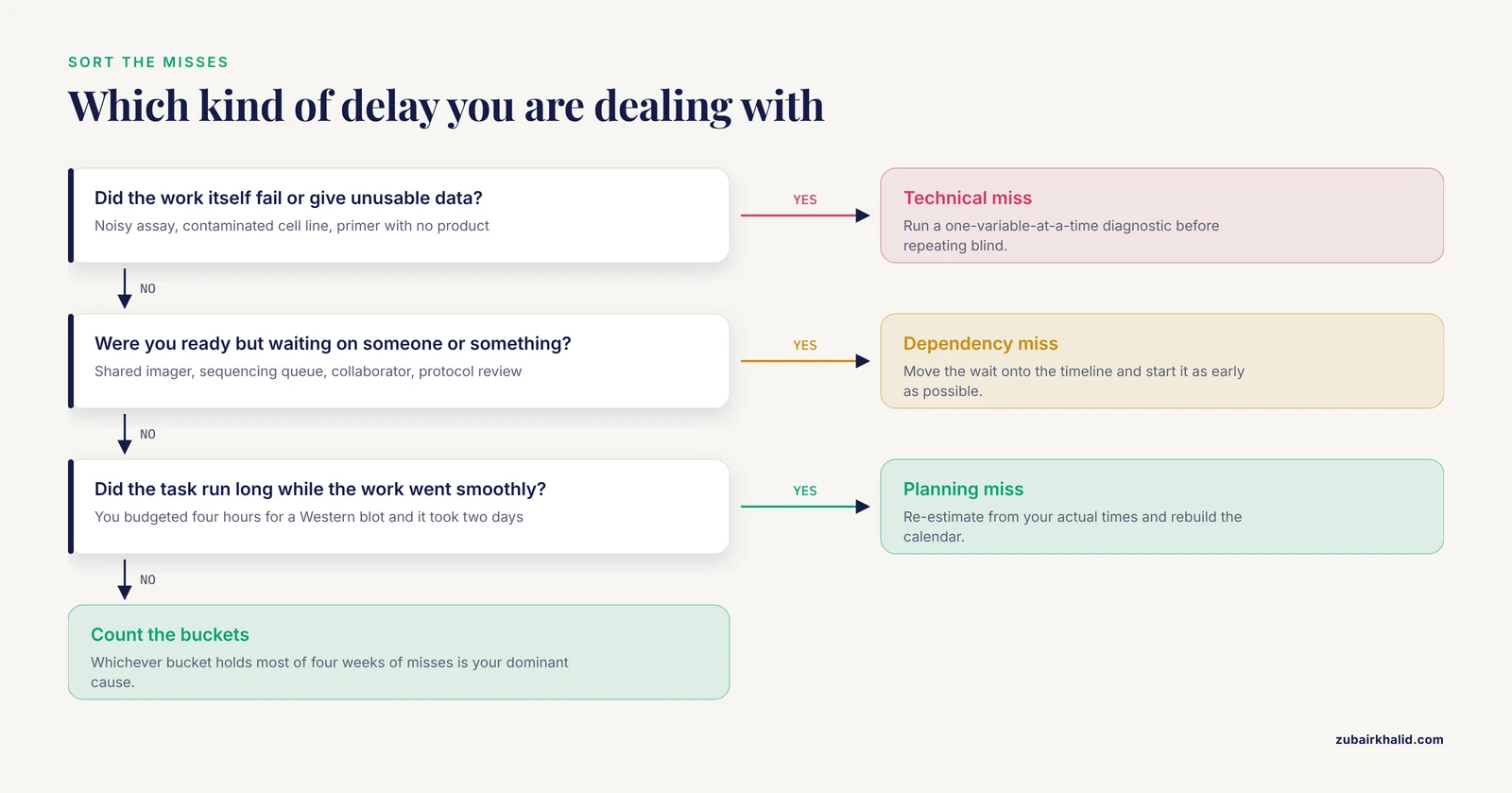
Open your calendar and your lab notebook or project log side by side. For each of the last four weeks, write down two numbers. The first is the output you planned: the number of samples processed, reactions run, chapters drafted, or datasets analyzed. The second is the output you actually delivered. Then classify each miss into one of three buckets.
Planning misses happen when the task took longer than you estimated but the work went smoothly. If you budgeted four hours for a Western blot and it took two days because you also had to optimize the transfer conditions, that is a planning miss. Planning misses are the most common category and the easiest to fix, because the fix is arithmetic rather than troubleshooting.
Technical misses happen when the work itself failed. An assay gave noisy data, a cell line became contaminated, a primer pair produced no product, an animal cohort had to be re-ordered. Technical misses in bench biology are normal, not exceptional, and a realistic timeline budgets for them.
Dependency misses happen when you were ready but something else was not. The shared imager was booked, the sequencing facility had a queue, your collaborator needed three weeks to return edited plasmids, or the animal protocol revision was still in review. Dependency misses are the hardest to fix alone, because the constraint sits outside your control.
Sorting your last month of misses into these three buckets takes about thirty minutes and tells you which section of this article applies to you. Researchers who study why organizations catch up or fall behind describe the same structure in a different setting: outcomes depend on the interaction of formal rules and informal conditions, not on either one alone [1]. Your thesis behaves the same way. Your formal plan and the informal realities of your lab, your facility queues, and your own estimate error jointly determine whether you catch up.
Why Thesis Timelines Slip: Causes, From Most Common to Rarest
1. Optimistic baseline estimates
The most common cause of a thesis timeline falling behind is an original plan built from best-case durations. Psychologists call the general version of this the planning fallacy: people predict task durations based on the best outcome they can imagine rather than on how similar tasks actually went. Graduate students rarely make this error out of carelessness. They make it because a plan that shows every experiment working on the first attempt is the only plan that fits the funding clock, the visa clock, or the graduation deadline in the first place.
The mechanism is compounding. If each of ten planned steps runs forty percent long, the project does not finish forty percent late. It finishes much later, because each delayed step pushes the next one into a calendar slot already occupied by coursework, teaching, or a committee meeting. A schedule with no slack converts small estimate errors into large schedule errors.
The confirmation is simple. Take your last five completed tasks. Compare planned duration to actual duration for each. If actual time exceeds planned time for most of them, your baseline is optimistic and every downstream date in your plan is fiction.
2. Experimental failures and repeat work
In bench biology, failure is part of the workload, not an interruption of it. A realistic plan prices in a failure rate. The trouble is that most students price it at zero. The second most common cause of a falling-behind timeline is treating each failed PCR, each disoptimized purification, and each ambiguous replicate as an unplanned event rather than as expected work.
The mechanism is easy to see. A project with twelve experimental steps and a two-in-three success rate per step will, on average, require eighteen attempts to get twelve successes. If your plan budgeted twelve attempts, you are short six attempts of time, reagents, and calendar. Students who internalize this stop asking "why did this fail again" and start asking "how many repeats does my schedule assume."
There is one hazard to flag here. When a timeline slips, the temptation is to compress protocol steps, skip controls, or run assays at the edge of the validated range. Do not do this. Controls are what make failed experiments interpretable, and skipping them usually costs more time than it saves, because you end up repeating the whole experiment without knowing which step failed. Work under your institution's chemical hygiene plan and biosafety requirements at full rigor, even in a crunch. Rushed handling of hazardous reagents is the most expensive way to lose a week.
3. Hidden dependencies and waiting time
The third cause is invisible on most student Gantt charts: time spent waiting. Instrument queues, core facility turnaround, animal protocol approvals, collaborator responses, reagent backorders, and committee review windows do not show up as tasks on a plan, but they consume calendar time all the same. A sequencing run that takes two days at the bench can take three weeks door to door once the facility queue is counted.
The mechanism is that dependency time is contractual, not technical. You cannot work faster to shorten it. The fix is to surface these waits explicitly, put them on the timeline as their own entries, and start the dependency clock as early as possible even if the preceding work is not finished. Submit the animal protocol while you validate the assay. Order the primers before the pilot data are in. Dependency-aware planning is one of the few places where starting early beats working fast.
4. Data analysis bottlenecks
The fourth cause is the analysis wall. Students budget heavily for data collection and lightly for analysis, then discover that cleaning the data, writing analysis scripts, generating figures, and re-running everything after a reviewer or committee member asks a question takes longer than the experiments did. In modern biology, where a single project can generate imaging datasets, sequencing outputs, and behavioral recordings, analysis is often the true critical path.
The mechanism is that analysis work is iterative in a way bench work is not. You do not make each figure once. You make it, see a problem, fix the pipeline, and regenerate. A plan that gives figures one pass will undercount this by a factor of several.
5. Writing treated as a final phase
The fifth cause is structural. Many students treat writing as a phase that starts after experiments end. This is workable in a textbook project and unworkable in a thesis, because thesis writing is itself a form of analysis. Drafting the methods chapter reveals what you failed to record. Drafting the introduction reveals gaps in the literature review. Drafting the results chapter reveals which controls are missing. When writing starts after the bench work stops, every gap the writing exposes becomes a return trip to the bench, at the worst possible moment on the calendar.
The mechanism is a dependency loop: writing depends on data, but the shape of the final data depends on decisions that writing clarifies. Breaking the loop requires drafting during the experimental phase, not after it.
6. Low-probability events
The rarest causes are the ones no plan survives: an advisor leaves the institution, a funding line lapses, a pandemic closes the building, a family emergency, a serious illness. These deserve mention because their fix is different. You cannot schedule around them. You can only keep your records, data, and drafts in a state where a substitute advisor or a delayed restart costs weeks rather than semesters. If you are in this category, your problem is not time management. Your problem is an exception that your graduate program's petition and extension processes exist to handle, and the right move is to contact your program director early.
A Diagnostic Sequence You Can Finish in One Afternoon
Work through this list in order. Stop when you find your dominant cause, because that is where your effort belongs.
- Measure the gap. List every milestone in your original plan with its planned date. Mark each as done, in progress, or not started. Count the weeks of delay at the milestone level, not the guilt level. "I am behind" is not actionable. "Chapter 2 is three weeks late" is.
- Bucket four weeks of misses. Use the three categories above. Whichever bucket holds most of your misses is your dominant cause.
- Check your critical path. Identify the single longest chain of dependent tasks between today and your defense. If your delay is not on that chain, your graduation date may not move at all. Many students panic about delays in parallel work that has zero effect on the endpoint.
- Test the math against the deadline. Estimate the remaining hours of the remaining work honestly, divide by the realistic hours you have per week, and compare the result to your deadline. This crude calculation, done on one page, predicts most semester outcomes.
- Decide the response. If the math fits with scope cuts, cut scope. If the math fits with more hours per week for a bounded period, add hours. If the math does not fit at all, begin the extension conversation this week, not after the deadline passes.
Troubleshooting Table
| Symptom | Likely cause | How to confirm | Fix |
|---|---|---|---|
| Every task takes longer than planned but nothing fails | Optimistic baseline | Planned vs. actual times for the last five tasks consistently mismatch | Re-estimate remaining tasks using actual times, multiply by 1.5, rebuild the calendar |
| The same assay keeps failing | Technical failure with an undiagnosed root cause | Failure reproduces across new reagent lots, new days, new samples | Stop repeating blind. Run a one-variable-at-a-time diagnostic, or consult the technique's standard troubleshooting references before spending more reagents |
| You were ready to work but the instrument, facility, or collaborator was not | Dependency miss | You have idle days documented while waiting on an external party | Move dependencies to the start of your plan, parallelize independent work into the wait, and ask the advisor to escalate chronic facility conflicts |
| Data are collected but no figures exist | Analysis bottleneck | Weeks of bench output with no notebooks of analysis scripts or figure drafts to show | Block daily analysis time now, treat figure-making as a scheduled task with its own deadline, and build one pipeline script per figure type |
| Experiments are done but no text exists | Writing deferred | Word count of chapter drafts near zero despite a complete dataset | Start with methods and results, which require no new ideas, and write daily at a fixed word target |
| Your remaining-work estimate fits no possible schedule | Genuine overload | Honest hour count exceeds available hours even at maximum sustainable effort | Cut thesis scope to the minimum publishable core, or open the extension request with your program |
| Plan collapses around a single external event | Low-probability event | A specific identifiable disruption, not a pattern of slippage | Contact your program director, document the disruption, and use the program's formal petition or extension process |
How to Fix a Thesis Timeline: Rebuild, Don't Patch
The most common failed response to a slipping timeline is patching. Students move every remaining deadline back by the same number of weeks and keep the original structure. This fails because the structure itself, not just the dates, contains the estimate errors that caused the slip. The durable fix is a rebuild, done in five steps.
Step 1: Fix the endpoint and work backward
Anchor your rebuild to a fixed endpoint: the defense date, the graduation application deadline, or the funding end date, whichever comes first. Work backward from it. For a typical experimental biology thesis, reserve the final block for thesis completion tasks: figure finalization, full-draft revisions, formatting against the graduate school's submission requirements, committee scheduling, and the defense itself. Reserve the block before that for discussion and conclusion writing. Then allocate what calendar remains to experiments and analysis. Backward planning forces every luxury in the middle of the project to justify itself against the immovable endpoint.
Step 2: Apply a buffer rule you actually keep
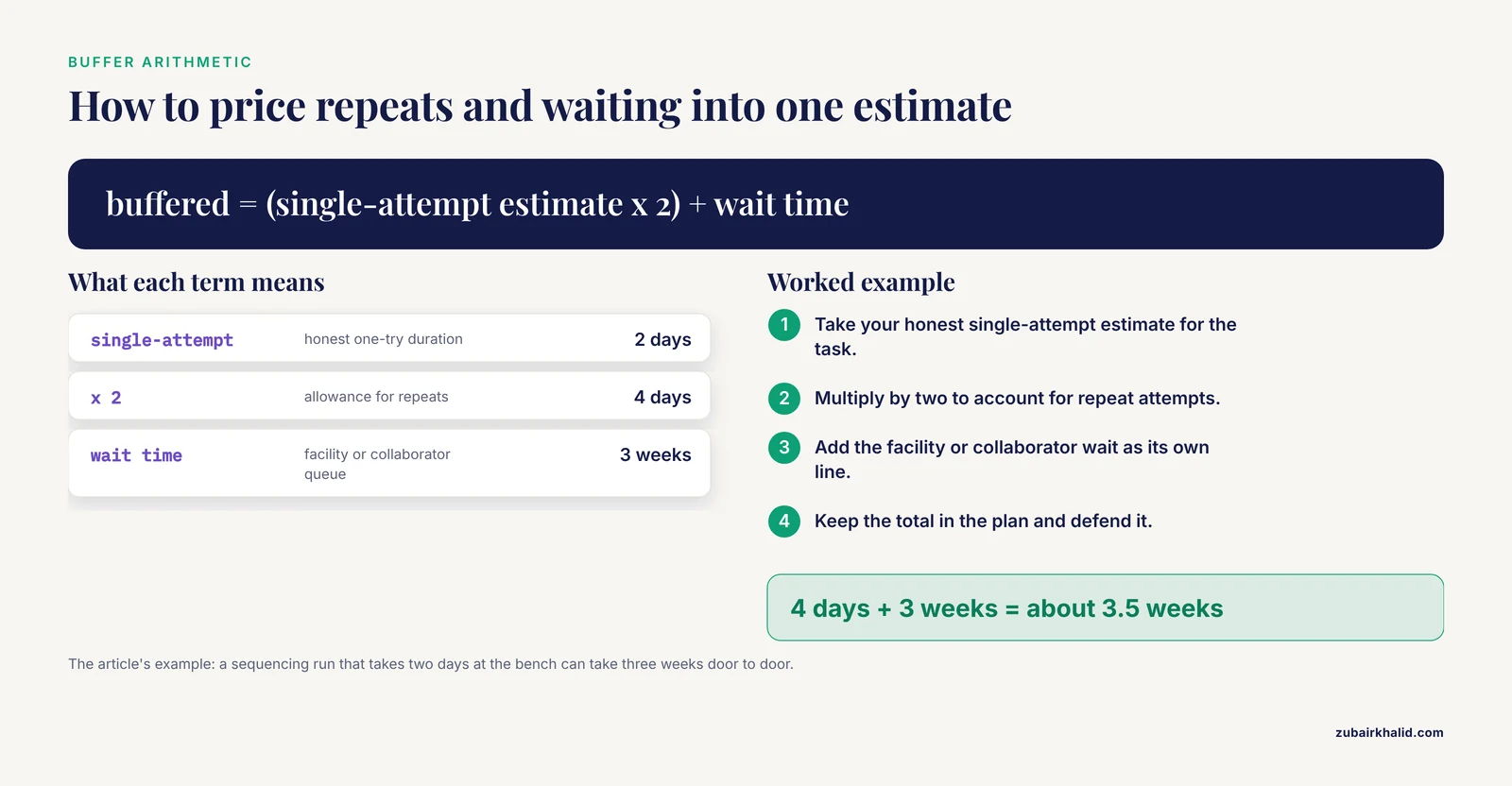
Add explicit buffer to every estimate, then defend it. A workable rule for experimental work: take your honest single-attempt estimate, multiply it by two to account for repeats, and add the facility or collaborator wait time as its own separate line. For writing, budget by output rather than duration, for example five hundred usable words per writing day, and count only days you have actually protected. Buffers that appear in your plan but get spent the first time a seminar looks interesting are not buffers. They are fiction with a nicer name.
Step 3: Identify and protect the critical path
In scheduling, the critical path is the longest chain of dependent tasks that determines your finish date. Any delay on the critical path delays the endpoint. Any delay off it may not. Draw your remaining tasks as a chain, mark the longest dependency chain, and protect it fiercely. Everything off the critical path becomes optional, delegable, or deferrable. This one distinction dissolves most schedule panic, because it shows which delays actually threaten graduation and which merely feel urgent.
Step 4: Cut scope before cutting quality
When the arithmetic says the plan cannot fit, the next question is what to remove. The order of operations matters. Cut scope first. Drop the third aim, the exploratory experiment, the second model organism, the extra condition nobody asked for. A thesis built around a smaller, complete, internally consistent dataset is stronger than one built around an ambitious half-finished dataset. Cut quality last and only at planned, deliberate points, such as reducing the number of technical replicates per biological replicate after discussing it with your advisor, never by dropping controls or skipping randomization, which are load-bearing for the validity of everything you have already done.
The completed theses around you illustrate how much scope variation is normal. An undergraduate honors thesis on the mathematics of blackjack betting systems [2] and a doctoral thesis on the cultural legacy of 9/11 in contemporary film and literature [3] occupy wildly different scopes and lengths, and both are legitimate degrees. Your committee is examining a coherent, defensible piece of scholarship, not a maximum-volume one.
Step 5: Re-estimate with real data and share the result
Rebuild the remaining schedule using your actual measured rates from the diagnostic step, not your old estimates. Then send it to your advisor. A rebuilt timeline that lives in your head protects nobody. A one-page revised plan, sent with a short explanation of what changed and what you cut, turns your advisor from a surprised bystander into an ally who can defend the new schedule at the committee level.
How to Plan a Thesis So You Do Not Fall Behind Again
A timeline fails when it is built from tasks instead of from deliverables. The fix is to plan a thesis around its structure, with a milestone for each structural unit, and to accept that biology thesis structure is fairly standard, which makes it an excellent planning scaffold.
Working backward from your degree requirements
Start your next plan from the documents your graduate school actually requires: the proposal or qualifying document, the completed thesis manuscript, the committee approval steps, and the defense. Assign each a target date in reverse order. Then fit experimental milestones into the space between. A plan that starts from the degree paperwork rather than from the bench is immune to the most common late-stage surprise, which is discovering that formatting, committee sign-off, and submission windows consume more calendar time than a chapter.
Biology thesis structure and chapter-level planning
Most experimental biology theses follow a recognizable skeleton: a general introduction with a literature review, a methods chapter, one or more results chapters that often map to individual aims or datasets, a general discussion, plus front matter, references, and appendices. Published theses show how flexible this skeleton is across disciplines. A law thesis built as a comparative study of parental leave regulation in two countries and a bioscience-style thesis organized around a single technical question both resolve into the same functional units: an argument, the evidence for it, and the description of how the evidence was produced. Planning against the structure, rather than against a list of experiments, gives you a schedule where partial progress is always visible, because a half-written methods chapter is real, countable progress in a way that "worked on experiments" is not.
Three structural practices prevent late-stage collapses:
- Write methods as you go. Record parameters, reagent lots, and deviations the day they happen. A methods chapter assembled from contemporaneous notes takes days. One reconstructed from memory a year later takes weeks and is less accurate.
- Treat each results chapter as its own mini-paper with its own figures, legend drafts, and internal logic. This creates natural checkpoints and lets you show your committee finished units rather than a smear of partial work.
- Keep a running "limitations and future directions" file from the first month. Your general discussion will already be half-written before your final实验 session, which converts the last writing phase from a mountain into an assembly job.
Weekly cadence
A thesis plan holds up when it lives at two scales. At the project scale, keep the milestone list with dates. At the weekly scale, hold a fifteen-minute review: compare planned output to actual output, classify any miss with the three-bucket test, and adjust the next week. This weekly loop is the entire maintenance system. Timelines decay when they are reviewed monthly or never, because small drifts compound silently. Reviewed weekly, drift gets corrected while it is still cheap to correct.
Talking to Your Advisor and Committee
Falling behind triggers an instinct to hide, and hiding is the most expensive choice available. Every week of silence converts a scheduling problem into a trust problem. A short, factual message outperforms a long apologetic one. State where you are, state the revised plan, and state the decision you need. For example: "Chapter 3 analysis will finish two weeks later than planned because the imaging queue added ten days. I am cutting the third condition to protect the defense date. The revised milestone list is attached."
Bring your committee in earlier than feels comfortable when the delay is structural. Committees can approve scope reductions, waive an aim, or adjust a milestone, but only before the deadline, not after. The single most reliable predictor of a recoverable delay is how early the student said it out loud.
When the Gap Is Too Large
Some gaps cannot be fixed by triage. If your honest estimate shows the remaining work exceeds your available time even with maximum scope cuts, the correct action is an extension request or a deferral, initiated by you, framed with a realistic completion plan. Programs have formal processes for exactly this situation. Using them is a normal administrative act, not a failure. The students who damage their careers are rarely the ones who extended a semester. They are the ones who defended an unfinished thesis under deadline pressure and spent years repairing the consequences.
Common Mistakes and Limitations
- Patching dates instead of rebuilding structure. Sliding every deadline keeps the estimate errors that caused the slip. Rebuild from your measured rates.
- Compressing rigor to buy time. Dropping controls, skipping replicates you cannot justify, or rushing hazardous protocol steps trades long-term validity for short-term calendar. Controls and safety procedures are the two places where the schedule never wins.
- Confusing busy weeks with productive weeks. Teaching, seminars, and lab maintenance consume hours without advancing milestones. Count only milestone output in your review.
- Treating the advisor as an obstacle. A delay announced early is a planning input. A delay announced late is a surprise, and surprises are what damage relationships.
- Ignoring the critical path. Reorganizing parallel, non-blocking tasks feels productive and changes nothing about your finish date.
- Assuming every reader's situation matches yours. Program rules, funding terms, and visa constraints vary enormously between institutions and countries. This article describes general practice. Your individual case depends on your program's specific requirements and, where relevant, your international student office. When in doubt, the authoritative source is your own graduate program handbook and your advisor, not a general guide.
Prevention Practices That Hold Up
- Estimate from history, not hope. Every new estimate starts from the actual duration of your last similar task, not from an idealized one.
- Price in failure explicitly. Budget repeat attempts for every experimental step, in time and in reagent cost, from the first planning pass.
- Put waiting on the calendar. Facility queues, protocol approvals, and collaborator turnaround appear as named timeline entries with start dates as early as possible.
- Write during experiments, not after. Methods text, figure drafts, and a running discussion file advance in parallel with bench work.
- Review weekly, adjust weekly. A fifteen-minute gap check every week keeps small drifts from compounding into crises.
- Protect the critical path and defend the buffer. Say no to non-critical demands during protected blocks, and treat buffer time as committed time.
- Keep the minimum viable thesis visible. Know, from the start, which results form the irreducible core of your degree, so that scope cuts under pressure are pre-decided rather than improvised.
Frequently Asked Questions
Is it normal to fall behind on a thesis timeline?
Yes. Nearly every thesis experiences schedule slips, because research is the production of novel results, which by definition have unpredictable durations. Falling behind is a signal to re-plan, not evidence that you are unsuited for research.
Should I tell my advisor I am behind, or wait until I catch up?
Tell your advisor now. Early disclosure lets your advisor help with triage, escalate facility conflicts, and defend a revised plan to the committee. Waiting converts a solvable scheduling issue into a relationship and deadline crisis.
How much buffer should a thesis schedule include?
A practical rule for experimental work is to double your honest single-attempt estimate and add external wait times as separate line items. For writing, budget by word output per protected day. The exact percentage matters less than the discipline of never planning at best-case speed.
Can I still graduate on time if my experiments failed?
Often yes, if you act early. The usual path is cutting scope to your minimum viable thesis, converting partial results into a coherent chapter, and confirming the reduced plan with your committee before the deadline. If the math shows the core work cannot finish, pursue an extension rather than an incomplete defense.
How do I estimate how long data analysis will take?
Track the hours your first analysis pass actually takes, then multiply by roughly three to account for the cleaning, re-running, and figure revision cycles that follow. Analysis is iterative, so a one-pass estimate will always be short.
What do I do if my advisor is the bottleneck?
State the specific decision you need, a deadline, and the consequence of delay, in writing and with a default option attached, for example "unless I hear otherwise by Friday I will proceed with plan A." If chronic delay persists, involve your committee's other members or your graduate program director.
How far behind can I fall before I should request an extension?
Request an extension as soon as an honest estimate shows the remaining work cannot fit the remaining time, even with maximal scope cuts. The request should go in weeks before the deadline, with a realistic completion plan attached, because committees need time to approve schedule changes.
How do I plan a thesis so this does not happen again?
Plan backward from your defense and degree deadlines, build the schedule around your thesis structure chapter by chapter, price in experimental repeats and external waiting time, and hold a fifteen-minute weekly review comparing planned output to actual output. The weekly review is what keeps a plan alive.
Further Reading
- Pre-9/11 Islamophobia: A Contrapuntal Reading of Don DeLillo’s Falling Man
- Contemporary Painting : Falling in Love
Sources
- Determinants of catching up or falling behind: interaction of formal and informal institutions
- [Blackjack betting systems and strategies : the mathematics behind the game : an honors thesis [(HONRS 499)]](https://www.semanticscholar.org/paper/b51121e903e86f6e236482e4157923dedd62ba00)
- Behind apocalypse : the cultural legacy of 9/11