What to Do When You're Stuck on Your Thesis: Emergency Actions
By Dr. Zubair Khalid, DVM, MS, PhD ·
A stuck thesis feels like one giant problem. It is usually a small set of specific problems wearing a giant costume. This article gives you an emergency procedure for the moment when weeks have slipped and the deadline is real. Run these thesis stuck emergency actions in order and you will end the week with protected data, a chapter skeleton, at least one drafted section, and a plan your advisor has actually seen.
By the end of this article you will be able to:
- Diagnose which of five block types has stopped you.
- Back up your thesis and put it under version control in under ten minutes.
- Build a results inventory and convert it into a chapter skeleton using the standard biology thesis structure.
- Run a working statistical analysis in R and fix the four most common error messages.
- Send your advisor an email that gets a reply.
- Follow a seven-day plan that takes you from stuck to drafted.
Have these on hand before you start:
- Your data files, lab notebook, and protocols.
- A laptop with R installed. R is the free statistics environment used throughout this guide.
- A reference manager such as Zotero, which is free and stores your citations.
- Your graduate program's thesis handbook, because it defines your required format and deadlines.
The worked examples use molecular biology and plant biology data. The procedure itself transfers to ecology, biochemistry, and neighboring fields without change.
Thesis Stuck Emergency Actions Start With a Diagnosis
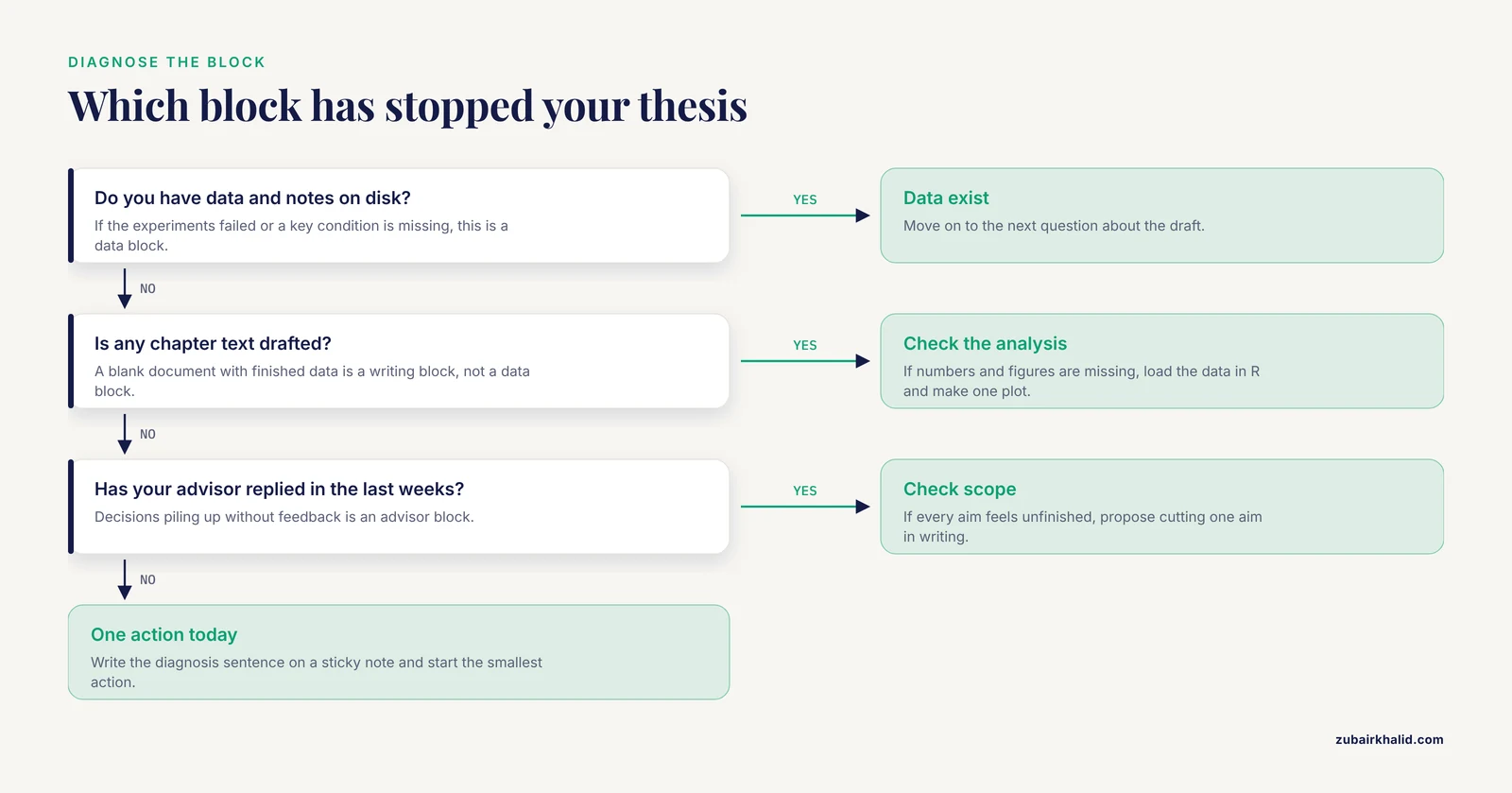
Triage is the process of sorting problems by urgency so you fix the most damaging one first, and it is the first of these emergency actions because you cannot fix "the thesis" as a single object. You can fix one specific block today. Name it in one sentence using this pattern:
I am stuck because [exact obstacle], and the smallest action that would move me forward is [exact action].A filled-in example: "I am stuck because my qPCR melt curves look abnormal, and the smallest action is rerunning the no-template control." Three terms in that sentence need definitions. qPCR stands for quantitative polymerase chain reaction, a lab method that measures how much a target gene is expressed in a sample. A melt curve is a qPCR quality check that shows whether each reaction amplified one specific product rather than a mixture of products. A no-template control is a reaction that contains water instead of DNA, so it should produce no signal, and any amplification points to contamination.
Most stuck students fall into one of five block types:
| Block type | What it looks like | First emergency action |
|---|---|---|
| Writing block | Data and notes exist, the draft does not | Three 25-minute sprints on Methods today |
| Data block | Experiments fail or a key condition is missing | List what each planned figure needs, then run the smallest missing control |
| Analysis block | Data exist on disk, numbers and figures do not | Load the data in R and produce one plot |
| Advisor block | No feedback for weeks, decisions pile up | Send the status, blocker, ask email in Action 6 |
| Scope block | Every aim feels unfinished and the deadline is close | Propose cutting one aim, in writing, with your advisor |
Write your diagnosis sentence on a sticky note before touching anything else. It usually reveals that the real block is smaller and more specific than the fear.
Emergency Action 1: Protect What You Already Have
Data loss is the only truly unrecoverable disaster on this list. Everything else can be repaired. Before you change a single file, make two copies of your project folder, one on a separate drive and one in cloud storage. Many labs summarize this as two copies plus one off the machine.
# See how large the project is
du -sh ~/thesis_project

# Make a dated copy onto a backup drive
cp -r ~/thesis_project /Volumes/BACKUP/thesis_2026-11-11

# Confirm the copy exists
ls -lh /Volumes/BACKUP/thesis_2026-11-11
Expected output from the first command:
1.9G /Users/you/thesis_projectThe ls command should list your files with sizes. If it shows an empty folder, the copy failed. Repeat it before moving on.
Next, put your text and code under version control. Version control is a system that records a snapshot of your files at each commit, and a commit is a saved change you can return to later. Git is the standard tool and it is free.
cd ~/thesis_project
git init
git add .
git commit -m "Snapshot before emergency recovery week"
git log --oneline
Parameter notes. git init creates the version control database once. git add . stages every file in the current folder. The -m flag attaches the message that will identify this snapshot later.
Expected output:
Initialized empty Git repository in /Users/you/thesis_project/.git/
[main (root-commit) 3f9c1ab] Snapshot before emergency recovery week
 12 files changed, 1204 insertions(+)
3f9c1ab Snapshot before emergency recovery week
The hash 3f9c1ab and the file counts will differ on your machine. What matters is that git log, oneline shows your commit.
One caution. If your folder holds gigabytes of raw sequencing reads, create a file named .gitignore containing the single line data/ before running git add. Git then stores your text and code while the raw data stays in the separate backup copy.
Check the result by running git log, oneline and seeing the commit. Then commit again at the end of each working day this week. Common error: fatal: not a git repository (or any of the parent directories): .git. This means the terminal is not inside the folder you initialized. Change into the project folder with cd, or run git init there if you have not yet.
Emergency Action 2: Build a Results Inventory
Panic thrives on vagueness. A results inventory replaces it with a table. A results inventory is a list of every claim your thesis could make, the evidence behind each claim, and the current status of that evidence.
Set up four columns: Claim, Evidence, Status, Next action. Status takes one of three values, Done, Weak, or Missing. Here is a worked example for a plant biology thesis on a drought treatment:
| Claim | Evidence | Status | Next action |
|---|---|---|---|
| Treated plants grow taller than controls | Height measurements, 10 plants per group | Done | Build Figure 1 |
| Treated plants express more Gene X | qPCR with 3 biological replicates | Weak | Check melt curves, repeat one replicate |
| Protein Y moves into the nucleus after treatment | Microscopy images | Missing | Cut the claim or book microscope time |
Two definitions matter here. A biological replicate is an independent sample processed separately, such as a plant grown in its own pot. A technical replicate is a repeated measurement of the same sample, such as running the same extract twice. Only biological replicates increase the sample size for a statistical test, and confusing the two is a classic thesis error that examiners catch.
The inventory does three jobs. It shows what is actually finished, which is usually more than the panic suggested. It converts Missing claims into cut candidates rather than sources of guilt. It turns Weak claims into a short repair list with named actions.
Two rules keep the inventory honest. Every row needs a next action you could start within a day. If a row has no plausible next action, that is your signal to discuss a cut with your advisor. Update the table every Friday, in the same folder as your thesis.
Emergency Action 3: Convert the Inventory Into a Thesis Skeleton
The standard thesis format for biology is an extended version of IMRaD, which stands for Introduction, Methods, Results, and Discussion, the structure used by most research articles. A thesis stretches IMRaD into chapters, often with one results chapter per aim or experiment.
| Section | The job it does | Where its content comes from |
|---|---|---|
| Abstract | A one-paragraph summary of question, methods, findings, meaning | Write last |
| General introduction | The open question, the gap, your hypotheses | Literature, draft early |
| Methods | What you did, in enough detail to repeat it | Lab notebook and protocols, write first |
| Results chapters, one per aim | What you found, organized around figures | Inventory rows marked Done |
| General discussion | What the findings mean, limitations, future work | Results plus literature |
| References | Full citations for every claim | Reference manager such as Zotero |
| Appendices | Protocols, raw data tables, sequence files | Notebooks and instrument outputs |
Many programs also accept a thesis by publication, a format built from your published or submitted papers with connecting introduction and discussion chapters. Your handbook decides which format is required, so read it before drafting rather than after.
Now map the inventory onto the skeleton. Each Done claim becomes a subsection built around one figure. Each Weak claim becomes a subsection with a placeholder for the repaired figure. Each Missing claim becomes a cut candidate. A chapter skeleton for the example thesis looks like this:
Chapter 3: Gene X expression under drought treatment
  3.1 Overview (about 150 words)
  3.2 Growth response (Figure 1, claim Done)
  3.3 Gene X expression (Figure 2, claim Weak, repair in progress)
  3.4 Protein localization (cut pending advisor approval)
  3.5 Chapter summary (about 100 words)
This skeleton is the template you write into. You are no longer facing a blank document. You are filling named slots, and each slot has a source you already possess.
Check the result by reading your handbook against the skeleton and confirming every required element, such as an abstract or a biographical sketch, has a slot.
Emergency Action 4: Start Writing at the Easiest Point
The Methods chapter is the highest-yield first draft in any thesis. You already know the content, the protocols exist, and writing it requires no new results. Start there, even if it feels unglamorous.
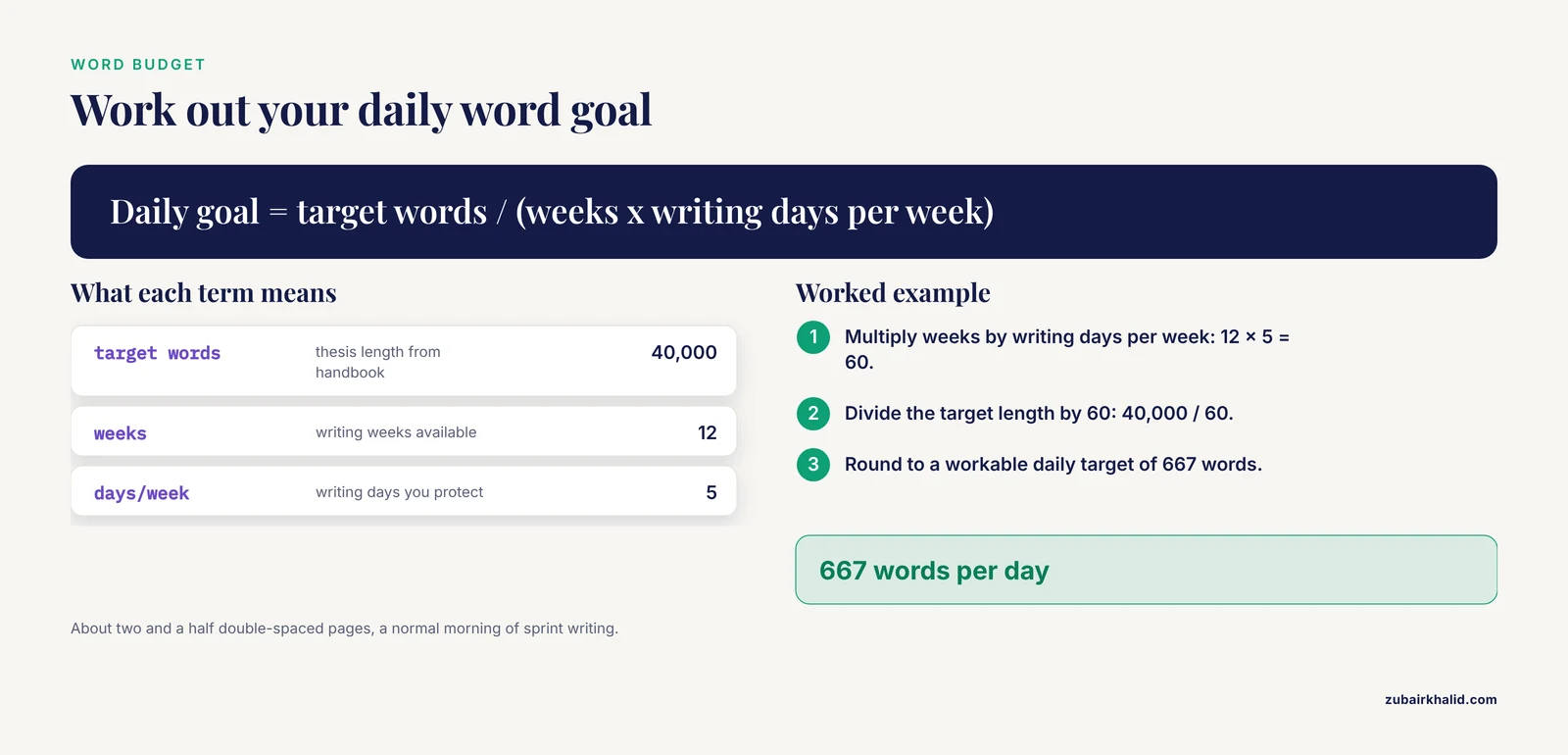
Set a daily word budget from simple arithmetic. Suppose your program expects about 40,000 words, you have 12 weeks, and you can protect 5 writing days per week:
Target length:       40,000 words (example, check your handbook)
Weeks available:     12
Writing days/week:   5
Daily goal = 40,000 / (12 x 5) = 40,000 / 60 = 667 words per day
Six hundred sixty-seven words is roughly two and a half double-spaced pages. That is a normal morning of sprint writing, not a heroic one.
Use 25-minute sprints with 5-minute breaks, a cycle known as the Pomodoro technique. During a sprint, follow three rules. Keep the cursor moving forward, never backward. Type [ref] wherever a citation belongs and insert the real reference later from your manager. Stop mid-sentence when the timer ends, because a half-finished sentence is the easiest place to restart tomorrow.
Freewriting is the fallback for days when even Methods will not start. Freewriting means writing continuously about your topic for a fixed time without stopping to edit, delete, or reread. Ten minutes of freewriting about what Figure 1 shows almost always produces the first sentences of the Results text.
Check the result by recording your word count at the end of each day in a simple spreadsheet. A daily count that moves in one direction, even slowly, is the clearest sign the emergency week is working.
Common error: editing yesterday's paragraphs until today's writing time is gone. The draft phase has one job, existence. Revision is a scheduled later phase with its own sprints.
Emergency Action 5: Unblock the Analysis
If your block is analysis, the fastest fix is one small analysis that runs end to end on real data. The walkthrough below uses R with a tiny growth dataset of the kind a biology thesis produces.
Save this as growth.csv in your project folder:
treatment,weight
control,10.2
control,11.0
control,9.8
control,10.5
control,10.9
treated,12.1
treated,11.8
treated,12.4
treated,11.5
treated,12.0
Then run:
# 1. Confirm where R looks for files
getwd()

# 2. Load the data
growth <- read.csv("growth.csv")

# 3. Confirm the load worked
head(growth)

# 4. Group means
aggregate(weight ~ treatment, data = growth, FUN = mean)

# 5. Compare the groups
t.test(weight ~ treatment, data = growth)

# 6. Save a figure for the thesis
pdf("figure_growth.pdf", width = 5, height = 4)
boxplot(weight ~ treatment, data = growth)
dev.off()
Reading the parameters. In the formula weight ~ treatment, the tilde reads as "as a function of", so you are modeling weight by treatment group. read.csv assumes the first row holds column names. FUN = mean tells aggregate which function to apply. t.test defaults to the Welch test, the version that does not assume equal variances between groups. The working directory is the folder R reads files from and writes files to, and getwd() prints it.
Expected output for head(growth):
  treatment weight
1   control   10.2
2   control   11.0
3   control    9.8
4   control   10.5
5   control   10.9
6   treated   12.1
Expected output for the group means:
  treatment weight
1   control  10.48
2   treated  11.96
Expected output for the t-test, with digits rounded here because R prints more:
	Welch Two Sample t-test

data:  weight by treatment
t = -5.5156, df = 7.0265, p-value = 0.00088
alternative hypothesis: true difference in means between group control and group treated is not equal to 0
95 percent confidence interval:
 -2.1145 -0.8455
sample estimates:
mean in group control mean in group treated
               10.48                11.96
The p-value is the probability of observing a difference at least this large if the treatments truly had no effect, and values below 0.05 are the conventional threshold for calling a difference statistically significant. Here the treated group is heavier on average and the difference is significant.
How to check the result is right. Run table(growth$treatment) and confirm the group sizes match your design:
table(growth$treatment) control treated
5 5 Then plot the raw points and confirm the picture agrees with the test. A statistical result that contradicts the plotted data signals a data-handling error, not a discovery.
Common errors with exact messages and fixes:
Error: object 'growth' not found. You ran a later line before loading the data. Run theread.csvline again.Error in file(file, "rt") : cannot open the connection, usually with the warningcannot open file 'growth.csv': No such file or directory. The file is not in the working directory. Rungetwd()to see where R is looking andlist.files()to see what is there, then either move the CSV into that folder or pass its full path toread.csv.- In Python,
ModuleNotFoundError: No module named 'pandas'means the library is not installed in the current environment. Install it withpip install pandasorconda install pandas, then restart the notebook kernel. - In git,
fatal: not a git repository (or any of the parent directories): .gitmeans you are outside the initialized folder. Change into the project folder first.
Once one small analysis runs end to end, repeat the pattern on your real dataset. Most analysis blocks are not one giant problem. They are ten small ones, and this sequence clears them in order.
Emergency Action 6: Reopen Communication With Your Advisor
Silence between a stuck student and an advisor compounds weekly. Break it with a four-part email, status, blocker, ask, plan. The format matters less than the fact that it contains one specific question a busy person can answer in two minutes.
Subject: Chapter 3 update, one question on Figure 2

Hi Dr. Alvarez,

Status: The Chapter 3 draft is at 2,100 of a planned 4,000 words.
Figure 1 (growth) is final.

Blocker: Figure 2 needs the delta-delta Ct values for the qPCR data.
I am unsure whether to normalize to the average of both housekeeping
genes or to the single most stable one.

Ask: Could you confirm the normalization choice, or spare 15 minutes
this week for me to show you the calculation?

Plan: With your answer by Thursday, Figure 2 is done by Monday and
the full chapter draft follows the Friday after.

Thank you,
Sam
Definitions for the example. Delta-delta Ct, written ΔΔCt, is the standard qPCR calculation that first normalizes each sample to a housekeeping gene, a gene expected to keep constant expression across conditions, and then compares the normalized values between groups.
If five working days pass without a reply, forward the same email with one added line requesting a 15-minute meeting. Do not apologize for the block in the email. Advisors respond to specific, answerable questions, and the template above is answerable by design.
Bring a one-page agenda to any resulting meeting, three items at most, and send a two-line summary of the decisions afterward. That summary becomes part of your lab notebook record and prevents re-litigating the same question next month.
How to Plan a Thesis From the Deadline Backward
Backward planning means starting at the final deadline and giving each earlier milestone the latest date that still leaves enough time for the steps after it. It is the core of how to plan a thesis under time pressure, and it takes twenty minutes.
Worked example. Suppose the defense is May 15 and your program requires the complete draft to the committee three weeks before, which is April 24. Allowing two weeks for committee review and corrections, the full draft must exist by April 10. Work backward from there:
Defense:                      May 15
Draft to committee:           April 24
Full draft finished:          April 10
All figures and tables final: March 27
Analysis complete:            March 13
Last data collected:          February 27
Each gap is a work budget, not a suggestion. If the gap between analysis complete and figures final is two weeks, then every figure needs an owner, a dataset, and a date inside that window.
Compare the plan against your results inventory. Any claim whose evidence cannot reach Done before its milestone date becomes a cut candidate or a scope conversation with your advisor, held now rather than in April.
Review the plan every Monday in ten minutes. When reality slips, cut scope before you cut sleep, because exhausted analysis produces errors that cost more time than they save.
Thesis Stuck Emergency Actions Example: Seven Days From Stuck to Drafted
Here is the full sequence applied to one realistic case. Sam is a second-year doctoral student in molecular biology. For three weeks Sam has opened the thesis document, read Chapter 3, and closed it. The growth data are complete, one qPCR replicate has abnormal melt curves, and the microscopy experiment never started.
- Day 1, diagnosis and protection. Sam writes the sentence, "I am stuck because Chapter 3 has no structure and one weak qPCR replicate, and the smallest action is building the results inventory." Sam runs the backup commands and the first git commit from Action 1.
- Day 2, inventory and skeleton. The inventory produces three claims, one Done, one Weak, one Missing. The skeleton turns them into subsections 3.1 through 3.5.
- Day 3, cut and write. Sam sends the advisor email proposing to cut the microscopy claim. Three 25-minute sprints produce 780 words of Methods.
- Day 4, repair. Sam reruns the no-template control, which stays clean, then repeats the failed qPCR replicate. The new melt curve is a single sharp peak, so the Weak claim moves toward Done.
- Day 5, analysis. Sam runs the R sequence on the full growth dataset, checks group sizes with
table(), and saves the boxplot as a PDF figure. - Day 6, results text. Two sprints produce 640 words of Results around Figures 1 and 2, using the
[ref]placeholder method for citations. - Day 7, consolidate. Sam writes the 100-word chapter summary, commits everything to git, updates the inventory, and emails the advisor a two-line summary of the week.
The week produced roughly 1,400 drafted words, one repaired replicate, one proposed cut, and a plan for the following week. Nothing in it required brilliance, only the sequence, applied in order.
Common Mistakes and Limitations
- Polishing the introduction in a loop. The introduction is the chapter students rewrite most and need least during an emergency. Draft it early, mark it rough, move forward.
- Waiting for complete data before writing anything. Methods and the introduction do not depend on final results, and writing them now shortens the crisis by weeks.
- Treating every planned claim as mandatory. A thesis with a tight, fully supported scope beats a stalled thesis with an ambitious one. Propose cuts in writing so the decision is recorded.
- Counting technical replicates as biological replicates. This inflates the apparent sample size and unravels during the defense.
- Editing during sprint writing. Drafting and revision need different mental modes, and mixing them stalls both.
- Skipping the backup step. It feels like procrastination and is the opposite. It makes every later action safe.
- Staying silent about scope changes. Committees respond far better to a proposed change raised early than to a surprise in the finished draft.
One limitation applies to everything above. The general sequence in this guide cannot know your program's rules, your committee's expectations, or the exact state of your data, so the handbook and your committee govern the individual decisions. Formal problems such as health emergencies belong with your graduate office, which maintains leave and extension procedures for exactly those cases.
Frequently Asked Questions
What is the first thing to do when you are stuck on your thesis?
Write a one-sentence diagnosis naming the exact block, then back up every file before changing anything. The diagnosis converts a fog of anxiety into one actionable problem, and the backup makes every later action safe.
Can I start writing my thesis before my experiments are finished?
Yes. Methods and the introduction draw on protocols and literature rather than final data, so they can be drafted while experiments continue.
What is the standard biology thesis structure?
Most biology theses use an extended IMRaD format, with an introduction, methods, results chapters organized by aim, a general discussion, references, and appendices. Some programs accept a thesis by publication built from your papers.
How do I tell my advisor I am stuck?
Send a short email with four parts, status, blocker, one specific ask, and your proposed plan, and offer a 15-minute call. Specific questions get answers, general distress signals get sympathy.
How many words a day do I need to finish?
Divide your target word count by the writing days remaining. For example, 36,000 words across 60 writing days is 600 words per day, about two double-spaced pages.
What should I do when my experiment keeps failing?
Separate technical failure from a genuine biological result, verify the controls, document every attempt in the notebook, and review the pattern with your advisor before redesigning anything.
Should I cut a thesis aim that is not working?
Yes, with your advisor's agreement and in writing. A focused thesis you finish serves you better than a complete one that never gets written.
Is it normal to get stuck during a thesis?
Yes. Nearly every graduate student hits a block, and the reliable way out is the same triage sequence, diagnose the specific block, protect your work, and take one small action today.