Thesis Roadblock Self-Assessment: Find What's Holding You Back
By Dr. Zubair Khalid, DVM, MS, PhD ·
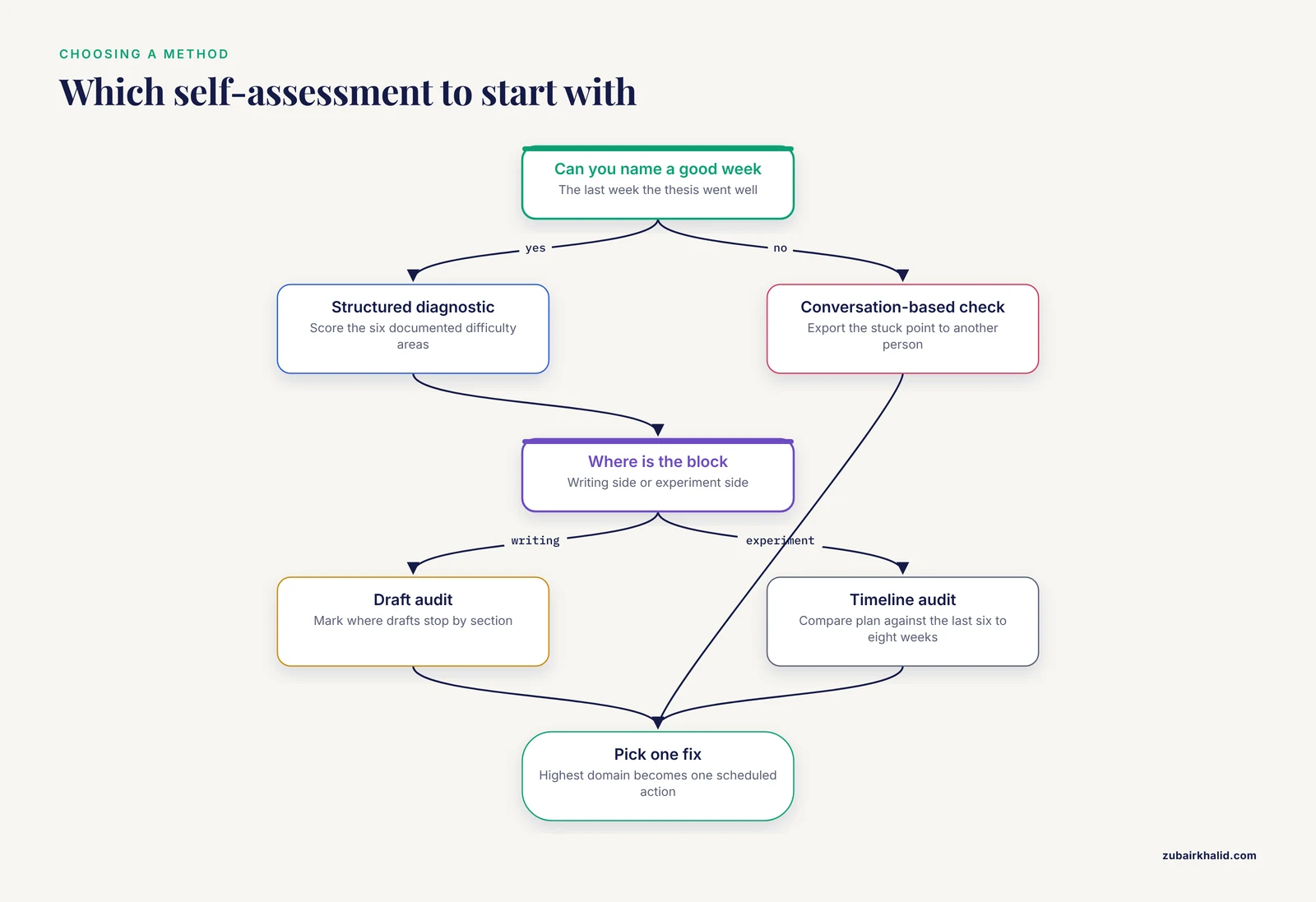
A thesis roadblock is a specific, repeatable failure point in your project, not a general feeling of being behind, and the fastest way to find yours is to match the assessment method to the kind of problem you suspect. The rule of thumb is simple. If you can name the last week your thesis went well, start with a structured self-diagnostic, because your difficulty is probably localized to one skill or one chapter. If everything has felt stuck for months and you cannot name a cause, start with a conversation-based check, because the blocker is more likely emotional, motivational, or relational, and those rarely show up on a worksheet.
This guide walks through four thesis roadblock self-assessment options, compares them side by side, gives worked scenarios drawn from common biology thesis situations, and shows how the results feed into a realistic plan.
What Counts as a Thesis Roadblock
Research on final-year students identifies a consistent set of difficulty areas: trouble focusing on the thesis topic, difficulty writing the background of the problem, confusion about thesis structure and content, limited mastery of theory, weak research methodology skills, and ineffective communication with supervisors [1]. Those six areas are the backbone of any useful thesis roadblock self-assessment, because they cover both the intellectual side of the project and the working relationship that keeps it moving.
A roadblock is different from ordinary slow progress in three ways:
- It repeats. The same wall appears every time you approach the same task, whether that task is writing a methods section or troubleshooting an assay.
- It is located. You can point to where it happens, for example "every draft dies at the results to discussion transition" rather than "everything is hard."
- It resists ordinary effort. Working more hours does not fix it, because the missing piece is a skill, a decision, a resource, or a conversation, not time.
One more distinction matters before you assess anything. When a project feels impossible, students often call it "too complex." A careful analysis of this habit argues that what looks like complexity is usually not an objective property of the project at all, but a gap between the capabilities a person currently has and the demands they are facing [2]. That reframing is practical. If the wall is a capability gap, then the roadblock has a specific name, such as "I have never designed a primer pair" or "I have never written a results section from raw data," and it can be trained, borrowed, or delegated. If you label the whole project complex, you stop looking.
Thesis Roadblock Self-Assessment Options at a Glance
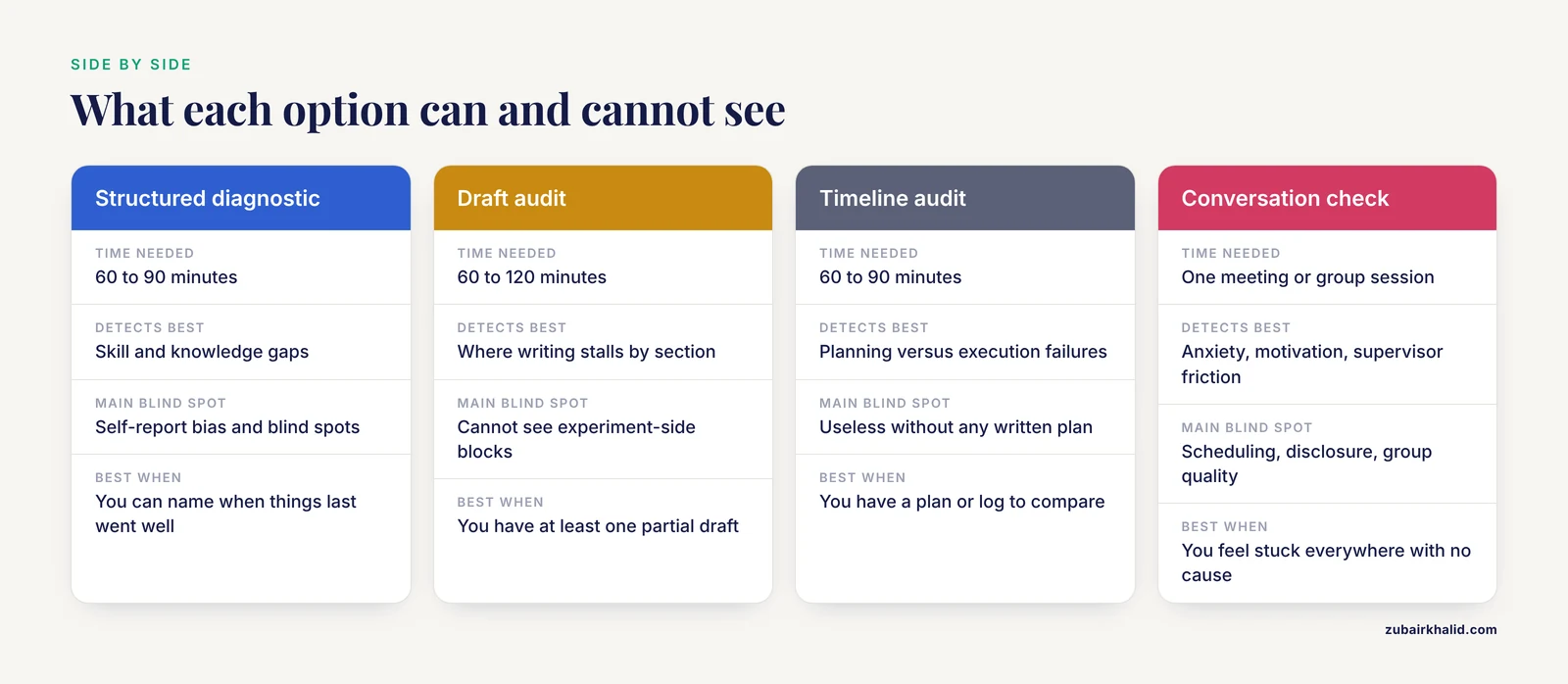
The four options below differ in cost, evidence, and the kind of problem they detect. No single option is complete, and most students get the best result from a structured diagnostic first, followed by whichever second option fits their situation.
| Option | Time needed | What it detects best | Evidence base | Best when | Main drawback |
|---|---|---|---|---|---|
| 1. Structured roadblock diagnostic | 60 to 90 minutes | Skill and knowledge gaps across the six documented difficulty areas | Built from documented categories of thesis difficulty [1] | You can name when things last went well | Self-report bias, misses blind spots |
| 2. Draft audit | 60 to 120 minutes | Exactly where writing stalls within your thesis structure | Direct inspection of your own text | You have at least one partial draft | Cannot see experiment-side blocks |
| 3. Timeline audit | 60 to 90 minutes | Planning versus execution failures, and drift you failed to catch | Adapted from audit frameworks built on execution, oversight, and impact [3] | You have a plan or log to compare against | Useless without any written plan |
| 4. Conversation-based check | One meeting or one group session | Anxiety, motivation, supervisor friction, and blind spots others can see | Group counseling and group therapy studies with measured pre-post effects [1] [4] | You feel stuck everywhere and cannot name a cause | Scheduling, disclosure, variable group quality |
Option 1: The Structured Roadblock Diagnostic
The thesis roadblock diagnostic is a self-administered questionnaire you build once and reuse. It works because the major difficulty areas are already documented, so you are scoring yourself against known categories rather than against a vague sense of failure.
Build the diagnostic around the six domains, with two or three questions each. Score each question from 1 (never a problem) to 5 (blocks me every time).
Topic focus. Can I state my research question in one sentence without opening a file? Have I changed the question more than once this semester? Do I know which experiments or analyses would settle it?
Background and introduction. When I sit down to write background text, do I know the three to five papers that anchor my argument? Can I summarize each anchor paper's finding in one sentence? Do I know what gap my thesis fills?
Structure and content. Can I sketch my full biology thesis structure from memory, chapter by chapter? Do I know which chapter I am currently in and what "done" looks like for it? Do I know my program's formatting and committee requirements?
Theory mastery. Can I explain my key techniques and their underlying principles to a first-year student? When a result contradicts my expectation, do I have the conceptual background to generate two competing explanations?
Research methodology skills. Can I design the next experiment or analysis without help? Do I know my error rates, sample sizes, or replicate numbers and why they were chosen? Can I troubleshoot a failed protocol in a structured way?
Supervisor communication. Do I leave meetings knowing what to do next? Do I send updates between meetings, or wait to be asked? Is there anything I am avoiding telling my supervisor?
Tally the scores by domain. Your highest-scoring domain is your primary roadblock, and your lowest-scoring one is usually load-bearing, meaning it will become the next roadblock once the first is cleared.
Pros. The diagnostic is fast, repeatable, free, and requires no one else. Because the domains come from documented categories of thesis difficulty [1], your scores map directly onto known problems with known fixes.
Cons. Self-report measures inherit your blind spots. If your anxiety comes from a relationship problem you have normalized, no questionnaire you write yourself will surface it. The diagnostic also locates the problem without solving it, and students sometimes mistake a completed worksheet for progress.
Option 2: The Draft Audit
The draft audit uses the strongest evidence you have, which is your own text. Most biology theses follow a recognizable structure: title, abstract, introduction or literature review, materials and methods, results, discussion, and references, with exact requirements set by your program. Each section has a characteristic failure mode, so the section where drafts die is itself a diagnostic signal.
Run the audit like this. Open your most recent draft, read it from the start, and mark every place where you stopped writing last time and where you feel resistance now. Then classify each stop against the structure:
- Stops inside the introduction usually trace to the background-writing problem, meaning you do not yet command the anchor literature well enough to build an argument [1].
- Stops inside materials and methods usually trace to methodology skill, meaning you can perform the work but cannot yet narrate it at the precision the genre demands.
- Stops at the results usually trace to data organization, meaning figures and statistics are not settled enough to write around.
- Stops at the discussion usually trace to theory mastery, because the discussion is where you must connect your findings to concepts, mechanisms, and prior literature, which is precisely the difficulty students report when their theoretical grounding is thin [1].
Pros. The draft audit is nearly impossible to fool. A worksheet can be answered optimistically, but a blank section after the results heading speaks for itself. It also produces an artifact, the marked-up draft, that converts directly into a work plan.
Cons. It only detects writing-side roadblocks. If your block is a failing assay, contaminated cell line, or a sampling design flaw, your draft is blank for a good reason, and the audit will mislead you. It is also uncomfortable, which is why many students postpone it.
Option 3: The Timeline Audit
Auditing, as a practice, exists to answer three questions about any system: did the work happen as intended (execution), did anyone catch problems along the way (oversight), and did the completed work change anything (impact). Those three questions transfer directly to a thesis, and they separate problems of planning from problems of doing.
To run a timeline audit, take the last six to eight weeks and build a two-column log: what you planned each week, and what actually happened. Then sort every gap into one of the three audit categories.
- Execution failures are gaps where the plan was sound but the work did not happen. Look for a pattern in the cause. Equipment access, reagent delays, course load, and avoidance all have different fixes.
- Oversight failures are gaps where drift went unnoticed for weeks, for example an analysis that quietly produced unusable output, or a chapter direction your supervisor would have corrected a month earlier. The fix is a review cadence, not more effort.
- Impact failures are weeks where work happened but moved nothing, for example experiments that will never appear in any chapter. This is the most demoralizing category and the most important to catch, because it means the plan itself needs revision.
Implementation research supports the underlying point. Case studies of large public works projects found that even well-selected innovations stall at the implementation stage when the day-to-day workflow is not redesigned around them [5]. A thesis plan is the same. A beautiful semester plan fails if the weekly routine, which is where implementation actually lives, was never rebuilt to serve it.
Pros. The timeline audit is the only option that distinguishes planning problems from effort problems, and it produces a record you can bring to a supervisor meeting.
Cons. It requires a written plan or log to compare against. If you have neither, building the plan is your first task, and the audit comes second.
Option 4: The Conversation-Based Check
Supervisor communication appears in the documented difficulty list in its own right, and it interacts with all the others, because an unspoken problem stays unsolved [1]. The conversation-based check means deliberately exporting your stuck point to someone else: your supervisor, a labmate, a writing group, or a facilitated peer group.
This option has measured support rather than mere plausibility. In a pretest-posttest study, group counseling with a reality therapy approach significantly reduced thesis anxiety and raised self-confidence among final-semester students, with a calculated t value of 24.413 against a table value of 2.571 [1]. Separately, a study of 94 final-year nursing students split into 14 facilitator-led supportive group therapy sessions measured thesis-completion motivation before and after, and found students at high motivation rose from 18% to 95%, while those at moderate motivation fell from 82% to 5% [4]. Both interventions worked through structured conversation, not through new content, which is exactly what this option provides.
Run a one-on-one version in thirty minutes: describe your stuck point in three sentences, name what you have already tried, and ask one specific question. Run a group version by asking two peers to look at the same draft or data set and tell you the first thing that confuses them.
Pros. This is the only option that reliably surfaces blind spots, and it is the only one that treats the anxiety and motivation components directly. Thesis-related anxiety around topic choice, writing, and advisor interactions is common enough that structured group support was developed specifically for it [4].
Cons. It costs other people's time, requires disclosure, and depends on the quality of the listener. The supporting studies are also small, one with six participants [1] and one from a single cohort of nursing students [4], so treat the measured effects as encouraging rather than guaranteed for any individual.
Pros and Cons: Choosing the Best Thesis Roadblock Self-Assessment for Your Situation
Students searching for the best thesis roadblock self-assessment are really asking which option fits their constraint set. Decide on four criteria.
Where the block lives. Writing-side blocks favor the draft audit. Experiment-side blocks favor the timeline audit, because failed or stalled work shows up as execution failures. Whole-project stuckness favors the conversation-based check.
What you can name. If you can name when things last went well, your problem is localized and the structured diagnostic will find it fast. If you cannot, the problem is diffuse, and diffuse problems respond to conversation, not questionnaires.
Time available. The structured diagnostic and timeline audit each fit inside one focused hour. The draft audit needs a protected half-day to be done honestly. The conversation-based check runs on other people's schedules, which can mean days of lead time.
What you are willing to see. Each option has a characteristic blind spot. The diagnostic flatters a student who misreads their own avoidance as a full schedule. The draft audit flatters a student whose real problem is upstream in the lab. The timeline audit flatters a student with no plan to audit. The conversation flatters a skilled listener who tells you what you want to hear.
Two cautions belong here. First, some roadblocks are not inside you at all. Accounts from scientists from underrepresented groups in the PhD community document persistent, structural obstacles that individual effort and self-assessment do not remove [6]. If your blocker is access, funding, mentoring, or belonging, the honest output of your assessment is that you need an institutional or network fix, not more personal discipline. Second, roadblocks can also live in the research community's own habits and assumptions. Studies of translational research roadblocks find that researcher knowledge, attitudes, and biases themselves create barriers, which is why targeted institutional programs were built to address them [7]. If your stuck point involves a population, system, or dataset that your field routinely overlooks, the roadblock may be partially external, and naming that changes the solution.
Worked Scenarios
Scenario 1: The failing assay. A molecular biology student has had western blots fail for three months and has written nothing since. The timeline audit shows eight consecutive execution failures clustered on one technique, with no oversight failure, because the student checked each batch promptly. The diagnosis is a methodology-skill roadblock, not a writing or motivation problem. The fix is structured troubleshooting with help, for example a core facility consult or a senior labmate shadowing one run, plus drafting the methods chapter in parallel, because methods text can be written from the protocol even while the technique is being repaired.
Scenario 2: The empty discussion. An ecology student has clean data and finished results figures, but every writing session ends within a paragraph of starting the discussion. The draft audit shows three drafts that all stop at exactly the results-to-discussion boundary, with fluent introductions. The diagnosis is a theory-mastery roadblock, the documented difficulty students report when conceptual grounding is thin [1]. The fix is targeted reading on the two competing frameworks that explain the pattern in the data, followed by writing the discussion as direct answers to the questions the introduction raised.
Scenario 3: The avoided advisor. A student has not emailed their supervisor in six weeks after a meeting that went badly, and now avoids the department hallway. A conversation-based check, here a peer writing group, surfaces that the fear is about one unresolved comment on the aims page. The diagnosis is a supervisor-communication roadblock complicated by anxiety, a combination documented in studies of thesis students who report advisor interactions as a distinct anxiety source [4]. The fix is a written agenda for the next meeting that names the comment and proposes two responses, which converts a face-threatening conversation into a decision between options.
Common Mix-Ups
Students misrun these assessments in predictable ways.
- Confusing a roadblock with perfectionism. Rewriting the same paragraph for the fifth time is a located, repeating, effort-resistant block, which makes it a genuine roadblock, usually in the structure-and-standards domain.
- Diagnosing topic choice when the real problem is background writing. Students who cannot write their introduction often conclude they chose the wrong topic. Changing topic costs a semester. Testing whether you can summarize your three anchor papers costs an hour and often proves the topic was fine.
- Treating anxiety as laziness. Thesis anxiety is documented across student populations and responds to structured support [1] [4]. A student who labels an anxiety-driven block as a character flaw will apply the wrong fix and blame themselves when it fails.
- Re-running the assessment without acting. Scoring yourself weekly feels productive and changes nothing. Run the diagnostic, pick the highest domain, apply one fix for two weeks, then re-score.
- Calling the project complex instead of naming the gap. Treating difficulty as an objective property of the project invites passivity, while naming the specific capability gap invites training, borrowing, or delegation [2].
How Assessment Results Feed Into Planning a Thesis
A thesis roadblock self-assessment is only useful if its output becomes a plan. Planning a thesis works best backward. Start from your defense or submission date, reserve the final weeks for revision, committee review, and formatting, then place your chapters on the calendar in reverse order. Use the standard biology thesis structure as the scaffold, since each section is a milestone with a definable end state: introduction anchored on three to five key papers, materials and methods complete enough for another researcher to replicate, results organized around finalized figures and tables, and discussion answering the questions the introduction raised.
Then shrink the plan to the week. Each week gets at most three concrete tasks tied to the current chapter, a fixed writing block, and a fixed check-in, because implementation, not intention, is where plans fail [5]. Your assessment result determines the first milestone. A methodology roadblock puts technique repair at the top of the plan. A theory roadblock puts a reading list at the top. A communication roadblock puts the supervisor meeting at the top, before any other task, because every downstream step depends on it.
Re-assess on a monthly cadence, not weekly, and rotate options. A structured diagnostic in month one, a timeline audit in month two, keeps the picture honest without turning self-assessment into avoidance.
Common Mistakes and Limitations
- Self-report bias is built in. Every self-assessment option here is filtered through your own perception, and the conversation-based check only fixes that if the other person is actually candid.
- A snapshot is not a trend. One low-scoring week can reflect a bad dataset or a sick roommate. Assess over at least two weeks before making large decisions such as changing topics.
- The supporting evidence comes from small studies. The counseling and group-therapy results cited here come from small samples and single cohorts. They support the approach, not a promise about your individual outcome.
- Structural obstacles are real. Obstacles arising from bias, exclusion, and unequal access are documented in the scientific PhD community, and they will not resolve through a worksheet [6]. Name them accurately and route them to mentors, ombudspersons, or program leadership.
- Know when to involve professionals. Persistent anxiety that disrupts sleep, eating, or daily function calls for your campus counseling or student health service, not a self-assessment. Individual cases vary, and no worksheet replaces your program's formal requirements or your committee's judgment.
- Do not assess instead of writing. The most common failure mode of self-assessment is using it as a sophisticated form of procrastination. Cap the time you spend on it and spend the rest of the block on the flagged fix.
Frequently Asked Questions
What is the best thesis roadblock self-assessment?
For most students, the structured roadblock diagnostic is the best first option, because one hour of scoring against the six documented difficulty areas usually localizes the problem [1]. The best overall sequence is the structured diagnostic first, then the draft audit for writing blocks or the timeline audit for experiment blocks, with a conversation-based check whenever you cannot name a cause at all.
How do I know if I have a roadblock or just slow progress?
You have a roadblock when the failure repeats at the same task, you can point to where it happens, and extra hours do not fix it. If effort eventually moves the work, you had a heavy week, not a roadblock, and the right response is scheduling rather than diagnosis.
Can a self-assessment replace talking to my supervisor?
No. A self-assessment can tell you which conversation to have and what to ask, but supervisor communication is itself a documented difficulty area, and problems you cannot see are the ones another person catches [1]. Use the self-assessment to prepare a specific question, not to avoid the meeting.
How often should I run a thesis roadblock self-assessment?
Run a full assessment monthly, and only re-run early if you apply a fix and the block persists. Weekly self-assessment tends to become avoidance with a spreadsheet. Track execution in your normal planning log instead, and let that log feed the next timeline audit.
Where do roadblocks usually appear in a biology thesis structure?
The two most common stall points are the introduction, where background-writing and literature-command problems surface, and the discussion, where theory-mastery gaps surface [1]. Materials and methods stall when methodology skills are thin, and results stall when data organization and figures are not settled before writing begins.
What should I do immediately after the assessment points to a problem?
Convert the highest-scoring domain into a single scheduled action within one week. A methodology roadblock gets a troubleshooting session or a consult, a theory roadblock gets a named reading list and a writing prompt, and a communication roadblock gets an emailed meeting agenda. Then re-assess after two weeks to check whether the score actually moved.
Sources
- Reality counseling: Overcome anxiety and build self-confidence in thesis completion
- The problem of complexity and common sense
- From Algorithmic Audits to Actual Accountability: Overcoming Practical Roadblocks on the Path to Meaningful Audit Interventions for AI Governance
- ENHANCING THESIS COMPLETION MOTIVATION IN NURSING STUDENT THROUGH SUPPORTIVE GROUP THERAPY
- Overcoming Roadblocks Facing the Implementation of Innovations: Three Case Studies at Caltrans
- Overcoming the Layers of Obstacles
- Reducing translational science roadblocks to disability research