Thesis Defense Dress Code and Etiquette: What to Expect
By Dr. Zubair Khalid, DVM, MS, PhD ·
Your dress code is what you wear to the defense, while your etiquette is how you handle the room, the questions, and the people in it. The simplest rule of thumb for both: aim one clear notch above your normal working clothes, and behave the way you would in a professional seminar where you are the speaker and the guest of honor at the same time.
This guide walks through the common thesis defense dress code options with their pros and cons, the etiquette that actually gets evaluated on the day, worked scenarios for typical situations, and the mistakes candidates make most often. It ends with a short planning section that places dress and etiquette in the context of how to plan a thesis as a whole, because the defense is the last step of a project that starts months earlier.
What "Dressed for a Defense" Actually Means
A thesis defense is a formal academic examination, but it is not a courtroom or a corporate board meeting. The committee has spent months reading your work, and in most departments they have watched you present in jeans and a T-shirt at lab meetings. Nobody expects a tuxedo. What they do expect is a visible signal that you take the occasion seriously.
That signal sits in a narrow band. Dress too casually and you risk looking like you did not prepare, which is an unfair but real impression. Dress too formally and you can look stiff, and some committees read extreme formality as anxiety or as a misunderstanding of academic culture. The comfortable middle ground for most candidates in the United States is business professional or polished business casual.
Two practical facts shape the decision more than any abstract rule. First, the defense is usually followed by celebrations, photos, or a lab lunch, so you will likely be photographed and seen by people beyond the committee. Second, defenses run long, often two to three hours including closed deliberation, so you need clothes you can sit, stand, gesture at slides, and sweat mildly in without discomfort.
Thesis Defense Dress Code Options
The table below is the core of this article. It compares the five realistic thesis defense dress code options on what they look like, who they suit, and their main advantages and drawbacks.
| Option | What it looks like | Best suited for | Pros | Cons |
|---|---|---|---|---|
| Business formal | Dark suit with tie for men, tailored suit or matching separates for women, polished dress shoes | Very traditional departments, job talk scheduled the same day, candidates who own a well-fitting suit | Unambiguously respectful, photographs well, doubles as interview attire | Can read as stiff or corporate in casual departments, expensive if you must buy new |
| Business professional | Blazer with dress pants or a professional dress and cardigan, closed-toe shoes | The default choice for most in-person defenses | Signals seriousness without rigidity, comfortable enough for a long session | Requires more thought than a suit, easy to get slightly wrong in fit or color |
| Business casual | Collared shirt or blouse, chinos or slacks, no blazer, clean casual shoes | Informal departments, small committee of familiar faculty, second attempts or final sign-off meetings | Comfortable, authentic, zero costume feeling | Risk of looking underdressed if the committee dressed up, fewer photographs where you look "official" |
| Smart casual (elevated everyday) | Your best version of normal lab wear, dark jeans with a structured shirt, clean sneakers or boots | Very relaxed labs, master's defenses in laid-back programs | Feels like yourself, avoids distraction | Thin margin for error, one wrong piece tips it into too casual |
| Virtual defense attire | Professional top half, business casual bottom half, solid colors on camera | Remote or hybrid defenses | Only the top half appears on camera, you can be comfortable below the frame | Camera framing can betray casual pants, lighting and color behave unpredictably on video |
Business Formal
Business formal means a matched dark suit, a pressed dress shirt, a conservative tie if you wear one, and polished leather shoes. For women this translates to a tailored pantsuit or a skirt suit with hosiery or bare legs depending on season, closed-toe heels or flats, and minimal jewelry.
The case for business formal is strongest when the defense doubles as something else. If your committee chair has hinted that a visiting professor will attend, or if you have a faculty interview or a job talk within the same week, a suit earns its keep twice. Departments with strong industry or clinical ties, such as pharmacology or translational medicine programs, also tend to run slightly more formal cultures.
The drawbacks are real. A suit you rarely wear can fit oddly on defense day, and stiffness in unfamiliar clothes shows on stage. If the entire committee arrives in fleece vests and corduroys, a full suit can create social distance you did not intend.
Business Professional
Business professional sits just below the full suit. Think blazer over a dress shirt or blouse, dress pants or a professional dress, and leather shoes or polished flats. The blazer is the anchor. It frames you at the podium, covers a range of body types well, and can come off during the private deliberation break if the room runs warm.
This is the option most faculty would name if you asked them for the best thesis defense dress code, because it clears the bar of seriousness in virtually every department while remaining flexible. You can adjust the register up or down by swapping the shirt, adding or removing a tie, or choosing a dress versus separates.
Fit matters more here than with a suit, because separates give you more ways to look slightly off. Check three things a week before the defense: that the blazer closes without pulling, that pant hems break correctly over your shoes, and that nothing wrinkles badly after an hour of sitting.
Business Casual
Business casual drops the blazer. A collared shirt, a knit or blouse, slacks or chinos, and clean leather or suede shoes define the range. In departments where professors teach in jeans and every lab meeting runs informal, business casual is a defensible and comfortable choice, particularly for a master's defense where the committee knows the candidate well.
The pros are comfort and authenticity. You will fidget less, and you will look like the same person your committee has watched grow for years. The cons are asymmetry risk. If even one committee member treats the defense as a formal occasion and arrives in a jacket, the visual gap is noticeable in the room and in photographs.
A good hedge within business casual is to keep one elevating piece in your bag, such as a blazer or a structured jacket, and put it on when you see how the room is dressed.
Smart Casual
Smart casual means your everyday clothes at their best. Dark, well-fitted jeans rather than faded ones, a structured shirt rather than a worn band tee, clean boots or minimalist sneakers rather than running shoes. Some very young, very informal research groups operate here, and some candidates defend in exactly what they wear every day by deliberate choice, as a statement of lab culture.
The honesty of this option is its main advantage. The main disadvantage is that it gives you almost no buffer. A shirt that looks fine in the lab can look sloppy under auditorium lights. If your defense will be recorded or photographed for the department website, smart casual rarely photographs as well as a blazer.
Virtual Defense Attire
Remote defenses, which became routine during and after the pandemic years, changed the dress calculus. On camera, only your upper body matters, so a solid-colored shirt, blouse, or blazer over anything comfortable covers the requirement. Solid mid-tones, such as navy, burgundy, or forest green, read better on webcams than stark white or very dark black, which can blow out or crush under typical room lighting.
Three virtual-specific points deserve attention. First, check your camera framing in the actual seat you will use, because a "professional top, sweatpants" plan fails the moment you stand up and the camera shows your lap. Second, avoid fine stripes and tight patterns, which create moiré artifacts on video compression. Third, wear the full outfit anyway. Candidates report that dressing completely, rather than half professionally, changes their own sense of the occasion and reduces the temptation to slouch.
How to Choose: The Criteria That Decide Real Choices
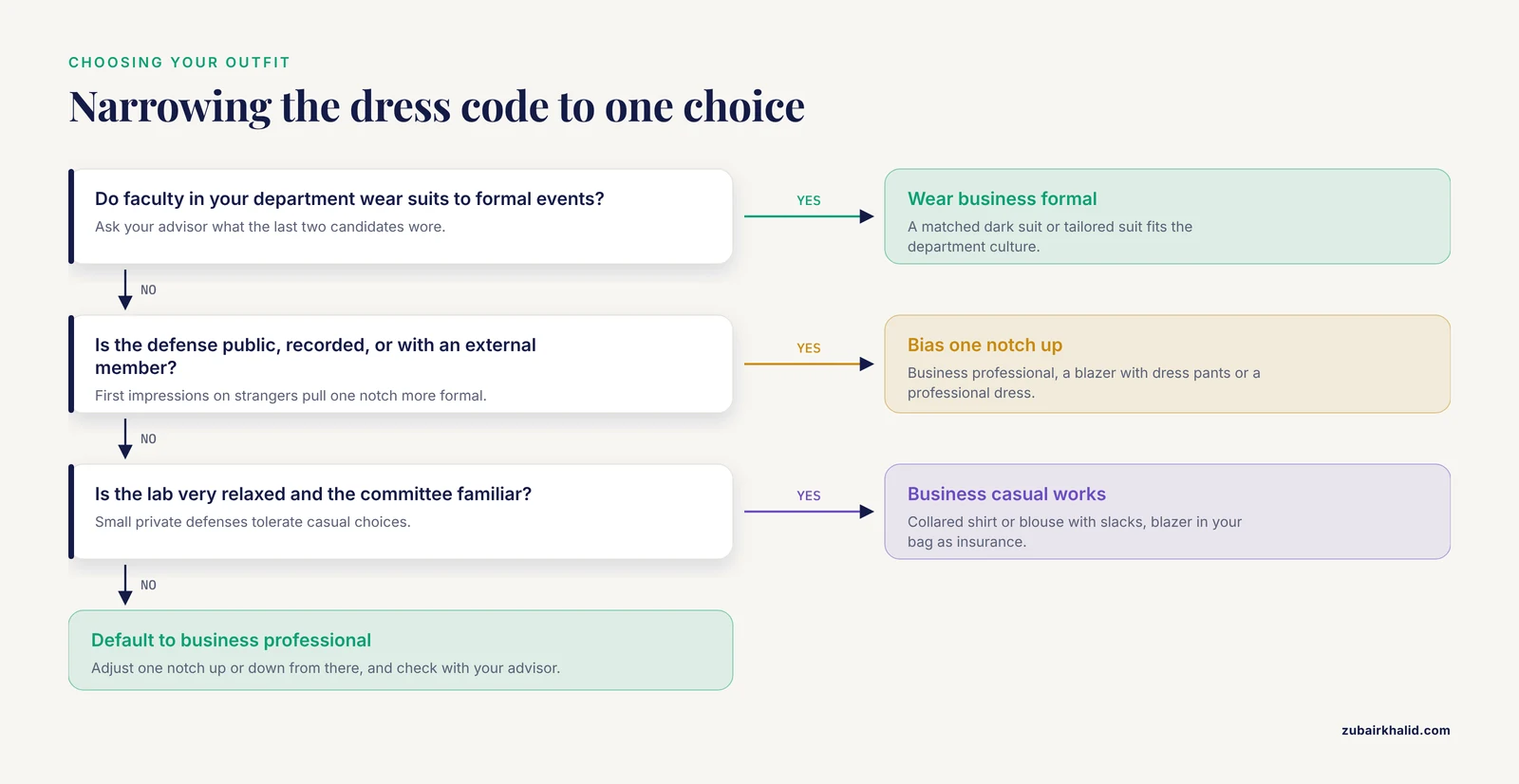
Abstract categories matter less than five concrete factors. Work through them in order and your dress code options usually narrow to one or two.
Department and lab culture. The strongest predictor of the right answer is what faculty in your specific department wear to formal events. Ask your advisor directly, in these words: "What did the last two candidates wear to their defenses?" Advisors answer this question easily and accurately. A department where defenses are suits is a department where you wear a suit.
Committee composition. If your committee includes an external member, a dean's representative, or faculty you have never met, bias one notch more formal. You are making a first impression on those people, and you cannot calibrate to strangers the way you can to your own mentor.
Format and stakes. A closed-room defense with three committee members and your closest labmates is a different event from a public defense in the departmental auditorium with an announcement sent to the whole building. Public defenses and recorded defenses pull toward business professional or formal. Small private defenses tolerate casual choices.
Photography and aftermath. Nearly every defense ends with photos that circulate for years, on lab websites, LinkedIn posts, and the framed picture in your parents' hallway. Ask yourself whether you want those photos to show you in a blazer. For most people the answer is yes, which pushes the decision up one level.
Physical comfort over a long session. Defenses run two to four hours including deliberation, often in warm seminar rooms under bright lights. Wear shoes you can stand and present in for an hour, fabrics that breathe, and layers you can add or remove. A beautiful outfit that makes you miserable by minute ninety will degrade your performance more than a slightly simpler outfit ever could.
Etiquette: What to Expect Before, During, and After
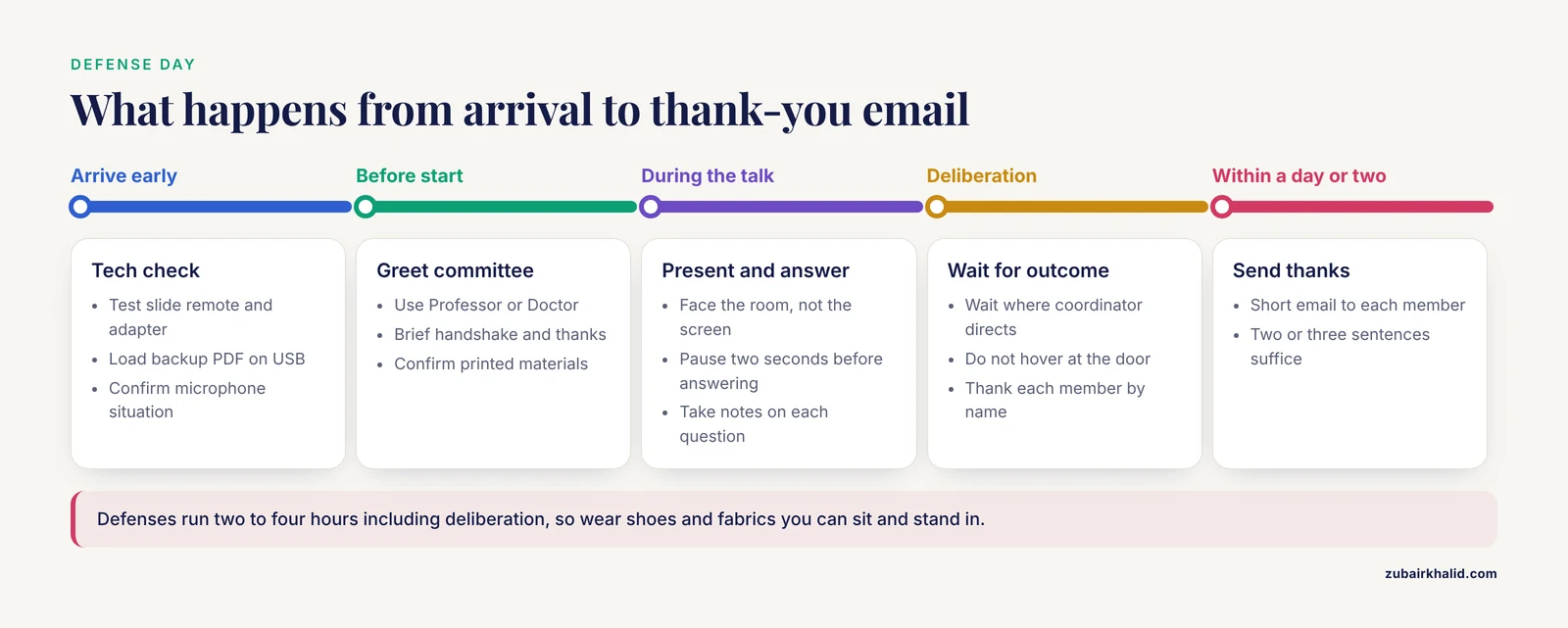
Dress gets you through the door. Etiquette is what the committee actually evaluates, often more heavily than candidates realize. The good news is that defense etiquette follows a predictable script, and knowing the script removes most of the anxiety.
Before the Defense
Arrive early enough to handle technology without an audience. Twenty to thirty minutes before the start is standard for an in-person defense. Use that time to test your slide remote, check that your laptop adapter works with the room's system, load your backup PDF on a USB drive, and confirm the microphone situation. Committees form a lasting impression from how smoothly a defense starts, and a candidate wrestling with an HDMI cable for five minutes burns goodwill before saying a word.
Greet each committee member individually as they arrive or as you are introduced. Use the title they prefer, which is almost always Professor or Doctor unless invited otherwise. A brief handshake and a thank you for their time is the right register. Do not launch into conversation about your research in the lobby. Save it for the room.
Distribute any printed materials your department requires, which may include a copy of your thesis, a one-page abstract, or sign-off forms. In many programs the coordinator handles this, but confirming the day before is your responsibility, not theirs.
Have water within reach at the podium. Dry mouth from adrenaline is near-universal, and pausing to sip is completely acceptable.
During the Presentation
Your talk, usually forty-five minutes to an hour for a doctoral defense and twenty to thirty for a master's, should follow the same structure as your written thesis: context and question, methods, results, interpretation, and contributions. A related point on planning appears in the section below on fitting the defense into your overall timeline.
Etiquette during the talk reduces to a handful of behaviors. Speak to the committee and the audience, not to the screen. Face the room when speaking, and turn to the slide only to point something out. Keep your hands visible and calm. Do not read your slides aloud.
When questions begin, and this is the part candidates fear most, the etiquette is simpler than it feels. Listen to the full question without interrupting. Pause for two seconds before answering, which signals thought rather than panic. If you did not understand the question, asking for clarification is a strength, not a weakness. If you do not know the answer, the accepted professional response is to say so, offer your best current reasoning, and propose how you would find out. Committees do not expect omniscience. They expect honesty and scientific thinking.
Disagreement deserves its own paragraph. At some point, a committee member may push back on an interpretation, a method, or a framing, sometimes assertively. The correct etiquette is to engage with the science, never the person. Restate their point to confirm you understood it, present your evidence, and if the disagreement stands, acknowledge it as an open question rather than a fight. Phrases such as "That is a fair critique, and here is how I weighed it" or "I had not considered that framing, and I think it would change the discussion section in the following way" serve you far better than defensiveness. Committee members remember composure under pressure more than they remember who won an exchange.
Taking notes during questions is not only acceptable but recommended. Writing down each question shows respect and helps you answer multi-part questions in order. It also gives you a record for revisions, since closed-door deliberations frequently produce required manuscript edits that are easy to forget two hours later.
During Deliberation and After
After the public portion, the committee dismisses the audience and deliberates. This wait, typically fifteen minutes to an hour, is often the most nerve-wracking part of the day. Wait where your advisor or coordinator indicates, usually just outside the room or in a nearby office. Do not hover at the door.
When you are recalled, the outcome is announced, forms are signed, and congratulations follow. The etiquette here is warmth and gratitude in roughly that order. Shake hands with every committee member, thank them by name, and thank your advisor last and longest, since they carry the largest share of your success. Many candidates then host or join a small reception, and departments differ on who arranges it. Ask your coordinator or labmates in advance so no one is caught unprepared.
Within a day or two, send a short thank-you email to each committee member. Two or three sentences suffice. This small habit matters for a practical reason: these are the people who will write your recommendation letters, serve on your next student's committee, or collaborate with you for a decade.
Worked Scenarios
Three scenarios show how the criteria above resolve into decisions.
Scenario one: public doctoral defense in a large biology department. The defense is announced department-wide, a visiting professor sits on the committee, and the department photographs each graduate for its website. Culture is moderately formal. The best choice is business professional, a blazer with dress pants and closed-toe shoes, or a suit if you own one that fits. Etiquette priorities are the technology check, note-taking during questions, and composure when the external member, who knows your field less intimately, asks a broad framing question. Answer it generously and without condescension.
Scenario two: master's defense in an informal lab. Three committee members, all of whom you know well, a small seminar room, no recording. Your advisor wears jeans to every meeting. Business casual is defensible here, a collared shirt and chinos or a blouse and slacks. Keep a blazer in your bag as insurance. The etiquette risk in a familiar room is informality in speech, so keep your answers structured and avoid the conversational shorthand you use at lab meetings.
Scenario three: fully remote doctoral defense. Committee members join from four time zones, the defense runs on the university's video platform, and your chair has warned that the external examiner is strict about time. Dress business professional from the waist up in a solid mid-tone color, and wear proper trousers anyway. Test your framing, lighting, and microphone the day before at the same hour as the defense, because afternoon window light differs from morning light. Etiquette priorities shift online: mute when not speaking, look at the camera when answering rather than at the faces on screen, wait a beat before answering to avoid talking over compressed audio, and have a co-host or coordinator handle any breakout-room logistics for the deliberation.
Fitting the Defense Into Your Overall Thesis Plan
Dress and etiquette are the final layer of a plan that starts much earlier, and candidates who leave them to the last week add avoidable stress to an already demanding period.
A doctoral timeline that works for most students counts backward from the defense date. Draft completion lands three to four months out, committee review of the full draft lands two to three months out, and revisions, formatting checks, and the formal announcement of the defense fill the final six weeks. Master's timelines compress the same sequence into roughly half the span. Whatever the degree, book the defense room and confirm committee availability before you finalize the date, since assembling five busy academics is often the slowest step in the entire process.
For students asking how to plan a thesis in a field like biology, the written document follows a conventional biology thesis structure, and knowing that structure early makes both writing and defending easier. A typical biology thesis opens with an abstract, followed by a general introduction that establishes the biological question and the gaps in existing knowledge. Methods chapters or sections describe experimental design, organisms or cell lines, reagents, and statistical approaches in enough detail for reproduction. Results chapters present findings, often organized by experiment or by question, with figures designed to stand alone. A general discussion integrates the results, addresses limitations, and states the contributions. Front matter, literature cited, and appendices close the document. The defense talk is not the thesis read aloud. It is a distillation of that structure into the narrative arc that answers one question: what did you ask, how did you answer it, what did you find, and why does it matter.
Planning the defense day itself belongs on the same calendar. When you schedule the date, also schedule a full talk rehearsal with your lab at least two weeks out, a slide and technology check the week before, your outfit decision a week out so there is time to fix fit problems, and the post-defense reception logistics. Candidates who script the day in advance consistently report lower anxiety than those who improvise.
Common Mistakes and Limitations
The following mistakes account for most of the dress and etiquette problems that actually occur at defenses.
Dressing for a fantasy audience. Candidates imagine a stern panel in suits and overdress for a department full of cardigans, or they mirror their casual lab and underdress for a committee that dressed up for the occasion. The fix is empirical, not intuitive. Ask your advisor what recent candidates wore.
Buying new clothes the day before. New shoes blister during a three-hour session, and new garments fit differently under stress and bright lights. Wear your chosen outfit for a full day at least a week before the defense.
Neglecting the tech rehearsal. The single most common etiquette failure is not rudeness or poor answers. It is a defense that starts ten minutes late because of avoidable technology problems. One full run-through in the actual room, or in your actual video setup, prevents almost all of it.
Treating questions as attacks. Defensive body language, crossed arms, and argumentative replies damage candidates far more than any wrong answer. Committees expect dialogue, and they grade thinking, not perfection.
Talking through the answer instead of to the questioner. Rambling answers that circle without landing are the second most common question-phase failure. Practice the three-part answer: direct response in one or two sentences, supporting detail, and a clean stop.
Forgetting the people outside the committee. Coordinators, administrative staff, and technical support control rooms, forms, and schedules. Thank them. Rudeness to staff has a way of reaching faculty.
One limitation belongs on the record. Norms vary enormously between institutions, countries, and even individual labs, so no general guide can substitute for local knowledge. Every specific choice in this article, from the blazer to the thank-you email, should be checked against your own advisor and department coordinator, whose knowledge of your committee outranks any published advice.
Frequently Asked Questions
What should I wear to my thesis defense?
Wear business professional as your default, which means a blazer over a dress shirt or blouse with dress pants or a professional dress and closed-toe shoes. Then adjust one notch in either direction based on your department's culture, asking your advisor what recent candidates wore.
Can I be overdressed for a thesis defense?
Yes. A full suit in a department where faculty wear sweaters can read as stiff or as a misunderstanding of academic culture, and some committees find it creates distance. The safest correction is to drop the tie or the jacket while keeping everything else polished.
What should I wear to a virtual thesis defense?
Wear a solid mid-toned professional top, such as navy, burgundy, or green, because bright white and deep black distort on webcams. Dress fully rather than half professionally, check your camera framing while seated, and avoid fine stripes that create visual artifacts on video.
How should I handle questions I cannot answer during the defense?
Say directly that you do not know, offer your best current reasoning, and describe how you would investigate the question. Committees evaluate scientific thinking and honesty, and a composed admission of uncertainty scores better than a bluff.
What should I bring with me on defense day?
Bring your slides on a USB drive as a backup, printed copies of any forms or abstracts your department requires, a bottle of water, a pen and notepad for recording committee questions, and your elevation layer, such as a blazer, in case the room is more formal than expected.
What happens after the defense presentation ends?
The committee dismisses the audience and deliberates in private, typically for fifteen minutes to an hour, then recalls you to announce the outcome and sign the paperwork. Wait where your coordinator directs, thank each committee member by name when recalled, and send a short thank-you email within a day or two.