How to Do a Systematic Review Without Meta-Analysis
By Dr. Zubair Khalid, DVM, MS, PhD ·

By the end of this article you will be able to plan, register, search, screen, appraise, synthesize, and report a systematic review that answers a research question without pooling effect sizes in a meta-analysis. This is a complete skill, not a consolation prize. Reviews that stop at structured narrative synthesis are published constantly, and many of the highest-impact review teams pool data only where the evidence allows and synthesize everything else narratively.
Here is what you need on hand before you start:
- A reference manager such as Zotero, Mendeley, or EndNote (Zotero is free)
- A spreadsheet program for screening logs and data extraction
- Access to at least PubMed/MEDLINE and Embase or Scopus through an institution or publisher interfaces, plus the Cochrane Library, which offers free abstract-level searching
- The PRISMA 2020 checklist, which is freely available from the PRISMA statement website
- A free PROSPERO account if your topic falls within PROSPERO's scope (health and social care interventions, diagnostics, public health)
What a Systematic Review Without Meta-Analysis Actually Is
A systematic review answers a pre-specified research question using explicit, reproducible methods to identify, select, and critically appraise all relevant studies. A meta-analysis is the statistical pooling of quantitative results from those studies into a single combined estimate. The two are not the same thing, and a systematic review is complete and publishable without the pooling step.
When you replace statistical pooling with a structured, transparent, pre-planned narrative synthesis, you are doing a systematic review without meta-analysis, sometimes called a systematic review with narrative synthesis.
There are three common reasons to skip pooling:
- The studies are too different. When populations, interventions, or outcome measures vary widely, a pooled average can be misleading. The calcaneal fracture review by de Sa and colleagues pooled surgical outcomes but flagged high heterogeneity in operative times and length of stay, which weakens the interpretation of those pooled numbers [1]. In a review without meta-analysis, that same diversity is a reason to organize studies into coherent groups and compare them in tables rather than collapse them into one number.
- The reporting is too sparse or inconsistent. The radical prostatectomy review by Anceno and colleagues found that heterogeneous and incomplete reporting precluded quantitative synthesis of urinary continence and erectile function outcomes, so those outcomes were described narratively [2]. If your topic has that problem across most outcomes, narrative synthesis is the honest choice for the whole review.
- There are too few studies, or they use incompatible designs. Pooling two studies with different instruments and metrics produces a number nobody can interpret.
A useful model is the hybrid approach used by Amjad and colleagues in their review of weight regain after bariatric surgery. They ran random-effects meta-analysis only when at least two independent studies reported the same construct, the same instrument family, and the same metric, and synthesized everything else narratively [3]. Huhtala and colleagues did the same in their pediatric blood-sampling review, reporting pooled statistics where possible and narratively where statistical analysis was not possible [4]. Deciding this in advance, in your protocol, is what separates a systematic review from an ordinary essay.
Systematic Review Without Meta-Analysis Step by Step
The walkthrough below assumes a health sciences topic, which is where most first-time reviewers start, but the same eight steps apply in ecology, education, psychology, and engineering.
Step 1: Frame the Question and Define Scope
Write your question in a structured format. For intervention questions, use PICO: Population, Intervention, Comparison, Outcome. For example:
- P: Adults with chronic lateral ankle instability
- I: Modified Broström repair with suture augmentation
- C: Modified Broström repair without augmentation
- O: Return to sport, complications, failure, revision
Rubin and colleagues framed their suture augmentation review in almost exactly this shape, which is why their inclusion criteria were unambiguous [5]. For diagnostic accuracy questions, add the reference standard, the gold-standard test that defines true disease status. The cervicography screening review defined histopathology of colposcopy-directed biopsy as its reference standard before searching began [6].
Decide now, and write down: study designs you will accept, publication date ranges, language limits, and outcomes. Every one of these decisions becomes an eligibility criterion, and every eligibility criterion must be justified or you will argue with peer reviewers about it later.
Step 2: Write a Protocol and Register It
A protocol is the written plan for your review, drafted before you see any results. It fixes your question, eligibility criteria, search strategy, screening process, data items, risk-of-bias tools, and synthesis plan. Register it in PROSPERO, the international prospective register of systematic reviews maintained by the National Institute for Health and Care Research in the UK. Registration is free, takes about an hour, and gives your review a permanent record that prevents accusations of retrospective rule-changing.
The needlestick injury review by Zhu and colleagues displays its PROSPERO registration number (CRD42024598365) in the abstract, which is standard good practice [7]. Some teams also publish the protocol as a separate paper, as Chen and colleagues did for their biomarker diagnostic review in Frontiers in Medicine [8]. Publishing the protocol is optional. Registering it costs nothing and buys credibility.
Your synthesis plan should state explicitly whether you intend to pool data and under what conditions. A sentence like "we will pool estimates when at least two studies report a comparable outcome using the same instrument, and we will otherwise synthesize findings narratively" is the single most important sentence in the protocol for a systematic review without meta-analysis.
Step 3: Build the Systematic Literature Search
A systematic literature search is designed to be reproducible. Another person should be able to rerun it and get the same records.
Cover multiple databases. Published reviews in this field typically combine a biomedical core with subject-specific and regional sources:
- Core: PubMed/MEDLINE, Embase, Web of Science, Scopus
- Trials and evidence: Cochrane Central Register of Controlled Trials (CENTRAL), ClinicalTrials.gov
- Nursing and allied health: CINAHL
- Grey literature and supplements: Google Scholar, ProQuest, and for unpublished work, tools like MedNar and PsycArticles, which Huhtala and colleagues searched alongside CINAHL, PubMed, Scopus, and the Cochrane Library [4]
- Regional literature when relevant: CNKI, Wanfang, VIP, and SinoMed for Chinese-language studies, as Chen and colleagues planned in their protocol [8]
State the exact date of each search. Zhu and colleagues reported searches conducted through October 13, 2024, which lets any reader judge the currency of the evidence [7].
Here is an illustrative PubMed query for a question about probiotics and antibiotic-associated diarrhea, using standard PubMed field tags:
("anti-bacterial agents"[MeSH] OR antibiotic*[Title/Abstract])
AND
("diarrhea"[MeSH] OR diarrhea[Title/Abstract])
AND
(probiotic*[Title/Abstract] OR "Lactobacillus"[Title/Abstract]
 OR "Saccharomyces"[Title/Abstract])
AND
("systematic review"[pt] OR "randomized controlled trial"[pt]
 OR "clinical trial"[pt] OR cohort*[Title/Abstract])
Run it with the -verbose mindset of a search logger: record the platform (PubMed via NCBI), the date, any filters applied (year range, language), and the number of records returned. Expected output looks like this in your search log:
Database: PubMed (via NCBI)
Date run: 2026-11-11
Query: (see protocol Appendix A)
Filters: 2010-present, English, humans
Results: 1,412 records exported to RIS
Use Boolean operators (AND narrows, OR broadens) and controlled vocabulary (MeSH terms in PubMed, Emtree in Embase) alongside free-text synonyms. Test the search against a handful of papers you already know should be included. If your known key study does not appear, the search has a gap, usually a missing synonym.
Supplement database searching with citation searching, the practice of screening the reference lists of included papers for additional studies. Amjad and colleagues found seven additional studies of weight regain through citation searching that the databases alone missed [3].
Step 4: Screen Records in Two Stages, With Two Reviewers
Screening has two stages: title-and-abstract screening, then full-text screening. Best practice, and the expectation of most journals, is that two reviewers screen independently and a third resolves disagreements.
Keep a screening log so you can report the flow. Two published reviews show the scale involved. The femoral nerve block review by Oliveira and colleagues identified 922 studies and included 11 randomized trials [9]. The weight regain review yielded 1,212 database records plus 12 from other sources, assessed 108 full texts, and included 19 studies after citation searching [3]. These are the numbers that populate the PRISMA flow diagram, the required four-block figure showing records identified, screened, eligibility-assessed, and included.
A simple spreadsheet log keeps you honest:
record_id,title,abstract_screen_decision,reason_exclusion,fulltext_decision,reason_exclusion_ft,screened_by_1,screened_by_2,disagreement
0001,"Probiotics for AAD in adults",exclude,not RCT,,,,,
0002,"Lactobacillus rhamnosus GG prophylaxis",include,,include,,YA,MK,n
0003,"[Fecal transplant](/knowledge/veterinary-medicine/veterinary-pathology-microbiology/fecal-transplant-fmt-science-and-veterinary-use) overview",maybe,,exclude,wrong population,YA,MK,y
Common exclusion reasons at full text: wrong population, wrong intervention, wrong outcome, wrong study design, wrong publication type (conference abstract with no data), duplicate cohort. Record the reason for every excluded full text. Journals ask for it, and reviewers check it.
Step 5: Extract Data Onta a Standardized Form
Build a piloted extraction form covering study identifiers, design, population, intervention or exposure, comparator, outcomes with units and time points, funding, and any numbers you will tabulate. Pilot it on three studies, fix the ambiguities, then extract the rest. Two independent extractors with a reconciliation step is the standard for high-quality reviews, and Chen and colleagues specified exactly that dual independent extraction in their protocol [8].
A workable extraction table has one row per study:
study_id,author_year,country,design,n,intervention,comparator,
outcome1_name,outcome1_measure,outcome1_timepoint,outcome1_value,
risk_of_bias_tool,risk_of_bias_judgment,funding
Pilot, fix, freeze. Once extraction begins in earnest, changes to the form should be documented as protocol amendments.
Step 6: Assess Risk of Bias With a Design-Appropriate Tool
Risk of bias is the judgment about whether a study's design and conduct threaten the validity of its results. This is not optional, and it is not the same as scoring quality on a vibes-based checklist. Use a validated tool matched to each study design:
| Study design | Standard tool | Example of use in practice |
|---|---|---|
| Randomized trials | Cochrane RoB 2 | Used for RCTs in the pediatric septic shock review [10] and the vancomycin infusion review [11] |
| Nonrandomized studies of interventions | ROBINS-I | Applied to observational evidence in the septic shock and vancomycin reviews [10] [11] |
| Cohort studies | Newcastle-Ottawa Scale | Used in the weight regain review [3] |
| Cross-sectional and prevalence studies | JBI critical appraisal checklists | Used for prevalence studies in the needlestick injury review [7] |
| Diagnostic accuracy studies | QUADAS-2, QUADAS-3, QUADAS-C | Specified in the PJI biomarker protocol [8] |
| Prior systematic reviews | AMSTAR 2 | Used to appraise reviews in the probiotics umbrella review [12] |
Two reviewers judge each domain independently. Report judgments per study per domain, usually as a traffic-light figure. In a review without meta-analysis, risk-of-bias ratings do double duty, because they become the quality dimension of your narrative synthesis.
Step 7: Synthesize the Evidence Narratively, But Structurally
This is the step people get wrong. Narrative synthesis is not "write a paragraph about each study." It is a pre-planned, transparent procedure. A robust workflow:
- Group the studies by intervention type, population, or outcome family, guided by your protocol. The pediatric septic shock review classified interventions into measurement-informed strategies, structured early vasoactive strategies, and a hybrid approach, and analyzed randomized and nonrandomized evidence separately [10]. Grouping before describing prevents a random study-by-study laundry list.
- Build structured tables that put studies side by side on population, intervention, outcomes, and risk of bias. Patterns and disagreements become visible in the table, and your prose describes the pattern, not each paper in turn.
- Describe the direction, size, and consistency of effects in words, with the actual numbers from each study where reporting allows. Anceno and colleagues described their continence and potency findings narratively precisely because pooling was precluded [2], and the result is still interpretable because the underlying data appear in tables.
- Weigh each finding by its risk of bias and certainty. Amjad and colleagues rated confidence in the evidence with a structured approach informed by GRADE domains, meaning the synthesis prioritizes trustworthy results over noisy ones [3]. GRADE (Grading of Recommendations Assessment, Development and Evaluation) is the standard framework for rating certainty from high down to very low, and the septic shock review used it to label its pooled estimate as very-low-certainty evidence [10].
- State what the evidence cannot support. When effect estimates are imprecise, say so plainly. The hydration review by Zhang and colleagues reported a time-to-exhaustion benefit of 34.1 percent whose prediction interval included no benefit at all, and said exactly that rather than overclaiming [13].
The 8-step and SWiM (Synthesis Without Meta-analysis of Intervention Studies) reporting guidelines give you checklists for this section and are worth printing before you write it.
Step 8: Report Under PRISMA 2020
PRISMA 2020 (Preferred Reporting Items for Systematic Reviews and Meta-Analyses) is the 27-item checklist that journals expect, whether or not you pooled data. Rubin and colleagues stated PRISMA-guideline compliance for their search and screening [5], and Amjad and colleagues cited PRISMA 2020 directly [3]. Complete the checklist, produce the flow diagram with your own counts, deposit your full search strategies as supplementary files, and state in the abstract that synthesis was narrative. Reviewers who understand that phrase will trust the rest of the paper more, not less.
Choosing Synthesis Options: A Quick Reference
| Decision | Options | Rule of thumb |
|---|---|---|
| Grouping structure | By intervention, population, outcome, or study design | Pre-specify in the protocol, adjust only with documentation |
| Effect description | Direction and magnitude in words, standardized differences, ranges across studies | Report each study's own numbers and units, never an invented average |
| Quality weighting | GRADE certainty, risk-of-bias dominance | Findings from high-bias studies should not drive conclusions |
| Heterogeneity handling | Tabular comparison, subgroup tables, explicit narrative contrast | Name the likely sources: population, dose, comparator, instrument |
| When pooling becomes possible | Convert to meta-analysis post hoc | Only if the protocol allowed it, and say so |
Common Mistakes and Limitations
Calling an unsystematic essay a systematic review. If you did not pre-specify eligibility, search multiple databases with documented strategies, dual-screen, and appraise bias, you have written a narrative literature review. That is a legitimate genre (see the FAQ), but mislabeling it is a rejection letter.
Searching one database. PubMed alone misses a large share of relevant trials. Every one of the published reviews cited here searched multiple databases, and the most thorough protocols in this set planned ten or more sources including regional and grey-literature databases [7] [8].
Screening alone. Single-reviewer screening misses studies. Dual independent screening with disagreement resolution is the field standard, and protocols in this set specified two independent reviewers for screening, extraction, and bias assessment [8].
Deciding to pool after seeing the results. Choosing meta-analysis or narrative synthesis based on what the data show is outcome-driven reverse engineering. Fix the synthesis plan in the registered protocol. The hybrid reviews cited here state their pooling conditions up front.
Treating "narrative synthesis" as a license to summarize loosely. Without structure, narrative sections degrade into study-by-study abstracts with no conclusion. Grouping, structured tables, and bias-weighted interpretation are what keep the synthesis rigorous.
Ignoring heterogeneity when describing findings. Even without pooling, diversity across studies matters. Reviews in this set explicitly flagged high heterogeneity as a caveat on their conclusions [13], and your discussion should do the same.
Skipping citation searching and grey literature. Database searches alone undercount. Citation searching added seven studies to one published review [3], and grey-literature sources were formally included in another [4].
Forgetting the limits of the method itself. A systematic review without meta-analysis cannot produce a single pooled effect estimate, and its conclusions are correspondingly more qualitative. State that limitation in your discussion. And like any research project, an individual review benefits enormously from early input from a subject librarian and an experienced methodologist, especially for search design and tool selection.
Frequently Asked Questions
Is a systematic review without meta-analysis still a systematic review?
Yes. The systematic part refers to the pre-specified, reproducible methods for identifying and appraising studies, not to the statistical pooling. Journals publish reviews with narrative synthesis regularly, provided the methods are transparent and the reporting follows PRISMA.
When should I skip the meta-analysis?
Skip pooling when studies differ too much in population, intervention, or outcome measurement, when reporting is too sparse or inconsistent to pool, when there are very few studies, or when designs are incompatible. State the reason explicitly in your methods and protocol.
How many studies do I need?
There is no minimum. A review with five or six high-quality studies can be more valuable than a pooling of twenty heterogeneous ones. What matters is that the included studies answer your question and that your synthesis is structured.
Do I still need to register a protocol if I am not doing a meta-analysis?
Yes. PROSPERO registration documents your plan before you see the results, which protects you from accusations of selective methods. Registration is free and takes about an hour.
What exactly is narrative synthesis?
Narrative synthesis is a structured, pre-planned way to combine findings in words and tables: group the studies, compare them side by side, describe the direction and consistency of effects, and weigh each finding by its risk of bias. The 8-step and SWiM guidance documents formalize the process.
How is this different from a regular literature review?
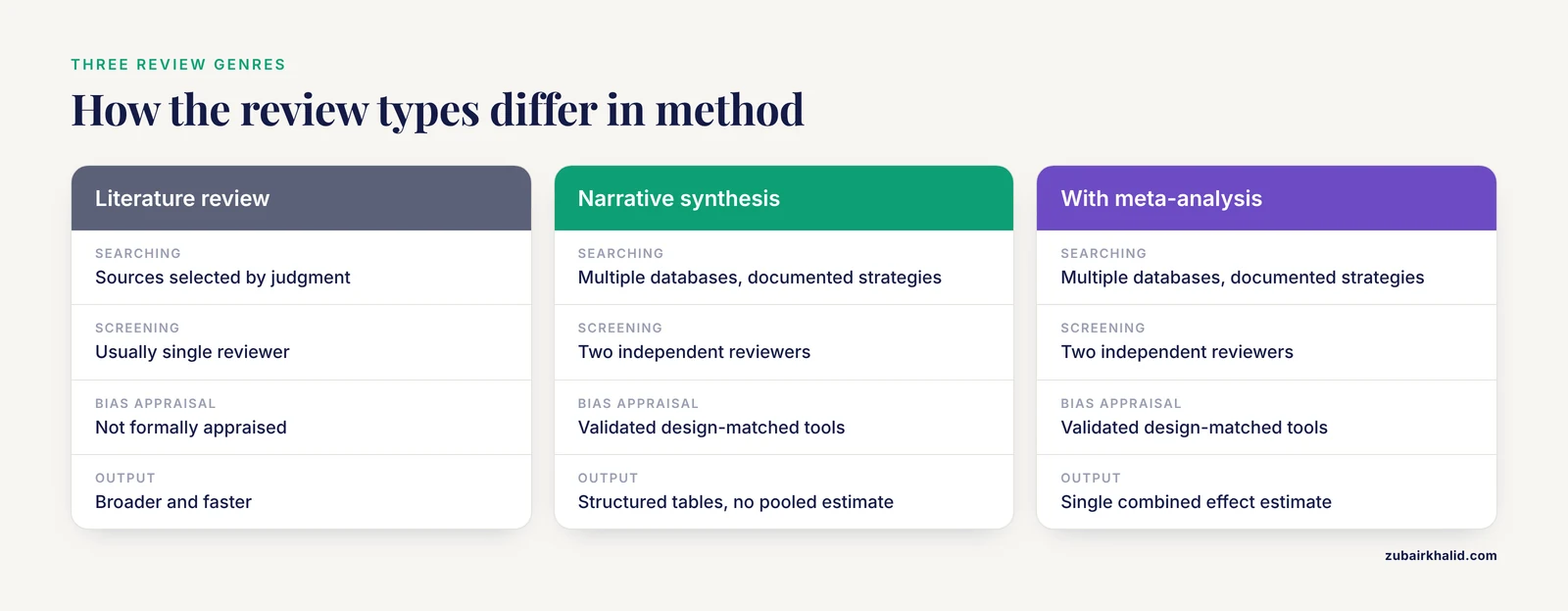
A regular literature review selects sources by judgment, without documented exhaustive searching, dual screening, or formal bias appraisal. A systematic review does all of those things and reports them. The regular review is faster and broader; the systematic review is reproducible and defensible.
What software do I need?
At minimum, a reference manager (Zotero is free), a spreadsheet for screening and extraction, and database access. Optional tools include Rayyan or Covidence for screening, and RevMan or R if you ever decide to add pooling under your protocol's conditions.
Can I add a meta-analysis later if enough data turn out to be available?
Only if your registered protocol anticipated that possibility. Adding pooling after seeing the results is outcome-driven and will draw criticism. The cleanest path is to write the pooling conditions into the protocol from day one, as several published hybrid reviews have done.
Sources
- Closed percutaneous reduction versus mini-open sinus tarsi approach for fixation of displaced intra-articular calcaneal fractures: a systematic review and meta-analysis.
- Diagnostic yield and early outcomes of radical prostatectomy without prior histopathologic diagnosis: a single-arm systematic review and meta-analysis.
- Postoperative Behavioral and Psychological Factors Associated With Recurrent Weight Gain After Metabolic and Bariatric Surgery: A Systematic Review and Meta-Analysis.
- Effectiveness of distraction-based interventions for relieving anxiety, fear, and pain in hospitalized children during venous blood sampling: a systematic review and meta-analysis.
- Suture Augmentation May Facilitate Earlier Return to Sport Without Improving Return Rates or Clinical Outcomes Following Modified Broström Repair: A Systematic Review and Meta-Analysis.
- Cervicography for cervical cancer screening: A systematic review and meta-analysis.
- Global prevalence of needlestick and sharps injuries among dental health care workers: A systematic review and meta-analysis.
- Diagnostic performance and reported diagnostic thresholds of serum and synovial host-response biomarkers for periprosthetic joint infection in patients with inflammatory arthritis: protocol for a systematic review and diagnostic test accuracy meta-analysis.
- SINGLE-SHOT FEMORAL NERVE BLOCK VERSUS LOCAL INFILTRATION ANALGESIA FOR PATIENTS UNDERGOING TOTAL KNEE ARTHROPLASTY: A SYSTEMATIC REVIEW AND META-ANALYSIS.
- Measurement-Informed and Fluid-Sparing Cardiovascular Resuscitation Strategies in Pediatric Septic Shock: A Systematic Review and Exploratory Meta-Analysis.
- Continuous vs. intermittent vancomycin infusion in critically ill patients: a systematic review and meta-analysis.
- Probiotics for the prevention of antibiotic-associated diarrhea: an umbrella review and second-order meta-analysis of 21 systematic reviews covering 170 unique randomized controlled trials.
- Effects of during-exercise oral hydration strategies on endurance performance and thermophysiological strain: a systematic review with meta-analysis.