How to Write Specific Aims That Impress Reviewers
By Dr. Zubair Khalid, DVM, MS, PhD ·

By the end of this article you will be able to draft a complete, one-page Specific Aims page using a five-part template, fill that template with a real worked example, and stress-test your draft the way a study section member would. You need three things on hand before you start: your funder's formatting instructions (the page limit and font rules), your preliminary results summarized in one paragraph, and the three to five published papers that define the gap your project fills.
The Specific Aims page is the single most read page of most biomedical grant applications. Many reviewers form their opinion of the entire proposal from it, and some bring only that page to the review meeting. Treat it as the application in miniature, not as a summary you write last.
What the Specific Aims Page Actually Does
The Specific Aims page answers four questions in one page: what problem are you solving, why has nobody solved it yet, what exactly will you do, and what changes if you succeed. Reviewers use it to assign your application a score before they ever read the Research Strategy. A page that answers all four questions in order, in plain sentences, survives that first pass. A page that opens with background history, hides the hypothesis on line 40, or lists aims that could each be their own five-year grant does not.
Everything on the page must be checkable. Reviewers who cannot tell what your outcome measure is, who your study population is, or how Aim 2 depends on Aim 1 will assume the worst. The template format below exists to force those details into predictable places so a tired reviewer finds them on the first read.
The Specific Aims Page Template Format at a Glance
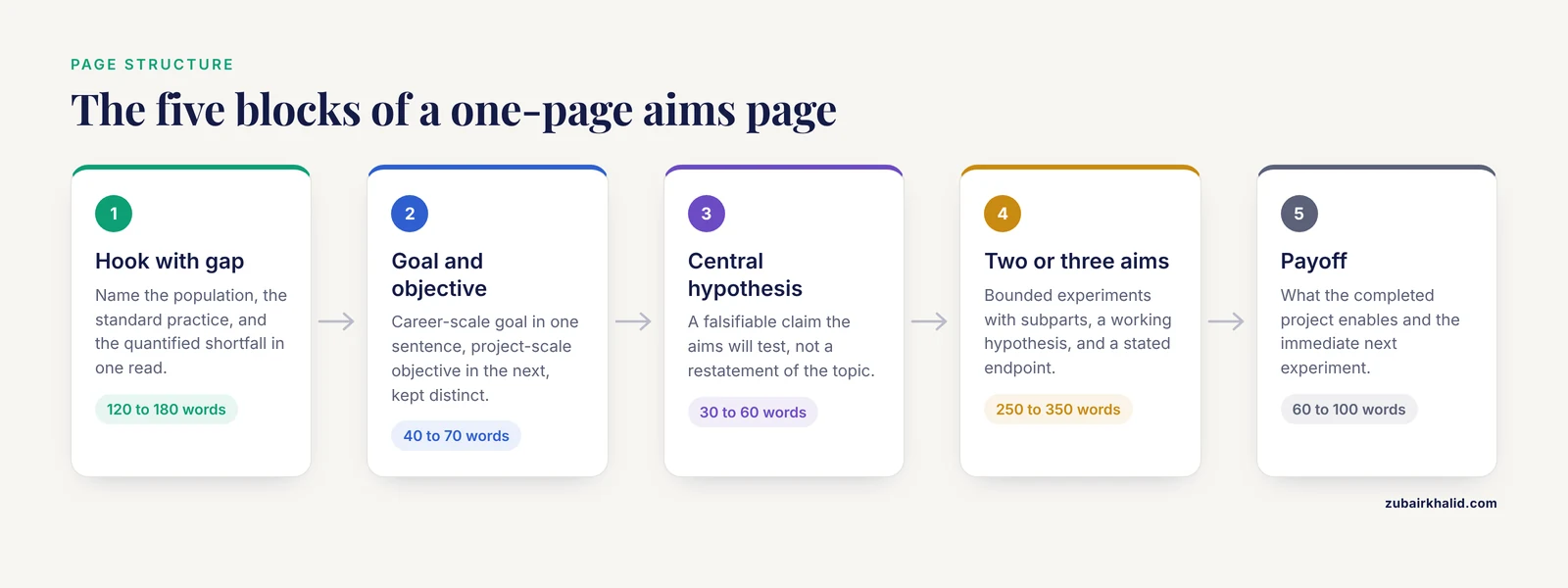
The standard NIH-style page has five blocks. Word budgets assume a one-page limit, which is the norm for this section, so check your agency's instructions before you commit to these numbers.
| Section | Job it performs | Rough budget | Typical failure |
|---|---|---|---|
| Hook (problem plus gap) | Make the reader care and name the missing knowledge | 120 to 180 words | Opens with a textbook history instead of a gap |
| Long-term goal and objective | Anchor the project in a career-scale goal and a project-scale objective | 40 to 70 words | Goal and objective are the same sentence twice |
| Central hypothesis | Commit to a falsifiable claim the aims will test | 30 to 60 words | Restates the topic rather than a testable prediction |
| Aims (two or three) | Concrete, bounded experiments with subparts and a rationale | 250 to 350 words | Aims overlap, lack a logical order, or have no stated endpoint |
| Payoff | State what the completed project enables | 60 to 100 words | Vague impact language with no next experiment named |
This is the skeleton every specific aims page template you will find is built on, whether it is labeled as such or not. Institutional templates, including free ones from university grant offices, mostly rearrange these blocks or add prompting questions under each heading.
Step-by-Step Walkthrough: Building the Page
Step 1: Assemble your inputs
Write down, before drafting:
- One sentence describing who has the problem and what it costs them.
- One sentence describing what is already known, with the strongest citation you have.
- One sentence describing the specific thing nobody knows.
- Your preliminary data, in one paragraph, with the key number.
- The two or three experiments you are actually qualified and equipped to run.
If you cannot fill item 3, you are not ready to draft. A vague gap ("little is known about X") is the most common reason reviewers score an application as lacking focus.
Step 2: Write the hook
Open with the population that carries the burden, the current standard of care or practice, and the specific shortfall. Real published literature shows what a strong hook looks like. In hepatocellular carcinoma (HCC, the dominant primary liver cancer), current guidelines recommend surveillance with ultrasound and α-fetoprotein, yet fewer than 1 in 4 patients with cirrhosis actually receive that surveillance, and the strategy itself has suboptimal sensitivity [1]. That sentence contains a population, a standard practice, and a quantified failure. A reviewer can locate the gap in one read.
A second kind of hook names a shift in practice that creates a new unknown. Recent guidance for HCC surveillance in chronic hepatitis B removed race from eligibility criteria and replaced it with country of origin plus a PAGE-B score above 10. In one retrospective cohort of 259 patients, 60 percent were eligible under the older race-based guidance while 63 percent would be eligible under the new criteria, with discordance in 28 percent of cases [2]. If your project addresses that discordance, your hook writes itself: the criteria changed, the change moves real patients in and out of screening, and nobody has measured the consequences.
Step 3: State the long-term goal, the objective, and the central hypothesis
These are three different sentences and reviewers look for all three.
- The long-term goal is career-scale. "My long-term goal is to eliminate preventable liver cancer deaths in patients with chronic hepatitis B."
- The objective is project-scale. "The objective of this application is to determine whether adding a validated risk score to routine clinic workflow improves HCC surveillance uptake."
- The central hypothesis is a falsifiable claim. "Central hypothesis: risk-stratified surveillance schedules identify the same number of cancers as universal surveillance at a fraction of the examinations."
The PAGE-B score gives you a concrete example of why a named instrument strengthens a hypothesis. PAGE-B predicts hepatocellular carcinoma risk in treated chronic hepatitis B patients using age, gender, and platelet count, and it has shown strong predictive performance both alone and against competing risk scores [3]. Its performance has been reproduced outside the original development population, including a 978-patient cohort in Northeast Brazil where PAGE-B achieved an area under the ROC curve of 0.78 with a cutoff of 11 points [4]. A hypothesis built on a tool with this track record inherits credibility. A hypothesis built on a tool you invented last month does not.
Step 4: Write the aims
Use two or three aims, never more. Each aim gets three parts: a one-sentence statement of what you will do, two or three subparts describing how, and one sentence naming the outcome and the interpretation if the result goes either way. The template looks like this:
Aim 1: [Verb] [specific object] using [method] in [population/model].
  1a. [First concrete step with the key reagent, cohort, or dataset.]
  1b. [Second step, often the comparison or control condition.]
  Working hypothesis for Aim 1: [prediction].
  Outcome and interpretation: If [result], this will [support/weaken] the
  central hypothesis and [next step]. If [alternative result], we will
  [fallback plan].
Fill the template with your own numbers before you touch the prose. Here is a filled example for a surveillance-improvement project:
Aim 1: Quantify the change in surveillance eligibility produced by the
  transition from race-based to score-based HCC surveillance criteria.
  1a. Apply both criteria sets to a diverse chronic hepatitis B cohort,
      mirroring a published 259-patient cohort in which eligibility shifted
      from 60 percent to 63 percent with discordance in 28 percent of cases.
  1b. Stratify discordant patients by PAGE-B component variables (age,
      gender, platelet count) to identify who gains and who loses screening.
  Working hypothesis: The new criteria systematically shift eligibility
  toward higher-risk patients.
  Outcome and interpretation: If discordance concentrates among patients
  with borderline platelet counts, surveillance intervals for that subgroup
  become the target of Aim 2. If discordance is random, the field's
  assumption that scores outperform demographic criteria weakens, and the
  project pivots to criterion validation (Aim 2 alt.).
For a methods or prediction-model project, the same structure carries quantitative milestones. A systematic review of machine learning for post-operative nausea and vomiting found that three studies of mixed surgical populations reported areas under the curve between 0.714 and 0.814, numerically exceeding the 0.68 of Apfel's classic four-parameter score, yet none of the studies provided their models in a form sufficient for implementation and none specified how standard errors were calculated [5]. An aims page for that space can cite exactly that dual fact as both the opportunity (better discrimination is achievable) and the gap (reported models cannot actually be used). Building the TRIPOD+AI reporting framework into your aim's subparts, as that review used it for quality assessment, signals to reviewers that you know how a prediction model must be documented to be credible [5].
Step 5: Write the payoff
Close with two sentences: what the completed project makes possible, and what the immediate next experiment is. Avoid impact inflation. "These results will provide the evidence base for a randomized trial of risk-stratified surveillance" is stronger than "these results will transform liver cancer prevention."
Step 6: Stress-test the draft
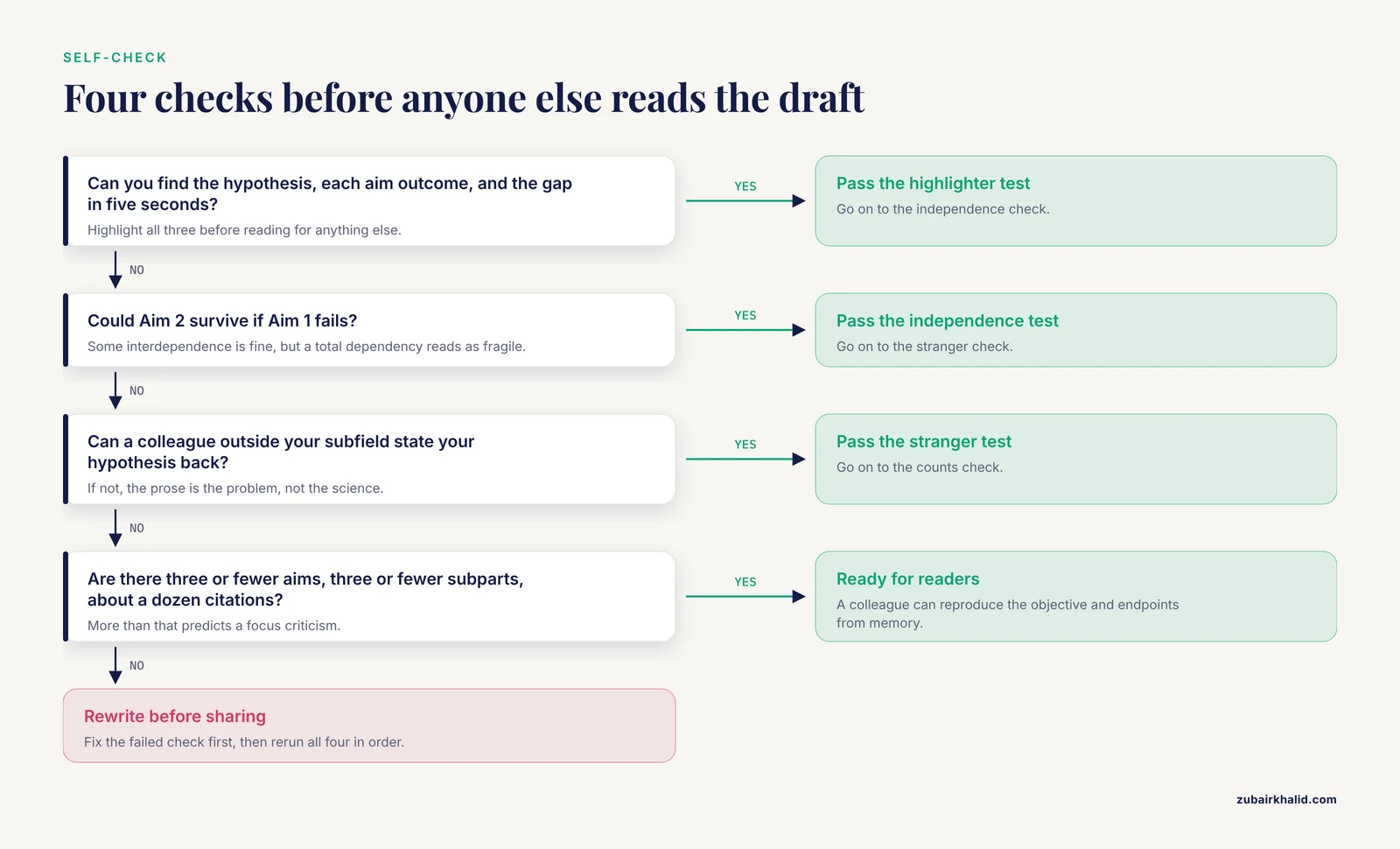
Run four checks before anyone else reads it:
- The highlighter test. Highlight the hypothesis, the outcome of each aim, and the gap sentence. If any of the three takes more than five seconds to find, rewrite.
- The independence test. Ask whether Aim 2 could survive if Aim 1 fails. Some interdependence is fine, but if Aim 2 cannot be attempted at all without Aim 1's result, reviewers will call the project fragile.
- The stranger test. Hand the page to a colleague outside your subfield. If they cannot state your hypothesis back to you, the prose, not the science, is the problem.
- The counts test. Count the aims, the subparts, and the citations. More than three aims, more than three subparts per aim, or more than roughly a dozen citations on one page each predict a focus criticism.
Expected output of a successful pass: a colleague can reproduce your objective, hypothesis, and the endpoint of each aim from memory after a single read.
Step 7: Fold the page back into the rest of the application
Every aim becomes a research strategy section, and every number on the aims page must reappear with its full citation in the body. Write the aims page first, then use it as the outline for everything else. This is the core habit that separates efficient grant proposal planning from the drafting spiral, where people write thirty pages of background and then try to reverse-engineer a one-page summary out of them.
What Funders Actually Weight When They Read an Aims Page
Grant review is a decision under uncertainty, and the factors that drive investment decisions have been studied directly. Interviews with healthcare executives who committed funding to a pilot of the Project ECHO telementoring model identified five themes driving their decisions: personal experiences, benefits, risks, partnerships, and timing [6]. Notably, the executives treated the drive and sustainability of the project team itself as an indicator of future viability, and the proposal's claims about financial sustainability, ongoing improvement, and scalability positively influenced their investment confidence [6].
Translate those five themes into aims-page language:
- Benefits map to your payoff paragraph.
- Risks map to your fallback plans inside each aim.
- Partnerships map to your co-investigators and access to cohorts or data, which you should name in the aim subparts.
- Timing maps to your hook. A gap created by a recent change in practice or guidance, like the shift in HCC surveillance criteria [2], is a timing argument.
- Personal experience of the team maps to preliminary data. Reviewers fund people who have already touched the system they propose to study.
Three Aims Patterns Drawn from Published Science
Studying how real studies phrase their purpose is the fastest way to internalize the format. A published abstract is essentially a completed aims page, so you can reverse the template and see which pattern each project follows.
Pattern A: Validate and improve an existing tool. The PAGE-B and REACH-B scores were evaluated in a Brazilian chronic hepatitis B cohort of 978 patients, where PAGE-B reached an area under the ROC curve of 0.78 and REACH-B reached 0.79, with defined cutoffs of 11 and 7.5 points respectively [4]. The aims pattern is: Aim 1 reproduces the tool in a new population, Aim 2 tests a modification, Aim 3 translates the improved tool into practice. If your field has a widely used score or assay, this is the most fundable entry-level pattern because the preliminary data already exist in print.
Pattern B: Fill a population or knowledge-domain gap. The multi-ethnic PAGE Study genome-wide association analysis of glycemic traits covered 52,267 participants for fasting glucose, 48,395 for fasting insulin, and 23,357 for HbA1c, with substantial representation of African American, Hispanic/Latino, and other non-European ancestry groups, and it identified four novel genetic associations [7]. The motivating gap, that most prior discoveries came from European-ancestry populations, is a textbook example of a gap a reviewer can verify in seconds. The same pattern appears in natural products research, where a patent review of the Euphorbiaceae plant family documented 41 species across 19 genera and 31 metabolites in patents published between 1998 and 2023, with anti-tumoral activity the most represented (21 patents), followed by anti-inflammatory (10), antioxidant (7), and anti-bacterial (6) [8]. An aims page in that space would state the mapped landscape as the known, and the untested lead compounds as the gap.
Pattern C: Upgrade methods with explicit rigor. The deprescribing field illustrates it well. An updated systematic review and meta-analysis of deprescribing in older people included 259 studies reported across 286 papers, and found that deprescribing polypharmacy did not significantly reduce mortality in randomized studies (odds ratio 0.96, 95 percent confidence interval 0.84 to 1.09) [9]. An aims page for a new deprescribing trial can use that null result as its gap: the field has an enormous evidence base, mortality has not moved, so the aim must target a mechanism or population the meta-analysis could not resolve. Pattern C aims are strong precisely because they confront an honest negative result rather than pretending the literature is a blank slate.
Notice what all three patterns have in common. Each gap is one sentence, each gap is verifiable with a citation, and each proposed response is a bounded set of experiments rather than a research program.
Working with Free Templates Without Sounding Like a Template
Free specific aims page templates circulate through university grant offices, professional societies, and funder websites, and there is nothing wrong with starting from one. Two cautions keep the template from showing. First, delete the template's prompting text ruthlessly. Pages that still contain phrases like "[Insert long-term goal here]" or that answer the template's questions in the template's order, mechanically, read as assembled rather than authored. Second, adapt the block order to your field's expectations. A hypothesis-driven basic science proposal, such as a targeted drug delivery project where the key structural claim is that an anti-CD22 antibody fragment conjugated to a cyclodextrin framework delivers daunorubicin to CD22-positive tumor cells while sparing CD22-negative controls, tested in CD22-positive Raji cells against CD22-negative Jurkat cells [10], puts the model system and its negative control at the center of every aim. A health services proposal, such as a scoping review of emergency department clinical registries conducted under the PRISMA-ScR checklist across PubMed, EMBASE, and SCOPUS, which identified 60 manuscripts with 27 primary registries [11], leads with the evidence-mapping question instead.
The scoping review example makes a further point about phrasing. Its authors posed two explicit questions: what types of social interactions take place between staff and people living with dementia, and what barriers and facilitators influence those interactions, drawing on 19 articles from 8 countries [12]. When your project is exploratory, phrase each aim as a question with a defined search or sampling frame. Reviewers accept descriptive aims when the question is sharp and the frame is explicit. They reject descriptive aims when the question is "what is the experience of X" with no boundary anywhere.
If you want structured instruction beyond templates, a research grant writing course through your institution or a professional society is the conventional next step, and most pair the template with real reviewer critiques, which is the part you cannot get from a document alone.
Common Mistakes and Limitations
Burying the hypothesis. If your central hypothesis appears after the aims, you do not have a central hypothesis. Reviewers score focus before they score feasibility.
Aims that are topics, not experiments. "Aim 2: Understand the role of protein X" names a topic. "Aim 2: Determine whether protein X knockdown reduces drug uptake in CD22-positive Raji cells relative to CD22-negative Jurkat cells" names an experiment with a built-in comparison, the same positive-versus-negative-cell-line logic that gives nanomedicine papers their persuasiveness [10].
Gap statements without numbers. "Surveillance is underused" is weak. "Fewer than 1 in 4 patients with cirrhosis receive surveillance" is strong and verifiable [1]. When a precise number is not available in the literature, describe the shortfall qualitatively and name the best existing estimate rather than inventing a figure.
Overstating novelty. Reviewers know your field. Claiming that nobody has ever studied your topic, when a reviewer can name three papers that have, ends the read. The stronger move is the Pattern C move: concede the existing work, cite its limits, and aim at what it could not resolve.
Aims that exceed a five-year project. A single aim that requires a new cohort, a new assay, and a new animal model is three aims wearing a coat. Split it or cut it.
Copying the abstract of your preliminary paper as the hook. Reviewers recognize recycled text. The aims page is an argument about the future, not a summary of your last publication.
Ignoring the page limit. Aims pages that compress to the limit by shrinking the font or deleting the payoff paragraph lose on both counts. Cut aims, not structure.
One limitation of the format itself. A one-page argument compresses uncertainty. Reviewers know this, and experienced panels read the aims page together with the biographical sketch and the resource section to judge whether the team can deliver. Write the page knowing that your claims will be checked against the rest of the application, and against the published record, which is exactly what a rigorous reviewer does with a prediction-model claim that reports an impressive area under the curve but no code and no standard errors [5].
Frequently Asked Questions
How long should a specific aims page be?
One page, which is the standard limit for this section in NIH-style applications. Check your funder's instructions, because some programs allow slightly more, but write to one page regardless since reviewers reward density over length.
What is the difference between a goal, an objective, and an aim?
The goal is your long-term, career-scale ambition. The objective is what this specific funded project will accomplish in its grant period. The aims are the two or three bounded bodies of work that together accomplish the objective.
Can I use a free specific aims page template I found online?
Yes, and institutional templates from grant offices are a reliable starting point. Strip out the prompting language, keep the five-block structure, and make sure every placeholder gets replaced with your own population, method, and numbers.
How many aims should I include?
Two or three. One aim reads as a pilot rather than a program, four or more signals a project you cannot finish, and three with a clear logical sequence is the convention reviewers see most often in fundable applications.
Should my aims be independent or build on each other?
Interlocking is standard, meaning each aim uses something the previous aim produced, but each should have a plausible independent route so a setback in one does not collapse the project. State the fallback inside each aim.
What if my project is exploratory and has no hypothesis?
Phrase each aim as a sharply bounded question with an explicit sampling frame or search strategy, and say in the hypothesis slot what pattern would confirm or refute your working expectation. Explicitly descriptive studies are fundable when their boundaries are precise.
How early should the aims page come in grant proposal planning?
First. Draft it before any other section, then use it as the outline for the research strategy, budget justification, and timeline, so every later section traces back to a sentence the reviewer has already read.
Do I need preliminary data for every aim?
No. You need preliminary data sufficient to show the project is feasible, which usually means at least one aim is already half-true in your hands. For aims resting on published tools, validation in a new population can substitute for your own pilot data.
Sources
- AGA Clinical Practice Update on Risk Stratification and Emerging Surveillance Strategies for Hepatocellular Carcinoma: Expert Review.
- Shifts in Cohort Eligibility With Deimplementation of Race-specific Guidance for Hepatocellular Carcinoma Surveillance.
- Evaluation of PAGE-B Score for Hepatocellular Carcinoma Development in Chronic Hepatitis B Patients: Reliability, Validity, and Responsiveness.
- PAGE-B and REACH-B Predicts the Risk of Developing Hepatocellular Carcinoma in Chronic Hepatitis B Patients from Northeast, Brazil.
- Application of machine learning for the prediction of post-operative nausea and vomiting in adult surgical patients - A systematic review.
- Executive Decision-Making: Piloting Project ECHO® to Integrate Care in Queensland.
- Multi-ethnic GWAS and fine-mapping of glycaemic traits identify novel loci in the PAGE Study.
- Properties and medical applications of the Euphorbiaceae family and their bioproducts: a patent review.
- The effect of deprescribing interventions on mortality and health outcomes in older people: An updated systematic review and meta-analysis.
- Target-specific daunorubicin nanoplatform based on anti-CD22-ScFv decorated β-cyclodextrin metal organic frameworks.
- Emergency Department Clinical Quality Registries: A Scoping Review.
- Social Interactions Between People Living With Dementia and Staff in Health and Social Care Settings: A Scoping Review.