From Broad Question to Specific Aims: A Step-by-Step Guide
By Dr. Zubair Khalid, DVM, MS, PhD ·

By the end of this guide you will be able to take a broad research idea, narrow it into an answerable research question, and convert that question into a set of specific aims that a reviewer, collaborator, or ethics committee can evaluate line by line. You will also be able to apply the SMART test to each objective, match your design to your question, and catch the errors that most often sink early-stage proposals.
To work through the steps, have three things on hand: your draft topic written as one sentence, the three to five papers closest to your idea, and a blank copy of the aims template shown in Step 4. If you want the automated length check in Step 8, install Python 3 and create a plain text file called aims.txt.
Aims, Goals, Objectives, and Targets
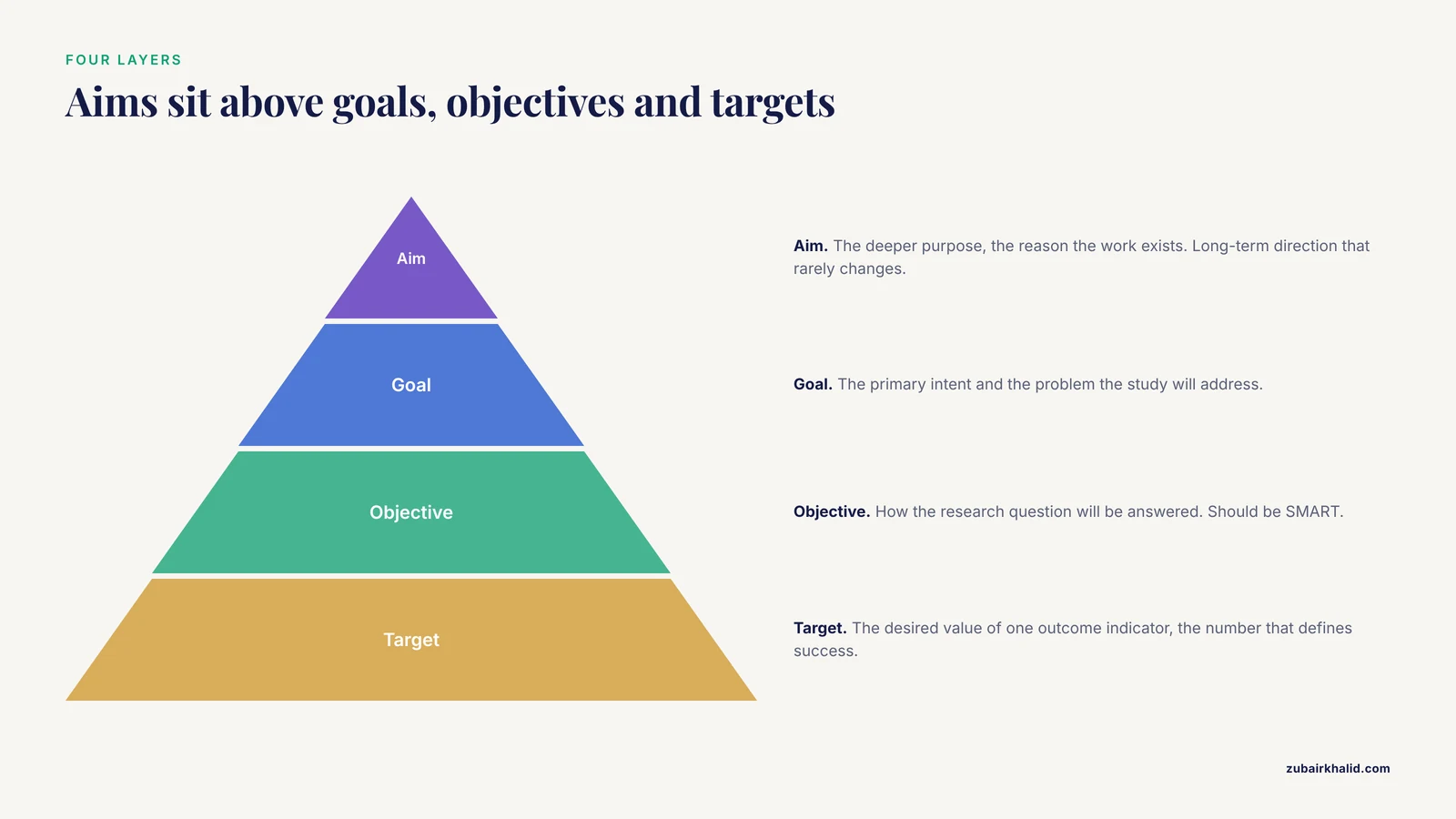
The vocabulary of research planning causes more confusion than any other part of the process. A recent review in Addictive Health analyzed how these terms are actually used across research projects and drew clean boundaries between them [1]. The distinctions matter because each statement answers a different question.
An aim expresses the deeper purpose of the work, the underlying reason for doing the study at all. Aims express ideals and long-term direction, and they rarely change even when tactics do. A goal outlines the primary intent and the problem the study will address. Objectives link intention to action by specifying exactly how the research question will be answered. Targets indicate the desired values of outcome indicators, the concrete numbers that define success [1].
A useful way to remember the hierarchy is that the apparent purpose of a study, expressed through its goals and objectives, addresses specific research questions, while the deeper purpose, the aim, explains why those questions are worth answering [1]. The review also states the quality bar for objectives: a strong objective should be SMART, meaning specific, measurable, achievable, relevant, and time-bound [1].
When people search for guidance on specific aims in clinical research, they are usually looking for help with the objective layer, the part that converts a question into a plan. The rest of this guide focuses there, but it keeps the aim layer visible, because an objective without an aim behind it reads as busywork to any experienced reviewer.
What a Specific Aim Looks Like in Published Research
Before building your own, study how working researchers phrase theirs. Published protocols and papers state their aims in their abstracts, and those statements follow recognizable patterns.
The D-SERPENT protocol, an implementation-effectiveness study of snakebite envenoming documentation in India, states its aim in a single sentence with three verbs and a bounded scope. The study aims to develop, validate, and implement a geography-specific syndromic coding and reporting system for snakebite envenoming, in order to improve standardized documentation, clinical management, surveillance, and epidemiological data quality in selected districts [2]. Notice the structure. Three verbs in a logical sequence, a named deliverable, a defined population and place, and a stated benefit. Nothing in the sentence promises what the design cannot deliver.
A diagnostic accuracy study of osteoporosis screening shows a two-aim pattern. The study aims to evaluate the relationship between CT-based Hounsfield Unit measurements at lumbar levels L1 through L4 and DXA T-scores, and to develop a nomogram for individualized osteoporosis risk prediction [3]. Aim one establishes a relationship. Aim two builds a tool that depends on aim one. Each aim has a measurable endpoint, correlation and cutoff analysis for the first, predictive performance with internal validation for the second.
Epidemiological studies phrase aims in terms of the estimates they will produce. A study within the Rotterdam Study states its aim as determining the prevalence and incidence of chronic axonal polyneuropathy in the general population, and it reports the deliverables as numbers, a prevalence of 6.0 percent among 1,894 eligible participants aged 50 and over, and an incidence rate of 3.8 per 1,000 person-years over a median follow-up of 7.4 years [4]. The aim promised estimable quantities, and the results delivered exactly those quantities.
Review articles use the same discipline with verbs suited to synthesis. A review of monoclonal gammopathy of clinical significance states four aims, to decode the mechanisms of paraprotein-mediated organ injury, to chart the diverse clinical spectrum, to integrate modern diagnostic approaches, and to propose a precision medicine roadmap for targeted therapy [5]. Each verb names a different intellectual operation, mechanism, mapping, integration, and proposal, and a reader can check the paper against each one.
Retrospective clinical studies bound their aims by population, timeframe, and site count. A multicenter study of secondary intestinal diffuse large B-cell lymphoma states its aim as systematically exploring the clinical characteristics and prognostic factors of the disease, then delivers it through 483 patients collected over an 11-year window across five tertiary centers [6]. The aim is honest about scale, which makes it credible.
The lesson from all four examples is the same. A well-formed specific aim names an action, a deliverable, a population, and a boundary, and it never promises more than the design can support.
From Broad Question to Specific Aims, Step by Step
This is the core workflow for moving from broad question to specific aims. Each step produces a written artifact you can show to a mentor, so progress is checkable at every stage.
Step 1. Write the broad question in one sentence
Start with the question that actually interests you, stated plainly and without methodological vocabulary. In clinical research, broad questions often sound like this. Why do patients with a treatable disease still die of it. Which patients benefit from a new diagnostic test. How can surveillance for an underreported condition be improved.
The snakebite work in India began from exactly this kind of question. India accounts for nearly half of global snakebite deaths, yet the disease remains underreported because documentation and phenotypic classification lack standardization [2]. That observation, a large burden with poor data, is a broad question in its natural state. It motivates the work but cannot be answered by a single study.
Similarly, the field of endometrial cancer classification moved from a broad question, how should endometrial cancer be classified, toward molecular subtyping, which then opened a set of narrower, answerable questions about whether each subtype can move from risk stratification into actual treatment decisions [7]. A broad question is not a failure. It is raw material.
Write your broad question down. Do not polish it yet. Its job is to anchor the aim statement you will write in Step 4.
Step 2. Decide whether the question needs new data
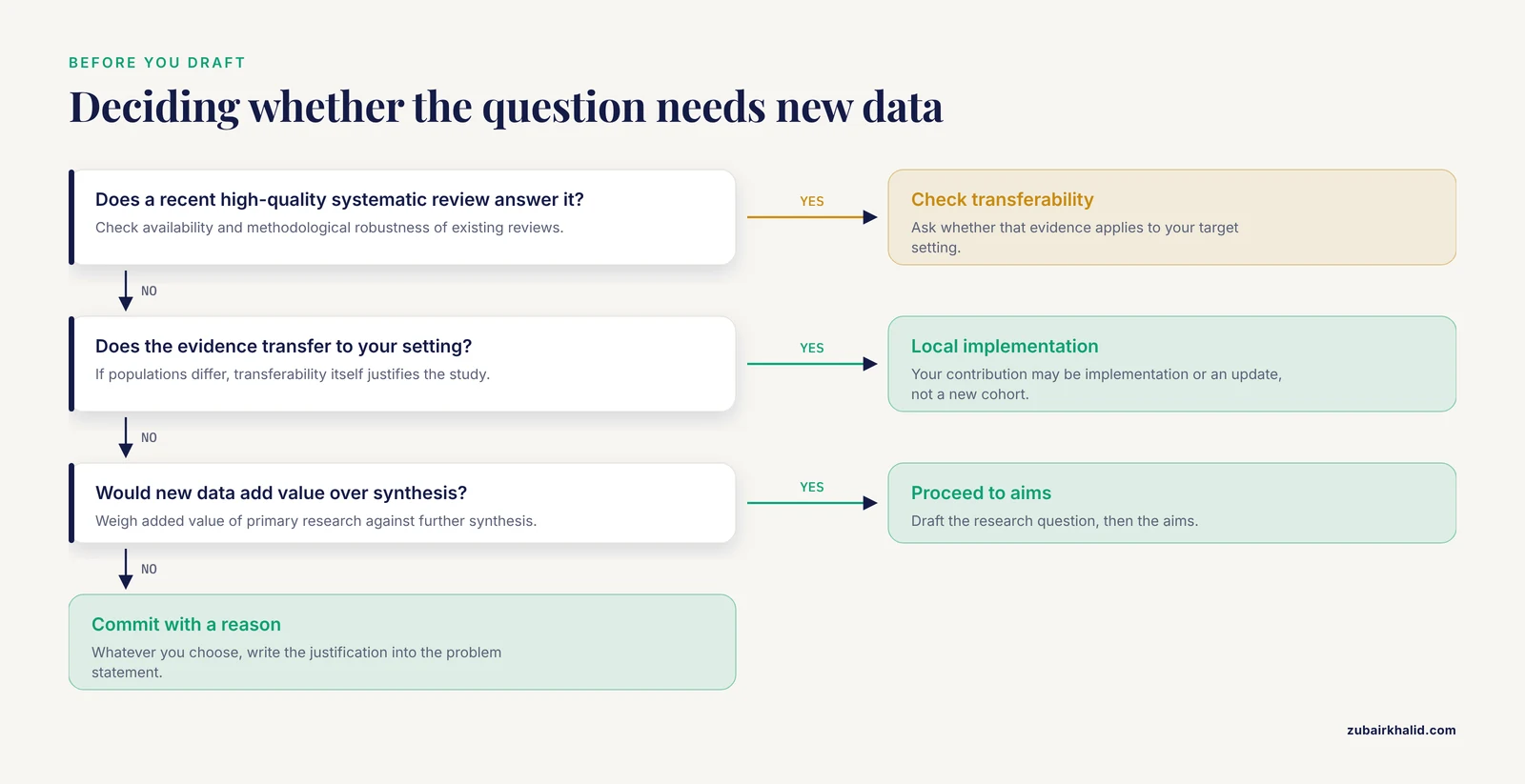
Before drafting aims, check whether the question is already answered. A decision framework published in the Indian Journal of Community Medicine proposes evaluating five domains before committing to new primary research. The domains are the contextual specificity of the research question, the availability of recent high-quality systematic reviews, the methodological robustness and consistency of existing primary studies, the transferability of available evidence to your target setting, and the potential added value of further synthesis compared with new primary research [8].
Run your question through those five checks. If a recent, methodologically sound review answers the question for your setting, your contribution may be local implementation or an update rather than a new cohort. If the existing evidence comes from populations unlike yours, transferability becomes the justification for your study, and you should say so in your problem statement. This step protects you from designing a study that a reviewer will reject as redundant.
Step 3. Convert the broad question into an answerable research question
This is where most projects succeed or fail. A research question is a narrow, empirically testable version of the broad question, and standard training in how to write a research question converges on two tools.
The first is the PICO framework. State the Population, the Intervention or Exposure, the Comparator, and the Outcome. The second is the FINER screen. A good question is Feasible, Interesting, Novel, Ethical, and Relevant.
Work an example from the endometrial cancer literature. The broad question, how do molecular subtypes affect endometrial cancer care, appears in reviews as a set of distinct focused questions, including whether therapy can be de-escalated for the POLE ultramutated subtype, whether immunotherapy has predictive value for the mismatch repair deficient subtype, whether therapy should be intensified for the p53 abnormal subtype, and how the no specific molecular profile subtype should be further risk stratified [7]. Each of those is a separate research question with its own population, exposure, and outcome. Notice that one broad question legitimately yields four questions, not one super-question. Trying to answer all four in a single study is a classic scoping error.
A well-formed research question for a biology project follows the same logic. A biology research question should name the organism or system, the variable being manipulated or measured, and the readout. "How do chloride transporters affect plants" is a topic. "Does loss of SLAC/SLAH family channel function alter stomatal closure under drought conditions in Arabidopsis" is a question, and the underlying biology of those transporter families, their gating mechanisms, ion selectivity, and roles in stomatal regulation, is documented in the plant transport literature [9].
Write your question in one sentence. If it contains the word "and" joining two independent ideas, split it into two questions.
Step 4. Draft the aim and the specific aims
Now convert the question into the standard aims architecture. Use this template, adapted to plain text so you can keep it in any editor.
Long-term goal: [the ideal state your line of work moves toward]
Problem statement: [the gap that blocks the goal, with evidence]
Broad question: [your one-sentence topic from Step 1]
Research question: [your PICO-structured question from Step 3]

Specific Aim 1: [Action verb] [deliverable] in [population] to [purpose].
    Working hypothesis: [predicted direction or null]
    Outcome measures: [the indicators that define success]
Specific Aim 2: [Action verb] [deliverable] in [population] to [purpose].
    Working hypothesis: ...
    Outcome measures: ...
Specific Aim 3: [Action verb] [deliverable] in [population] to [purpose].
    Working hypothesis: ...
    Outcome measures: ...

Expected outcomes and payoffs: [what the field can do with each result]
The long-term goal and problem statement carry the aim in the formal sense defined earlier, the underlying reason for the study [1]. The numbered aims carry the objectives, each specifying how a piece of the research question will be answered.
Three practical tips for this step. First, choose strong verbs and let them order the work. The snakebite protocol used develop, validate, and implement, which conveniently describes a build-test-deploy sequence [2]. The osteoporosis study used evaluate and develop, an analysis-tool sequence [3]. Second, make each aim dependent on at most the previous aim, never on all previous aims, so that a setback in one aim does not collapse the whole project. Third, write a working hypothesis for each aim even when the study is exploratory. A hypothesis states what result would count as informative, which forces you to define your outcome measures.
Step 5. Apply the SMART test to every objective
Take each specific aim and interrogate it against the five SMART criteria from the framework literature [1].
- Specific. Does the aim name one deliverable, one population, and one setting.
- Measurable. Can you state the outcome as a number, a classification, or a predefined qualitative finding.
- Achievable. Do you have the sample, the instruments, and the time.
- Relevant. Does completing this aim move the long-term goal forward.
- Time-bound. Can you attach a realistic duration.
Here is a worked check on a deliberately weak aim. Weak version, "We will study snakebite reporting." Run the test. It is not specific, no deliverable. Not measurable, no indicator. Not time-bound, no period. Now the repaired version, "Develop and validate a geography-specific syndromic coding and reporting system for snakebite envenoming in four study districts representing four geographical zones, and measure its effect on documentation quality within the study period." That repair is essentially what the D-SERPENT investigators wrote, with its four districts, its zone-based sampling, and its defined deliverable [2]. The SMART test is not an academic exercise. It is the difference between a wish and a plan.
Step 6. Match the design and the model to the question
Every specific aim carries an implicit design claim, and mismatches between question and design are a leading cause of rejected proposals. The comparative literature on research models makes the principle concrete. In autoimmune disease research, conventional murine models provide experimental control and mechanistic clarity, while humanized mouse models improve assessment of human immune responses and patient-specific biology, at the cost of incomplete immune reconstitution, graft-versus-host disease, donor variability, and higher expense. The published guidance is explicit that model selection should be tailored to the specific research question [10].
Apply the same reasoning to your own aims. If Aim 1 claims to establish a mechanistic pathway, a design with experimental control is appropriate. If Aim 3 claims to improve real-world documentation practices, as the snakebite study did, the design must reach into clinical workflows, which is why that protocol chose an implementation-effectiveness hybrid design across four districts [2]. If Aim 2 promises an individually applicable risk tool, the design must produce individual-level predictions and test them, which is what the osteoporosis nomogram study did with receiver operating characteristic analysis and bootstrap internal validation [3].
Step 7. Set boundaries and targets with the people who will use the work
Specific aims live or die on scope. Two published projects show how scope gets set in practice.
The Outdoor Air and Health Atlas project used a Delphi process, structured rounds of questionnaires with discussion between rounds, to decide which health outcomes and pollutants the atlas would include, starting from those with dose-response functions already available in the literature and then considering proposals for additions [11]. The methodological lesson is that boundary conditions, what is in and what is out, are decisions that benefit from structured stakeholder input, and that starting from established, usable methods keeps the scope realistic. The snakebite protocol used the same Delphi methodology, with clinicians, researchers, and public health specialists contributing to the coding system design [2].
Targets, in the formal sense, belong here too. A target is a desired value of an outcome indicator [1]. For a coding system, a target might be agreement between coders. For a surveillance dashboard, a target might be reporting completeness within a defined period. State your targets during planning, not after data collection, because a target chosen after seeing the data is no longer a test.
Step 8. Edit for length and balance
Most agencies and journals expect the aims statement to fit on a single page. A practical budget is three aims, each a few sentences long. Balance matters as much as brevity, because an aims page where one aim runs three times the length of the others signals uneven thinking.
A short script enforces the budget mechanically. Save your aims in a file called aims.txt with one line per aim, like this, adapted from the structure of the snakebite protocol [2].
Specific Aim 1: Determine whether the standardized coding system classifies snakebite cases consistently across districts.
Specific Aim 2: Validate the coded data against clinical outcomes for surveillance quality.
Specific Aim 3: Implement the system in four districts and measure reporting completeness over one year.
Then run this script, saved as aim_length_check.py.
# aim_length_check.py
# Counts words in each numbered aim line so you can balance effort across aims.
import re

text = open("aims.txt", encoding="utf-8").read()
aims = [line for line in text.splitlines()
        if re.match(r"^\s*Specific Aim \d", line)]

if not aims:
    print("No lines starting with 'Specific Aim N' found.")
else:
    for aim in aims:
        label, body = aim.split(":", 1)
        print(f"{label.strip()} -> {len(body.split())} words")
Run it from the directory containing both files.
python3 aim_length_check.pyExpected output for the file above.
Specific Aim 1 -> 12 words
Specific Aim 2 -> 10 words
Specific Aim 3 -> 13 words
The script reports an error message, No lines starting with 'Specific Aim N' found., if your file uses a different label format, which is itself a useful check that your numbering is consistent. A second check catches a subtler error, a missing colon. If an aim line has no colon, the script raises a ValueError: not enough values to unpack, which tells you the line is malformed before a reviewer ever sees it.
The final edit is a read-aloud test. If an aim sentence takes two breaths to say, it contains two aims. Split it.
Quick Reference Table
| Statement | Answers the question | Scope | Time horizon | Measurability |
|---|---|---|---|---|
| Aim | Why does this work exist | Whole program or line of research | Long term | Directional, aspirational |
| Goal | What does this study intend | Study level | Primary intent of the project | Broad |
| Objective | How will the question be answered | Step level | Near term | Should be SMART |
| Target | What value counts as success | Single outcome indicator | Defined endpoint | Numeric |
The SMART criteria apply primarily at the objective layer, with specificity, measurability, achievability, relevance, and time-bounding as the five checks [1].
Common Mistakes and Limitations
Restating the title as an aim. An aim that repeats the study title adds no information. If your aim reads like a compressed abstract title, rewrite it with a verb and a deliverable.
Confusing objectives with targets. These are adjacent layers with different jobs. Objectives specify how the question will be answered, targets specify the values that outcome indicators should reach [1]. A proposal that lists numeric targets where objectives belong reads as unfinished thinking, and a proposal that lists actions where targets belong leaves reviewers guessing what success means.
Promising what the design cannot deliver. A retrospective chart review cannot establish causation. A single-district pilot cannot establish national prevalence. Reviewers check the verb in each aim against the methods section. The osteoporosis study provides a good contrast, since its aims, a correlation with DXA T-scores and a nomogram with internal validation, stay within what a retrospective paired-imaging dataset of 148 patients can support [3].
Letting the method drive the question. Researchers who own a technique often reverse-engineer a question to fit it. The model-selection literature warns against this directly, since the correct model depends on the question, not the reverse, and every model carries limitations that must match what the question demands [10]. Write the question first, in Step 3, before any design commitment.
Letting claims drift from the aims. In longitudinal work, later records and later interpretations can reorganize earlier observations without independently confirming the explanations attached to them. An analysis of a decade of clinical records applied three audit dimensions to exactly this problem, provenance, inferential reach, and evidential independence, showing how a recurrent functional problem documented before a later diagnostic formulation was gradually assigned increasingly specific causal roles that the earlier data had not established [12]. The practical lesson for aims writing is to define, at the planning stage, which claims each aim supports and which it merely suggests. Otherwise interpretation creeps and the final paper claims more than the aims promised.
Overloading a single study. One broad question can decompose into four or more distinct research questions, as the endometrial cancer subtyping literature shows [7]. Attempting all of them in one project produces aims that share a topic but not a design, sample, or timeline. Choose the two or three your resources actually support and name the rest as future directions.
Skipping the redundancy check. A framework developed for low- and middle-income country settings emphasizes that the decision to generate new evidence should weigh the contextual specificity of the question, the availability and quality of existing reviews, and the added value of new data [8]. Skipping this check wastes resources and invites the most demoralizing reviewer comment of all, that the study has already been done.
A note on individual cases. The frameworks in this guide govern study design, not the care of any individual patient, and clinical decisions for a specific patient require the treating clinician's judgment.
Frequently Asked Questions
What is the difference between a specific aim and a hypothesis?
A specific aim states what you will do, and a hypothesis states what you expect to find. In the template above, each aim carries its own working hypothesis. An aim without a hypothesis is often exploratory, which is acceptable if you say so plainly.
How many specific aims should a study have?
Three is the practical convention, because it fits a one-page statement and allows a build-test-extend logic. Two aims work well for focused diagnostic or validation studies, such as the evaluate-then-build structure used in the osteoporosis nomogram study [3].
What makes a research question answerable?
A research question is answerable when it names a defined population, a defined exposure or intervention, a comparator, and a measurable outcome, and when the data needed to answer it can realistically be obtained. The PICO structure and the FINER screen are the standard tools for testing this.
How do I know if my aims are too broad?
Run the SMART test. If an aim fails the specificity check, meaning it names several deliverables, several populations, or no defined setting, it is too broad [1]. Splitting it usually reveals two or more distinct projects.
Should aims change after data collection starts?
Minor refinements are normal, and honest protocols describe them. Wholesale changes to aims after data collection begins are a serious problem, because they sever the link between the question you posed and the evidence you gathered. If the question itself turns out to be unanswerable, report that finding.
How do specific aims differ between a grant application and a published paper?
A grant application states aims prospectively, with hypotheses and planned outcome measures, because nothing has happened yet. A published paper restates the aims in its abstract and then reports how each was met. The retrospective lymphoma study is a typical example, with the aims stated up front and the 483-patient, 11-year, five-center dataset presented as the means of meeting them [6].
What is the SMART test and how do I apply it?
SMART stands for specific, measurable, achievable, relevant, and time-bound, and it is the published quality standard for research objectives [1]. Apply it by asking five questions of each aim, one per criterion, and rewriting the aim until all five answers are yes.
How do aims relate to objectives and goals?
Aims sit above goals, objectives, and targets in the hierarchy of purpose statements. The aim gives the underlying reason for the work, the goal states the primary intent and problem, the objectives specify how the research question will be answered, and the targets give the numeric values that define success [1]. A complete proposal uses all four layers deliberately.
Sources
- The Purpose of Research: Clarifying Aims, Goals, Objectives, and Targets.
- Development, Validation, and Implementation of a Geography-Specific Syndromic Coding and Reporting System for Snakebite Envenoming (D-SERPENT): Protocol for an Implementation-Effectiveness Hybrid Study.
- Routine CT-based hounsfield unit measurements as predictors of osteoporosis: A comparative analysis with DXA and development of a nomogram for clinical application.
- Age- and Sex-Specific Prevalence and Incidence of Chronic Axonal Polyneuropathy in the General Population.
- Monoclonal gammopathy of clinical significance: the pathogenic paraprotein and a precision medicine roadmap.
- Clinical characteristics and prognosis analysis of secondary intestinal diffuse large B-cell lymphoma: a multi-center retrospective study over a decade.
- Endometrial cancer molecular classification: research advances and clinical application.
- Decision Framework for Prioritizing Systematic Reviews Versus Primary/translational Research in Low- and Middle-income Countries.
- Research Progress on Chloride Channel- and Transporter- Related Gene Families in Plants.
- Murine and Humanized Mouse Models in Autoimmune Disease Research and Therapeutics Development.
- The co-creation process of the “Outdoor Air and Health Atlas” project: A tool to support decisions and research.
- The History of a Phenomenon and the History of Its Explanations: Provenance, Inferential Reach and Evidential Independence in Longitudinal Clinical Records.