How to Write SMART Objectives for Your Research Project Plan
By Dr. Zubair Khalid, DVM, MS, PhD ·

By the end of this article you will be able to turn a loose research idea into a set of SMART objectives, place those objectives inside a complete research project plan, and check each objective against the five SMART criteria before anyone else reads it. You will need your draft research question, your project timeline or funding deadlines, and either a text editor or a spreadsheet for the template in the walkthrough. Nothing else is required.
SMART stands for Specific, Measurable, Achievable, Relevant, and Time-bound. The framework is widely used in research training programs, quality improvement projects, and large cohort studies to convert broad intentions into statements that can be planned, monitored, and evaluated [1][2][3].
What SMART Objectives Are in a Research Context
A research objective is a statement that links your intention to action by specifying how you will answer your research question [4]. The SMART label adds five tests to that statement:
- Specific. The objective names one concrete activity or outcome, not a broad theme.
- Measurable. You can count, score, or otherwise verify whether you met it.
- Achievable. The objective fits your resources, skills, and timeline.
- Relevant. The objective connects directly to your research question and to the larger goal of the study.
- Time-bound. The objective carries a deadline or a defined period.
Recent work on clarifying research purpose describes a strong objective as one that is specific, measurable, achievable, relevant, and time-bound, and argues that clear articulation of purpose improves the overall quality of research and the translation of findings into practice [4]. A monitoring framework built for a large stroke cohort study used the same SMART criteria to refine checklist items before deriving Key Performance Indicators for study oversight [2].
The framework is not academic decoration. In a radiology research mentorship program, trainees completed SMART Goal worksheets and met individually with mentors to refine objectives, identify barriers, and create action plans. Nineteen of 22 invited trainees, 86 percent, completed the process, and participants produced 45 accepted abstracts or conference presentations, 30 manuscripts or publications, and 7 successful grants, with measured gains in research confidence [1]. Structured objectives, in other words, are a working tool for research project management, not a formality.
Aims, Goals, Objectives, and Targets: Getting the Hierarchy Right
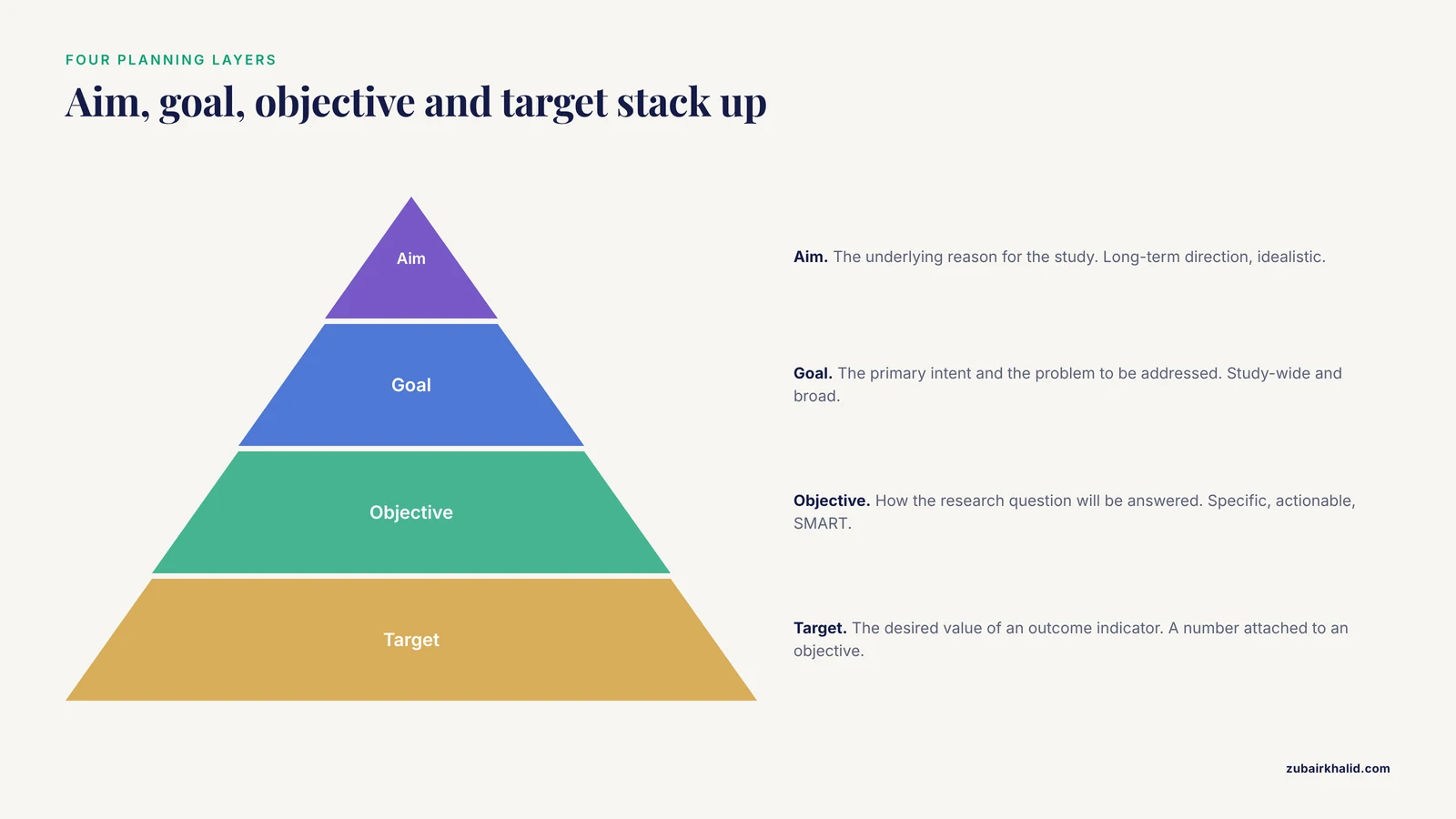
The most common source of confusion in early planning is mixing up four related terms. A recent review in the field clarifies the hierarchy [4]:
| Term | What it expresses | Scope and timeframe | Example phrasing |
|---|---|---|---|
| , - | , - | , - | , - |
| Aim | The underlying reason for doing the study | Long-term direction, idealistic | "To improve early detection of diabetic kidney disease in primary care" |
| Goal | The primary intent and the problem to be addressed | Study-wide, broad | "To determine whether a screening protocol changes detection rates" |
| Objective | How the research question will be answered | Specific, actionable, SMART | "To measure albumin-to-creatinine ratio screening completion before and after protocol introduction" |
| Target | The desired value of an outcome indicator | A number attached to an objective | "Screening completion rises from 40 percent to 70 percent within 12 months" |
The apparent purpose of a study, expressed through objectives and goals, addresses the research questions. The deeper purpose, the aim, explains why anyone should care [4]. When you write objectives, keep them subordinate to your goal and aligned with your aim. If an objective does not visibly help answer the research question, cut it or move it.
Targets deserve special attention because they are where measurability lives. A quality improvement project in palliative oncology set an objective to raise the referral rate of newly registered Stage IV cancer patients to the specialist palliative care team from 7.5 percent to 25 percent within 6 months [3]. That single sentence contains a baseline, a target value, and a deadline. It is a model of how the four layers stack together.
SMART Objectives Research Project: Step by Step
This walkthrough uses a worked example. Suppose you are a graduate student planning a 12-month project on medication adherence in older adults. Your draft idea reads: "I want to study why older patients do not take their medications." Follow the steps below.
Step 1. Write down your research question and goal
State the research question in one sentence. For the example: "Which barriers to medication adherence are most frequently reported by adults over 65 in a single primary care clinic?" Your goal sits one level above: "To identify the primary modifiable barriers to medication adherence in this population" [4].
Step 2. Break the goal into discrete pieces of work
Each piece of work that produces evidence or a deliverable becomes a candidate objective. For the example, three candidates emerge naturally:
- Conduct and transcribe interviews with patients about adherence barriers.
- Code and analyze the interview data to rank barrier themes.
- Produce a report and a manuscript describing the ranked barriers.
Step 3. Force each candidate through the five SMART tests
Take the first candidate and interrogate it.
Specific. "Study adherence barriers" fails. Name the population, the setting, and the activity: "Conduct semistructured interviews with 20 adults over 65 recruited from the clinic."
Measurable. Twenty completed and transcribed interviews is countable. Define what counts as complete: an interview is complete when the participant finishes all questions on the topic guide and the recording is transcribed.
Achievable. Check the arithmetic against your real capacity. If you can schedule two interviews per week and transcription takes three days per interview, 20 interviews span roughly 15 to 20 weeks. If your project gives you 12 months in total, this fits. If you had proposed 60 interviews, it would not.
Relevant. Interviews about barriers answer your research question directly. A side activity, such as building a survey for clinic staff, is relevant only if it serves the same question or a stated secondary question.
Time-bound. Attach a deadline: "by the end of month 5."
Step 4. Write the objective in a fixed sentence pattern
Use the pattern: To [action verb] [measurable output] in/with [population or system] by [deadline]. Applied to the example:
Objective 1: To conduct and transcribe semistructured interviews on
medication adherence barriers with 20 adults over 65 recruited from
the partner primary care clinic by the end of month 5.

Objective 2: To code all 20 transcripts using thematic analysis and
produce a ranked list of the top 5 barrier themes by the end of month 8.

Objective 3: To submit a manuscript describing the ranked barriers to
a peer-reviewed journal by the end of month 12.
Notice that each objective contains a number (20 interviews, top 5 themes, 1 submission) and a date. That is what measurability and time-binding look like in practice.
Step 5. Convert objectives into targets where possible
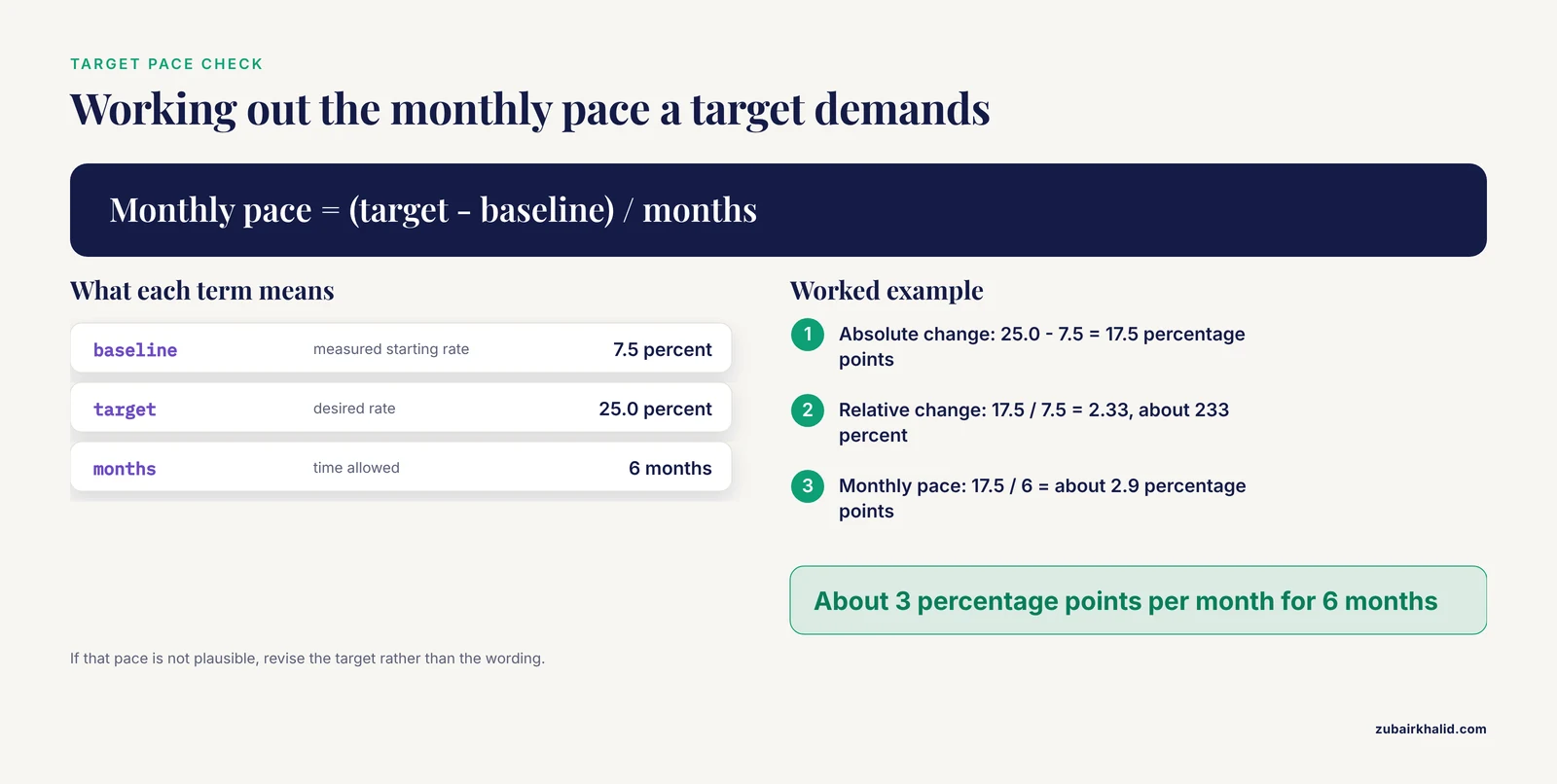
If you have baseline data, attach a target value. The palliative care project did exactly this, moving from a measured baseline referral rate of 7.5 percent to an explicit target of 25 percent within 6 months [3]. You can compute how demanding a target is with a simple calculation:
Baseline rate:      7.5 percent
Target rate:        25.0 percent
Absolute change:    25.0 - 7.5 = 17.5 percentage points
Relative change:    (25.0 - 7.5) / 7.5 = 2.33, or about a 233 percent increase
Time allowed:       6 months
Required monthly    17.5 / 6 = about 2.9 percentage points per month
pace:
Expected output: a single line you can defend in a meeting, such as "the objective requires roughly a 3 percentage point gain in referral rate every month for 6 months." If that pace is not plausible given your intervention, the target, not the wording, needs revision. This check catches overambitious targets before they fail quietly.
Step 6. Attach each objective to milestones and, where appropriate, Key Performance Indicators
In the stroke cohort monitoring framework, study activities were disaggregated into critical sub-processes, prioritized by consensus, refined with SMART criteria, and finally converted into 16 Key Performance Indicators drawn from 10 checklists covering 89 activities [2]. You do not need that scale of machinery, but the logic scales down well. Each objective should map to at least one milestone date on your Gantt chart and, if your project involves ongoing processes, one indicator you can count at regular intervals.
Step 7. Review the objectives with someone who will challenge them
In the radiology mentorship program, the refinement step happened in individual meetings with mentors, where objectives were revised, barriers were identified, and action plans were written [1]. Book a 30-minute review with your supervisor, mentor, or collaborator. Ask them to mark each objective against the five criteria and to name one barrier for each. Rewrite before you commit the plan.
A Reusable Research Project Plan Template
The following template is plain text you can paste into any editor, version control system, or shared document. Fill every bracket.
# Research Project Plan

## Working title
[One line]

## Aim (the underlying reason)
[One sentence, long-term direction]

## Goal (the primary intent)
[One sentence, problem to be addressed]

## Research question(s)
RQ1: [One sentence]
RQ2: [Optional]

## SMART objectives
Objective 1: To [action verb] [measurable output] in [population/system]
by [date]. Linked RQ: [RQ number]. Milestone date: [date].
Objective 2: To [action verb] [measurable output] in [population/system]
by [date]. Linked RQ: [RQ number]. Milestone date: [date].
Objective 3: [Same pattern]

## Targets (where baseline data exist)
T1: Objective 1, baseline = [value], target = [value], deadline = [date]
T2: [Same pattern]

## Timeline (months 1-12)
M1-M2:  [Activity for Objective 1]
M3-M5:  [Activity for Objective 1 continued, Objective 2 starts]
M6-M8:  [Activity for Objective 2]
M9-M11: [Analysis and writing]
M12:    [Submission, closeout, archive]

## Monitoring
Checklist item: [What you will check, how often, who checks]
KPI: [Countable indicator, e.g., number of participants enrolled per month]

## Barriers and action plans
Barrier 1: [Description] -> Action: [Specific response] Owner: [Name]
Barrier 2: [Description] -> Action: [Specific response] Owner: [Name]

## Stakeholders and engagement
Stakeholder: [Group] Engagement type: [Inform / Consult / Involve / Collaborate]
Activity: [What you will do with them and when]

## Deliverables
D1: [Report, dataset, app, manuscript] Due: [date]
A completed version of the objectives block for the worked example would show three objectives, each with a linked research question, a milestone date, and a named deliverable. When every bracket is filled, you have a one-page plan that a supervisor, ethics committee, or funding reviewer can scan in two minutes.
Key Options and Formulas at a Glance
| SMART component | Core question | Weak phrasing | Strong phrasing |
|---|---|---|---|
| , - | , - | , - | , - |
| Specific | What exactly will be done, to whom or what? | "Explore adherence" | "Interview 20 adults over 65 about adherence barriers" |
| Measurable | What number or artifact proves completion? | "Understand barriers" | "A ranked list of the top 5 barrier themes from coded transcripts" |
| Achievable | Does capacity match the workload? | "Survey all patients nationally" | "Survey patients at 1 clinic over 10 weeks at 2 interviews per week" |
| Relevant | Which research question does this serve? | Unlinked activity | "Linked to RQ1, feeds the ranked barrier analysis" |
| Time-bound | When is it due? | "Eventually" | "By the end of month 5" |
| Target (optional layer) | What value counts as success? | "Improve referrals" | "Referral rate from 7.5 to 25 percent within 6 months" [3] |
SMART Objectives Research Project Tips from Real Studies
Keep the sentence pattern consistent. Every objective in your plan should follow the same grammatical shape. Consistency lets a reader check specificity and measurability by eye.
Write objectives that produce artifacts, not feelings. A transcribed dataset, a ranked theme list, a submitted manuscript, or a working prototype are all verifiable artifacts. A pilot nursing innovation course tied its evaluation to documented project outputs alongside measured score changes, with creativity rising from 20.50 to 23.63 on the study scale (mean difference 3.13, 95 percent CI 1.69 to 4.58, p < 0.001) and self-efficacy rising from 38.78 to 42.48 [5]. The lesson for planning is that scores and outputs together give you two independent ways to verify an objective.
Plan engagement objectives, not just analysis objectives. A retrospective analysis of the Horizon Europe KijaniSpace project classified stakeholder engagement activities into four categories drawn from the IAP2 Spectrum of Public Participation: Inform, Consult, Involve, and Collaborate [6]. If your project depends on communities, clinics, or industry partners, write a SMART objective for each engagement category you plan to use, with dates and named formats such as workshops or advisory board meetings. A two-year community partnership project on Indigenous data sovereignty structured its work around a Community Advisory Board, public meetings, and iterative prototyping, which shows how engagement objectives can carry deadlines and deliverables like any technical objective [7].
Build the monitoring plan from the objectives. The stroke cohort project derived its monitoring checklists and Key Performance Indicators directly from SMART-refined process items [2]. Write a one-line monitoring check under each objective at the same time you write the objective. Later retrofitting is where monitoring plans collapse.
Use structured problem-solving methods when the objective is an improvement. The palliative care quality improvement project paired its SMART goal with an A3-based Plan-Do-Study-Act cycle, a fishbone diagram for root-cause analysis, and a run chart for ongoing measurement [3]. If your objective is to change a process rather than describe a phenomenon, borrow these tools.
Scope objectives conservatively for pilot studies. A protocol for evaluating a prevention program in adolescents with type 1 diabetes defined a pilot of 24 participants organized into four cohorts of 6, with an explicit feasibility and acceptability focus rather than a claim of definitive efficacy [8]. Pilot objectives should promise feasibility data and preliminary estimates, not definitive conclusions.
For agenda-setting or consensus work, define the process as the objective. A Canadian initiative used a modified Delphi approach with 79 representatives to identify five research priorities for digital workflows in prosthetics and orthotics [9]. If your deliverable is a set of priorities or recommendations, count the participants, the rounds, and the final number of priorities.
Common Mistakes and Limitations
Mistake 1: Confusing the aim with the objective. "To improve medication adherence in older adults" is an aim. It expresses long-term direction and cannot be completed by one study team in one project [4]. Objectives sit below it and state the concrete work. If a supervisor can ask "how, exactly, and by when?" and your objective has no answer, you have written an aim.
Mistake 2: Writing objectives with no number anywhere. An objective with no countable output cannot be verified. Fix this by naming the artifact (transcripts, a dataset, a submission, a prototype) and, where possible, a quantity or a target value.
Mistake 3: Omitting the deadline. A time-bound objective requires a calendar date or a month number relative to the project start. Objectives without deadlines drift indefinitely and cannot drive a schedule.
Mistake 4: Setting too many objectives. Three to five objectives cover most funded projects of one to three years. Each additional objective multiplies your milestones, monitoring items, and reporting burden. If you have ten objectives, you have probably written a work plan and an aim in disguise.
Mistake 5: Setting targets without baselines or capacity checks. A target is only meaningful when you know the starting value and the plausible rate of change. The 7.5 percent to 25 percent referral target in the palliative care project worked because the baseline had been measured before the objective was written [3]. Guessing a target number is a common error that produces either trivial goals or impossible ones.
Mistake 6: Treating objectives as fixed after sign-off. Objectives get refined when barriers surface. The mentorship program explicitly built barrier identification and action planning into the SMART goal process [1]. Schedule a mid-project review date in your plan and permit yourself to revise targets with documented reasons.
Mistake 7: Planning activities without a unifying framework. In the KijaniSpace case, engagement activities were planned as operational tasks but were not originally conceptualized as components of a unified framework, which complicated later analysis of what the engagement achieved [6]. The fix is structural: assign every activity to an objective at planning time.
Limitation to state honestly. SMART objectives measure whether planned work happened. They do not by themselves guarantee that the underlying science is sound or that findings generalize. Pair objective tracking with scientific review, and state in your plan that individual results and clinical or operational decisions require appropriate expert oversight.
How to Check Your Objectives Are Right
Run this five-question test on every objective before finalizing the plan. For each question, the expected answer is a specific sentence, not a shrug.
1. SPECIFIC     Could a stranger describe the task from this sentence alone?
2. MEASURABLE   What exact artifact or number will exist when it is done?
3. ACHIEVABLE   Does my capacity calculation show it fits the timeline?
4. RELEVANT     Which research question, aim, or goal does it serve?
5. TIME-BOUND   What calendar date or project month is the deadline?
A second check: read your objectives in order and confirm they form a sequence that, if all completed, would answer your research question. If a gap remains between the last objective and the research question, you are missing an objective. If an objective could be deleted without leaving a gap, it is not relevant.
Frequently Asked Questions
What does SMART stand for in a research project?
SMART stands for Specific, Measurable, Achievable, Relevant, and Time-bound. The criteria turn a broad research intention into an objective you can plan, monitor, and verify.
How many objectives should a research project have?
Most projects of one to three years need three to five objectives. More than that usually means you have written a task list rather than objectives, and your monitoring burden grows with each addition.
What is the difference between an aim and an objective?
The aim expresses the underlying reason for the study and its long-term direction, while objectives specify how the research question will be answered through concrete, deadline-bound work [4]. Aims are idealistic, objectives are actionable.
Can research objectives change during a project?
Yes, and planning for revision is good practice. Programs that use SMART goals typically pair them with barrier identification and action planning, which means objectives are revisited as real constraints emerge [1]. Document any change and the reason for it.
How do I make a qualitative study objective measurable?
Count things that exist regardless of interpretation: the number of interviews conducted and transcribed, the number of transcripts coded, the number of themes ranked, and the date of the completed report. The interpretive findings stay qualitative, but the completion criteria stay numeric.
Do I need SMART objectives for a grant proposal?
Reviewers expect them. Objectives that carry baselines, targets, and deadlines, in the pattern demonstrated in quality improvement literature [3], let a reviewer judge feasibility directly. Vague objectives are a common reason proposals score poorly on approach.
How long should the time frame be for an objective?
Match the time frame to your shortest meaningful work cycle, typically two weeks to six months per objective. Long objectives should be broken into sub-objectives so you can detect slippage early.
What tools can I use to track SMART objectives?
A versioned text template, a spreadsheet with one row per objective, or a project board with milestone dates all work. The essential feature is a place where each objective, its target value, its deadline, and its monitoring check appear together and can be updated visibly.
Sources
- Implementing SMART Goals in a Radiology Research Mentorship Program: A Single-Institution Pilot Study.
- Operationalizing independent oversight in large-scale public health cohorts: Monitoring protocol for the NIMHANS-NH-SKAN Stroke project.
- Palliative Care Quality Improvement Project: Integrating Palliative Care into Oncology.
- The Purpose of Research: Clarifying Aims, Goals, Objectives, and Targets.
- A BOPPPS-PBL Nursing Innovation Course for Newly Recruited Nurses: A Single-Group Quantitative Pilot Evaluation of Creativity, Self-Efficacy and 1-Year Project Outputs.
- Retrospective Analysis of Stakeholder Engagement Activities in a Horizon Europe Multi-Actor Project: Evidence from KijaniSpace.
- Development of a Blockchain-Based Platform to Enable Indigenous Data Sovereignty and Shared Research Participation With Indigenous Communities: Technology Prototyping and Community Engagement Study.
- Evaluating the implementation of the Diabetes Body Project in a clinical cohort of Australian adolescents with type 1 diabetes.
- Developing a research agenda in digital workflows for the fabrication of prostheses and orthoses.