Significance vs. Innovation: What Reviewers Really Mean
By Dr. Zubair Khalid, DVM, MS, PhD ·

Significance asks whether your project will matter. Innovation asks whether your approach departs from the way the field already works. Reviewers treat these as two separate questions, score them separately, and fund the proposal only when both answers are strong.
The rule of thumb is simple. Significance is the destination. Innovation is the route. A project can promise an important destination by a well-traveled road, or an exciting new road to a place nobody wants to go. Reviewers reject both. The difference between significance and innovation in grant proposal review is one of the most misunderstood points in early-career grant writing, and misunderstanding it costs real money. This article defines each criterion on its own terms, puts them side by side, walks through worked examples from funded and studied projects, and lists the mistakes reviewers see most often.
What Reviewers Mean by Significance
Significance, in grant review, is a judgment about consequences. If this project succeeds, what changes? Who uses the result, what decision does it alter, and what does the field gain that it does not already have? A significant project addresses an important problem or a critical barrier to progress, and its completion moves knowledge or practice in a way someone can name.
Reviewers evaluate significance at three levels, and a proposal needs all three.
- The problem matters. The condition, process, or question affects health, scientific understanding, or practice at a scale the reviewer recognizes. Vague statements about importance do not work here. Concrete statements about affected populations, blocked progress, or costly failures do.
- The gap is real. The project fills a hole that the field has actually left open. Reviewers check your gap claim against their own knowledge of the literature. If they can name two recent papers that already closed the gap, the significance claim collapses.
- The results will be used. The expected outcomes change how people think, diagnose, treat, model, or regulate something. A project whose endpoint is "more data on X" reads as significant only if someone downstream clearly needs that data.
Notice what is absent from that list. Significance does not require novelty. A rigorous replication, a definitive trial of an established intervention in an underserved population, or a careful validation of a widely used method can all score highly on significance. Reviewers reward importance, not fashion.
Funders behave like investors, and the research on how health care executives actually commit money to a project shows what that means in practice. In a qualitative study of executives who chose to fund a pilot of Project ECHO, a telementoring model used to integrate pediatric, education, and primary care services in Queensland, Australia, five themes drove the investment decision: personal experiences, benefits, risks, partnerships, and timing [1]. The executives weighed the promised benefits against the risks, judged whether the team and partnerships could sustain the project, and asked whether the timing was right. Those are significance judgments. They are concrete, skeptical, and grounded in what the investment will change, and reviewers on a study section run the same calculation with your aims.
The Questions Reviewers Write in the Margins
When a reviewer drafts the significance paragraph of a critique, the underlying questions look like this.
- What problem does this project solve, stated in one sentence?
- Who has this problem, and how large is the affected population or knowledge gap?
- What happens if nobody funds this work?
- If the aims are achieved, what specific practice, model, or understanding changes?
- Does the proposal overstate the problem or understate prior work?
If your significance section answers those five questions in order, the reviewer has almost nothing to criticize. If it answers none of them, the reviewer writes "importance not well justified," and that phrase is very hard to recover from.
What Reviewers Mean by Innovation
Innovation, in grant review, is a judgment about departure. Does the project employ new methods, apply an existing method to a new problem, refine an existing approach in a way that changes its power, or challenge the assumptions the field currently works within? Reviewers look for a genuine break from standard practice, not polish on the standard practice.
Innovation takes several recognizable forms, and it helps to know which form you are claiming.
- Conceptual innovation. The project challenges an assumption the field treats as settled, or reframes the problem in a way that opens new experiments.
- Methodological innovation. The project introduces a technique, instrument, analysis, or design that the field does not currently use for this question.
- Translational or adaptational innovation. The project moves an existing tool into a setting where it has not been applied, or combines two established tools in a way no one has combined them.
All three count. The failure mode is claiming innovation when the actual departure is small. Reviewers read hundreds of proposals and they calibrate quickly.
What Innovation Is Not
Three claims read as inflation rather than innovation, and each one damages credibility.
- New to you is not new. The first use of a method in your laboratory is training, not a contribution to the field.
- A new label is not a new approach. Renaming an established workflow does not change what reviewers see when they read the methods.
- More of the same, faster or bigger, is usually incremental. Higher resolution, larger sample size, or added time points can support significance, but they rarely carry an innovation claim on their own.
There is also a subtler trap. Innovation without a demonstrated payoff reads as risk without reward. Reviewers ask not just "is this new" but "what does the novelty buy us." A proposal that cannot connect its novel element to a concrete expected advance often earns comments like "innovative but preliminary" or "interesting but why fund this over a proven approach."
Significance vs. Innovation: The Side-by-Side Comparison
The table below captures the core of the significance vs. innovation distinction as reviewers actually apply it.
| Criterion | Significance | Innovation |
|---|---|---|
| Core question | Will the results matter to the field or to practice? | Does the approach depart from current practice? |
| Reviewer's silent question | If this works, so what? | Why is this the right new way, and not just a new way? |
| Evidence that convinces | Problem scale, documented gap, preliminary data, named end users of the results | Prior methods and their limits, a clear description of the departure, a rationale for why the departure solves the limits |
| Where it lives in the proposal | Background, gap statement, expected outcomes, impact statement | Approach section, methods, experimental design, rationale for alternatives |
| Common failure mode | Importance asserted without evidence, or a gap the literature has already closed | Novelty claimed for renaming, resizing, or recombining without a functional change |
| Relationship to risk | Significant projects can be low risk | Innovative projects usually carry higher technical risk, which the approach section must manage |
| Quick self-test | Delete the project and ask what the field loses | Swap in the standard method and ask what the project loses |
The two criteria form independent axes, which produces four combinations reviewers see constantly.
- Strong significance, strong innovation. The rare and fundable case. An important problem approached by a method that genuinely departs from standard practice, with the departure tied directly to the expected advance.
- Strong significance, weak innovation. An important problem attacked with conventional tools. Fundable when the contribution is scale, population, rigor, or translation, and the proposal says so honestly instead of manufacturing fake novelty.
- Weak significance, strong innovation. A clever method in search of a problem. This is the most common pattern in rejected proposals from technically strong applicants, and it is the pattern reviewers describe with the phrase "solving a problem nobody has."
- Weak significance, weak innovation. Not competitive anywhere, and usually a sign the aims need to be rebuilt rather than reworded.
Why the Distinction Shapes Grant Proposal Planning
The practical consequence for grant proposal planning is that the two criteria live in different sections of the application, and you should map them before drafting anything.
Significance evidence belongs in the background and significance section. That section builds the case in sequence: the problem, its scale, what has been tried, why the current approaches fall short, and what changes if your aims succeed. The expected outcomes and impact statements then close the loop back to the problem.
Innovation evidence belongs mostly in the approach section. There you name the standard method, state its specific limitation for this question, and show how your design removes that limitation. A brief innovation summary, often a dedicated subsection near the front of the research strategy, collects those departures in one place so a skimming reviewer can find them.
Planning the two arguments separately exposes a common structural error. Many drafters write one long paragraph that tries to do both jobs at once, opening with the importance of the disease and sliding into the novelty of the technique without a hinge between them. Reviewers following the scored criteria cannot find either argument cleanly. In grant proposal planning, budget time to write the significance argument as a standalone case, then write the innovation argument as a standalone case, then check that each one survives if a reviewer reads only that paragraph.
A final planning point concerns burden of proof. Significance claims lean on literature and existing evidence, which means they can be substantiated before you ever collect new data. Innovation claims often lean on feasibility, which means your preliminary data usually serve the approach and innovation arguments, not the significance argument. Applicants who wait for preliminary data to prove importance have inverted the logic, and reviewers notice.
Worked Examples From Health Services Research
Two studied cases show the two criteria operating in the real world, one where innovation had to earn significance and one where significance had to earn investment.
An Innovative Role That Had to Define Its Significance
The clinical nurse leader (CNL) role, introduced in 2003 by the American Association of Colleges of Nursing, is a well-documented case of an innovation whose significance case lagged behind its novelty. A narrative review of the CNL evidence base identified 25 implementation reports, one job analysis, seven qualitative or survey studies, and three quantitative studies. Every implementation report and study in that literature described improved care quality after the role was introduced into a care delivery microsystem [2].
On the surface, that is a strong record. The role was explicitly framed as an innovative new nursing role, and the early evidence consistently pointed in a favorable direction. Yet the same review concluded that CNLs were still struggling to define the role, both to themselves and to the wider health care system, and that the field needed further research to delineate the CNL role in practice, define the care delivery structures that influence CNL integration, and develop indicators capable of capturing CNL-specific contributions to improved care quality [2].
The lesson for grant writers is direct. An innovation that cannot articulate what it contributes beyond existing alternatives will stall, even with encouraging outcomes, because funders cannot tell the improved result apart from what current practice already delivers. The CNL literature did not lack positive findings. It lacked a differentiated significance argument, the specific indicators that would show the new role, rather than general care quality momentum, produced the gain. In proposal terms, a reviewer reading a CNL-style application would ask exactly that question. If your innovation improves an outcome, name the mechanism and the measure that isolates your contribution from what the standard approach already achieves.
A Significant Pilot That Had to Earn Investment Confidence
The Queensland Project ECHO pilot shows the mirror image, a project whose funding case was built almost entirely on significance reasoning. A project team secured grant funding to pilot Project ECHO, a telementoring model, to drive integration across pediatric, education, and primary care services. Researchers then interviewed the healthcare executives who had decided to commit organizational resources to the pilot, using a phenomenological approach with semi-structured interviews and project document analysis, and identified five themes in the decision process: personal experiences, benefits, risks, partnerships, and timing [1].
The same study found that the intrapreneurial character of the project team, meaning the internal team acting like entrepreneurs within the organization, positively influenced investment confidence when the team framed the proposal around financial sustainability, ongoing improvement, and scalability [1]. In other words, the decision-makers were not won over by the technical novelty of telementoring. Project ECHO was an established model being applied in a new organizational setting, which is adaptational innovation at most. They were won over by a significance argument assembled from concrete parts, credible benefits, acknowledged and managed risks, committed partners, favorable timing, and a team that could sustain and scale the result.
For a grant writer, this case shows what a mature significance argument looks like when a real funder examines it. Benefits stated in operational terms, risks named and mitigated, partnerships evidenced, and a credible path from pilot to sustained practice. Reviewers applying a significance criterion reward exactly that structure, and penalize proposals that assert importance in the abstract while leaving risks and sustainability unaddressed.
When to Use Significance, and When to Lead With Innovation
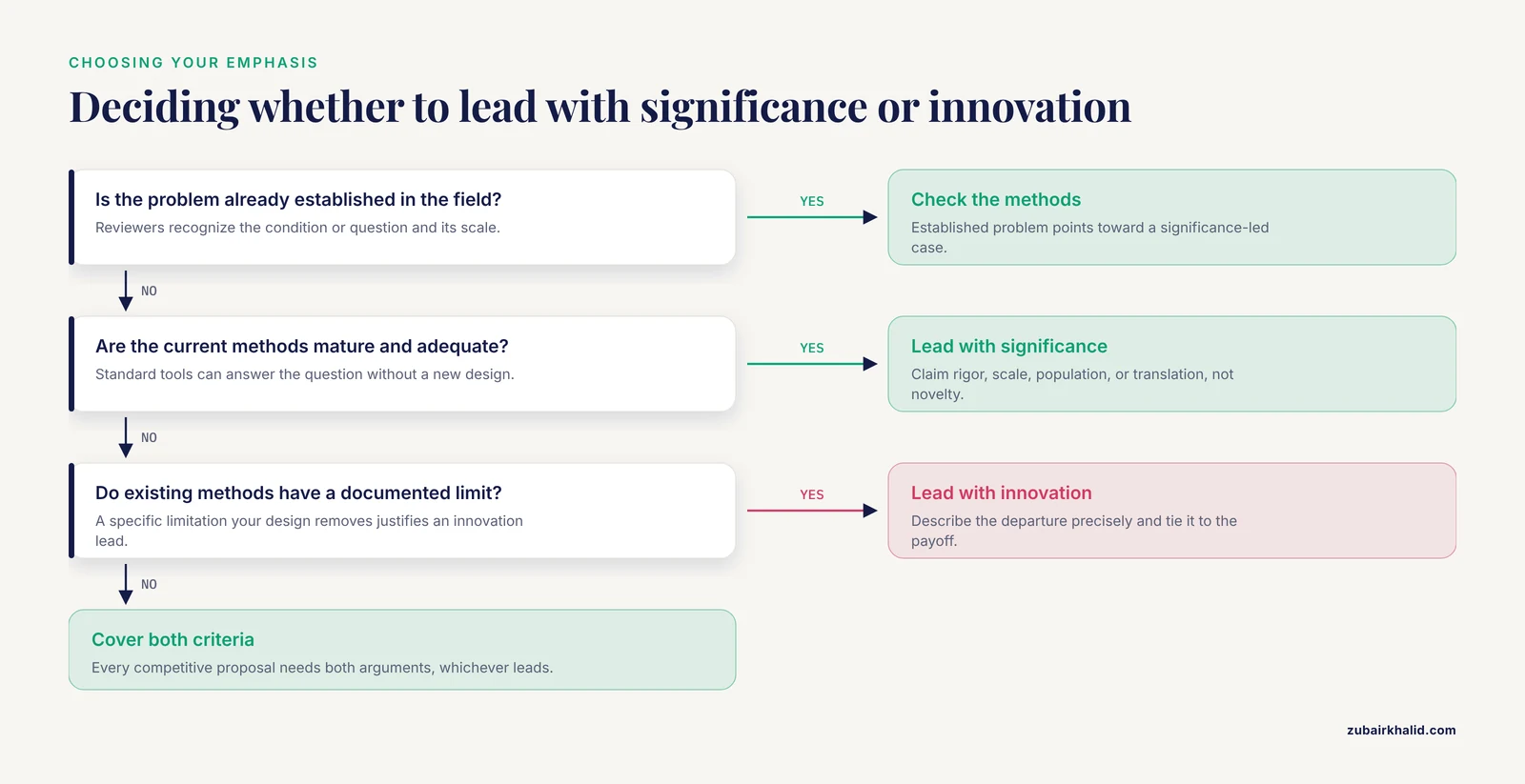
Both criteria need coverage in every competitive proposal, but emphasis is a real choice, and the choice should follow the project rather than the applicant's comfort.
Lead with significance when the problem is established, the methods are mature, and your contribution is rigor, scale, population, or translation. In that case, pretend novelty is not your selling point and do not manufacture it. Reviewers respect an application that says plainly, the approach is standard because it is the right approach, and the contribution is the definitive answer this question deserves. A multicenter validation study, a replication in a population the original work excluded, or a decisive test between two competing models all belong here.
Lead with innovation when the field is crowded with similar projects, when existing methods have a documented limitation your design removes, or when the paradigm itself is the problem. Here the innovation section does the heavy lifting, and the significance section must still answer the "so what" question so the novelty has a destination.
Three situations deserve specific mention.
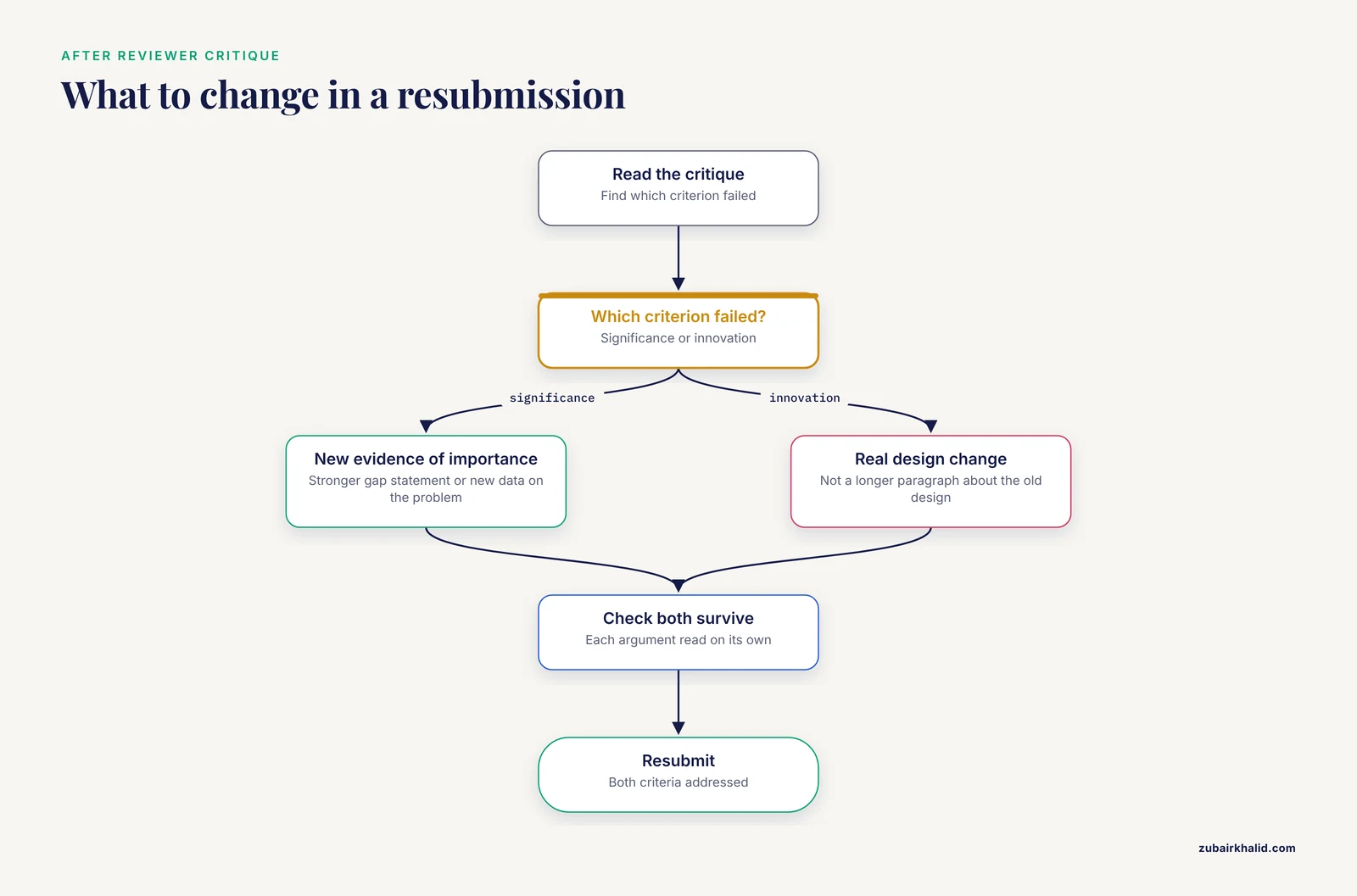
- Resubmissions and revisions. A resubmission that failed on significance needs new evidence of importance, such as a stronger gap statement or new data on the problem. A resubmission that failed on innovation needs a real design change, not a longer paragraph about the old design.
- New investigators. Reviewers of first applications tend to scrutinize feasibility alongside innovation. A modest, highly rigorous project with clear significance often outperforms an ambitious, unproven technique applied to a vague question.
- Program announcements and requests for applications. When a funding announcement names a priority area, the significance argument must connect to that priority explicitly, because reviewers check alignment as part of judging importance.
How the Two Criteria Interact on a Review Panel
At agencies such as the National Institutes of Health, reviewers score significance and innovation as separate criteria, and both feed the overall impact judgment that drives the priority score. Established textbooks on grant writing describe the same structure at most major funders, with local variations in weighting.
Separate scoring creates two dynamics worth planning around.
First, a weakness in one criterion drags the whole critique even when the other is excellent, because the drafters of the overall impact paragraph weigh everything. A dazzling method applied to a trivial question produces a critique whose significance paragraph undermines the innovation paragraph, and the overall score lands in the middle rather than at the top.
Second, reviewers apply the two criteria with different default behaviors. Reviewers rarely award the top innovation rating unless they can point to a specific, describable departure from current practice, and they rarely punish a proposal for honestly declining to claim novelty it does not have. Significance behaves differently. Reviewers default toward asking for more justification, because almost every applicant claims importance and the reviewer's job is to sort credible claims from inflated ones. That asymmetry has a practical meaning for significance vs. innovation in grant proposal work. Evidence carries the significance argument, while precise description carries the innovation argument.
Common Mistakes and Limitations
The following mistakes account for most of the criticism reviewers write about these two criteria.
- Asserting significance without evidence. Phrases like "this critically important problem" persuade no one. Numbers, documented gaps, and named end users persuade.
- Claiming a gap the literature has already closed. Reviewers know their field. Verify the gap against recent publications before you stake the application on it.
- Conflating novelty with innovation. Being the first to try something in your lab, or attaching a new acronym to an old workflow, does not meet the criterion.
- Burying the innovation inside the methods. If a reviewer has to reconstruct your departure from standard practice by reading the experimental design, you have lost the skimming reader.
- Overclaiming both at once. Describing a modest project as paradigm-shifting invites the reviewer to find the gap between claim and content, and reviewers write that gap into the critique.
- Writing one paragraph that serves both criteria. The significance argument and the innovation argument have different evidence bases and different structures. Merge them and reviewers lose both threads.
- Ignoring the risk that innovation creates. Every departure from standard practice raises technical risk. An innovation section that never acknowledges feasibility questions reads as naive.
- Using preliminary data for the wrong job. Preliminary data primarily support feasibility and approach. They rarely establish that the problem matters, which is the literature's job.
- Forgetting the destination. Innovation sections that end at "we will develop X" without stating what X enables leave the significance question unanswered, and the two criteria are supposed to connect.
One limitation applies to everything above. Review criteria, weightings, and submission formats vary across agencies, programs, and mechanisms, and panel culture varies across study sections. The principles here are general. For any specific application, the program officer for the funding opportunity and an experienced mentor who has served on the relevant panel are the right sources for calibration, because individual proposals and individual panels each need tailored advice.
Frequently Asked Questions
Can a proposal be significant without being innovative?
Yes. A rigorous replication, a definitive trial in an underserved population, or a careful validation of a widely used method can score strongly on significance with a standard approach. The key is to state honestly that the contribution is rigor, scale, or translation rather than novelty, and to support that contribution with evidence.
Can a proposal be innovative without being significant?
Yes, and this is a common rejection pattern. A novel method applied to a question the field does not need answered earns praise for creativity and still fails, because reviewers cannot justify spending finite funds on a result nobody will use. Every innovation claim needs a named payoff.
Where do significance and innovation belong in the proposal?
Significance evidence belongs in the background and significance section, built from the problem, its scale, the documented gap, and the expected impact. Innovation evidence belongs in the approach section and in a short dedicated innovation summary, built from the limits of current methods and the specific departure your design makes.
Which criterion matters more to reviewers?
Both feed the overall impact judgment, so neither can be skipped. In practice, significance is the harder argument to make without evidence, while innovation is the harder argument to make without precise description. Weakness in either one drags the overall score down.
How much preliminary data do I need to show significance?
Preliminary data usually establish feasibility, not importance. Significance is established with literature on the problem's scale, evidence that the gap is real, and a clear statement of who will use the results. Use preliminary data to show your approach can deliver the result that matters.
Will a research grant writing course help me with these sections?
A good research grant writing course helps, especially one that uses real funded applications and reviewer critiques as teaching material, because seeing how reviewers phrase their comments calibrates your own writing faster than abstract advice does. Pair any course with feedback from a mentor who has served on the relevant study section.