Sensitive Data Sharing in Journals: Common Problems and Fixes
By Dr. Zubair Khalid, DVM, MS, PhD ·
Most journal rejections and revisions over data sharing trace back to one cause: the authors wrote a data availability statement before they had a workable plan for the data itself. They promise "data available on reasonable request" or "deposited in a public repository," then discover at revision stage that the dataset contains protected health information, that no repository will accept it in its current form, or that the consent forms never covered secondary sharing. The fix starts with the same first check every time. Read the journal's data policy and your funder's data policy side by side, then ask one question of your dataset: does it contain direct identifiers, such as names, medical record numbers, or genomic sequences that can be tied back to a person? The answer determines everything that follows, from whether you can use an open repository to whether you need a Data Use Agreement, a controlled-access archive, or a privacy-preserving analytical method that never moves raw data at all.
This article walks through the causes of sensitive data sharing compliance failure in order of how often they occur, explains the mechanism behind each one, gives you a diagnostic sequence you can follow, and then covers the fixes, from manual de-identification to federated learning and blockchain-backed access control.
What Counts as Sensitive Data in Research Data Sharing
Sensitive data is any dataset in which disclosure could harm the people or institutions it describes. In the life sciences this usually means one or more of the following:
- Human health data collected in clinics, hospitals, apps, or wearables. Electronic health records, personal health records, and sensor data all fall in this category, and each carries legal duties around confidentiality, consent management, and privacy [1].
- Genomic data. A genome is inherently identifying and cannot be changed if it leaks, which makes genomic data sharing a distinct problem in precision medicine [2].
- Substance use and behavioral health records. In the United States, federal confidentiality rules such as 42 CFR Part 2 give these records extra protection beyond general health privacy law [3].
- Location, employment, or other quasi-identifiers that become identifying when combined.
Two terms drive the whole compliance conversation. A direct identifier points at one person on its own, like a name or a social security number. A quasi-identifier is harmless alone but identifying in combination, like zip code plus date of birth plus sex. Quasi-identifiers matter because combining them across datasets enables linkage attacks, where an attacker re-identifies supposedly anonymous records by matching them against another dataset they hold [4].
Why Sensitive Data Sharing Journal Compliance Fails: The Causes, Most Common First
Cause 1: The policy-literacy gap
The single most documented cause is that researchers simply do not know what the rules require of them. A survey of 155 researchers at an academic medical center found that 67 percent understood the 2023 NIH Data Management and Sharing (DMS) Policy, but only 47 percent felt comfortable developing a DMS Plan, and only 29 percent had ever used DMPTool.org, a web-based tool for drafting data management plans. Confidence dropped further at the operational level: just 40 percent felt confident identifying appropriate repositories and 38 percent felt confident budgeting for data management and sharing activities, while 68 percent perceived executing the plan as burdensome [5].
The mechanism here is straightforward. Funders such as the NIH now require a Data Management and Sharing Plan as a condition of the award, and journals increasingly require a matching data availability statement. When a researcher writes that statement without understanding the operational side, the plan describes actions nobody can actually perform, and the failure surfaces months later during peer review or at submission.
Cause 2: No repository path for the data as it exists
Even researchers who understand the policy often cannot name a suitable repository for their specific data type. Generic repositories may reject human subjects data, and discipline-specific controlled-access archives have their own submission requirements. When no obvious home exists, the default becomes "available from the corresponding author," which most journals now treat as a weak answer unless the author describes the access conditions in detail [5].
Cause 3: De-identification that does not survive contact with an attacker
Many authors remove names and call the dataset de-identified. The problem is that quasi-identifiers remain. Datasets integrated across platforms accumulate combinations of quasi-identifiers, and linkage attacks against those combinations create both re-identification risk and regulatory exposure for the sharing organization [4]. This is why a dataset that looks anonymous to the research team can still be non-compliant when a journal or repository performs its own risk review.
Cause 4: Consent and legal scope mismatches
Consent forms written years before a sharing mandate rarely mention deposit in external repositories or transfer to other institutions. Layered on top of consent are legal instruments. Cross-jurisdiction sharing in public health has traditionally relied on individually negotiated Data Use Agreements (DUAs), a process described as resource-heavy and often opaque, and one that produces inconsistent terms across jurisdictions [6]. When the consent, the DUA, and the journal's expectation do not line up, sharing stalls.
Cause 5: No sharing mechanism that preserves data sovereignty in multi-center studies
Multi-center clinical and AI research needs large, multimodal, longitudinal data, but privacy and regulatory constraints make centralizing that data difficult. Institutions want to preserve data sovereignty, meaning control over data that never leaves their walls. When the study design assumes a central pooled database that no partner can legally fill, the collaboration stalls before any journal sees a manuscript [7].
Cause 6: Administrative burden and lack of institutional support
The operational load is real. The same academic medical center survey found that 87 percent of respondents wanted tailored discipline-specific templates, and qualitative themes emphasized the need for centralized consultation, equitable access to expertise, and budget guidance [5]. Where that support infrastructure does not exist, individual researchers absorb the compliance work on top of their research, and quality suffers.
Cause 7: Segmentation failures inside the source records
Sometimes the problem originates upstream, in the electronic health record itself. Sensitive items such as substance use information are supposed to be segmented and withheld from general disclosure under 42 CFR Part 2, but manual segmentation is burdensome and error-prone, so sensitive items leak into datasets that were assumed clean [3]. A dataset built from such records inherits the violation.
Troubleshooting Table
| Symptom | Likely cause | How to confirm | Fix |
|---|---|---|---|
| Journal or reviewer asks why data are not deposited | No repository path was identified before submission | Check whether any controlled-access or discipline-specific repository accepts your data type | Match data type to repository access model (see comparison below) and update the availability statement |
| Data availability statement says "available on reasonable request" but no request mechanism exists | Plan written without an operational mechanism | Try to actually fulfill a hypothetical request. List who approves, what legal instrument is needed, and what format you would send | Specify conditions, approval steps, and timeline in the statement, or move data to a repository with managed access |
| Repository or ethics board flags re-identification risk | Quasi-identifiers were left in the shared file | List direct identifiers and quasi-identifiers, then estimate uniqueness and prosecutor-style re-identification risk [4] | Apply local differential privacy or other statistical protection before release [4] |
| Consent forms do not mention sharing or deposit | Consent obtained before sharing requirements existed | Read the consent language and the protocol approval for secondary-use scope | Seek ethics guidance on re-consent or restricted sharing consistent with the original scope |
| Multi-center partners refuse to pool data | Data sovereignty concerns, no trust mechanism | Ask each site what its legal or institutional barrier is | Adopt federated learning or model-centric collaboration so raw data never move [7] |
| Reviewer questions whether shared data match the paper | Dataset was altered after analysis, or provenance is unclear | Compare analysis code outputs against the deposited files | Deposit analysis-ready data with version identifiers and an audit trail, potentially blockchain-backed [8] |
| Dataset contains substance use or similarly protected records | Segmentation failure upstream | Audit records against 42 CFR Part 2 categories [3] | Use automated granular data segmentation before any release [3] |
| Funder rejects the Data Management and Sharing Plan | Plan is vague, unbudgeted, or lists an unsuitable repository | Check the plan against the funder checklist. Confirm a budget for sharing activities exists [5] | Revise the plan with institutional templates and consultation [5] |
How to Fix Sensitive Data Sharing Journal Compliance: Solutions in Order
Fix 1: Write the plan before the paper, with templates and consultation
Start the data plan at proposal stage, not at submission stage. Use a structured planning tool, get institutional consultation where it exists, and request a discipline-specific template if your institution offers one. The demand for this support is well documented, with 87 percent of surveyed researchers requesting tailored templates and most wanting centralized consultation and budget guidance [5]. A plan written this way names the repository, the access model, the legal instruments, and the costs, which means the journal's data availability statement later describes something real.
If your funder is the NIH, the DMS Policy requires the plan at proposal stage and expects shared data to be made available by the end of the award. Treat the plan as an executable document. Every sentence should map to an action a named person can perform.
Fix 2: De-identify against linkage attacks, not against eyeballs
Proper de-identification is a risk assessment, not a find-and-replace job. A published operational methodology walks through three steps. First, identify direct identifiers and quasi-identifiers in the data. Second, quantify baseline re-identification risk using uniqueness measures and prosecutor-style risk proxies, which estimate how easy it is to re-identify a known individual in the release. Third, apply protection before release. The method demonstrated there is local differential privacy implemented with a Generalized Randomized Response (GRR) mechanism, evaluated across privacy budget values (the parameter epsilon) to map the privacy-utility trade-off using both distributional distortion and downstream task performance [4].
The key insight for compliance is that the right amount of protection depends on how the data will be released. Repeated releases over time and longitudinal deployments need privacy accounting so that cumulative leakage stays bounded, a consideration raised explicitly in that work [4].
Safety note on identifiable data. Working with identifiable human data outside an approved secure environment risks real harm to participants, including re-identification and loss of trust. Do all cleaning and de-identification inside the secure environment your institution has approved, and export only the protected output.
Fix 3: Compare repositories by access model, not by name recognition
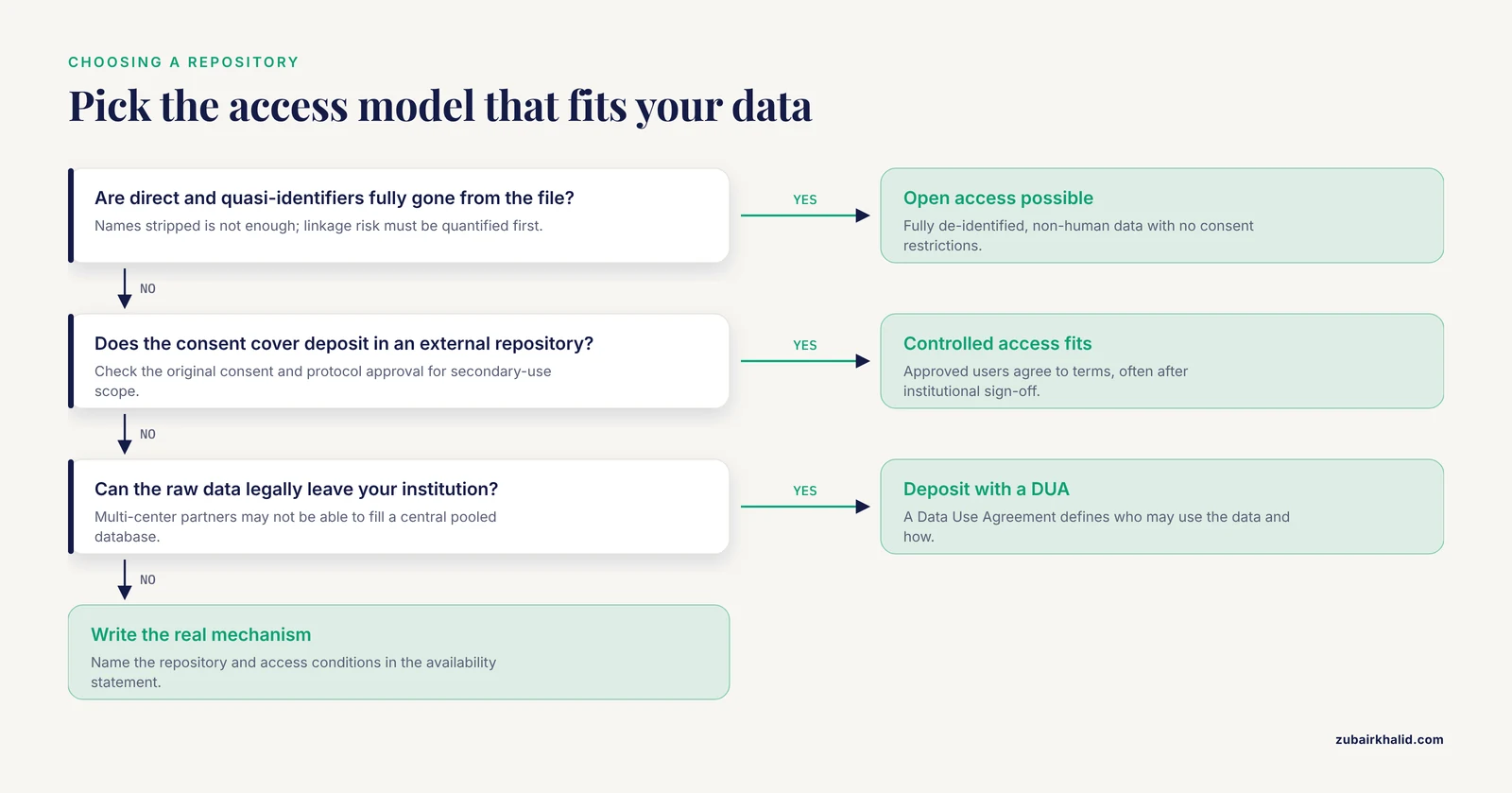
Choosing a repository is a matching problem. The comparison that matters for sensitive data is not brand names but access models, because the access model is what makes a deposit compliant or not.
| Access model | Who can download the data | Typical fit |
|---|---|---|
| Open access | Anyone, immediately | Fully de-identified, non-human data with no consent restrictions |
| Controlled access | Approved users who agree to terms, often after institutional sign-off | Human genomic and clinical data where re-identification risk remains [2] |
| Restricted or metadata-only | Data stay with the depositor. The repository publishes metadata and access procedures | Data with narrow consent scope or legal limits that no repository can host |
For genomic data specifically, controlled access exists precisely because genomic data are highly sensitive and immutable [2]. When you compare repositories, check four things: accepted data types and formats, the access-control model, whether the repository issues a persistent identifier, and whether it supports metadata standards your field expects. Genomic data management platforms additionally need to handle large data volumes, data standardization, and sensitive information protection within unified ecosystems that combine collection, standardization, analysis, and governance [9].
Fix 4: Standardize the legal layer with Data Use Agreements
When controlled access or partner-to-partner transfer is required, a DUA defines who may use the data, for what purpose, and with what security obligations. The traditional approach of negotiating every DUA individually is resource-heavy and opaque, which is why the Centers for Disease Control and Prevention have proposed a Core DUA to standardize terms and reduce administrative burden across jurisdictions [6]. The lesson for any research program is the same as the lesson from public health: reusable agreement templates lower the transaction cost of compliance. Check whether your institution or consortium has a standard DUA before negotiating one from scratch.
Fix 5: Segment sensitive fields in the source records
If your data come from electronic health records, verify that specially protected categories were segmented before the dataset reached you. Automated segmentation is now feasible at scale. One open-source platform built on HL7 Fast Healthcare Interoperability Resources (FHIR), a standard format for exchanging health information, was evaluated on 11,519 synthetic patient records covering 1,848 unique clinical terms classified by physicians. The engine labeled and segmented substance use-related data under varying confidentiality thresholds, and physicians categorized 232 data items as substance use-related for rule construction [3]. The principle generalizes: rather than manually scrubbing protected items from a finished dataset, encode classification rules so the sensitive fields are segmented at the record level, before analysis or sharing ever begins.
Fix 6: Consider synthetic data when raw data cannot be released
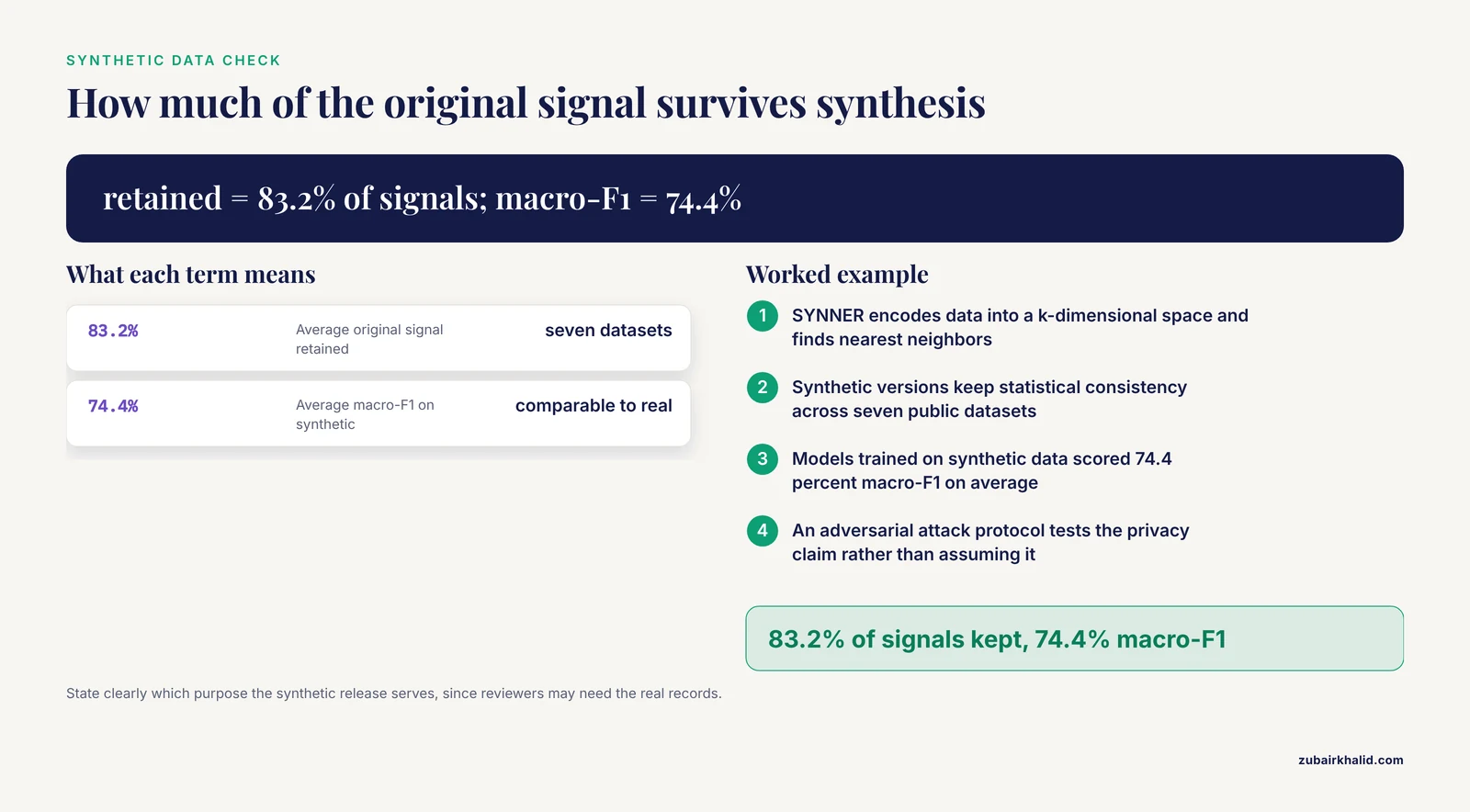
Synthetic data generation creates an artificial dataset that preserves the statistical structure of the original without containing real individuals. One framework, SYNNER, uses knowledge graph embeddings to encode data into a k-dimensional space, finds nearest neighbors for each entity, and generates synthetic versions that maintain statistical consistency. Across seven publicly available datasets it preserved an average of 83.2 percent of the original data signals, and models trained on its synthetic data achieved an average macro-F1 score of 74.4 percent, comparable to models trained on the original data. It also ships with an evaluation protocol that simulates an adversarial attack to infer missing values, testing the privacy claim rather than assuming it [10].
Synthetic data is a legitimate answer to a data availability statement when the journal accepts it and the synthesis is documented. It is not a substitute for the real data when reviewers need to verify analyses on the actual records, so state clearly which purpose the synthetic release serves.
Fix 7: Use privacy-preserving computation when data must not move
When raw data cannot leave an institution at all, shift the computation instead of the data.
Federated learning trains a model locally at each site and shares only model updates, such as gradients or parameters, so raw patient data never transfer. A model-centric collaboration framework for medical AI pushes this further: institutions train models locally and exchange model artifacts, including parameters and distilled representations, within a decentralized ecosystem, preserving data sovereignty and embedding privacy protection by design [7]. Systematic reviews of healthcare data management describe this federated-plus-blockchain-plus-explainable-AI architecture as an emerging integrated pattern, while flagging real issues to manage, including communication costs, scalability, interoperability, limited clinical explainability, and high computational cost in real-time settings [11]. A scoping review of privacy-enhancing technologies in biomedical AI, covering 87 studies across clinical decision support, genomics, and medical imaging, mapped the distinct trade-offs of differential privacy, federated learning, secure multiparty computation, and homomorphic encryption, and emphasized that each carries residual risks that should be stated openly rather than hidden [12]. Define those terms plainly. Secure multiparty computation lets several parties jointly compute a result without any one of them seeing the others' inputs. Homomorphic encryption allows computation directly on encrypted values.
Federated approaches have their own failure modes. Malicious participants can poison model updates to degrade performance or embed backdoors, which matters in medical applications where reliability and regulatory compliance are essential. One countermeasure framework, FedSecure-Chain, combines anomaly detection before aggregation, robust aggregation to limit the influence of suspicious updates, and a lightweight blockchain layer recording updates and client trust information for auditability. It was evaluated on breast cancer datasets using TabNet and compact multilayer perceptron models under multiple poisoning scenarios, and the combination significantly reduced the impact of attacks on the global model [13].
Fix 8: Add cryptographic trust layers for provenance and access control
Where multi-center sharing needs auditable trust rather than just privacy, combining privacy computing with blockchain gives three things at once: privacy-preserving training, tamper-evident logging, and controlled access. One published protocol integrates federated learning with a multi-channel, tiered-sharding blockchain, using Paillier homomorphic encryption for local training, blockchain-backed secure aggregation, and dynamic coordination of differential privacy based on data sensitivity. Under experimental conditions it reached 92.5 percent model accuracy after 20 training rounds, supported up to 30 nodes, and detected no raw data exposure [8].
For genomic data, a blockchain-based framework using zero-knowledge proofs, smart contracts, and off-chain storage has been demonstrated in prototype. Metadata stays on the blockchain, encrypted data sit in off-chain storage, rule-based access is enforced by smart contracts, and zero-knowledge proofs let a party prove an assertion about the data without revealing the data. The prototype reported an average zero-knowledge-proof query latency of 5.83 milliseconds with 90 percent accuracy and elliptic curve cryptography latency of 8.72 milliseconds under the same accuracy [2].
A systematic review of 32 studies published between 2018 and 2024 confirms the pattern and its limits. Blockchain can support consent management, secure data sharing, traceability, and tamper-resistant audit trails, but reported barriers include limited scalability and throughput, difficulty integrating with legacy electronic health record systems, heterogeneous regulatory requirements, and the complexity of encoding privacy and consent into code [14]. In practice, treat blockchain components as an audit and provenance layer on top of a compliant sharing design, not as a replacement for de-identification, consent, and repository policy.
Fix 9: Fix the upstream security and consent posture
Compliance at the journal is downstream of compliance everywhere else. Across the healthcare data life cycle, current best practice combines strict adherence to consent and privacy policies, standardized and accurate data, and advancing privacy-preserving techniques including trusted execution environments and cryptographic methods [1]. A dataset produced under that discipline passes journal scrutiny almost automatically. A dataset produced without it cannot be repaired at submission time.
A Diagnostic Sequence You Can Follow
Work through these steps in order for any dataset you plan to share alongside a journal submission.
- Read the journal's data policy and your funder's data policy. Note exactly what each requires and by when.
- Inventory the dataset for direct identifiers and quasi-identifiers.
- Check consent and protocol scope for secondary use, deposit, and transfer language.
- If the data are EHR-derived, audit for specially protected categories such as substance use records subject to 42 CFR Part 2 [3].
- Estimate re-identification risk from quasi-identifier combinations [4].
- Match the data to a repository access model: open, controlled, or metadata-only.
- Identify the legal instrument needed, such as a DUA, and find a standard template before drafting new terms [6].
- If no compliant transfer path exists, select a privacy-preserving alternative: synthetic data [10], differential privacy [4], or federated learning [7].
- Write the data availability statement to describe the actual mechanism, including access conditions and timelines.
- Record the version, format, and provenance of whatever you release, so reviewers can verify the deposit matches the paper.
Common Mistakes and Limitations
- Equating name removal with de-identification. Quasi-identifiers do the damage in linkage attacks. A file with names stripped can still be re-identifying.
- Writing the DMS Plan as paperwork. Plans that describe actions nobody can execute fail quietly. The gap between understanding a policy (67 percent of surveyed researchers) and feeling able to execute it (47 percent comfortable with the plan) is exactly where compliance dies [5].
- Overlooking the budget. Sharing has real costs for curation, repository deposition, and access management. Only 38 percent of surveyed researchers felt confident budgeting for these activities, and unbudgeted sharing tends to become unshipped sharing [5].
- Promising open data under open consent. If participant consent covers only the original study, deposit in an open repository is not an option. Restricted access or synthetic release may be the compliant path.
- Choosing repositories by familiarity. A generalist repository your lab has used before may refuse human subjects data. Compare by access model and data type first.
- Assuming privacy technology removes all risk. Differential privacy, federated learning, homomorphic encryption, and secure multiparty computation each carry residual risks and utility costs that should be evaluated and disclosed, not assumed away [12].
- Treating blockchain as a compliance checkbox. Blockchain provides provenance and auditability. It does not by itself satisfy consent, de-identification, or repository requirements, and scalability and legacy-system integration remain open barriers [14].
- Sending data by email or unmanaged cloud storage. This bypasses every access control and audit mechanism you claim in your availability statement.
- A general limitation. Individual datasets, institutions, and jurisdictions differ, and this article cannot substitute for your institutional review board, data protection office, or the journal's own editorial guidance. Verify specifics against those authorities before acting.
Prevention Practices
Build the habit stack once and every future submission gets easier.
- Draft the data management plan at proposal stage, using institutional templates and consultation where available [5].
- Budget for data management and sharing activities explicitly [5].
- Write consent language that anticipates deposit, or document clearly why it cannot.
- Keep a data dictionary and record-level provenance from day one, so provenance claims can be backed by audit trails if needed.
- Audit source records for specially protected categories before analysis, not before submission [3].
- Decide the repository and access model before the first draft of the manuscript, and cite that decision in the availability statement.
- Where multi-center work is involved, agree on the collaboration model, federated versus centralized, at study design time, because retrofitting data sovereignty is far harder than designing for it [7].
- Reuse standard agreements. A standing DUA template, like the Core DUA approach proposed for public health data sharing, cuts negotiation friction for every future partnership [6].
Frequently Asked Questions
Do I have to share my data publicly to publish?
No. Most journals accept controlled-access deposition, restricted access with documented conditions, or in some cases a justified refusal based on ethical or legal constraints. What journals increasingly do not accept is a vague statement with no mechanism behind it. Match the access model to the sensitivity of the data and document it.
What is the difference between open, controlled-access, and restricted repositories?
Open repositories let anyone download the data. Controlled-access repositories release data only to approved users who agree to terms, which suits sensitive human data such as genomic records [2]. Restricted or metadata-only arrangements keep the data with the depositor and publish only metadata and access instructions. The access model, not the repository's fame, determines compliance.
Can I just remove names and dates to de-identify my dataset?
No. Removing direct identifiers leaves quasi-identifiers such as zip code, date of birth, and sex, which can re-identify people through linkage attacks when combined across datasets [4]. Proper de-identification quantifies re-identification risk first, then applies statistical protection calibrated to that risk.
What should I write in a data availability statement?
Describe the real mechanism. Name the repository and accession pathway, or state the access conditions, who approves requests, and how long fulfillment takes. If you release synthetic data, say so and cite the generation method. A statement describing actions you can actually perform will survive peer review. A vague one will not.
What is a Data Use Agreement and when do I need one?
A Data Use Agreement is a legal contract defining who may use shared data, for what purposes, and under what safeguards. You need one whenever data move between institutions under restrictions, which is the traditional and still common mechanism for interjurisdictional public health data sharing [6]. Ask whether your institution already has a standard template before negotiating new terms, since standardized DUAs reduce administrative burden.
Is synthetic data a valid substitute for sharing the real dataset?
It depends on the purpose. Synthetic data can support reproducibility claims and method validation when it preserves statistical structure, as demonstrated by a framework that retained an average of 83.2 percent of original data signals and achieved macro-F1 scores of 74.4 percent in prediction tasks comparable to models trained on real data [10]. It cannot substitute when reviewers need to verify results against the actual records, so be explicit about which purpose it serves.
My consent forms never mentioned data sharing. What now?
Do not deposit the data in an open repository. Return to your ethics board or institutional review body for guidance on whether re-consent, restricted sharing consistent with the original consent scope, or a metadata-only release is appropriate. Consent scope is a legal constraint, and the compliant paths narrow accordingly.
How does federated learning help when raw data cannot leave the hospital?
Federated learning trains the model at each site and shares only model updates, never raw patient data, so each institution keeps data sovereignty while the collaboration still produces a shared model [7]. Known trade-offs include communication overhead and vulnerability to poisoning attacks, which can be mitigated with anomaly detection and robust aggregation combined with blockchain-based audit trails [13]. It is a strong option for multi-center clinical AI where no partner can legally pool records.
Sources
- eHealth Data Security and Privacy.
- A Blockchain-Based Framework With Zero-Knowledge Proof Incorporated for Safeguarded Sharing of Genomic Data Through Health Record Systems.
- Assessing the Effectiveness and Scalability of Fast Healthcare Interoperability Resource-Based Granular Data Segmentation Technology.
- Assessing Local Differential Privacy for Compliance with the Personal Data Protection Law in Integrated Data Systems.
- Supporting researcher compliance: assessing institutional readiness for the 2023 NIH Data Management and Sharing Policy.
- Trust, Transparency, and the Fragile Promise of Data Governance in the Era of Modernization.
- Model centric collaboration reduces data sharing barriers in medical artificial intelligence.
- Collaborative Mechanism of Privacy Computing and Blockchain in Multi-Center Medical Data Sharing.
- Toward a Common Set of Interface Requirements for Genomic Data Management: Scoping Review.
- SYNNER synthetic data generator framework.
- Secure healthcare data management using federated learning, blockchain, and explainable artificial intelligence: a systematic review.
- Safeguarding biomedical AI: a critical scoping review of privacy-enhancing technologies, hybrid approaches, and deployment models.
- A robust and verifiable federated learning framework for preventing data poisonous threats in e-health.
- Blockchain Technology to Enhance Clinical Data Management in Healthcare: A Systematic Literature Review.