Secure Research Collaboration Tools Compliance: How to Choose
By Dr. Zubair Khalid, DVM, MS, PhD ·

The difference between secure research collaboration tools comes down to where the data physically lives and who is legally accountable for it, not which app has the nicest interface. A practical rule of thumb for choosing: match the tool category to the most sensitive dataset in the project, then pick the lightest option within that category that your institution's security office will actually approve. Anything heavier wastes months of setup time, and anything lighter will be rejected at review.
This article explains what compliance means for research collaboration tools, compares the main secure research collaboration tools compliance options on the criteria that decide real choices, works through concrete scenarios, and lists the mistakes that derail multi-institution projects.
What Compliance Actually Means for Research Collaboration Tools
Compliance is not a single checkbox. When researchers talk about secure research collaboration tools compliance, they usually mean four separate requirements that stack on top of each other.
Data protection law. If the project involves human participants from Europe, the General Data Protection Regulation (GDPR), the European Union's data protection law, applies to that data regardless of where the analysis happens. In the United States, the Health Insurance Portability and Accountability Act (HIPAA) governs identifiable health data held by covered entities. A review of cloud computing in international clinical trials found that adherence to laws like GDPR and HIPAA was the central factor in evaluating whether a cloud platform could safely manage sensitive healthcare data [1].
Institutional security review. Most universities and hospitals require an Information Security Office review before any externally facing system goes live. A case study of four internally developed AI tools in an academic health environment found that early setup steps, including cloud access, institutional subdomain configuration, and Information Security Office review, were comparatively stable and predictable when institutional knowledge and reusable assets existed [2].
Formal legal agreements between collaborators. When data crosses institutional or national borders, contracts define who controls the data and who can process it. A Nordic rheumatology collaboration spanning Denmark, Sweden, and Norway, funded to develop personalized medicine approaches, ended up with more than 20 legal documents to govern the collaboration, including consortium agreements, joint controller agreements, research collaboration agreements, data sharing agreements, and a series of unique two-way data processing and material transfer agreements. The authors attributed part of this burden to national implementations of GDPR and the lack of agreed-upon templates [3].
Domain-specific quality standards. Some fields add their own regulatory layer. In preclinical toxicologic pathology, whole slide imaging for primary histopathology reads must comply with Good Laboratory Practice (GLP), the quality system governing nonclinical safety studies submitted to regulators. A position paper from that field concluded that digital pathology now supports GLP-compliant work, with benefits including remote collaboration, data security, and compatibility with AI-based tools, provided implementation strategies and technical requirements are handled properly [4].
Any tool you choose must satisfy all four layers. A platform with excellent encryption but no executed data sharing agreement still blocks the collaboration.
The Main Secure Research Collaboration Tools Compliance Options
There are five practical categories. Each one answers the two defining questions, where the data lives and who is accountable, differently.
Institutional Secure Cloud Workbenches
These are purpose-built cloud environments designed around funder data policies. The clearest example is the NHGRI Genomic Data Science Analysis, Visualization, and Informatics Lab-space (AnVIL), which provides a secure cloud-based environment where genomic and biomedical data can be analyzed and stored in compliance with NIH policies, with work products shareable to promote reproducible science and collaboration [5].
The compliance logic is that the environment itself is pre-approved. Data stays inside a governed workspace, access follows funder rules, and the institution does not need to re-review the platform for every new project. A community survey of AnVIL users found opportunities for adoption beyond the current user base and identified areas where training needed enhancement, which is a useful signal that these platforms carry a real learning curve even for their target audience [5].
Federated Consortium Infrastructure
In a federated architecture, each institution keeps its own data on its own servers, and only approved queries, metadata, or aggregate results move between sites. The European Federation for Cancer Images (EUCAIM), built under Europe's Beating Cancer Plan, establishes exactly this model for cancer imaging. It provides a secure centralized and federated infrastructure for secondary use of large-scale oncological imaging and related clinical data, with common data models, quality standards, and a documentation framework intended to ensure regulatory compliance, safeguard data integrity, and support secure data flows across institutional and national boundaries [6].
The population experience from a reference hospital joining EUCAIM reinforces the point. Robust documentation was described as essential for regulatory compliance and for supporting secure data flows across borders, aligned with European regulations and ethical standards [7]. Federated systems shift the compliance work toward harmonization and documentation rather than data transfer.
Self-Hosted Edge Nodes With Cloud Coordination
A middle path keeps raw data at each site on a locally controlled server and uses a cloud layer only for coordination. In radiology, a proof-of-concept cloud-native platform for multicenter research hosted each institution's image data and metadata on a localized edge-node Orthanc DICOM server, where DICOM is the standard format for medical imaging. Critical metadata were reverse-proxied to a cloud database through REST APIs, which removed any need for complicated virtual private network setups. Principal investigators defined clinical workflows that were dynamically pushed to radiologists, who evaluated pending cases in a single workspace with an embedded zero-footprint viewer and standardized reporting forms [8].
The compliance advantage is that identifiable images never leave the source institution, while the collaboration layer stays lightweight. The tradeoff is that each site must maintain its own node.
Sovereign and National Research Compute
At the largest scale, governments are building publicly owned AI supercomputers for biomedical research. A global landscape review of these systems described sovereign AI supercomputers as providing secure, large-scale computational capacity for integrating complex health data, supporting workloads from cancer imaging and diagnosis to whole-genome analysis and computational drug discovery. The same review evaluated the governance models these infrastructures use to safeguard patient privacy [9]. For teams whose projects align with a national program, this category offers compliance posture and compute scale that no individual lab could replicate, at the cost of working within program-defined access rules.
Commercial Platforms Under Contract
General-purpose commercial tools, project management suites, cloud storage, and conferencing platforms, can be used compliantly when they are covered by the right contracts and configurations. The clinical trials cloud computing review noted that cloud systems enabled real-time updates and integration of multicenter trial data while upholding security requirements and reducing infrastructure costs [1]. Compliance here depends on what your institution negotiates: a signed data processing agreement, configured access controls, and verification that the vendor will not use your research data for its own purposes. Without those pieces, the same tool is noncompliant.
Internally Developed Tools Through Institutional Review
Some teams build their own applications. This is viable but carries a specific and often underestimated compliance cost, which researchers call deployment burden: the organizational, technical, and coordination work needed to move a functioning prototype into legitimate institutional use. In the academic health case study mentioned earlier, the heavy burden fell on first-team pathway discovery, enterprise integration, and cross-institutional access. Early steps were stable when reusable assets existed, but one case showed gaps of approximately two weeks before later requests were even initiated, reflecting time spent identifying the next institutional step rather than formal review time. Later teams reused that pathway knowledge, though recurring integration work remained [2].
Side-by-Side Comparison
| Criterion | Institutional secure cloud (AnVIL type) | Federated consortium (EUCAIM type) | Self-hosted edge nodes + cloud coordination | Sovereign national compute | Commercial SaaS under contract | Internally built tools |
|---|---|---|---|---|---|---|
| Where raw data lives | Governed cloud workspace | Each institution keeps its data | Each site's local server | National system under public ownership | Vendor's cloud | Your infrastructure |
| Compliance fit | Funder data policies (NIH-type) [5] | Cross-border sharing under European regulations [6] | Local data residency, no VPN needed [8] | National governance models for privacy [9] | Depends on executed agreements [1] | Institutional security review [2] |
| Legal agreement burden | Low to moderate | High, consortium-level | Moderate, site-level | Defined by program | One strong data processing agreement | High, plus internal review |
| Setup burden | Moderate, training needed [5] | High, harmonization and documentation [7] | Moderate, each site runs a node | High but program-supported | Low configuration, high contract diligence | Highest, pathway discovery [2] |
| Best for | Genomic and biomedical analysis under funder rules | Large multi-country consortia | Multicenter imaging and clinical studies | Nationally aligned AI-scale projects | Everyday project coordination | Novel needs no product serves |
How to Choose: The Criteria That Decide Real Outcomes
Once you know the categories, the best secure research collaboration tools compliance choice comes from five questions asked in order.
1. What is the most sensitive dataset in the project?
Classify the data before looking at any software. Identifiable health data, genomics linked to individuals, and regulated preclinical study data each pull you toward a different category. Human imaging consortia fit the federated model [6]. Genomic analysis under NIH policies fits AnVIL-style workbenches [5]. GLP toxicology fits validated digital pathology systems [4]. If any AI component touches patient data, privacy and security safeguards and compliance with privacy regulations are explicit recommendations in clinical policy statements [10].
2. Which jurisdictions apply?
Data does not respect borders, but law does. The Nordic rheumatology project showed how national implementations of GDPR introduced administrative delays and created disincentives for data sharing even among willing collaborators [3]. If your consortium spans jurisdictions, budget for the agreement stack early, not after the tool is chosen. The tool and the contracts interact: a federated design can reduce the volume of data movement that agreements must govern.
3. Who controls identity and access?
Access control is where compliance fails in practice. Ask for each candidate tool how accounts are provisioned, whether institutional single sign-on works, how a departing collaborator is removed, and whether audit logs exist. In the edge-node radiology model, avoiding VPN configurations entirely was an explicit design goal, because complex network access requirements were a barrier to multi-site participation [8].
4. What is the deployment burden, not just the purchase cost?
The deployment burden concept from the AI tool case study is directly useful here: the cost is organizational and coordination work, including cloud account setup, subdomain configuration, security review, and enterprise integration, not license fees [2]. Ask your security office which platforms already have approved pathways. A tool with an existing institutional pathway can be live in weeks while a technically similar tool without one can stall for months.
5. Does the tool support reproducibility and controlled sharing?
Compliant does not mean sealed. AnVIL was explicitly designed so that work can be shared to promote reproducible science and collaboration within its governance rules [5]. If your project needs to publish analyses or hand off pipelines, choose a tool whose sharing model satisfies both your funder and your privacy obligations.
Pros and Cons of Each Option
Institutional secure clouds. Pros: pre-aligned with funder policies, shared infrastructure costs, built-in reproducibility support [5]. Cons: training burden and limited adoption beyond the existing user base, meaning your collaborators may not know the platform [5].
Federated consortium infrastructure. Pros: data never leaves the source institution, supports cross-border collaboration under harmonized governance [6], and builds lasting reusable infrastructure. Cons: heavy documentation and harmonization work up front [7], and participation requires sustained institutional commitment.
Self-hosted edge nodes. Pros: strong data residency, no VPN complexity, single shared workspace for distributed clinicians [8]. Cons: every site operates and maintains a server, and the coordinating team owns integration.
Sovereign compute. Pros: secure large-scale capacity, established governance models for patient privacy, infrastructure no single lab could build [9]. Cons: access is program-gated and project goals must align with national priorities.
Commercial SaaS. Pros: fast to deploy, mature collaboration features, proven value in multicenter trials for real-time updates and data integration [1]. Cons: compliance rests entirely on contracts and configuration, and AI-driven features inside these platforms raise additional questions of software validation, data security and privacy, and change management [11].
Internally built tools. Pros: exact fit for novel workflows. Cons: highest deployment burden, with pathway discovery and enterprise integration dominating the timeline for the first team that tries [2]. The practical advice from that case study is to reuse pathway knowledge: if a previous team already walked a tool through security review at your institution, follow their route.
Three Worked Scenarios
Scenario 1. A five-country cancer imaging consortium wants to train diagnostic AI. Raw scans are identifiable health data spread across jurisdictions. The federated model fits directly. Join or emulate an infrastructure like EUCAIM, which provides common data models, quality standards, and a documentation framework for regulatory compliance and secure cross-border data flows [6]. Expect the legal agreement work described in the Nordic experience, where one consortium needed more than 20 governing documents, and start drafting before the technical build [3]. Realistic timeline thinking: the Nordic authors reported that administrative delays from GDPR implementation disincentivized data sharing, so agreements are on the critical path [3].
Scenario 2. A pathology core facility wants pathologists at three sites to do primary reads on GLP studies. GLP compliance is mandatory, so an unvalidated ad hoc viewer is out. The toxicologic pathology forum position concluded that whole slide imaging is suitable for GLP-compliant nonclinical safety assessment when implementation strategies and technical requirements are addressed, with remote collaboration and data security among the established benefits [4]. The right move is a validated digital pathology system with documented validation evidence, not a general file-sharing service.
Scenario 3. A university team builds a web app for caregiver support and wants it used across affiliated clinics. The prototype working on a laptop is not the hard part. The case study of similar tools found the heavy burden in pathway discovery, enterprise integration, and cross-institutional access, with roughly two-week gaps spent merely identifying the next institutional step [2]. Before writing more code, book time with the Information Security Office, find the team that deployed a similar tool, and reuse their pathway. Also apply the validation and privacy expectations that clinical AI policy statements set for GenAI tools, including validation protocols, compliance with privacy regulations, and clear accountability structures [10].
Common Mistakes and Limitations
Choosing the tool before classifying the data. Teams pick a collaboration app, invite collaborators, and only then discover the dataset is regulated. Reverse the order.
Treating compliance as the security office's problem alone. The legal agreement layer is the researchers' responsibility. A collaboration can be technically secure and still stalled because the data processing agreements were never drafted [3].
Assuming a secure tool makes the collaboration compliant. A tool is one component. The Nordic consortium's experience shows compliance is a property of the whole governance arrangement, including more than 20 agreements in one project [3].
Underestimating first-team deployment burden and overestimating it for later teams. Internal tools face a steep first pathway, but the knowledge is reusable. Later teams at the same institution moved faster once the pathway existed [2].
Accepting VPN complexity as normal. Multicenter platforms have demonstrated that reverse-proxied metadata and local data hosting can eliminate VPN configuration entirely [8]. If a proposed architecture requires every collaborator to configure network access, ask whether a federated or edge-node design would remove that barrier.
Ignoring training needs. Even well-designed secure platforms show adoption gaps tied to training. The AnVIL community survey identified areas where training should be enhanced, a reminder that onboarding is part of compliance, because untrained users create workarounds [5].
Forgetting that AI features inside tools add a compliance layer. Reviews of AI in regulated settings repeatedly flag software validation, data management security and privacy, and change management as distinct obligations beyond ordinary software [11]. Clinical AI guidance likewise stresses validation protocols, privacy compliance, and human oversight [10]. AI systems also carry privacy and security risks if data is breached or exploited, and responsible use depends on regulatory compliance and ethical oversight [12].
A limitation on scope. Specific legal requirements vary by institution, funder, dataset, and jurisdiction, and this article cannot substitute for your institution's security office or legal counsel. Every real project needs its own review.
Frequently Asked Questions
What does secure research collaboration tools compliance actually require?
It requires four layers together: applicable data protection law such as GDPR or HIPAA, institutional security review, executed legal agreements between collaborating organizations, and any domain-specific quality standard such as GLP for regulated preclinical work. A tool that satisfies one layer but not the others will still block the project.
Which tool category is best for sensitive human health data?
For identifiable clinical data that must stay at its source institution, federated or edge-node architectures, where raw data remains local and only metadata or results move, have the strongest structural fit. The EUCAIM cancer imaging infrastructure and the edge-node radiology platform are documented examples of this approach [8][6].
Do multi-site research collaborations always need VPNs?
No. A cloud-native radiology platform demonstrated that locally hosted edge nodes with reverse-proxied metadata delivered through REST APIs allow multi-institution collaboration without any VPN configuration [8]. Simpler network access lowers the barrier for collaborator participation.
How much legal paperwork does GDPR-compliant academic collaboration involve?
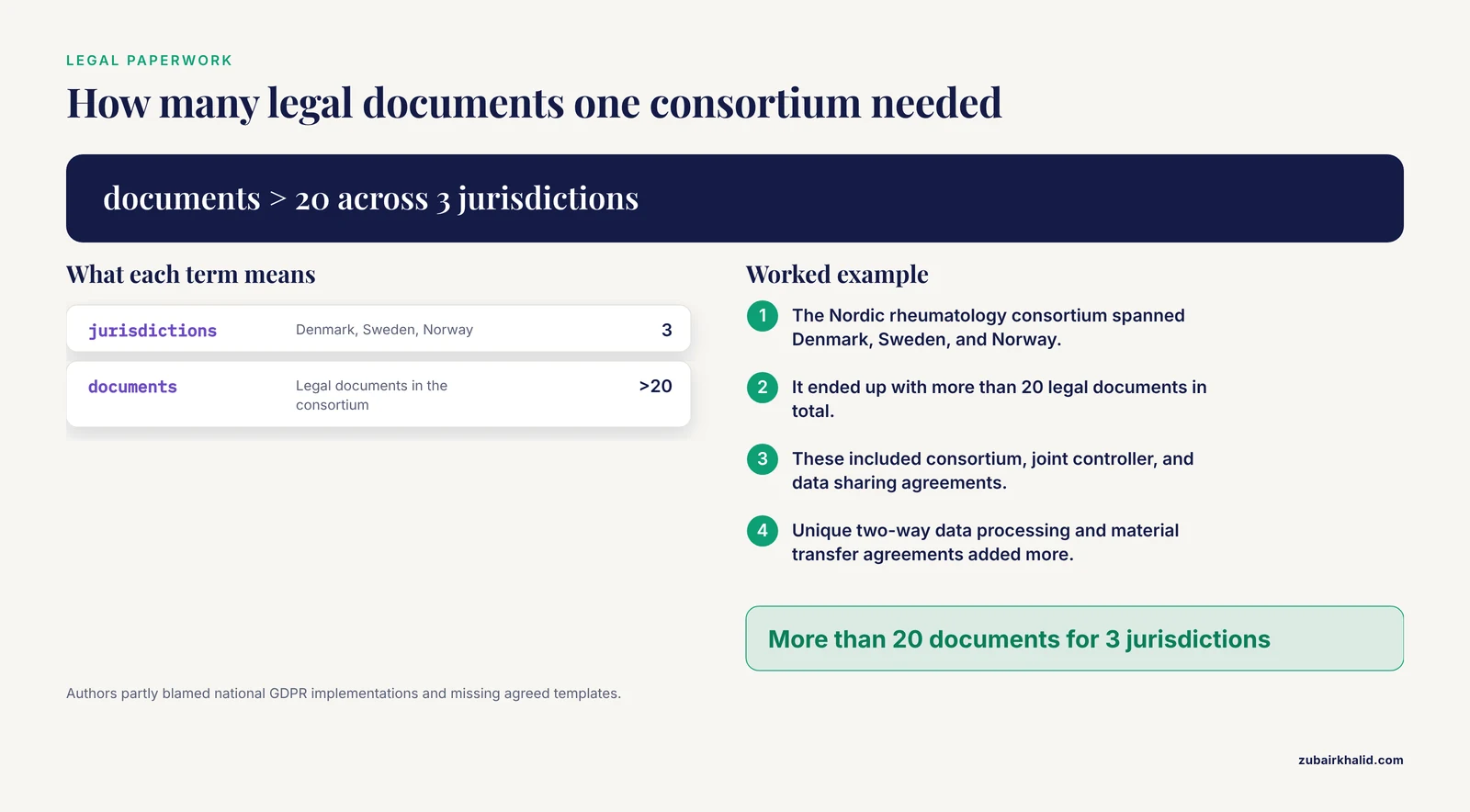
It varies, but it can be large. One Nordic rheumatology consortium produced more than 20 legal documents, including consortium, joint controller, research collaboration, data sharing, data processing, and material transfer agreements, partly because agreed-upon templates were lacking [3]. Start agreement drafting at project kickoff.
Can we build our own collaboration tool instead of buying one?
Yes, but plan for deployment burden. The path from working prototype to legitimate institutional use runs through cloud access, institutional subdomain configuration, security office review, and enterprise integration, and first teams at an institution spend significant time discovering that pathway. Reuse existing pathways and reusable assets wherever they exist [2].
Is a commercial productivity tool ever compliant for research data?
Yes, when the right contracts and configurations are in place. Cloud platforms are widely used in international clinical trials, where adherence to GDPR and HIPAA was emphasized as the key to safely managing sensitive healthcare data [1]. The compliance comes from the data processing agreement, access configuration, and vendor data-use terms, not from the brand name.
Sources
- Cloud Computing Facilitating Data Storage, Collaboration, and Analysis in Global Healthcare Clinical Trials.
- Analyzing and redesigning deployment pathways for internally developed artificial intelligence tools in clinical education and health research.
- Legal obstacles jeopardise research in personalised medicine - experiences from a Nordic collaboration within rheumatology.
- Toxicologic Pathology Forum*: Opinion on the Future of Histopathology Using Whole Slide Images in Toxicologic Pathology of Preclinical Studies and Its Successful Implementation in Compliance With Good Laboratory Practice-Yes, We Are There!
- Insights into the Datasets, Tools, and Training Needs of the AnVIL Community: 2024.
- Empowering cancer research in Europe: the EUCAIM cancer imaging infrastructure.
- How the First Medical Imaging Cancer Atlas EUCAIM Was Populated: The Experience of a Reference Hospital.
- Radiology research platform: automating multicenter radiological research workflows using a cloud-native platform.
- Sovereign AI supercomputers: a global landscape review of unprecedented biomedical research infrastructure.
- Recommendations for the Development and Implementation of Generative Artificial Intelligence Tools in Pediatric Clinical Care: Policy Statement.
- Innovative Approaches in Regulatory Affairs: Leveraging Artificial Intelligence and Machine Learning for Efficient Compliance and Decision-Making.
- Ethical Challenges and Current Opportunities of Artificial Intelligence in Cardiology.