Scientific Writing Sentence Starters: A Template
By Dr. Zubair Khalid, DVM, MS, PhD ·
By the end of this article you will be able to draft any section of a scientific manuscript using a tested bank of sentence starters, convert rough lab notes into finished paragraphs, and adapt the same format for research proposals, posters, and lab notebooks. You will also learn the common failure modes of template-based writing and how to check that your sentences still carry your own argument.
To follow the walkthrough you need three things on hand. First, a plain text editor or word processor such as Notepad, VS Code, Google Docs, or Microsoft Word. Second, your own material, which can be a draft manuscript, a set of lab notebook entries, or a data summary table. Third, optionally, a reference manager such as Zotero or EndNote so that citation sentences can be filled in with real sources rather than placeholders.
What Sentence Starters Do in Scientific Writing
A sentence starter is the opening phrase of a sentence that signals its job to the reader before the specific content arrives. "We measured" tells the reader a method follows. "These results suggest" tells the reader an interpretation follows. Readers of scientific text process sentences faster when the opening phrase announces the sentence's function, because they no longer have to infer the role of each clause from scratch.
This works because of a principle linguists call the given-new contract. A sentence should open with information the reader already holds, the given material, and end with the new information. Sentence starters enforce this contract mechanically. When you open a sentence with "Building on this finding," you tell the reader to attach what follows to the previous sentence. When you open with "In contrast," you announce a contradiction.
Sentence starters also serve three structural jobs in a manuscript.
- Signposting. They mark where the paper moves from background to question, from question to method, from method to result, and from result to interpretation.
- Cohesion. They link each sentence to the one before it so the paragraph reads as an argument rather than a list of facts.
- Voice control. They let you manage hedging, which is calibrated uncertainty. "The data indicate" and "one possible explanation is" hedge appropriately, while "this proves" overclaims.
Most journals in the life sciences expect the IMRaD format, an acronym for Introduction, Methods, Results, and Discussion. The template below follows that order, so you can work through a manuscript section by section. Established writing guidance in the sciences, summarized in standard texts such as the style manuals used across graduate programs, treats this structure as the default for empirical papers.
The Master Template: A Scientific Writing Sentence Starters Bank by Section
This is the core of the format. Each subsection gives you starter phrases grouped by the job they perform, followed by a filled-in example. Copy the starters into your own document and replace the bracketed placeholders with your content.
Starting the Introduction
The introduction moves from broad context to a narrow gap to your specific question. Openers for each move look like this.
Establishing context.
[X] is a central process in [field] because [reason].
Over the past [n] years, [topic] has attracted increasing attention due to [driver].
[X] affects [outcome] in [system], making it a priority for [application].
Identifying the gap.
However, little is known about [specific unknown].
Despite this progress, [problem] remains unresolved.
Previous studies have focused on [A], leaving [B] largely unexamined.
Whether [question] remains an open question.
Stating your aim.
Here, we asked whether [question].
The aim of this study was to [verb] [object] in [system].
To address this gap, we [approach].
We hypothesized that [prediction].
A filled example for a microbiology paper:
Antibiotic resistance is a central problem in [clinical microbiology](/knowledge/diagnostics/microbiology/clinical-microbiology-from-specimen-collection-to-pathogen-identification) because
resistant infections limit treatment options. However, the role of
biofilm formation in resistance transfer between species remains poorly
characterized. Here, we asked whether biofilm co-culture accelerates
plasmid transfer between two clinical isolates.
Notice that the three sentences perform exactly three moves. If your introduction paragraph contains sentences that perform none of these moves, they probably belong elsewhere or not at all.
Reviewing Prior Work
Citation sentences follow predictable patterns. The verb you choose encodes how strongly you endorse the cited claim.
[Author] showed that [finding].
[Author] demonstrated that [finding] using [method].
Several groups have reported [finding] in [system].
[Author] proposed that [interpretation].
[Author] suggested that [weaker interpretation].
[Author] reported an association between [A] and [B].
Consistent with this, [Author] found [related finding].
In contrast, [Author] observed [conflicting finding].
Use "demonstrated" and "showed" for strong, well-supported findings. Use "suggested" and "proposed" for interpretations the authors themselves flagged as provisional. This calibration is one of the most common comments reviewers make on early-career manuscripts.
Describing Methods
Method sentences should let a competent reader reproduce the work. Starters organize them by job.
Setting up the design.
We used [method] to [purpose].
Samples were collected from [source] between [time range].
The study included [n] [subjects/samples] divided into [groups].
We performed [procedure] as previously described, with minor modifications.
Specifying conditions.
Reactions contained [component] at [concentration] in [buffer].
Incubation was carried out at [temperature] for [duration].
Animals were housed under [conditions] with [details].
Data were acquired on [instrument] using [settings].
Justifying a choice.
We selected [method] because [reason].
[Method] was chosen over [alternative] because [advantage].
This approach allowed us to [capability].
Analysis.
Statistical analyses were performed in [software] version [number].
Differences between groups were assessed using [test].
Significance was defined as [threshold].
Values are reported as mean ± [measure].
Reporting Results
Result sentences state what the data show before any interpretation. A reliable format is observation first, direction second, statistic third.
[X] increased/decreased by [amount] in [condition] compared with [control].
We observed [phenomenon] in [n] of [total] samples.
[X] was positively/negatively correlated with [Y] ([statistic]).
Treatment [A] had no significant effect on [outcome] ([statistic]).
As shown in Table [n], [summary of table content].
Figure [n] shows [what the figure demonstrates].
Across all [conditions], [consistent pattern].
A filled example:
Treatment with compound X decreased viable cell counts by 45% relative
to the vehicle control at 24 hours. We observed this reduction in 8 of
10 replicate cultures. Compound Y had no significant effect on viable
cell counts under the same conditions.
Each sentence reports one observation. Interpretation words such as "suggests," "indicates," and "explains" do not appear in the Results section.
Interpreting in the Discussion
Discussion starters do the heavy lifting of a paper. Group them by interpretive job.
Opening the discussion.
In this study, we found that [headline finding].
Our results show that [main conclusion].
Three main findings emerged from this work.
Connecting results to the literature.
This finding is consistent with [prior work].
Our results extend previous observations by [new element].
This result contrasts with [prior work], likely because [difference].
Proposing mechanisms.
One possible explanation for this is [mechanism].
A likely mechanism is [mechanism], because [evidence].
These results are consistent with a model in which [model].
We interpret this as evidence that [interpretation].
Stating implications.
These findings suggest that [practical implication].
Our results have implications for [field or application].
If confirmed, this approach could [future use].
Limitations.
Our study has several limitations.
First, [limitation], which may have affected [aspect].
Second, the sample size limits our ability to [conclusion].
Third, [design constraint] prevents us from [inference].
Despite these limitations, our findings [qualified takeaway].
Writing Conclusions and Abstracts
Abstract sentences compress each IMRaD section into one or two lines.
[Background sentence] [X] is important for [reason].
[Question sentence] We asked whether [question].
[Method sentence] We used [approach] to [purpose].
[Result sentence] We found that [key result].
[Conclusion sentence] These results indicate [take-home message].
A 150-word abstract typically holds one sentence per move. If an abstract sentence carries more than one move, split it.
A Numbered Walkthrough: From Lab Notebook to Finished Paragraph
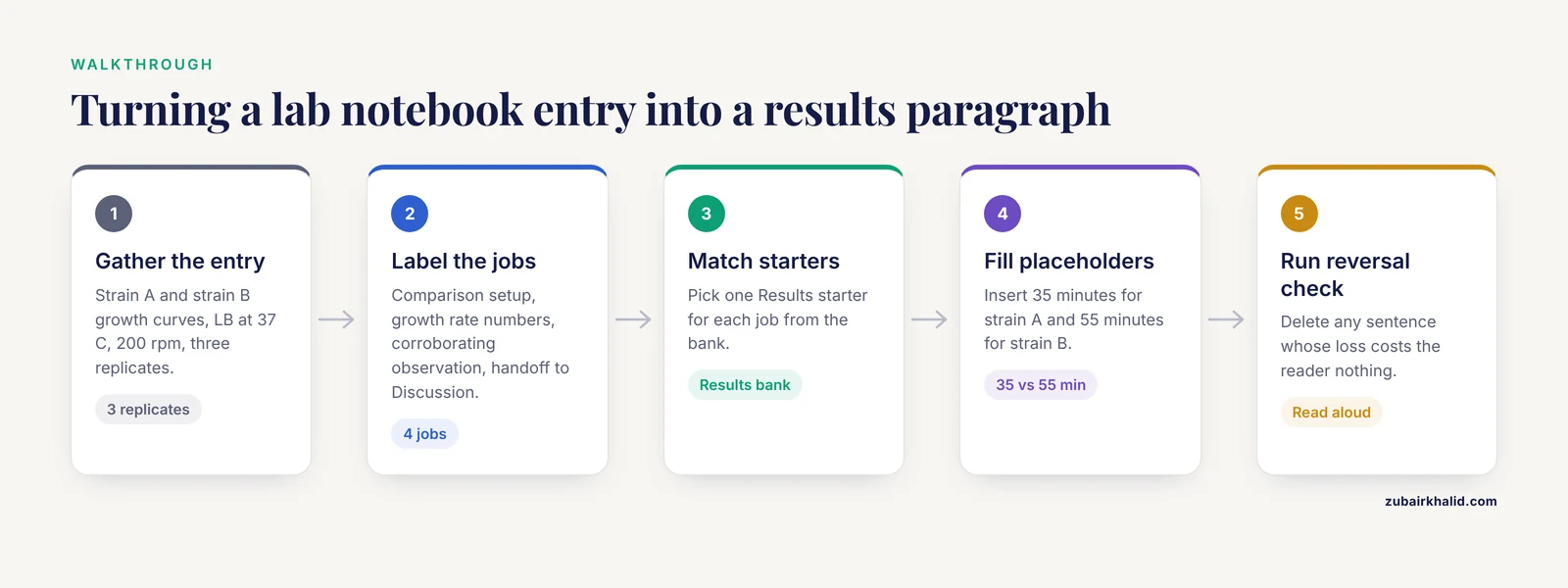
This walkthrough converts a raw notebook entry into a publication-quality Results paragraph using the starter format. Follow it with your own material after reading.
Step 1. Gather the raw entry.
Suppose your lab notebook contains this entry:
2026-10-14. Ran growth curves for strain A and strain B.
Both grown in LB at 37 C, shaking 200 rpm, 3 biological replicates each.
Strain A doubled every ~35 min. Strain B doubled every ~55 min.
Strain B looked sick, smaller colonies on plate.
Step 2. Identify the sentence jobs.
A Results paragraph for this entry needs four jobs: state the comparison, give the quantitative outcome, give the supporting observation, and hand off to interpretation. Write each job as a label in your draft file:
JOB 1: comparison setup
JOB 2: growth rate numbers
JOB 3: corroborating observation
JOB 4: handoff to Discussion
Step 3. Match a starter to each job.
From the Results bank above, select:
JOB 1 starter: "We compared [A] and [B] under [conditions]."
JOB 2 starter: "[X] grew [faster/slower] than [Y], with [quantitative detail]."
JOB 3 starter: "This difference was accompanied by [observation]."
JOB 4 starter: "Together, these observations indicate [preliminary point]."
Step 4. Fill the placeholders with notebook content.
We compared the growth of strain A and strain B in LB medium at 37 C
with shaking at 200 rpm, using three biological replicates per strain.
Strain A grew faster than strain B, with a doubling time of
approximately 35 minutes for strain A versus approximately 55 minutes
for strain B. This difference was accompanied by visibly smaller
colonies of strain B on solid medium. Together, these observations
indicate a growth defect in strain B under these conditions.
This block is the expected output of the walkthrough. Read it against the notebook entry. Every number traces to a note, every sentence performs one job, and the final sentence hands the reader to the Discussion without overclaiming a mechanism.
Step 5. Run the reversal check.
Read the paragraph aloud and ask, for each sentence, what a reader would lose if it were deleted. If the answer is "nothing," delete it. If a sentence performs two jobs, split it. If a sentence contains an interpretation word in the Results section, move that claim to the Discussion.
Step 6. Log the paragraph back to the notebook.
Add a line to the notebook entry pointing at the finished text, for example "Results paragraph drafted 2026-11-11, saved as results_growth_v1.docx." This closes the loop between raw data and manuscript text, which is the habit that separates reproducible writers from scrambling ones.
Starter Patterns at a Glance
The table below summarizes the core patterns, the jobs they perform, and where each belongs in a manuscript. Keep it next to your draft and use it as a checklist.
| Job | Starter pattern | Where it belongs | Example fill |
|---|---|---|---|
| Establish context | "[X] is central to [field] because" | Introduction, first paragraph | "Biofilm formation is central to chronic infection because it protects bacteria from antibiotics." |
| State the gap | "However, little is known about" | Introduction, end | "However, little is known about plasmid transfer inside biofilms." |
| State the aim | "Here, we asked whether" | Introduction, final paragraph | "Here, we asked whether biofilms accelerate plasmid transfer." |
| Justify a method | "We selected [method] because" | Methods | "We selected qPCR because it quantifies plasmid copy number directly." |
| Report a result | "[X] changed by [amount] in [condition]" | Results | "Viable counts fell by 45% under treatment." |
| Point to a display item | "Figure [n] shows" | Results | "Figure 2 shows the full time course." |
| Offer a mechanism | "One possible explanation is" | Discussion | "One possible explanation is reduced plasmid uptake in stationary phase." |
| State a limitation | "Our study has several limitations" | Discussion, late | "Our study has several limitations, including sample size." |
| Close the paper | "These results indicate that" | Discussion, final paragraph | "These results indicate that biofilm structure shapes transfer dynamics." |
Adapting the Format for Other Documents
The same starter bank stretches across the documents a working scientist produces. The trick is knowing which subset to use.
Research proposals. A proposal is an introduction written in the future tense with a budget of credibility. The gap and aim starters carry over directly, and the methods starters convert to planned actions.
We will use [method] to [purpose].
Preliminary data from our lab show that [supporting result].
This project will determine whether [question].
Failure of [step] would be addressed by [contingency].
The last pattern, the contingency sentence, is the one reviewers of proposals read most carefully. Grant panels want evidence that you have thought about what happens when the plan meets reality.
Thesis chapters and reviews. Literature-heavy documents lean on the citation verbs. Build a personal roster of reporting verbs at three strength levels, strong ("demonstrated," "established"), neutral ("reported," "described"), and tentative ("suggested," "proposed"), and check that every citation sentence uses a verb that matches your actual confidence in the claim.
Posters and talks. Convert each Discussion starter into a headline. "One possible explanation for this is reduced plasmid uptake" becomes the slide title "Reduced plasmid uptake may explain slower transfer." The starter becomes the claim, and the evidence moves underneath it.
Lab notebooks. This is where the daily discipline pays off. A useful lab notebook template gives each entry fixed fields, and the fields map one to one onto Results paragraph jobs.
DATE:            [date]
EXPERIMENT:      [one-line goal]
METHOD SUMMARY:  [what you did, with conditions]
OBSERVATIONS:    [what you saw, numbers first]
PROBLEMS:        [what went wrong, deviations]
NEXT STEPS:      [decision or follow-up]
OBSERVATIONS becomes your Results sentences. METHOD SUMMARY becomes your Methods sentences. NEXT STEPS often becomes the final "Together, these observations indicate" sentence or the next experiment's rationale. Writers who keep a structured notebook draft Results sections in minutes rather than hours, because the sentence jobs were performed at the bench.
If you prefer working on paper, a lab notebook template PDF with these fields printed as a form works just as well. Many universities provide generic notebook page templates as downloadable PDFs through their research offices or writing centers, and pre-formatted laboratory notebooks sold by scientific suppliers follow the same field logic. The exact fields matter less than the habit of separating what you did, what you saw, and what you think it means, because those three categories become your Methods, Results, and Discussion sentences.
Common Mistakes and Limitations
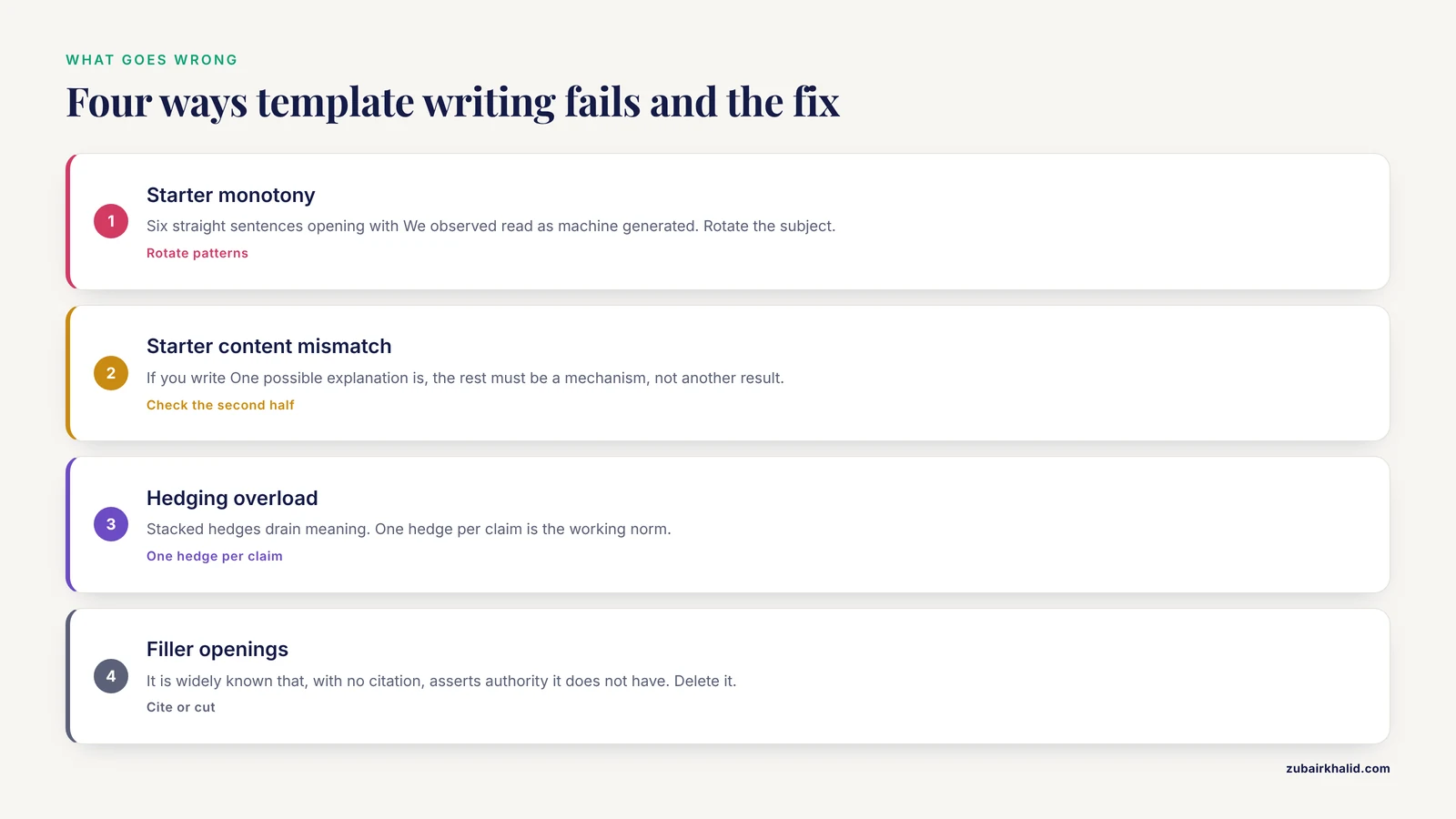
Template-based writing fails in predictable ways. Each of the following is a real failure mode seen in review drafts, with the fix.
- Starter monotony. Opening six consecutive Results sentences with "We observed" produces prose that reads as machine-generated. Rotate between the data-subject pattern ("Viable counts fell") and the observer-subject pattern ("We observed a fall in viable counts") across a paragraph.
- Starter content mismatch. A starter that promises one job while the sentence performs another confuses readers more than no starter at all. If you write "One possible explanation is," the rest of the sentence must actually be a mechanism, not another raw result. After drafting, reread each sentence and confirm the second half delivers what the first half promised.
- Hedging overload. Stacking hedges ("it may possibly be the case that perhaps") drains meaning. One hedge per claim is the working norm. If a claim needs two hedges, the underlying evidence is probably too weak for the claim, so soften the claim itself.
- Overclaiming in citation verbs. Writing "Smith demonstrated" when Smith's evidence was correlational commits you to a strength the source does not have. Reviewers who know the cited work will flag it, and it damages trust in your other claims.
- Template dependence in the Discussion. Starters can carry structure, but they cannot supply the reasoning between your results and your conclusion. A Discussion where every sentence is a stock phrase with no specific reference to your own data reads as empty. Every interpretive starter must be followed by content unique to your study, usually a number, a comparison, or a mechanism.
- Tense drift. Established convention in the life sciences is past tense for your own methods and results, present tense for general truths and for what figures show ("Figure 2 shows"), and present or past for literature depending on whether you are describing a finding (past) or its ongoing relevance (present). Mixing tenses within one sentence is the most common mechanical error in early drafts.
- Filler openings. Starters such as "It is widely known that" and "Studies have shown that" without a citation assert authority they do not possess. If you cannot attach a citation or a specific finding, delete the sentence, because a claim no one can check has no place in a scientific paragraph.
- Copying structures from your own field into new genres. The sentence format that works for a research article does not transfer unchanged to a lay summary or a regulatory document. Each genre has its own audience contract, so re-derive the sentence jobs for the new genre before reusing the starters.
One honest limitation of any template applies here as well. Sentence starters organize thinking you have already done. If the underlying logic of your study is unclear, the template will expose that unclarity rather than fix it, which is a feature, but a uncomfortable one. The remedy is to return to your data and your notebook, not to the template.
Individual manuscripts also face journal-specific style rules on voice, tense, and structure, so always check the target journal's guide for authors before submission and adjust the template output to match.
Frequently Asked Questions
What are scientific writing sentence starters?
They are reusable opening phrases that signal what a sentence will do, such as introduce a gap ("However, little is known about"), report a result ("We observed"), or propose an explanation ("One possible explanation is"). They act as scaffolding that speeds drafting and helps readers follow your argument.
How do I use a scientific writing sentence starters template without sounding repetitive?
Rotate between starter patterns that perform the same job and vary the grammatical subject from sentence to sentence. Within one paragraph, aim for no more than one sentence with any given opener, and read the paragraph aloud to catch monotony.
Can you give a scientific writing sentence starters example for a results section?
Yes. A three-sentence example: "We compared the growth of strain A and strain B in LB medium at 37 C. Strain A grew faster than strain B, with a doubling time of approximately 35 minutes versus approximately 55 minutes. This difference was accompanied by visibly smaller colonies of strain B on solid medium."
What is the correct format for scientific writing?
The standard format for empirical papers is IMRaD, which stands for Introduction, Methods, Results, and Discussion, usually preceded by an abstract and followed by references. Each section has characteristic sentence jobs, and the starter bank in this article is organized around those jobs.
How do sentence starters fit into a research template?
A research template defines the sections and fields of a document, while sentence starters define the openings of sentences within each field. Combine them by assigning a starter category to every template field, so a notebook field labeled OBSERVATIONS is drafted with Results starters and a field labeled NEXT STEPS uses aim starters.
Can I use sentence starters in a lab notebook?
Yes, and doing so makes later manuscript drafting much faster. Use did-observed-concluded starters in each entry, for example "I performed," "I observed," and "This suggests," keeping interpretations clearly separated from observations so raw data stay clean for the manuscript.
Where can I find a lab notebook template PDF?
Check your university's research office, writing center, or graduate program website, many of which offer free downloadable notebook page templates as PDFs. Scientific suppliers also sell pre-formatted laboratory notebooks with structured fields such as date, experiment, observations, and sign-off lines.
Do sentence starters work for abstracts?
Yes, they work especially well because an abstract has exactly one sentence per job. Open with a context sentence, state the question with "We asked whether," summarize the method with "We used," report the headline result with "We found that," and close with "These results indicate."