Scientific Project Proposal Template: A Selection Guide
By Dr. Zubair Khalid, DVM, MS, PhD ·
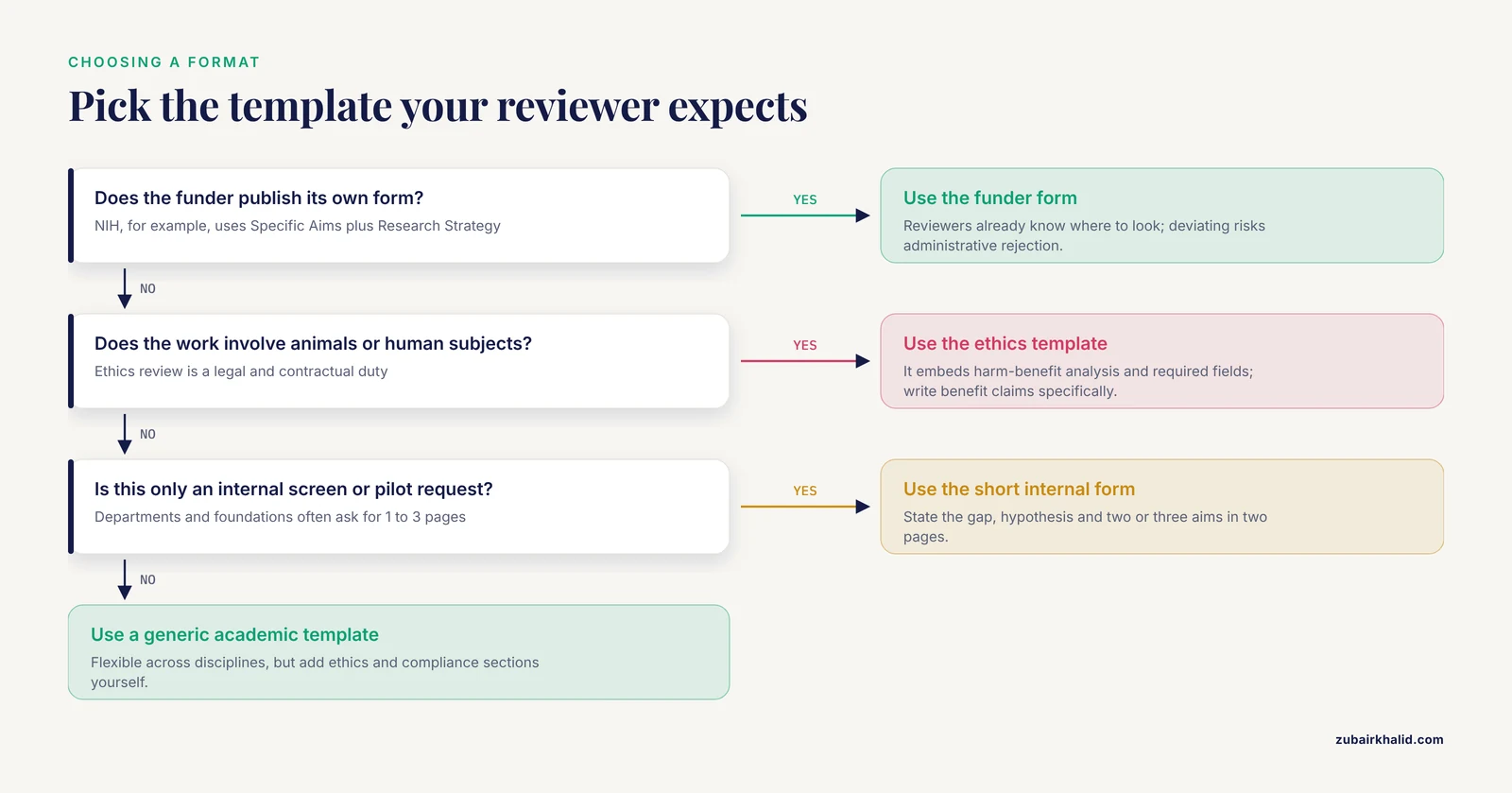
A scientific project proposal template is a pre-structured skeleton for a research plan, while a research template in general is any reusable document format that organizes how you plan, record, or report work. The rule of thumb for choosing: start from the template your reviewer already knows how to read. If a funder supplies a format, use that format. If nobody dictates one, use a generic academic proposal structure and borrow section logic from funder models. The template never writes the science for you, but the right one keeps a reviewer from losing your best ideas in a wall of free text.
This guide walks through the main scientific project proposal template options, lays out the pros and cons of each in a side-by-side comparison, works through realistic selection scenarios, and flags the mistakes that waste the most time.
What a Scientific Project Proposal Template Actually Does
A template does three jobs. First, it standardizes sections so a reviewer can find your hypothesis, aims, methods, and expected outcomes without hunting. Second, it forces completeness. A good research template has a field for every element a reviewer expects, which means an empty field announces itself. Third, it embeds compliance, since funder and ethics templates hard-code the requirements you are legally or contractually obliged to address.
The completeness effect is measurable. In a retrospective audit at a tertiary care radiology department, researchers compared 30 pelvic MRI reports written as free text with 30 written after a structured reporting template was introduced, all for suspected or biopsy-proven primary rectal carcinoma. Reports were scored against a predefined checklist of essential staging elements, including tumor distance from the anal verge, circumferential resection margin status, depth of extramural spread, extramural vascular invasion, and involvement of the low rectal sphincter complex. The structured template was associated with more complete documentation of the elements that drive treatment planning [1]. The setting was clinical reporting rather than grant writing, but the underlying principle transfers directly: when the structure demands an entry, the entry gets made.
Free-text writing has the opposite failure mode. Important items go unstated, not because the author does not know them, but because nothing prompts them. A proposal template is, in effect, a checklist disguised as a document.
Scientific Project Proposal Template Options
There are six broad options. They are not mutually exclusive, and most working scientists eventually use several.
Funder-specific grant templates
Agencies that fund research publish their own forms, page limits, and section orders. The National Institutes of Health (NIH), for example, organizes applications around a short Specific Aims page followed by a Research Strategy, a structure reviewers have read thousands of times. The competition for these awards is intense, and a recurring finding in the grant-writing literature is that many early-career biomedical investigators lack sufficient grant-writing skills [2]. That gap makes the funder template more valuable, not less, because every hour spent reinventing structure is an hour not spent on the science.
Funder templates also encode reviewer habits. A reviewer who has scored hundreds of NIH applications knows exactly where to look for innovation, approach, and rigor. Deviating from the expected structure forces that reviewer to search, and searching is a mild form of annoyance you do not want to cause.
Generic academic research templates
For thesis proposals, dissertation committees, coursework, and intra-university projects, a generic academic template usually covers the same core sections: title, abstract, background and significance, hypothesis, specific aims, methods, analysis plan, timeline, budget, expected outcomes, potential problems and alternatives, ethical considerations, and references. Length varies from 3 to 10 pages depending on the institution.
The strength of a generic research template is flexibility. You can reshape it for a ecology field study or a computational modeling project without violating anyone's formatting rules. The weakness is the absence of built-in compliance checks. Nothing in a generic template reminds you that your animal work needs a harm-benefit justification or that your human subjects data need a privacy plan. Those prompts have to come from you.
Internal pre-proposal and letter of intent templates
Many departments, institutes, and foundations use a short internal template, often 1 to 3 pages, to screen ideas before a full application is invited. A letter of intent template typically asks for the gap in knowledge, the central hypothesis, two or three aims, a sketch of the approach, and the resources needed. The format forces prioritization. If you cannot state your hypothesis and three aims in two pages, the problem is usually the hypothesis, not the page limit.
Animal research and ethics proposal templates
Proposals involving animals pass through a formal review process built on a structured template. In the European regulatory context, harm-benefit analysis (HBA), the structured weighing of expected animal harm against expected benefit, is one pillar of Directive 2010/63/EU, which governs animal research [3]. A review of the animal research ethics literature found that proper implementation of HBA is hampered by vague policies, particularly around assessing benefit [3]. The same review identified three considerations for improving proposals: the epistemic benefits of preclinical trials receive scarce value, ethical evaluation should better account for experimental quality and validity, and researchers should engage the public more actively to rebuild trust in biomedicine [3].
The practical takeaway for anyone filling in an ethics template is that vague benefit language ("this study will advance our understanding") is a documented weakness. Reviewers respond better to specific claims about what the experiment will establish, how validity will be protected, and why the design justifies the harm.
Structured reporting and data collection templates
A second family of templates governs what happens after approval. Structured reporting templates, case report forms, and standardized data extraction sheets enforce completeness during execution and publication. Structured extraction templates are now routine even in methodology reviews. A rapid review of generative artificial intelligence in qualitative health research, conducted under Joanna Briggs Institute and PRISMA guidance, extracted study data using a structured template to keep the synthesis consistent across studies [4].
These templates connect directly back to your proposal. A well-built data collection template mirrors the aims and outcome measures you declared, which makes it easy to show, at the end, that you delivered what you proposed.
Disciplinary staged frameworks
Some fields prescribe a staged structure rather than a single form. Surgical innovation research uses the IDEAL framework, which stands for idea, development, exploration, assessment, and long-term study, a staged approach that matches the evaluation method to the maturity of a new technique [5]. The framework has been applied to robotic-assisted minimally invasive esophagectomy, where early proof-of-concept reports progressed through exploratory studies and randomized trials and finally into a global registry that had collected 5,567 cases across 58 contributing sites as of November 2025 [5]. The lesson for proposal writers is that a "template" can be a sequence of predefined study types, and asking whether your project fits a recognized staging framework can strengthen the justification section considerably.
Side-by-Side Comparison
The table below is the core of the selection decision.
| Template type | Typical length | Best suited for | Pros | Cons |
|---|---|---|---|---|
| Funder-specific grant template | 5 to 15 pages plus agency forms | Applications to a specific agency | Matches reviewer expectations exactly, hard-codes compliance, minimal guesswork | Rigid, heavy agency boilerplate, useless for other audiences |
| Generic academic proposal template | 3 to 10 pages | Thesis proposals, coursework, first projects | Flexible across disciplines, teaches core structure, easy to adapt | No built-in compliance prompts, format may not match external reviewers |
| Internal pre-proposal or letter of intent | 1 to 3 pages | Internal screening, pilot funds, resource requests | Fast to complete, forces prioritization of aims | Too short for scientific depth, usually a gate rather than a final document |
| Animal research and ethics template | Varies by institution and regulation | Studies involving animals or human subjects | Embeds harm-benefit analysis and legal duties [3] | Benefit language tends toward vagueness, high compliance burden |
| Structured reporting or data template | Follows the study | Data collection, documentation, audit | Improves completeness of records and reports [1] | Can encourage checkbox thinking over interpretation |
| Disciplinary staged framework | Multi-document, multi-year | Maturing techniques and programs | Aligns evidence demands with project maturity [5] | Slow by design, requires long-term commitment |
Scientific Project Proposal Template Pros and Cons
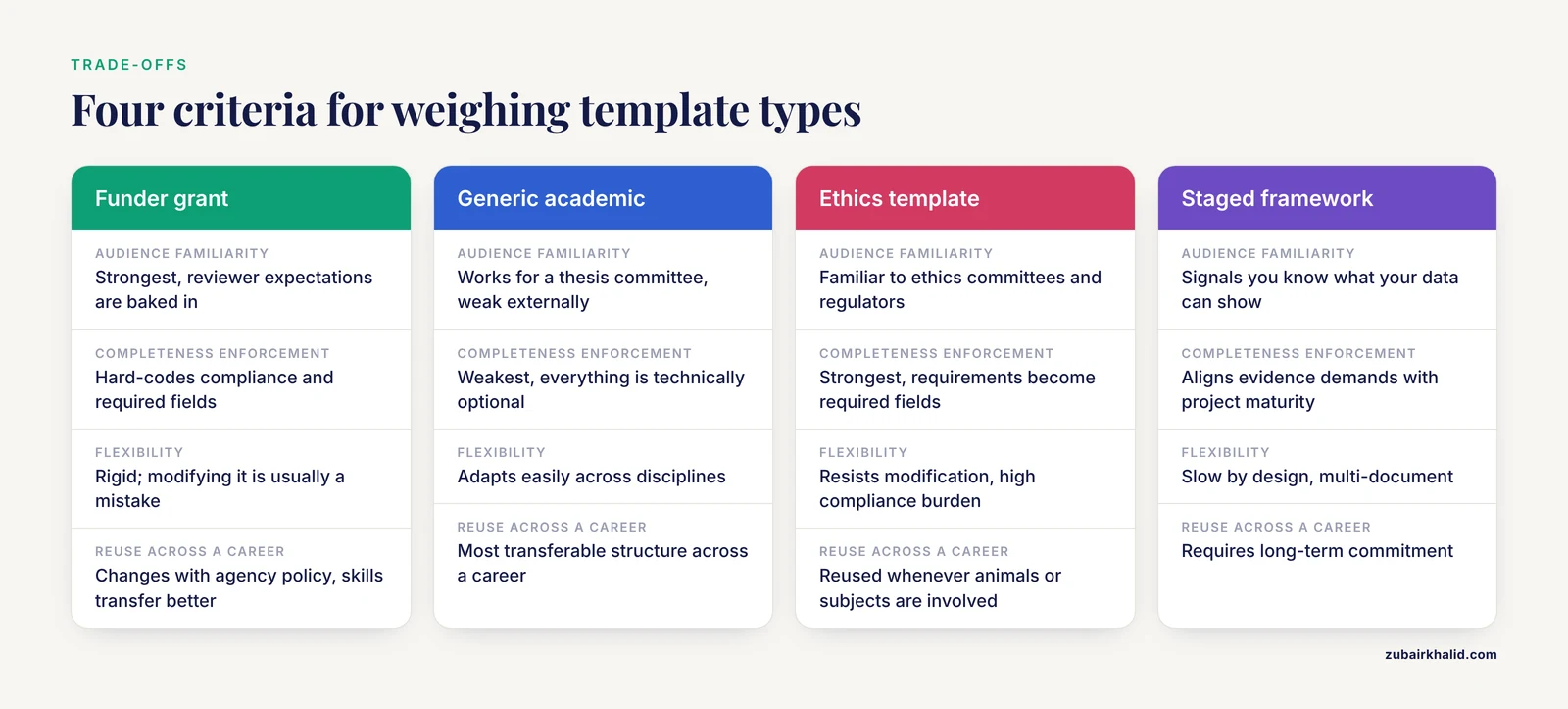
Beyond the table, the trade-offs cluster around four criteria.
Audience familiarity. A funder template wins here because the reviewer's expectations are baked in. A generic template loses with external reviewers but works fine for a thesis committee that has seen the same format for decades. When choosing the best scientific project proposal template for your situation, identify who reads the document first and pick the format that reader already trusts.
Completeness enforcement. Ethics and reporting templates are the strongest, because they turn requirements into required fields [1]. Generic templates are the weakest, since everything is technically optional. If your project has regulatory exposure, choose the template with the most explicit required fields, even if it feels bureaucratic.
Flexibility. Generic and internal templates adapt easily. Funder and ethics templates resist modification, and modifying them is usually a mistake, because deviating from a mandated format can get an application administratively rejected before scientific review begins.
Reuse across a career. Generic academic structure is the most transferable. Once you know how to build background, hypothesis, aims, and methods, you can pour that structure into any mandated form. Funder templates change with agency policy, so skills transfer better than documents do.
There is also a trade-off inside every template choice: structure versus originality. A rigid form can flatten a genuinely novel idea into language that sounds like every other application. The remedy is not to abandon structure but to put originality where reviewers expect it, chiefly in the hypothesis and the approach, while keeping the scaffolding conventional.
Worked Scenarios
Scenario 1: A postdoc preparing a mentored career development application. The right starting point is the funder's own template, because the review panel reads thousands of applications in that format. Beyond the document itself, evidence supports structured support. A group-randomized trial enrolled 367 faculty and postdoctoral fellows across 76 grant-writing coaching groups in 6 cohorts between 2020 and 2022, randomizing groups to different coaching durations and different modes of engaging each participant's scientific mentor. Overall, 69 percent of participants submitted at least one national application and 32 percent received at least one award. Among faculty, structured engagement of a mentor in the coaching process was associated with significantly higher odds of any award (adjusted odds ratio of 1.87) and of receiving an NIH mentored career development award (adjusted odds ratio of 3.32) [2]. Translation: pair the funder template with a mentor who engages in a defined, structured way, not just an occasional read-through.
Scenario 2: A PhD student writing a first thesis proposal. Start with a generic academic template from your program, then check whether your committee wants anything added. Because nothing in a generic template prompts you on ethics, add those sections yourself. If the project involves animals, port the harm-benefit logic from an ethics template into your proposal, and write the benefit claims specifically rather than generically, since vague benefit justifications are a recognized weakness in animal project proposals [3].
Scenario 3: A lab defining a collaborative, multi-stakeholder project. When a project involves many partners who must agree on scope, the template choice matters less than the process of filling it in. The Outdoor Air and Health Atlas project used a co-creation process modeled on the Delphi method, running two rounds of questionnaires with open-ended questions in which participants proposed options for data sources, exposures, health outcomes, and analysis methods, with responses from the first round informing the second round and a plenary session with external experts closing the loop [6]. A proposal written this way arrives pre-negotiated, which prevents the common failure of partners discovering disagreements after funding.
Scenario 4: A team adopting a new technical method in the clinic. If your proposal introduces an innovation that will need years of evaluation, structure it around a staged framework from the start. Declaring which stage your project occupies (proof of concept, exploration, assessment, or long-term study) tells reviewers that you understand what your data can and cannot establish at this point [5].
Where a Lab Notebook Template PDF Fits In
A proposal is a plan. A lab notebook is the record that shows whether the plan was followed. A lab notebook template pdf is simply a printable page with predefined fields, typically the date, experiment number, the aim it belongs to, reagents and conditions, observations, calculations, deviations from plan, and signature lines. The template form matters because free-form notebooks suffer the same completeness problem as free-text reports. Fields get skipped, conditions go unrecorded, and a year later nobody can reconstruct what happened.
The practical link between the two documents is traceability. When your notebook template has an explicit field linking each experiment to a specific proposal aim, every page of data maps onto a section of the funded proposal. That mapping makes progress reports trivial to write and makes it obvious early when an aim is failing and needs replanning. Printed templates also suit environments where electronic devices are impractical, such as work near magnetic field sources or in animal facilities.
Common Mistakes and Limitations
Filling the template before defining the science. Writers who start typing into section headings often produce a document shaped by the form rather than by the question. Write the hypothesis and the three aims on a blank page first, then choose the template that best displays them.
Copying prior text wholesale. Reusing your own or others' past proposals raises plagiarism and self-plagiarism problems, and reviewers recognize recycled paragraphs. Reuse structure, not sentences.
Treating the template as a substitute for logic. A form can enforce the presence of a methods section. It cannot make the methods sound. The animal ethics literature makes this point directly: evaluation should account for experimental quality and validity, not merely the presence of required sections [3].
Burying the key items. Reviewers work fast. The hypothesis, the innovation, and the expected outcome belong where the template and reader expect them, not scattered through the text.
Over-delegating to generative AI. AI tools are entering research workflows, including analysis stages, and reviews of their use report efficiency gains alongside continuing concerns about methodological rigor, interpretive capacity, equity, and ethical implications [4]. Using an AI assistant to draft proposal boilerplate is reasonable, but the scientific argument, the feasibility claims, and the ethical justifications must be yours and must be verified by you.
Assuming the template guarantees a good outcome. The structured reporting audit showed improved completeness, not improved correctness [1]. A complete proposal can still describe a flawed experiment.
Leaving benefit claims vague in regulated proposals. In animal research especially, reviewers and regulators are explicitly wrestling with how benefit should be assessed, and the ambiguity in current policy is acknowledged in the literature [3]. Specific, falsifiable benefit statements fare better than aspirational ones.
Ignoring process design for team projects. A template filled by one person and presented to others invites objections. Iterative structured rounds, as in the Delphi-style co-creation described above, resolve disagreements before the document is final [6].
One general limitation applies to everything above. Templates, guidelines, and review processes vary across institutions and funders, so confirm the current requirements with your own program officer, ethics office, or mentor before you commit to a format.
Frequently Asked Questions
What is a scientific project proposal template?
A scientific project proposal template is a reusable document skeleton that pre-defines the sections of a research proposal, such as background, hypothesis, aims, methods, timeline, budget, and ethics, so the writer fills in content rather than inventing structure. It exists to make proposals complete, comparable, and easy to review.
Which is the best scientific project proposal template?
The best scientific project proposal template is the one your primary reviewer already expects. Use the funder's own template when one exists, a generic academic template when no format is mandated, and the institution's ethics template whenever animals or human subjects are involved. Reviewer familiarity outweighs almost every other feature.
Can generative AI help me fill in a proposal template?
It can help with boilerplate, rewording, and checking that sections are present, but reviews of AI use in research methods report ongoing concerns about rigor, interpretive capacity, and ethics [4]. Treat AI output as a draft to verify, and write the scientific argument and ethical justification yourself.
How detailed should the methods section be?
Detailed enough that a knowledgeable colleague could judge whether the experiment will work and, later, whether it was done as proposed. Include the design, samples or subjects, measurements, analysis plan, and contingency plans for the most likely failure points. Vague methods are the most common reason reviewers lose confidence in an otherwise interesting idea.
Do I need a lab notebook template as well as a proposal template?
Yes, they serve different stages. The proposal template organizes the plan before the work starts, and the lab notebook template organizes the record while the work happens. A notebook template with a field linking each experiment to a proposal aim makes progress reporting and troubleshooting far easier.
When should I start working from a template before a deadline?
Start as early as possible, ideally weeks before you plan to write. Choosing the template first settles the required sections, page limits, and compliance items, and leaves the remaining time for the parts templates cannot supply, namely the hypothesis, the logic, and the preliminary data. Evidence from grant-writing coaching programs suggests structured, sustained engagement over months rather than days improves outcomes [2].
Sources
- Impact of a Structured MRI Reporting Template on the Completeness of Primary Rectal Cancer Staging Reports: A Retrospective Audit.
- Grant writing coaching groups: A randomized trial to discern the influences of coaching duration and engagement of scientific mentors on participants' proposal submission and success rates.
- Cui Bono? Characterisation of the benefit concept and the justificatory narratives in animal research ethics literature.
- Generative Artificial Intelligence for Qualitative Methods in Health Research: Rapid Review.
- The Impact of Robotics on Benchmarking Criteria for the Surgical Treatment of Esophageal Cancer in Western Centers: An Evaluation Using the IDEAL Framework.
- The co-creation process of the “Outdoor Air and Health Atlas” project: A tool to support decisions and research.