Science Fair Project Template Bundle: How to Choose the Right Set
By Dr. Zubair Khalid, DVM, MS, PhD ·
The difference that decides this choice is coverage versus fit. A science fair project template bundle packages scaffolds for every deliverable a fair expects, while a single research template structures one document, such as a lab notebook or a report outline. The rule of thumb: choose the smallest bundle that covers every deliverable your fair actually grades, and skip any piece you will not realistically fill in.
Bundles exist because science fair projects fail in predictable ways. Students collect data they cannot chart, cite websites they never evaluated, or reach the poster deadline with a notebook that has no dates in it. Templates attack those failures directly, and the market now runs from a free lab notebook template PDF to paid kits with grading keys and submission checklists. This guide is written for students choosing a kit, and for the teachers and mentors who buy thirty of them at a time.
The clearest picture of what a bundle must cover comes from students themselves. A national survey of high school Science and Engineering Fair (SEF) participants asked which communication and presentation practices they used during their projects, from literature review and research notebook through written report, poster, and the interview with judges. Across surveys run in 2021-22 and 2022-23, 1,789 students answered [1]. Those practices map to Obtaining, Evaluating, and Communicating Information, one of the eight Science and Engineering Practices in the National Research Council framework behind the Next Generation Science Standards [1]. A bundle earns its keep when it supports those practices in the order a real project needs them.
What a Science Fair Project Template Bundle Contains
Two terms come up constantly, so let's pin them down. A research template is a pre-structured document that guides one stage of a project, such as a background planner, a data table, or a report outline. A lab notebook template PDF is the printable version of that idea for the experimental record, with numbered pages and fixed fields for date, objective, method, observations, and next steps.
Most bundles mix some subset of seven components, and the mix tracks the practices students report using at real fairs [1]:
- Question and background planner. Frames the testable question and identifies the variables.
- Source evaluation sheet. A checklist for judging website and article quality before anything gets cited.
- Lab notebook pages. Paper or PDF, with dated, numbered entries.
- Data collection sheets and a graphing guide. Blank tables sized for the project's variables, plus rules for choosing chart types.
- Analysis and results outline. Prompts for trends, outliers, and whether the data actually answer the question.
- Report, poster, and slide skeletons. Outlines for the written report, the poster board, and the presentation deck.
- Interview prep sheet. Anticipated judge questions and practiced answers.
The source evaluation sheet is the component most often missing, and school librarians treat it as a step of its own. Library guides built for science fair seasons walk students through website evaluation before a source gets cited, which keeps the background section from becoming a dump of first-page search results [2]. When you compare bundles, a missing source evaluation sheet is a reliable warning sign that the kit was assembled by someone who has never judged at a fair.
What a good lab notebook template includes
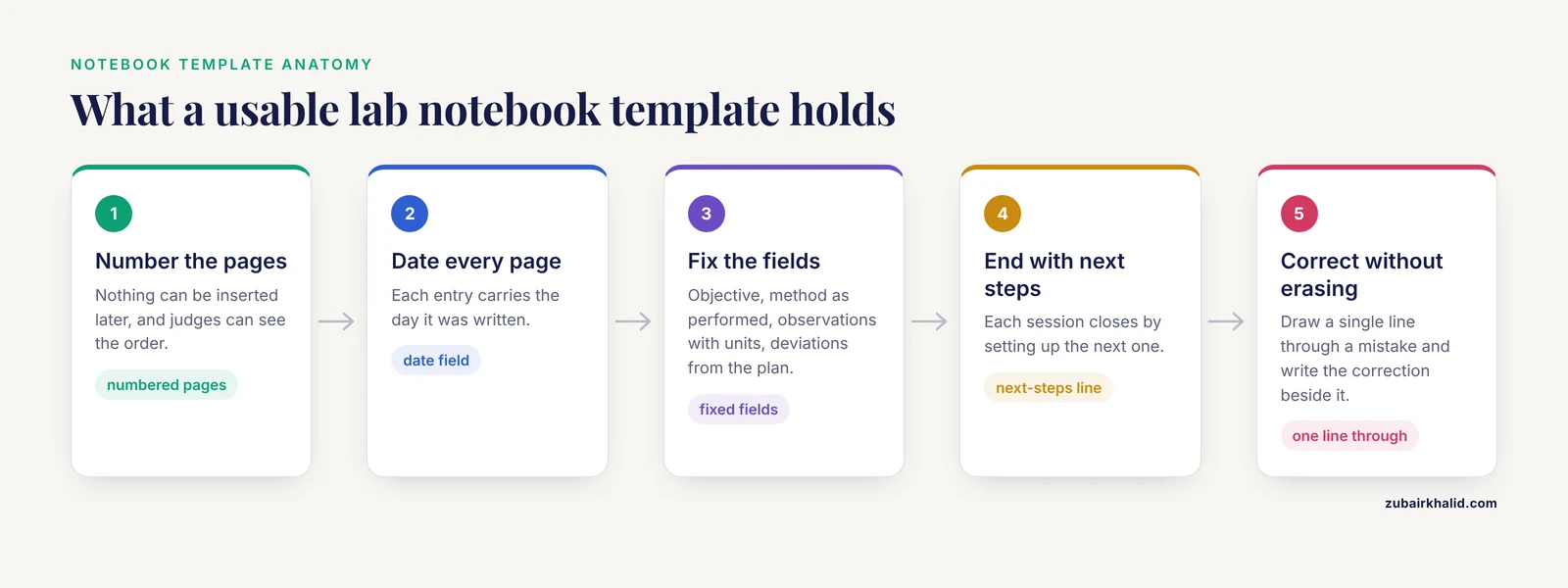
Whether paper or PDF, a usable lab notebook template has the same anatomy. Numbered pages, so nothing can be inserted later. A date field on every page. Fixed fields for objective, method as actually performed, observations with units, and deviations from the plan. A next-steps line at the bottom, so each session ends by setting up the next one. And a corrections rule: draw a single line through a mistake, write the correction beside it, and never erase or remove a page. Judges commonly ask to see the original notebook during the interview, so page numbering and dated entries do double duty as authenticity markers. A template without page numbers or date fields is a worksheet pretending to be a notebook.
Science Fair Project Template Bundle Options: The Four Main Types
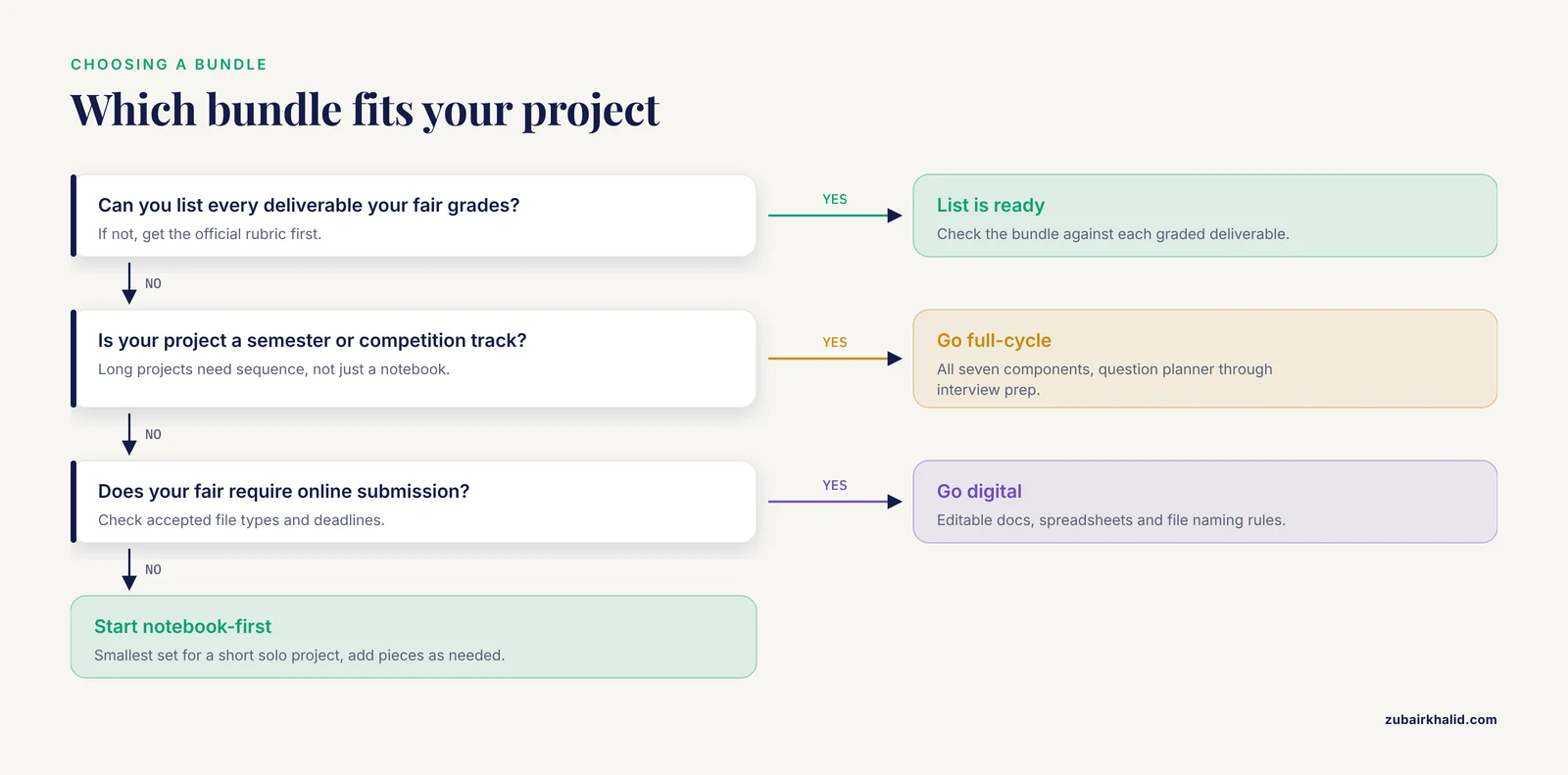
Four bundle types cover most of what is on offer. They differ in scope, format, and how tightly they connect to evaluation.
1. Notebook-First Bundle
The smallest set: a lab notebook template PDF, a data log sheet, and a one-page bibliography sheet. The bet behind it is that the notebook is the scientific record, and everything else can be written from it later. That bet holds for small projects, because project work differs from a classroom practical in a specific way. Research with science fair learners has evaluated their experience of scientific investigations in the classroom and during project work as two distinct settings [3]. In class, the teacher usually supplies the question and the method. In a project, the student owns both, which is exactly why a notebook with fixed fields for objective, method, and observations earns its place. The blank fields force the decisions that a classroom practical would normally make for you.
2. Full-Cycle Bundle
The complete set, covering all seven components from question planner to interview prep sheet. This is the default choice for a semester-long project, a competition track, or any setting where several students need a consistent structure. Its value is sequence. Background research precedes methods, raw data precedes analysis, and analysis precedes the poster, because the templates arrive in that order and each one references the output of the previous one. For a class, the same sequence lets a teacher spot a stalled project at week 3 instead of week 10, because an empty section is visible immediately. The cost is weight. A student with a narrow question and a six-week calendar will spend more time learning the bundle than running the experiment.
3. Digital and Submission-Ready Bundle
Editable documents, spreadsheets, submission-ready forms, and file naming rules, usually delivered as a shared folder. The case for tailoring digital tools to a specific fair is well documented. At one science and technology fair, organizers replaced generic online submission forms with a responsive web tool built specifically for the event, developed iteratively with SCRUM, an agile method built around short repeated development cycles. Participants rated the tool on the System Usability Scale (SUS), a ten-item questionnaire scored from 0 to 100, and average scores exceeded 75, a range the researchers classed as good to excellent, while the organizing committee found submission management substantially easier [4]. The transferable lesson: tailored tools beat generic ones. A digital bundle should match your fair's actual submission format, accepted file types, and deadlines, not a generic idea of what a science fair wants.
4. Rubric-Aligned Bundle
Every section maps to a line in the judging rubric, the scoring guide judges use, so each template exists because a judge scores for it. The design pattern has a serious precedent in research appraisal. The ImpResPAC tool, a quantitative appraisal instrument for implementation research, the study of how evidence-based programs get put into real-world practice, is being developed by mapping the domains of an existing methodological guidance tool onto scoring criteria, refining them with an international expert group, and then testing reliability and validity in a three-stage mixed-methods study [5]. The lesson transfers directly. A credible rubric-aligned bundle is derived from a named rubric, refined by people who judge, and checked against how scoring actually behaves. If a product claims alignment but will not say which criteria it maps to, treat the claim as decoration.
Side-by-Side Comparison of the Four Bundle Types
| Criterion | Notebook-first | Full-cycle | Digital and submission-ready | Rubric-aligned |
|---|---|---|---|---|
| Core pieces | Lab notebook template PDF, data log, bibliography sheet | All seven components, question planner through interview prep | Editable docs, spreadsheets, submission forms, file naming rules | Sections mapped line by line to a judging rubric |
| Best for | First solo project, short timeline | Full semester, competition track, teams | Fairs with online submission, shared group files | Students who know the rubric, teachers grading many projects |
| Setup effort | Lowest | Highest | Moderate, plus file discipline | Moderate, needs the rubric in hand |
| Main strength | The record-keeping habit forms early | No deliverable gets skipped | Fewer lost files, cleaner submissions | Every section has a graded reason to exist |
| Main trade-off | You build the rest yourself | Paperwork can crowd out the science | Generic forms fit real workflows poorly | Can narrow work to box-checking |
Read the table by column if you already know your constraints, and by row if you are still deciding what matters. The setup effort row is the one people underestimate, because a bundle's real cost is the hour spent learning its logic, not its price. No column wins outright. The deciding variables are the deliverables your fair grades, your timeline, the submission format, and the team size. The next sections turn those variables into selection criteria, pros and cons, and worked scenarios.
What Makes the Best Science Fair Project Template Bundle
Six criteria separate a bundle that will carry a project from one that will sit half-filled in a folder.
1. Deliverable coverage
List what your fair requires, then check the bundle against the list. The practice categories students report at SEFs, from literature review through the judge interview, are the realistic checklist [1]. A bundle without an interview prep sheet fails a deliverable most students underestimate, because the interview is where judges probe what the notebook actually recorded.
2. Data management built in
FAIR is the standard shorthand in modern research for data that is findable, accessible, interoperable, and reusable [6]. Large research platforms take this seriously. The PLANTdataHUB in plant science manages research data as evolving collections of files, supports scientists from early planning through data publication, and provides continuous quality control along the way [6]. A good bundle does the same job in miniature. Look for a file naming rule, a version column on every data sheet, and a hard separation between raw and processed data.
3. Format portability
Templates age, and formats lock in. The taxonomy community learned this the hard way. DELTA, a description language for taxonomy ratified as a standard in 1986, tied its data format to specific software, so any change to the standard required modifications across large amounts of software code and updates became difficult. The field later moved to the Structured Descriptive Data (SDD) standard in 2005 [7]. For a student bundle the practical version is simple. Prefer PDF for anything you will print, standard word processor and spreadsheet formats for anything you will edit, and plain text for raw data. Avoid kits that only open inside one vendor's app.
4. Evaluation alignment
The bundle should map to the scoring guide your judges actually use. The appraisal precedent in Option 4 sets the standard: criteria derived from a named source, refined by people who score, and checked against real scoring behavior. In practice, ask one question of any bundle's author or seller: which rubric does this map to, and where is that rubric published?
5. Adaptability across projects
A bundle is reusable when it separates fixed structure from project-specific fields. The notebook anatomy, the data sheet layout, and the report skeleton stay the same from project to project, while the question, variables, and rubric mapping change. Kits that hard-code an example project, such as a plant growth experiment, into every page force students to write around someone else's variables. The best test is to imagine a second project in a different topic and check whether the templates still make sense.
6. Honest scope
Even rigorous standards admit interpretation gaps. In research data management, different FAIR metrics produce different evaluation results for the same digital object. Bundles behave the same way. Two kits can both claim to be complete or aligned, and only a check against your fair's actual rubric and submission rules settles the question.
Science Fair Project Template Bundle Pros and Cons
| Bundle type | Pros | Cons |
|---|---|---|
| Notebook-first | Cheapest and fastest to start, builds the record-keeping habit, stays flexible | You assemble the report, poster, and interview guidance yourself, easy to miss a deliverable |
| Full-cycle | Nothing gets skipped, enforces sequence, keeps a class or team consistent | Heavy for a small project, invites box-checking |
| Digital and submission-ready | Shared editing, cleaner submissions, fewer lost files | Needs device access and file discipline, generic forms fit real workflows poorly |
| Rubric-aligned | Every section has a graded reason to exist, makes revision efficient | Needs the actual rubric, can narrow the work to what gets scored |
The cons share one theme, mismatch between bundle size and project scope. A full-cycle kit on a four-week project buries the science under paperwork. A notebook-first kit on a competitive multi-month project leaves the student to invent the report and poster structure in the final two weeks. Match the scope first, then the features. A quick self-test before you commit: write your fair's deliverable list on one line. If you cannot, you are not ready to choose a bundle, get the rubric first.
Worked Scenarios
Scenario 1: A first solo project on an eight-week timeline
An eighth grader testing a question about seed germination has one variable, one contributor, and a short deadline. A notebook-first bundle fits. Week 1 goes to the question planner and the source evaluation sheet. Weeks 2 through 5 run on the lab notebook and data sheets, one dated entry per work session. Week 6 is the analysis outline. Weeks 7 and 8 turn the notebook into a short report and a single poster. Nothing else is needed, and the student practices the habit that matters most, writing down what happened on the day it happened. At the interview, the dated notebook answers most questions before the student has to.
Scenario 2: A two-student engineering project at a competitive fair
Two students building a device over a semester need the full-cycle bundle plus teamwork forms. Shared templates hide unequal contributions, and evaluation research has addressed this directly. In a systems engineering course at a European university, a teamwork evaluation method individualized results by team member using team feedback and self-evaluation, and applying the method changed the final teamwork results [8]. The template implication is concrete. Add a contribution log updated at every work session, plus a short self- and peer-evaluation form completed before the report is written. Both take minutes per session and prevent the end-of-project argument about who did what.
Scenario 3: A community health project with local partners
Projects that work with a community, such as a water quality or hygiene study, need components that standard academic bundles omit. Project SHINE in rural Tanzania shows the full pattern. The program engaged pastoralist high-school students and their communities through teacher workshops, school-based lessons, extra-curricular activities, community events, and a One Health sanitation science fair, where One Health means the linked health of people, animals, and the shared environment. Pre- and post-questionnaires completed by students showed statistically significant improvements on key measures, including a decrease in unhygienic behaviors [9]. The template implication: add a community engagement log, a cultural relevance checklist, and pre- and post-survey sheets. A project that touches a community is judged partly on how it treated that community.
Scenario 4: A teacher facilitating a class set of projects
Running thirty projects at once is a management problem before it is a science problem. Research on agricultural science educators identifies limited teacher preparation and self-efficacy as barriers to facilitating agriscience research projects, a hands-on type of supervised agricultural experience (SAE) [10]. In a one-group pre-posttest study during the 2024 to 2025 school year, a professional development workshop for agricultural educators significantly increased perceived behavioral control, the teacher's confidence that facilitating projects is within their power (p < .001, Cohen's d = 1.29, a large standardized effect size), and intent to facilitate agriscience fair projects rose from 71.9 percent to 76.6 percent [10]. Here p < .001 means the improvement had less than a one in a thousand chance of being a fluke. The template implication is that teacher-facing bundles need pacing guides, grading keys, and safety review checklists, not just student worksheets. A bundle that only scaffolds the student leaves the teacher to invent the course management layer.
Common Mistakes and Limitations
Filling the template instead of doing the science. A completed notebook is not the goal. The notebook exists to record decisions while there is still time to change them, and a template filled in mechanically produces a neat record of a weak project. If a week produces no entries, that is a signal about the project, not the paperwork.
Choosing formats that lock you in. Standards tied to one software package age badly, as the taxonomy community learned when its once-standard descriptive format became difficult to update precisely because it was welded to specific programs [7]. Pick formats you will still be able to open after the fair, especially if you want to reuse the project for a portfolio or a later competition.
Deferring data management to the end. Modern research treats data management as a thread running from planning through publication, not a final cleanup step [6]. In student terms, decide the file naming rule and the raw versus processed split before the first data point exists.
Grading teams as a single unit. If your fair grades team projects, build individual accountability into the bundle from the start (see Scenario 2).
Citing whatever the search returns. Source evaluation is a step with its own checklist, not a formality (see the components list above).
Skipping the rehearsal. An interview prep sheet with anticipated questions is worthless until someone asks them out loud. Two practice sessions, one with a teacher or parent playing judge, expose the gaps between what the notebook shows and what the student can explain.
Assuming the bundle replaces adult guidance. Templates scaffold the work, they do not supervise it. Every project needs a safety review by a teacher, mentor, or adult supervisor before experiments begin, and the right guidance depends on the student's age, topic, and materials. No template substitutes for that review.
Buying scope you will not use. The rule of thumb from the opening holds. The smallest bundle that covers every graded deliverable beats a larger kit with unfilled sections, because an unused template adds guilt, not structure.
Frequently Asked Questions
What should a science fair project template bundle include?
At minimum, a template for every deliverable your fair grades. That usually means a question planner, a lab notebook, data sheets, a report outline, a poster layout, and an interview prep sheet, with a source evaluation sheet as the component most often missing.
Is a lab notebook template PDF enough on its own?
For a small first project it can carry the experimental record, but most fairs also require a written report and a poster, so a notebook alone leaves gaps you would have to improvise under deadline. Treat it as the foundation of a bundle, not the whole bundle.
Are digital templates better than paper ones?
Digital templates win for shared files, graphs, and online submission, while paper wins for bench-side logging where spills and dust are likely. Many students run both, a paper notebook plus digital data sheets.
How do I match a bundle to my fair's judging criteria?
Download the official rubric first, then check that every rubric line maps to a named section in the bundle. If the seller cannot name the criteria the kit aligns to, treat the alignment claim as marketing.
Can one bundle work for a team project?
Yes, if you add a contribution log and individual self-evaluation forms, because shared templates hide unequal contributions. Build both in from the first work session, not the last one.
When should I start using the templates?
At the question-selection stage, before the first experiment, so the notebook captures background decisions and source evaluations from day one. Starting at the analysis stage defeats the purpose of every template in the set.
Sources
- High school science fair: Characterizing student communication and presentation practices and their association with SEF outcomes
- Libraries: Science 8: Science Fair Project 2019: Website Evaluation
- Science fair learners' evaluation of their experience of scientific investigations in the classroom and during their project work
- Development of a responsive web tool for managing scientific project submissions: A comparative usability study at BRAGANTEC science fair
- Development and psychometric evaluation of the Implementation Science Research Project Appraisal Criteria (ImpResPAC) tool: a study protocol
- PLANTdataHUB: a collaborative platform for continuous FAIR data sharing in plant research.
- E-taxonomy, Open Science, and FAIR Principles: A comparison of how taxon descriptions are computerized
- Fair and Individualized Project Teamwork Evaluation for an Engineering Course
- Participatory science and innovation for improved sanitation and hygiene: process and outcome evaluation of project SHINE, a school-based intervention in Rural Tanzania
- Evaluation of the Impact of Professional Development on Agricultural Science Educators' Attitudes, Perceived Control, and Intentions Toward Facilitating Agriscience Fair Projects