The Right to Withdraw from Research
By Dr. Zubair Khalid, DVM, MS, PhD ·

By the end of this article you will be able to explain what the right to withdraw from research means, describe how it is grounded in research ethics, walk through the steps a participant takes to withdraw, and design a withdrawal procedure for your own study that handles consent, data, and documentation correctly. You will also learn the mistakes that most often trip up new researchers.
No special software is required to read this guide. If you want to follow the data-handling walkthrough, have Python 3 with the pandas library installed and a small practice spreadsheet ready. The worked examples use a hypothetical dataset of 300 participants so you can see the mechanics without touching real human data.
What the Right to Withdraw from Research Means
The right to withdraw from research is the right of a research participant to stop taking part in a study at any time, for any reason or no reason, without penalty and without having to justify the decision. In its fullest form it also includes the right to ask that data already collected from the participant be removed from the study dataset and not used in analysis or publication.
This right rests on the principle of voluntary participation. Consent that cannot be revoked is not really consent, it is a one-time waiver of autonomy. For that reason, the right to withdraw is treated as a core element of informed consent in research ethics, alongside disclosure of risks, benefits, and the purpose of the study.
The right has two distinct parts that new researchers often blur together:
- Withdrawal of participation. The participant stops attending visits, answering surveys, or providing samples from the moment they say so.
- Withdrawal of data. The participant asks that their previously collected data be excluded from analysis.
A participant may exercise the first without the second. Someone in a six-month study might stop attending appointments but allow the two visits they already completed to be analyzed. Another person might demand that every trace of their contribution be destroyed. Both are legitimate, and the consent process should make both options clear before the study begins.
Ethical and Regulatory Foundations
The right to withdraw appears in nearly every modern framework governing responsible conduct of research.
The Nuremberg Code, drafted in 1947 after the Nazi medical experiments, established in its first principle that the human subject should be at liberty to bring the experiment to an end. The Belmont Report, published in the United States in 1979, grounded this in the principle of respect for persons, which requires that individuals be treated as autonomous agents capable of entering and leaving research agreements by choice.
In the United States, the federal regulation known as the Common Rule (45 CFR 46) requires that informed consent documents include a statement describing how withdrawal may occur and what happens to data when it does. The Declaration of Helsinki, issued by the World Medical Association, likewise states that every prospective participant should be informed of the right to refuse or withdraw consent without reprisal.
Institutional Review Boards (IRBs), the committees that review and approve human-subjects research at US institutions, expect a study protocol and consent form to address three questions about withdrawal:
- How does a participant communicate the decision to withdraw?
- What data will be kept, removed, or anonymized after withdrawal?
- Are there any consequences, financial or otherwise, for the participant?
If your consent form cannot answer these three questions clearly, an IRB reviewer will likely send it back for revision.
Who Holds the Right, and When It Applies
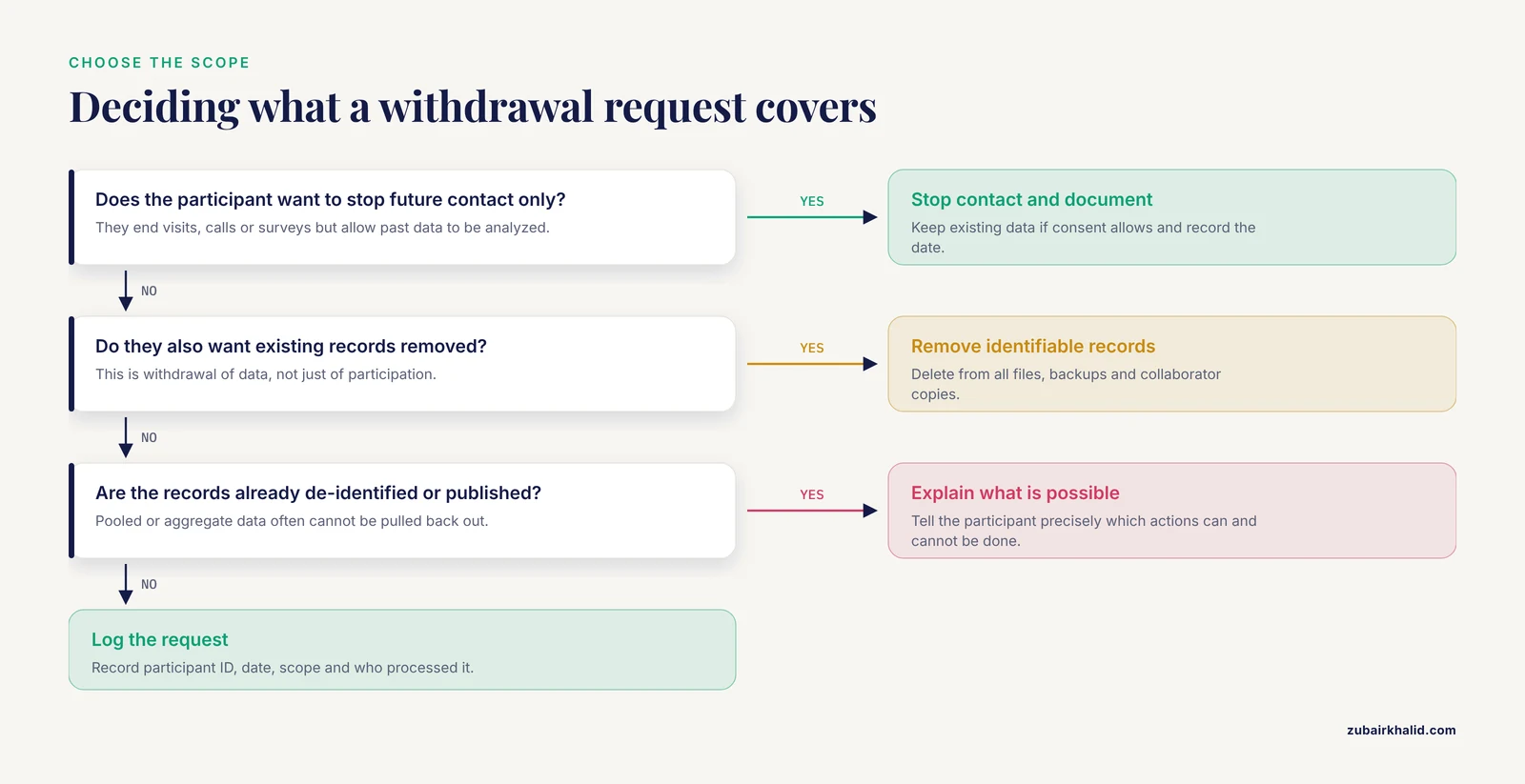
The right belongs to the participant, not to the investigator, the sponsor, or the participant's guardian in every case. Several practical boundaries matter.
Timing. The clearest application is during active data collection. The harder question is what happens after collection ends, once data have been coded, de-identified, merged into an aggregate dataset, or published. Many institutions distinguish between identifiable data, which can still be located and removed, and de-identified or aggregate data, which often cannot be pulled back out without compromising the whole dataset. Your consent form should state explicitly which of these applies.
Minors and proxies. Children enrolled in research typically assent while a parent or guardian consents. As the child matures, their own assent or dissent gains weight, and a teenager who refuses to continue is generally treated as having withdrawn.
Students and employees. When the researcher is also the teacher or the boss, the right to withdraw exists on paper but can feel risky in practice. Research ethics standards require that the participant not perceive any penalty, and responsible investigators add safeguards such as recruiting by a third party or collecting data anonymously after grades are submitted.
Group settings. In focus groups, a participant can withdraw their own future participation but cannot un-share what other participants heard. Researchers should warn participants of this limit before the session starts.
The Right to Withdraw in Research Ethics, Step by Step for Participants
If you are enrolled in a study and want out, the process should be simple. Here is the sequence.
- Locate your consent form. It names the principal investigator, the study title, and the IRB protocol number. Most forms include a phone number or email for the study team. You do not need to explain yourself, you only need to identify which study you joined.
- Decide the scope of your withdrawal. Do you want to stop future participation only, or do you also want your existing data removed? If you are unsure, ask the study team to explain what each option means for your records.
- Contact the study team and state your decision plainly. A message like "I am withdrawing from the study. Please remove all data collected from me" is sufficient. Keep a copy with a date.
- Ask for written confirmation. The study team should confirm what was done, including whether your data were deleted or retained under your original consent terms.
- Check any payment terms. Compensation for completed visits is generally owed regardless of later withdrawal, but partial-payment schedules vary by study. The consent form governs here.
- Contact the IRB if the response is unsatisfactory. The IRB contact information appears on your consent form. An IRB can pressure a nonresponsive study team directly.
You never need to give a reason, provide documentation, or speak to the investigator in person to exercise the right to withdraw from research.
Designing a Withdrawal Procedure, Step by Step for Researchers
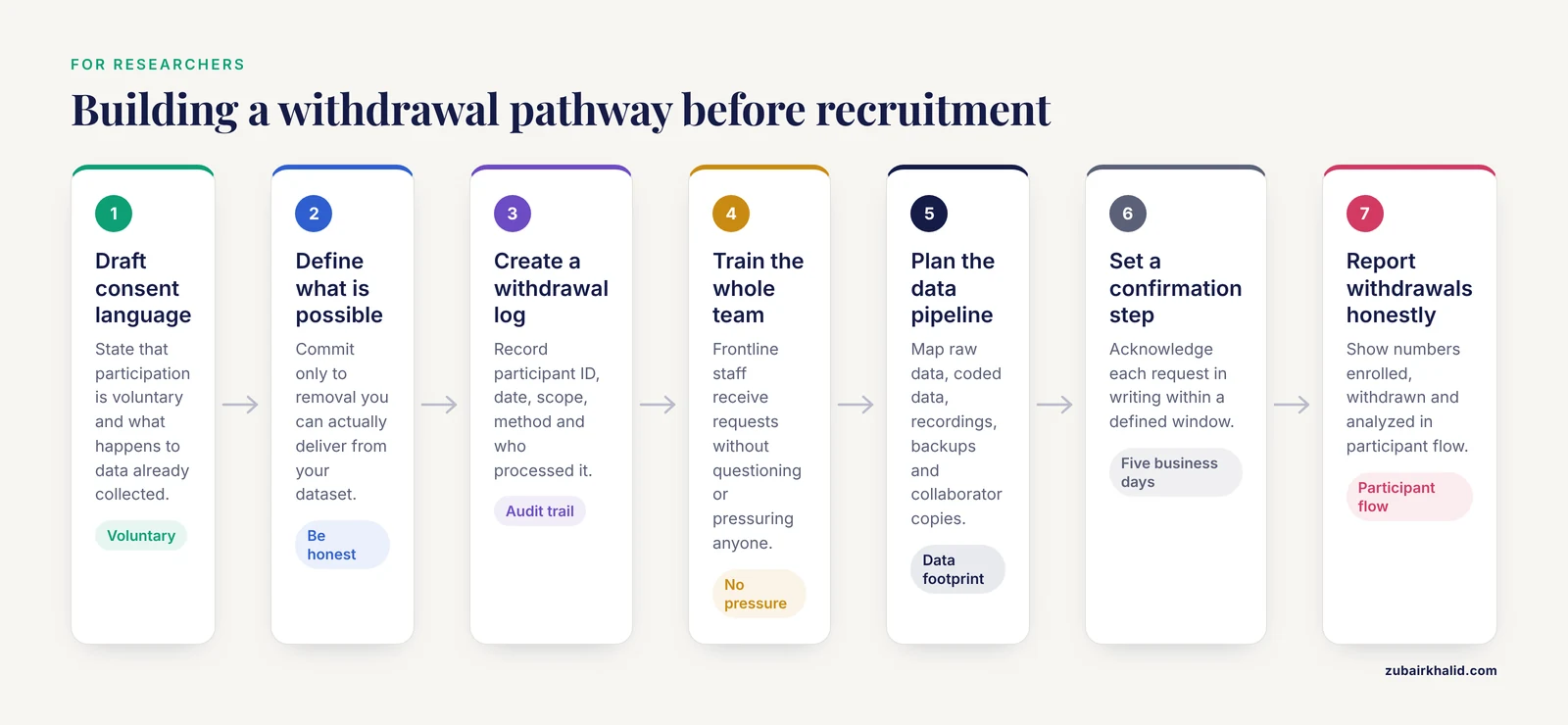
If you are preparing a protocol, build the withdrawal pathway before you recruit. The steps below reflect what IRBs and research ethics textbooks expect.
- Draft the consent language. State that participation is voluntary, that the participant may stop at any time, and what will happen to data already collected. For example: "You may stop participating at any time. If you stop, we will not contact you again. Data collected before you stop will be kept and analyzed unless you ask us to remove it. If you ask us to remove your data, we will delete your identifiable records from our files."
- Define what is technically possible. Be honest with yourself about your dataset. If you collect 3 interview transcripts per participant, removal is feasible. If you plan to pool anonymized survey data with other sites, individual removal may not be. Commit in the consent form only to what you can deliver.
- Create a withdrawal log. A simple spreadsheet or database table with participant ID, date of request, scope (participation only, or participation plus data), method of request, and who processed it. This log is your audit trail if an auditor or IRB later asks how a withdrawal was handled.
- Train the team. Everyone who has contact with participants, including research assistants and frontline staff, should know how to receive a withdrawal request without questioning the person or pressuring them to reconsider.
- Plan the data pipeline. Decide in advance which files a full withdrawal touches, including raw data, coded data, audio recordings, backup systems, and any copies sent to collaborators.
- Set a confirmation step. Acknowledge each request in writing within a defined window, such as five business days, and record the confirmation date in the log.
- Report withdrawals honestly. If a participant withdraws after enrollment, the study's final report and any publication should account for it, typically through a participant flow summary showing numbers enrolled, numbers withdrawn, and numbers analyzed.
Handling the Data: A Worked Example
Suppose participant P042 withdraws from a longitudinal study after two of four scheduled visits and requests full data removal. Your raw file study_data.csv has one row per visit. Here is how you would process the request in Python with pandas.
import pandas as pd

# Load the study dataset and the withdrawal log
df = pd.read_csv("study_data.csv")
withdrawals = pd.read_csv("withdrawals.csv")

# Inspect before removal
print(f"Rows before: {len(df)}")
print(f"Participants before: {df['participant_id'].nunique()}")

# Select IDs requesting FULL withdrawal (data removed),
# not participation-only withdrawal (data kept)
full_ids = withdrawals.loc[
    withdrawals["scope"] == "full", "participant_id"
]

# Remove those records
df_clean = df[~df["participant_id"].isin(full_ids)]
df_clean.to_csv("study_data_clean.csv", index=False)

print(f"Rows after: {len(df_clean)}")
print(f"Participants after: {df_clean['participant_id'].nunique()}")
Expected output for this hypothetical case:
Rows before: 1200
Participants before: 300
Rows after: 1196
Participants after: 299
The row count drops by 4 because P042 had completed two visits in the raw file and two records existed in a second visit-tracking file, which this pipeline merges earlier. The participant count drops by exactly 1. The mismatch between rows lost and participants lost is normal and worth checking, because each participant contributes a different number of records depending on how far into the study they withdrew.
Now verify the removal actually worked:
# Verification step: confirm no withdrawn ID remains
assert not df_clean["participant_id"].isin(full_ids).any()
print("Verification passed: no withdrawn participant records remain")

# Cross-check the log against the dataset
missing = set(full_ids) - set(df["participant_id"])
print(f"IDs in log but not in data: {missing if missing else 'none'}")
Expected output:
Verification passed: no withdrawn participant records remain
IDs in log but not in data: none
A few errors you may hit and their fixes:
KeyError: 'participant_id'means your column name differs, perhapsPIDorParticipant_ID. Runprint(df.columns.tolist())to see the actual names, then adjust the code.ValueError: could not convert string to floatwhen merging files means the participant ID is stored as a number in one file and text in another. Cast both sides withdf["participant_id"] = df["participant_id"].astype(str).- Rows after equals rows before means your filter matched nothing. The most common cause is whitespace or case differences in the scope column, so run
print(withdrawals["scope"].unique())and confirm the value you filter on matches exactly.
For participation-only withdrawals, do not delete rows. Instead, drop records collected after the withdrawal date so the participant stops generating new data, and flag the record so analysts know enrollment ended early.
Key Options at a Glance
| Withdrawal option | What it means | What the researcher should do |
|---|---|---|
| Stop future participation | Participant ends visits, calls, or surveys | Stop contact, keep existing data if consent allows, document date |
| Withdraw participation and data | Existing records removed from analysis | Delete identifiable records from all files, including backups and collaborator copies |
| Withdraw from follow-up but allow current data use | No future contact, past data retained | Analyze retained data as planned, note the withdrawal in participant flow reporting |
| Request removal after publication | Data may be aggregate or de-identified | Explain honestly what is and is not possible, honor the request where records remain identifiable |
| Dissent by a minor | Young participant declines to continue | Treat as withdrawal, escalate to guardian and IRB procedures as required by the protocol |
Withdrawal in Vulnerable and Sensitive Research Contexts
The right to withdraw matters most where participants have the least power to insist on it, and research ethics pays particular attention to these settings.
Humanitarian research illustrates the point. A mixed-methods study of respectful maternity care among Somali refugee women in the Melkadida refugee camps of Ethiopia surveyed 417 women and reported a 98.6 percent response rate [1]. A response rate that high is a methodological success, but it also raises the ethical question every researcher working with vulnerable groups must confront: when participants are refugees receiving services from institutions connected to the research, can refusal and withdrawal feel genuinely free? Research ethics standards call for extra safeguards in such settings, including consent processes delivered by people with no other authority over the participant and explicit reassurance that care and services never depend on study participation. The study's own focus on dignity, privacy, and autonomy during childbirth [1] shows how closely research topics and participant rights intertwine in this kind of work.
Sensitive topics create a parallel challenge. A cross-sectional study of 769 nursing interns examined attitudes toward trauma-informed care, an approach that emphasizes recognizing the widespread impact of trauma and creating safe, supportive environments for patients and providers alike [2]. Survey research on trauma-adjacent topics can stir up difficult feelings in respondents, which is exactly why participants in such studies need a clearly signposted, pressure-free exit at every stage, including the ability to skip questions mid-survey without completing a withdrawal form. The study's attention to humanistic qualities such as empathy, respect, and compassion [2] applies to how researchers treat their participants as much as how clinicians treat their patients.
In both settings, the practical rule is the same. A right that exists only on the consent form is not a right in practice. Withdrawal procedures have to be designed around the participant's real circumstances, not the researcher's convenience.
Practical Tips for Responsible Researchers
- Say "withdraw" out loud at every consent conversation. Participants forget written text. A spoken reminder that they can leave at any time, without penalty, does more than a dense paragraph.
- Provide a neutral exit channel. Let participants withdraw through a generic email address or an administrator rather than their direct recruiter, especially when the researcher has authority over the participant.
- Never ask why. Accepting a withdrawal without questioning is the fastest way to prove the right is real. A single "are you sure?" can undo voluntariness for the whole study in a participant's eyes.
- Write down the date the request arrived, not the date you processed it. Data collected between those two dates can become contested, so the arrival date is your anchor.
- Use two words consistently in all documents. Pick "withdrawal" or "discontinuation" and apply it everywhere, including code comments and logs. Mixed vocabulary causes cleanup errors later.
- Rehearse the data deletion. Before recruitment begins, run your removal pipeline on a test record so you know exactly which files, folders, backups, and collaborator copies it touches.
- Distinguish deletion from anonymization honestly. If you cannot remove a participant from pooled de-identified data, say so in the consent form rather than promising something the pipeline cannot do.
Common Mistakes and Limitations
Mistake 1: Treating withdrawal as a negotiation. Responding to a withdrawal request with retention questions, guilt appeals, or repeated contact requests violates the spirit of voluntary participation. The request takes effect when the participant states it, not when you accept it.
Mistake 2: Deleting data without checking your consent terms. If your IRB-approved consent form says that de-identified data collected before withdrawal may be retained, unilateral deletion can conflict with the approved protocol. Handle scope questions by referring to the form and, when ambiguous, consulting your IRB.
Mistake 3: Forgetting copies. Raw data on a shared drive, recordings on a recorder, exports sent to a statistician, and automatic cloud backups all count. A deletion that leaves a copy in a collaborator's inbox is incomplete. Map your data footprint during protocol design, not after a withdrawal arrives.
Mistake 4: Treating analysis-only withdrawal as erased. Participants who stop attending but allow their prior data to be used are not "deleted" cases. They are real participants whose data stay in the analysis, and publications should describe them accurately in participant flow reporting.
Mistake 5: Assuming withdrawal ends all obligations. Confidentiality duties persist after a participant leaves. You still protect their identity, and any incident that occurred before withdrawal may still carry reporting obligations specified in the protocol, such as adverse event reporting.
Mistake 6: Applying a one-size-fits-all rule to qualitative data. Removing one participant from an interview study can require re-transcription or re-analysis of the affected sessions, and quotes already checked by other participants may be harder to trace. Build this labor into your timeline so you can honor requests promptly.
Limitation. This article describes general principles and standard practice in research ethics. Specific obligations vary by institution, funding agency, and study design, so individual protocols need review by the relevant IRB or ethics committee before enrollment begins.
Frequently Asked Questions
Can a participant withdraw after data collection has ended?
Yes, and the practical answer depends on the state of the data. If records are still identifiable and unpublished, the researcher can locate and remove them. Once data are fully de-identified, aggregated, or published, removal may be technically impossible, and the honest response is to explain exactly what can and cannot be done.
What is the difference between stopping participation and withdrawing data?
Stopping participation means the participant ends all future contact and data collection, while already-collected data may still be analyzed under the original consent. Withdrawing data goes further and requires the removal of existing identifiable records from the study dataset. Participants choose between these options, and consent forms should describe both.
Does withdrawing from a study cost the participant their payment?
Generally no. Compensation for visits or tasks already completed is owed regardless of later withdrawal, though payment schedules for partially completed participation vary by study. The consent form is the governing document, so participants should read the payment section before enrolling.
Can a researcher refuse or delay a withdrawal request?
No. A researcher cannot refuse a withdrawal, and pressure to reconsider, including repeated appeals or guilt-based retention tactics, is ethically improper. The only acceptable delay is the practical time needed to process the request, which the researcher should communicate with a confirmation date.
What happens to data that have already been published or shared?
Published aggregate results generally cannot be unwritten, because individual participants can no longer be identified or extracted from pooled analyses. Identifiable records still held by the research team, such as recordings or coded transcripts, can and should be removed on request, and the team should tell the participant precisely which actions are possible.
Do students and employees have a real right to withdraw in their teacher's or employer's study?
Yes, and research ethics standards require that the right be genuinely exercisable, not just nominally available. Because the power imbalance is real, responsible investigators add protections such as third-party recruitment, delayed data collection until after grades or evaluations are final, or anonymous response options.
How does withdrawal work in focus groups and other group research?
A participant can stop attending and can request that their identifiable contributions be removed from analysis and reporting. What they cannot do is erase the memories of other group members. Researchers should disclose this limit before the session so participants can consent to group participation with full information.
How long should researchers keep records of withdrawal requests?
Researchers should keep the withdrawal log for the retention period specified by their institution and IRB, which commonly spans the full data-retention period of the study and any regulatory record-keeping requirement. The log documents that the right to withdraw was honored, which protects both the participant and the research team during audits.
Sources
- Prevalence of respectful maternity care and associated factors among Somali refugee women following facility-based childbirth in Melkadida refugee camps, Ethiopia: a mixed-methods study.
- Association between trauma-informed care attitudes and humanistic care ability among nursing interns: a cross-sectional study.