How to Handle a Request to Review a Manuscript Outside Your Expertise
By Dr. Zubair Khalid, DVM, MS, PhD ·

A request to review a manuscript outside your expertise is really two requests in one. The editor is asking whether you can add reliable judgment to the publication process and whether you will be honest about the boundaries of that judgment. The one-sentence difference between the two common outcomes is this: declining well protects both the scientific record and your standing, while accepting quietly and stretching beyond your competence injects unreliable judgment into a permanent record. The rule of thumb is simple. Accept only if you can state, in a single sentence, what you can competently judge and what you cannot. If you cannot write that sentence, decline and suggest someone who can.
This article walks through the full set of options for how to review a manuscript outside expertise you hold, the pros and cons of each, worked scenarios, and the mistakes that trip up even experienced reviewers.
What an Editor Is Actually Asking You to Do
Peer review is a core element of the responsible conduct of research. When you agree to review, you take on three duties that professional bodies and journal policies treat as binding:
- Competence. You should possess the knowledge needed to evaluate the manuscript's central claims.
- Confidentiality. The manuscript is unpublished work. You may not share it, discuss its contents broadly, or use its ideas before publication.
- Timeliness and candor. You should respond quickly, complete the review within the agreed window, and disclose conflicts of interest and limits of competence up front.
The competence duty is the one researchers most often bend, usually for polite reasons. Nobody wants to say no to an editor. But an ethics review of forensic pathology, a field that depends on public trust and scientific objectivity, identified recurring failure patterns that included inadequate peer review, competence or credentialing problems, over-certainty, and disclosure failure [1]. Those patterns did not arise from bad intentions. They arose from situations where people were asked to certify judgments they were not positioned to make, and said yes.
There is a useful parallel in laboratory medicine. Descriptions of a commercial phage susceptibility testing method note that classical agar overlay techniques require expertise outside of normal training and competency for many medical laboratory science staff, which is precisely why the field invested in defined methods and validation rather than improvised assessment [2]. The lesson transfers directly. When a task sits outside established competence, the responsible response is structure and declaration, not quiet improvisation.
Editors also cannot fully protect you from this decision. They match manuscripts to reviewer profiles, and those profiles are often incomplete or out of date. A documented analysis of a national vaccine advisory committee showed how quickly review quality can degrade when expertise and process slip, with the committee's policymaking maturity rating falling from 100 percent to 58 percent over months, alongside transparency violations, poorly framed questions, and failure to apply standard evidence-grading methods [3]. Reviewers are the last structured safeguard before publication. Your honesty about your own limits is part of that safeguard.
Review Manuscript Outside Expertise: Your Main Options
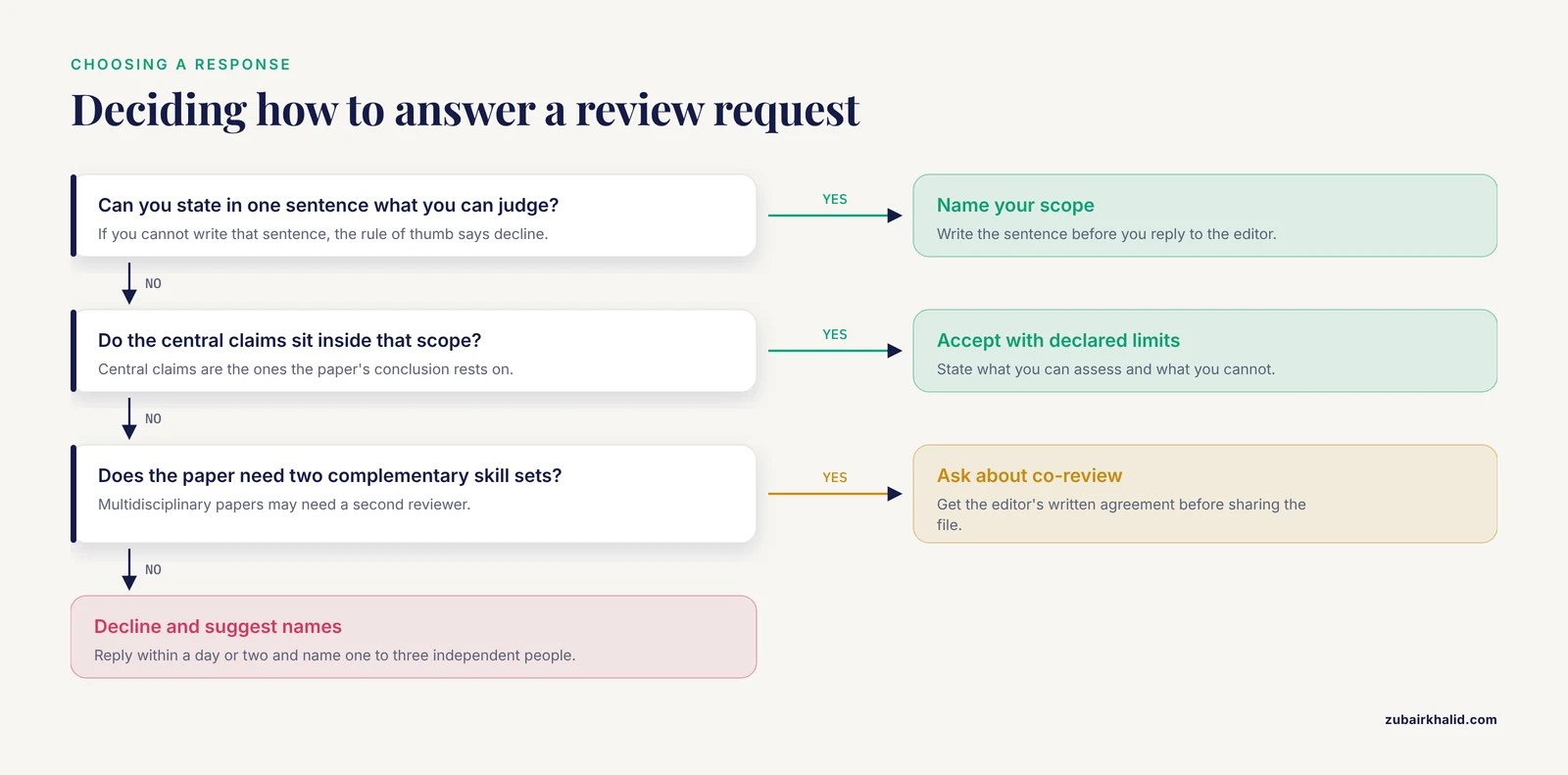
When a request lands in your inbox and the topic is adjacent to, or clearly beyond, your expertise, you have five realistic options. Each is legitimate in the right circumstances.
| Option | What you tell the editor | Time cost | Main ethical risk | Best when |
|---|---|---|---|---|
| Decline outright | "I cannot judge this competently." | Minutes | Almost none, if prompt | The manuscript is far from any work you do |
| Decline and suggest reviewers | Same as above, plus 1 to 3 named people | Minutes to an hour | Suggesting someone with a conflict, or someone equally unsuitable | You know the niche and the people in it |
| Accept with declared scope limits | "I can assess X and Y. The editor should seek judgment on Z." | Full review effort | Under-declaring your limits | The manuscript overlaps a core skill but crosses into another field |
| Accept and co-review | "I propose to review jointly with [name], with your permission." | Full review, shared | Sharing confidential material without permission | The paper genuinely needs two complementary skill sets |
| Accept as a general methods or reporting reviewer | "My review covers study design, statistics, and reporting standards, not domain interpretation." | Full review effort | Presenting a general review as a domain expert review | Your methodological skills apply regardless of topic |
No option is universally best. The phrase "best review manuscript outside expertise" has no single answer because the right choice depends on three variables: how far outside your expertise the manuscript sits, what specifically the editor needs from a reviewer, and how much time you have before the deadline.
How Each Option Works
Option 1: Decline Outright
Declining is not a failure of collegiality. It is the correct answer whenever you cannot evaluate the manuscript's central claims. Editors expect declines and build them into their planning. A good decline has three properties:
- Speed. Reply within a day or two. A late decline is more damaging to the editorial process than an early one, because the editor has held a slot for you.
- Specificity. "This is outside my expertise" is acceptable but weak. "I work on numerical methods for groundwater modeling and could not evaluate the clinical endpoints in this trial" gives the editor information they can act on.
- No false modesty. Do not decline a manuscript you could, in fact, review well. Under-confidence quietly narrows the reviewer pool and burdens your colleagues.
Keep the decline brief. Editors read dozens of these. A two-sentence message is normal and expected.
Option 2: Decline and Suggest Alternative Reviewers
This is the single most useful thing an outside-expertise recipient can do. You have context the editor lacks: you know who works on the specific problem, which labs are credible, and which subfields the manuscript straddles. Two cautions apply.
First, only suggest people you genuinely believe can judge the work independently. Never suggest a current collaborator, recent co-author, close mentor, or anyone at your own institution if the journal's conflict-of-interest policy would exclude them. A suggestion that funnels the paper to a friendly reviewer is a research ethics problem, not a networking tactic.
Second, frame suggestions as suggestions. Write something like, "Dr. X works on this exact assay problem and would likely be well placed. Dr. Y has recently reviewed this literature for [venue]." The editor decides. You advise.
Option 3: Accept with Declared Scope Limits
This is often the best review manuscript outside expertise option when the manuscript overlaps a genuine competence but crosses into another domain. The pattern is common. A statistician is asked to review a clinical paper. A chemist is asked to review a paper with a materials-science component. A field ecologist is asked to review a paper with heavy geospatial modeling.
The mechanics are straightforward:
- Reply to the editor before accepting, stating what you can and cannot assess. For example: "I can evaluate the statistical design, the validity of the causal inference, and the reporting quality. I cannot independently evaluate the clinical interpretation of the biomarker findings, and I recommend the editor obtain a domain reviewer for that component."
- Put the same statement in your confidential comments to the editor when you submit the review. Editors read these first, and it frames everything else you say.
- Hedge only where you actually lack knowledge. Within your zone of competence, be as firm as you would be on your own work. Outside it, mark your comments explicitly, for example "As a non-clinician, I cannot confirm whether this dosing framing matches standard practice."
- Avoid reviewing outside your declared scope silently. A comment that reads like domain authority, written by someone without domain authority, is exactly the over-certainty pattern documented in ethical failures [1].
A published example illustrates why scope separation matters. A narrative review of artificial intelligence and robotic execution in knee arthroplasty deliberately kept evidence for AI-based prediction analytically separate from evidence for robotic execution, because conflating them obscures what the literature actually supports [4]. A reviewer working across a disciplinary boundary should impose the same discipline on their own comments: judgments about methods in one section, explicit non-judgments about content in another.
Option 4: Accept and Co-Review with Permission
Some manuscripts genuinely need two complementary skill sets, the way a clinical care pathway for childhood mouth breathing required coordinated evaluation from pediatric allergy, ear-nose-throat, and orthodontic perspectives because no single specialty could assess every contributing factor [5]. Peer review can work the same way.
The procedure has one non-negotiable step: ask the editor first. Manuscripts are confidential. Sharing the file with a colleague without the editor's written agreement is a breach of confidentiality, one of the clearest violations of reviewer duty. Once the editor agrees, the norms in most journals are:
- The named reviewer submits the review, with the co-reviewer's contribution acknowledged in the way the journal specifies.
- Some journals allow and even welcome a co-reviewer's name in the submission form or confidential comments. Others do not permit it. Check the journal's reviewer guidelines.
- The co-reviewer is bound by the same confidentiality and conflict-of-interest rules as the primary reviewer.
This option has a career dimension worth naming honestly. Early-career researchers often learn reviewing through co-review with a mentor. Done openly, with the editor's knowledge, this is legitimate training. Done invisibly, where a senior name signs a review written by someone undisclosed, it misleads the editor about whose judgment certified the manuscript.
Option 5: Accept as a General Methods or Reporting Reviewer
Some requests can be answered well even from outside the specific topic, because a large share of any manuscript's quality lives in its methodology, statistics, and reporting, and those are portable skills. If your genuine competence is study design, inference, or reporting standards, you can say so and deliver real value on a paper whose subject matter you only partly follow.
The key to doing this well is to review against explicit frameworks rather than impressions. Concrete examples of what that looks like in practice:
- For a submitted systematic review, check whether the authors followed PRISMA. A systematic review of palliative care needs of adolescents and young adults conducted its search across six named databases up to a stated date and reported its screening and extraction process under PRISMA guidelines [6]. Those are checkable facts, and a reviewer does not need deep domain knowledge to verify them.
- For a scoping review, the expected scaffolding is the PRISMA Extension for Scoping Reviews and the Arksey and O'Malley framework as developed in Joanna Briggs Institute guidance, which one published medical education scoping review stated and followed explicitly [7].
- For a software-engineering-style review in health informatics, Kitchenham and Charters' guidelines are a recognized standard, and one systematic review of explainable AI for disease classification applied them and additionally scored clinical readiness using a named evaluation checklist aligned with a published manifesto [8].
This is also where a reviewer can add the most value on synthesis papers. In a systematic review of circulating tumor DNA as a response biomarker in early-phase oncology trials, the authors identified substantial heterogeneity in ctDNA methodology between trials even as they reported a strong overall association between molecular and radiological response across 18 reconstructable cohorts [9]. A methods-focused reviewer who did not work in oncology could still ask the right questions: How was heterogeneity assessed? Were the eligibility criteria stated before screening? Was the statistical pooling appropriate given that heterogeneity? Domain reviewers ask different questions. Both kinds of review are needed, and being explicit about which one you are providing makes your review more useful, not less.
The Pros and Cons of Each Option
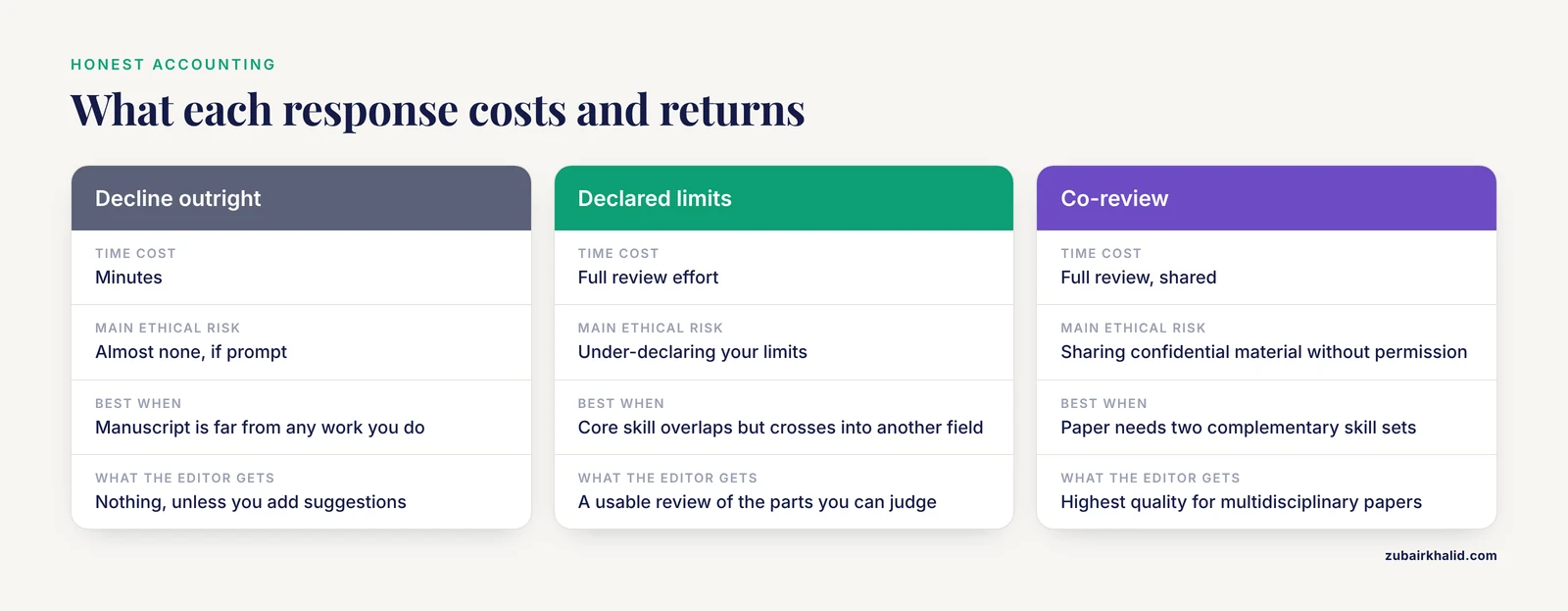
The search phrase "review manuscript outside expertise pros and cons" describes a real decision. Here is the honest accounting.
Declining outright. The pro is integrity with almost zero cost in time. The cons are that you provide nothing to the editor and, if you decline too often, editors stop asking. Neither con is serious if your declines are prompt and occasionally accompanied by suggestions.
Declining with suggestions. The pros are that you help the editor solve their actual problem, which is finding the right person, and you demonstrate that your self-assessment is precise rather than reflexive. The con is responsibility: a careless suggestion can waste the editor's time or, worse, route the paper to someone with a conflict.
Accepting with declared limits. The pros are substantial. The editor gets a usable review of the parts you can judge, the manuscript still receives scrutiny of its statistical and design choices, and your confidential note tells the editor exactly what gaps remain. This option also builds your standing as someone editors can trust with borderline cases. The cons are effort and exposure. You owe a full, careful review, and your comments outside your zone must be visibly hedged or omitted. If you pad those sections with confident-sounding prose, you reproduce the documented failure pattern of using technical language to obscure uncertainty [1].
Co-reviewing. The pros are the highest review quality available for genuinely multidisciplinary papers, plus a legitimate training route for newer researchers. The cons are coordination cost, dependence on journal policy, and the confidentiality rules that make improvisation impossible.
General methods review. The pros are that reporting and design flaws, the kind that most often sink papers at later stages, get caught before publication, and the skill set travels across fields. The con is scope creep. If your "general" review drifts into confident claims about the subject matter, you have drifted back into the problem you were trying to avoid.
One more comparison point deserves emphasis. Peer review is not a rubber stamp, and manuscripts change because of it. In one published cross-sectional study on childhood adversity and adolescent self-injury, the authors state plainly that their theoretical model was re-specified during peer review, and the revised analysis showed that the moderation interactions explained very little additional variance [10]. That is peer review doing its job: a statistical model was interrogated before publication, and the published version is more honest than the submitted one. Reviews like that require someone competent at the point of evaluation. If a manuscript's reviewer lacked the statistical competence to demand that re-specification, the published record would look the same but rest on weaker ground.
How Editors Decide Whom to Ask, and Why Mistakes Happen
Understanding the editorial mechanics makes your response more effective. Editors typically draw from reviewer databases, author-suggested names, personal networks, and keyword matching. When a manuscript spans two fields, the editor may have one reviewer slot for what are really two review tasks. Multidisciplinary papers, like the clinical pathway above that needed allergists, ENT specialists, and orthodontists to evaluate different facets of the same condition [5], sometimes get sent to a single person who can only cover part of the ground.
This is why the declared-limits option matters so much. When you reply to the editor with a precise statement of what you can and cannot assess, you are not hedging. You are handing the editor the information needed to fill the remaining gap with a second reviewer. Editors handle this situation routinely. What they cannot handle is silence, because silence looks like competence.
Worked Scenarios
Scenario 1. You are a biostatistician asked to review a surgical outcomes paper. You can evaluate the study design, sample size justification, analysis plan, and reporting of effect estimates. You cannot judge whether the surgical technique described is standard or whether the outcome grading matches clinical convention. Best response: accept with declared limits, state in your opening confidential note that a surgeon should assess the operative content, and review the statistics rigorously. In your visible comments, restrict yourself to the analysis and reporting.
Scenario 2. You are a second-year postdoc asked to review a paper in your advisor's niche, which you have not yet mastered. If you cannot yet name what you can judge, you cannot write the one-sentence rule-of-thumb statement, so decline. If the journal permits acknowledged co-review, propose to co-review with your mentor, which converts the request into supervised training rather than an unsupported solo judgment.
Scenario 3. You are asked to review a systematic review in an applied health field you know only from the methods side. Accept as a methods and reporting reviewer if that is your genuine competence. Check the PRISMA compliance, database coverage, search dates, eligibility criteria, risk-of-bias assessment, and how heterogeneity was handled, in the spirit of the published examples above [6][9][7]. Declare that domain interpretation is outside your scope.
Scenario 4. You are an ecologist asked to review a paper on diagnostic AI algorithms for a disease you have never studied. This is beyond adjacency. Decline within a day, be specific about why, and suggest two or three names if you happen to know the machine-learning methods community that publishes on that clinical problem. Alternatively, if your expertise is the modeling and validation methods rather than the clinical application, apply the declared-limits approach and say exactly that.
Scenario 5. You are asked to review for a journal you have never published in or reviewed for, with a tight deadline. Before accepting anything, verify the journal is legitimate and its aims fit the manuscript. Outside-expertise requests sometimes arrive from journals you do not recognize. A rapid decline costs nothing and avoids lending your name to an outlet with weak review standards.
Common Mistakes and Limitations
These are the errors that recur in real editorial workflows, several of them mirroring documented failure patterns in professional ethics reviews [1].
- Accepting out of guilt or flattery. Editors are skilled at making requests feel like honors. An honor you cannot discharge competently is a liability to the record.
- Vague self-assessment. "I'm not sure this is quite my area" gives the editor nothing. Name the specific components you can and cannot judge.
- Confident prose outside your competence. Hedged language like "I am not positioned to assess this" is a feature, not a weakness. Over-certainty and opaque technical language are documented vulnerabilities in fields where review failure has real consequences [1].
- Sharing the manuscript informally. Asking a lab mate to "take a quick look" without the editor's permission breaches confidentiality, even with good intentions.
- Suggesting reviewers with conflicts. Recent co-authors, mentors, and people at your institution are usually excluded by journal policy. Check before suggesting.
- Treating all review manuscripts the same way. A systematic review, a scoping review, and a narrative review follow different reporting standards. Reviewing a scoping review as if it claimed exhaustive evidence synthesis is a category error, as the distinct frameworks for each design make clear [7].
- Assuming structured process substitutes for knowledge. A committee or reviewer can follow every procedural step and still produce a poor evaluation if no one at the table grasps the science, as the documented ACIP analysis showed when process maturity collapsed alongside demonstrated gaps in scientific understanding [3].
- Letting a deadline force the decision. If you accept and then realize mid-review that you are out of your depth, contact the editor immediately rather than submitting a hollow review. Editors prefer an honest withdrawal at day ten to a worthless report at day twenty-one.
One general limitation applies to everything above. Individual situations vary, journal policies differ, and when a case feels genuinely uncertain, the right move is to consult your institution's research integrity office or the journal's published reviewer guidelines before acting. Responsible conduct of research is a set of habits built on that kind of check, not a memorized rulebook.
Frequently Asked Questions
Is it ever acceptable to review a manuscript outside your expertise?
Yes, in one specific configuration: when the manuscript overlaps a competence you genuinely hold and you declare your limits to the editor before accepting and again in your confidential comments. What is not acceptable is accepting a request whose central claims you cannot evaluate and staying silent about it.
Should I suggest alternative reviewers when I decline?
Almost always, if you can. Suggesting one to three named, independent, conflict-free researchers is the most helpful thing you can do for an editor, and it costs minutes. Only suggest people you believe can judge the work competently and impartially.
Can I share the manuscript with a colleague to get their input?
Not without the editor's explicit permission. Manuscripts under review are confidential, and this applies to hallway conversations as well as forwarded files. Ask the editor to recognize your colleague as a co-reviewer, which many journals allow under their published policies.
How quickly should I respond to a review invitation?
Within one or two business days, whether you accept or decline. A fast decline lets the editor find someone else before the review cycle slips, while a slow decline burns the slot you were given.
What exactly should I tell the editor about my limits?
State it twice, briefly. In your acceptance reply, say what you can assess and what you cannot, and recommend the editor recruit a second reviewer for the gap. In your confidential comments with the submitted review, repeat the statement so whoever reads the review file sees your declared scope next to your judgments.
Does declining a review hurt my career or my standing with journals?
A prompt, professional decline does not. Editors track responsiveness, not unconditional acceptance, and a decline with useful suggestions often raises your standing. What damages standing is accepting and delivering a review that misses the paper's central problems, because that is visible in the editorial file.
Sources
- When Forensic Pathology Fails: Ethical Lessons From International Regulatory, Judicial, and Historical Human-Rights Cases.
- Preliminary Reproducibility Evaluation of a Phage Susceptibility Testing Method Using a Collection of Escherichia coli and Staphylococcus aureus Phages.
- Science for vaccine policy: Independent review of the September 2025 ACIP processes, deliberations and votes.
- Distinguishing artificial intelligence from robotic execution in total knee arthroplasty: a narrative review and evidence map.
- A Multidisciplinary Care Pathway for Childhood Mouth Breathing: The Pediatric Allergist, ENT, and Orthodontic Perspective.
- The palliative care needs of adolescents and young adults with a life limiting condition: a systematic review.
- A scoping review of autoethnographic approaches in medical education research.
- Explainable AI-based techniques for disease classification: a systematic review and future work.
- Circulating Tumour DNA (ctDNA) as an Emerging Biomarker of Response in Early-Phase Oncology Drug Development: A Systematic Review.
- Peer victimization and family dynamics in the association between childhood abuse and adolescent non-suicidal self-injury: a cross-sectional moderated mediation study.