Response Letter for Minor Revisions: Template and Examples
By Dr. Zubair Khalid, DVM, MS, PhD ·

By the end of this article you will be able to write a complete reviewer response letter for a manuscript that received minor revisions. You will know the standard format, the exact wording that satisfies editors, how to quote each reviewer comment, and how to describe the changes you made in the manuscript. You will have a reusable template and two worked examples you can adapt in an afternoon.
To follow along, have these on hand:
- The decision letter from the editor, with all reviewer comments
- The reviewer comments as a separate text file, if the journal sent them as a PDF or attachment
- Your revised manuscript file, with tracked changes or a highlighted clean copy
- The journal's author guidelines, open to the revision instructions page
- A plain text editor such as Notepad, TextEdit, or Visual Studio Code for drafting the letter
What a minor revision decision actually asks of you
A minor revision decision means the editor intends to publish your paper after you fix a short list of problems. Typical items include clarifying a sentence, adding a citation, defining an abbreviation, correcting a statistical notation, or answering one or two questions about a figure. The editor usually does not send the revised manuscript back through a full round of review. Often the handling editor reads your response letter alone and makes the final call.
That last point shapes everything else in your letter. The person who decides may not re-read your paper carefully. Your response letter must let an editor confirm, comment by comment, that you addressed every point. A vague letter forces the editor to hunt through your manuscript, and hunting creates doubt. A precise letter makes acceptance the easy next step.
The standard response letter structure for minor revisions
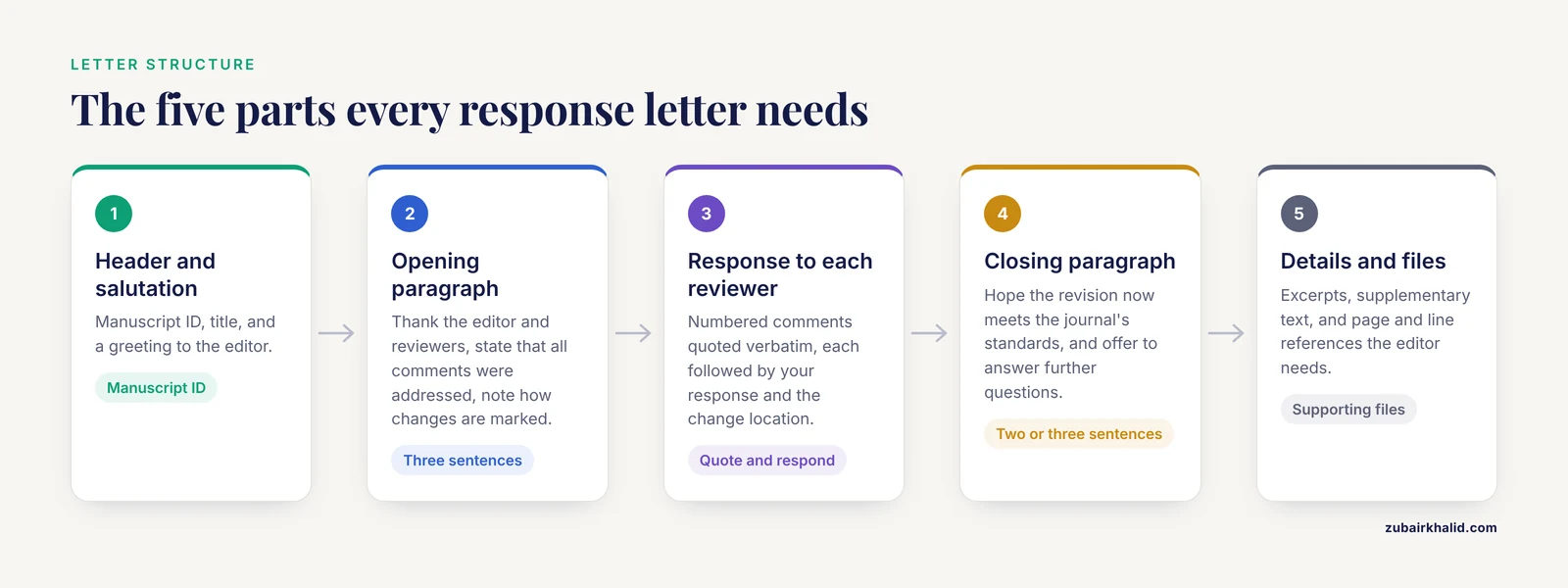
Across journals and fields, a reviewer response letter follows the same five-part skeleton. Review the format once and you can reuse it for every submission of your career.
- Header and salutation. Manuscript ID, title, and a greeting to the editor.
- Opening paragraph. One short paragraph thanking the editor and reviewers, stating that you addressed all comments, and noting that changes are marked in the manuscript.
- Response to each reviewer. A numbered list of comments, each quoted verbatim, followed by your response and the location of the change.
- Closing paragraph. A brief statement of your hope that the revision now meets the journal's standards, plus an offer to answer further questions.
- Point-by-point details and supporting files. Any excerpts, supplementary text, or page and line references the editor needs.
Keep the whole letter readable in one pass. Editors skim. Short paragraphs, consistent numbering, and clear labels such as "Response:" and "Changes in manuscript:" do most of the work before the editor reads a single sentence of your prose.
Step-by-step walkthrough: building your letter
This walkthrough produces a complete letter in plain text. You can paste the finished text into an email body or upload it as a Word or PDF file, depending on what the journal's submission system requests. Check the author guidelines first, because some journals require the response letter as a separate uploaded file and reject letters pasted into the comments box.
Step 1. Extract every comment into a numbered list
Open your editor and create a file called response-letter.txt. Paste in each reviewer comment as its own numbered block. Do not merge comments, and do not skip any, including ones you think are trivial. Missing even one comment is the most common reason an editor sends a revision back.
If the journal sent comments as a PDF, copy the text out of the PDF viewer. If copying fails or garbles the text, retype the comments by hand. Verbatim quoting matters because your response reads as a direct answer to a specific question.
Your file at this stage looks like this:
Reviewer 1:

1. The abstract states that the method improved yield, but no
quantitative comparison with the standard method is given.

2. Page 4, line 12: "significant" should be defined
statistically or removed.

3. Reference 14 is incomplete, missing the article title.
Step 2. Write the header and opening paragraph
Start the file with the manuscript identifiers the editor listed in the decision email. Then write three sentences: thanks, summary of what you did, and how the changes are visible in the manuscript. Use this template:
Manuscript ID: MS-2026-01472
Title: [Your exact title as submitted]

Dear Dr. [Editor's last name] and Reviewers,

Thank you for the opportunity to revise our manuscript and for
the constructive comments from both reviewers. We have addressed
all points raised. All changes are marked with tracked changes in
the revised manuscript, and our point-by-point responses appear
below. Reviewer comments are shown in italics, and our responses
follow in plain text.
Three choices live inside this paragraph, and you should make each one deliberately.
Quoting style. Most authors italicize reviewer comments so the letter visually separates the question from the answer. If you cannot use italics in your file format, wrap each comment in quotation marks or prefix it with the word "Comment:". Pick one style and use it for the entire letter.
Change marking. Tracked changes, highlighting, or colored text all work. Say which one you used. If the journal wants both a marked and a clean copy, upload both and say so in the letter.
Tone. Thank the reviewers once, in the opening. Reviewers read the comment-specific responses for substance, not for repeated gratitude.
Step 3. Write the response block for each comment
This is the core of the letter. For each numbered comment, use a three-line pattern: the quoted comment, your response, and the change location. The template:
Reviewer 1, Comment 1:

Comment: The abstract states that the method improved yield, but
no quantitative comparison with the standard method is given.

Response: We agree that a quantitative comparison strengthens
the abstract. We have added the percentage improvement and the
number of replicates to the final sentence of the abstract.

Changes in manuscript: Abstract, line 14. The revised sentence
now reads: "The modified protocol increased yield by 23 percent
across six independent runs (p = 0.004)."
Worked answers follow four rules.
Rule one, answer the question asked. If a reviewer asks whether you considered an alternative analysis, say yes or no, then explain the choice. Never answer a nearby question instead.
Rule two, quote the revised text when the change is short. A sentence or two of new manuscript text, pasted into the response, lets the editor verify the fix without opening the manuscript. For longer changes, describe the change and give the section name, page, and line numbers from your revised file.
Rule three, disagree with evidence, not with attitude. When you decline a suggestion, state your reason in one or two sentences and, where possible, cite the specific literature, dataset property, or statistical principle behind your choice. Editors accept reasoned disagreement routinely. They push back on unexplained disagreement.
Rule four, keep each response self-contained. An editor reading Comment 7 should not need to scroll back to Comment 3 to understand your answer. Repeat the necessary context in one clause.
Here is a second worked response, this one handling a request you partially decline:
Reviewer 2, Comment 2:

Comment: The authors should provide raw dose-response data as a
supplementary table.

Response: We have added the underlying absorbance readings for
all concentrations as Supplementary Table S2. We have not added
individual mouse body weights, because the animal use protocol
approved for this study covers group-level reporting, but group
means, standard deviations, and animal numbers per group now
appear in the Methods section.

Changes in manuscript: Methods, "[Statistical analysis](/blog/guides/statistical-analysis)"
subsection, page 8, lines 3-9. Supplementary Table S2 added.
Notice the structure of that disagreement. The author grants the achievable part, explains the constraint on the rest in one sentence, and points to where the reader can check the compromise. That pattern, agree where you can, explain where you cannot, resolve almost every contested point.
Step 4. Add a line-number convention
Many journals ask for page and line numbers keyed to the revised manuscript. If your word processor displays line numbers, cite them exactly as shown. If it does not, count lines or use section names plus paragraph numbers, for example "Discussion, paragraph 3." Then state your convention once, near the top of the letter, so reviewers know how to find changes:
Note on references to the manuscript: page and line numbers refer
to the tracked-changes version of the revised manuscript.
Step 5. Close the letter
End with two or three sentences. Thank the editor again, state that you hope the revision is now suitable, and offer availability for questions:
We thank the reviewers again for comments that improved the
clarity of the manuscript. We hope the revised version is now
suitable for publication in [Journal Name] and would be glad to
address any further questions.

Sincerely,
[Your name], on behalf of all authors
[Affiliation, email]
Step 6. Produce the marked and clean manuscript files
Most submission systems ask for the revised manuscript in two forms. The marked version shows every change with tracked changes or highlighting. The clean version has all changes accepted, so it reads like a finished paper. Name them clearly, for example MS-2026-01472_revised_marked.docx and MS-2026-01472_revised_clean.docx. Verify that every change you promised in the response letter actually appears in both files before you upload anything.
Worked example: a complete letter for a two-comment revision
Small papers sometimes attract only two or three comments. Here is a full letter for that case, assembled from the templates above. Treat it as the minimum viable response letter for minor revisions.
Manuscript ID: MS-2026-01472
Title: Rapid Detection of Salmonella in Ground Turkey Using a
Lateral Flow Assay

Dear Dr. Alvarez,

Thank you for the opportunity to revise our manuscript and for
the reviewer comments. We have addressed both points. Changes
are marked with tracked changes in the revised manuscript.
Reviewer comments appear in italics below, followed by our
responses.

Reviewer 1, Comment 1:

Comment: The limit of detection should be stated in CFU/g in
the abstract, not only in the Results section.

Response: We agree. The abstract now states the limit of
detection as 10 CFU/g in spiked samples.

Changes in manuscript: Abstract, sentence 4, page 1, line 18.

Reviewer 1, Comment 2:

Comment: Reference 9 appears to be missing the page range.

Response: We have completed the reference. The corrected entry
now includes the full page range.

Changes in manuscript: Reference list, entry 9, page 21.

We thank the reviewer for the careful reading. We hope the
revised manuscript is now suitable for publication in the
Journal of Food Protection Methods and would be glad to
address any further questions.

Sincerely,
Jordan Lee, on behalf of all authors
Department of Food Science, State University
[email protected]
Two things to notice. First, each response quotes the new text or states exactly what changed, so the editor can accept without hunting. Second, the letter stays under one page. Brevity is a feature at the minor revision stage, not a weakness.
Worked example: handling a disagreement within a minor revision
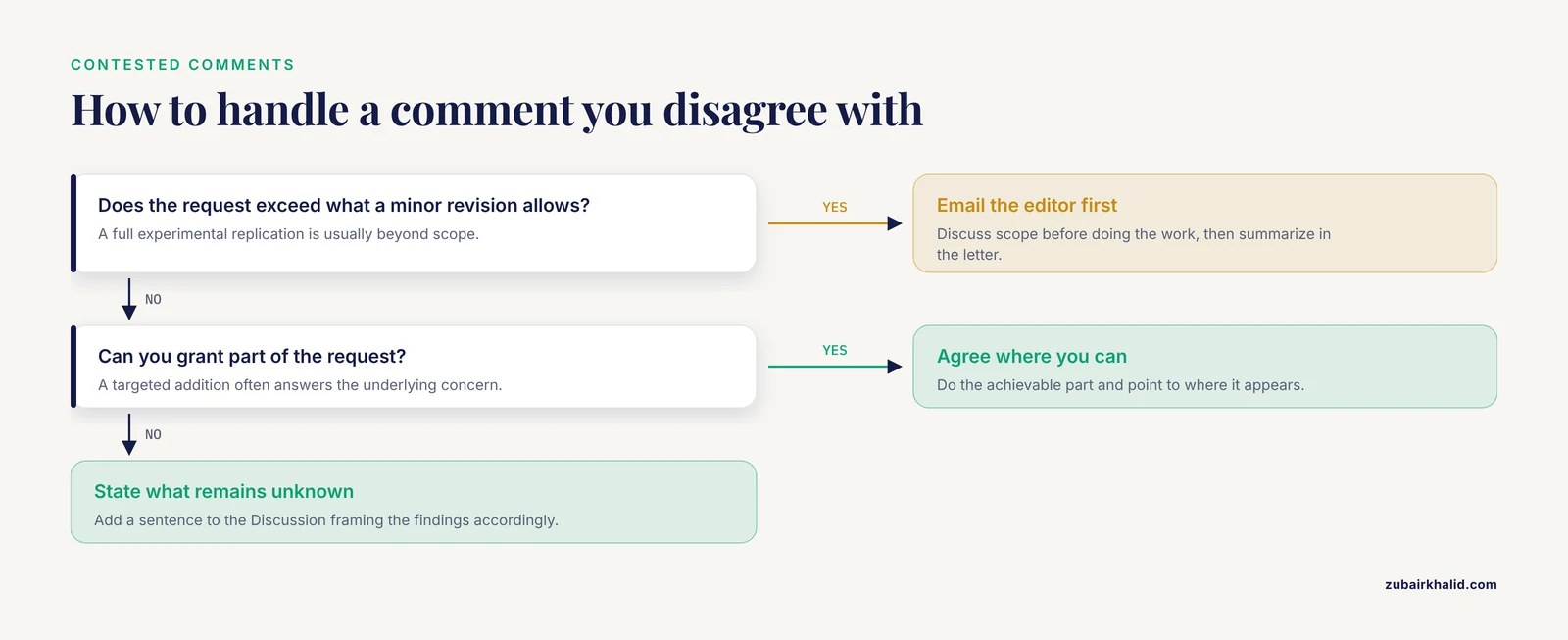
Minor revision rounds occasionally contain one comment that deserves pushback. Handle it inside the same letter structure, in the same neutral voice, with the same quote-and-response format. Here is the contested block in isolation:
Reviewer 2, Comment 3:

Comment: The authors should repeat the entire experiment with a
second, independent bacterial strain before the findings can be
considered generalizable.

Response: We appreciate the concern about [generalizability](/blog/data-analysis/generalizability-in-research).
We have repeated the key inhibition assay with a second strain
(serovar Enteritidis) and added the results to Figure 3B and to
the Results text, where they support the same conclusion. We
have also added a sentence to the Discussion acknowledging that
additional serovars remain untested and framing the findings
accordingly.

Changes in manuscript: Results, subsection "Inhibition assay,"
page 6, lines 2-11. Figure 3B. Discussion, page 10, lines 4-8.
This response works because the author found a middle path. A full experimental replication was beyond the scope of a minor revision, but a targeted second strain answered the scientific concern at reasonable cost. When a reviewer asks for more than minor revision allows, look for the smallest addition that genuinely addresses the underlying question, then state plainly in the Discussion what remains unknown.
Choosing between letter formats
Two organizational choices divide most response letters. Pick one of each before you write, and the rest of the letter falls into place.
| Decision | Option A | Option B | Choose A when | Choose B when |
|---|---|---|---|---|
| Letter organization | One combined numbered list for all reviewers | Separate sections per reviewer | The journal requests a single point-by-point document | Reviewers raised distinct issues, the common case |
| Response placement | Full responses in the letter only | Responses in the letter plus inline author replies in the manuscript | Journal guidelines ask for letter-only responses | Reviewer comments sit in the manuscript margins |
A third choice concerns quoting. Direct verbatim quotes preserve context and are the default. Some authors summarize each comment in a short paraphrase to save space. If you paraphrase, mark it clearly, for example "Comment (paraphrased):", because a reviewer who does not recognize their own comment may think you altered it.
Common errors, their symptoms, and fixes
A comment goes unanswered. Symptom: the editor returns the revision asking you to address Comment 4, which never appeared in your letter. Fix: after drafting, run a mechanical check. Number the comments in the decision letter 1 through N on paper, then tick each number off against your letter. Every number must appear exactly once.
The response describes work the manuscript does not contain. Symptom: an editor or reviewer searches the revised PDF for the promised sentence and finds nothing. Fix: draft responses and manuscript edits together. For each response block, open the revised file and confirm the quoted text matches character for character, including the numbers.
Line numbers point at the wrong file. Symptom: "page 8, line 12" lands in the middle of the reference list. Fix: always cite line numbers from the same file version you are submitting, and regenerate numbers after any last edit. If you fix a typo at the last minute, re-verify every line reference in the letter.
Vague responses such as "Done" or "We agree." Symptom: reviewers read these as dismissive, and the editor asks for another round. Fix: every response must contain either the revised text, a description of the change, or the reason no change was made. "Done" alone never satisfies this.
Missing files in the submission. Symptom: the submission system blocks upload or the editorial office emails a request for the marked copy two weeks later, delaying the decision. Fix: before submitting, confirm the checklist the journal requires, typically the response letter, the marked manuscript, the clean manuscript, and any revised supplementary files.
Tone drifts into argument. Symptom: a letter that reads as a rebuttal rather than a response, often after a frustrating review. Fix: set the draft aside overnight, then cut every sentence that evaluates the reviewer ("This comment misunderstands our methods") and keep only the sentences that supply evidence.
How to verify the letter before you send it
Run this six-point check. It takes about fifteen minutes and catches nearly every preventable problem.
- Count the reviewer comments in the decision letter. Count your response blocks. The two numbers match.
- Search your letter for the word "will." Promises of future work ("we will add") belong only where you genuinely could not complete the work, and even then say why and what you did instead. Everything else should read in the past tense, because the revision exists.
- Open the revised manuscript and spot-check three quoted passages against your letter. All three must match exactly.
- Confirm every response names a location: section, page, and line, or the equivalent your journal accepts.
- Read the letter aloud, or use your editor's text-to-speech function. Awkward or defensive sentences become obvious by ear.
- Confirm file names and formats against the author guidelines one final time, then submit.
A finished letter that passes these checks reads like a completed contract. Every claim in it is verifiable on the spot, which is exactly what lets an editor move straight to acceptance.
Common Mistakes and Limitations
The errors above cover the mechanical failures. Three judgment errors deserve their own space, and one limitation frames the whole exercise.
First, treating "minor" as "easy." Minor revision means the remaining problems are small, not that the reviewer will forgive sloppy responses. Editors who receive careless letters sometimes upgrade a paper to a second full review, adding weeks. Match the reviewers' thoroughness even when the comment count is low.
Second, padding responses with unrelated new analyses. A minor revision is a poor moment to introduce a new experiment, a new dataset, or a rewritten introduction. Anything substantial you add may reopen review. If you believe the paper needs major additional work, write to the editor and discuss scope before doing it, rather than presenting it unannounced.
Third, silent disagreement. Failing to mention a comment you chose not to act on looks like an oversight and reads badly when discovered. State the disagreement openly, give your reasoning, and let the editor arbitrate. Editors resolve contested points regularly and expect to.
The limitation: every journal has its own submission mechanics, and this article describes the widely shared letter format rather than any single journal's checklist. Read the specific author guidelines and the decision letter for requirements that override general practice. A letter that follows the structure above but ignores a journal-specific instruction can still be returned.
Frequently Asked Questions
How long should a response letter for minor revisions be?
Short enough to read in ten minutes. For a typical minor revision with two or three reviewers and roughly ten comments total, one to three pages is standard. Match response length to comment weight. A typo fix needs two lines, a methods question may need a paragraph.
Should I quote reviewer comments verbatim or paraphrase them?
Quote them verbatim. Verbatim quotes prove you answered the actual question, keep the letter self-contained for the editor, and prevent disputes about what was asked. Paraphrase only when a comment is very long, and label the paraphrase clearly.
How do I respond to a reviewer comment I disagree with?
State your disagreement plainly, give the specific evidence or principle behind your position in one or two sentences, and note what you did to acknowledge the concern in the manuscript, such as adding a clarifying sentence to the Discussion. Editors resolve these disagreements routinely and favor reasoned, documented positions over concessions made without conviction.
Do I need to respond to every single comment, even trivial ones?
Yes. Every numbered comment needs a response block, even one that says the typo was fixed and points to the page. A missing response is the most common trigger for a revision being sent back.
What is the difference between a response letter and a rebuttal letter?
In practice the terms overlap, and most journals use one document for both. "Response letter" usually refers to the point-by-point document accompanying any revision. "Rebuttal letter" more often describes the document you write to contest a rejection, which follows a different strategy because you are asking the editor to reverse a decision rather than confirm a plan.
Should the response letter include tracked changes of the manuscript?
The letter itself does not contain tracked changes, but the submission usually includes a separate marked manuscript that does. State in the letter which marking method you used, and cite page and line numbers that match the marked file so reviewers can jump from each response to the exact change.
How quickly should I return a minor revision?
Check the deadline in the decision letter, which for minor revisions is often around two to four weeks, and treat it as firm. If you need more time, email the editorial office before the deadline and request an extension. Editors grant reasonable extensions routinely and respond badly to silent delays.
Can I contact the editor directly instead of writing everything in the response letter?
You can, and you should, for one situation: if you believe a reviewer request exceeds the scope of a minor revision, or if a comment seems to rest on a misunderstanding you cannot resolve in the letter, email the editor separately. The editor can arbitrate before you submit. Everything resolved through such an email should still appear, in summarized form, in the formal letter so the record stays complete.