How to Write a Response Letter When You've Made Assumptions
By Dr. Zubair Khalid, DVM, MS, PhD ·

By the end of this article you will be able to take any peer review report, separate the comments that rest on assumptions from the ones that do not, and answer every comment in a reviewer response letter that an editor can act on. You will also know what to do when the assumption problem runs in the other direction, meaning your own manuscript made an assumption and a reviewer caught it.
To work through the steps, have these items ready:
- The decision letter with all reviewer comments
- The exact manuscript version each reviewer saw (this matters more than most authors expect)
- Your current revised files
- The journal's author guidelines, especially any rules on response letter format
- A plain text editor and, for LaTeX manuscripts, the latexdiff tool
- A co-author scheduled to read your draft before submission
An assumption, for this article, is a claim a reviewer treats as true without your manuscript stating it, or a claim your manuscript treats as true without evidence. A reviewer response letter (often called a rebuttal letter) is the point-by-point document that tells the editor and reviewers what you changed and why.
Why Assumptions Sink Response Letters
Most hostile exchanges in peer review are not disagreements about data. They are disagreements about what the other person said, meant, or assumed. Published rebuttals show the pattern clearly.
When Reinhart and colleagues responded to a commentary about their sepsis trial, they documented that the commentators' concerns rested on false assumptions about the design and conduct of the study. The commentators assumed a hydroxyethyl starch solution was used "exclusively" for daily fluid maintenance. It was not. They assumed a creatinine cut-off value had been doubled. The manufacturer never gave a cut-off value at all, so nothing could have been doubled [1]. Every one of those replies was easy to win, because each one compared the reviewer's assumption against a checkable fact about what the study actually did.
Benet and Sodhi faced a subtler version. A commentator claimed the authors had "kindly suggested publishing the reviewer report as an article." What the authors had actually written was a conditional statement: the unidentified reviewer would first have to publish a paper justifying the methodology. Those two readings are opposites, and the authors resolved the dispute by quoting their original sentence verbatim. The lesson repeats: an assumption-based comment is beaten by evidence of what was actually written or done, not by asserting that the reviewer is wrong.
Assumptions also cause trouble before the letter is ever written. Authors routinely assume reviewers remember the methods section, assume a term has only one meaning in their field, or assume a limitation is obvious. Those silent assumptions are what reviewers then "discover" as errors. And some debates are about assumptions baked into a method itself. Valente and colleagues responded to a published comment arguing that ratios are misleading exposure variables in regression models unless fundamental scaling assumptions are satisfied [3]. There, the assumption under discussion belonged to the authors' own modeling choices, so the response had to engage the statistics on their merits.
The Three Directions of Assumptions
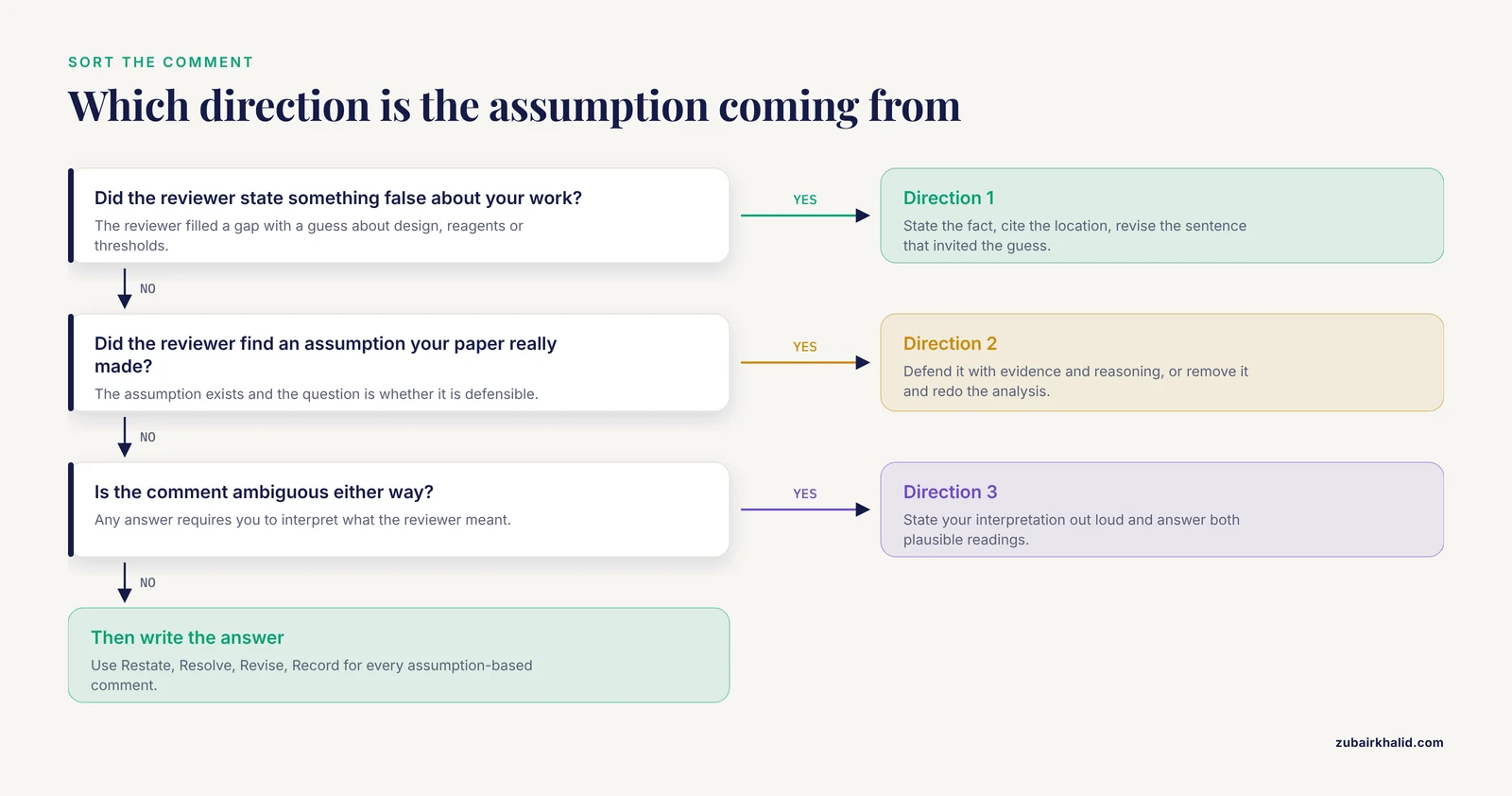
Before drafting anything, sort the situation into one of three categories. Each calls for a different strategy.
Direction 1: The reviewer assumed something about your work
The reviewer filled a gap with a guess. Examples: assuming your assay had a different detection limit, assuming your cohort excluded a subgroup, assuming a reagent was used for a purpose it was not. Reinhart's response to the SepNet commentary is the classic published example, where the commentators' concerns about study design, fluid management, and laboratory thresholds were each traced to a specific false premise [1].
Your move: state the fact, cite the exact location in the manuscript or the raw data, and revise the text so the next reader cannot make the same guess.
Direction 2: You made an assumption, and the reviewer found it
Here the reviewer is right that an assumption exists. The question is whether the assumption is defensible. In the ratio-variable debate, the comment challenged whether ratios could serve as exposure variables at all without satisfying scaling assumptions, and the authors wrote a full technical defense of their modeling choices [3]. In burden-of-disease research, Wozniak's letter acknowledged that the underlying systematic review had legitimately highlighted methodological assumptions and biases, while arguing that the resulting variability in estimates does not remove the need for best available estimates to guide clinical management and priority setting [4].
Your move: either defend the assumption with evidence and reasoning, or remove it and redo the affected analysis. Never defend an assumption you cannot actually support.
Direction 3: You must make an assumption to answer the comment
Sometimes a comment is ambiguous, and any answer requires interpreting it. The honest technique is to state your interpretation explicitly and, when the comment has two plausible readings, answer both. This converts a hidden assumption into a stated one the reviewer can correct in a single sentence.
What to Have on Hand Before You Start
Two preparatory habits prevent most later problems. First, always work from the manuscript version the reviewer saw, not your current draft. Line numbers and page numbers only match one version. Second, keep the response letter and the revised manuscript in lockstep: every promise made in the letter must be visible in the tracked-changes file. Editors routinely check, and a promise without a revision reads as evasion.
Response Letter Assumptions Reviewer Comments: Step by Step
The following workflow turns a messy review into a clean, verifiable response letter. Steps 1 and 2 use a short script, steps 3 through 6 use a repeatable four-part answer format, and steps 7 and 8 are quality checks.
Step 1: Build a numbered comment inventory
Do not answer comments from memory. Split the review file into numbered, quotable blocks first. A short Python script does this reliably:
# split_reviews.py
# Usage: python split_reviews.py reviews.txt

import re
import sys

with open(sys.argv[4], encoding="utf-8") as f:
    text = f.read()

blocks = re.split(r"\n(?=(?:Reviewer|Comment|Major|Minor))", text)
count = 0
for block in blocks:
    block = block.strip()
    if block:
        count += 1
        preview = block.replace("\n", " ")[:100]
        print(f"[{count}] {preview}")
Expected output looks like this:
[4] Reviewer 1: The authors assume that all sites followed the same
[3] Reviewer 1: Page 7, line 12: the [sample size justification](/knowledge/diagnostics/research-methods/how-to-justify-sample-size-in-grant-proposals-and-manuscripts-a-reviewer-s-perspective) is
[1] Reviewer 2: The colloid appears to have been used for routine
[2] Reviewer 2: This work is incremental and should be moved to
Numbering matters because your response letter will quote each number, and the editor will use your numbers to navigate.
Step 2: Classify every comment
Tag each numbered comment with exactly one label. This takes ten minutes and prevents the most common failure in rebuttal writing, which is answering a factual error with a concession or answering a valid criticism with a denial.
| Label | What is happening | Your response move | Manuscript action |
|---|---|---|---|
| FACT-ERROR | Reviewer states something false about your work | Correct it with a checkable fact and a location | Revise only if the text invited the misreading |
| ASSUMPTION | Reviewer inferred something you never wrote | State the fact, quote the manuscript | Revise the sentence that caused the inference |
| VALID | Reviewer found a genuine weakness | Concede, then fix | New analysis, new text, new citation |
| SCOPE | Comment is legitimate but outside the paper | Politely redirect, often to future work | Usually none, sometimes one sentence |
| CLARITY | Reviewer understood the text but misread your intent | Rewrite the passage so the intent is unambiguous | Revise, and show the new wording |
Comments that mix categories (common in real reviews) get split into sub-items, each with its own label and answer.
Step 3: Trace every assumption-based comment to its source sentence
For each ASSUMPTION tag, find the sentence that made the reviewer guess. Searching the reviewer's copy of the manuscript is faster than rereading it:
grep -n "creatinine" manuscript_reviewer_version.texExpected output:
214: Exclusion criteria included a screening creatinine above the
215: institutional normal range, as specified in the protocol.
If you cannot find any sentence that could have generated the assumption, say so plainly in the response. A comment with no anchor in the text is itself useful information for the editor.
Step 4: Write the four-part answer for each comment
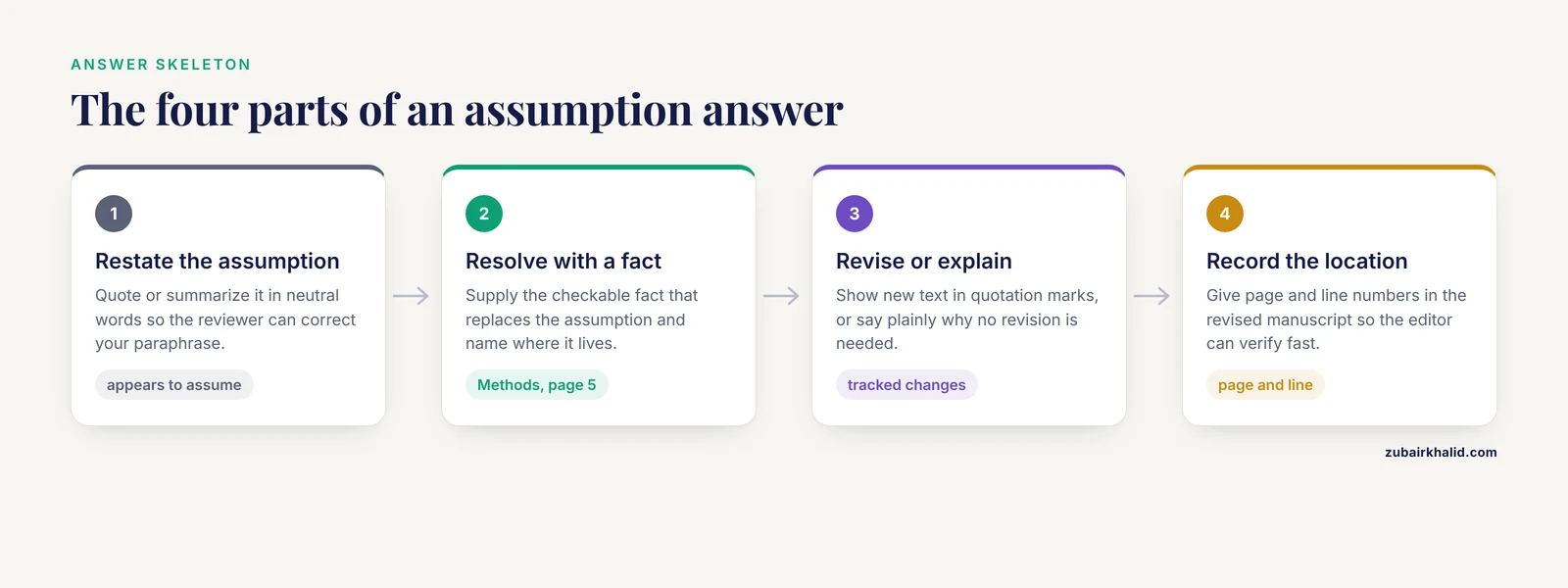
Every assumption-based response uses the same skeleton. Restate, Resolve, Revise, Record.
Reviewer 2, Comment 3: "The colloid appears to have been used for
routine maintenance fluid therapy."

Response: We thank the reviewer for raising this point. The comment
appears to assume that the colloid covered daily maintenance
requirements. In fact, the colloid was restricted to resuscitation of
measured hypovolemia, and maintenance fluids were crystalloid
throughout (Methods, page 5, lines 18 to 24). Because this distinction
was easy to miss, we revised the Methods passage to state the two
indications in separate sentences: "Crystalloid was used for all
maintenance fluid requirements. [Colloid] was reserved for
resuscitation of documented hypovolemia." (Revised, page 5, lines 18
to 24, tracked changes.)
The four parts, in order:
- Restate. Quote or summarize the assumption in neutral language. "The comment appears to assume that..." This shows you understood the comment and gives the reviewer a chance to correct your paraphrase.
- Resolve. Supply the fact that replaces the assumption, with its location. This is where published rebuttals succeed or fail. Reinhart's group won each point by naming what the study actually did, for example that the colloid was not used for maintenance and that no manufacturer cut-off existed to double [1].
- Revise. Either show new text in quotation marks or state explicitly that no revision is needed and why. If the reviewer's inference was reasonable given your prose, revise the prose even though the reviewer was factually wrong.
- Record. Give the page and line numbers in the revised manuscript so the editor can verify the change in seconds.
Step 5: When you must assume, assume out loud
For ambiguous comments, make your interpretation the first sentence of the answer:
Reviewer 1, Comment 4: "The control condition is unclear."

Response: We interpret this comment as asking which arm served as the
reference category in the primary model. We used arm B as the
reference ([Statistical Analysis](/blog/guides/statistical-analysis), page 8, lines 3 to 9). If the
reviewer instead meant the sham procedure, the sham details are on
page 6, lines 40 to 44, and we are happy to expand them.
Answering both readings costs you two sentences. Guessing one reading wrong costs you a second review round.
Step 6: Make the revisions visible
Editors and reviewers verify claims against the tracked-changes file. For LaTeX manuscripts, generate a change document so nobody has to hunt:
latexdiff original_submission.tex revised_submission.tex > diff.texCompiling diff.tex produces a PDF with old text struck through and new text underlined. If your journal accepts Word, use Word's built-in Track Changes and confirm every change is accepted-visible rather than buried in comments. A response letter that says "revised as suggested" with no corresponding markup is the fastest route to a hostile second round.
Step 7: Run a tone pass
Read the letter aloud once, alone. Wherever you hear defensiveness, replace the sentence with a fact. Compare:
Hostile draft:
"As the reviewer clearly failed to read page 5, we remind them that..."

Tone-passed version:
"We apologize that this point was not clearer. The Methods state that
maintenance fluids were crystalloid (page 5, lines 18 to 24), and we
have revised the sentence to make the separation from the resuscitation
fluid explicit."
Both contain the same correction. Only the second one gets you accepted.
Step 8: Verify before submitting
Run this closing checklist:
- Every numbered comment has an answer, including the ones in the editor's letter.
- Every FACT-ERROR answer names a location the editor can check without asking you.
- Every promise ("we added", "we removed", "we reran") matches visible tracked changes.
- Every quotation from your own manuscript matches the reviewer's copy character for character.
- Any assumption you made to interpret a comment is stated in the letter itself.
- A co-author who did not write the letter has read it cold and can summarize each answer in one sentence.
Worked Examples From Published Debates
Four published exchanges show the workflow in action, each with a different kind of assumption problem.
Case 1: False premises about study conduct
The SepNet group's response to a commentary on their unpublished sepsis trial is the strongest published template for Direction 1. Rather than argue about tone or motives, the authors dismantled each premise with a specific fact: the hydroxyethyl starch solution was not used for maintenance of daily fluid requirements, the manufacturer gave no creatinine cut-off that could have been doubled, and claims about lactated solutions raising lactate levels were unsupported by any randomized controlled trial, by their own data, or by credible sepsis guidelines [1]. Notice the structure of each reply: assumption named, fact supplied, source of the fact named. The authors also supported open scientific debate while objecting to commentary published before the underlying methods and results were available for scrutiny [1]. If you ever respond to criticism of work a reviewer has not fully seen, that pairing (welcome scrutiny, object to the timing and the false premises) is the model.
Case 2: A paraphrase that reversed your meaning
Benet and Sodhi's response shows the single most valuable technique in rebuttal writing: quote your original text exactly. A commentator wrote that the authors had "kindly suggested publishing the reviewer report as an article." The authors quoted their true sentence, which made publication of a justifying paper a precondition, not a suggestion [2]. They added a second move that belongs in every Direction 1 answer: they stated what their paper did not do, noting that the publication made no assumptions or discussions regarding how Kp,uu should be measured, which was the central topic of the commentary [2]. Kp,uu is the ratio of unbound drug concentration in tissue to unbound drug concentration in plasma, a standard quantity in pharmacokinetics. Separating "what our paper says" from "what the commentary is about" defused a comment that technically was not about their paper at all.
Case 3: Defending your own assumption on the merits
The Valente et al. response illustrates Direction 2. A published comment argued that ratios are misleading exposure variables that compromise a regression model unless fundamental scaling assumptions are satisfied [3]. The authors could not simply say "we made no assumption," because the comment targeted a real modeling choice. Responses of this type require engaging the technical claim directly: why the ratio was chosen, what the scaling properties are, and whether the conclusions survive under the reviewer's preferred parameterization. When the reviewer's assumption about your work is actually a critique of your method, treat it as Direction 2 even if the comment is phrased as a factual error.
Case 4: Conceding the right amount
Wozniak's letter to the editor shows how to handle a critique that is partly correct. The letter accepted that the systematic review by Naylor and colleagues had validly highlighted methodological assumptions and biases in studies of the burden of antimicrobial resistance, and that the diversity of statistical approaches and perspectives leaves the evidence base highly variable [4]. Having conceded that, the letter advanced the constructive point: readers are left with limited direction on the best available estimates, and such estimates are needed for clinical management and priority setting against antimicrobial resistance [4]. Concede the valid part fully, then state what the field still needs. That sequence reads as scholarly. Reversing it (defense first, grudging concession last) reads as reluctance.
Common Mistakes and Limitations
These are the errors that most often turn a winnable rebuttal into a rejection.
- Restating the assumption as if it were your conclusion. If you open with "While our use of X as the maintenance fluid..." you have adopted the reviewer's false premise in your own voice. Reinhart's response never did this. It said the assumption was wrong, then gave the fact [1].
- Answering a quote with a counter-paraphrase. If a reviewer or commentator misquotes you, reproduce your exact sentence. The Benet and Sodhi reply worked because the two versions of their sentence, placed side by side, speak for themselves.
- Correcting the fact but not the prose. If a reviewer misread your Methods, a thousand other readers can too. Fix the sentence even when you win the point.
- Conceding without revising. "We agree this is a limitation" followed by no manuscript change tells the editor the concession was cosmetic.
- Writing your rebuttal to the version you wish the reviewer had read. Verify line numbers against the reviewer's copy. Mismatched line numbers make editors suspect you are hiding changes.
- Assuming a silent reviewer will stay silent. If a comment ignores something stated in your paper, the answer is still a courteous pointer plus a clarification of the text, never "this is addressed on page 5" with nothing else.
- Fighting in public before the record exists. The SepNet commentators criticized an unpublished trial, which left them arguing over assumptions instead of data. Authors can make the mirror-image mistake by arguing on preprint forums before the peer-reviewed record is settled. Put the facts in the response letter first.
- Treating a methodological critique as a misunderstanding. In the ratio-variable exchange, the comment challenged scaling assumptions in the modeling itself, and the response had to be a technical argument, not a pointer to a line number [3]. Label such comments VALID or ASSUMPTION (Direction 2) honestly.
One limitation of technique: a response letter can resolve disagreements about what was assumed, written, or done. It cannot rescue a study whose underlying design or data cannot support its conclusions. When a reviewer's assumption turns out to be a correct description of a real flaw, the productive response is the new analysis, not a better paragraph. Editorial outcomes also vary by journal and editor, so treat any template as a starting structure rather than a guarantee.
Frequently Asked Questions
How do I respond to a reviewer comment that is based on a false assumption?
Name the assumption neutrally, supply the checkable fact with its exact location in the manuscript, and revise any sentence that allowed the misreading. Reinhart and colleagues used exactly this pattern against commentary built on incorrect premises about their trial's fluid management and laboratory thresholds [1].
Should I quote my own manuscript inside the response letter?
Yes. Quote the original sentence character for character whenever a reviewer has paraphrased or misquoted you, because side-by-side quotations settle disputes faster than any argument. Benet and Sodhi resolved a commentator's reversed paraphrase of their acknowledgments by quoting what they had actually written [2].
What if the reviewer's assumption reveals a real weakness in my writing?
Then the assumption was reasonable and the fix belongs in the manuscript. Rewrite the passage so the next reader cannot make the same inference, and say in the letter that you revised for clarity even though the factual claim was incorrect.
How long should a reviewer response letter be?
Long enough to answer every numbered comment with the four-part structure (Restate, Resolve, Revise, Record) and no longer. Editors prefer a two-page letter with verifiable line numbers over a ten-page letter that argues.
Can I push back on a reviewer without sounding hostile?
Yes, if every pushback is a fact with a location rather than a judgment about the reviewer. Phrases like "the comment appears to assume" and "we apologize this was not clearer" let you correct the record while keeping the relationship intact.
What if two reviewers make contradictory assumptions?
Answer each comment on its own facts, and if resolving one comment the other way would create a contradiction, say so and ask the editor to adjudicate. Editors expect to arbitrate conflicting reviews, and stating the conflict plainly is faster than silently satisfying one reviewer and hoping the other does not notice.
Do I need to revise the manuscript when the reviewer's assumption is simply wrong?
You do not need to change the science, but you usually need to change the sentence that produced the assumption. A correction without a revision invites the same misreading in the next round and from future readers.
How do I handle a comment on an assumption my paper genuinely made?
Treat it as a substantive critique. Either defend the assumption with evidence and reasoning, as the authors did in the ratio-variable exchange over scaling assumptions in regression models [3], or acknowledge the assumption, as the antimicrobial resistance burden debate shows can be done productively, and explain how the field can still move forward despite variability in estimates [4].
Sources
- [[Study protocol of the VISEP study. Response of the SepNet study group].](https://pubmed.ncbi.nlm.nih.gov/18584135/)
- Response to the commentary on "are all measures of liver Kp(uu) a function of F(H), as determined following oral dosing, or have we made a critical error in defining hepatic drug clearance?".
- Response to "Ratios are misleading exposure variables that compromise a regression model unless fundamental scaling assumptions are satisfied: a comment on Valente et al.".
- Letter to the editor in response to estimating the burden of antimicrobial resistance: a systematic literature review.