Resource Leveling in Research Projects
By Dr. Zubair Khalid, DVM, MS, PhD ·

By the end of this guide you will be able to build a task list for a research project, calculate how much work each day demands from your people and equipment, spot the days where demand exceeds capacity, and move tasks to fix the overload without breaking the science or the deadline. You will also get a reusable research project plan template and a checklist of common mistakes.
What you need on hand:
- A spreadsheet tool such as Excel or Google Sheets for the manual method.
- Optional: Python 3 with the pandas library for the scripted method shown below.
- Your current task list, or enough knowledge of the project to write one in about 30 minutes.
- The availability of every shared resource your project touches, including core facility calendars, animal facility windows, and each team member's committed non-project time.
What Resource Leveling Means in Research Projects
Resource leveling is a scheduling technique that adjusts the start and end dates of tasks so that demand for people, equipment, and funds matches what is actually available. In the project management literature, the resource leveling problem is defined as adjusting a project's timeline, its start and end dates for activities, with the goal of matching resource allocation demands, and it becomes especially complex when a project involves hundreds of activities [1].
Two scheduling modes matter for research project management:
- Time-constrained scheduling. The end date is fixed, for example by a grant progress report or a thesis committee date. You resolve overloads by adding people, outsourcing, or dropping scope.
- Resource-constrained scheduling. Capacity is fixed, for example one flow cytometer core slot per week. You resolve overloads by delaying tasks.
A few terms recur throughout this article:
- Overallocation. Demand for a resource exceeds its capacity on one or more days. Two experiments need the one biosafety cabinet on Tuesday.
- Float (slack). The number of days a task can slide without pushing the project's end date. Tasks with float are your leveling levers.
- Critical path. The longest chain of dependent tasks. Any delay on the critical path delays the whole project.
Why Research Schedules Break Differently
Resource leveling comes from construction and software project management, but research adds pressures those fields rarely face.
First, work is not uniformly predictable. Cultures fail, Western blots need repeats, and animal protocols have fixed windows you cannot move. Second, key resources are shared. A single microscope, a sequencing core, or one trained coordinator serves many projects at once. Third, staffing is tight and specific. In clinical research, the number of registered trials has surged by more than 30 percent since 2020, sharply increasing demand for skilled coordinators, yet a national shortage persists because escalating responsibilities and workloads drive burnout and turnover [2]. Tools that quantify protocol complexity, such as the Ontario Protocol Assessment Level (OPAL) scoring system, help estimate coordinator workload but overlook factors like organizational structure and budget constraints that affect real productivity [2]. That gap is exactly where leveling spreadsheets earn their keep.
Fourth, complexity scales badly. Small textbook examples with ten to twenty activities demonstrate the math, while real projects run into the hundreds or thousands of activities, which is why researchers studying the problem often turn to algorithmic and artificial intelligence methods that produce accurate approximate solutions [1]. A 1,178-activity ship construction dataset exists precisely because realistic problem sizes overwhelm manual methods [1]. A typical lab project with 40 to 80 tasks sits in the range where a spreadsheet works and a script helps.
Resource Leveling in Research Projects Step by Step
This walkthrough uses a concrete example: a molecular biology subproject with one biosafety cabinet (hood), one flow cytometer, and four tasks over two weeks. Follow the same steps with your own numbers.
Step 1: Inventory resources and true capacity
List each resource and its honest daily capacity. For people, capacity is not the hours you pay them. Subtract meetings, teaching, training, instrument maintenance, and administrative work. A postdoc paid for 40 hours rarely has more than 25 hours of project work available, and often less. Write the number down anyway, even if it is an estimate. For shared equipment, capacity is the number of usable slots per day after calibration, cleaning, and other groups' bookings.
For the example:
hood        (biosafety cabinet): 1 use per day
cytometer   (flow core slot):    1 use per day
Step 2: Build the task list with durations and dependencies
Write every task with its duration in working days, its earliest possible start, and the resource it consumes.
id   name                earliest_start  duration  resource
T1   Culture prep              1             2      hood
T2   Western blot              1             2      hood
T3   Confirmatory blot         2             2      hood
T4   Flow panel run            1             2      cytometer
Dependencies also matter (T3 depends on T1 finishing, for instance), but for leveling the resource column drives the first pass.
Step 3: Compute daily demand and find the overallocations
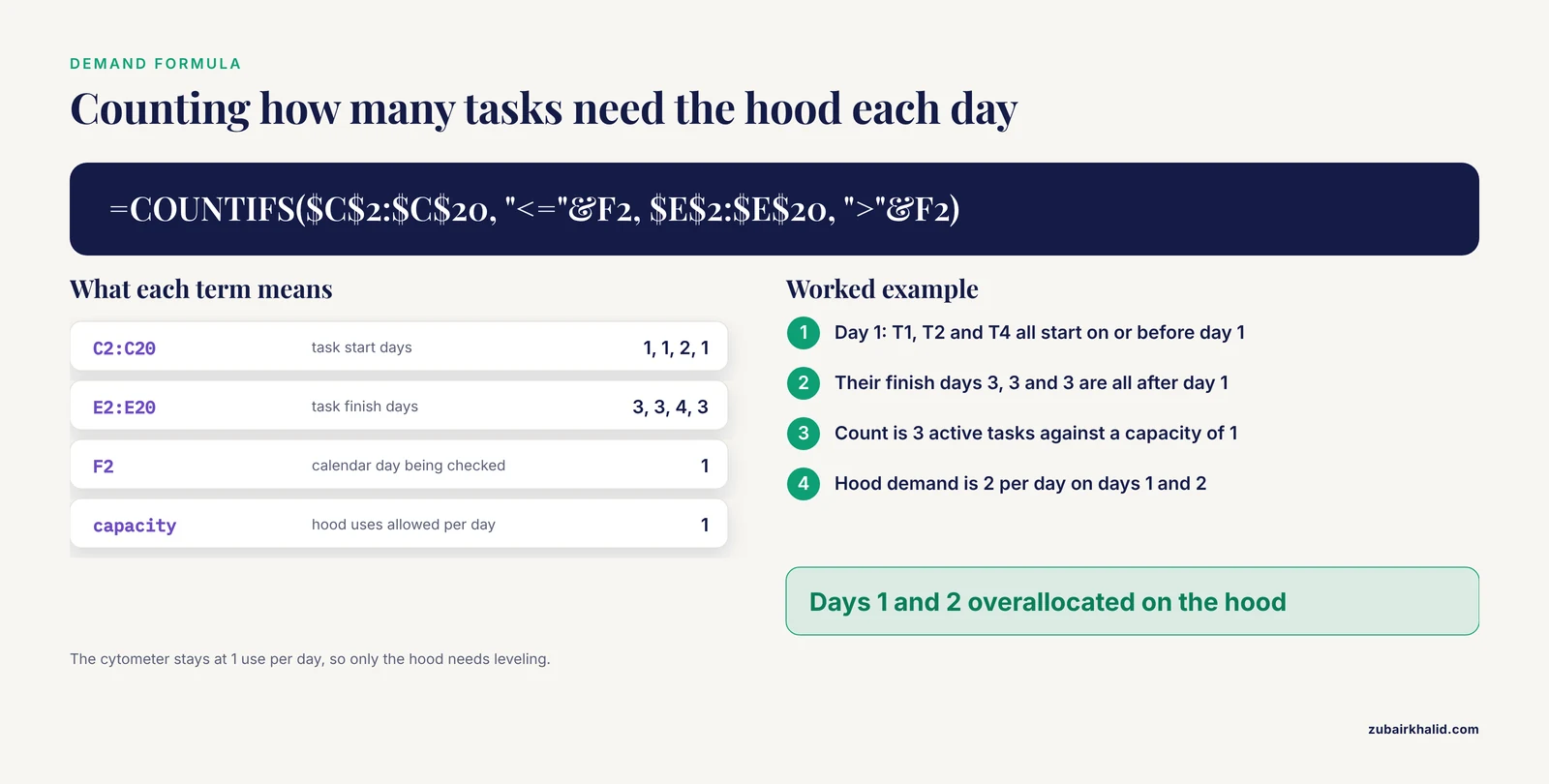
In a spreadsheet, put task starts in column C, durations in column D, and compute the finish date in column E with =C2+D2 (an exclusive end, meaning the task occupies days C2 through D2). Then lay a calendar in column F starting at row 2 and count how many tasks are active each day:
=COUNTIFS($C$2:$C$20, "<="&F2, $E$2:$E$20, ">"&F2)Copy that formula down the calendar column. Apply a conditional formatting rule that highlights any cell greater than the capacity for that resource, which is 1 in this example. The result for the example before leveling:
Day:        1  2  3  4  5  6
hood:       2  2  0  0  0  0     <- overallocated on days 1 and 2
cytometer:  1  1  0  0  0  0     <- fine
Days 1 and 2 demand two hood uses per day against a capacity of one. That is your leveling problem.
Step 4: Level the schedule
The simplest leveling algorithm is a greedy delay. Process tasks in priority order (earliest start first, longest task first as a tiebreaker), and for each task, push its start forward one day at a time until placing it creates no overload with the tasks already placed. Tasks with float absorb the delay. Here is a working pandas script:
import pandas as pd

tasks = pd.DataFrame(
    [
        ("T1", "Culture prep",      1, 2, "hood"),
        ("T2", "Western blot",      1, 2, "hood"),
        ("T3", "Confirmatory blot", 2, 2, "hood"),
        ("T4", "Flow panel run",    1, 2, "cytometer"),
    ],
    columns=["id", "name", "start", "dur", "resource"],
)

CAPACITY = {"hood": 1, "cytometer": 1}

def busy(taskframe, res, day):
    t = taskframe[taskframe["resource"] == res]
    return int(((t["start"] <= day) & (day < t["start"] + t["dur"])).sum())

def level(tasks):
    tasks = tasks.sort_values(
        ["start", "dur"], ascending=[True, False]
    ).reset_index(drop=True)
    for i, task in tasks.iterrows():
        start = task["start"]
        while True:
            trial = tasks.copy()
            trial.at[i, "start"] = start
            clash = any(
                busy(trial[trial.index < i], task["resource"], d)
                >= CAPACITY[task["resource"]]
                for d in range(start, start + task["dur"])
            )
            if not clash:
                break
            start += 1
        tasks.at[i, "start"] = start
    return tasks

leveled = level(tasks)

# verify: no resource day may exceed capacity
for res, cap in CAPACITY.items():
    for day in range(1, leveled["start"].max() + leveled["dur"].max()):
        assert busy(leveled, res, day) <= cap, (res, day)

print(leveled)
Expected output:
   id                name  start  dur   resource
0  T1        Culture prep      1    2       hood
1  T2        Western blot      3    2       hood
2  T3  Confirmatory blot       4    2       hood
3  T4      Flow panel run      1    2  cytometer
Reading the output: the cytometer task never moved because it never conflicted. The two blot tasks slid to days 3 and 4, giving a leveled hood demand of one use per day from day 1 through day 5, and the assert loop confirms no day exceeds capacity. The project finish moves from day 4 to day 6, which is the trade you accept in resource-constrained mode.
Two parameters control the result. The sort order decides which task wins a contested slot. Sorting by earliest start and then longest duration keeps long, hard-to-move tasks in place. The capacity dictionary decides how hard the algorithm pushes. Set it to your true capacity, not your hopeful capacity, or the script will produce a plan your lab cannot execute.
Step 5: Check the leveled plan
Run three checks before committing.
- Dependency check. Confirm no leveled task starts before its predecessor finishes. In the example, if T3 needed T1's product, T3 starting on day 4 is fine because T1 ends after day 2.
- Critical path check. Identify the longest dependency chain and confirm no leveled delay landed on it. If a delay did land on the critical path, either the deadline moves or you must add capacity.
- Deadline check. Compare the new finish date against grant and reporting milestones. If the leveled finish overshoots a hard milestone, you are in time-constrained mode for that milestone and need to add capacity or cut scope instead.
Step 6: Track actual use and re-level on a fixed cadence
A leveled plan decays the moment reality diverges from it. Pick a cadence, weekly works for most lab projects, and compare planned versus actual effort for each resource, then re-run the leveling pass with updated dates. This mirrors the resource tracking discipline used in health financing studies, where researchers compared budget estimates against actual spending and found persistent gaps between allocations and use, recommending more comprehensive and regular resource accounts [3]. Your lab equivalent is a simple log of planned versus actual hours and instrument slots. The gap between the two columns is the correction your next leveling pass must absorb.
A Research Project Plan Template You Can Reuse
Build this template once in a spreadsheet and copy it for every new project. Each column feeds the leveling calculation from the previous section.
| Column | Example entry | Why it matters |
|---|---|---|
| Task ID | T3 | Stable reference for dependencies and scripts |
| Task name | Confirmatory blot | Shared vocabulary across the team |
| Owner | Postdoc A | The human resource consuming hours |
| Predecessor | T1 | Dependency that constrains the start date |
| Duration (working days) | 2 | Drives demand window length |
| Earliest start | 2 | Initial schedule before leveling |
| Resource(s) | hood | Which capacity pool the task draws from |
| Units per day | 1 | How much of the resource each day consumes |
| Float (days) | 2 | Your leveling lever, larger means safer to move |
| Critical (Y/N) | N | Flags tasks whose delay moves the deadline |
| Status | Not started | Updated weekly during tracking |
Add a second sheet per resource with the calendar and the COUNTIFS demand formula. Add a third sheet for the weekly actuals log. With those three sheets, any member of a research team can re-level the plan in under an hour.
Practical Tips for Resource Leveling for Research Teams
- Front-load float. Identify which tasks have slack and be willing to move them early, on purpose. Sliding a low-float task late in the project is how deadlines die quietly.
- Treat core facility bookings as resources, not favors. Enter confirmed instrument slots in your plan and re-level around them. A canceled slot is an overallocation you did not plan for.
- Consider task shifting deliberately. In implementation research, task shifting, moving duties to trained staff who do not traditionally perform them, can expand capacity, though evaluations rarely report the resource implications of redirecting existing staff [4]. Before you redirect a technician to free a scientist's hours, budget the training time and the coverage for their old duties.
- Weigh concentration against spread. Modeling work on allocating HIV prevention resources across Kenyan counties compared extreme concentration in the highest-need areas against uniform spread and found real trade-offs across budget levels [5]. The lab version of the same trade-off is batching all samples into one intense instrument session versus spreading runs. Batching saves setup time and concentrates risk. Spread flattens demand and shortens queue-related delays. Compute both and pick with your eyes open.
- Keep a named buffer. Reserve 10 to 15 percent of each person's week as unlabeled float. Do not assign it to a task. It absorbs the repeats and failures that leveling on paper cannot foresee.
- Level small and often. One-hour weekly re-levels beat a quarterly replanning marathon, because small date moves are easy for a team to absorb.
Common Mistakes and Limitations
- Leveling without knowing the critical path. If you slide a task on the critical path, the whole project moves. Compute dependencies before you move anything.
- Leveling people but not equipment, or the reverse. Overallocation hides in whichever resource you did not count. Run the demand calculation for every shared resource, including reagent lots with expiration dates.
- Assuming effort is uniform. Research tasks fail and repeat. A two-day blot is sometimes a four-day blot. Pad durations based on your own historical repeat rates rather than optimistic first-pass estimates.
- Treating skilled staff as interchangeable. The clinical trial coordinator shortage shows what happens when workload is assigned without accounting for skill, experience, and burnout, with turnover feeding back into project delays [2]. A senior postdoc is not a fungible unit of capacity.
- Ignoring funder rules. Grant funds often carry conditions on what they can pay for, and overlapping funding streams can create conflicting incentives and inefficiencies in how resources get allocated [6]. Before you shift a person or instrument to another project, confirm the funding terms allow it.
- Splitting unsplittable work. A cell culture that needs continuous daily feeding cannot be paused and resumed. Only split tasks where the work is genuinely pausable.
- Leveling once. A plan leveled in month one and never revisited is a historical document. Schedule the weekly review.
- Trusting a single pass to be optimal. Greedy leveling produces a feasible plan, not necessarily the best one. For very large problems, published methods use evolutionary and other algorithmic approaches precisely because exact optimal solutions become impractical to compute [1]. For a 40-task lab project, a greedy pass plus human judgment is usually enough, and you should verify the result by eye.
One general limitation applies to everything above: every lab's true capacities and failure rates differ, so the numbers in your plan must come from your own tracking, not from any article, and complex or high-stakes scheduling decisions deserve a conversation with your PI and grants administration.
Frequently Asked Questions
What is resource leveling in research projects?
It is the practice of adjusting task start and end dates so that daily demand for people, equipment, and facilities matches what your lab actually has available.
When should I level resources instead of adding staff or equipment?
Level when capacity is genuinely fixed, such as a shared instrument or a frozen hiring budget. Add capacity when a hard deadline is threatened and the overload cannot be absorbed by float.
What is the difference between resource leveling and resource smoothing?
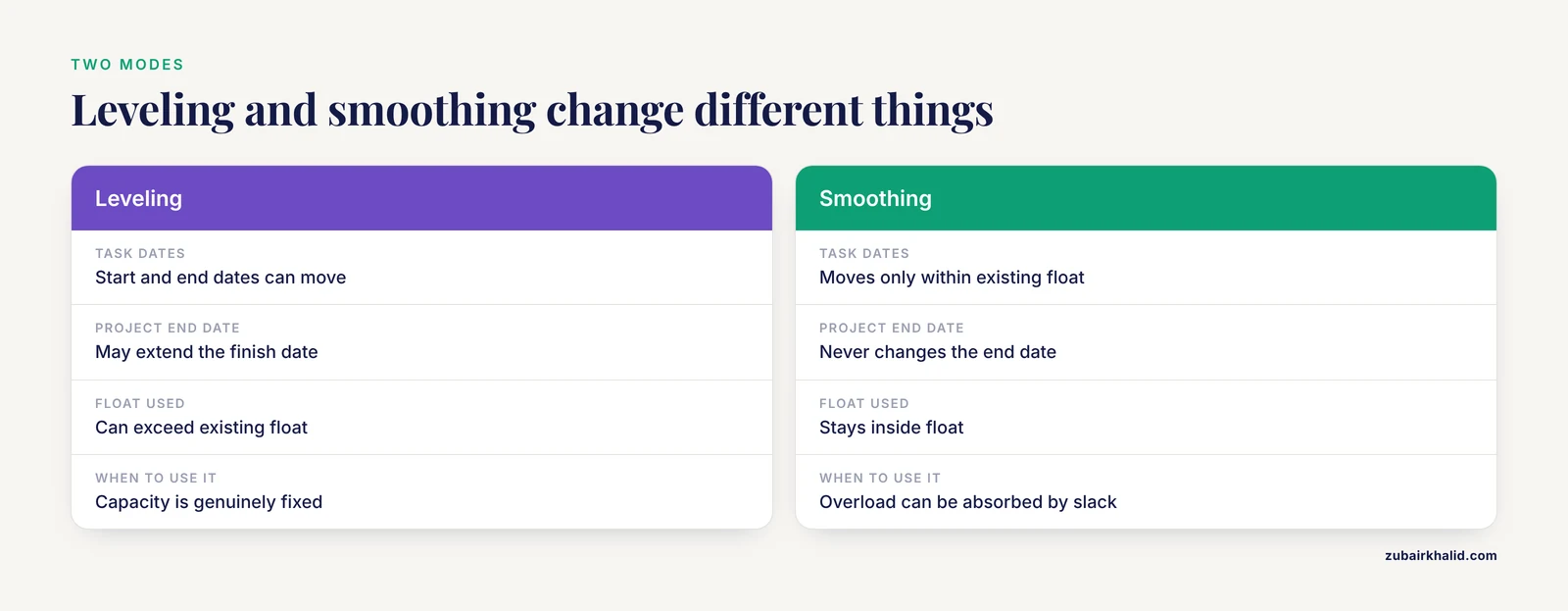
Leveling changes task dates and may extend the project end date, while smoothing moves tasks only within their existing float and never changes the end date.
How do I calculate daily resource demand in a spreadsheet?
Use a COUNTIFS formula that counts how many tasks have a start date on or before the calendar day and a finish date after it, then compare the count to capacity.
Can I use project management software for resource leveling?
Yes, tools like Microsoft Project and Gantt-based planners include automatic leveling, but you still need accurate task durations, resource capacities, and dependencies for their output to mean anything.
How often should a research team re-level its schedule?
Weekly is a practical cadence for most lab projects, aligned with your regular group planning meeting, plus an immediate re-level whenever a major experiment fails or a core booking changes.
How does leveling affect grant deadlines?
Leveling that delays tasks on the critical path pushes the finish date, so any leveled delay that reaches a grant milestone means you must add capacity, reduce scope, or request a no-cost extension.
What skills help with resource leveling in research project management?
Spreadsheet fluency, honest task duration estimation, clear dependency mapping, and regular communication with shared facility managers and team members about real availability.
Sources
- A ship-construction dataset for resource leveling optimization in large project management problems.
- Resource management and capacity planning for clinical trial sites.
- Reproductive health financing in Kenya: an analysis of national commitments, donor assistance, and the resources tracking process.
- Leveling Up PrEP: Implementation Strategies at System and Structural Levels to Expand PrEP Use in the United States.
- HIV prevention where it is needed most: comparison of strategies for the geographical allocation of interventions.
- Strategic Purchasing Arrangements in Uganda and Their Implications for Universal Health Coverage.