Common Mistakes in Research Project Planning and How to Avoid Them
By Dr. Zubair Khalid, DVM, MS, PhD ·
Most research projects that stall do so for one reason: the team started work before anyone wrote down how the final result would be produced. The question sounds clear in conversation, so the plan lives in people's heads. Then the data arrive, and no one can say which table, figure, or statistical test will turn them into an answer.
The first thing to check takes five minutes. Write your objective in one sentence. Then state the exact deliverable that answers it, for example a specific figure, an effect estimate with a confidence interval, or a signed-off protocol. If you cannot do both, the project has a planning problem. The sections below cover the most common research project planning mistakes, the mechanisms behind them, and the fixes, plus a diagnostic sequence you can run this week.
This guide is written for biology students, early-career researchers, and small lab teams planning a thesis project, a grant-funded study, or a first independent experiment.
Why Research Project Planning Mistakes Happen
Research project planning mistakes rarely come from laziness. They come from predictable pressures:
- The planning fallacy. People underestimate how long tasks will take even when they remember similar tasks overrunning. Bench experiments repeat, orders arrive late, and reviews take weeks, yet first drafts of timelines assume none of that.
- Progress bias. Pipetting feels like progress. Writing an analysis plan does not, so planning gets compressed to make room for visible work.
- Diffuse responsibility. In a team, everyone assumes someone else is tracking the deadline, the budget, or the backup plan.
- Optimism about data. New researchers assume the data will be clean, complete, and sufficient. Experienced researchers assume the opposite and plan for it.
Failure itself is normal. A review of student-run scientific events in India and Argentina concluded that the difference between people who succeed and people who abandon their projects lies in how they respond to adversity, not in whether they hit problems [1]. Planning is how you control that response. The eight mistakes below are ordered roughly from the most common to the least common, and each section explains the mechanism and the fix.
Troubleshooting Table: From Symptom to Fix
Use this table to move from a symptom you can observe to a cause you can fix. Work down the rows in order, because the most common causes sit at the top.
| Symptom | Likely cause | How to confirm | Fix |
|---|---|---|---|
| Milestones slip repeatedly while everyone stays busy | No written plan linking tasks to owners and dates | Ask each team member to state the next deliverable and its date from memory, then compare answers | One-page plan with an owner, a deliverable, and a date for every task |
| The collected data cannot answer the research question | Vague objective, no analysis plan | Try to write the caption of the final figure from the current protocol | Draft the analysis plan before further collection |
| The first full-scale run fails for avoidable reasons | No pilot stage | Check whether any small-scale test preceded the full run | Run a deliberate pilot with a study step, then refine |
| Participants or end users disengage, findings go unused | Design locked without consultation | List who was consulted before the design was finalized | Consult and co-create with end users while change is still cheap |
| One oversight ruins months of work | Delegated work with no verification | Trace who produced each number and who checked it | Name a verifier for every delegated output |
| An event, launch, or experiment collapses on a single failure | No contingency plans | List the steps that would stop the project if they failed | Keep a backup option for each single point of failure |
| Field or lab staff apply criteria inconsistently | Definitions not operationalized | Audit a sample of decisions against the written standard | Write operational definitions, train, and re-audit |
| New team members repeat the same errors | Skill-dependent steps lack training and written procedures | Compare error types across newcomers | Attach a standard operating procedure and a training plan to each skill step |
| The team runs out of money, time, or materials mid-project | Scope never matched to resources | Compare the task list against available person-hours, funds, and equipment | Descope or phase the project before the shortfall, not after |
The Eight Planning Mistakes, From Most Common to Rarest
1. Vague Objectives With No Operational Definitions
An objective written as a topic ("study antibiotic resistance in local rivers") is not a plan. An operational definition states exactly what counts as a case, an exposure, or an outcome, and how it will be measured. Without one, every person on the project fills the gap with a private assumption, and the problem compounds wherever many people apply the same criteria in the field or the clinic.
A quality improvement review of a vitamin A capsule program in Antique Province, Philippines began with a systems analysis, a structured comparison of observed practice against written performance standards. The analysis found that providers did not know which categories of children were high priority, counseled incompletely, and made frequent mistakes judging nutritional status, and the province rolled fixes out to six of its seventeen municipalities first [2]. Those are definition and training failures showing up as field errors.
The fix is mechanical. For every key term in your objective, write the operational definition before work starts: who counts as a case, what counts as an exposure, what the primary outcome is, and which instrument or assay measures it. Then audit a small sample of real decisions against the written definition during the first weeks and retrain where the audit shows drift. A systems analysis at the start is cheaper than a reworked dataset at the end.
2. Collecting Data Before Writing the Analysis Plan
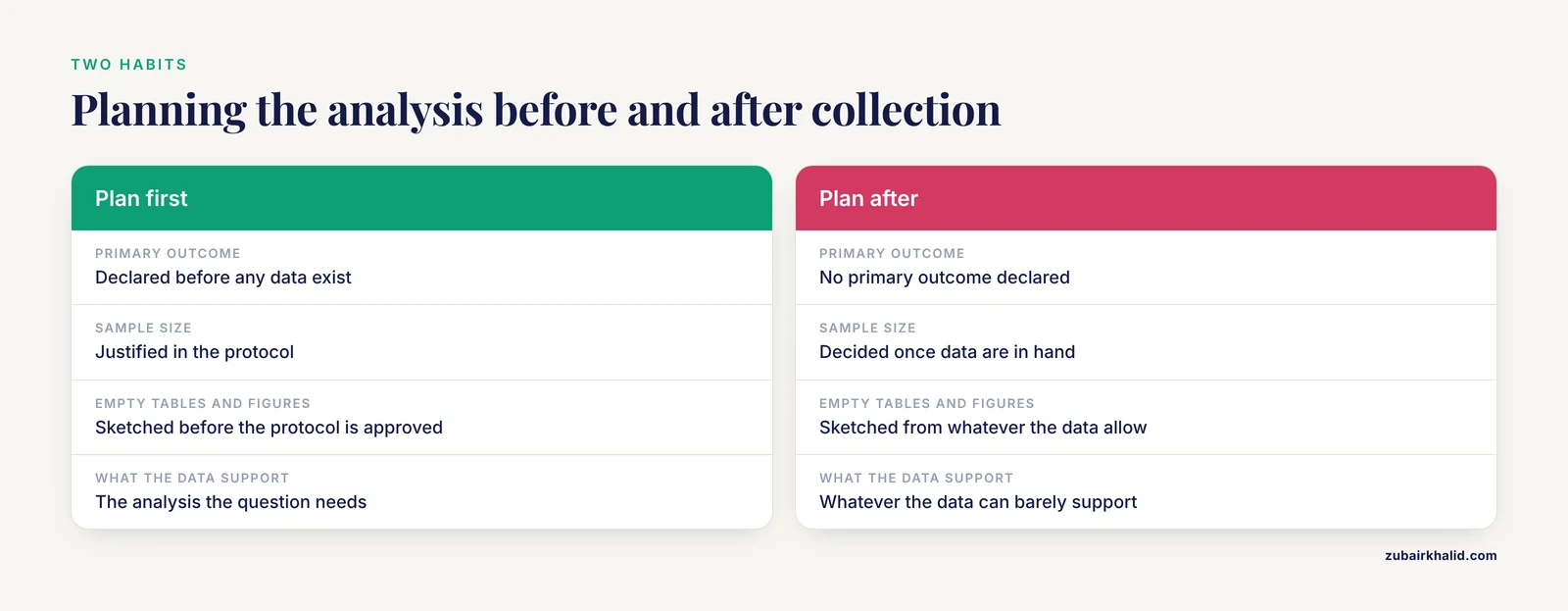
The symptom is a dataset with no primary outcome declared, variables collected "just in case," and no one who can name the statistical test. The mechanism is that analysis feels like a later problem, so design choices get made without the end in mind. Sample size, grouping, and the timing of measurements are all analysis decisions disguised as collection decisions. When the plan is written after the data exist, researchers drift toward whatever analysis the data can barely support, which is how weak results get published and strong questions get wasted.
Guidance on quantitative analysis urges analysts to understand their data and methods well enough to get the analysis right the first time, and documents how celebrated findings can collapse when the numbers are wrong. The best-known case is Weitzman's study of no-fault divorce, which reported that women's standard of living fell 73 percent after divorce while men's rose 42 percent. Those figures were cited across hundreds of newspaper stories, social science articles, and legal cases before an Associated Press investigation in 1996 reported problems with them [3].
Draft a one-page analysis plan before collection starts. Name the primary outcome, the comparison you will make, the test or model, and the sample size justification. Sketch the empty tables and figures you intend to fill. If you cannot sketch the final figure, the protocol is not ready.
3. Timelines With No Dependencies, Buffers, or Lead Times
The symptom is a task list running in parallel, everything ending on time, nothing marked as depending on anything else. The mechanism is the planning fallacy plus a structural error. Most project tasks share people, instruments, and money, so a delay in one lane stalls the others. Timelines also omit the slowest steps, which are usually administrative: ethics approvals, animal care protocols, chemical orders, equipment maintenance, and reviewer turnaround.
Build the schedule backward from the deliverable. Mark every dependency, meaning every task that cannot start until another finishes. Identify the critical path, the longest chain of dependent tasks, because a slip anywhere on it moves the end date. Schedule the long-lead-time items first, so submissions, orders, and approvals are locked in before the work that depends on them. Then add explicit buffer and treat buffer as a scheduled task with a purpose, not as slack to be spent early. A timeline that survives contact with reality usually has fewer parallel tasks and more buffer than the first draft.
4. No Contingency Plans for Single Points of Failure
The project depends on one instrument, one supplier, one collaborator, one dataset, or one server, and nobody has said what happens if that dependency fails. Contingency planning costs time now to prevent time later, so it loses to visible work. The failure mode is binary: a single point of failure either holds or stops the project.
Two regional student groups learned this in public. A group in India attempted an online scientific meeting with geographically dispersed participants, a format new to them, and a group in Argentina organized its first two-day symposium. Both hit complications. Some were easy to fix, some led to cancelled activities, and the groups' shared conclusion was that every project needs a healthy panel of contingency plans [1].
List every step whose failure would stop the project. For each, define a backup before you need it: a second instrument or core facility, an alternate supplier, a mirrored copy of the data, a substitute speaker or session format. Rehearse the risky steps. A dry run of the technology, the transfer, or the assay costs an afternoon and converts unknown failures into known ones with known fixes.
5. Treating the First Full-Scale Run as the Pilot
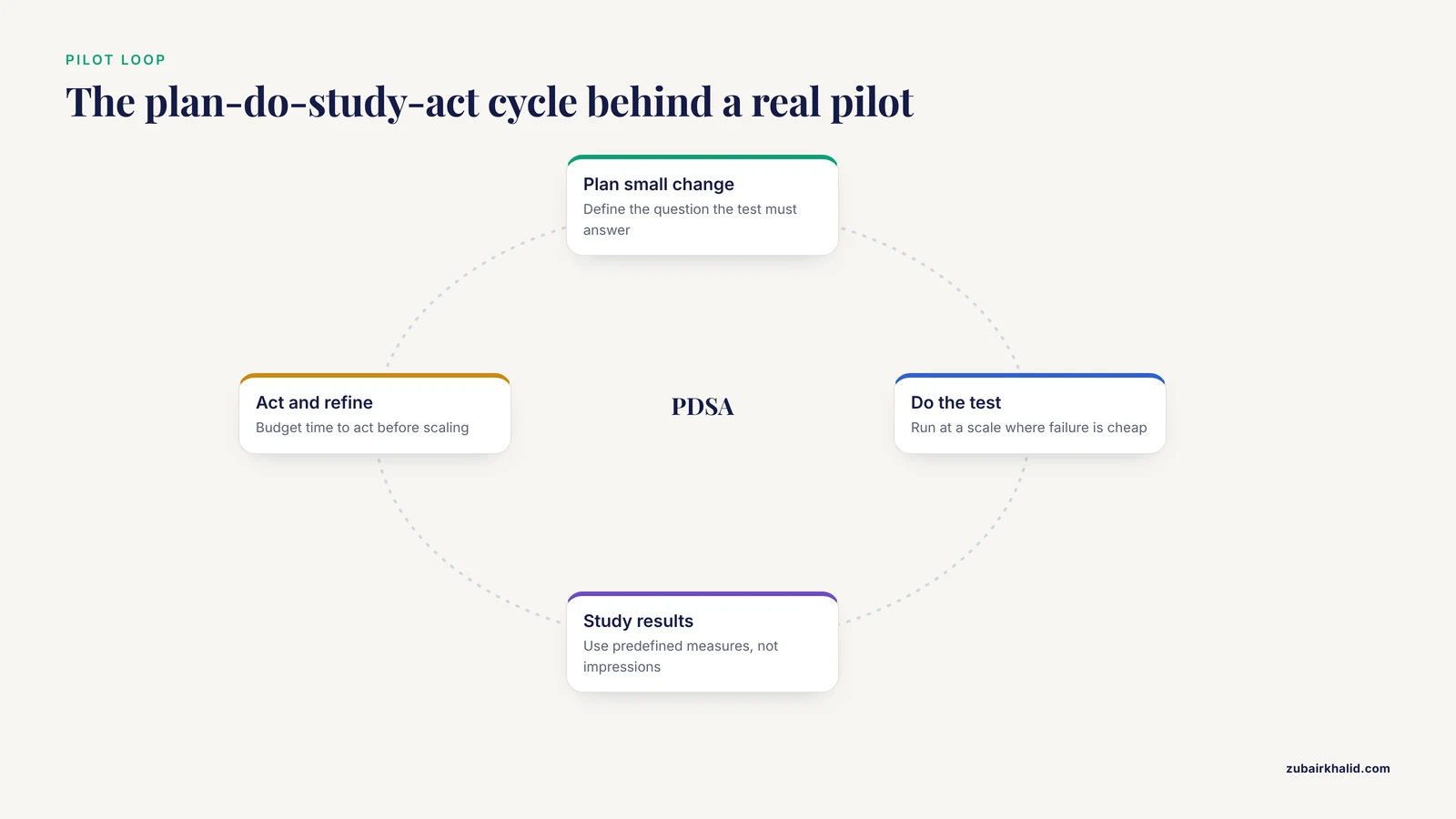
The project goes straight from protocol to full data collection, and every unforeseen problem consumes real samples, real money, and real goodwill. A real pilot is a planned test with a built-in study step, run at a scale where failure is cheap, not a compressed rehearsal of the full study. The plan-do-study-act cycle, usually abbreviated PDSA, formalizes this: plan a small change, do it, study the results, act on what you learned, then repeat.
One service made the study step explicit. A community eating disorder service developing a pilot multidisciplinary pathway for ARFID, avoidant restrictive food intake disorder, embedded semi-structured interviews with 17 participants, 7 service users and 10 staff members, into the study stage of its PDSA cycle. The interviews surfaced engagement barriers and resource allocation tensions that the design phase had not predicted, and the act stage used them to refine the pathway [4].
Schedule a deliberate small-scale test before full rollout, with a defined question the test must answer, such as whether the recruitment script works or the assay reproduces. Budget time to act on the findings before scaling. One full PDSA loop is the minimum, and iterative projects typically run several.
6. Locking the Design Before Consulting End Users
The protocol is finalized, then participants, clinicians, or downstream users see it for the first time after approval. Planners substitute their own assumptions for the people the project serves. The wrong assumptions get baked into recruitment materials, visit schedules, or outputs, and they surface as poor enrollment, disengagement, or findings nobody uses, when changing them is most expensive.
The ARFID pathway team found barriers to service user engagement and communication that pointed directly to the need for consultation and pathway co-creation, and its refinements prioritized service user consultation, treatment adaptations for neurodiversity, and cross-service working [4]. A different project made co-creation the method itself: an activist sport research project in Brazil built a pedagogical model together with 17 boys aged 13 to 15, 4 coaches, a coordinator, and a social worker over six months, and named learning from mistakes and valuing each other's knowledge among its explicit outcomes [5].
List everyone who participates in or uses the project, consult them while the design is still changeable, and co-create the parts that depend on their behavior or their context. Expect the communication load. The Brazilian team logged 36 planning and debrief meetings in six months alongside its field sessions [5]. Consultation is a scheduled work item, not a courtesy.
7. Delegating Work Without Verification
One person runs the assay, another codes the data, a third writes the results, and no one checks anyone else's output against the raw material. Teams divide labor but not verification. Delegated work that is inadequately communicated or mismanaged propagates errors silently, and the error is often discovered by outsiders at the worst possible time.
An analysis of quantitative research failures opens with cautionary cases, including NASA's Mars Polar Explorer, where bright, dedicated teams suffered disastrous consequences because delegated work was inadequately communicated or mismanaged [3].
Give every delegated output a named verifier, someone other than the producer. Put handoffs in writing: what was done, with which data or reagents, and what remains open. Adopt one rule and enforce it: no number enters a report, a slide, or a manuscript until someone other than its producer has traced it back to the raw data. The same rule covers code, unit conversions, and sample labels.
8. Skill-Dependent Steps With No Training, Standards, or Monitoring
The plan assigns bench, field, or clinical steps to whoever is available, without checking competence, written procedure, or output quality. Some steps in a project depend on technique, and technique drifts without standards. Each new person reintroduces the same errors, and because the errors look like results, they survive into the dataset.
Clinical specialties handle this with explicit mistake catalogs. Standardized training guidance for ultrasonic scaling in periodontology teaches each procedure by listing its key operation points, precautions, common mistakes, and countermeasures [6]. Quality improvement programs use the complementary tool: a systems analysis that compares observed practice against written performance standards, then targets the deviations [2].
Inventory the skill-dependent steps in your project. Attach a written standard operating procedure to each, plan hands-on training with a competent practitioner before the step enters the timeline, and monitor a sample of outputs against the standard on a schedule. Where a step is error-prone, list its common mistakes and countermeasures in the procedure itself, the way clinical training documents do.
Safety note: planning hands-on work means planning its hazards. Before scheduling bench or clinical steps, confirm that everyone performing them has current safety training, that personal protective equipment and written procedures are in place, and that the required approvals, such as biosafety, chemical safety, radiation, or animal care review at your institution, are secured. Enter these approvals in the timeline as lead-time items, not afterthoughts.
A Short Diagnostic Sequence
Run these seven steps in order when a project feels stuck, or before one starts.
- Write the objective in one sentence.
- State the deliverable that answers it and the analysis that produces the deliverable.
- List every task between now and that deliverable, each with an owner and a date.
- For each task, mark what it depends on and what happens if it fails.
- Identify the smallest testable version of the project and schedule it first.
- Name the verifier for every delegated output.
- Set the first interim review date and the criteria you will use to continue, adjust, or stop.
If step 2 stalls, you have found the cause of most of the other symptoms. Fix it before touching anything else.
What a Research Project Plan Template Should Contain
A template is a set of questions that force written answers. Any format works if every row below has a written response, a date, and a name next to it.
| Section | What to write |
|---|---|
| Objective and deliverable | The one-sentence objective and the exact final deliverable |
| Background and rationale | Why the question matters and what is already known |
| Stakeholders and roles | Who participates, who uses the results, who owns each decision |
| Scope and exclusions | What the project will and will not answer |
| Work breakdown and timeline | Tasks, dependencies, critical path, buffer, long-lead approvals |
| Resources | Person-hours, budget, equipment, reagents, and when each is needed |
| Analysis plan | Primary outcome, comparison, test or model, sample size justification, empty tables |
| Data management | Where raw data live, how they are backed up, naming and versioning rules |
| Quality assurance and training | Standard operating procedures, training plan, monitoring schedule |
| Risk register and contingencies | Each single point of failure and its backup |
| Communication | Meeting cadence, decision log, how updates are recorded |
| Approvals and safety | Ethics, biosafety, animal care, or other reviews, with submission dates |
Two habits make a template useful. Keep it short enough that filling it takes hours, not weeks. Treat it as version one of a living document, because a plan nobody updates is a record of past intentions, not a plan.
Day-to-Day Research Project Management
Planning fails at the execution layer when management habits are missing. Four habits carry most of the weight.
One source of truth. Keep the plan, the analysis plan, and the decision log in one place with version history. If the plan exists in three copies, none of them is the plan.
Short, plan-anchored meetings. Review the task list, the risk register, and the decision log at a fixed cadence. Iterative research runs on this kind of structured communication, as the co-creation projects described above show.
A decision log. Record what was decided, by whom, when, and why. This is the cheapest defense against relitigating settled questions every month.
Milestone reviews with predefined criteria. Decide in advance what evidence at an interim review would mean continue, change course, or stop. Deciding this before the review protects the project from the sunk cost instinct.
Common Mistakes and Limitations
A few failure patterns sit outside the eight above, and a few limits apply to the advice itself.
- Plans rot. An unupdated plan misleads more than no plan, because it looks authoritative. Review and revise it at every milestone.
- Over-planning is also a mistake. A plan's job is to enable the smallest useful test, not to predict everything. If polishing the plan has replaced running the pilot, start the pilot.
- Activity is not progress. Measure progress in deliverables, not in hours logged or samples processed.
- Mistakes are information. Log them, review them at milestones, and let them change the plan. Projects that hide small errors usually meet the large ones later.
- Individual studies vary. Work involving human participants, animals, or hazardous materials needs review by the relevant ethics or safety committees, and studies with complex statistics benefit from a statistician's review of the analysis plan before collection starts.
Frequently Asked Questions
What is the most common research project planning mistake?
Starting data collection before anyone has written down the objective, the deliverable, and the analysis that connects them. Everything downstream, from sample size to timeline, inherits that gap.
How do I fix a research project that is already off track?
Stop collection, run the seven-step diagnostic sequence above, descope to the core question, and schedule a small pilot of the next step before restarting. Correcting course mid-project is normal, hiding the problem is not.
What should a research project plan template include?
At minimum: objective and deliverable, stakeholders and roles, scope, a task timeline with dependencies, resources, an analysis plan, data management, quality assurance, a risk register with contingencies, communication cadence, and approvals. The table above lists what each section must contain.
How far ahead should a research project timeline go?
Milestone level for the whole project, task level with named owners and dates for the near term. Long-lead items such as approvals and orders get fixed dates immediately, because they sit on the critical path.
When should stakeholders be consulted during planning?
Before the design is locked, while changes are still cheap, and again after each pilot cycle. Consultation after the protocol is final is feedback you cannot use.
What is a contingency plan in research project management?
A pre-decided backup for any step whose failure would stop the project, such as a second instrument, an alternate supplier, or a mirrored data copy. The test of a contingency plan is that no meeting is needed to activate it.
How do I plan the statistical analysis before collecting data?
Write a one-page analysis plan naming the primary outcome, the comparison, the test or model, and the sample size justification, then sketch the empty tables and figures. If the final figure cannot be sketched, the protocol is not ready.
What is the plan-do-study-act cycle?
A four-step improvement loop: plan a small change, do it at a scale where failure is cheap, study the results with predefined measures, and act on what you learned before scaling. Research projects use it to turn pilot findings into design decisions.
Sources
- The upside of failure: how regional student groups learn from their mistakes.
- The Quality Assurance Project assists the vitamin A capsule program in Antique Province, Philippines.
- Peeking inside the statistical black box: how to analyze quantitative information and get it right the first time.
- "We might be making mistakes, but we're learning, we're trying, and we're listening": embedding qualitative methods within the plan-do-study-act cycle to support the development of a pilot multidisciplinary ARFID pathway.
- An Activist Approach to Sport Meets Youth From Socially Vulnerable Backgrounds: Possible Learning Aspirations.
- [[Correctly performing ultrasonic supragingival scaling, subgingival scaling and root planning exercises: part Ⅵ of a series on basic training in periodontal diagnosis and treatment].](https://pubmed.ncbi.nlm.nih.gov/41605489/)