10 Essential Elements of a Research Project Plan: A Checklist
By Dr. Zubair Khalid, DVM, MS, PhD ·
By the end of this guide you will be able to draft a complete plan for a life science research project, check the draft against ten essential elements, and convert the plan into dated milestones you can defend to a supervisor, a committee, or a funder. You need a spreadsheet program, a plain text editor, and optionally R and Python for the worked calculations. Everything runs on a standard laptop with no special access or paid tools.
What a Research Project Plan Does
A research project plan is a written document that states what a study will do, how it will do it, when each part happens, what it costs, and what happens to the data and the results. Research project management is the practice of keeping those five promises across the life of the study.
A plan is not a grant proposal. A proposal persuades a review panel that an idea deserves funding. A plan tells your team what happens in week one, who owns each deliverable, and how you will know the project is on track. Many new researchers inherit a funded proposal and assume the planning is finished. The proposal usually covers the question and the design. It rarely covers file naming, backup, who orders the reagents, or what happens when a key shipment arrives three weeks late. Run any draft against the research project plan checklist below to close that gap.
The same checklist fits a one semester rotation project, a dissertation, a multi year grant, or a systematic review. The elements do not change. The depth does.
The 10 Essential Elements of a Research Project Plan
The table lists the ten elements and the question each one answers. The sections that follow explain what to write in each element and how to tell that the section is finished.
| # | Element | The question it answers |
|---|---|---|
| 1 | Question and objectives | What are we asking, and what counts as an answer? |
| 2 | Background | What is already known, and what exactly is missing? |
| 3 | Design and methods | How will the data be produced? |
| 4 | Protocol and registration | Is the method written down and timestamped before data collection? |
| 5 | Team and stakeholders | Who does what, and who else holds a stake? |
| 6 | Timeline | Due when, and what happens when something slips? |
| 7 | Budget | What does each activity cost? |
| 8 | Data management | Where do the data live, and who can find them in a year? |
| 9 | Analysis and quality control | How will results be produced and checked? |
| 10 | Risk, ethics, dissemination | What can go wrong, and who will hear the results? |
1. Research Question and Objectives
Write the question as one sentence. Then break it into two to four objectives that are specific, measurable, achievable, relevant, and time bound, the SMART framework used across project management. Define every construct in the question before anything is collected. A construct is the abstract idea your variables stand in for, such as sleep quality or medication adherence.
Construct definition is where early career projects wobble. A scoping review (a review that maps the breadth of literature on a topic without pooling effect estimates) of posttraumatic stress among people with diabetes handled this by treating posttraumatic stress disorder, posttraumatic stress symptoms, medical traumatic stress, and diabetes distress as four distinct constructs before mapping any prevalence estimates [1]. Four similar sounding terms, four definitions, one clean search strategy. If any word in your question could be read two ways, define it in the plan.
Pass test. A colleague outside your subfield can restate the question and objectives without asking what a single term means.
2. Background and Literature Review
The background has three jobs. Summarize what is known. Name the gap. Position your objectives against that gap.
Organize the summary around mechanisms and regulators instead of a chronological list of papers. A narrative review of the glymphatic system, the brain's waste clearance pathway and a therapeutic target in Alzheimer's and Parkinson's disease, organized the field around its known regulators, including aquaporin-4 (AQP4, a water channel protein whose positioning directs fluid movement through brain tissue), cerebral arterial pulsatility (the rhythmic expansion of brain arteries that drives fluid flow), and the integrity of meningeal lymphatic vessels (lymphatic vessels in the membranes surrounding the brain), and then grouped the emerging interventions, focused ultrasound, repetitive transcranial magnetic stimulation, and transcranial photobiomodulation [2]. A review of ferroptosis, an iron dependent form of programmed cell death, did the same for drug induced kidney injury by mapping core mechanisms, crosstalk with other cell death pathways, and the molecular targets where drugs act [3]. Both reviews earn their length because a reader sees the system, its controls, and the open question in one pass.
Set up a reference manager before writing, tag every reference by theme, and state the gap in one sentence. If the gap will not fit in one sentence, the review is not done.
Pass test. The gap sentence appears in the background, and the objectives in element 1 answer it directly.
3. Study Design and Methods
State the design (experiment, cohort study, cross sectional survey, case series, or a named review type), the population and the sampling plan, every variable, and the instrument that measures each variable. Prespecify the parameters that could split your analysis later, such as dose, duration, frequency, and the characteristics of the participants or samples.
Prespecification is what separates a planned subgroup analysis from a fishing trip. A network meta-analysis (a method that compares multiple treatments at once by combining direct and indirect evidence across trials) of exercise regimens for sleep quality in older adults fixed its parameters in advance, naming the databases to search, requiring two researchers to extract data independently, and listing the subgroup factors before the search ran, including single session duration, weekly frequency, intervention period, exercise intensity, and participant characteristics [4]. Because those choices were written down first, the subgroup analysis answered questions the team had decided to ask rather than questions the data suggested afterward.
Pass test. Every objective from element 1 maps to at least one variable, and every variable maps to an instrument with a stated unit.
4. Written Protocol and Registration
A protocol is the full methods section, written and version dated before data collection begins. Registration places a timestamped copy in a registry, which makes later deviations visible to everyone.
Systematic reviews have a settled routine here. The diabetes scoping review followed the PRISMA-ScR guideline (the extension of the PRISMA reporting standard for scoping reviews) and registered its detailed protocol in the Open Science Framework (OSF), a free project registry, before the literature search started [1]. Clinical trials follow the same logic in public trial registries. For early exploratory or pilot work that no registry fits, a dated, version controlled protocol file that the whole team approves is a reasonable substitute. The timestamp is the point, not the venue.
Pass test. The protocol carries a version number, a date, and either a registration record or a dated commit the team has agreed on.
5. Team Roles and Stakeholder Engagement
List every person, their role, and the rule for disagreements. A simple scheme works: one accountable owner per deliverable, named contributors under them, and named people who must be consulted before a decision becomes final.
When a project involves communities, patients, or several disciplines, plan the collaboration with the same rigor as the methods. Leaders of convergent, co-produced coastal research (projects designed jointly with the communities they affect) funded through the National Science Foundation's Coastlines and People program distilled their experience into recommendations that transfer to any engaged study: use inclusive communication practices, incorporate boundary spanners (people who can translate between disciplines and between researchers and communities), build shared understanding, choose the style and depth of co-production deliberately, focus on earning trust, and equalize power dynamics [5].
Patient and public involvement (PPI), the structured participation of patients and citizens in research governance, deserves its own mini plan. The DIADEME group at a French comprehensive cancer center recruited five patients and five citizens, mostly through patient associations, and ran nine monthly meetings. The members co-developed the mission statement, engagement charter, and annual action plan during the first two meetings, a patient facilitator gathered independent feedback to keep the collaboration balanced, and the involvement produced concrete results, including revisions to a colorectal cancer prevention study so it better addressed patient needs [6]. The pattern is the lesson: a deliberate recruitment channel, a fixed meeting rhythm, a written charter, and a defined feedback route. Write those four items into your plan.
Pass test. Each deliverable has one accountable name, and every community or patient role has a recruitment route, a meeting rhythm, and a written charter.
6. Timeline, Milestones, and Buffers
A milestone is a dated, verifiable event, such as protocol registered or data collection complete. Give every milestone a date and one owner. Then add buffer, extra time that absorbs delay, and write the number into the plan instead of hiding it inside optimism.
Delay is a normal feature of research, not an exception. The Coastlines and People project leaders recommended embracing the expanded timeline that co-produced research requires, planning for delays, and treating the schedule as adjustable [5]. A single lab project needs a smaller buffer than a multi partner consortium, but both need a written number with a justification. The worked example below turns a week based schedule into real calendar dates with a buffer applied.
Pass test. Every milestone has a date and an owner, and the buffer is a written number with a one line justification.
7. Budget and Resource Inventory
List the direct costs (reagents, consumables, core facility and sequencing fees, per diem animal housing charges, participant payments), the personnel effort in hours or percent per week, and the equipment or facility access the project depends on. A core facility is a shared institutional service such as sequencing, imaging, or flow cytometry. Add a contingency line for costs you cannot yet name, with a one sentence justification.
Then walk the budget against the timeline. If week 12 requires a sequencing run, the purchase order must exist before week 12, which means the quote and the approval must exist earlier. A budget that ignores the timeline is a wish list.
Pass test. Every cost maps to a timeline activity, and every activity that costs anything has a funding line.
8. Data Management Plan
A data management plan (DMP) states how data are named, stored, backed up, documented, retained, and shared. Write the naming convention down and decide the folder structure before the first file exists. Apply the 3-2-1 backup rule, a standard practice meaning three copies, on two different types of media, with one copy off site. State the retention period and the repository where finished data will be deposited.
The plan should also list the metadata a stranger would need to reuse the data, such as instrument settings, batch numbers, reagent lot numbers, and collection dates. The walkthrough below creates a folder skeleton you can adapt.
Pass test. A new file can land in the right folder with the right name without anyone asking a question.
9. Analysis Plan and Quality Control
The analysis plan prespecifies the primary outcome, the statistical test for each objective, the software, and the rules for missing data and outliers. Lock it before data collection. Anything explored after the data arrive gets labeled exploratory.
Prespecify the full pipeline, down to the software and the robustness checks. The exercise and sleep review fixed its methods in advance, using RevMan for study quality assessment, Stata for the network meta-analysis, funnel plots with Egger's test (a statistical check for whether small studies skew the funnel plot, a sign of publication bias) to examine publication bias, the SUCRA statistic (surface under the cumulative ranking curve, a value from 0 to 100 percent used to rank treatments) to rank interventions, and a leave-one-out sensitivity analysis (repeating the analysis with each study removed in turn) to confirm that no single study drove the result [4].
Build quality control checkpoints into the schedule as well. An evidence based implementation project (one that translates published best evidence into local practice and audits the result) on immunosuppressant adherence, the proper use of the medications that prevent transplant rejection, in adult kidney transplant patients summarized 38 pieces of best evidence, had a multidisciplinary expert panel prioritize 18 recommendations, and translated them into 23 measurable audit criteria covering structure (whether the right resources exist), process (whether staff act correctly), and outcome (whether patients benefit). The team then ran a baseline audit, two implementation rounds, and two follow-up audits, analyzing barriers and facilitators between rounds [7]. The transferable idea is simple. Define what done correctly looks like as a measurable criterion, audit against it at a fixed date, and plan the correction round before you need it.
Pass test. Someone else could run the primary analysis from the protocol alone, without making a single new decision.
10. Risk Register, Ethics, and Dissemination
A risk register is a table of things that could go wrong, each with a likelihood, an impact, a mitigation, and an owner. Typical rows for a life science project include a key reagent going out of production, a core facility backlog, an animal protocol amendment, a data loss event, and the departure of a trained team member. Ten minutes of writing per row saves weeks later.
List the approvals the project cannot start without, such as institutional review board (IRB) approval for human subjects work, institutional animal care and use committee (IACUC) approval for animal work, and biosafety review where relevant, each with the lead time it needs. Close the plan with a dissemination section: target journals and conferences, data and code deposit, and, for engaged projects, how results return to the communities and partners who contributed, which is part of sustaining those partnerships over the long term [5].
Pass test. Every risk has a mitigation and an owner, and the first milestone that depends on an approval has that approval's lead time built into the timeline.
Research Project Plan Checklist Template
The template below is the checklist in document form. Copy it, fill every heading, and keep it short. Treat this as your research project plan template for any life science study.
# Project Plan: [Short title]
Version / date:
Owner:

## 1. Question and Objectives
- Question (one sentence):
- Objectives (SMART):
- Constructs and definitions:

## 2. Background
- What is known:
- The gap (one sentence):
- Key references:

## 3. Design and Methods
- Design:
- Population and sampling:
- Variables and instruments:

## 4. Protocol and Registration
- Protocol version and date:
- Registry or version control record:

## 5. Team and Stakeholders
- Roles and accountable owners:
- Decision rule:
- Engagement plan (recruitment, rhythm, charter, feedback route):

## 6. Timeline
- Milestones with dates and owners:
- Buffer (number and justification):

## 7. Budget
- Direct costs:
- Personnel effort:
- Contingency:

## 8. Data Management
- Naming convention:
- Folder structure:
- Storage, backup (3-2-1), retention, sharing:

## 9. Analysis and Quality Control
- Primary outcome:
- Tests and software:
- Missing data and outlier rules:
- Audit points:

## 10. Risk, Ethics, and Dissemination
- Risks, mitigations, owners:
- Approvals and lead times:
- Outputs and return of results:
The same ten elements also work as a machine readable format, which is what the walkthrough builds and validates next.
From Checklist to Working Plan: A Worked Example
These five steps take the checklist from a document to a dated, sized, and stored project. Treat the whole walkthrough as a research project plan checklist example you can adapt. The commands use Python 3, R, and a Unix style shell, and every step ends with a way to check the result.
Step 1. Write the checklist as a data file
Save the following as plan_checklist.csv. Each row holds one element, its core content, and its pass test.
element,core_content,pass_test
question,"One sentence question, SMART objectives, defined constructs","A stranger can restate the question without asking what a term means"
background,"Scoped summary, named gap, reference library","The gap is one sentence and the objectives answer it"
design,"Study type, population, sampling, variables, instruments","Every objective maps to a variable and an instrument"
protocol,"Full methods, version number, registration record","The protocol is timestamped before data collection"
team,"Named roles, decision rule, engagement plan","Each deliverable has one accountable person"
timeline,"Dated milestones, owner per milestone, written buffer","Every milestone has a date and the buffer is written down"
budget,"Direct costs, personnel effort, contingency","Every cost maps to a timeline activity"
data,"Naming convention, folders, backup, retention, sharing","A new file lands correctly without asking anyone"
analysis,"Primary outcome, tests, software, missing data rules","The primary analysis runs from the protocol alone"
risk,"Risk table, approvals, dissemination plan","Every risk has a mitigation and an owner"
Step 2. Validate the file
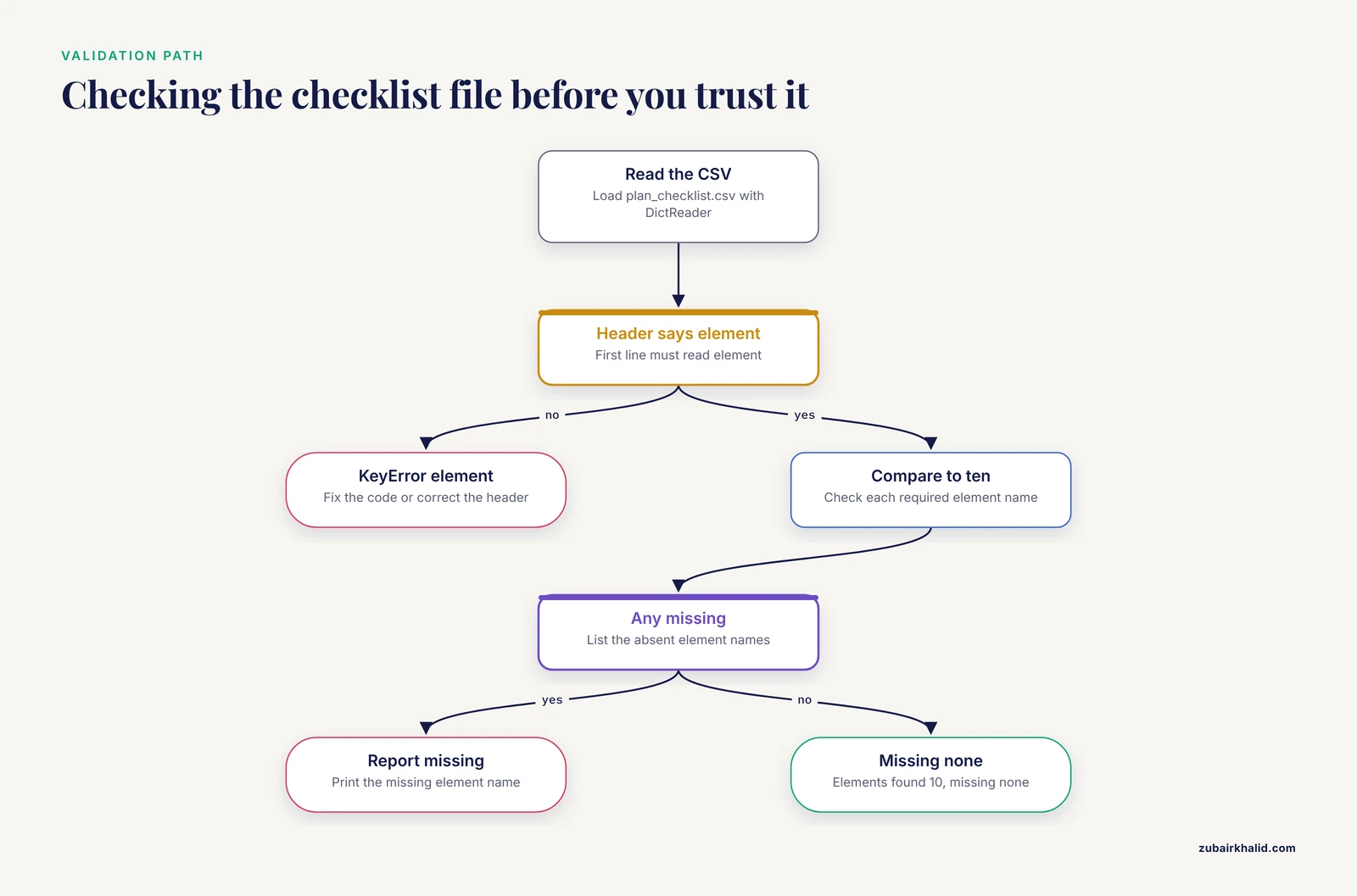
Run this check so a typo in a header or a missing element cannot hide:
import csv

with open("plan_checklist.csv", newline="") as f:
    rows = list(csv.DictReader(f))

required = ["question", "background", "design", "protocol", "team",
            "timeline", "budget", "data", "analysis", "risk"]
present = [r["element"] for r in rows]
missing = [e for e in required if e not in present]

print("Elements found:", len(present))
print("Missing:", missing if missing else "none")
Expected output:
Elements found: 10
Missing: none
Common error. If the first line of the CSV says sections instead of element, Python raises:
KeyError: 'element'Fix: make the code match the header, or correct the header. The same check catches a missing row, which prints the missing element name instead of none.
Step 3. Turn the timeline into dated milestones
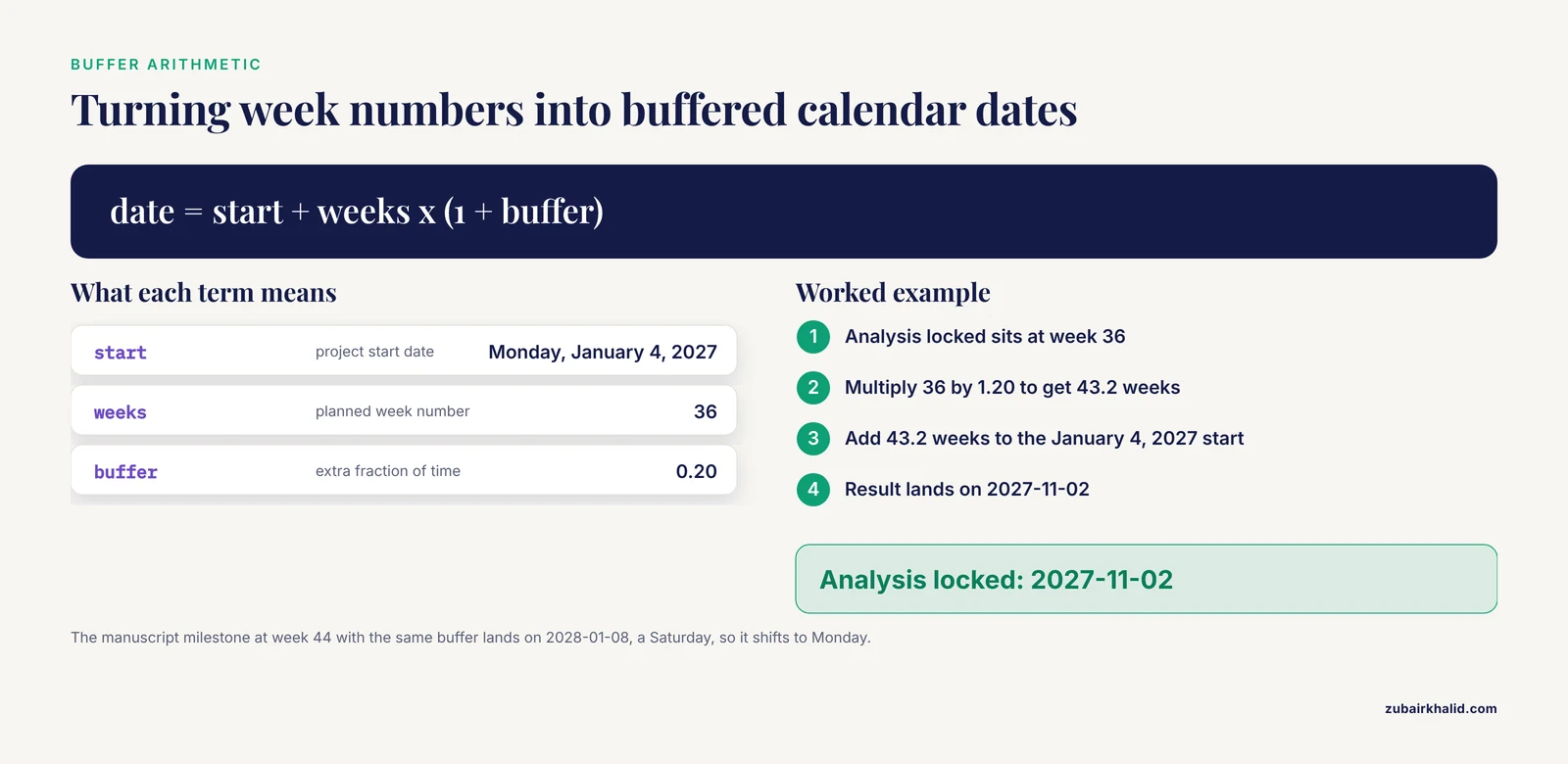
Suppose the project starts on Monday, January 4, 2027, and the week based schedule reads: protocol registered by week 4, data collection complete by week 24, analysis locked by week 36, manuscript drafted by week 44. Convert weeks to calendar dates and apply a 20 percent buffer to the analysis and writing phases, a number you would choose and justify for your own project:
from datetime import date, timedelta

start = date(2027, 1, 4)
milestones = {
    "Protocol registered": (4, 0),
    "Data collection complete": (24, 0),
    "Analysis locked": (36, 0.20),
    "Manuscript drafted": (44, 0.20),
}

for name, (weeks, buffer) in milestones.items():
    effective = weeks * (1 + buffer)
    print(f"{name}: {(start + timedelta(weeks=effective)).isoformat()}")
Expected output:
Protocol registered: 2027-02-01
Data collection complete: 2027-06-21
Analysis locked: 2027-11-02
Manuscript drafted: 2028-01-08
Check the result. The two buffered dates fall nine and five weeks later than the unbuffered targets, which is the buffer doing its job. Then inspect the calendar. January 8, 2028 is a Saturday, so shift that milestone to the following Monday and record the change in the plan.
Step 4. Size the study before you commit
Before locking the timeline, check that the sample size is realistic. For a two group comparison where a difference of half a standard deviation matters (Cohen's d = 0.5, a conventional medium effect), with 80 percent power (the probability of detecting a true effect of that size) and a two sided alpha of 0.05 (the threshold for calling a result statistically significant, testing for a difference in either direction):
install.packages("pwr")   # run once per machine
library(pwr)
pwr.t.test(d = 0.5, power = 0.80, sig.level = 0.05)
Expected output:
     Two-sample t test power calculation

              n = 63.76561
              d = 0.5
      sig.level = 0.05
          power = 0.8
    alternative = two.sided
That is about 64 subjects per group, 128 in total. If the budget or the timeline cannot carry that number, the plan needs a different design, a paired or repeated measures approach, or a larger expected effect. It is far cheaper to learn that now than after data collection.
Common error. On a fresh machine, library(pwr) fails before installation:
Error in library(pwr) : there is no package called 'pwr'Fix: run install.packages("pwr") first, then load the package.
Step 5. Create the folder structure
mkdir -p glymphatic-pilot/{docs,data/raw,data/clean,analysis,output}
find glymphatic-pilot -type d | sort
Expected output:
glymphatic-pilot
glymphatic-pilot/analysis
glymphatic-pilot/data
glymphatic-pilot/data/clean
glymphatic-pilot/data/raw
glymphatic-pilot/docs
glymphatic-pilot/output
Raw data never gets edited, cleaning scripts write into data/clean, analysis code lives in analysis, figures and tables land in output, and the plan document and protocol sit in docs. Check the result by running the find command again after a week of work. If data files appear in the project root or in output, the convention is slipping.
Next steps: attach the validated CSV to the plan document, register or commit the protocol, and send the dated milestone table to everyone named in element 5.
Common Mistakes and Limitations
- Treating the proposal as the plan. The proposal answers why fund this. The plan answers what happens on Monday. If your plan cannot assign a task to a person and a date, it is still a proposal.
- Vague objectives. Investigate the role of protein X cannot be marked complete. Measure protein X abundance in treated versus control samples by week 24 can.
- Analyzing after collecting. Choosing the primary outcome and the test after seeing the data invites cherry picking. Lock the analysis plan first and label later findings exploratory.
- Hiding the buffer. A schedule with no written buffer turns every delay into a crisis. Write the number and its justification.
- Skipping the timestamp. Without a dated protocol, nobody can tell later whether the analysis changed after the data arrived, including you.
- Data anarchy. Files named final_v2_REAL_use_this.xlsx mean the project runs on memory. A naming convention and a folder tree cost one meeting.
- Underestimating engagement. Community engaged and multi partner projects take longer than single team projects because coordination itself takes time. If the timeline assumes nothing slips, it is not a timeline.
- Concentrated knowledge. If only one person knows how to run the analysis or order the reagent, their absence stops the project. Name this risk in the register and schedule the cross training.
- A note on limits. The ten elements are a general framework, not a mandated format. Funders, journals, and institutions specify their own required sections, and fields differ in the registration and oversight they expect. Adapt the checklist to your field, your scale, and your institution's current requirements, and have someone experienced review the finished plan before you commit to it.
Frequently Asked Questions
What is a research project plan checklist?
A research project plan checklist is a fixed list of the sections a complete plan must contain, used to review a draft before work starts. The version in this guide has ten elements, running from the research question through the risk register, and each element has a pass test that tells you the section is finished.
What are the 10 essential elements of a research project plan?
The ten elements are the research question and objectives, the background and literature review, the study design and methods, the written protocol and registration, team roles and stakeholder engagement, the timeline with milestones and buffers, the budget, the data management plan, the analysis plan and quality control, and the risk register with ethics and dissemination.
How is a project plan different from a grant proposal?
A proposal persuades a funder that the idea deserves support. A plan tells the team what to do, when to do it, and who owns each task. Most proposals cover the question and the design but leave out naming conventions, backups, purchase lead times, and delay buffers, which is exactly what the plan adds.
Do I need to register my study protocol?
Registration is expected for clinical trials and systematic reviews because a timestamped public record makes later changes visible. For early stage exploratory work, a dated, version controlled protocol that the whole team approves serves a similar purpose. The goal is a timestamp before data collection, not a specific website.
How much buffer time should a research timeline include?
Enough to absorb a realistic delay, chosen for your project and written into the plan. Multi partner and community engaged projects need larger buffers than single lab projects because coordination itself takes time. The exact number matters less than writing it down and justifying it.
What tools do I need for research project management?
At minimum, a spreadsheet for the timeline and budget, a reference manager for the background, a shared folder with a written naming convention, and version control for code. A project registry such as the Open Science Framework can host the protocol and key files.
How do I involve patients or community members in my research plan?
Recruit through established associations, set a regular meeting rhythm, co-write a short engagement charter covering the mission and annual actions, and name a facilitator who gathers independent feedback. Treat recruitment, rhythm, charter, and feedback route as four written items, not good intentions.
When should the analysis plan be written?
Before data collection. Prespecify the primary outcome, the test for each objective, the software, and the rules for missing data, then lock the plan. Findings explored after the data arrive get labeled exploratory in the manuscript.
Sources
- Reported Prevalence and Associated Factors of PTSD and Posttraumatic Stress Symptoms Among Individuals With Diabetes: A Scoping Review.
- The Glymphatic System: From Basic Research Advances to Non-Invasive Brain Stimulation Applications-A Narrative Review.
- Research progress on ferroptosis in drug-induced kidney injury.
- What exercise regimen is most effective for improving sleep quality in older adults? a systematic review and network meta-analysis.
- Navigating the practice of co-produced convergence research: Lessons from projects funded by NSF's Coastlines and People (CoPe) program.
- Patient and public involvement in a cancer prevention research department: lessons learned from the DIADEME group.
- Improving immunosuppressant medication compliance management in adult kidney transplant patients: an evidence-based practice project.